Showing posts with label Anglo Saxon. Show all posts

10 October 2016

Treasure: The Staffordshire Hoard and the Anglo Saxons by Michelle Styles

Sometimes something comes along that totally changes how people consider think about an era. Think King Tut’s tomb or even Pompeii. One of the big discoveries of recent years has been the Staffordshire Hoard..
Mis-spelled Biblical inscription from Staffordshire hoard
This was discovered by two metal dectorists in 2009 and is the largest collection  of Anglo Saxon gold ever uncovered — over 3,500 individual pieces.  It was uncovered in a field near Hammerwich in south Staffordshire.  No one is sure who put it there. Given its location, it is probably from the Mercian court as it is. Most of the objects are broken, leading some to speculate that it might have belonged to a metal worker connected to the court. Because some such as a cross were folded, it may be that they were destined for a melting pot.
 The proximity of the field to two major royal centres (Tamworth and Lichfield) seems to indicate this. However because there was a distinct lack of other identifying material (such as coins) , no one can know for certain what happened except that sometime, probably in the 8th century, the horde was buried in woodland scrub near Watling Street (one of the great Roman roads which remains in use today). One would assume whoever buried it had the intention of retrieving it but never did.

Gold and garnet sword pyramid
The pieces are intricate and do give another glimpse of this forgotten world. Some of the techniques used to make the pieces. The quality of the pieces and the artwork is astonishing. They are intricate and vibrant. They are very similar in style to the Sutton Hoo treasure. Leading some to speculate that those pieces might have come from the same goldsmith  who worked on the Sutton Hoo treasure.  This could indicate that goldsmiths were highly mobile  during that time. Or it could indicate that there were close links with East Anglia. It also could be that this was part of the treasure Penda and Mercia seized when they defeated Oswald  and Northumbria. Or it could go back even further to when Oswald’s uncle
Stylised sea horse from Staffordshire Hoard
Edwin lost his crown to Cadwallon and Penda of Mercia in 632. Edwin was a great ally of Redwald. In fact Redwald had defeated Oswald’s father Aethelfirth at the River Idle and set in motion the events that led to Edwin becoming king of Northumbria and the eventual Bretwalda of all Britain.  In this scenario, it would make sense  for treasure seized from Edwin to have some links back to Sutton Hoo.  It could also explain why the silver gilt cross which was folded had mis-spelt words.
Given the different motif iconography  in the horde – mainly birds of prey, snakes, boars and fish — it is impossible to say if it comes one area or represents a jumbling together of booty from different lands. The horde may also represent when Anglo Saxon Britain was changing from a pagan society to Christian one. Some of the iconography is pagan, some is Christian. However we know from Bede that certain parts of the British Isles were Christian before St Augustine reached Kent so the treasure could be related to these shadowy kingdoms as well.

Currently researchers are still in the piecing together phase and it may be many years before these questions can be answered.  But the Staffordshire hoard allows an important new light to be shone on the Dark Ages.

Michelle Styles writes warm, witty and intimate historical romance for Harlequin Historical. Her next book, Sold to the Viking Warrior will be published in February 2017. You can learn more about Michelle on her website at www.michellestyles.co.uk 

07 October 2014

The Battlefield: Heavenfield, Northumberland 634

By Michelle Styles

It is amazing how battles can be forgotten. The seventh century boasts some of the most significant battles in terms of British history and yet most are forgotten. If you love Game of Thrones and its complexities, you will adore the 7th century. The only it is missing is dragons… and sometimes you have to wonder…

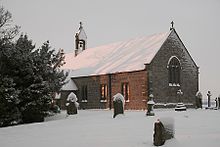
I first discovered Heavenfield when my mother insisted we stop beside a sign. There was a lonely church in the middle of a field. Churches are generally easy access so this in itself was strange. Reading the sign, I learnt about one of the more significant battles on English soil – literally the battle which decided if England would be Christian or if it would continue to be pagan.
St Oswald's Church Heavenfield

Conventional wisdom seems to hold that St Augustine came over to Kent and started Canterbury and everyone became Christian. It wasn't that simple. Christianity had been a part of British religious life for centuries before then. In Vindolanda, there are the remains of a 4th century church. Constantine was proclaimed emperor of Rome in York on 25 July 312. Constantine was famously the emperor who made Rome Christian. However in the years after the Roman legions left and the Angles  and Saxons settled, things changed and Christianity was not necessary the religion of choice of the ruling elite.

St Augustine’s mission became poised on a knife-edge because he was, according to British Christians arrogant. He expected obedience. The British church differed from the Roman church in the way they figured Easter, the way the monks wore their tonsure, the unique way of penance and how many bishops it took to consecrate another bishop. The last was surprising as  Britain sent three bishops to the council of Arles and signed up to that.  There were other differences but apparently the way monks wore their hair was a huge sticking point.
Another view of Heavenfield

In 632,the Northumbrian Bretwalda,  King Edwin who was nominally Christian in the Roman tradition (his wife had Kentish connections) lost a battle and his life to Penda of Mercia. Pagans then overran Northumbria.

In 634, the son of the previous Bretwalda Athelfirth and nephew to Edwin, Oswald made his bid for the Northumbrian throne. Oswald had converted to Christianity when he was exiled amongst the Dalriata in south western Scotland. He followed the Celtic tradition of Christianity.  He landed in the west and his war band which included warrior monks made their way to just outside the Roman town of Corbridge. There, in a field, Oswald raised his standard and a cross. This field became known as Heavenfield. He defeated the pagan Penda and drove his followers from the lands. Northumbria was restored to its previous prosperity.
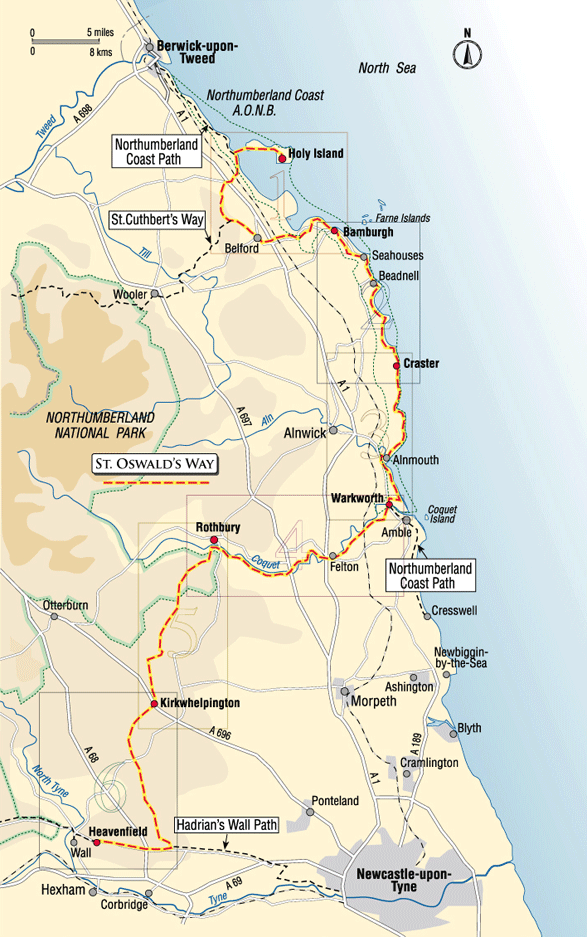
St Oswald's Way

Unlike his late uncle who merely paid lip service to Christianity, Oswald decided his new kingdom would be Christian. He sent for monks from Iona. They started a monastery at Melrose and rapidly expanded to Lindisfarne (or Holy Island).  Oswald became the Bretwalda or High King of all Britain. Tolkien is supposed to have based Aragon on him.  After Oswald fell in battle, his brother Oswui became Bretwalda and was the only 7th century British king to die in his own bed after 40 years of rule. It was Oswui who convened the Synod of Whitby which decided to follow the Roman rather than the Celtic traditions of worship.

These days, Heavenfield is part of the St Oswald’s Way – a long distance walk which takes in some of the most beautiful parts of Northumberland and stretches from Chollerford (near to Heavenfield) up to Lindisfarne (Holy Island). It takes about a week to walk it.

Michelle Styles writes warm, witty and intimate historical romance for Harlequin Historical. This month Harlequin historical are releasing 3 of her Victorian novels To Marry a Matchmaker, Compromising Miss Milton and Breaking the Governess’s Rules. You can learn more about Michelle and her books on www.michellestyles.co.uk