Showing posts with label To Touch the Knight. Show all posts

28 August 2011

Guest Blog: Lindsay Townsend

This week, we're welcoming historical romance author and regular contributor, Lindsay Townsend, as she celebrates the release of her latest novel, TO TOUCH THE KNIGHT, from Kensington Zebra. Lindsay is giving away a copy! Here's the blurb:

As a pestilence sweeps medieval England, a low-born woman has only the sharpness of her wits—and the courage of her heart…Edith of Warren Hemlet plays a dangerous game. At the knights’ tourneys across the land, among the lords and ladies, she is a strange foreign princess. But in the privacy of her tent with the other survivors of her village, she is but a smith’s widow with a silver tongue. They are well-fed, but if discovered, the punishment is death. And one knight—fierce, arrogant, and perilously appealing—is becoming far too attentive…

Sir Ranulf of Fredenwyke cares little for tourneys: playing for ladies’ favors, when his own lady is dead; feasting, while commoners starve; “friendly” combat, when he has seen real war. Still, one lady captivates him—mysterious in her veils and silks, intoxicating with her exotic scents and bold glances. Yet something in her eyes reminds him of home…and draws him irresistibly to learn her secrets…


***An Interview with Lindsay Townsend***

Your historicals are set in the ancient world and the Middle Ages. If you could go back in time, where would you go?


I would love to have been alive in the ancient Egyptian city of Alexandria during the 1st or 2nd centuries. To browse in that amazing library! Or, like my Flavia in Flavia's Secret, I would have seized the chance to bathe in the Roman baths of Aquae Sulis and see the whole healing and religious site. Sarmatia, my heroine in Bronze Lightning, fulfills my own wish when she sees Stonehenge and Avebury as they were in the Bronze Age. She also helps a metalsmith to create the wonderful treasures of the Bush Barrow Hoard, something I would like to attempt, if only in a more modest way.


During the Middle Ages, I wish I could have seen the great Arabian cities and seats of learning and culture, or hear the scholars debate at the University of Bologna. It would have been fascinating to be a courtier at the Duc de Berry's court or a Knight of the Garter at the court of Edward III. More likely I would have been a peasant woman, working I hope in a part of England where the dues to my lord were light.  I would happily settle to be a craftswoman, perhaps working in a free town, or a lady whose fortune would not tempt greedy barons to invade my lands.This more modest world is one I enjoy exploring in my 'knight' books, including To Touch The Knight.


What do you most enjoy about writing historical romance?


I really enjoy writing tender, getting-to-know-you scenes in my books, including the historical romances. I relish the differences in culture and beliefs that are part of historical romance and enjoy using the morals and customs of a particular time to add tension and throw obstacles in the way of my heroes and heroines. Events shape my historical characters and they in turn share happenings and adventures. Sometimes I use situations from the direct historical record, such as the tense coronation of William I in A Knight's Captive, or the customs of the world of the tourney in A Knight's Enchantment and To Touch The Knight.


What, apart from reading, influences your work?


Nature - I love the British countryside. I have a semi-wild garden filled with primroses, cowslips, bluebells, St John's Wort, old roses, marigolds, cherries, apples and plums. I go walking in woodland to relax and to be inspired. I watch the birds and animals and think about the animals that use to thrive in our woods, such as the wild boar.  (In parts of the south of England, by the way, wild boar are coming back.)


Music also influences my work. I listen to certain pieces and for some reason pictures and scenes play in my head. It must be simply how my mind works.


Television and radio can also be wonderful windows on the world, sharing all kinds of information that I can adapt and feed into my own stories.


What are you working on at the moment?


I'm trying to promote my recently published To Touch the Knight. I've also just finished the proof-reading on one novel and returned the edits to another story. At present I'm working on scanning my previously published romantic suspense Voices in the Dark, for re-issue on Smashwords.


What do you have coming out next?


I have a romantic suspense, Palace of the Fountains, appearing this month. This is a modern story set in Spain, but it has its roots in the past.


Thank you for having me at Unusual Historicals today!

Lindsay Townsend
http://www.lindsaytownsend.net/
http://www.twitter.com/lindsayromantic

Thank you, Lindsay! Remember, leave a comment to win a free copy of TO TOUCH THE KNIGHT!

25 August 2011

Excerpt Thursday: Lindsay Townsend

This week on Excerpt Thursday, we're welcoming historical romance author and regular contributor, Lindsay Townsend, as she celebrates the release of her latest novel, TO TOUCH THE KNIGHT, from Kensington Zebra. Join us on Sunday, when Lindsay will be here to talk about the novel and give away a copy! Here's the blurb:


As a pestilence sweeps medieval England, a low-born woman has only the sharpness of her wits—and the courage of her heart…

Edith of Warren Hemlet plays a dangerous game. At the knights’ tourneys across the land, among the lords and ladies, she is a strange foreign princess. But in the privacy of her tent with the other survivors of her village, she is but a smith’s widow with a silver tongue. They are well-fed, but if discovered, the punishment is death. And one knight—fierce, arrogant, and perilously appealing—is becoming far too attentive…

Sir Ranulf of Fredenwyke cares little for tourneys: playing for ladies’ favors, when his own lady is dead; feasting, while commoners starve; “friendly” combat, when he has seen real war. Still, one lady captivates him—mysterious in her veils and silks, intoxicating with her exotic scents and bold glances. Yet something in her eyes reminds him of home…and draws him irresistibly to learn her secrets…

***An Excerpt from To Touch the Knight***


In this excerpt, Edith the heroine and Ranulf the hero are intrigued by each other can cannot resist tormenting and 'testing' each other. The novel takes place just after the first outbreak of the Black Death, against the glittering backdrop of the world of the tournament.

The following day, the theme of the tournament had changed. Damsels were to wear white and the knights black. Sir Tancred had hurried to her tent before dawn, noisy as a blackbird with the news.

"It is to be a procession of Day and Night, the ladies the day..."

And one has his black armor already, for night.

"...We are to ride in company to the wayside spring of a saint, Saint Loye or Saint Frideswide, I forget which, and the damsels will dip their favors in the sacred waters."

Edith quelled a churning rush of panic: she could not ride, not as a lady would. "May I ride with you, Sir Tancred?"

"Princess! It will be an honor!" His face shone in anticipation. "It will be splendid!"

Edith smiled and agreed that it was indeed splendid, while she uttered her genuine thanks and wondered if they would pass any villages. If they did, would the people there be hale and fed? Her eyes strayed through the open tent flap to the present combat field and that host of tall grass and growing wheat. It was surely wrong to allow that to rot, when there were men enough to harvest, at least the hay. The wheat would not be ready yet.

Concern for the crops? But you have left that life behind.

"Peace, my brother," Edith thought in answer in her head, but the waste irked her.

"Do the damsels set tasks for the knights today?" she asked Sir Tancred. This had been a feature of Lady Blanche's tournament so far and she was eager to give Ranulf of Fredenwyke a very particular task, one he would no doubt refuse. She still ached to see his expression when she proposed it.

"That is for tomorrow, after a morning game of hoodman blind."

"I see." Edith itched to say that in her village, a game where one person's hood was turned so that the 'face' of the hood was to the back of the head and the person, blind-folded, was urged to give chase, was considered fit for children. She recalled that as a princess of Cathay she should not know it. "What is hoodman blind, Sir Tancred?"

Her thoughts drifted as her companion eagerly explained. She would not be taking part in hoodman blind: if caught she would be too easily recognized, or worse, unveiled.

I do not miss a child's game, she told herself, wondering even so how it would be to be caught by the black knight himself. He would be gentle, skimming his long fingers lightly across her shoulders, and then her face. When he knew her - as he must at once when he felt the veil - would he wind an arm about her bare middle and scoop her closer to him? Would he thrust her away? Or would he kiss her?

Edith felt her breath stop and her fingers tremble. Such thoughts were idle folly and she was startled by her own soft-heartedness. It must be lust. You have been too long without a mate. Consider your own pale costume: you must be the most splendid and shocking of the damsels.


Ranulf spurred his black palfrey to ride alongside Sir Tancred and his pillion, smirking as the princess unpinned yet another scrap from her costume to hand across to another ever-gracious knight.

"Well met, Sir Dew, Lady Jade," he said, noting the shield of the latest who had received the saucy wench's favor: this time a blue heron on a gold background. So far he had counted five favors granted and five warriors he would fight: he meant to best them all and take nothing from them but those irritating bits of silk. Then we shall see if men are quite so eager to ask for them, eh?

"We are night and day today." Sir Tancred shook his own black cloak and jutted his beard. "You will fight in your own armor?"

"I do. My squire and my page await me at the tourney ground, when we return from the sacred spring." Ranulf watched the small, pale figure riding behind Sir Tancred as he said "page," but the hardened princess did not flinch. "Lady Day." He stood on his stirrups and bowed, hearing the larks in the fields close by and the heady buzz of the damsels' chatter.

"Lord Night."

She stared off into the distance, so far as he could tell. He guided his palfrey closer still, catching a whiff of her perfume.

Her costume, the lack of it, was astonishing. Her head and hair were covered and veiled but as for the rest of her...

He whistled softly, turning the sound quickly into a tune so she would not realize he was disconcerted and yes, frankly impressed.

Truly she was as opulent, as translucent, as fragrant as a lily. Today he and others could see her long, shapely legs, glimpsed through a series of light-as-air skirts that seemed both white and colorless. He had been ready for her naked waist and belly but the tiny, tight-fitting sleeveless jerkin clung to her breasts like moon-light. He found himself imagining if her nipples were pink or dark and cursed himself for being so easily ensnared.

Her feet, brushing Sir Tancred's meaty calves, were narrow, high-arched, and bare.

He decided it was safe and indeed very pleasing to stare at her dainty little feet. "You do not feel the cold, Lady Day? I have heard the land of Cathay is far warmer than England; some would say as hot as hell."

Sir Tancred snorted and his horse danced beneath the pair as he must have tightened his grip on the bridle, but "Lady Day" sighed like a moth moving round a candle and finally fixed her bright eyes on him.

“I never feel the cold, Lord Night. What do you call those blue flowers in the road?”

“Speedwell, my lady,” several young squires replied, all at once, but Ranulf smiled at her obvious ploy. He decided to test her some more.

"I was at a joust once where the ladies gave so much of their sleeves and veils, chemises and mantles, to their jousting knights that they were all but naked by the end of the tournament."

"Strange, Lord Night. I was told that such a fable was from the romance of Perceforest." She smiled, or at least above the white veil pinned across the lower half of her face her eyes crinkled.

"I have heard the romance, too, but this time I saw it," Ranulf went on, determined to have his point. "But you, I note, are already in that state. What will you do, if a knight at the lists asks you for a favor?"

"Are you asking me, Lord Night?"

He admired her courage in tilting straight at the heart of the matter. For that reason he chose not to shame her. "Indeed I am, my lady."

Her dark brows drew close in a frown: clearly she had not expected that answer.

"Nay, I see you puzzled, but do not trouble so, princess. I will find a way. I do not think you can lose any more cloth." He grinned and spurred on, cantering to greet Lady Blanche and Giles, who were already kneeling at the spring.

Lindsay Townsend

Follow Lindsay on Twitter


26 July 2011

Photo Essays: A medieval summer

By Lindsay Townsend


My latest historical romance, To Touch The Knight, takes place in summer, a tense summer just after the outbreak of plague in 1348, when people are trying to return to normal.

In more usual years, summer for people in the Middle Ages was both very busy and a time of relaxation and pleasure. After the hard graft of winter and spring, May was a holiday month in early summer, with few tasks in the agricultural calendar. May Day, a blend of Christian and older pagan traditions, was celebrated by everyone, with dancing, revels and drink.

May was the time when people would go wandering in the fields and woodlands, to enjoy the fresh greenery and woodland flowers. It was also blossom time, when the fruit trees and hedgerows burst into bloom, wild cherries and wild apples following each other in glorious profusion.

Later summer was a harder task-master: if a peasant worked on the land, later summer was when the sheep were sheared, then the hay and wheat harvests were gathered in. Summer, too, was often the prime time for military activity, when knights might be called to fight for their overlord or king on campaign. However, even in these months there was merry-making.

Midsummer was marked by bonfires, a pagan ‘left-over’ from the earlier festival of Beltane and celebrated in the Middle Ages as the saint’s day of St John. Young couples would sometimes leap over the midsummer bonfire for luck. Wells could also be dressed with flowers around this time – a relic of earlier water-spirit worship, and still carried on today.

July was marked by St Swithin’s day, when the strewings in the churches would be changed from the winter rushes and straw to the summer hay and sedges, and August saw the feast time of Lammas – loaf mass – to give thanks for the hard-won harvest.

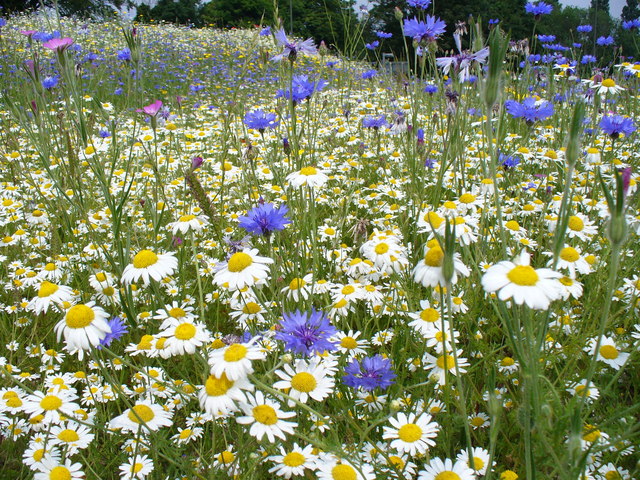
[Photo of oxeye daisies and cornflowers by Colin Smith, photo of well-dressing by Bob Embleton, both of geograph.org.uk. The fifteenth-century stained glass harvesting scene is from the Victoria and Albert Museum. All three sourced from Wikimedia Commons.]

Lindsay Townsend writes historical romance set in medieval England and the ancient Mediterranean. Lindsay's latest book, To Touch the Knight, a story of jousting, deception and romance at the time of the Black Death, is published by Kensington Zebra in July.

18 February 2011

Weekly Announcements - 18 Feb 2011

Lindsay Townsend has received the cover and copy for her July release, TO TOUCH THE KNIGHT, another in her very popular medieval series from Kensington.

As a pestilence sweeps medieval England, a low-born woman has only the sharpness of her wits--and the courage of her heart...

Edith of Warren Hemlet plays a dangerous game. At the knights' tourneys across the land, among the lords and ladies, she is a strange foreign princess. But in the privacy of her tent with the other survivors of her village, she is but a smith's widow with a silver tongue. They are well-fed, but if discovered, the punishment is death. And one knight--fierce, arrogant, and perilously appealing--is becoming far too attentive...

Sir Ranulf of Fredenwyke cares little for tourneys: playing for ladies' favors, when his own lady is dead; feasting, while commoners starve; "friendly" combat, when he has seen real war. Still, one lady captivates him--mysterious in her veils and silks, intoxicating with her exotic scents and bold glances. Yet something in her eyes reminds him of home...and draws him irresistibly to learn her secrets...
***

Join us Sunday when Kristina McMorris will be here to celebrate the debut of LETTERS FROM HOME, set in WWII. She'll also be giving away two copies! Be sure to join us then.

***

We'll also draw the winner of E. D. Walker's romance featuring a Norman knight werewolf, THE BEAUTY'S BEAST. You still have time to leave a comment or question for your chance to win.

***

Stay with us through the coming weeks when we'll be featuring the best unusual historical authors! Denise Agnew Michelle Styles, Elizabeth Lane, Kris Tualla, will be coming up. Join us!

***

Remember, you don't have to be an Unusual Historicals contributor to submit good news to the weekend announcements. If it has to do with unusual historicals, we'd love to shout it out to the world! Send announcements to Carrie. See you next week...

16 February 2011

An Ordinary Day In: The Life of a Medieval Peasant Woman

By Lindsay Townsend

A medieval woman had to be many things, depending on her social position. A noble woman could be responsible for running and managing a castle, great house or estate and also be involved in actively pursuing her family's or husband's aims, including warfare. A woman in a town would need to oversee her house and also continue her own business, or that of her husband's if she was a widow. A peasant woman would need to be skilled in herb-lore and folk-medicines, also a cook, laundress, spinner, harvester, child-minder, store keeper, brewer (or brewster, the female of brewer) and more! So the day in the life of any medieval woman was likely to be busy.

I'm looking at the day in the life of Mary, a peasant woman who lived in the 1300s before the Black Death. Mary is a housewife who is married to Adam and they live with their three children on a small holding in medieval Oxfordshire.

Mary's day begins at first night whatever the season. In summer this might be as early as 4 am. In winter her simple wattle and daub timber-framed home would be shared with the family's few animals, for extra warmth and to protect the beasts from wolves and other predators. Today in July Mary rises early from her sacking and straw bed. She dresses in a plain dress of wool, usually russet in colour, and then helps the children to dress before providing them and Adam with a breakfast of ale and bread or cold pottage. While Adam and the two older children leave to help with cutting and turning their lord's hay harvest, Mary is busy at home. She will help with the harvest later but she has other tasks first, beginning with washing the clothes.

She and her youngest daughter take the woollen and linen clothes down to the small river to pummel with small paddles and rinse in the clear stream. They spread the wet things on bushes to dry and Mary then tends her few chickens and geese. She and her daughter work for a while in her kitchen garden, weeding and gathering herbs and vegetables. Both are glad of a drink of ale, bartered from the village ale-wife, when they take a break.

It is July, hay-making time, back-breaking and tedious. July is also the hungry month, when wheat and other grain stores are low. Mary is always hungry in July and when she has time she grinds up the bits of wheat and old peas and beans on her small saddle query to make a kind of flour she can turn into bread and bake on her hearth under an upturned pot. She grinds in secret, with her youngest daughter keeping watch by the cottage door, because the miller would complain to her lord that she is not getting her wheat ground by him and paying a fee for the 'privilege'.

Some days Mary makes rush lights, or collects berries and wild fruits from the surrounding countryside, or helps her husband Adam tend their own or their lord's field strips. Some days are a holy day--a holiday--when the family go to church to celebrate special saints' days and festivals. Today, although her back is hurting--many skeletons from medieval times show people plagued by rheumatism and stress injuries brought on by the sheer hard work--Mary goes to join Adam and her two older children, labouring to bring in the hay harvest. She takes with her a lunch of bread and cheese for her family--the cheese is a soft one, made by her from the milk of their cow, and needs to be eaten quickly. She also gathers a few wild strawberries.

Reaching the hay fields of their lord, Mary finds the other workers resting and taking a midday meal. The reeve has brought some ale for all the hay makers and more bread. Adam and her children eat quietly. Her youngest child asks what is for supper and Mary has to admit it will be cold pottage again--she has no time to prepare anything else. Later, Adam draws her aside and whispers he has bartered another day's hay-making with the reeve for a fat rabbit, taken from the lord's warren. With onions from their garden they will eat well tonight, God willing.

With a lighter heart Mary works in the hay field for the rest of the day, gathering and turning the long grass and flowers the men have cut with scythes. The summer evening and dusk is long in coming but then she, Adam and the children wander off to their cottage with the prospect of supper and bed.

I show the impact of the Black Death on the lives of peasants like Mary in my forthcoming novel, TO TOUCH THE KNIGHT. For details of this and my other medieval historical romances, please visit my website.

Lindsay Townsend writes historical romance set in medieval England and the ancient Mediterranean. Her latest is A KNIGHT'S ENCHANTMENT, available now. She lives in Yorkshire with her husband.