Showing posts with label 13th century. Show all posts

20 July 2016

Beyond Our Stars: The Thirteenth-Century Astronomy Patronized by Alfonso X

Gemini. Spain, thirteenth century. 

It’s something of a tradition to begin or end biographies of Alfonso X, el Sabio, with one historian’s sanctimonious judgment of him: “While he contemplated the heavens and gazed at the stars, he fell on the earth.” I quote it here not to perpetuate misconceptions, but because the wording shows the importance of the astronomy carried out in Alfonso X’s court. In spite of the other fields of inquiry enhanced under the wise king’s patronage, it was the astronomy that fascinated the most people first and longest.

Alfonso’s interest in the movement of the heavens was based, as most of his passions, in pragmatism. In Alfonso’s time, astrology hadn’t been separated from astronomy as a scientific discipline and was even farther from being as discredited as it is today, as many fourteenth- and fifteenth-century medical treatises (some of which refer to Alfonsine works) attest. The king likely believed knowledge of the stars could be an important tool in gaining the upper hand on Earth because of their obvious, albeit mysterious, influence on human character and behavior.

That said, many of the Alfonsine astronomy books are based on what is still considered solid science.

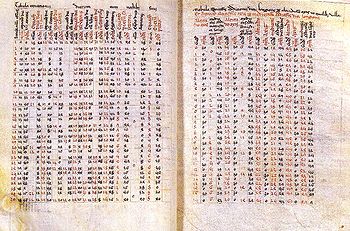
Alfonsine Tables. Spain, thirteenth century. 
The Alfonsine Tables are a set of measurements from about 1272 composed by Isaac ben Sid and Judah ben Moses ha-Cohen that track the positions of the sun, moon, and planets relative to Earth using Ptolemaic calculations. One of the astronomers who worked on the Alfonsine Tables took a copy with him in 1280 to Paris, where scholars adjusted the readings for the Paris meridian, enabling astronomers all over northern Europe to make use of the information for three hundred years. Copies survive today that were used by Copernicus and Galileo. The practical applications of the Tables are what made them popular. They well represented Alfonso X’s yearning for useful knowledge in the wider world.

The Alphonsus moon crater. Wikimedia Commons. 
Composed in the late 1270s, the most extensive book, the Book of Knowledge of Astronomy, also had the largest team behind it. The authors and translators named within the book include Jewish physicians, Muslim lawmen, and Italian and Castilian churchmen. The Book of the Eighth Sphere, which makes up the first part, describes the constellations with their celestial coordinates. The second part describes how to make and use nine different kinds of astronomical instruments, such as the astrolabe and the quadrant. Again, even in this most extensive and encyclopedic work, useful is paramount.

The Book of the Fixed Stars was translated from an Arabic book by Abd al-Rahman al Sufi composed around the year 964. In this book, the Alfonsine collaborators created a powerful combination of Ptolemy’s astronomy, Arabic traditions, and Castilian curiosity. The Andromeda Galaxy and the Large Magellanic Cloud, among other landmark bodies, were introduced to the European scientific community in this translation.

Ursa Major from a 1490 English copy of the Alfonsine Tables
The astronomy works are exemplars of the admirable Alfonsine traits of practicality and encyclopedism. The collaborators translated and compiled information from the best and most reliable sources. The majority draws from documents found in Arabic, with some information coming into Castilian from far-flung languages such as Chaldean. Without the bridge formed by these works, European astronomy might have had to start from scratch.

It’s much harder to see into the heavens if you’re not standing on the shoulders of giants.


Jessica Knauss earned her PhD in medieval Spanish with a dissertation on the portrayal of Alfonso X’s laws in the Cantigas de Santa Maria, which has been published as the five-star-rated Law and Order in Medieval Spain. Look for her book of stories based on the Cantigas, coming 2021. A driven fiction writer, Jessica Knauss has edited many fine historical novels and is a bilingual freelance editor. Her historical epic, Seven Noble Knights, is available from Encircle Publications in ebook, paperback, and hardcover. Her contemporary paranormal Awash in Talent is now available from Kindle Press. Find out more about her writing and bookish activities here. Follow her on Facebook and Twitter, too!


20 April 2016

The Intellectuals: Alfonso X’s Contribution to World Science and Culture


Juan Diego portrays
Alfonso X on the
series Toledo
He has a portrait hanging in the US House of Representatives in the Great Lawgivers series. A moon crater bears his name. His name is on the largest unified collection of annotated medieval music. Why do so many fields of inquiry praise the intellectual efforts of Alfonso X, el Sabio? What mark did he leave on the world to make us think he was so learned?

The short answer: his books.

In the General Estoria, we read: “The King makes a book, not because he writes it with his hands, but because he outlines the facts in it, and edits it and makes it right, and shows the way in which it is to be made… Just as we say that the King makes a palace, we don’t say it because he constructs it with his hands, but because he ordered it to be made…” The Book of the Sphere discusses at length the way King Alfonso worked as general editor. He came up with the idea for the book and what it should contain, and then went through it to take out extraneous parts and correct infelicities.

Alfonso X oversaw these projects to give himself access to the best knowledge in order to learn how rule his country more wisely, and a great additional benefit was that the books were created in Castilian and in Latin. They could then be consumed by Alfonso’s Castilian-reading subjects and Europeans farther afield. A wise populace is the beginning of a wise kingdom, and wise foreign friends make for smooth dealings and further the cause of that wise kingdom.

The collaborators made use of the finest sources available. They accurately cite Aristotle, the early Christian saints including Augustine, and eleventh-century philosophers such as Pedro Alfonso and Aelred of Rievaulx, to give the most basic examples. The scope of the intellectual activity has led to many scholarly volumes. Here’s a list of highlights.

The Alphonsus Crater on the Moon. Wikimedia Commons
Astronomy
• Alfonsine Tables
• Picatrix
Book of Knowledge of Astronomy
Book of the Forms and Images
Book of the Fixed Stars
Book of the Sphere, etc.

Other Science
Lapidario—A book of erudition about types of stones.

Alfonso X in the US House of Representatives
Law
• The Fuero Real—A pragmatic town charter that was granted to new towns in order to begin regularizing the rule of law throughout Alfonso’s kingdoms.
• Espéculo—Elegant and comprehensive legal theory with practical applications as an afterthought.
• Siete Partidas—A great book of medieval thought that also served as the basis of Spanish law for centuries.
• Specialized books of law—The Book of Gambling Houses, the Book of Frontier Commanders, various ordinances, etc.

History/Wisdom
• Book of Calila and Digna—This charming book is the first work of Castilian prose narrative. Based on ancient Indian texts via Arabic sources, two jackals (or lynxes) tell each other fables to illustrate complex and sometimes conflicting points of wisdom.
• Setenario—Often classed with the legal works, this book obsessed with the number seven is an unfinished compendium of the most secret kinds of knowledge and how to apply them.
• History of Spain—Tells the story of the Iberian Peninsula from the end of the Roman Empire to the beginning of the thirteenth century.
• General History—An astoundingly wide-reaching world history from Biblical times.

Music/Religion
• The Cantigas de Santa Maria—The largest collection of written medieval music in the world. More than 400 praise and miracle songs in Galician Portuguese for the Blessed Virgin with fun melodies and gorgeous illustrations. I attempted to describe how wonderful this collection is in this post. I investigate one exciting cantiga in this post.

Alfonso's sculpture at the National Library in
Madrid emphasizes intellect with books and a scroll.
Pastimes because leisure is important for refreshing the intellect.
• Various cantigas de escarnio e mal dizer—Profane, sometimes grotesque, mostly humorous, and at least one moving account of the weariness of a king in failing health (“Non me posso pagar tanto”).
• Libro de ajedrez, dados e tablas—A comprehensive illustrated compendium of chess strategy for the troubled intellectual. Ways to play dice, backgammon, and other games of chance are not as highly regarded.

Much of this body of work had far-reaching impacts in medieval Europe and modern world. The astronomy inspired and informed Copernicus, and the law works influence decisions even today in the American Southwest.

In order to begin my studies of Alfonso X, I had to vastly broaden my fields of expertise in addition to the strictly literary training I’d had up to that time. Perhaps Alfonso X’s greatest wisdom lay in the voracity with which he pursued all intellectual subjects. It seems there was nothing the Wise King wouldn’t want to investigate and read about further.


Simon R. Doubledays’ biography (The Wise King, New York: Basic Books, 2015) seamlessly weaves the trials and tribulations of Alfonso X’s life and times into the writing of the body of work he left behind. He makes a good case that Alfonso X based his intellectuality on the model of polymath Muslim princes. Indeed, the translators and compilers frequently relied on rescued ancient documents in Arabic. Doubleday’s book is an excellent overview of a fascinating king—I learned a few things I didn’t know before. 


My tribute to Alfonso's contribution to world culture, Our Lady's Troubadour, lets you experience the Cantigas de Santa Maria in a fun new way! 

Jessica Knauss earned her PhD in Medieval Spanish with a dissertation on the portrayal of Alfonso X’s laws in the Cantigas de Santa Maria, which has been published as the five-star-rated Law and Order in Medieval Spain. A driven fiction writer, Jessica Knauss has edited many fine historical novels and is a bilingual freelance editor. Her historical novel, Seven Noble Knights, is available from Encircle Publications in ebook, paperback, and hardcover. Find out more her writing and bookish activities here or here. Follow her on Facebook and Twitter, too!

11 March 2015

A Miracle Close to Home: Chincoya, 1264

The restored castle at Almodóvar del Río looks the way Chincoya might have in 1264.
Photo by Jessica Knauss 2009 
Spain’s thirteenth-century Cantigas de Santa Maria are a treasure of medieval culture. Many of their stories recount events that had just happened in familiar places. This is especially the case for the songs that take place in Andalucía.

Cantiga 185 begins, “I heard a miracle that took place a while ago, over in Chincoya.” This may be the first time the event was written about. Such immediacy gives the song a partiality and emotional weightiness the miracles about far-off lands lack. Any thirteenth-century Spanish listener would have understood the implications inherent in the reference to Chincoya, in modern Jaén, at the border of what was at the time the Muslim kingdom of Granada.

Both Chincoya and its corresponding castle on the Muslim side, Belmez, would have been responsible for maintaining security in a sensitive border region. The story focuses on the castles’ two alcaides, castellans appointed personally by their respective kings for upkeep, defense, and general administration. The Christian alcaide of Chincoya has been identified in real life as a man named Sancho Martínez de Jódar.

Sancho’s fictional double has a character flaw in spite of his best intentions: “the alcaide there protected it well, but he lacked the good sense to protect it completely” (lines 11-12). The concept of good sense recurs in the Cantigas time and again as the most important virtue. Sancho’s sin would seem innocent enough: “He had a great friendship with a Moor who was the alcaide of Belmez” (15-16a). Making friends with other castellans in the region could even be a good strategy, but this alcaide’s location across the enemy border makes it a bad idea.

From Cantiga 187 (185) of the Códice rico 
The alcaide of Belmez conspires with the King of Granada, Ibn al-Ahmar, founder of the Nasrid dynasty, and a vassal of Castile since the time of Fernando III in 1246. The Moor explains to his king that he can deliver Chincoya Castle to Granada by using the alcaide’s trust to lure him out and capture him. Sancho, unsuspecting, goes out to meet his friend, bringing two squires with him. The stage has now been set to show the gap between proper conduct and the irresponsible behavior of the alcaide of Chincoya.

The squires say they are afraid of the alcaide of Belmez and offer reasonable arguments against going to meet him: Unarmed and not dressed for self-defense, Sancho has failed to take even the minimal precautions. Because we have seen the alcaide of Belmez plotting to betray Sancho’s friendship, we are obliged to believe the squires in this instance. When the squires turn back to their castle, they not only do what is right, but also show themselves to be more sensible than their alcaide, who displays his stubborn intentions by proceeding to contravene a law in which anyone who has charge of a castle specifically on the border may not leave it without the king’s mandate. In line 51, Sancho crosses a river, which is presumably the border into Granada.

The alcaide of Belmez wastes no more time duping his supposed friend, and captures the Christian alcaide. Under threat of beheading, Sancho informs his captors that only fifteen Christians defend his castle, and that they have nothing to eat. Sancho then returns to Chincoya to ask the Christians to hand it over to the Muslims. This is the last time we hear anything about the alcaide of Chincoya. Because the second stanza indicates that he almost lost the castle, and the laws only indicate punishments for such behavior when the castle is lost to the enemy, we may guess that he assumes guardianship again after this incident. However, ignoring the man who is supposed to be in charge of the castle, especially during its victorious moments, is a serious criticism of his actions, not unlike the kind of insults so frequent in the cantigas de escarnno y de maldizer. His conduct throughout the cantiga is in direct opposition to the fearlessness recommended in the law books of the time.

A more appropriate response comes from those inside the castle. In spite of what would appear to be the hopelessness of their situation, they heroically refuse to give up on their duty to keep King Alfonso’s castle safe from invasion. They comply with the heroism legally suggested for the people who might find themselves inside a besieged castle.

When the alcaide is threatened by the King of Granada, he folds immediately and betrays Chincoya. Similarly defenseless against the King of Granada, the men inside the castle show what separates them from their incompetent leader by thinking of the Virgin Mary as protector rather than giving in to fear. They place a statue of Our Lady, which in the miniatures appears as a majestic enthroned Virgin and Child, on the outside walls and bargain with her, remind her that she, too, is under threat, and reiterate their devotion (“somos teus,” line 76).

Instantly, they see results. The host turns back, and the three Moors who get through are thrown over the castle walls, merely to make the King of Granada see that he should retreat because he knows that those protected by St. Mary cannot be defeated.

Defending Chincoya in the Códice rico 
Such a swift turn of events in such hopeless circumstances, directly after the people inside the castle enlist Mary’s help, clearly indicates the intervention of the Blessed Virgin in their favor. If the castellan of Chincoya had asked for her help, he might well have received it, but he lacked the good sense. Throughout the song, the unthinking alcaide, who trusts an enemy and abandons the castle to its fate, contrasts sharply with those of good sense, who stay to defend their king’s castle and who place their faith in St. Mary, the only being who is truly worthy of it.

Although it would be impossible to legislate faithfulness in the hearts of his soldiers, King Alfonso praises it as a common trait of the people of his kingdom and offers it as the best example of his soldiers’ potential. All of the laws concerning his citizens’ duties toward their king’s fortifications amount to suggestions for achieving this state of ultimate loyalty. A dependable armed force is the only one of real use to a king. The alcaide of Chincoya in 185 is an anti-example.

Chincoya Castle today. Photo from applicajaen.com 
The ending functions as a moral to the story, poising itself purposefully as the concept anyone listening should take away: It is right to praise Mary; she takes care of her own (and it is only too clear who they are in Cantiga 185); and her enemies will always be defeated. These are useful lessons for anyone, and perhaps especially for military men who find themselves in similar situations.

It is spectacular that only fifteen men without provisions successfully defend themselves against an army, but not completely incredible, because well-staffed castles turned back armies on a regular basis. By never straying far from everyday, almost prosaic, events that really occurred, such miracles invite the devotion of even the most skeptical. Here, the audience is absorbed in the story because its location is readily identifiable by the listeners and features situations someone they know will probably encounter in their lives. It is easy to look up to the defenders of Chincoya, close in space and time to the potential audience, and to identify their behavior as an ideal model.

Listen to a great recording of Cantiga 185. 
Learn more about the Cantigas de Santa Maria
I’ve written about the legal implications of the alcaide’s actions in Law and Order in Medieval SpainI’m also working on a short story based on the incident in Cantiga 185—stay tuned for more Cantigas stories!

J. K. Knauss earned her PhD in Medieval Spanish with a dissertation on the portrayal of Alfonso X’s laws in the Cantigas de Santa Maria, which has been published as the five-star-rated Law and Order in Medieval Spain. A driven fiction writer, Jessica Knauss has edited many fine historical novels and is currently a bilingual copyeditor. Find out more about her historical novel, Seven Noble Knights, and her other writing and bookish activities here. Follow her on Facebook and Twitter, too!


Selected Resources
Alfonso X, el Sabio. Cantigas de Santa María. 3 vols. Walter Mettmann, ed. Madrid: Clásicos Castalia, 1986-1989.
—. Cantigas de Santa María: Edición facsímil del códice T.I.1 de la Biblioteca de San Lorenzo el Real de El Escorial, siglo XIII. Madrid: Edilán, 1979.
—. Las Siete Partidas del Rey don Alfonso el Sabio cotejadas con varios códices antiguos por la Real Academia de la Historia y glosadas por el lic. Gregorio López. Nueva edición. 3 volumes. París: Librería de Rosa y Bouret, 1861.
Montoya Martínez, Jesús. Historia y anécdotas de Andalucía en las Cantigas de Santa María de Alfonso X. Granada: Universidad de Granada, 1988.
O’Callaghan, Joseph F. Alfonso X and the Cantigas de Santa Maria: A Poetic Biography. Leiden: Brill, 1998.

Paredes Núñez, Juan. La guerra de Granada en las Cantigas de Alfonso X el Sabio. Granada: Universidad de Granada, 1991.

03 September 2014

Wonders and Marvels: The Cantigas de Santa Maria

By Jessica Knauss


King Alfonso directs his subjects to worship Jesus through the Virgin Mary
and the angel Gabriel in the F manuscript of the Cantigas de Santa Maria
A poor woman takes her baby with her to the wheat fields — she has no alternative. While his mother works, the boy swallows a head of wheat and his belly swells to alarming proportions. His mother, believing he’s been poisoned or bitten by a spider, frets over him for several days. When she despairs for his life, there’s only one person — or supernatural being — she can turn to. She lays him before the altar of Our Lady of Atocha. The boy’s clothes are removed, and no one can find a spider bite, but they do find an intact head of wheat coming out the boy’s side. The boy recovers immediately. Everyone gives praise to the Virgin Mary for such a beautiful miracle.


The Cantigas de Santa Maria tell of the wonders of the Virgin Mary in a way that still makes people marvel.

Alfonso X of Castile and León is called el Sabio because he loved learning. He made it possible for a team of scholars to record the latest scientific advances for future generations. He carried this compulsion for compilation through to the Cantigas, which are a collection of nearly 400 songs with words, music, and illustrations.

Many of the miracles involve a dramatic recovery, as in Cantiga 315 above, or theatrical leaps of faith, as in the story about the good wife whose husband was so jealous of her that he mistreated her terribly. She asks him if he would believe she’s faithful to him if she underwent a trial by fire. He responds that he doesn’t think that’s necessary, but she can jump off a cliff! If she comes out alive, that will be proof of her fidelity. The woman comes to the edge of the highest, scariest cliff for miles around.


She commends herself to the Virgin Mary and throws herself over. With the entire town as witness, she lands feet first on ground that seems soft and smooth to her, although for non-believers, it would have been rocky — and deadly.

In the style of a rosary, the Cantigas punctuate the miracle stories with songs in praise of the Virgin Mary’s own wondrous nature at every tenth cantiga.


Even these most spiritual of the Cantigas display a down-to-earth quality. One of Alfonso’s main objectives with these songs was to show how wonder could reach absolutely everyone in his realm through Mary, from the poor lady in the wheat field, through nobles, sheriffs, monks, nuns, and warriors, to the king himself. Because they so accurately portray real life, the Cantigas don’t limit Alfonso’s realm to people, but also include the animals that cohabited with his subjects, such as horses, cattle, sheep, dogs, ermines, and silk worms!

A woman who makes her living with silk has trouble: her silk worms are dying. She goes to the Virgin Mary’s altar and promises that if Mary revives her silk worms, she will make an altar cloth to honor the Queen of Heaven. Soon enough, the silk worms are hard at work again, but the woman forgets her promise — until, one day, she comes home to find that the worms have taken her promise upon themselves. They make not one, but two altar cloths, and in the illustrations we see the added miracle that they already have a beautiful lacy design. The fame of the miracle spreads, and since there are two of them, King Alfonso takes one for his own altar to the Virgin Mary.


Most of the lower-numbered cantigas take stories from all over Europe’s Marian repertoire, but as the king’s demand for more and more miracles increased (the goal may have been 500), the poets searched closer to home and in more recent history. As Cantiga 18 shows, some feature Alfonso himself, and 22 take place during the reconstruction of El Puerto de Santa María in the south, one of the king’s pet projects.

Cantiga 371 tells how a large ship headed for El Puerto was laden with flour and people. Some of them were coming for the land grants, some to work as masons, some to form part of the new religious community. El Puerto’s fame was already widespread, as the refrain reports: “Holy Mary performs so many miracles in her Port that we poets can’t describe the least part of them.”


Unfortunately, the ship in this cantiga hits a rock and sinks, killing everyone on board except one woman. She cries out to the Virgin, “I’m coming to you, so save my life with your great power.” In that instant, one of the sacks of flour emerges from the ship, and even though it’s heavy, it floats as if it were very light. The woman floats along atop it, calling, “Holy Mary, Mother of God, Emmanuel,” until she arrives at El Puerto to be welcomed by the residents.

Not all the miracles are so outwardly spectacular. In one of my favorites, the miracle consists of a violent, lustful knight deciding to change his ways.


As you can see in the illustrations, he’s already got an angel on one shoulder and a devil on the other. The Virgin Mary appears to him with a beautiful silver platter filled with rotten food — a metaphor for the knight’s outward loveliness and evil interior. He gets the message loud and clear. Even though the knight’s life is never threatened in this cantiga, his soul is in danger of eternal damnation, which, to medieval thinking, is the most dramatic story of all.

It’s said that the Cantigas were the king’s favorite project, as they incurred the most labor, expense, and time. The compilation may have begun before Alfonso ascended to the throne in 1252 and ended only upon his death in 1284. In his will, Alfonso instructed that the Cantigas manuscripts should be kept in the chapel where he was buried (in the cathedral in Sevilla) and sung on high feast days. None of the four extant manuscripts reside there now: an early draft without illustrations known as To is in the Biblioteca Nacional in Madrid; King Felipe II had three deluxe manuscripts (including E and T) removed to the Escorial in the sixteenth century; and somehow one of those deluxe manuscripts (F) came to be at the Italian National Library in Florence today.

The Cantigas de Santa Maria deal with people’s interior lives as well as the most unexpected details of their exterior lives, and include everyone from every social class, from Spain to Europe to Northern Africa and the Middle East. Some of these songs are masterpieces of lyricism, others are solid narratives from a time before short stories existed, and still others take humor to new heights. Each of the thousands of illustrations offers delights to appreciate from any point of view. They constitute the largest collection of medieval music ever amassed and contain every imaginable Western musical style.

In their time, the Cantigas celebrated marvels and wonders, and today they have become a marvel in themselves because of the sense of wonder they convey in greater measure as time goes on


You can now experience ten of the Cantigas de Santa Maria in a fun new way in J. K. Knauss's Our Lady's Troubadour

Jessica Knauss earned her PhD in Medieval Spanish with a dissertation on the portrayal of Alfonso X’s laws in the Cantigas de Santa Maria, which has been published as the five-star-rated Law and Order in Medieval Spain. A driven fiction writer, Jessica Knauss has edited many fine historical novels and is currently a bilingual copyeditor at an educational publisher. Find out more about her historical novel, Seven Noble Knights, and her other writing and bookish activities here. Follow her on Facebook and Twitter, too!


30 March 2014

Author Interview & Book Giveaway: Rebecca Hazell on THE GRIP OF GOD

This week, we're pleased to welcome author Rebecca Hazell with her latest novel, THE GRIP OF GOD. The author will offer a free copy of The Grip of God to a lucky blog visitor.  Be sure to leave your email address in the comments of today's author interview for a chance to win. Winner(s) are contacted privately by email. Here's the blurb.


Rebecca Hazell's The Grip of God, the first novel in an epic historical trilogy, is available on amazon.com  and its affiliates and by special order through your local bookstore. The subsequent two novels in the trilogy are scheduled for publication later this year. The saga’s heroine, Sofia, is a young princess of Kievan Rus. Clear eyed and intelligent, she recounts her capture in battle and life of slavery to a young army captain in the Mongol hordes that are flooding Europe. Not only is her life shattered, it is haunted by a prophecy that catalyzes bitter rivalries in her new master's powerful family. She must learn to survive in a world of total war, always seeking the love she once took for granted.

Sofia's story is based on actual historical events that determine her destiny. Readers will delight in this very personal and engaging tale from a time that set the stage for many of the conflicts of today's world.

Praise for the trilogy

“How deftly and compellingly Hazell takes the reader with her into that mysterious and exotic world, and makes it all seem so very close to hand!” – Peter Conradi, Fellow of Britain's Royal Society of Literature and author of Iris Murdoch: A Life, and of A Very English Hero.

"I enjoyed watching her morph from a spoiled sheltered princess with slaves of her own, into a tough, savvy survivor, with a new awareness of social injustice. The book is action packed. I couldn't put it down." -- from a review on Amazon.com.

"I got completely caught up in the characters and story and always looked forward to getting back to them. What a fully fleshed and fascinating world you developed and it was wondrous to learn so much about that time and the Mongol culture. Your gifts come out in your lush descriptions of place and objects. All very vivid and colorful." --author Dede Crane Gaston


**Author Interview with Rebecca Hazell**

Welcome to Unusual Historicals. You certainly have an unusual setting for your novel. What gave you the idea for this series?

Thanks for hosting me. I was literally gripped by the plot for this trilogy when I was about twenty years old, and I still have the first, very crude pages that I wrote way back then. I thought I was going to write only one novel, The Grip of God, but it naturally became three.

My interest in this era actually started when I was assigned to learn Russian instead of German in high school. I got hooked on Slavic culture and majored in Russian history at university. Somehow Kievan, or Kyivan Rus’ interested me more than any other period. It was such a dramatic time, so much happened and spilled over into today’s events, but I didn’t know that yet. I had a rather simplistic idea about the whole thing that got shattered when I did the almost 17 years of research that went into the three novels.

What kept you going when it took so much research? 

It was fascinating! It had never occurred to me that so much was happening simultaneously in Europe, Asia and the Middle East: the Mongol invasions, the final years of the Assassins, the final Crusades, the occupation of Constantinople, and the French Inquisition. And St. Thomas Aquinas and Jalaluddin Rumi were writing great works while Marco Polo’s uncle and dad were traveling to China. What an era!

That was partly why it took so much research because historians generally specialize, and I had to consult many sources for each element of the story. It took me three years of research to find out a single thing about occupied Constantinople. That was a bit discouraging, but I persevered and found out enough to write about it.

How did your main/secondary characters come by their personalities? 

There were several characters that I plotted into the novel from the very beginning, like the Persian merchant, Selim, who has a secret that I won’t give away here, but whose help forms the context for the second novel. Others appeared spontaneously along the way, like Sofia’s young Hungarian servant Anna. In fact, I had to really control Anna and her doings because they threatened to swamp my heroine. On the other hand, Anna’s experiences growing up allow the reader to learn a lot about differences in rank and therefore learning, as well as lots of the superstitions and prejudices of the day.

Other characters like Lady Q’ing-ling popped up out of nowhere to tell side stories, or to help Sofia grow up. I feel that there have always been people of good heart who keep the world afloat like that while the big names start wars and sign treaties; and my secondary characters, with their personalities are like that. They are both unique and also represent their cultural heritages, so the story becomes a sort of rich stew typical of that time.

How hard was it to make the switch from writing for youngsters to writing for adults? 

I was lucky in that as my own children grew older, I started writing for older children. And Sofia was still a child by today’s standards, though twelve was considered adult by medieval standards. Then as she matured, I could show her inner journey quite easily.

What can we look forward to in the other two novels?

Sofia continues her outer and inner journey, crossing paths with many of the important people of her generation. She encounters Persian culture, Crusader culture, and the Inquisition, each challenging her to adapt to outer circumstances, some of them quite dangerous, while not becoming callous or selfish. Though she is tempted! Also tempted by love, as she meets a special someone who is as much trouble in his way as Anna is in hers! There’s lots of adventure and real history interwoven in her story. I cried at the end, and not only out of relief. I think my readers will feel the same.


About the author

Rebecca Hazell is an award winning artist, author and educator. She has written, illustrated and published four non-fiction children’s books, created best selling educational filmstrips, designed educational craft kits for children and even created award winning needlepoint canvases.

She is a senior teacher in the Shambhala Buddhist lineage, and she holds an honours BA from the University of California at Santa Cruz in Russian and Chinese history.

Rebecca lived for many years in the San Francisco Bay Area. In 1988 she and her family moved to Halifax, Nova Scotia, and in 2006 she and her husband moved to Vancouver Island. They live near their two adult children in the beautiful Cowichan Valley.

Visit Rebecca:

27 March 2014

Excerpt Thursday: THE GRIP OF GOD by Rebecca Hazell

This week, we're pleased to welcome author Rebecca Hazell with her latest novel, THE GRIP OF GOD. Join us again on Sunday for an author interview, with more details about the story behind the story. The author will offer a free copy of The Grip of God to a lucky blog visitor.  Be sure to leave your email address in the comments of today's post or Sunday's author interview for a chance to win. Winner(s) are contacted privately by email. Here's the blurb.


Rebecca Hazell's The Grip of God, the first novel in an epic historical trilogy, is available on amazon.com  and its affiliates and by special order through your local bookstore. The subsequent two novels in the trilogy are scheduled for publication later this year. The saga’s heroine, Sofia, is a young princess of Kievan Rus. Clear eyed and intelligent, she recounts her capture in battle and life of slavery to a young army captain in the Mongol hordes that are flooding Europe. Not only is her life shattered, it is haunted by a prophecy that catalyzes bitter rivalries in her new master's powerful family. She must learn to survive in a world of total war, always seeking the love she once took for granted.

Sofia's story is based on actual historical events that determine her destiny. Readers will delight in this very personal and engaging tale from a time that set the stage for many of the conflicts of today's world.

Praise for the trilogy

“How deftly and compellingly Hazell takes the reader with her into that mysterious and exotic world, and makes it all seem so very close to hand!” – Peter Conradi, Fellow of Britain's Royal Society of Literature and author of Iris Murdoch: A Life, and of A Very English Hero.

"I enjoyed watching her morph from a spoiled sheltered princess with slaves of her own, into a tough, savvy survivor, with a new awareness of social injustice. The book is action packed. I couldn't put it down." -- from a review on Amazon.com.

"I got completely caught up in the characters and story and always looked forward to getting back to them. What a fully fleshed and fascinating world you developed and it was wondrous to learn so much about that time and the Mongol culture. Your gifts come out in your lush descriptions of place and objects. All very vivid and colorful." --author Dede Crane Gaston

*An Excerpt from The Grip of God**

December? Anno Domini 1239

            An evil dream: weird whistling demons were chasing me. I woke into darkness. It took several moments to realize that the whistling was real. A harsh medley of thuds, cries, groans, shouts, clashing metal, and screams of fear and pain brought me fully awake. Our horses, tethered on the far side of the clearing, were whinnying and jostling each other. The dead stranger’s terrible smell was back.
            “Kateryna?” I called softly. There was no answer. I crawled out of my furs to waken her. She was gone. Thinking to crawl to my tent flap, I threw my cloak over my shoulders and shakily drew my eating knife from its sheath, but another unearthly shriek threw me flat as something tore through the tent. When I dared to look up, small holes on either wall gleamed like little gray stars. I inched forward to lift the bottom of the flap a little, but at first all I could see was a boot sole. I lifted the flap a little higher.
            A corpse lay on its back, open eyes glittering in the moonlight, knees bent and boots before my face, its beard obscuring its features. A stick jutted out of its throat—no, an arrow. I dropped the tent flap back down, gulped air, stared at those holes. Where was Oleg? He shouldn’t leave me alone—Good God, this must be a bandit attack and he must be with his warriors fighting it off! But then Kateryna should not be out there. More shouts, screams cut short. Why didn’t Alexander come for me? Should I go or stay?
            It suddenly grew quiet. Oleg’s warriors must be chasing the attackers from our camp. Nonetheless, I hesitated for an eternity, afraid to pass that corpse in case its angry ghost fastened on me. I began to feel both foolish and cowardly. By now Alexander should have come to make sure I was safe—
            Dear God, had something happened to him? I awkwardly pulled on my boots, fastened my cloak, and slowly drew aside the tent flap.
            At first the light from the half-moon transformed the meadow into glowing silver and deep black shapes, lending an eerie beauty to the camp. But then I truly saw. It was as if a tempest had struck: bodies scattered everywhere with arrows thrusting up from most of them, tents askew, goods spilled. Strange men with torches were moving among the fallen, bending over each in turn. A terrible stench struck my nose, a mixture of that dead man’s bad smell, loosed bowels, sweat, and blood. I looked down at the corpse.
            It was Oleg.
            Just beyond him lay Kateryna, her arms flung out, a knife in her hand, blood still oozing from a slash across her breast onto the pelt that lay under her like a funeral bed.
            “No!” I cried. The world went black.
            An iron hand gripped my arm, twisted me around, and pulled me upright. My head cleared, and a stranger stood before me, so like yesterday’s dead man that for a moment I thought it was his ghost. But this man was very much alive. His slanting eyes glinted down at me, his high cheekbones seemed carved of stone. A pointed, plumed helmet covered his head, animal tails dangling absurdly from its sides; metal-plated leather armor covered his clothing. Worst, though, was that foul odor of stale sweat, dirt, and of blood, old and fresh. Not even a peasant stank like that. He grinned at me.
            I swung my little knife, but the man-beast knocked it out of my hand with a humorless laugh. Others like him came up, and they all began barking in some hideous dog speech. One of them squatted by Oleg and Kateryna, slit their throats, cut an ear off each as if carving meat for supper, and stowed his bloody relics in a bulging bag.
            I’d have fainted again, but the man-beast wrenched me upright into painful clarity as he lifted his sword, smirking. With cunning born of terror, I twisted from his grip and fled. He shouted; within moments a pack of those dogs was so close behind me that I could almost feel their breath on my neck. Rabbit-like, I bounded one way and another, jumping over corpses and dodging felled tents, slipping right past one man, to his dismay and the hoots of his companions, but they rapidly encircled and then closed in on me until I had nowhere to go. I was panting with fear and frustration, and they were laughing!
            The circle parted. The warrior who had first found me stepped into it, followed by another with a torch. He glared at me as he marched up, wicked sword in hand, reached out and gripped my arm so hard it nearly broke off, shook me like a rag, forced me onto my knees, yanked my hair up, and raised his sword once again. I closed my eyes, waiting for the sword to strike.
            The blow never came.
  
About the author

Rebecca Hazell is an award winning artist, author and educator. She has written, illustrated and published four non-fiction children’s books, created best selling educational filmstrips, designed educational craft kits for children and even created award winning needlepoint canvases.

She is a senior teacher in the Shambhala Buddhist lineage, and she holds an honours BA from the University of California at Santa Cruz in Russian and Chinese history.

Rebecca lived for many years in the San Francisco Bay Area. In 1988 she and her family moved to Halifax, Nova Scotia, and in 2006 she and her husband moved to Vancouver Island. They live near their two adult children in the beautiful Cowichan Valley.

Visit Rebecca: