Showing posts with label France. Show all posts

31 March 2017

Herstory: Brittany and the Vendée – Secrets and Horrors of the French Revolution

By Laura Rahme


Drownings of Nantes in 1793, Joseph Aubert (1882)


“We must exterminate all men who have taken arms against the Republic 
and strike down their fathers, their wives, their sisters and their children. 
The Vendée must become a national cemetery.” 
      – General Turreau

The French Revolution is generally accepted as covering the period 1789 to 1799, ending with Napoleon’s coup d’état and the dissolution of the Directory. Prior to the formation of the Directory government, France was ruled by the National Convention, headed by Robespierre. This period, aptly known as the Terror, lasted from September 1793 to July 1794. 

For Western France, in the region of the Vendée, the Terror was accompanied by bloody and religious civil war, including a period of mass killings that some French historians have recently come to denounce as a genocide, and which led to the decimation of a third of the inhabitants in the Vendée. 

In the Western town of Nantes, the representative of the National Convention, Jean-Baptiste Carrier, was responsible for atrocities and massacres that defy imagination. 

In my latest novel, Julien’s Terror (July 2017), I was interested in portraying a female perspective for this turbulent period.


Origins of the Conflict


It is a misconception that aside from aristocrats and nobles, all French people were in favor of the beheading of their king and queen. 

The inhabitants of Brittany and of the newly named region of Vendée (comprising parts of Brittany, Poitou and Anjou regions) were never in favor of the guillotining of their king, Louis XVI, on 21 January 1793. They were staunch royalists and deeply Catholic. The execution of King Louis was not well received. 

To compound the people’s outrage, the new Republic had not only nationalized church property, but it also outlawed all priests who refused to forsake their oath on the Holy Bible.  According to these new laws, priests now had to swear upon the Constitution. Those who resisted were labelled ‘refractory’ and banished from preaching. There were persecutions involving both priests and nuns. In worst cases, such priests were hunted to death or murdered en masse, as happened in Nantes in December 1793, when hundreds of refractory priests were tied up, locked into a barge and drowned in the Loire River. 

Already unsettled, the Vendée peasants rose in arms against the Republic when in February 1793, the National Convention made a call for the conscription of 300000 unmarried men, from the age of 18 to 40 years. 

The people of the Vendée had already witnessed great injustices toward their beloved priests, whom they hid, but this new conscription law was the tipping point because it would have left thousands of peasants unable to fend for their families. Meanwhile they would be forced to enlist in support of a Republic they had come to see as tyrannical.

Determine to oppose the Republic, these men, often illiterate and attached to their land, elected nobles and landlords—local men whom they held in high esteem—to lead and train them in battle. The Great Vendéan Army was born. 

Initially this Great Army won many victories against the soldiers of the Republic but later from December 1793, its luck began to turn: from January to July 1794, Paris sent a giant army to sweep across the Vendée. Its orders were clear—annihilation with no quarters. 


The Infernal Columns


Children, women, the aged, even the sick and farm livestock were not spared from massacres. The Republican army practiced scorched-earth and sought to obey decrees from Paris aimed at starving or exterminating the population. 

The army possessed twenty columns, led by several Republican generals, some like those commanded by General Grignon, were crueller than others. These columns became known as the ‘infernal columns’ for the very hell they spawned. 


The living defend their dead. War of the Vendée. 
Georges Clairin, 19th century


The words pronounced by General François Joseph Westermann are powerful illustrations of the atrocities that followed: 

“There is no more Vendée. I have trampled the children to death with our horses, I have massacred the women, and they are no longer able to give birth to any brigands. I am not guilty of taking a single prisoner, I have exterminated them all… The roads are covered with corpses. There are so many of them at several places they form pyramids. The firing squads work incessantly… Brigands arrive who pretend that they will surrender as prisoners… but we are not taking any. One would be forced to feed them with the bread of liberty, but compassion is not a revolutionary virtue.” 


Her story


In Julien’s Terror, my desire was to convey what might have been the experience of a young girl in these violent times. The journey begins when she is a spoilt child, daughter a well-to-do merchant, living on the prestigious Île Feydeau in the middle of Nantes, and it ends just after the Terror, when she is a spirited but destitute orphan. What she sees and lives in-between, and the aftermath of her horrendous psychological journey provide both drama and mystery, but more importantly, it casts a light on the hardships faced by many French women in this period.

My female character is barely nine when she loses her parents to Carrier’s butchery. She is reunited with relatives in war-torn Vendée, staying with them first in Montaigu, La Guyonnière and then later in Les Epesses—all communes that were swept by the infernal columns.


The Underground and the Hidden Places of the Vendée


Less well-known about the conflict in Western France is how much the peasants’ knowledge of their natural surroundings supplied them with advantages for surviving the Republican army. Like the Viet Cong of Vietnam, the people of Brittany and Vendée crawled in secret undergrounds. They also waged a guerrilla war long before the word ‘guerilla’ officially surfaced, when Napoleonic French troops encountered fierce resistance in Spain.

As François Pagès describes in Secret History of the French revolution—the soldiers of the Catholic royalist army ceaselessly disappeared and then re-appeared to fight. The underground, the woods, the stones and the marshes in the West would conceal and then suddenly release hordes of former valets, brigands, priests, ex-nobles, and peasants. They were everywhere and yet they remained unseen. 

In his last novel, Quatre-Vingt Treize, Victor Hugo wrote of his father’s experience in the war against Breton royalists. He too mentions the forests that sheltered thousands of peasants in Brittany: 

“The peasant had two points on which he leaned: the field which nourished him, the wood which concealed him.”

“There were wells, round and narrow, masked by coverings of stones and branches, the interior at first vertical, then horizontal, spreading out underground like funnels, and ending in dark chambers. [ ] The caves of Egypt held dead men, the caves of Brittany were filled with the living.”


“The subsoil of every forest was a sort of mad repose, pierced and traversed in all directions by a secret highway of minds, cells, and galleries. Each one of these blind cells could shelter five or six men.”


In Les Epesses, my female character follows her great-uncle, a giant Breton man who walks everywhere with his large wooden staff, and seems to know all the secrets of the underground. He hides his family in an underground cavern where they remain for months. 

As the infernal columns advance in the Vendée countryside, my character witnesses horrors beyond her years. Later she will hide in the secret Gralas forest, south of Nantes, and meet one of the most courageous men to lead the Vendée rebellion – General François Athanase de Charette de la Contrie (Charette). In Gralas, she will also discover the strong, independent women who fought to death alongside Charette, and one of these women will change her life forever.


"Liberty, Equality, Fraternity or Death" 
- the original motto of the French Republic


Further Reading:

1. Histoire secrète de la Révolution française depuis la convocation des notables jusqu' a la 
prise de l'ile de Malthe..., François Pagès, 1798.
2. Quatrevingt-treize, Victor Hugo, 1874.
3. Souterrains de Vendée, Laurent et Jérôme Triolet, Editions Ouest-France, 2013.
4. Colonnes Infernales - Wikipedia 
5. A French Genocide: The Vendée, Reynald Secher, University of Notre Dame Press, 2003.


______________________________________


Laura Rahme is an Australian-French writer based in Sydney. She was born in Dakar, Senegal where she spent her early childhood. Her first novel, THE MING STORYTELLERS (2012), is a historical saga set in China's Early Ming Dynasty. THE MASCHERARI (2014), is a historical mystery with supernatural themes set in late medieval Venice. Her third novel, JULIEN'S TERROR (July 2017) is set during and after the French Revolution and pays homage to her Breton roots.

14 June 2015

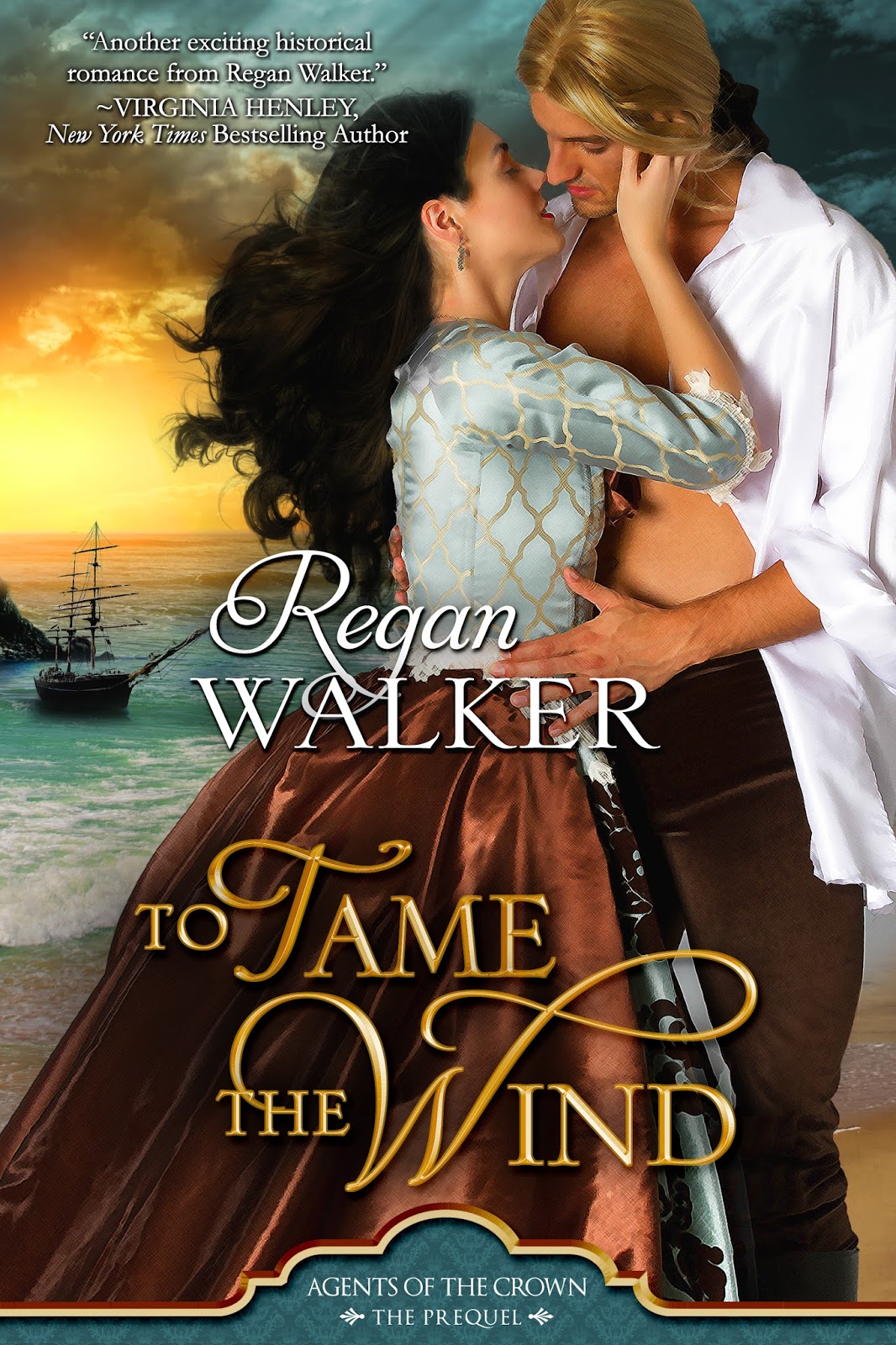
Author Interview & Book Giveaway: Regan Walker on TO TAME THE WIND

This week, we're pleased to again welcome author REGAN WALKER with her latest release, TO TAME THE WIND, part of the Agents of the Crown trilogy. One lucky visitor will get a free copy of the prequel in the Agents of the Crown trilogyBe sure to leave your email address in the comments of today's author interview for a chance to win. Winner(s) are contacted privately by email. Here's the blurb.

Paris 1782…AN INNOCENT IS TAKEN

All Claire Donet knew was the world inside the convent walls in Saint-Denis. She had no idea her beloved papa was a pirate. But when he seized Simon Powell's schooner, the English privateer decided to take the one thing his enemy held most dear... her.

A BATTLE IS JOINED

The waters between France and England roil with the clashes of Claire's father and her captor as the last year of the American Revolution rages on the sea, spies lurk in Paris and Claire’s passion for the English captain rises.

Praise for To Tame the Wind

“A sea adventure like no other, a riveting romance!”
–Shirlee Busbee, NY Times Bestselling Author

**Q&A with Regan Walker**
What is the historical setting for To Tame the Wind that makes this historical romance unusual?

It’s set in 1782, the last year of the American Revolution and Ben Franklin, as well as other real historic figures, are characters, but it does not take place in America. It’s set in London, Paris and the waters of the English Channel. It’s a seafaring story with privateers, a love story with a handsome English sea captain and a convent-raised French girl, and it’s a spy adventure with a real spy of the period.

How does this story fit into your Agents of the Crown series?

This is the prequel…the hero and heroine are the parents of the heroes of books 2 and 3 of the Agents of the Crown trilogy—all Regency romances.

What are you working on now that To Tame the Wind is released?

Well, last year I released my first medieval, The Red Wolf’s Prize. Readers have been urging me to write more in the series, so I am mad at work writing book 2, Rogue Knight, that will feature William the Conqueror’s “harrying of the North” in 1069 in England. It will tell the story of Sir Geoffroi de Tournai, the right arm of the Red Wolf who sets off to York never realizing what he will find there. It will change him forever as will his love for Emma of York, a young widow.

Learn more about author Regan Walker at www.reganwalkerauthor.com

11 June 2015

Excerpt Thursday: TO TAME THE WIND by Regan Walker

This week, we're pleased to again welcome author REGAN WALKER with her latest release, TO TAME THE WIND, part of the Agents of the Crown trilogy. Join us again on Sunday for an author interview, with more details about the story behind the story. One lucky visitor will get a free copy of the prequel in the Agents of the Crown trilogyBe sure to leave your email address in the comments of today's post or Sunday's author interview for a chance to win. Winner(s) are contacted privately by email. Here's the blurb.

Paris 1782…AN INNOCENT IS TAKEN

All Claire Donet knew was the world inside the convent walls in Saint-Denis. She had no idea her beloved papa was a pirate. But when he seized Simon Powell's schooner, the English privateer decided to take the one thing his enemy held most dear... her.

A BATTLE IS JOINED

The waters between France and England roil with the clashes of Claire's father and her captor as the last year of the American Revolution rages on the sea, spies lurk in Paris and Claire’s passion for the English captain rises.

Praise for To Tame the Wind

“A sea adventure like no other, a riveting romance!”
–Shirlee Busbee, NY Times Bestselling Author

** An Excerpt from To Tame the Wind**

Claire stirred as the rays of the sun warmed her face, but instead of the gentle sound of the songbirds that woke her each morning, she heard raucous shrieking. What was that noise? Was she late for Matins? The cacophony of sound suddenly reminded her of her childhood in Lorient before she’d gone to live at the convent.
Gulls.
Eyes still closed, she frowned. Non. It cannot be gulls. She inhaled, deeply, cautiously, smelling fish, and the unforgettable briny smell of the sea.
She opened her eyes, and the memory of the night returned. Mon Dieu! Had all that really happened? She looked around the carriage, realizing she’d been left alone.  Her captor had removed the blindfold and the cloth that had been stuffed in her mouth. Dieu merci! She swallowed and licked her dry lips, her dazed brain trying to make sense of her predicament. Where am I?
Realizing she was still wearing only her nightgown and wrapped in the blanket her captor had thrown over her the night before, a wave of shame rippled through her at the thought he and his men had seen her in such a state.
Not that she had been given any choice in the matter! Anger surged through her veins at the memory of her abduction. English pirates!
She drew the blanket more tightly around her and pushed herself into a sitting position. Through the open carriage window, she glimpsed the sun glinting off the ocean, so bright she winced. White, puffy clouds floated idly in the blue sky. A ship with sails furled was anchored just off shore. On the beach, men loaded crates into a small boat. It wasn’t Lorient but it might still be France. The nearby cliffs looking out on la Manche, what these men would call the English Channel, told her it was.
Had she been left without a guard? Might she escape? A shout for help would only gain the attention of her kidnappers, but perhaps she could work loose the bindings on her hands and ankles and sneak away before they were aware. She reached toward the cloth around her ankles.
The door of the carriage swung open, a gown was tossed into her lap and a broad shouldered man filled the opening.
Claire’s jaw went slack while her heart kicked into a gallop as if responding of its own accord to the first man to stir it from slumber.
Bonjour, Mademoiselle Donet,” he said in French. “Captain Simon Powell.” He bowed in grand gesture. “Your humble servant with something for you to wear.”
The golden one. It had been nearly two years since she had seen him, but she had never forgotten the night of the masquerade. She had never forgotten him. Though the linen shirt stretched tight across his broad chest and the leather breeches and boots he wore now were a far cry from the shimmering costume he’d worn then, his amber eyes were the same. Impossibly, he was even more handsome that in her faded memory. In the last two years, he had never been far from her thoughts, for the night she’d first seen him—and imagined a man’s pleasure—was the night Claire’s girlish dreams had ended forever.
And now he’d returned to France and abducted her.
He leaned into the carriage and untied her feet, then her wrists. The touch of his rough man’s hands on her skin sent odd chills rippling through her. She bit her lip, shamed by her body’s reaction to this stranger. Her living temptation turned away for a moment, then faced her, a cup in his outstretched hand. “’Tis only water,” he said when she was reluctant to take it.
Too grateful to complain, she hastily brought the fresh water to her dry lips and drank her fill.
“I’ll give you some time to dress,” he said not unkindly. His eyes shifted to her blanket-covered nightclothes. “I wouldn’t want my men to see you as you are.”
Claire felt her cheeks burn at the thought.
“The gown is modest enough to please even your nuns,” he said. “Call me if you need… ah, assistance. I will be just outside.”
She fumed at his insolence, at his actions that had placed her at his mercy. Though she knew he was English and a privateer, she had no idea why he had taken her, and she would wait no longer to learn the truth of it. “Why did you bring me here? Why did you take me from the convent?”
Leaning one arm against the frame of the carriage, he regarded her intently, his eyes like chips of amber.
“You have your father to thank for that, mademoiselle. As soon as he returns what is mine you will have your freedom.”
Claire blinked. “My father?” Her voice sounded to her like the pleading of a feeble schoolgirl. She would not be cowed! She lifted her chin, confident in his error. “What has he to do with this… this perfidy? Papa is a man of business and letters, a man of some wealth. He has no need to steal!”
His mouth twitched up in a grin, drawing Claire’s gaze to his sensual lips, reminding her of a night when she had seen him use those lips to good effect. She scowled, angry with the rogue and with herself for finding him so attractive.
He shut the door of the carriage and peered in through the open window. “Your father, mademoiselle, is a pirate.”

TO TAME THE WIND
Copyright © 2015 Regan Walker


Learn more about author Regan Walker at www.reganwalkerauthor.com

Buy link: http://www.amazon.com/Tame-Wind-Agents-Crown-Book-ebook/dp/B00VO4DZYE 

Blog:  http://reganromancereview.blogspot.com/

Twitter: @RegansReview

Facebook: http://www.facebook.com/regan.walker.104

Goodreads: http://www.goodreads.com/author/show/6450403.Regan_Walker

04 May 2014

Author Interview & Book Giveaway: Rachel L. Demeter on THE FROST OF SPRINGTIME

This week, we're pleased to welcome author RACHEL L. DEMETER with her latest novel,  THE FROST OF SPRINGTIME. The giveaway for this title - one $25 Amazon gift card - see the Rafflecopter details at the end of this post. Here's the blurb:

To rescue her was to rescue his own soul.

On a cold Parisian night, Vicomte Aleksender de Lefèvre forges an everlasting bond with a broken girl during her darkest hour, rescuing her from a life of abuse and misery. Tormented by his own demons, he finds his first bit of solace in sheltering little Sofia Rose.

But when Aleksender is drawn away by the Franco-Prussian war, the seasons pass. And in that long year, Sofia matures into a stunning young woman—a dancer with an understanding of devotion and redemption far surpassing her age.

Alongside his closest friend, Aleksender returns home to find that “home” is gone—replaced by revolution, bloodshed, betrayal—and a love always out of reach. Scarred inside and out, he’s thrust into a world of sensuality and violence—a world in which all his hours have now grown dark, and where only Sofia might bring an end to the winter in his heart.

Inspired by the 1871 Paris Commune, The Frost of Springtime is a poignant tale of revolution, redemption, and the healing power of love.


**Q&A with Rachel Demeter**

Can you tell me a little bit about yourself and how long you’ve been writing?

Thank you for having me on your blog! Simply put, writing is my life’s blood, my passion, and obsession. It has always been, and always will be. I’ve been writing before I physically learned to write. As a child, one of my favorite pastimes was imagining stories and characters while my mom would jot them down for me. Now, at the ripe age of twenty-six, my passion for creating living, breathing worlds is stronger than ever.
Aside from writing, my interests include researching history (especially 19th century France and the Middle Ages), reading, singing, cooking, health and fitness, playing the violin, videogames (I’m a bit of a nerd at heart), loyally following television shows, philosophy, and animals.

How would you describe your style?

Unconventional, dark, edgy, and character-driven. My writing is very descriptive with a definite Gothic flare.

What is The Frost of Springtime about?

The Frost of Springtime emerged from my love of French history and unconventional romances. I have always been drawn to the darker facets of love, and this served as a central inspiration for the characters. Severely scarred inside and out, Aleksender de Lefèvre’s twisted past and the horrors of the battlefield have hardened his heart–and Sofia’s love and compassion embodies the ideal counterpoint to his darkness. Like Aleksender, she suffers from a tragic and ill-fated past. I had yearned to create a pair of star-crossed lovers whose deep affection for each other could triumph over seemingly impossible odds. Aleksender and Sofia are two flawed characters who are made perfect through their love.  

In addition to the romance and sensuality, The Frost of Springtime offers a vivid perspective into the war-torn streets of revolutionary Paris. My book truly is a historical romance; the history of the era plays a significant role in both the story and characterizations. Laced with Gothic undertones, conflicted characters, and forbidden love, it’s a journey of intense emotional stakes and plenty of twists and turns.

What inspired you to write about the 1871 Paris Commune?

Nineteenth century France has always been a dear passion of mine. It was an era of conflict, political intrigue, and romance. While researching French history, the 1871 Paris Commune (infamously referred to as “The Bloody Week”) called out to my creative muse. Set during the aftermath of the Franco-Prussian war, I was positively fascinated by the moral ambiguity in regards to both parties involved (the Communards, who really did execute hostages), and of course, the army of Versailles (who executed thousands of citizens in hopes to retain peace). In addition, little details caught my eye—the underground Communard’s road inside of the eerie catacombs, the destruction of the Vendôme column, and the sheer brutality of the civil war.

I love unusual settings, and the 1871 Paris Commune rarely appears in storytelling. It is a vastly overlooked, yet historically devastating event. The revolution lasted only for 72 days—and, in that time, 100,000 men, women, and children were either murdered or exiled to the colonies. I believe that the Communards’ stand against the government truly encompasses the patriotic spirit of the French people. It represents an eternal love and loyalty to the city of Paris.

How historically accurate is The Frost of Springtime?

Very accurate. I not only strived to include a day-by-day account of the civil war and Paris’s devastated state, but incorporated actual participants as well. In the interest of the plot and characterizations, some details and events were altered—but nothing drastic. When developing my stories, I take great pride in authentically conveying an era with as much honesty as I can.

What projects are you currently working on?

I have several novels in the works, including an edgy historical romance set during the Napoleonic Wars, a historical romance/horror hybrid set within a Victorian asylum (I’m super excited about this one), a medieval historical romance, a few contemporary romances, and a horror. Do you reckon I’ll find time to sleep?   

Rachel L. Demeter lives in the beautiful hills of Anaheim, California with Teddy, her goofy lowland sheepdog, and high school sweetheart of ten years. She enjoys writing dark, edgy romances that challenge the reader’s emotions and examine the redeeming power of love.

Imagining stories and characters has been Rachel’s passion for longer than she can remember. Before learning how to read or write, she would dictate stories while her mom would jot them down for her. She has a special affinity for the tortured hero and unconventional romances. Whether sculpting the protagonist or antagonist, she always ensures that every character is given a soul.

Rachel strives to intricately blend elements of romance, suspense, and horror. Some common themes her stories never stray too far from: forbidden romance, soul mates, the power of love to redeem, mend all wounds, and triumph over darkness. Her dream is to move readers and leave an emotional impact through her words.

Learn more about Rachel L. Demeter:


Tour-wide giveaway for a $25 Amazon Gift Card. 
a Rafflecopter giveaway

01 May 2014

Excerpt Thursday: THE FROST OF SPRINGTIME by Rachel L. Demeter

This week, we're pleased to welcome author RACHEL L. DEMETER with her latest novel,  THE FROST OF SPRINGTIME. Join us again on Sunday for an author interview, with more details about the story behind the story. The giveaway for this title - one $25 Amazon gift card - see the Rafflecopter details at the end of this post. Here's the blurb:

To rescue her was to rescue his own soul.

On a cold Parisian night, Vicomte Aleksender de Lefèvre forges an everlasting bond with a broken girl during her darkest hour, rescuing her from a life of abuse and misery. Tormented by his own demons, he finds his first bit of solace in sheltering little Sofia Rose.

But when Aleksender is drawn away by the Franco-Prussian war, the seasons pass. And in that long year, Sofia matures into a stunning young woman—a dancer with an understanding of devotion and redemption far surpassing her age.

Alongside his closest friend, Aleksender returns home to find that “home” is gone—replaced by revolution, bloodshed, betrayal—and a love always out of reach. Scarred inside and out, he’s thrust into a world of sensuality and violence—a world in which all his hours have now grown dark, and where only Sofia might bring an end to the winter in his heart.

Inspired by the 1871 Paris Commune, The Frost of Springtime is a poignant tale of revolution, redemption, and the healing power of love.


**An Excerpt from The Frost of Springtime**

Sofia saw the memories buried within his eyes. Gunshots. Screams. Rolling cannons and the faded cries of despair. They lodged inside Aleksender, battling for his soul.

Sofia rose from the ground and tentatively crouched behind him. Remaining silent, her hands sunk below the material of his dress shirt and encouraged him with gentle caresses.

“Disease and death were everywhere. Men with boils and rashes the size of saucers. Anyway, we almost managed to escape. It was a good mile away that we were spotted. They were corrupt soldiers, nothing but hungry dogs with a taste for blood-lust. We were tied at the wrists and ankles, crammed inside a tent. Whether it was days or weeks, I cannot say.” Scoffing under his breath, he spat, “The fools demanded answers. They demanded our plans. Strategies. We refused each time. Even so none of us knew anything.”

“Oh, Alek. Why didn’t you tell them? To think you could have avoided so much pain.”

His shoulders lifted into a dry shrug. “I suppose we took a morbid delight in their frustration.” His voice was icy, harsh and void of all emotion. “And besides—it was the prospect of whipping information from our skin that kept us alive. But we were eventually returned to the camp. Bloodied, battered and burned—but alive.” Aleksender passed fingertips through his hairline. “Till this day, I have no idea what changed their minds …” Aleksender sighed and gave an afterthought, “Word had spread of their rather unorthodox methods, so to speak. According to rumor, they’d paid dearly.”

“I pray they burn in hell,” Sofia gasped. “Every last one of them!”

Aleksender laughed, amused by her goodhearted blasphemy. “Ah, Sofia, ma chérie. You do wonders for me.” And then a sudden thought came to his mind. “Christophe was there with me.”

“In the tents?” Sofia murmured, her heart reaching out to both heroes.

Aleksender merely nodded.

Although she’d never had the pleasure of meeting Monsieur Cleef, his name inspired a strange twinge of nostalgia inside her gut. Aleksender had often spoken of his dear friend—a rather admirable man of big ideas and too little restraint. From what she knew of the roguish skirt-chaser, she’d always admired him very much.

“Such wonderfully brave men,” she crooned, caressing one of many scars. “You have a soldier’s heart.”

Cloaked beneath the darkness, Sofia’s fingertips moved over his back in hypnotic motions, not leaving an inch of him unloved. “Do they pain you much?”

“No,” he hoarsely answered, “they are no bother.” His body trembled within her arms. “Not any longer.”

Between tentative kisses and muffled sniffles, she whispered, “To think of the pain you endured. The cruelty—your suffering.”

Aligning their two bodies, Aleksender cradled Sofia’s face between his palms and sweetly stroked her skin. Sofia’s toes curled against the barrier of her slippers. It was intoxicating. By far the sweetest moment in her nineteen years of life. With a last kiss, he whispered into her mouth, “Pain is in the mind. And, in my mind, ma chérie … I was with you.”

Rachel L. Demeter lives in the beautiful hills of Anaheim, California with Teddy, her goofy lowland sheepdog, and high school sweetheart of ten years. She enjoys writing dark, edgy romances that challenge the reader’s emotions and examine the redeeming power of love.

Imagining stories and characters has been Rachel’s passion for longer than she can remember. Before learning how to read or write, she would dictate stories while her mom would jot them down for her. She has a special affinity for the tortured hero and unconventional romances. Whether sculpting the protagonist or antagonist, she always ensures that every character is given a soul.

Rachel strives to intricately blend elements of romance, suspense, and horror. Some common themes her stories never stray too far from: forbidden romance, soul mates, the power of love to redeem, mend all wounds, and triumph over darkness. Her dream is to move readers and leave an emotional impact through her words.

Learn more about Rachel L. Demeter:


Tour-wide giveaway for a $25 Amazon Gift Card. 
a Rafflecopter giveaway

27 April 2014

Author Interview & Book Giveaway: Ginger Myrick on INSATIABLE: A MACABRE HISTORY OF FRANCE ~ L’AMOUR: MARIE ANTOINETTE

This week, we're pleased to welcome author and Unusual Historicals' contributor Ginger Myrick with her latest novel,  INSATIABLE: A MACABRE HISTORY OF FRANCE ~ L’AMOUR: MARIE ANTOINETTE. The novel is available NOW. The author will offer a free copy of Insatiable to a lucky blog visitor.  Be sure to leave your email address in the comments of today's post or Sunday's author interview for a chance to win. Winner(s) are contacted privately by email. Here's the blurb.

In 1770, fourteen-year-old Austrian archduchess, Maria Antonia, left her homeland to marry the most sought after prince in Europe. Upon stepping into France she became Dauphine Marie Antoinette and assumed a fairytale life would follow.

But being the Queen of France is not all masked balls, beautiful dresses, and extravagant living. There are horrifying and unnatural forces at work behind the scenes, a mysterious plague causing a sinister transformation in the residents of Paris. When Marie Antoinette learns the details, she is stunned to find out that France has kept the secret for over two hundred years, and now she will be burdened with one of her own.

Determined to be the obedient daughter of the iron-willed Holy Roman Empress, she agrees to fulfill her commitment to the French Crown, until she unexpectedly falls for the handsome Swedish count, Axel von Fersen. Torn between her husband and her true love, her duty and her desire, Marie Antoinette longs for the day when she can be free to choose her path and follow her heart.


**Q&A with Ginger Myrick**


What do you want people to know about this book?

Although for the most part Insatiable is historically accurate, it’s not straight historical fiction. I don’t want a potential reader to think this book is wholly one thing or the other. I don’t want them to be put off by the horror aspect, because that is only a part of it. Some of the scenes get graphic, but hey! It was a revolution! There is a sweet and touching family depiction and a passionate love story at the core. I also try to give a well-rounded look at the political picture if not a detailed account.

How is Insatiable different from any other work of historical fiction about Marie Antoinette?

This book is a work of alternate history and borderline horror. Although for the most part it is historically accurate in respect to the documentation and timeline, I attribute some of the causes of historical events to the mysterious plague and its victims. I also put a spin on the propaganda against Marie Antoinette, taking the line that some of the assertions were true, even thought there was never any solid proof to back them up

In the past, your books have featured fictional characters. What made you decide on Marie Antoinette?

In my work, the inspiration dictates all. The period was perfect for the premise. There was a lot of upheaval during that time, and the violence and chaos suited my needs. I was actually more drawn to Catherine de’ Medici, but more people are interested in Marie Antoinette. I figured I’d try to hook readers with the big draw—fancy clothes, salacious love story, and the birth of the guillotine—and they’d stay with me through the series.

What liberties did you take with the history?

I stick with the assumption of Louis XVI’s impotence, although I attribute it to a fictional cause. There were also stories by the libelles—basically the National Enquirer of the time—that Marie Antoinette and her brother-in-law, the Comte d”Artois, had an affair. This also plays a major part in the book. I adopt the assertion that she and Axel von Fersen were lovers, which although widely accepted has never been conclusively proven. I also make her enmity with Madame du Barry into something more than a simple clash between personalities.

Who was your favorite character to write?

I really loved Louis XVI. The more I learned about him, the more I liked him. Most historians agree that he was a decent, upstanding man who was dealt an impossible hand. He was handed a country in a dire financial state and just couldn’t figure out how to make it work. He was being pulled in so many different directions, and his biggest downfall was his indecisiveness. He got a raw deal. 

I also loved writing Louis-Joseph, the first Dauphin who died when he was seven. By all accounts he was a sweet little thing, and I can’t even read those scenes without crying. It was heartbreaking. He died at the outset of the revolution, and no one really cared. The revolutionaries didn’t even give Louis the chance to mourn him properly, because they were so intent upon their cause.

Any interesting Google searches this time around?

Definitely! I wanted the pathology of my plague to be realistic, so there are a lot of diseases in my history! This may be giving things away, but I researched anemia, rabies, Creutzfeldt–Jakob disease (human mad cow), Kuru, the guillotine, and the list goes on in the same macabre theme. I don’t think I’ll go to jail for this one, though. I couldn’t replicate the diseases to inflict them upon someone, and I won’t be building a guillotine in my backyard any time soon!

What’s next?

This book is part of a series. I originally thought to do only a trilogy but have since revised my opinion. I think I have enough interesting ideas to do at least four books without the premise becoming hackneyed. The next will be about Napoleon and the subsequent one about Catherine de’ Medici. I’m still debating the others. 

Ginger Myrick was born and raised in Southern California. She is a self-described wife, mother, animal lover, and avid reader. Along with the promotion for BUT FOR THE GRACE OF GOD, WORK OF ART, THE WELSH HEALER, and EL REY, she is currently putting the finishing touches on novel #5. She is a Christian who writes meticulously researched historical fiction with a ‘clean’ love story at the core. She hopes to persevere and show the reading community that a romance need not include graphic details to convey deep love and passion. Look for Insatiable: AMacabre History of France ~ L’Amour: Marie Antoinette live now at Amazon!