Showing posts with label mining. Show all posts

27 July 2011

Photo Essays: 19th Century Boom Town


By: Jacquie Rogers

Many of my western historical romances are set in the Silver City area of Idaho Territory, in Owyhee County (a large county in southwest Idaho with area about the same as New Jersey, but with one person per square mile).  This was a wild and wooly area of the West. 

The gold and silver strike sent prospectors, gamblers, painted ladies, merchants, Chinese miners and merchants, bankers, and newspapermen to Ruby City.  Problem is, the creek liked to flood there so the residents packed up the town, buildings and all and moved them to the Silver City site, where it still stands.

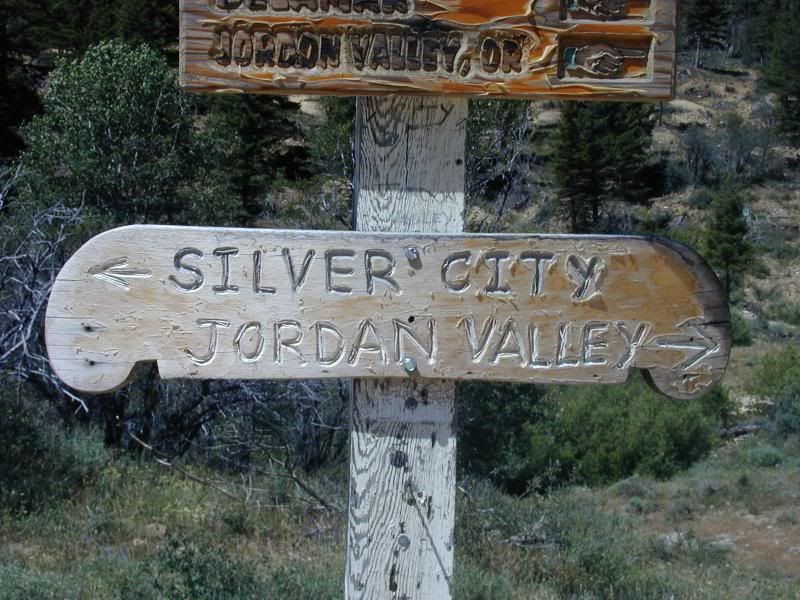
So let's take a tour.  On the right is the sign that tells you how to get there.  I'd advise not to miss the sign.  Oh, wait, there's only one road.  I'd advise you to stay on that road.  If you get lost, you have to pay Owhyee County to hunt for you.  They had to implement this because so many city people got themselves into fixes they couldn't get themselves out of.  It got costly, and the budget just didn't have room for people's errors in judgment.

These pictures are all taken by my daughter, Mercedes Christesen.  Special thanks to her husband, Rodney, for using his day off to chase after pictures for his mother-in-law.  Yes, you get points for that.

Drug Store
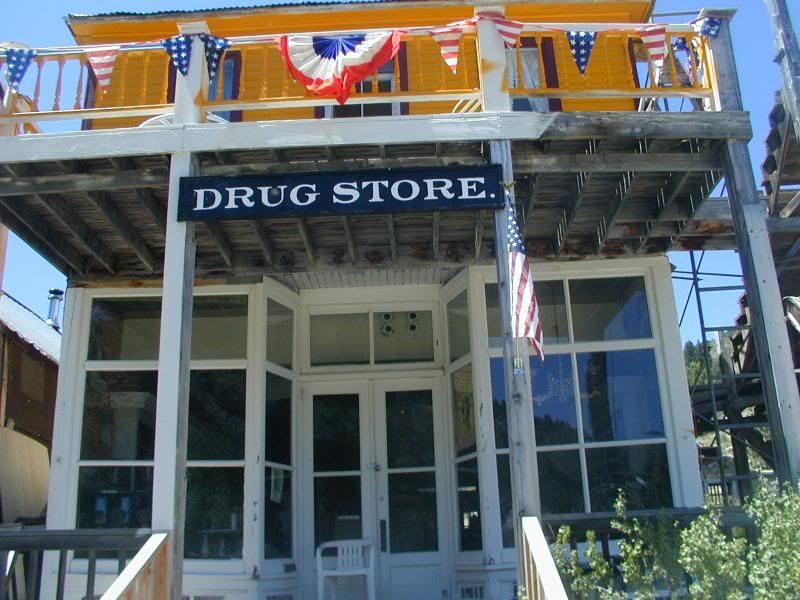
Here's the Drug Store.  She wasn't able to get any history on it, but it was either called the Knapp Drug Store or the Model Pharmacy.  Or maybe it was one and then the other.  I think it's just called the Drug Store now.  It's not open for business anymore.  It's a residence now, as so many formerly commercial buildings are. 

There's an open house the weekend after Labor Day every year.  I've been there--great fun!

Silver Slipper Saloon
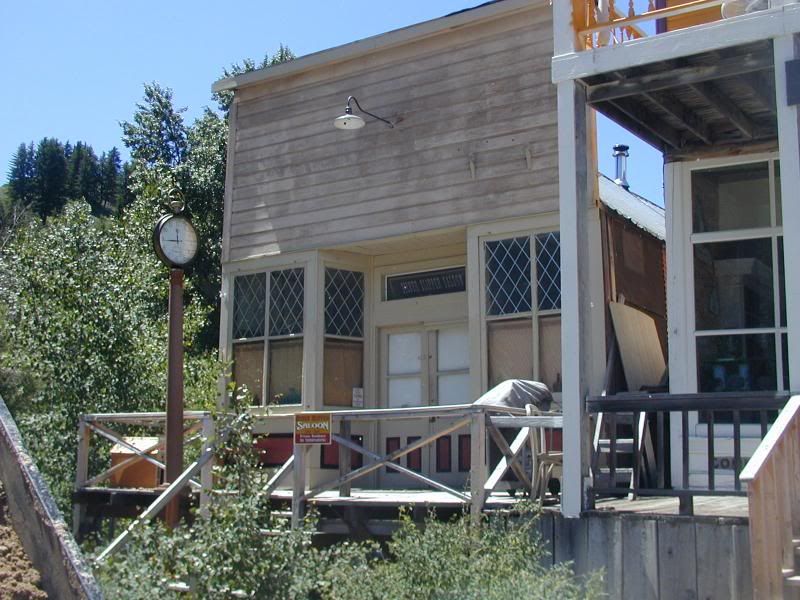
To the right is the Silver Slipper Saloon.  This is a 20th Century saloon, open from 1918 to the early 1940s but it still looks cool so I included it.  Silver City had many, many saloons and of course also had cribs and a street called Virgin Alley where ladies of ill-repute plied their trade.  On Ghosttowns.com, you can see an older photo of this saloon and the drug store above.

Silver City Trivia:
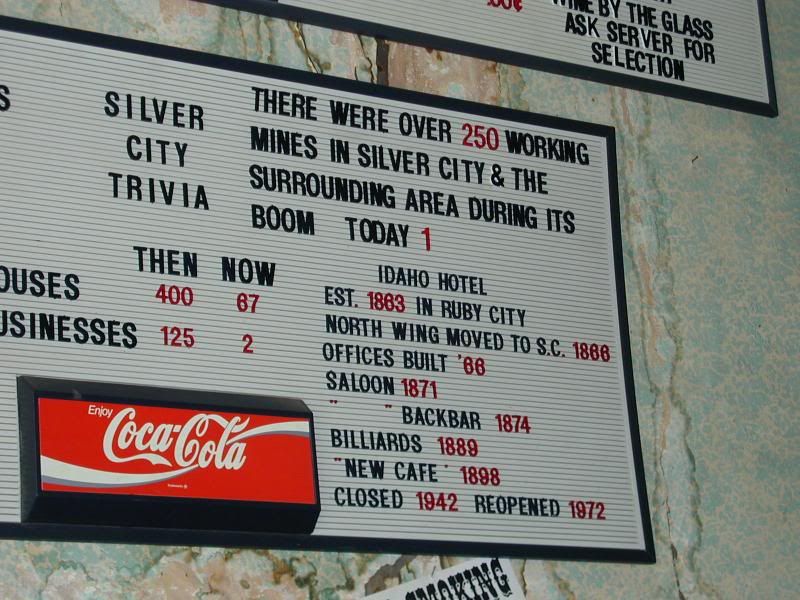
Houses at its peak, 400: now, 67.  Businesses at its peak, 125: now, 2.  Working mines at its peak, 250: now, 1.  This informaton comes from a sign on the menu at the Idaho Hotel.  The building was constructed in Ruby City and moved to Idaho City in 1866.

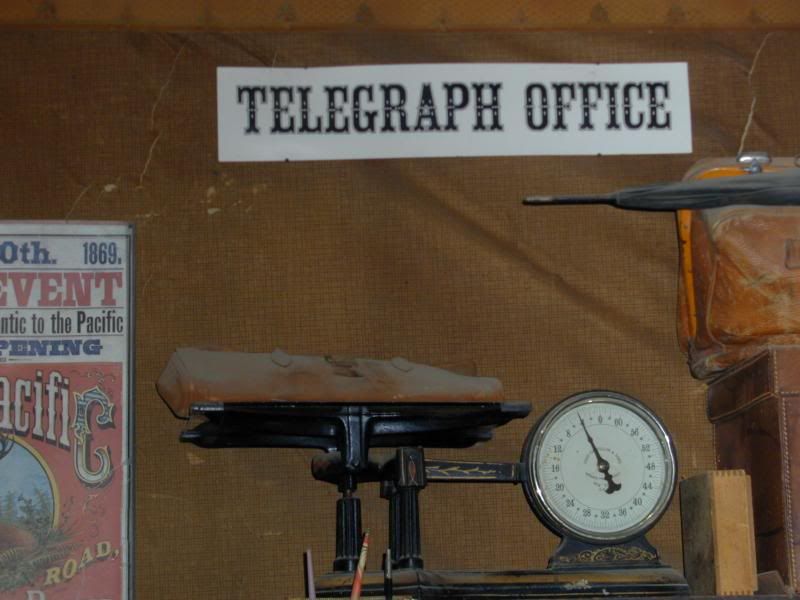
Even though Silver City had telephone service by 1880, the telegraph business was thriving for longer distances.
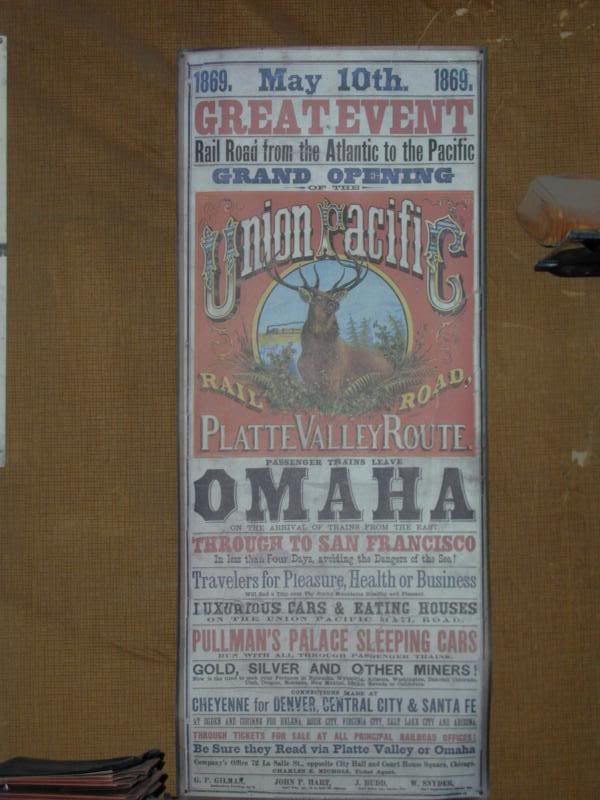
Silver City, Idaho Territory, never did have rail service, but the train service was within a stage ride.  Here's a Union Pacific train ticket:

May 10th. 1869
GREAT EVENT
Rail Road from the Atlantic to the Pacific
GRAND OPENING
of the
Union Pacific Rail Road
Platte Valley Route

Passenger trains leave
OMAHA
on the arrival of trains from the East

THROUGH TO SAN FRANCISCO
In Less than Four Days, avoiding the Dangers of the Sea!
Travelers for Pleasure, Health or Business

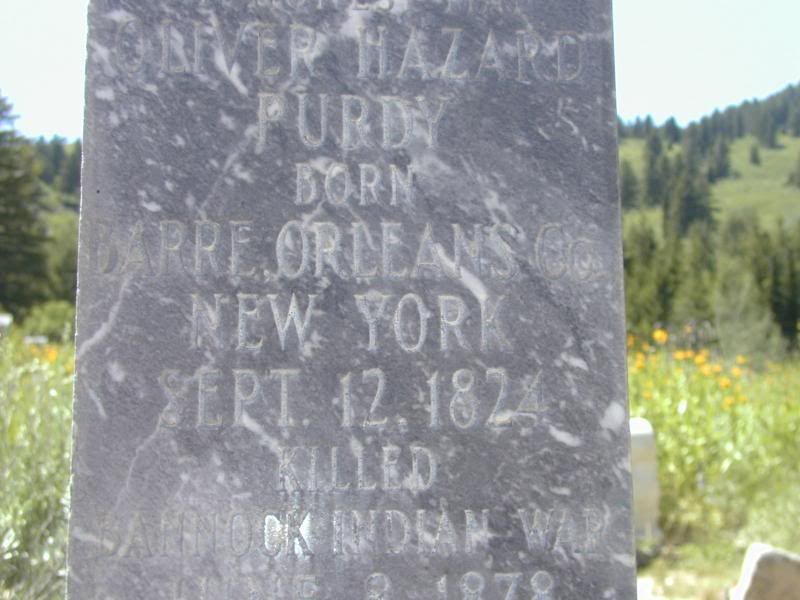
Life was hard in the Old West, especially when you're a couple hundred miles off the beaten path, at over 6,000 feet in elevation.  But this wasn't empty country. A long-standing population of Native Americans from the Bannock and Paiutes were not all that happy about Europeans coming in and ruining their livelihood and cultures.  The next photo is the gravestone of Oliver Hazard Purdy, born September 12, 1824, and killed during the Bannock Indian War in 1879.
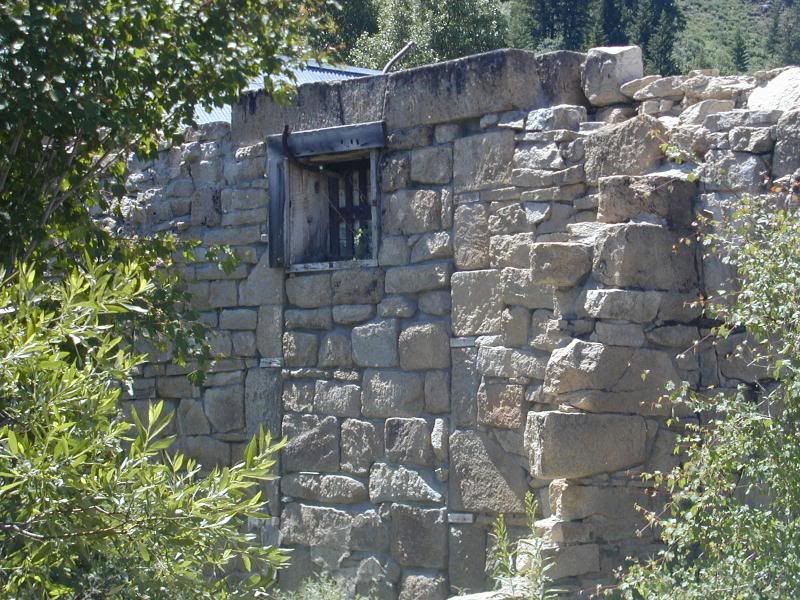
Sometimes bad things happen but instead of dying, the perpetrators were put in jail.  It looks as if this jail wouldn't be too secure these days, but it was formidible in its time.

For more cool photos and accompanying descriptions, I highly recommend EdnaPurviance.org and GhostTowns.com.  You can see the school and the church, too, where services are still held.  The Masonic Lodge is still in good condition and is in use as well.

I'll leave you with the coolest hotel ever.  I mean EVER.  This is the Idaho Hotel that I talked about above (menu board trivia).  Yes, you can still stay there--they have 13 rooms in service.  Go to the hotel's website for more cool history about Silver City.

 
Idaho Hotel, in Silver City, Idaho

Much Ado About Marshals takes place in Oreana, Idaho Territory, but the pre-story takes place right here in Silver City.  Stay tuned because another book in the Much Ado series will be set in Silver, and you can bet these buildings will have a strong say-so in how the story goes. :)

Jacquie Rogers writes western historical and fantasy romance.  Her latest release, MUCH ADO ABOUT MARSHALS, debuted #1 in Western Romance at Smashwords, and #2 in Humor. Available also are her contemporary western, DOWN HOME EVER LOVIN' MULE BLUES, a multi-era faery story, FAERY SPECIAL ROMANCES, and a Christmas story, FAERY MERRY CHRISTMAS. She's co-founder of 1st Turning Point, a pay-it-forward website where authors teach, share and learn promotion and marketing.

04 August 2010

Tragic Tales: Baby Doe

By Elizabeth Lane

Horace "Haw" Tabor may not have been long on talent or ambition, but he made up for it with sheer dumb luck. The year 1878 found the 48-year-old Tabor running a store in Leadville, Colorado, while his loyal wife, Augusta, kept a boarding house. Storekeepers at the time had the option of providing a "grubstake" for miners on their way to the wilds for a shot at fortune. In return, the storekeeper was entitled to one-third of any riches the miners discovered.

That spring, Tabor grubstaked a pair of sorry-looking miners named August Rische and George Hook. They didn't seem to know much about prospecting, but the two of them wandered into the hills and, by chance, dug into a vein of pure silver. Their Little Pittsburgh Mine yielded $20,000 a week. Haw Tabor's $60 investment earned him $2 million in the first year alone without getting his hands dirty. In short order he became mayor of boomtown Leadville and lieutenant governor of Colorado. Augusta, unable to adjust to her husband's meteoric rise, became more and more reclusive.

Enter Baby Doe. Born Elizabeth Bonduel McCourt, and newly divorced from her slacker husband, Harvey Doe, she was blue-eyed, blond, spunky, and irresistible. In 1879 she met the newly-rich Haw Tabor. Despite their 26-year age difference, the two fell in love. Over the next few years, as Tabor's relationship with Augusta became more distant, his liaison with Baby Doe became increasingly public. In 1881, Tabor quietly obtained a backwoods divorce from his wife (without bothering to inform her). At some point he and Baby Doe were quietly married.

Eventually word of the secret divorce reached Augusta Tabor. She hauled her ex-husband into court and received a million dollar settlement.

In 1883 Tabor was appointed to fill a 30-day vacancy as U.S. Senator from Colorado. He and Baby Doe took advantage of the chance to stage a lavish Washington wedding, attended by no less a person than President Chester A. Arthur. Soon, however, the gossip caught up with them. The priest who'd performed the ceremony declared the marriage illegal because both parties had been divorced. But since they'd already married each other earlier, it didn't make any difference. The wedding had been pure theater.

That was the end of Tabor's political career. Although he and Baby Doe lived well for a time, and he attempted to run for governor and senator, public opinion had turned against him.

In 1893 the final blow cam when the federal government announced that it was going to stop buying silver for its currency and convert to the gold standard. The crash ruined Tabor. Everything he had was sold, but nothing he could do was enough to support Baby Doe and their two daughters. In 1899 he died of appendicitis in the single room he shared with his family. Shortly before his death, he reportedly told his wife to "hang onto the Matchless Mine."

Baby Doe spent the remaining thirty-five years of her life in a cabin outside the Matchless Mine in Leadville. Still beautiful, she could have easily remarried. She chose instead to "hold onto the Matchless."

In early March of 1935, her frozen body was discovered on the floor of her cabin. Deserted by her daughters, she had passed into legend. Her life has been the subject of two books, a Hollywood movie, two operas, a screen play, a one-woman show and countless other books and articles.

28 March 2010

Guest Author: Deborah Schneider

This week on Unusual Historicals we're welcoming Deborah Schneider as she celebrates the release of PROMISE ME, a new western. Published by The Wild Rose Press, it's now available in paperback. Here's the blurb:

After spending years in an arranged marriage as the repressed wife of an older man, Amanda Wainwright has learned the hard way that money can’t buy happiness. She arrives in Willow Creek determined to keep a deathbed promise to her husband and do something to help other people. When Amanda meets a handsome, mysterious stranger who tempts her with sweet promises and long nights of passion, she discovers a fiery, passionate nature that could lead her to disaster.

For Samuel Calhoun, falling in love wouldn't just be foolish, it could be deadly. He's in Willow Creek, Montana as an undercover agent for the Secret Service. In order to maintain his secret identity, he accepts an offer from a consortium of mine owners to seduce, humiliate, and ruin the Widow Wainwright. Before long, Sam knows he’s met the woman who can banish the aching emptiness in his soul, and he's willing to risk everything--even his life--to be with her.
***

A love for American History drew Deborah to the field of education and teaching American History right after college. She resides in a small town near the Cascade Mountains in the Pacific Northwest, where she fulfills her dream of waking up every day to look at a mountain. She's the winner of the Molly Award for Most Unsinkable Heroine for her book, Beneath A Silver Moon. She loves writing about strong, smart women who aren't afraid to challenge the men they love. She's employed by one of the busiest library systems in the US, is the 2009 Romance Writers of America Librarian of the Year, and believes in the power of books to change lives.

You can see the book trailer for PROMISE ME here on YouTube.

***

Do you have questions for Deborah? Perhaps about the transition from notable and award-winning librarian to romance author? Or maybe about hardscrabble Old West mining towns as a setting for romance? Please leave a question for Deborah to answer throughout the week. I'll draw one name at random next Sunday, and that person will receive a signed copy of PROMISE ME. Void where prohibited. Best of luck!

30 September 2009

Scandal: The Legend of Baby Doe

By Elizabeth Lane

Horace "Haw" Tabor may not have been long on talent or ambition, but he made up for it with sheer dumb luck. The year 1878 found the 48-year-old Tabor running a store in Leadville, Colorado, while his loyal wife, Augusta, kept a boarding house. Storekeepers at the time had the option of providing a "grubstake" for miners on their way to the wilds for a shot at fortune. In return, the storekeeper was entitled to one-third of any riches the miners discovered.

That spring, Tabor grubstaked a pair of sorry-looking miners named August Rische and George Hook. They didn't seem to know much about prospecting, but the two of them wandered into the hills and, by chance, dug into a vein of pure silver. Their Little Pittsburgh Mine yielded $20,000 a week. Haw Tabor's $60 investment earned him $2 million in the first year alone without getting his hands dirty. In short order he became mayor of boomtown Leadville and lieutenant governor of Colorado. Augusta, unable to adjust to her husband's meteoric rise, became more and more reclusive.

Enter Baby Doe. Born Elizabeth Bonduel McCourt, and newly divorced from her slacker husband, Harvey Doe, she was blue-eyed, blond, spunky, and irresistible. In 1879 she met the newly-rich Haw Tabor. Despite their 26-year age difference, the two fell in love. Over the next few years, as Tabor's relationship with Augusta became more distant, his liaison with Baby Doe became increasingly public. In 1881, Tabor quietly obtained a backwoods divorce from his wife (without bothering to inform her). At some point he and Baby Doe were quietly married.

Eventually word of the secret divorce reached Augusta Tabor. She hauled her ex-husband into court and received a million dollar settlement.

In 1883 Tabor was appointed to fill a 30-day vacancy as U.S. Senator from Colorado. He and Baby Doe took advantage of the chance to stage a lavish Washington wedding, attended by no less a person than President Chester A. Arthur. Soon, however, the gossip caught up with them. The priest who'd performed the ceremony declared the marriage illegal because both parties had been divorced. But since they'd already married each other earlier, it didn't make any difference. The wedding had been pure theater.

That was the end of Tabor's political career. Although he and Baby Doe lived well for a time, and he attempted to run for governor and senator, public opinion had turned against him.

In 1893 the final blow cam when the federal government announced that it was going to stop buying silver for its currency and convert to the gold standard. The crash ruined Tabor. Everything he had was sold, but nothing he could do was enough to support Baby Doe and their two daughters. In 1899 he died of appendicitis in the single room he shared with his family. Shortly before his death, he reportedly told his wife to "hang onto the Matchless Mine."

Baby Doe spent the remaining thirty-five years of her life in a cabin outside the Matchless Mine in Leadville. Still beautiful, she could have easily remarried. She chose instead to "hold onto the Matchless."

In early March of 1935, her frozen body was discovered on the floor of her cabin. Deserted by her daughters, she had passed into legend. Her life has been the subject of two books, a Hollywood movie, two operas, a screen play, a one-woman show and countless other books and articles.

23 June 2009

Places You've Never Heard Of: Silver City

By Jacquie Rogers

It was 1863 in the Owyhee Mountains located in the southwest corner of Idaho Territory. The War Between the States raged in the east, but out west, men had dollar signs in their eyes, looking for that next bonanza. They could get rich raising cattle, or logging, but fastest of all, gold. And silver.

The mining boom town of Ruby City was formed--a hotel, several business and residents, and the county seat. A few years later, Silver City sprang up as well. Ruby City hung on for a while but after a series of floods and a few other things that went haywire, the Idaho Hotel and the county seat were moved to Silver City.

Silver City was born on mining. Silver mine tunnels numbered in the hundreds, and dotted the countryside as well as the city. Here's a pan view of Silver City I found on YouTube. There's even a mine under the church! 60 million dollars worth of silver was taken in the 1900s, and if converted to today's currency, that would be a whole lot more for this little area. The silver lodes were the richest in Idaho Territory.

Historic Silver City writes:
During its "heydays", Silver City had about a dozen streets, seventy-five businesses, three hundred homes, a population of around 2,500, twelve ore-processing mills, and was the Owyhee County seat from 1866 to 1934. Some of the largest stage lines in the West operated in the area, and Silver City had the first telegraph and the first daily newspaper in the territory in 1874. Telephones were in use here at least by 1880, and the town was "electrified" in the 1890's.

Picture to the left: the bar at the Idaho Hotel

Never heard of it? Most people haven't, but it was truly the wild west in all manner of ways. It's located in Owhyee County, which is a large county in southwest Idaho. The newspaper they refer to is The Owyhee Avalanche, the longest operating newspaper in Idaho and one of the oldest in the West. I subscribe to it--it's a very high quality publication. There was never a shortage of news from the tough men who risked their lives in the mines every day for the promise of a life of luxury.

From The Owyhee Avalanche, October 17, 1868:
SHOOTING SCRAPE
Between seven and eight o'clock last Monday evening a shameful shooting affar occurred at Sommercamp's saloon, between two of our citizens. On account of the hitherto respectability of the parties and for the sake of their friends we suppress names. On the evening in question, we, together with the twenty-five or thirty others were in the saloon, when the two valiant shootists commenced banging away at each other with revolvers...
Silver City and the surrounding ore-rich area drew men from all over the world to mine the silver lodes. Many Chinese came to make their fortunes, and several did. Of course, as with the Anglo immigrants, most didn't. Still, the Chinese established a strong presence and the economy couldn't have survived without them. Not that there weren't a few problems along the way:

From The Owyhee Avalanche, October 17, 1868:
MORE SHOOTING
Last Tuesday night a Chinaman was shot and severely wounded in a Chinese gambling house on Jordan Street. It appears a Chinaman who was bucking at a game wanted to bet five dollars on jaw-bone, the dealer objected, the other fell back on his dignity and shot the almond-eyed gamboiler through the right shoulder. The next day we noticed Deputy Sheriff John Springer and a posse of mounted Chinamen hunting for the shootist. We learn from Dr. White, who is attending the wounded Chinaman, that he will get well.
And yes, there were Cyprians--the ladies of the evening. Men out-numbered women at one point by 200 to 1 so every woman, no matter what her status, was highly regarded. The women, however were not so impressed with one another.

From The Owyhee Avalanche, February 26, 1870:
FEMALE PUGLISTS
One evening this week be observed two frail females in the vicinity of Catalow's stable, engaged in commintting assault and battery upon each other. For some time the fur flew in all directions. They finally sank down in the snow through sheer exhaustion. Jealousy was the cause of the muss.
And, yes, confrontations with the Indians were frequent. Be warned, this next quote is even worse than the one about the Chinese and the women. "Politically Correct" was not yet invented. But we must also avoid revisionist history--Anglos were, for the most part, of the opinion that Native Americans were sub-human. This is why I avoid the entire issue in my westerns. I write humor and there isn't anything the least bit humorous about the treatment of the Indians.

From The Owyhee Avalanche, September 12, 1868:
LO THEY COME!
Tho's H. Smith Esq. just in from Camp Three Forks, informs us that last week the military of that place gobbled up and brought into Camp six-teen Indians as prisoners. Under promise of bringing in four-teen more, three bucks, whose squaws were retained as hostages, were allowed to go out into the mountains. The miserable wretches profess a desire to give themselves up and stop robbing and scalping the whites--at least till they recruit and obtain a fresh supply of arms and ammunition.
Silver City was difficult to get to and from (travel can get a bit dicey even today), so the subject of roads was always prominent in the news. Keep in mind "highways" is a subjective term here. The road into Silver City from the east isn't two-lane all the way even now. It's a dirt road and depending on the season, you drive on the high side of the ruts in order not to high center your vehicle. In those days, horses, stagecoaches, and wagons traveled the very same road.

From The Owyhee Avalanche, May 16, 1868:
THE ROADS
We are pleased to know that Mr. Abbott, Supervisor for the Road District No. 2, has commenced repairing the roads. As a consequence of the ground's thawing out and the melting of the snow, our highways in many places were in bad condition, but now the ground is becoming dry and the money now on hand in the road fund, with the taxes yet to be collected for that purpose will serve to put the roads in good order.
But most of all, people need entertainment, and the residents of Silver City weren't any different. There was a theater, several saloons, and lots of parties and receptions at the I.O.O.F Hall. In the dark of winter, entertainment was even more sought after.

From The Owyhee Avalanche, January 4, 1868:
ON WITH THE DANCE!
seems to be the motto just now--just what we expected, as soon as it became known on the outside that times were lively and money plenty in Owyhee, in comes a batch of hurdies to gobble up their share. It is an easy matter to find out where they hold forth --watch the crowds of suffering manhood as they emerge from cabins along the creek in the dusky twilight, or silently wend their way, in Indian file, down the mountainside; their steps are directed to Gabriel's large building, corner of Jordan and Second Sts., where, seated on a bench at one side of the spacious hall, are four coy and blushing damsels...
Sources
The Owyhee Avalanche
Historic Silver City Idaho
GhostTowns.com: Silver City
Wikipedia
Edna Purviance
Associated Content
IdahoHistory.net: Chinese Pioneers

Silver City is one of my favorite places to go, although it wouldn't be half so fun if Ed Jagels hadn't worked so hard for the last 30 years of his life to keep the Idaho Hotel from crumbling into ruin. He passed on several years ago, but his friends continue his good work, restoring and operating the hotel, and I'm grateful.

Jacquie

Princess Keely, Star of Faery Special RomancesDown Home Ever Lovin' Mule Blues

Myspace *** Bebo *** Faery World

Faery Special Romances *** See the book video
Royalties go to Children's Tumor Foundation, ending Neurofibromatosis through Research

Available Now: Down Home Ever Lovin' Mule Blues

02 February 2009

Humans in Nature: The Big Hole

By Carrie Lofty

Until 2005, when scholars proved that the abandoned Jagersfontein mine was actually about 110 feet deeper, the Big Hole in Kimberely, South Africa was the largest pit ever dug by hand. The open-pit mine, established in 1871, attracted as many as 50,000 small time miners from all over the world until conglomerates founded by men such as Cecil Rhodes began to buy up shares and consolidate claims. By the time it closed in 1914, the Big Hole had yielded three tons of raw diamonds (2,720 kilos), and every single one of those diamonds was extracted using pick-axes, shovels and bare hands.

As with any discovery of rich natural resources, international players wanted a piece of the action. Major contenders for the African colonial land grab, including Britain, Germany, Portugal, and the Netherlands, became obsessed with what some called "the Diamond Crusade." Using a loophole in an existing treaty with the Griqua tribe, the British were able to repartition boundaries between Cape Colony and the Orange Free State in a move that made Kimberely's diamond-rich land property of the Queen. But the diamonds belonged to those who could best get at them.


As the hole got wider and deeper, miners were at risk of side collapses due to poor scaffolding or rain storms. No longer able to simply stroll to their claim and start digging, the miners and their supplies were lowered into the pit by a series of pulleys and cables. The deeper they got, the more costly to continue mining, which precipitated the push toward consolidation and mechanization.

Cecil Rhodes envisioned an African continent made British, with its populace taught to appreciate British values and customs. He also imagined a railroad that would stretch from Cape Town to Cairo, and his obsession needed funds. He eventually consolidated so many mining claims that he was able to buy out his chief rival, Barney Bernato, for more than five million pounds--the largest sum ever paid by check at that time. This created the De Beers monopoly which still hold tremendous sway over the diamond industry today.


By the time the mine closed in 1914, it had grown to 1500 feet wide (460 meters) and almost 500 feet deep. Upon seeing the mine for the first time, Winston Churchill said, "All for the vanity of women!" To which a woman in the crowd replied, "And the depravity of men!"

Water and debris now partially fill the mine, which has become known throughout the world by its designation as a World Heritage Site. You can read more about the tourist town that has since sprung up around the Big Hole on its website.

10 December 2007

Holidays & Celebrations:
Winter Festivities in the Old West

By Jacquie Rogers

Yule Brings Celebration For All

The snow blows nearly sideways as it blankets the range. Ranch hands hunker down in their saddles, scarves over their ears and their Stetsons protecting them from the fierce wind. They dream of a warm fire and hot buttered rum. But they have livestock to save from freezing and starvation, so they ride on.

It's Christmas on the open range. Miserable for man and beast. But it isn't just another day at the office, so to speak. They whittle gifts for one another, sing a few carols as they sit around the campfire warming their hands and feet. Cook gives them a hot meal--the finest beans with maybe some meat thrown in. And with a little luck, Cook would bake an apple pie. Life couldn't be better and they thank their lucky stars for a sound horse and solid tack.

(Yes, I know these cattle are a modern breed and very fat, but it's the only picture I could find.)

Chanukkah in the mines

It's the 1860's in Silver City, Idaho. The Festival of Lights has been celebrated in the West since the beginning of frontier settlement, but not like their counterparts back East who have a warm and dry place to worship with their families. A menorah can be lit anywhere, and the Jewish silver miners do just that. They pray, play a little dreidel, and think a lot of home.

The picture to the left is the oldest continuously used synagogue west of the Mississippi. It's located in Boise, Idaho, and was built in 1896 by the Beth Israel congregation, now called the Ahavath Beth Israel congregation. Very beautiful.

Christmas on the farm

Everyone has chores to do every day. Cows needs milked, livestock needs watered and fed, eggs need gathered, and the barnyard needs to be tidied (to use a gentile term). So after the chores are done, the family can gather together and celebrate Christmas with what meager resources they have. If they don't have evergreen trees to spare, they might decorate a sagebrush with popcorn and berries. They make ornaments with precious bits of paper and scraps of cloth. Peach tins make nice ornaments, too, and they shine in the firelight.

1876 Christmas, Harper's Weekly

Their celebration might be more humble than those in the eastern cities, but they have a grand time, nevertheless. The women cook for days. They're resourceful and whatever they have available will do for a fine pie or stew. The Christmas feast could consist of chicken, venison, or maybe a ham, along with homemade rolls, freshly churned butter, potatoes and gravy, and pies--maybe one made with dried apples and a vinegar pie. Each family member has made modest gifts for the others and even the smallest child has labored over precious gifts--maybe a drawing or a doll made of sticks. They sing carols, maybe read the Bible, and if they're close enough to town, maybe even go to church.

For most Christian families, Christmas is a day for family togetherness and to show their love and appreciation for one another, as well as celebrating the religious aspect of the holy day.

Christmas for Outlaws, Gunslingers, and Cyprians

The saloon owner brings small gifts for the working ladies, the bartender, the resident gambler, and a few of the regulars. A few cowpunchers bring gifts for their favorite girl. They might have a nice meal together before they open for business, and even then, the customers are few. It's one night they can relax.

Happy Holidays to Everyone!

***
Enter the Name that Christmas Carol contest. It's fun!

Princess Keely, Star of Faery Special Romances

Jacquie Rogers *** Myspace *** Bebo *** Faery World
Faery Special Romances (Available now)
Take a look at the book video
Royalties go to Children's Tumor Foundation,
ending Neurofibromatosis through Research