 By Blythe Gifford
If there's one thing we've learned during this month's focus on money matters, it's that the farther back you go in history, the more likely you'll find that "money" itself--coins, bills, and the like--has not always been the medium of exchange. Even after a country becomes accustomed to coins, they have not been the everyday necessity we would think. For example, for 13 years in the middle of the 17th century, Scotland minted no coins at all.
After 1603, Scotland and England were ruled by one King, but they remained two different countries with separate legal systems, Parliaments, government administrations, and currency.
 When King Charles I assumed the throne in 1625, he authorized minting of a wide variety of Scottish and English coins. (Banknotes were not issued as legal tender until later.) Shown here is a silver, Scottish 20 pence piece, featuring the King on one side and the crowned thistle, symbol of Scotland, on the other. It was minted somewhere between 1337 and 1642.
As his reign wore on, Charles had more pressing concerns than Scottish coins, including a civil war which ended with his execution. Some of the British coins minted at this time were authorized in various cities where he found himself campaigning against enemies.
Charles' execution did not stop the protracted, bloody, complicated civil war. Scotland, which fought both against and for the Stuart kings over the course of the war, was occupied by Oliver Cromwell's army between 1651 and 1660.
Cromwell issued "Cromwell Crowns," and other money, in England, but didn't get around to authorizing any new Scottish coins. Some suggest that he planned to consolidate the two currencies.
It was not until after Charles II formally returned to the throne in 1660, that there was once again new Scottish coinage. The first new money was dated 1663.
So how did people live without money? In many ways.
First, of course, existing coins continued to circulate, though after 13 years, there was definitely a shortage. People might shave gold or silver off an existing coin, debasing the currency and, in essence, creating the 17th century version of inflation.
Second, English coins found their way across the border, though the conversion rate was NOT one to one. (The value of Scots currency was fixed at 12/1 with English.)
Third, some businesses may have issued "tokens," sort of a local currency, good for local trade only. Such tokens were wide-spread in England, but exceedingly rare in Scotland.
Fourth, there was counterfeiting, despite severe legal penalties. Unlike today, when counterfeiters produce the biggest bills, it was the smaller pieces, in amounts ordinary people would actually use, that were most counterfeited in the 17th century.
But most important, Scotland at this time was still not a "money economy." While it had moved beyond a strictly feudal model, the average person in the country, where 90% of the people still lived, did not have much need for coins.
The family would work land held by a major landowner. They grew much of their own food, made many of their own clothes, and could trade or barter for most of the other goods and services. The only goods they needed to purchase were things like salt, iron tools, and cooking pots.
Most paid their rents and were paid for services in kind and even millers and blacksmiths did not work full time at their trades. So a shortage of circulating currency was not the hardship it would be for us.
It was, however, a challenge for an author, trying to put a coin in the hand of her 17th century heroine.
For more detail on all of this, see this excellent site. Images courtesy of CNG Coins, used under GNU Free Documentation License.
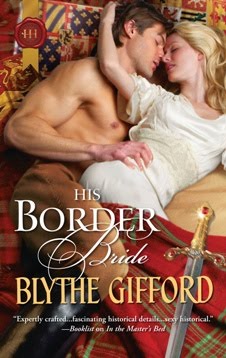 Blythe Gifford has written five 14th century medieval romances for Harlequin Historicals, featuring characters born on the wrong side of the royal blanket, most recently HIS BORDER BRIDE in May 2010. The Chicago Tribune called her work "the perfect balance between history and romance." Her 2011 release will be set in the 17th century Scottish Borders.


