Showing posts with label ships. Show all posts

28 December 2010

Accidents: The Loss of the White Ship

By Lindsay Townsend

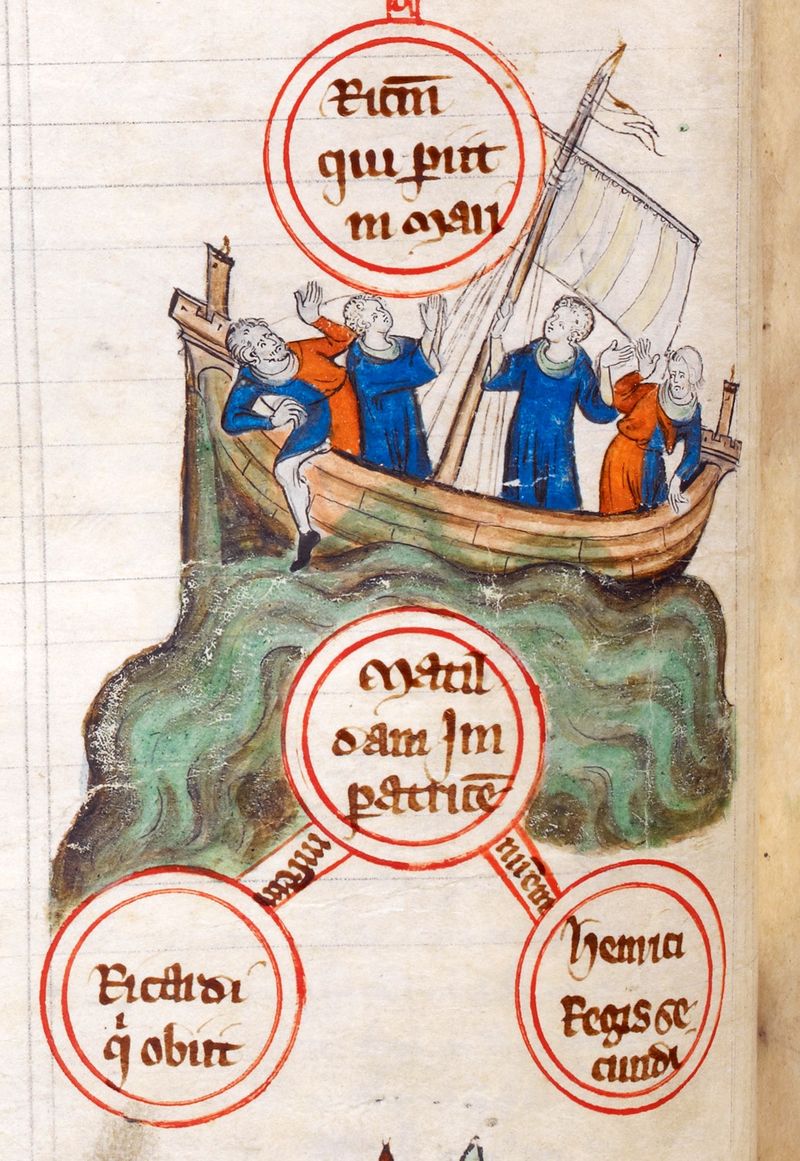
On November 25th, 1120, The White Ship was wrecked in a storm and sank in the English Channel. This terrible accident claimed over 300 lives and turned the course of English medieval history, since one of the victims was William 'the Atheling', seventeen years old and the only legitimate son of King Henry I of England and his queen Matilda, who had died two years before.

The White Ship was a modern vessel, a sturdy cog owned by Thomas FitzStephen, who was also on board, but the channel crossing from Normandy to England is treacherous, especially in winter. Henry's ship had already left Barfleur, on the north-western coast of France, in daylight, but when Fitzstephen's ship eventually sailed, after being loaded with more casks of wine, it was night. Worse, everyone on the ship was drunk. The ship struck a rock off Barfleur off the coast of north-western France and was wrecked. Only a butcher called Berthold from Rouen, on board to chase up payment, survived because the ramskins he was wearing saved him from exposure. Prince William and many of his friends, all young nobles, were drowned. Chroniclers of the time said that Thomas FitzStephen, knowing that Prince William was lost, allowed himself to drown rather than face King Henry.

At court, none of the barons dare tell the king. A child was finally sent with the terrible news. Henry fainted and afterward was said never to smile again.

Henry, stricken with grief, also afraid for his crown. His other legitimate child, named Matilda like her mother, was a daughter and in the Middle Ages women were not thought capable of ruling without male help. The traditional role of a queen was as a help-meet of the king and an intermediary for petitioners seeking mercy from the king. She was not expected to rule alone. Aware of this, King Henry married again within three months of the sinking of The White Ship and the loss of his male heir, but had no further legitimate children.

Henry was terrified of the prospect of no obvious male succession to the English crown, won by his father William of Normandy at the battle of 1066--the more so perhaps because he owed his own title of king to an 'accident' in the New Forest in August 1100 when his older brother, William Rufus, the King of England, was killed by an arrow while out hunting. Accident or assassination? It is still unclear but the younger brother, landless Henry, wasted no time in seizing the royal treasury and securing his position.

The death of William Rufus had favored him but the sinking of The White Ship threw his dynastic aims into turmoil. He attempted to extract promises of loyalty from his barons to his daughter Matilda, but some of the barons favored Henry's favorite nephew Stephen and when King Henry died in 1135, Stephen was crowned king of England in his place.

Matilda and her supporters saw this as a betrayal and both factions fought for their claims over England for over twenty years, a conflict which forms the backdrop for my novel A KNIGHT'S VOW, set in 1138.

Had William not been traveling on The White Ship all those years ago in 1120, if he had lived and succeeded his father, England would have seen a different line of Kings--Anglo-Normans instead of the later Angevins. No Henry II and Eleanor of Aquitaine, no Richard the Lionheart, no King John, all descended from Matilda's marriage to Geoffrey of Anjou.

Lindsay Townsend writes historical romance set in medieval England and the ancient Mediterranean. Her latest is A KNIGHT'S ENCHANTMENT, available now. She lives in Yorkshire with her husband.

05 May 2010

Disasters: RMS Lusitania

By Isabel Roman
NOTICE!

TRAVELLERS intending to embark on the Atlantic voyage are reminded that a state of war exists between Germany and her allies and Great Britain and her allies; that the zone of war includes the waters adjacent to the British Isles; that, in accordance with formal notice given by the Imperial German Government, vessels flying the flag of Great Britain, or any of her allies, are liable to destruction in those waters and that travellers sailing in the war zone on the ships of Great Britain or her allies do so at their own risk.
This ominous and foreshadowing warning was printed in all the New York newspapers three weeks before what would be the RMS Lusitania's final Atlantic crossing. The torpedoing of the Lusitania became one of the major factors for the US's entrance into the WWI theater of war.

It is probably true that the RMS Lusitania was carrying munitions to aid Britain in their fight against Germany but the attack on one of the world's most luxurious cruise liners, especially with the loss of RMS Titanic so fresh in the memories of the public, was a catastrophic miscalculation on Germany's part.

Initially, the German's defended their right when in a state of war to attack any enemy vessel. However, it soon became apparent that the world was against their position and in true back-pedalling style they reversed their position and agreed on rules of engagement. The Lusitania sank in just 18 minutes. In six minutes the forecastle was underwater. Of the 1900+ passengers, 1,195 died. The ship was just 18 miles from the coast of Ireland.

Germany justified it at the time by saying the Lusitania carried weapons (which she did) but the public didn't know this and so the outcry from both Germany, Britain, and America was immense. Her cargo had included an estimated 4,200,000 rounds of rifle cartridges, 1,250 empty shell cases, and 18 cases of non-explosive fuses, all listed in the manifest, but the cartridges were not officially classed as ammunition by the Cunard Line. (Various theories have been put forward over the years that she had also carried undeclared high explosives that were detonated by the torpedo and helped to sink her, but this has never been proven.)

Eventually, the German government issued a statement describing what the ship carried and how it had warned people not to travel on luxury ships during time of war, and the tide of German sentiment turned, but only slightly. No one advocated the killing of non-combatants. German's allies, Turkey and Austria-Hungry, criticized the sinking. It did outrage America, which was not ready to enter into any kind of global conflict, and President Wilson issued three increasingly strongly worded notes to the German government, with the last saying: the US would regard any subsequent sinkings as deliberately unfriendly.

In 1967 the wreck of the Lusitania was sold by the Liverpool & London War Risks Insurance Association to former US Navy diver John Light for £1,000. Gregg Bemis became a co-owner of the wreck in 1968, and by 1982 had bought out his partners to become sole owner. He subsequently went to court in England in 1986, the US in 1995, and Ireland in 1996 to ensure that his ownership was legally in force.

07 March 2010

Guest Author: Lisa Marie Wilkinson

This week we're welcoming Medallion Press author and Unusual Historicals contributor Lisa Marie Wilkinson as she celebrates the release of her second historical romance, STOLEN PROMISE. With colorful Gypsy characters and settings spanning from England to a sprawling South Carolina plantation, STOLEN PROMISE explores the deep passions that result when cultures collide.

At the Lowara Gypsy Camp outside Windsor, England, in 1806, a young woman will lose her independence in a common marriage market transaction. Jade knows she is promised to Dimitri, a possessive abuser. Jade knows he will hurt her. Jade knows her freedom is gone.

When her father sends her to the arms of another man, she finds only slight consolation...until she encounters her intended. Evan Dark is a half-Gypsy gentleman--nothing like Dimitri. Caught in a battle between tribes, Jade is a piece of property, the ideal runaway bride. In order to escape Dimitri's clutches, she sails for Charleston with Evan as his indentured servant. But, engaged to another woman as part of a plantation merger in South Carolina, Evan's affiliation with Jade can never be more than professional.

Evan must choose between fulfilling his obligation to marry his betrothed or accept his overpowering passion for Jade, a woman his matchmaking Gypsy grandfather deemed the perfect Romany wife. In nineteenth-century America, where insincere tradition meets old money and arranged matrimony in upper-crust society, Evan faces the most difficult decision of his life: Remain loyal to the fiancée he holds in commitment...or be true to the lover he holds in his heart.
***

"I fell in love with the intense passion, exciting adventures, the love that would not be beaten down, and the vivid and colorful depiction that make this a fantastic journey for those readers who want to take a trip within these wonderful pages." ~ 5/5 Cups from Coffee Time Romance

"Absolutely scrumptious! Our author has given us an action packed, emotional powerhouse that will keep you turning pages as quickly as possible from beginning to end...I totally adored this book." ~ Terra, Yankee Romance Reviewers

"With STOLEN PROMISE, Lisa Marie Wilkinson delivered a romantic but fast-paced story set against the backdrop of the gypsy world and the Southern hospitality of South Carolina. It is fluently written and researched with profound characters. This warm, dynamic and spirited story will keep you reading until the very last page!" ~ Marissa, Realms on our Bookshelves

***

What inspired you to write about Gypsies?

I met a group of Gypsies who were traveling through the Los Angeles area when I lived in California, and I found them fascinating. I've always been interested in different cultures, and the Romany people have beliefs and customs that make them wholly unique. Great fodder for a romance novel!

What is the significance of the necklace on the cover of STOLEN PROMISE?

In the era in which STOLEN PROMISE is set, the Romany women literally carried their fortunes on their person, in the form of a necklace called a galbé. The necklace was usually made of a gold chain with coins attached. The galbé in STOLEN PROMISE features prominently in the story, and the heroine, Jade, ends up with a much nicer necklace by the end of the story than she possessed at the beginning. The galbé depicted on the cover hints at a sort of blending of the two necklaces, and also represents the merge of two different cultures as Jade, the Gypsy heroine and Evan, the South Carolina plantation owner, fall in love.

And you're planning to give away a signed copy of the book this week?

Yes, it will be my pleasure to give away a signed copy of STOLEN PROMISE to the person who leaves the winning comment this week! I'm also holding a contest on my website for a free copy of the book, so stop by my website and enter there as well, to increase your chances of winning!

***

Thanks for stopping by, Lisa Marie! She will be here all week to answer questions about her latest historical romance novel. Please comment! I'll draw the random winner next Sunday. Void where prohibited. Best of luck!

04 March 2010

Excerpt Thursday: Lisa Marie Wilkinson

This week on Excerpt Thursday we're welcoming Medallion Press author Lisa Marie Wilkinson as she celebrates the release of her second historical romance, STOLEN PROMISE. With colorful Gypsy characters and settings spanning from England to a sprawling South Carolina plantation, STOLEN PROMISE explores the deep passions that result when cultures collide. Join us Sunday when Lisa Marie will be here to answer questions and give away a signed copy. Don't miss it!

At the Lowara Gypsy Camp outside Windsor, England, in 1806, a young woman will lose her independence in a common marriage market transaction. Jade knows she is promised to Dimitri, a possessive abuser. Jade knows he will hurt her. Jade knows her freedom is gone.

When her father sends her to the arms of another man, she finds only slight consolation...until she encounters her intended. Evan Dark is a half-Gypsy gentleman--nothing like Dimitri. Caught in a battle between tribes, Jade is a piece of property, the ideal runaway bride. In order to escape Dimitri's clutches, she sails for Charleston with Evan as his indentured servant. But, engaged to another woman as part of a plantation merger in South Carolina, Evan's affiliation with Jade can never be more than professional.

Evan must choose between fulfilling his obligation to marry his betrothed or accept his overpowering passion for Jade, a woman his matchmaking Gypsy grandfather deemed the perfect Romany wife. In nineteenth-century America, where insincere tradition meets old money and arranged matrimony in upper-crust society, Evan faces the most difficult decision of his life: Remain loyal to the fiancée he holds in commitment...or be true to the lover he holds in his heart.
***

"Not a bad disguise."

Evan inspected his reflection in the tavern window. The dark blue captain's uniform had been tailored for the figure of the man from whom he had stolen it, although the fawn colored suit underneath filled it out well enough. Measured to end above the backs of the knees, the coattail didn't reach as far on his tall frame. The fit was convincing enough if one didn't look too closely.

He tucked his hair beneath a black cocked hat and entered the tavern. The men searching for him wouldn't expect him to be wearing a British military uniform.

On the other hand, if the British authorities discovered him masquerading as one of their own, he would be hanged. Situated by the London docks, the smoke-filled tavern sat near a ship ready to sail for the Carolinas. Evan could dispense with his disguise once he and his uncle Joseph were safely aboard ship. If he never saw England again, it would be too soon. The six months following his mother's death had been filled with revelation. Everything he had believed to be true about his heritage and his life had faded like the ink on the pages of his mother's diary. Learning her secret had shattered his world.

The pub interior smelled like rancid fish and bilge water. It was still preferable to being outside. A torrential downpour had driven many to seek shelter in the pub. Conversation swelled around Evan as he chose one of the knotty maple tables near the entrance. He scanned a wall filled with posted notices while he waited for Joseph to arrive.

He glanced toward the entrance as a young woman in a dark, hooded cloak slipped inside the pub. Tall and slender, she carried herself with fluid grace, brushing rain from the garment as she crossed the room. She shook her head when the barkeep nodded toward the row of bottles and decanters behind him as he polished a tankard.

She drew back the hood of her cloak, yet didn't remove it, despite the clammy, crowded atmosphere. Was she among the many who sought temporary shelter from the storm? The murky light lent her an exotic appearance. Her long, inky hair shimmered with seductive blue highlights, the contrast rendering her creamy olive skin flawless. In daylight, she would either fulfill her promise of beauty, or be exposed as a maid whose features were softened by shadows.

Evan forced his gaze back to the doorway, but couldn't keep his attention from returning to the woman. A drunken sailor staggered toward her, dragging a well-worn chair. He placed the chair in front of her and made a sweeping gesture toward it.

"Rest yerself in me chair, bonnie."

He placed a dirty hand on her shoulder and shoved her into the chair. She frowned at the man's greasy, shoulder-length hair, his crumpled, filthy cotton shirt, threadbare breeches, and mud-caked boots.

The sailor's gaze sharpened, and he reached out and tugged at the collar of her cloak, revealing a necklace of gold coin. "Thass a Gyppie purse." He snagged the necklace from around her throat, swiftly levering it over her head.

She lunged for the necklace, but the sailor dangled the treasure out of her reach. The coins fluttered with a soft metallic jingle. Evan bolted from his seat, then froze and looked on in astonishment when the woman shrieked in outrage and dropped her ladylike demeanor with the speed of a ship dropping anchor. She dove at the sailor, her gaze fixed on the coin-studded strands of gold in his hand.

"No, bonnie, it be mine." The sailor chuckled at her attempts to grab the treasure he held aloft.

He continued to make sport of her until she kicked him in the shin. He howled and stomped in outrage as the necklace fell to the floor with a noisy jangle. She launched herself after it and pocketed the gold within the folds of her cloak. The sailor lunged at her, sucking in air and gasping as he grabbed her by the hair and hauled her up to face him. Evan kicked the chair aside and moved toward them.

"Ye'll pay fer tha', Gyppie. Ye'll 'ang by a long rope," the sailor warned.

She paled and went still. The intensity of her wide green eyes stunned Evan, and his jaw clenched at the image of her hanging from a rope at Tyburn or caged in a gibbet along the roadside.

"No, bonnie, dinna be afrighted. I be yer friend." The sailor chuckled, and a number of the men in the room joined in, their laughter ugly, lewd, and tense.

She attempted to twist from the sailor's grasp, but he jerked her back. She bit down on her lower lip. Evan couldn't decide whether her eyes sparkled with fear or defiance. Most women of Evan's acquaintance would have succumbed to an acute case of the vapors by now.

"Let her go." Evan's voice was loud, even in the din.

The sailor scoured him with a look of contempt. "Yer lordship," he sneered, spitting out the title as though it were a morsel of an inedible meal, "ye best leave."

Evan's gaze swept the room and settled upon a posted sign banning Gypsies, among others, from the establishment.

"Not without my prisoner," he said, flattening his tone to conceal his Southern drawl. To his own ears, his words still sounded like nah withou' mah pris'ner.

"What law have I broken?" she asked.

Evan frowned at her. He couldn't rescue her if she wasn't going to cooperate.

"That one." He pointed to the curling yellowed parchment as he stepped forward and tugged her out of the sailor's slackened grip. He urged her toward the door when she looked askance at him, her expression wary.

"No. The gyppie will go wie me." The sailor drew a stiletto from beneath the sagging waistband of his filthy breeches.

Evan grunted in surprise and stumbled forward when the woman shoved him toward the sailor. The sailor lunged, slicing the air with the knife blade as other men joined in the fight, blocking the sailor's path to Evan. Knocked off balance, Evan staggered into the boisterous crowd, catching glimpses of the woman as she fought to avoid grasping hands on her way to the door.
Skirting the common room, he made his way toward the entrance.

When he suddenly found himself face to face with her again, he seized her wrist and pulled her toward the exit as the skirmish deteriorated into a drunken brawl. Her fingernails bit into his forearms as she struggled to be free of his grip.

"I'm trying to help you, foolish woman. I won't hurt you."

You can read the rest of this excerpt here!

21 May 2009

Thursday Excerpt: Alex Beecroft

Thursdays on Unusual Historicals mean excerpts! This week we're featuring an excerpt from Alex Beecroft's debut, FALSE COLORS, a m/m romance set in the 18th century. Join us on Sunday when Alex will be stopping to talk about FALSE COLORS and give away a copy!

For his first command, John Cavendish is given the elderly bomb vessel HMS Meteor, and a crew as ugly as the ship. He's determined to make a success of their first mission, and hopes the well-liked lieutenant Alfie Donwell can pull the crew together before he has to lead them into battle: stopping the slave trade off the coast of Algiers.

Alfie knows that with a single ship, however well manned, their mission is futile, and their superiors back in England are hoping to use their demise as an excuse for war with the Ottoman Empire. But the darker secret he keeps is his growing attraction for his commanding officer--a secret punishable by death.

With the arrival of his former captain-and lover-on the scene, Alfie is torn between the security of his past and the uncertain promise of a future with the straight-laced John.
***

On the cluttered front of an empty warehouse, its great doors gaping wide, white flashes of lightning lighting up dangling chains, the last group of men parted before them and ran. They stood shoulder to shoulder in the rain, suddenly alone.

John turned, saw Alfie watching him; pale hair eerie in the night, wide eyes gold. Rain trickled down Alfie's face, streaking through the blood and dirt. He licked his lips, panting, his mouth open slightly, gleaming with water. "John, I...."

The look of shock, vulnerability, was just the same as he had worn that day John walked in on him when he was playing the flute. Off balance, taken unawares, and he was so…oh so beautiful. Why not? After all, why the hell shouldn't I?

Seizing Alfie by the wrist, John hauled him into the warehouse's private darkness, shoved him up against the wall and kissed him--desperate, demanding, furious. The storm crested and broke in him as he forced his way into Alfie's mouth. Warmth, and rain trickling off their hair onto his lips, and Alfie's solid body trembling against him, and for a lightning flash he had no thought at all; abandoned to sensation like an animal. Only slowly did he recognize the shaking of Alfie's pinned arms, the shudder of his chest, and the low, irregular gasp of his breath for what it was. Head back against the wall, eyes closed, he was sobbing very quietly, stripped of his authority and broken at John's touch.

The spirit stove in John's rooms sighed and guttered, damnably slow. All the time it struggled to heat the water Alfie sat at the table with his head in his hands, rain, blood, and mud dripping off him onto the clean floor. He took the teacup with numb fingers and did not drink, instead cradling it, bent over the steam.

There was so much John wanted to say. Principally "I've been an ass. I'm so sorry. I don't dare ask for your forgiveness but tell me what I can do now, to mend you. Please. Please don't carry on like this. I can't bear it." But he couldn't force it out. "You'll catch your death," he said instead. "Come, let me lend you some dry clothes."

Alfie looked up, his gaze as bleak and bedraggled as his clothing. He made to speak, but as he did so, there came a sudden, shocking hammering noise. They both flinched. Then John put down the linen towel he had been using to dry his hair and opened the door. Light shone out across a self-important, down at heel, middle-class man and the two bruisers with cudgels who lurked behind him.

"Certain accusations have been made concerning the late Captain Lord Lisburn," the man said, unconsciously patting his own belly. Indeed, he looked almost pregnant with satisfaction.

"What is that to me?" said John coldly, trying inconspicuously to stand in the man's line of sight. It did no good, he merely stepped to one side and looked past John, straight at Alfie.

"Some very serious matters have come to light about the captain's...ahem...relations with one Lieutenant Alfstan Donwell. I have been directed to take the gentleman in, for questioning. Enquiries about the harbor indicated he was last seen with you. So I came here. I presume this is him?"

John froze. So it had come to this after all; the death they had both been courting had found them here in his own rooms. He considered lying, considered drawing his sword and taking all three men down, hiding them somewhere. But as his soul revolted at the thought, Alfie slowly dragged himself to his feet. "Yes. Lieutenant Donwell at your service. What can I do for you?"

"Hand your sword to me and come with us."

"Alfie," John whispered, aghast. Alfie reached out and squeezed his wrist--he thought reassuringly, though it was hard to tell through the explosion of pain. His thin, new skin parted beneath the touch.

Alfie frowned at the blood on his fingertips as if he couldn't work out what it was. "Goodbye then, John. Pray for me."

20 August 2008

Weapons and Armies: Viking Threats from the Sea

By Michelle Styles

Men will quake with terror
Ere the seventy sea oars
Gained their well earned respite
From the labours of the ocean
Norwegian arms are driving
This iron studded dragon
Down the storm tossed river,
Like an eagle with wings beating.
Snorri Sturuluson: KING HAROLD'S SAGA Ch. 60
(translated by Magnus Magnusson)
It is impossible to think of the Vikings without thinking about their raids and most importantly, their ships. For the Vikings, their ships were more than transportation, they were the reason of their being. The vast majority of their sagas use ship imagery and revolve around the ships and their raids. To be a Viking warrior was also to be a sailor.

The reason for this lauding of all things nautical is simple. Because of the difficulty of the terrain, most of the commerce and transport was done by boat. The Nordic people in order to survive had to trade, and to trade over long distances. And the greatest warriors were afforded ship burials.

The Viking dragon ship or long boat did not emerge suddenly, but was a series of technological innovations.

The earliest Nordic boat discovered, Als Boat, dates from around 350BC and was basically a canoe with a a dug out lime tree as a base and two planks and was designed to be paddled.

Although we know the Romans and Greeks used rowers, the earliest Nordic boat displaying this feature, so far discovered dates from around 400 AD. The greatest ship burials--the Gokstad Ship and the Oseburg ships--have not only given us the most accurate information about the lifestyle during the early Viking period, but also information about the ships themselves and why they were so effective.

It is the combination of the sail and the oars which gave the long boats speed and maneuverability. During raids, there is a theory that the boats carried two crews--one to row while the other one rested. This is because the Gokstad ship had 32 oars, but was hung with 64 shields. There are, however, no benches and it is thought that the oarsmen perched on their sea chests.

The narrow hulls twisted and turned on the sea, like a serpent. Indeed, the prows of the ships were adorned with detachable dragon figureheads. In the Oseburg burial chamber, a number of the figureheads were discovered.

The ships had relatively shallow draughts and this enabled the Vikings to sail up rivers and to land their boats without harbours. Thus various rich inland cities such as London became targets as did places like Lindisfarne which did not have the anchorage for war ships.

The steering oar was always on the right side of the boat and hence the reason for the word--starboard. The old Norse word is styra and means to steer.

But how good were the boats? In 1893, a replica of the Gokstad ship took 28 days to sail from Bergen to Newfoundland Canada. The men who participated in the voyage recorded that the hull twisted and turned like a serpent, and this aided the quick crossing. The boat became the toast of the Chicago world fair, and apparently today is in a park at the Chicago Zoo.

The long ship was the secret to the Viking success--swift, responsive to the oarsmen and able to land warriors as and when the Vikings wanted. They were the engineering marvels of their time and gave the Vikings added advantage in their preferred method of warfare--raiding.

20 March 2007

Sailing Ships

There's something romantic about sailing ships, The creaking timbers, the wind-filled sails, the vast ocean, blue sky...

Of course historically it was very different for those sailing on those 'leaking coffins' for months at a time. Conditions were sometimes appalling, cramped cabins, restricted diet, seasickness, and for the sailors hard, dangerous work.


One of the famous ships of the era was 'The Cutty Sark'. On the afternoon of Monday, 22nd November, 1869, a beautiful little clipper ship displacing 963 tons was launched from Scott and Linton's shipyard at Dumbarton, on the Clyde. She bcarried a name that was to become famous throughout the world and was destined to win a place in the hearts of British seamen second only to Nelson's immortal Victory. Her name was the Cutty Sark.

The Cutty Sark was designed by Hercules Linton as a composite built extreme clipper ship for "Old White Hat" Jock Willis of London. She sailed on the China Tea Trade for a couple of seasons without distinguishing herself and lost her rudder in 1872 off the Cape of Good Hope when racing Thermopylae for London with the first tea.

She was moved over to the Australian wool trade when the tea trade was taken over by the steam ships. Here she proved to be a regularly fast sailer. But was sold to the Portuguese in 1895 and served for many year's as the training ship Fereirra. Rerigged as a barquentine after having been dismasted in a gale off the Cape of Good Hope in May 1916 and renamed Mario do Ambaro.

Then in 1922 she was purchased by Capt. Dowman and restored for use as a stationary training ship, first at Falmouth then later in 1938 she was moved to The Thames where she remained until 1949 after which she was permanently dry-docked at Greenwich as a museum ship.

Her registered measurements were as follows: gross tons - 963; net tons - 921; length - 212 feet, 5 inches; breadth - 36 feet; depth - 21 feet; moulded depth - 22 feet, 5 inches

The extreme length of bowsprit and jib-booms was 60 feet, the length of mainmast from deck to truck 145 feet 9 inchesmainyard 78 feet and spanker-boom 280 feetThe Cutty Sark was by far the most powerful of the tea clippers. Find out more at the Cutty Sark web site.

Some more websites to learn about sailing ships:
17th century Layout of a East Indiaman
18th & 19th century Sailing Vessels
History of Sailing Ships
Maritime History & British Sailing Ships
Maritime History & Naval Heritage
Naval History centre
Navy Links
Royal Navy
Sailing Ships
Articles & nautical terms
Tall Ships Books
The Navigators
Types of ships