
Thursdays on Unusual Historicals mean excerpts! Here's one from Jennifer Mueller, whose well-reviewed Kenyan-set novella SAMBURU HILLS has just been reissued by Red Rose Publishing. Here's the blurb:
***
When Celeste Reed steps off the boat in the fledgling colony of Kenya, East Africa she finds out the man that she was to marry doesn't even care to get to know her let alone listen to a word she says. Life is miserable and then he has the nerve to die leaving her to run an estate without any money. It seems he spent all he had to impress the colony and she was just part of the package. Africa is unforgiving to the weak, but it can be the people that you least expect that make it. And then there's Edward.
***
"What is this?" Celeste asked, pointing to a root-like thing at a seller's stand just outside the hotel as she waited for Nicholas.
"Muhogo," the man announced.
That wasn't working. Celeste only shook her head. She wanted to explore, but she knew she would get hopelessly lost in the maze of buildings.
"Una penda tui?" the man asked.
Celeste shook her head, not understanding a word he said.
"Ku nywa," he said and pulled out a wicked looking knife and lopped the top off a coconut to hand over.
Inside she could see liquid and he pantomimed drinking. It was the most exotic thing she had ever tasted. The man smiled back at her. "Una panda?"
Celeste nodded, guessing he asked if she liked it.
"Get your things." Nicholas called as he pulled up in a rickshaw. "The train leaves in an hour."
"What is this, Nicholas?"
He looked at the root faintly. "Hell if I know. You think I'd taste something like that?"
It was a thirty-six hour train ride to Nairobi over rough tracks filled with dust and ash. Leaving the coast, the palm trees quickly disappeared and she stared out the window at the landscape so different from the home she had left behind--huge expanses of grass as far as the eye could see, only a solitary flat-topped acacia tree breaking up the bareness. Once, she caught sight of a lone warrior painted red with ochre walking along the tracks, nothing in miles to show where he came from. The thoughts occupying her mind were why Nicholas was going to marry the gamekeepers' daughter from his family's estate instead of someone else. He was a lord by courtesy, after all. Then a herd of zebra, so large it made the ground shake, passed by and the thoughts of Nicholas's motives vanished.
***
Nairobi, three hundred-odd miles away, was a town filled with color and, more noticeably, people. After the train ride, seeing no one for hours was the most telling of all. Nairobi was a hodgepodge town filled with shanties, bazaars, and stinking swamps. A former camp for the railroad construction, proper English colonial buildings now poked out glaringly. English buildings, with women wearing large hoops all around their heads and no shirts, selling vegetables out front as Indian couples with turbans and saris walked stately by.
"It's race week," Nicholas informed her over the din. "Everyone who is anyone has come for the week. You can meet your future friends. With all of the ranches being so spread out, they fit a year's worth of socializing into one week. I hope you brought better clothes than those."
Celeste could only stare at him. He knew she had nothing; how could he ask such a thing?
"Nick!" The voice made her spin, a woman's voice. The way she hung on his neck was far more friendly a greeting than required. "And who is this?" the woman asked, finally noticing Celeste standing there.
"My fiancée." He made no motion even to introduce them. "Pretty, isn't she?" Nicholas waved to a well-dressed man down the street and left to greet him.
Celeste was left standing alone in the middle of the street. The tears threatened to fall down her cheeks, but Celeste fought them back. She didn't know this man. He wasn't in love with her. He didn't even seem to care to get to know her. She was an ornament, nothing more. One who had to fling herself out of the way to escape being run over by a donkey. She felt as much in common with him as she did with the exotic frangipani, bougainvillea, jacaranda, Nandi flame, and mimosa that grew around the houses and as out of place as the transplanted English varieties.
An hour later, she was married. No one she knew was there. Nicholas was clapped on the back numerous times but little was said to her.
"How did you meet Nicholas, dear?" a woman asked the first to speak to her since she arrived at the club. Well dressed in as fine a gown as she had seen Nicholas's mother wearing, the woman was obviously someone of importance.
"I . . ." Nicholas's hand closed around Celeste's elbow tightly. Too tightly for her comfort.
A smile as oily as he could produce filled his face. "Janet was looking for you but find me later. You will have to tell me of all that's happened since I left India."
The older woman smiled slyly. "Of course, Nicholas," she answered before walking off.
"No one needs to know you were a damned maid," he hissed in her ear.
"I wasn't the maid," Celeste snapped.
Nicholas leveled his gray eyes at her. "If you can't at least pretend you have anything to say then just keep your mouth shut. You were in service. I would imagine you know all the gossip to spread. They'll love that."
Celeste felt the tears forming again. "I was your gamekeeper's daughter. I didn't polish your father's boots." If only she wasn't halfway around the world without a penny to her name, she would walk out on him and his insults, as much as it would break her father's heart. What choice did she have now? She was married and poor.
Nicholas started shaking as someone pounded him on the back. "Nick, I can't believe you haven't taken this vision to your room for her wedding night. What a beautiful woman you've married. Good thing you got the vows out of the way before anyone could steal her away."
Nicholas held his arm out for her, but the look in his eyes showed not one twinkle that he even looked forward to the wedding night.

By Jennifer Mueller
The cradle of man. The oldest human bones in the world were found in Kenya and Tanzania. Ports along the coast were used and settled by the Arabs and Portuguese, under control of the Sultan of Oman at times, and yet once past the coast, it was all an unexplored wilderness. Not until the 1880s did the first outsider head through the lands of the Nandi, Maasai, Kikuyu, Akamba and dozens more.
With those few men's tales it took only a decade for the railroad to be put through. It was a foolhardy mission though; they built the railroad before there was hardly a colony, before there was industry to make it profitable. Much like the Field of Dreams--build it and they will come--the railroad was put through with the intention of bringing access, so the colonists would arrive and make the builders a fortune.
The Kenya/Uganda Railway was plagued by man-eating lions and Africa in general. It went over budget and took far longer to complete than anyone thought. Nairobi was just a rail supply stop built near a swamp in those days. Hardly a dozen white families were scattered across British East Africa--not much of a way to make that railroad pay for itself. For several years there was nothing, no infrastructure other than the railroad, almost no government, and no industry or business. Some Indian laborers brought in to build the railroad stayed on, opening stores near the few farms and gathering places the tribes already had. That was it though.
Excerpt from SAMBURU HILLS:
August 7, 1907
Dear Francis,
I have arrived at my new home in Africa. I give Nicholas credit, the site is beautiful. The sky is covered with a thick patchwork of black and white clouds washed in color like a painted photograph, shades of blue and yellow hover over the red dirt of the countryside. Hills rise from the plains, not gently slopping hulks like at home, but large distinct bodies that stop before the next one starts. The hills surround me like a crown and rocks jut from them like jewels.
In the diffused light outside, the conglomeration of clouds and rising sun cause the earth to be covered in odd shadows. Some hills are illuminated, some hidden in shadow, and others lost in the haze and clouds that the heat of the day has yet to burn off. The acacia trees turn a luminous gold. The trees and bushes on the hills burst forth as if viewed on a stereoscope. Now and then, herds of zebra or gazelle stop at the reduced river to drink. There is a drought on the land. Last night I heard my first lion roar and as I sat outside watching the sunrise, a giraffe passed by only a dozen feet away while the scent of Africa swirled about me.
The rest of my life is not so lovely, for when I pull back the net to keep away the dreadful mosquitoes, I am in hell. My house is made of mud with a thatch roof and a dirt floor. There are no windows or doors. Except for what I have brought with me, there is no furniture, only makeshift contraptions of packing crates and old paraffin tins. I seriously wonder what Nicholas is thinking when there is a house full of servants and no house.
Amir, the cook Nicholas brought with him from India, is quite a handsome little rascal. His wife Dunmeya has become the maid. There is a Somali butler, Sayid, in his long dress of the Musselman and a waistcoat. There is a housekeeper named Zahra, the most beautiful woman I have ever seen in my life. I do not have to lift a finger. He seems to forget I was raised on a farm and ran it after my mother died. Yet, he does not allow me to do anything. He talks only of India and England as if he never left. He treats the servants as servants, which means I can hardly talk to them. I share his bed and yet he tells me nothing of what he is doing. I am ignored. That is the worst hell in all of this.
Even if all I had was respect, I think I could handle this life better, but he does not even give me that. I have long wondered why he would marry the gamekeeper's daughter. I think I have arrived at an answer--it is the only way he can feel superior to a wife. Something tells me no one of title or wealth would have the lout, not as a husband anyway.
Celeste
Things grew slowly for the next decade, but that wasn't for of a lack of trying on the part of the colonists. Through trial and error, slowly crops and ventures were found that withstood the harsh African climate. At one point Jewish advocates were trying to turn Kenya into new Zion in the vein of Israel, only decades earlier. It was not a popular plan with the British colonists and eventually, when it was looked at in person, the plan was deemed unsuitable and nothing ever came of it.
Already it was the place to come for sportsmen out for a good hunt. President Roosevelt and Winston Churchill were only two of the famous visitors. Lords and younger sons looking for adventure were thick in the new colony.
That's the world in which Kenya's most famous citizen, Karen Blixen, arrived. Under the name Isak Dennison, she wrote the famous words: "I had a farm in Africa at the foot of the Ngong Hills." Her plight was common, a husband that was off hunting and a farm that made no money. The cows brought in for farms were often affected by rinderpest and other African diseases. Only after they were bred with local varieties were they able to have some success. Coffee prices were fickle and it took years for them to produce. Tea would come later. Rains wouldn't come. The locals wouldn't work all the time.
It was a hard life, and World War I made it even harder. Many men were off fighting the Germans--not in Europe, but in the South of Kenya. The Germans controlled what is now Tanzania and used men there to pester the Britain, hoping it would divert troops from Europe. There were skirmishes but few real battles. The true cost to the colony was the lack of supplies that never arrived. Equipment couldn't be fixed. Most farms were unable to sell their goods. The colony almost ground to a halt.
The men returning from war in Europe were the saving grace. Soldiers were given allotments of land and the population shot up. By the 1920s, Kenya was known for the Happy Valley--not a valley in the sense of location, but the hard working colonists looking to make a life there were given over to newcomers, young men and women there to have a good time. Some were even sent to Kenya after they had some scandal back home. Drugs, sexual exploits and orgies were rampant. They even gave the Prince of Wales cocaine on his visit there.
As the 1950s started, things were coming to a head. Elizabeth II was staying in a Kenyan hotel when she found out her father had died and she was Queen, but it wouldn't be long before the terror of Mau Mau took hold. Thirty thousand British settlers ruled and farmed the best land, leaving the less viable land for several million native Kenyans. The Kikuyu especially weren't happy at being forced to be tenant farmers, not for others who increasingly took more for themselves. It was their lands that were primarily taken for white farms.
The rebellion that followed killed 32 Europeans and took the lives of thousands of Kenyans--depending on who is asked, that number runs from 11,000 to as many as 50,000. A good portion of them were killed by their own people to keep some quiet, and to intimidate others. For years Kenya was an almost military state. The future president Jomo Kenyatta was convicted of being Mau Mau, even though a modern look at the evidence offers no proof. He spent six years in house arrest in the north of the country. The emergency was finally lifted in 1960, paving the way for full independence in 1963.
Not much more than sixty years of being a colony and the era was at an end.
By Jennifer Mueller
Say African food and you get a myriad of options: from Arabic inspired North Africa and the coast of East Africa to the Maasai drinking blood and milk, spicy Ethiopian to San Bushmen eating what they find--the same as they have for thousands of years. While the cities might sport as modern a kitchen as you can find, the countryside still cooks over an open fire. Where I lived in Kenya, the traditional kitchen was a room separate from the rest of the house, with thatched high roofs. It allows the smoke to rise and filter through the thatch, an odd sight to see smoking roofs as you walk by. Only with the advent of tin roofs have lung problems occurred.
The daily routine is centered on water. If you have it close you save hours. If you have to walk kilometers to find a source, things get more complicated. Kenyan breakfast is usually a cup of chai--watered down milk with enough tea and sugar to flavor it--and a thick slice of bread and blue band with a margarine product needing no refrigeration. Uji is also popular, a ground millet sort of porridge with or without fermentation. For anything else, it takes time. Quite a bit of it. There are very few snack foods other than fruit: mangoes, papaya, guava, passion fruit, maybe an orange or pineapple, and little bananas as big around as a silver dollar and half the length of the ones we see in the store. They're like eating candy.
Market day is the center of any village, usually held twice a week. Everyone with something to sell would descend, whether it was a woman with 10 mangoes looking for some extra cash or a seller who went to the larger town and found treasures that no one else had. Staples usually ran along the lines of beans (up to 20 sorts), rice in some areas, potatoes, carrots, tomatoes, onions, cabbage, kale, fruits and, when in season, peas and green beans. Up the mountain where there was access to Mount Kenya, odd fruits--giant green and ugly--could be found if anyone was ambitious enough to go find them.
Kenya was a British colony, but in building the railroad to Uganda, there were thousands of Indians who arrived to work. Modern day Kenyan food is a mix of traditional Kenyan and Indian. Small packets of curry can be bought for only a few cents. Seasonings are minimal: salt, curry, mchuzi mix, bouillon cubes, sometimes hot peppers. But with it they create quite the variety.
It all depends on where you live what you would be eating. In one area the staple food is githeri, another irio, and across the country you haven't eaten unless you've had ugali. All are based on corn to some degree. Githeri is a simple combination of maize and beans. Irio is a mixture of potatoes, maize, and pumpkin leaves. Ugali is corn meal cooked like stiff grits, mainly used as a filler for a soup of some kind.
In the area where I lived, the basis for most dishes were tomatoes and onions. They would be fried in melted shortening before adding the rest, whether beans, kale, cabbage, or githeri, green grams. A few dishes went without, such as mashed bananas and potatoes--only made with green plantains so it is starchy rather than sugary. Mashed potatoes and pigeon peas were served on special occasions.
Meat is expensive. Most families might only eat it only once or twice a week. A special treat is nyama choma, or bits of roast meat. Some places season it; others just cook it plain, like grilling steak. Chickens are raised by most families, as well as goats, cows and, in the north, camel. It's lean meat with no marbling at all. It just takes a little more prep since the connective tissue is rather hard to chew through if left in large pieces.
The coast is an entity unto itself. Middle Eastern spices and coastal ingredients like coconuts all mix to create a menu unlike any in the rest of the country. They make pilau--rice thick with spices and fried--and potatoes cooked in coconut milk, just to name a few.
Barbecued Meat
1 kilo meat
Juice of 2 lemons
2 pounded onions
2 crushed chilies
4 crushed cloves
salt to taste
Marinate: Clean meat and make a few stripes 1/2" deep all over meat. Mix in the rest of the ingredients and let stand for 2 hours.
Barbecue: Prepare the charcoal fire and place grilling wire on top. Place meat on the wire and roast it on a very low heat. Cook evenly on both sides. Garnish with lemon slices. Serve with potatoes.
Pigeon Pea Sauce
1 cup pigeon Peas
2 cups water
2 tablespoons butter
2 onions
seasoning
1 cup milk
Cook the peas in the water until soft. Fry the onions in the butter until golden brown and add the peas. Cook until all the water is dry. Mash the peas into a paste. Season well and add the milk. Reheat and serve with mashed potatoes or bananas.
Ugali
3/4 cup water
1/2 cup maize meal
1/2 dessertspoon dried skim milk powder
salt
Boil water. Sieve maize meal, dried skim milk powder, and salt. Add sieved flour to boiling water. Cook for a few minutes stirring continuously. Serve with stewed meat.
Beef stew
1 lb cut beef
2 carrots
2 green peppers
4 tomatoes
4 onions
Coriander
Curry powder
Black pepper
Seasoning salt, cooking oil, salt
Fry the onions that have been chopped until they turn brown. Add tomatoes and chopped green pepper. Add carrots, black pepper and coriander. Wash the cut meat and sprinkle it with seasoning salt. When the carrots have become slightly soft, add the cut meat. When meat is almost cooked, add some curry powder and salt to taste.
Pilau rice
1.5 lb rice (water according to rice)
1/2 lb green peas
2 T pilau masala (type of spice)
3 onions
3 tomatoes
Oil
Salt
Wash the rice with cold water. Boil the peas until cooked. Chop onions and then fry until slightly brown. Add tomatoes that have been peeled and cut. Boil some of the rice water with the pilau masala until it boils. Add some salt to taste. Add the rest of the water to the fried onions and tomatoes. Add the green peas when the water starts boiling and the rice; let it cook.
Chapati
1 cup flour
1 T shortening
1/2 t. or less salt
Melt shortening in a small frying pan. DO NOT boil it. Mix shortening with flour and salt. Mix with warm water (add just a little bit of water at a time and mix the dough thoroughly, make sure the dough is not hard). Keep for at least one hour. Separate dough into small rolls similar to oven cupcake buns. Use rolling pin and roll the dough balls each on a large flat surface as you roll the pin spread a little shortening on the dough and then tear the now flat pizza like dough spread from the center by pulling evenly to all edges and cut one side so you are left with a long lean piece of dough in your hands. Roll it into a coil (snakes) from each end in opposite directions (one clock wise and the other end counter clock wise) when they get together, then twist one of the collected coil and put it over the other.
Clean area over the oven top and keep a wide flat heavy/thick frying pan on the cooking range, turn on the cooker at low. Leave the dough for about 10 minutes then roll with rolling pin on flat surface into an evenly spread round (pizza like) thin spread. Turn the heat on to medium using oiling brush, spread a little shortening evenly all around the pan and cook the chapatis. Keep turning (rotating it) to ensure even cooking and turn over and keep pressing after turning and also put shortening on top but not too much and keep on pressing in the frying pen until light brown.
By Jennifer Mueller
Everyone always hears of the beautiful landscapes and the abundance of wildlife that fill the national parks of Kenya. Iconic names that fill your mind with images even if you've never seen them in person. Maasai Mara perhaps the most well known, the Kenyan side of the Serengeti. But the standards of beauty in a country where you're surrounded by the Rift Valley and Lions, and Elephants are just a different as the land. With 42 tribes making up the Kenyan fabric, though, saying one is all there is rather leaves out a lot of the story.
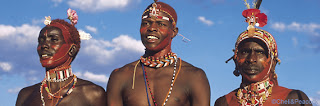
The Maasai and their cousins the Samburu are perhaps the most famous of the Kenyan tribes. Every movie it seems uses them to represent Africa. They are the ones who used to drink the blood of the cattle they raised instead of eating them. The men covered in red ochre, often with long plaited hair, were once known as the fiercest warriors. When killing a lion with nothing more than a spear was a test of manhood, the fact that the men often sat around preening, as many might call it, give a whole other impression. At the stage when they would be fighting, that is their only role protection. They spend several years as the guards before moving to the next age set, when they are of age to marry. If there is no protection needed they spend, their time on their looks to attract girlfriends.
They are one of the more traditional tribes in Kenya, and finding the men and women in traditional dress isn't hard, even today. The women are known for wearing many layers of beads around their necks, and while red is still a favored color, it now comes from dyes instead of ochre.
Here's an excerpt from my novel, Samburu Hills:
Celeste lay in bed as the contraction hit hard. She was going to die in the middle of Africa without anyone knowing she was gone. Damn good thing Nicholas was already dead. Breathing hard, she started laughing as the pain eased. If she died, she could go kill his ghost.
"Memsahib."
Celeste opened her eyes slowly, not recognizing the voice. Had Zahra actually spoken to her? She was the only one there. No, not the only one there, an older Samburu woman in her fifties with a closely shaved head stood there too. She had never seen one of the Samburu up close before. Two bottom teeth missing and long distended earlobes. She wore only a skirt and cape of skins dyed with ochre, iron band necklaces and bracelets that coiled on her fore and upper arms. Sayid had told her about them and the many inches of mpooro engiro, the elephant hair necklaces the older women wore, even though European beads were becoming popular. They were received at marriage, and hers were thick enough to support her chin.
"I brought someone to help with the toto kuja. The child to come. Her name is Nakadi Lelepokachau," her husband's mistress said.
Celeste closed her eyes as another contraction hit. Lying there when it was over, she was lifted up and a cup forced to her mouth. She was too exhausted to fight it.
In the Kikuyu, the largest tribe and the one that played the biggest part in Out of Africa, the brides wore a headdress made of large hoops round their whole head, while the older married women would have the hoops all in the bunch at the back of their heads. The men could usually be identified by the colobus monkey fur that they wore. The Kikuyu speak Bantu a groups of languages that make them cousins to several tribes in the area. The Embu, Ndia, Meru, Chuka, and Mbeere, the last of which I lived with for two years.
I can say without a doubt that the traditional dress is gone from the area. The woman would be scandalized to wear it. There are pictures of them in the 40s, and even then they had trouble finding the traditional clothing. They would often pluck their eyelashes to give them a modest look and a natural gap between their front teeth was one sign of beauty.
 To the north of the country, there are a number of tribes that don't fit the typical mold when you think of Africa. The Gabbra and Borana, as Joy Adamson put it, could have stepped straight from the Old Testament. With straight plaited hair unlike any other tribes in the area, even now they wear necklaces made of squares of aluminum to simulate the older version where the small squares were cut of stone. Leading camels about, they dress in flowing clothes wrapped around them that blow in the wind. The women in the colorful robes are found everywhere.
  The men, however, are all in white with a turban. The iconic picture of the north of the country depicted on the back of the 50 shilling note is actually still to be found.
Arab, Somali, Ethiopian, and Kenya all merge at the coast. Where Islam flourishes, women wear buibui like in the Middle East. Arab traders established routes down the coast of Africa, and the Portuguese set up a fort in Mombasa in the 1500s. There are Chinese names in the island of Lamu off the Kenyan coast from shipwrecked sailors. The beauty of Kenya takes many forms.


