Showing posts with label women. Show all posts

03 June 2016

Slaves and Servants: Concubines in the Islamic World

By Lisa J. Yarde

The 19th-century Orientalist period in art history, and the accounts of the explorer Sir Richard Francis Burton and Lady Mary Wortley Montagu, wife of the British ambassador to Turkey,  once influenced knowledge on the life of concubines in the Islamic world.  I'm particularly fond of the artwork, much of which I've used in the debut covers of my Sultana series, but a common theme among the portrayals is often the image of a beleaguered woman trapped in uncertain circumstances and awaiting cruel fate. The terrified slave girl, shamefaced and paraded naked before strangers who prod and poke her to determine her suitability for sale or as a gift. Equally represented is the idle, languid slave laying around the harem or household with nothing better to do than await the summons of her master. Just as fanciful was the idea that the concubines engaged in nightly orgies with their master, blessed to have easy access to nothing but gorgeous women at his disposal. The truth about concubines in harems from Spain to the Middle East indicates a different lifestyle, governed by strict rules and offering other possible outcomes for ambitious slaves. For the most fortunate among such women, even those who began their career as captives, their lovers and eventual husbands, sons and brothers gave them access to power that might have seemed unimaginable upon their introduction into a new life.

From the Moorish era, there are the best-known examples of Subh who lived in 10th-century Cordoba, and the bitter rivals, Butayna and Maryem in 14th-century Granada. But how did women become concubines in the Islamic world? Religious customs allowed the conquerors to makes slaves of any person captured in warfare so that by the first century of the Moorish period in Spain at least 20% of the population lived in bondage. Slavery did not bar these women from conversion to Islam or manumission in the future. As the Arabs and Berbers went westward across North Africa and into Spain, they seized captives of every age. Pirates, particularly from the North African coast known as the Barbary also raided across the Mediterranean Sea, attacking France and Italy, and as far north as the English and Irish coastlines up through the 17th-century. Black slaves came from eastern and Western Africa across the Sahara. In 14th-century Morocco the ruler Abu Inan Faris, whose mother was described as a black woman, supposedly had a favored concubine, an English woman renamed Shams ed-Duna. 

Women became part of the tribute demanded by Moorish rulers, slaves prized for more than their beauty or potential sexual partners, as singers, dancers, and poets. The base price for most of the Islamic world seems to have been 1,000 gold coins or dinars for European slaves; very beautiful or skilled women commanded much higher prices. Most importantly for such concubines, the children they bore for their masters were considered free from their birth and the legitimate heirs of their fathers, or in the case of royal concubines, their sons might become future rulers.  In the 10th-century, Ramiro II of Leon, Garcia Sanchez I of Navarre and Count Fernan Gozalez of Castile each had the obligation to provide the first caliph of Cordoba Abd ar-Rahman III with sixty young women as tribute. Perhaps that means allowed Subh's entry into the harem of Abd ar-Rahman's son and successor, Al-Hakam.


Although no one knows her Christian birth name, Subh received her new name, which meant  'dawn' in Arabic, after her abduction from Navarre. She must have became part of the household of Al-Hakam by at least 965 based on the birth of her child. Sources indicate that it's almost a miracle she attracted the caliph's interest because he had been a homosexual for most of his life and had a male harem. Supposedly, Subh overcame this difficulty because her hair had been  cut short like a young man's and she wore trousers. Subh bore Al-Hakam's son Hisham in 966.  Ten years later, he ascended the throne as the third caliph after his father's illness, despite the attempts of one of Al-Hakam's brothers to rule. One of two official regents, Subh advanced the career of a minister from Algeciras, Al-Mansur ibn Abi Amir, who dominated Hisham's rule. There is also speculation that Subh took Al-Mansur as her lover. She might have come to regret this choice when Al-Mansur effectively robbed Hisham of power in 997 for the next five years. Nothing is certain about Subh's eventual fate afterward.

Of  the concubines Butayna and Maryam, there are other uncertainties. Each has been called concubine or wife interchangeably in the sources - if married, it's likely they would have converted to Islam. Both were born as Christians, but there's no indication of where these women came from or when they became part of the harem of Sultan Yusuf I of Granada. He had come to the throne at the age of fifteen in 1333 upon the assassination of his elder brother Muhammad IV at eighteen, himself a successor of a murdered father, Ismail I. As with Subh, the dates of the women's entries into Yusuf's household can only be assumed by the births of their respective first sons. Butayna, whose name meant 'one who possesses a young and tender body' bore her first son Muhammad on January 4, 1338, so she would have been part of the harem by the previous year at least. Later, she also had a daughter Aisha and possibly another son called Ahmad. Maryem, whose possible alternate name of Rim might have been transposed incorrectly from the original sources, had her son Ismail on October 2, 1338. This tiny detail about Yusuf's sons being born ten months apart led me to imagine a deadly rivalry existed between Butayna and Maryem in the third novel of the Sultana series. Latter events also suggest the vicious nature of their relationship.


Most of the sources agree that Yusuf favored Maryem over Butayna, as supposedly evidenced by Maryem's seven children as compared to Butayna's two or three. In addition to Ismail, Maryem became the mother of another son called Qays, and five daughters named Fatima, Mumina, Khadija, Shams, and Zaynab; while the eldest of these princesses isn't specified she becomes important in subsequent history. Most of the court ministers favored Muhammad as Yusuf's eventual successor, but there are indications that he would have preferred Ismail to rule Granada upon his death. Yusuf's end on October 19, 1354, occurred suddenly and as brutally as that of his elder brother and father; a slave stabbed him to death in the main mosque near Alhambra palace. Muhammad V ascended the throne, married his cousin and had a young son. In the interim, Maryem and Yusuf's eldest daughter had married her cousin. On August 21, 1359, over one hundred conspirators in support of Maryem and her son-in-law scaled the palace walls and overthrew Muhammad who fled into an eventual exile in Morocco. Not all the sources agree Butayna was with her son at the time, but none mentions her death during this tumultuous period. Maryem's eldest son became the ruler of Granada, but Ismail II suffered, too. Almost a year later, Maryem's son-in-law overthrew Ismail, executing him with his brother Qays and possibly Maryem.

Image result for magnificent century

Other examples of famous concubines who became the power behind in the throne of Islamic societies can be found in my 2010 UH article, Women Did It Better: The Reign of Women, which explored how the 16th and 17th-century concubines Hurrem, Nurbanu, Safiye, Kosem, and Turhan influenced the reigns of their lovers and husbands, brothers, and sons. Georgians and Circassians were the most common among Ottoman concubines, but Hurrem was likely Polish, her daughter-in-law Nurbanu came from Venice, and Nubanu's daughter-in-law Safiye was either Venitian also or Albanian. Kosem was born in the Greek isles and her daughter-in-law Turhan came from the Ukraine or Russia. Turkey is enjoying a resurgence of interest in the lives and loves of those women as concubines or eventual wives within the Ottoman royal harems through the production of two series, Magnificent Century and Magnificent Century: Kosem. Both are well-done and entertaining, more than historical figures in fancy dress, illustrating the roles of concubines who became more than they might have once dreamed. 


Sources

All images are public domain, royalty-free. All data from numerous sources researched during the writing of the Sultana series.


Lisa J. Yarde writes fiction inspired by the Middle Ages in Europe. She is the author of two historical novels set in medieval England and Normandy, The Burning Candle, based on the life of one of the first countesses of Leicester and Surrey, Isabel de Vermandois, and On Falcon's Wings, chronicling the star-crossed romance between Norman and Saxon lovers before the Battle of Hastings. Lisa has also written five novels in a six-part series set in Moorish Spain, Sultana, Sultana’s Legacy, Sultana: Two SistersSultana: The Bride Price and Sultana: The Pomegranate Tree, where rivalries and ambitions threaten the fragile bonds between members of a powerful family. Her short story, The Legend Rises, which chronicles the Welsh princess Gwenllian of Gwynedd’s valiant fight against English invaders, is also available.

11 May 2011

15 Minutes of Fame: Regina Strinassachi

By Carrie Lofty

On April 29, 1784, a young woman performed with Mozart for Joseph II, the Holy Roman Emperor. But that woman, Regina Strinassachi, did not play pianoforte as most ladies were wont to do. She played violin, with Mozart on piano. Together they debuted Mozart's newest composition, Sonata in B flat for Violin and Keyboard (K. 454), which he had written for her.

By all accounts, K. 454 is a rather difficult piece, which speaks to Mozart's high opinion of Strinassachi as a performer. He often wrote "puff" pieces for influential patrons' children who had mediocre talent, but this was not one of them. In a letter to his father, Mozart wrote: "We now have here the famous Strinasacchi from Mantua, a very good violinist. She has a great deal of taste and feeling in her playing. I am this moment composing a sonata which we are going to play together on Thursday at her concert in the theater."

The concert was noted, however, not for Strinassachi's virtuosic performance, but because Mozart performed from blank pages. He had been in too great a hurry to write down his part, instead performing from memory. Later years would elevate this duet to the stuff of legend, with Mozart reputed to have composed his portion on the spot.

Regina Strinassachi, 1795But who was Strinassachi?

The nuns at Venice's famous Ospedale della Pietà--founded by Antonio Vivaldi as a refuge for orphan girls, or perhaps for the illegitimate daughters of wealthy nobleman--constantly obscured the year of Strinasacchi's birth. As a child prodigy, if she could pass for ten years old, that would wow the audiences more than if she was actually 16. The fact she had a surname adds to the mystery of her origins, because most of the girls at the Pietà took on the names of their preferred instruments--Anna della Violin from Barbara Quick's Vivaldi's Virgins is one famous example.

Strinasacchi toured Italy, France and Germany, performing on both violin and guitar, before arriving in Vienna in 1784, where she met Mozart. In 1785, she married Johann Conrad Schlick, a famous cellist and konzertmeister of the Gotha ducal band. Some speculate that her marriage may have been one of a professional nature, because she became the first woman in Europe to perform full-time with an orchestra, rather than as an occasional soloist. She may have also composed. Their daughter Caroline, born in 1786, grew up to play piano as part of a family trio, and they split their time between Gotha and tours that reached as far as Russia.

Here I imagine Mathida Heidel, the heroine of my first book with Carina Press, SONG OF SEDUCTION, meeting Regina before a concert.
The pair reached Arie where he stood next to an elegant woman in her early forties. She wore an exquisite gown of ice-blue silk and ivory lace trim. Gray-streaked black hair arranged in an elaborate coiffure of spirals and curls accentuated the graceful lines of her neck and slender face. Magnetic black eyes shone from beneath heavy dark lashes. An oblong bruise along her left jaw marred her otherwise flawless olive skin.

Mathilda had never seen such an arresting woman.

"De Voss, there you are," Haydn said.

"Gute Abend, Kapellmeister. And Frau Heidel. Lovely to see you." Arie bowed deeply, his air bright and amused. He turned to present the elegant woman. "Allow me to present Frau Regina Schlick."

"I am honored to meet you both," the woman said. Her lilting Italian accent created melody out of plain speech. "Herr De Voss has told me you perform exquisitely."

"Thank you." She smiled broadly at the unexpected compliment. That he would speak of her in glowing terms to this exotic woman warmed Mathilda from top to toes. "The maestro flatters me."

"Nonsense. He recognizes talent almost as well as he composes."
Their son Johann was born in 1801--when Strinassachi would have been nearly 40--and became a cellist and instrument maker. Caroline married and became an actress. Upon her husband's death in 1818, Strinassachi moved with her son to Dresden. She died in 1839, having lived through 80 tumultuous years--from the old Georgian and Classical periods, through the Napoleonic era, and into mid-19th century Victorian Europe.

But few remember Regina Strinassachi today. In fact, I was the person who wrote her Wikipedia entry, based on my research for SONG OF SEDUCTION. If the prodigal female violinist is remembered at all, it's because of that fateful day in 1784 when she found out what it meant to play second to Mozart.

SONG OF SEDUCTION's sequel from Carina Press, PORTRAIT OF SEDUCTION, is now available! Later this year watch for Carrie's new Victorian series from Pocket, as well as her "Dark Age Dawning" romance trilogy from Berkley, co-written with Ann Aguirre under the name Ellen Connor. "Historical romance needs more risk-takers like Lofty." ~ Wendy the Super Librarian

22 February 2011

An Ordinary Day In: The Life of a Washerwoman

By Elizabeth Lane

Among the family treasures in my home is my Great-Grandma Magelby's battered old copper wash boiler. It measures 20 inches across by 13 inches high and sits on a three-legged iron stand, which supported it over the fire. On one side of the lip, where the soapy water was always dumped out, the copper has been corroded away. It makes the old tub less presentable but even more precious. When I look at it I imagine her dumping out the wash water time after time, week after week, over the years of her life.

Washing clothes in those old days wasn't a job for sissies. To give you an idea of what was involved, here's a list of instructions, written by a grandmother to a new bride. The spelling errors are from the original. I can't vouch for its authenticity, but it's a fun read and probably pretty accurate.

WASHING CLOTHES

Build fire in backyard to heat kettle of rain water.
Set tubs so smoke wont blow in eyes if wind is pert.
Shave one hole cake of lie soap in boiling water.
Sort things, make 3 piles--1 pile white, 1 pile colored, 1 pile work britches and rags.
To make starch, stir flour in cool water to smooth, then thin down with boiling water.
Take white things, rub dirty spots on board, scrub hard, and boil, then rub colored don't boil just wrench and starch.
Take things out of kettle with broom stick handle, then wrench and starch.
Hang old rags on fence.
Spread tea towels on grass.
Pour wrench water in flower bed.
Scrub porch with hot soapy water.
Turn tubs upside down.
Go put on clean dress, smooth hair with hair combs.
Brew cup of tea, sit and rock a spell and count your blessings.

Monday was the traditional day for washing. In many communities there was competition among housewives to see who could get their wash hung first and whose whites were the whitest. In good weather the washing and drying could be done outdoors. In the winter the job had to be done in the kitchen, with lines strung wherever they would fit. Starched clothes were sprinkled and rolled up to await Tuesday--the traditional ironing day.

The above list mentions "lie soap". Most people made their own soap in those days out of lye (which came from wood ash) and fat. The soap was used for bathing as well as laundry. My mom's sister swore by homemade lye soap and made it all her life. We always used to save our bacon drippings to give her for soap. Here are a couple of recipes I found.

Boiled Soap (for cooking outdoors in a kettle)
32 pounds lard
16 quarts soft water
8 cans lye

Boil two hours and then add one more gallon of water. Stir and remove fire from kettle and pour into molds.

Cold Soap
6 lbs melted fat
1 can lye
2 1/2 pints water

Add lye to water and dissolve. When container which holds the lye water is warm, add the fat and stir until cool. Pour into a cloth lined box, or a box that has been dipped in cold water, and cover. Cut soap into squares when set.

The modern age of the washing machine dawned with the invention of a self contained electric machine in the first decade of the 20th Century. In 1922 Howard Snyder placed a circular plate studded with four vertical fins at the bottom of a tub and attached it to a drive shaft to make the first agitator washer. Some time later, rollers were added above the tub for wringing out clothes. My mother used an old Maytag of this style for most of my growing up years. She taught school all week and spent most of her Saturdays doing the wash. We've come along way with our modern automatic washers that known how and when to wash, rinse and spin. So give your washing machine a hug today.

Elizabeth Lane has written more than thirty historical romances, several set in the early 20th century. Her latest is CHRISTMAS MOON, a time travel set in present day and 1870s Wyoming, available in print and Kindle from Amazon.com, and in other e-formats from E-Reads. Watch for her latest Harlequin Historical, THE WIDOWED BRIDE, in March 2011.

16 February 2011

An Ordinary Day In: The Life of a Medieval Peasant Woman

By Lindsay Townsend

A medieval woman had to be many things, depending on her social position. A noble woman could be responsible for running and managing a castle, great house or estate and also be involved in actively pursuing her family's or husband's aims, including warfare. A woman in a town would need to oversee her house and also continue her own business, or that of her husband's if she was a widow. A peasant woman would need to be skilled in herb-lore and folk-medicines, also a cook, laundress, spinner, harvester, child-minder, store keeper, brewer (or brewster, the female of brewer) and more! So the day in the life of any medieval woman was likely to be busy.

I'm looking at the day in the life of Mary, a peasant woman who lived in the 1300s before the Black Death. Mary is a housewife who is married to Adam and they live with their three children on a small holding in medieval Oxfordshire.

Mary's day begins at first night whatever the season. In summer this might be as early as 4 am. In winter her simple wattle and daub timber-framed home would be shared with the family's few animals, for extra warmth and to protect the beasts from wolves and other predators. Today in July Mary rises early from her sacking and straw bed. She dresses in a plain dress of wool, usually russet in colour, and then helps the children to dress before providing them and Adam with a breakfast of ale and bread or cold pottage. While Adam and the two older children leave to help with cutting and turning their lord's hay harvest, Mary is busy at home. She will help with the harvest later but she has other tasks first, beginning with washing the clothes.

She and her youngest daughter take the woollen and linen clothes down to the small river to pummel with small paddles and rinse in the clear stream. They spread the wet things on bushes to dry and Mary then tends her few chickens and geese. She and her daughter work for a while in her kitchen garden, weeding and gathering herbs and vegetables. Both are glad of a drink of ale, bartered from the village ale-wife, when they take a break.

It is July, hay-making time, back-breaking and tedious. July is also the hungry month, when wheat and other grain stores are low. Mary is always hungry in July and when she has time she grinds up the bits of wheat and old peas and beans on her small saddle query to make a kind of flour she can turn into bread and bake on her hearth under an upturned pot. She grinds in secret, with her youngest daughter keeping watch by the cottage door, because the miller would complain to her lord that she is not getting her wheat ground by him and paying a fee for the 'privilege'.

Some days Mary makes rush lights, or collects berries and wild fruits from the surrounding countryside, or helps her husband Adam tend their own or their lord's field strips. Some days are a holy day--a holiday--when the family go to church to celebrate special saints' days and festivals. Today, although her back is hurting--many skeletons from medieval times show people plagued by rheumatism and stress injuries brought on by the sheer hard work--Mary goes to join Adam and her two older children, labouring to bring in the hay harvest. She takes with her a lunch of bread and cheese for her family--the cheese is a soft one, made by her from the milk of their cow, and needs to be eaten quickly. She also gathers a few wild strawberries.

Reaching the hay fields of their lord, Mary finds the other workers resting and taking a midday meal. The reeve has brought some ale for all the hay makers and more bread. Adam and her children eat quietly. Her youngest child asks what is for supper and Mary has to admit it will be cold pottage again--she has no time to prepare anything else. Later, Adam draws her aside and whispers he has bartered another day's hay-making with the reeve for a fat rabbit, taken from the lord's warren. With onions from their garden they will eat well tonight, God willing.

With a lighter heart Mary works in the hay field for the rest of the day, gathering and turning the long grass and flowers the men have cut with scythes. The summer evening and dusk is long in coming but then she, Adam and the children wander off to their cottage with the prospect of supper and bed.

I show the impact of the Black Death on the lives of peasants like Mary in my forthcoming novel, TO TOUCH THE KNIGHT. For details of this and my other medieval historical romances, please visit my website.

Lindsay Townsend writes historical romance set in medieval England and the ancient Mediterranean. Her latest is A KNIGHT'S ENCHANTMENT, available now. She lives in Yorkshire with her husband.

29 September 2010

Women Did It Better: Nellie Bly

By Elizabeth Lane

The crusading journalist known as Nellie Bly was a real-life heroine in every sense of the word. Born Elizabeth Jane Cochran in 1864, she was the third child of a wealthy Pennsylvania judge and his second wife. She was raised in comfort until the age of six, when her father died. Unfortunately he left no will providing for his second family. Elizabeth's mother and her five children were thrown into poverty.

In desperation, her mother married an alcoholic who abused her. When she later filed for divorce, Elizabeth testified at the trial. At fifteen, Elizabeth entered normal school, hoping to become a teacher and support her mother. But with her family so poor, she was only able to attend one semester. She then moved to Pittsburgh with her mother. For seven years she helped run a boarding house, taking other work when she could find it. She dreamed of becoming a writer.

That dream came true when she read a series of columns in the Pittsburgh Dispatch, from a popular writer who wrote that women belonged at home doing domestic tasks and called the working woman "a monstrosity." Elizabeth's spirited rebuttal about the plight of women and girls who had to work so impressed the paper that they hired her and gave her the pen name "Nellie Bly" after the Stephen Foster song. Her first story was about poor working girls. Her second called for a reform of the state's divorce laws. The paper, however, wanted to confine her to the women's page, writing about social events and fashion. Bly convinced the editors to let her be a foreign correspondent in Mexico, where she sent back stories about the lives of the Mexican people. On her return, however, she was again confined to the women's page. That was too much. Nellie quit and struck out for New York.

After knocking on doors for six months, she talked her way into the office of the New York World. The editor, possibly to brush her off, challenged her to write a story about the patients housed in a New York mental institution. Impersonating a mad person, Nellie came back from Blackwell's island ten days later with stories of beatings, ice cold baths and forced meals that included rancid butter. Her story stirred the public and politicians and brought money and needed reforms to the institution. At the age of 23, Nellie Bly had begun to pioneer a new kind of investigative journalism.

In the years that followed, she exposed corruption and injustice, always taking the side of the downtrodden. Her fame also opened the doors of the rich and famous, and she profiled many celebrities of her time. The peak of her fame came when she took a whirlwind trip around the world in 1889 to beat Phileas Fogg, the fictional hero of Jules Verne's "Around the World in Eighty Days." Traveling by ship, train and Burro, she made it back to New York in a little over 72 days, cheered by huge crowds.

At the age of 30 Nellie Bly married a 70-year-old industrialist named Robert Seaman. After his death ten years later she ran his business until it went bankrupt. Then she turned back to reporting. Picking up where she left off, she championed worthy causes, including finding homes for abandoned children. She died from pneumonia in 1922, at the age of 57, after a life that would rival any work of fiction.

08 September 2010

Women Did It Better: Higher Education

By Blythe Gifford

I'm going to approach this subject in a roundabout way. Instead of starting with something that women have done better, I'm going to start with something they were originally not allowed to do at all: go to college.

For most of recorded history, women were excluded from institutions of "higher learning." And when I say excluded, I mean that in the strictest sense. At Cambridge in the 14th century, for example, it was forbidden for a female laundress to even enter the hostels where the young scholars lived. A female student couldn't even be imagined.

The reasons for putting the "No Girls Allowed" sign on the tree house were, on the surface, "logical." The medieval explanation, as Thomas Aquinas stated it, was that women were "deficient," and needed to be ruled by men, who were rational. This was all part of God's plan, particularly at Cambridge, which I researched for IN THE MASTER'S BED. Cambridge did not confer its first degrees on women until 1948.

Nearly 600 years later, little had changed. In the mid-19th century, women-only institutions were created because women were still kept out of the "men-only" schools. The first women allowed to study beside men at a four-year, American college attended Oberlin in Ohio, graduating in 1841. In Britain it wasn't until 1880 that the first women were awarded degrees from a coeducational institution (the University of London), although women were allowed to study at Queen's College as early as 1848.

But even then, "everyone knew" that women were unsuited by nature for the physical and mental rigors of the higher forms of learning. A few unusual women might have been allowed to attend college, but medical school, law school and the like continued to be off limits. By then the reasons were attributed to science, not the Almighty, but the rationale was much the same. Women had measurably smaller brains. Their reproductive organs would draw away blood from the brain, rendering their mental faculties incapable of processing academic information. Not their fault, of course. They were simply, physically incapable of understanding such complex material.

While this may seem like ancient history, it was only within the last 30 years that there was any requirement that men and women be treated equally in higher education. We think of Title IX, passed in 1972, as requiring girls to have the opportunity to play sports, but the language of the act is much broader. Now called the Patsy T. Mink Equal Opportunity in Education Act, it says "No person...shall, on the basis of sex, be excluded from participation in, be denied the benefits of, or be subjected to discrimination under any education program or activity receiving Federal financial assistance."

What's been the result of this? The number of women in all levels of higher education has grown by leaps and bounds. In 1972, women earned 7% of law degrees and 9% of medical degrees. In 2001, women earned 47% of law degrees and 43% of medical degrees. And in 2006, women earned 58% of the bachelor's degrees and 60% of the master's degrees. Not only do women earn the majority of bachelors and masters degrees, recurring reports indicate that women maintain higher grade point averages than men. (Truman College, for example, reported in 2002 a consistent gap, which that year was between a 2.87 GPA for male freshmen and. a 3.19 GPA for female freshmen.)

We can put forward many arguments as to why women are, arguably, more successful than men in higher education. Explanations have ranged from the earlier onset of maturity in women to a male tendency to party more. (I do not cast aspersions on our brothers. I simply report a hypothesis.) Once again, we look to science for answers. And today's science has discovered that women's brains are larger than men's when it comes to the area governing the verbal skills so helpful to success in the classroom.

Will this look any more rationale in hindsight than the arguments of the 19th and 14th centuries? We'll see. But for now, it appears that women do higher education better.
Makes you wonder if we were excluded all those years because someone had a sneaking suspicion this might happen.

01 September 2010

Women Did It Better: Pioneer Codebreakers

By Carrie Lofty

Bletchley Park in England became the hub of Allied cryptography during WWII, famous for cracking Germany's Enigma code. The intelligence organization housed there, known as the Government Code and Cypher School, was staffed by more than 80% women. But two of the most dynamic and influential female codebreakers of the era were from the United States: Anges Meyer Driscoll and Elizebeth Friedman.

Illinois-born Anges Meyer Driscoll enlisted in the US Navy in 1918, just after the United States entered WWI. With her university background in foreign languages and mathematics, she entered as a chief yeoman and was assigned to the Code and Signal section of the Director of Naval Communications.

Emerging cryptographic methods included the invention and implementation of rotor machines to tackle mathematically-based codes--machines that were, in essence, proto-computers. Agnes was a tremendous advocate of this new technology and developed one of the Navy's first such machines, called "CM," during WWI. Thirty years of work on Japanese naval codes resulted in several considerable breakthroughs, including JN-25, the Japanese fleet's operational code. After Agnes and her team cracked JN-25, the post-Pearl Harbor Navy was able to out-maneuver the Japanese fleet.

Agnes also assisted in the Navy's attempt to pick apart Enigma, but that responsibility was eventually turned over to Bletchley Park. Following her retirement from the Navy after more than 30 years of service, she joined the NSA (National Security Agency) in 1952. She was buried in Arlington after her death in 1971 and was inducted into the NSA's Hall of Fame in 2000.

Indiana-born Elizebeth Friedman introduced her husband, renowned codebreaker William F. Friedman, to the field of cryptology--a passion they would share throughout their 52 years of marriage. She spoke Greek, Latin and German upon graduating from college with a degree in literature. Her love of Shakespeare earned her a job at the US intelligence facility known as Riverbank, where she initially studied whether Shakespeare's plays had actually been written by Sir Francis Bacon. Elizebeth's skills with language and the detection of patterns and anomalies eventually landed her a place at the forefront of Riverbank's juvenile codebreaking operations, including deciphering Prohibition-era codes used by gangsters.

Elizebeth and her husband left Riverbank in 1921 to found the War Department's Signals Intelligence Service, which William headed for 25 years. Elizebeth's skills at Prohibition-based decryptions were so in demand that she convinced Congress in the early 1930s of the need to train more people like her. Additional cryptoanalysts on the government payroll freed her and her husband to tackle more anomalous codes and, unbeknownst to them, to hone their skills for the conflict to come. Even being unfamiliar with a language did not stop her from applying mathematics and logic, as was exemplified by her decryption of a Mandarin Chinese code in a 1937 Canadian opium smuggling ring. She became the expert witness of choice in any trial involving the analysis of broken codes, and traveled extensively to help secure these convictions.

During WWII, Elizebeth was responsible for deciphering the codes that would eventually find Japanese spy Velvalee Dickinson, the notorious "Doll Woman," guilty of wartime censorship violation (a plea bargain down from espionage, which would've brought her the death penalty). Elizebeth and her husband were key players in negotiating with Bletchley Park to share information between Allied codebreaking operations. They exchanged deciphering machines and intelligence that resulted in many breakthroughs in the European Theater. Elizebeth's Coast Guard unit at one point attached to the Navy where she and her team solved one of the Enigma codes used by German submarines.

After the war, Elizebeth designed security measures for the Intenrational Monetary Fund and, with her husband, co-authored The Shakespearean Ciphers Examined, which revisited her early love for Shakespeare and the mysteries of his authorship. She died in 1980 at the age of 88 and is remembered as the first female American codebreaker.

25 August 2010

Tragic Tales: Chinese Slave Girls of the Barbary Coast

By Jacquie Rogers

The California gold rush of 1849 brought men from all over the world, including China, to find their fortune. The next gold rush was of a different nature--those who provided services to the miners...for a pinch or two of gold dust.

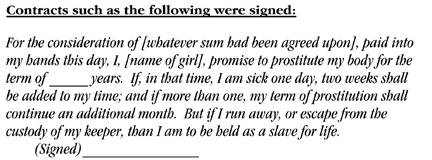
Barbary Coast was the section of San Francisco that harbored the red light district. It was rife with gambling, prostitution, pickpockets, and violent crime. The streets were crowded with brothels, gambling houses, saloons--this was where the rowdiest of the rowdy men went to kick up their heels. The Barbary Coast was also home to the cribs--low-class prostitution housing--and small Chinese girls pleading for the men walking by to use her services.

In China girls weren't valued, and many girls, even babies, were sold to "entrepreneurs" who took them to America to be used as sex slaves. In San Francisco, girls were bought and sold--a baby sold for a little over $100. These girls were raised to prostitute themselves.

This is from The Virtual Museum of the City of San Francisco, quoted from A la California: Sketch of Life in the Golden State by Albert S. Evans:
These poor creatures are all slaves, bought with a price in China, and imported by degraded men of their own race, who, despite our laws, contrive to hold them to a life-long servitude, which is a thousand times more hopeless and terrible than the negro slavery of Louisiana or Cuba could ever be. They have been reared to a life of shame from infancy, and have not a single trace of the native modesty of women left. They are, as we have said, mere children in point of intellect, having no education whatever, and no experience of the world outside of the narrow alleys in which they have always lived, and the emigrant ship in which they were brought over to this country...

The girls cost $40 each in Canton, but are valued here at about $400, if passably good-looking, young and healthy, and readily sell at that figure in cash, or approved paper. Each colony of half a dozen girls is under the immediate control of an "old mother," herself a retired prostitute, who jealously watches over each, and receives from them the wages of their shame as fast as earned.
Officials looked the other way for two reasons. First, they were paid off by the Chinese merchants, and second, they didn't consider the Chinese all the way human. Chinese girls were no more significant, and less valuable, than a horse. Once a girl was sold into slavery, there was no help for her.

These girls were also called sing-song girls and worked in small rooms lining the cribs alleyways. The girls would bare their breasts to passers-by. If they didn't attract enough customers, they were often physically punished. During their periods, if they had any, they were considered sick and that missed time was added to her contract.

This is from http://www.foundsf.org/:

Opium was administered to them for every ailment, and many girls were addicted. Once a girl's looks had faded and/or her health deteriorated, usually before age 20, she was placed in a room with a vial of narcotics. She could either take the overdose, starve, or if she wasn't dead when they came for her corpse, she was murdered. These murders weren't reported or even noted by the authorities.

One white woman who didn't look the other way was Donaldine Cameron, the Angry Angel of Chinatown. She was born in New Zealand and came to California with her parents when she was a child. At 18 she was engaged, but no one seems to know why she never married. In 1895 she took a position as a sewing teacher at the Occidental Mission Home for Girls and became a crusader for these abused girls no one else cared about. Over a period of 40 years, she was instrumental in the rescue and education of over 3,000 Chinese girls. Miss Cameron used sledgehammers and axes to get to the girls, and learned early on to find more girls in hidden in walls and under the floor boards. Of course the slavers hated her, calling her Fahn Quai--white devil.

History books teach that slavery ended in the United States with the Civil War, but that wasn't so for the sing-song girls of the Barbary Coast, who, in many cases, worked in worse circumstances than the slaves of the South, with a far shorter life expectancy. Finally, 75 years after the Emancipation Proclamation, the Chinese slave trade ended. It's a blight on American history that we should never forget.

Jacquie

Down Home Ever Lovin' Mule Blues (See the Book Video featuring Justin Saragueta)
Jacquie's Website * 1st Turning Point * Myspace * Twitter * Facebook
Faery Special Romances (Book Video) * Royalties go to Children's Tumor Foundation, ending Neurofibromatosis through Research


Read a book by Jacquie Rogers

03 March 2010

Arts and Music: Ma Rainey

By Lorelie Brown

On April 26, 1886, Gertrude Pridgett was born to parents Ella and Thomas, who worked the minstrel circuit, a kind of sub-category to vaudeville.

It doesn't seem like a particularly auspicious beginning, does it? Who would have ever imagined that Gertrude Pridgett would eventually become Ma Rainey, the woman acknowledged to be the "Mother of the Blues"?

Ma Rainey got her start in entertaining early. By 1900, at 14, she was working steadily in vaudeville, and traveling with her parents. In 1904, she met and married William "Pa" Rainey, and at that point took on her iconic name. At some point in her travels--most people seem to believe in St. Louis--she heard authentic country blues, and began incorporating them into her routines, as well as putting her own spins on songs.

By 1912, Bessie Smith, who would later be known as the "Empress of the Blues" had joined their troupe as a dancer. At one point, it was believed that Ma Rainey had vocally trained Bessie Smith, but that's lately come into doubt. It's now said that Smith mostly got her stage presence from Rainey. (And something else, but I'll cover that in a second.)

In 1923, Ma Rainey started recording for Paramount and would eventually go on to record a hundred "sides" (mini-albums) with them. She wasn't the first, and her recordings weren't the best, primarily because of poor quality, but she became one of the most famous, bridging the gap between country blues and the woman-centric blues that would become the signature style of the Roaring Twenties. Despite a few minor scrapes with the law, she was an exemplary entertainer, and is often regarded as a consummate professional. Her career faded in the 30s, as blues went out of style because people were already miserable and couldn't stand to listen to anything sad. She retired to her hometown of Columbus, Georgia, where she managed two theaters until her death of heart disease in 1939.

I know what you're saying to yourself. Lorelie wrote about a figure with no sex or scandal? Pshaw. Yeah, right.

Well, didja wonder what happened to Pa Rainey? The simple answer is not much. He and Ma separated in 1916, twelve years after their marriage, and he disappeared into obscurity.

So what did Ma do after that on the relationship front? Apparently anything she wanted. In Chicago Ma Rainey was arrested after a noise complaint led police to a hotel room, where they discovered a number of performers from Rainey's current show in a state of undress and performing "intimate" acts. Oh, by the way? All the performers in that hotel room were women! Ma was bailed out of jail by Bessie Smith, who she supposedly also had a relationship with. The general supposition seems to be that Rainey was at the very least bisexual, and her songs seem to bear that out.

Now we're going to have the interactive portion of this program. I'm including a YouTube vid of Ma's "See See Rider Blues," one of her most famous songs. But I need you to do something for me before you hit play. Either turn off all background noise or get some headphones. Then, after you start it up, sit back and close your eyes. Listen to the emotion and particularly the pain easily heard in her voice. An amazing performer, isn't she? Now you understand why she was inducted into the Rock and Roll Hall of Fame in 1990, fifty-one years after her death.

01 March 2010

Arts and Music: Skin Art

By Elizabeth Lane

Love them? Hate them? Want one? Have one? Nobody seems to be neutral about tattoos. But there's one thing we can all agree on. Tattoos have been around since the beginning of human history, and they aren't going away anytime soon.

The word tattoo is derived from the Tahitian word "tatau" which means to mark something. The history of tattoos is as diverse as the people who wear them. The reasons for having a tattoo are just as varied. A tattoo can be a rite of passage, a sign of belonging to a clan or group, a status symbol, a token of bravery, a mark of beauty, uniqueness or self expression.

The usual method of tattooing involved piercing or cutting the skin with a sharp object, rubbing colored pigment into the wounds and letting them heal. There were many variations on this method. Even today's techniques use the same principle.

Tattooing was widespread among Native American tribes. For example, the Sioux believed that after death the spirit of a warrior mounts a horse and sets forth on its journey to the afterlife. Along the way, the warrior meets an old woman who demands to see his tattoos. If he has none, she turns him back to wander the world as a ghost.

Tattooing was practiced in many Asian cultures. Elaborate facial tattoos were especially prevalent among the Maoris of New Zealand. Even among modern Maoris, these tattoos are still a source of pride.

Tattooing was brought to Europe in the early 1800s by sailors who'd discovered it in the South Pacific. Over time it became a fad among the aristocracy. Even members of the British royal family sported tattoos. Inevitably, the practice of tattooing spread to America. The first permanent tattoo shop in New York City was set up in 1846. Most of the customers were military servicemen, and the tattoos tended to be patriotic or romantic in nature, especially with the onset of the civil war.

Getting a tattoo wasn't for the fainthearted. The needles were attached to a wooden handle. The tattoo artist dipped the needles in ink and moved his hand up and down rhythmically, puncturing the skin two or three times per second. The technique required great dexterity and took years of practice to perfect. Even for the best artists, the process was painfully slow.

After Samuel O'Reilly invented the electric tattoo needle in 1891, tattooing became easier, cheaper and more common. Even women began getting tattoos. A few people had their entire bodies covered with skin art--a guarantee of employment in traveling side shows. In the American West, most tattooing would have been done in the larger cities. A cowboy with a tattoo would probably have either been in the military or in prison, where inmates tattooed each other, often badly.

In today's society, tattoos are more popular than at any time in American history. With academically trained artists entering the profession, tattooing can rise to the level of fine art. These two examples were done by Teresa, an artist working in Santa Cruz, CA. She has a degree in art and a growing reputation as a painter. She also happens to be my daughter, and, yes, I have a sample of her early work, a little butterfly on my back. I wear it proudly. For me, it's a connection to someone I love.

27 October 2009

Research: Life in Ancient Egypt

By Jean Adams

Daily life in ancient Egypt was harsh. Despite being the most advanced nation of the then world, most people didn't live beyond 40 years of age. Because of this, they usually married at a young age.

Egyptian culture expected women to marry at around age twelve. Marriage was a secular activity regulated by custom rather than law. Instead of a marriage contract, men and women drew up property contracts at the time of marriage in the event of death or divorce. The woman then travelled to the home of her new husband.

In the home, women were responsible for the day-to-day running and decisions. Women had the same legal rights and status as men under the law. The men were usually gone from the home much of the time because of seasonal work or warfare. Tomb builders had their own towns and villages near their current work, enabling their families to live with them.

The division of labor within a household evolved from environmental conditions. The men did heavy physical labor in the hot sun, while women labored inside or in the shade. Women attended to the household's gardens and orchards. Kitchens were situated outside the home because of the intense heat and meals were eaten outside or on the flat rooftops.

Twice a day, women fetched water and filled huge clay vessels that stood in the courtyard or by the doorway of every house. Women did most of the weaving, spinning linen thread from flax fibers. As farmers, women never handled tools with blades. They winnowed the grain, separating the stalks and seeds, and then they ground the grain for baking. Women helped to make wine and beer, and they pressed oil from nuts and plants.

How about this, ladies. Women did not wash dirty laundry! It was the men who handled the laundry because it was washed in the Nile and there was a constant threat from crocodiles along the river banks.

If they had the means, bathrooms were built right in their homes. There is evidence that in the New Kingdom the gentry had small bathrooms in their homes. In the larger homes next to the master bedroom there was a bathroom that consisted of a shallow stone tub that the person stood in and had water poured over him. There is no evidence that the common people had bathrooms in their homes.

It was the responsibility of each household to dispose of their garbage at the communal dump - the irrigation canals. As a result, these dumps were breeding grounds for vermin and disease. Some homes in the cities may have had trays of earth for drainage and disposal of waste. For the most part, however, ancient Egyptians simply dumped their waste in canals or open fields.

There were no formal schools for girls, so mothers educated their daughters in the home. Women attended professional schools, such as the school of medicine at Heliopolis and the woman's school at Sais, to learn to become doctors.

Women in Egypt were free to seek employment outside the home. Many women worked as musicians or dancers in the temples and during festivals. Wealthier households employed women as maids or nannies, and sometimes as professional mourners for funerals.

Some women would operate a small business out of their home, such as linen or perfume manufacturing. These activities increased the household income because these items were much in demand for funeral rites.

Professional opportunities for women included physician or midwife, director of dance or singing troupes, and overseer. The women who became doctors mostly attended to other women as gynecologists. Their skills were such that they performed Cesarean sections and surgically removed cancerous breasts.

Legal rights, responsibilities, and status were divided along class lines rather than gender lines. Within a given class, men and women had the same rights. Women were free to buy and sell property, enter and execute contracts, and file lawsuits. A woman could acquire possessions, property, and debt separate from her husband through labor or inheritance. A woman was entitled to inherit one third of their joint property on the death of her husband, the remaining estate was divided between the surviving children and siblings of the dead man.

Women were also equally accountable under the law. A woman who was convicted of a capital crime in a court of law would be executed, but only after the court determined that the woman was not pregnant. If one was found to be pregnant, her execution was stayed until she could give birth to the child.

15 July 2009

Greatest Hits: Aimee Semple McPherson

By Delia DeLeest

Back before Jimmy Swaggart and Jim and Tammy Faye Bakker brought their scandals to the religious world, there was Aimee Semple McPherson.

After spending years as an itinerant Pentecostal minister in the early 1920s, Aimee pulled into Los Angeles with her mother and two small children in tow. Her husband, Harold McPherson, had filed for a separation in 1918 and was granted a divorce in 1921 on the grounds of abandonment. She was a woman called on a mission and she couldn't let something like a reluctant husband slow her down.

Within five years, her ministry had grown from going from town to town in her "Gospel Car"--a 1912 Packard decorated with religious sayings painted on the sides--to a multi-million dollar business. Starting off by giving sermons wherever she could find crowds, including boxing rings before and after matches, she raised enough money to fund the Angelus Temple for her church, The International Institute of Four Square Evangelism. The temple cost $1.5 million and included a $75,000 radio studio, seats for over 5,000 people, a nursery, a lonely hearts club, and a miracle room for the discarded wheelchairs and crutches of those followers who were healed of their earthly afflictions. Aimee had a good thing going.


In 1926, the world was shocked by the disappearance of Mrs. McPherson. Aimee had gone for a dip in the ocean. The last her secretary had seen of her before heading out on an errand, Aimee had been joyfully frolicking in the waves. When the secretary returned, Aimee Semple McPherson had disappeared. The faithful gathered to pray for her deliverance while others, spurred on either by evangelical zeal or the $25,000 reward for her recovery, diligently searched the area for their missing leader. In the resulting clamor, one man drowned, one died of exposure, and a young girl killed herself, distraught at the loss of her idol.

Finally admitting to the loss, a memorial service was held. Shortly after the service, Aimee's mother received a ransom note, asking for half a million dollars for the release of the evangelist. Believing her daughter to be dead and the note a fraud, she threw it away.

On June 23, 1926, thirty-five days after her disappearance, Aimee Semple McPherson stumbled out of the desert and into a small Mexican town just south of the Arizona border. She'd been held hostage, she claimed, trapped, drugged and tortured in a small desert shack. She'd only escaped after making her way thirteen hours through the desert to civilization. The world rejoiced.

But...(you just knew there was going to be a 'but,' didn't you?) Aimee's story had more loopholes than an afghan made by your far-sighted great-aunt Millie. Though she supposedly made her way thirteen hours across the desert, her shoes weren't worn and had grass stains on the sides. Grass stains in the desert? The shack she described could never be found, and even though she had disappeared while swimming, she returned fully dressed and wearing a watch given to her by her mother, which she'd not had with her when she'd gone to the beach. Aimee's house of cards was beginning to topple, but it wasn't over yet.

Coinciding with Aimee's disappearance was another missing person. Kenneth Ormiston, a married radio operator for the Four Square Church with whom Aimee had developed a close friendship, had also gone missing. After tracing his whereabouts, the District Attorney found that Ormiston, along with a female companion matching Sister Aimee's description, had been visiting various hotels and beach resorts all along the West Coast. Handwriting analysis matched some of the entries in the hotel registers with Mrs. McPherson's own penmanship.

Oops.

An investigation ensued and though the prosecution could find no clear-cut proof that Sister Aimee had committed fraud or obstruction of justice, there was also no proof she'd been kidnapped, either. The DA produced an array of witnesses, hotel chambermaids, bellhops, etc., who could identify the amorous couple, but then he mysteriously moved for an acquittal without any explanation. So, Sister Aimee got off scott free...or did she?

After the scandal, she went back to proselytizing, but things just weren't the same. She was no longer a media darling and people no longer blindly followed her lead. Her subsequent marriage in 1931 to a musician and actor further riled up her congregation, as it was, against one of the tenants of The Four Square church which stated that a person could not remarry while a previous spouse was still alive--Harold McPherson was still around and kicking, though he'd had no part in Aimee's life for years. She and her latest husband were eventually divorced in 1934. Aimee and Harold's son, Rolf, took over the running of the church, though Aimee was still around to give her standby sermon, "Story of my Life".

In September of 1944, Rolf went to Aimee's hotel room to pick her up for a scheduled preaching session and he found her dead in her room, an open bottle of pills next to her. Aimee's death was not believed to be a suicide, despite how it looked. The barbiturate that was found in her room was commonly found to cause a hypnotic effect that could easily lead up to accidental overdose.

So now you know the story of Sister Aimee. Isn't it interesting to know that in a decade known for its wild abandonment, even the religious leaders of the 1920's weren't immune to its lure?

13 July 2009

Greatest Hits: Covent Garden Ladies

By Anita Davison

In Georgian England, for a man about town to enlist the services of a prostitute was an accepted part of life. London in1797 contained a total of 50,000 'Ladies of the Night,' which was around one in ten of the total female population. Covent Garden theatres were built with 'retiring rooms' connected to the boxes in order for the entertainment of clients while they enjoyed an evening out at the theatre. Even the vocabulary used to describe them was colourful.

-- Prostitutes who waited outside theatres for the plays to finish were called 'spells.'
-- Lower class streetwalkers were 'flash mollishers.'
-- Covent Garden Ague was a term for venereal disease.
-- Covent Garden Nun was another name for a prostitute.
-- Covent Garden Abbess was a bawd (madam) most of whom started out as whores themselves.

Between the years of 1757 and 1795, a publication was produced each Christmas entitled Harris's List of Covent Garden Ladies. This book was handwritten to begin with, but soon went into print and sold a quarter of a million copies during the thirty eight years it was produced. The List, priced at two shillings and sixpence, was a catalogue of around eighty up-market prostitutes. It included biographical details of each lady, together with a description of her appearance, personality and her sexual specialties, together with their charges.

Jack Got Safe into Port with His Prize
The name "Harris' referred to a Jack Harris, the head waiter at the Shakespeare's Head, a Covent Garden tavern frequented by sea captains and the directors of the East India Company. Harris christened himself the "Pimp General of All England," but in 1757, he was in Newgate prison for debt. He gave an impoverished, heavy drinking Irish poet by the name of Samuel Derrick, permission to use his name for the book.

A 'common whore' could be purchased in London for a shilling, perhaps two or three shillings to enjoy her company in a bedroom in a local tavern or lodging house. The average wage at the time was around a pound a week, and two pounds was a fairly large sum of money. With some of the ladies on Harris's Lists charging a guinea a time, the lists represented the top end of the market.

Jack Oakham Throwing Out a Signal for an Engagement
An account of one young woman from the 1773 edition reads:
Miss M__tague is a well-shaped girl, about twenty-three, good-natured and said to be thoroughly experienced in the whole art and mysterie of Venus's tactics and as soon reduce a perpendicular to less than the curve of a parabola. She is rather generous and you may sometimes find your way in there free of expence.
From the 1780 edition, the entry for a Miss B____rn. of No. l8 Old Compton Street, Soho:
This accomplished nymph has just attained her eighteenth year, and fraught with every perfection, enters a volunteer in the field of Venus. She plays on the pianofort, sings, dances, and is mistress of every Maneuver in the amorous contest that can enhance the coming pleasure; is of the middle stature, fine auburn hair, dark eyes and very inviting countenance, which ever seems to beam delight and love. In bed she is all the heart can wish, or eyes admires every limb is symmetry, every action under cover truly amorous; her price two pounds.
The list also alerted its readers to those women who were best avoided, a Pol Forestor was reported as having "breath worse than a Welch bagpipe" and warned against the "contaminated carcase" of a certain Miss Young from the Turk's Head Bagnio. And warning them off Miss Robinson, at the Jelly Shops, "a slim and genteel made girl--but rather too flat."

A review of one resident of Drury Lane reads, "Very impudent and very ugly; chiefly a dealer with old fellows. It is reported that she uses more birch rods in a week than Westminster school in a twelvemonth."

And another:
Known in this quarter for her immense sized breasts, which she alternately makes use of with the rest of her parts, to indulge those who are particularly fond of a certain amusement. She is what you may call, at all; backwards and forwards, all are equal to her, posteriors not excepted, nay indeed, by her own account she has most pleasure in the latter. Very fit for a foreign Macaroni - entrance at the front door tolerably reasonable, but nothing less than two pound for the back way.
A Mrs. Crosby of 24 George Street, for example, "being particularly attached to the sons of Neptune," (sailors) had married an elderly sea captain. When he died he left her a small annuity. This was enough to keep her off the streets, but not enough to live on--so she worked as a part-time prostitute. Harris's List says, "Mrs. Crosby could be contacted at home during the day or in the theatre at night. She has dark hair flowing in ringlets down her back, languishing grey eyes and a tolerable complexion." She charged one guinea (£1.05).

Men of War Bound for the Port of Pleasure
Of a Mrs. Grafton of Wapping, her "...best customers are sea officers, who she particularly liked, as they do not stay long at home, and always return fraught with love and presents." At 40 years old, the lady "...could give more pleasure than a dozen girls half her age. Her price was 5 shillings (25p). Most naval officers could afford that, as a day's pay for most captains in this period was about 20 shillings (£1.00).

Harris often used nautical terminology when describing the charms of the women. Miss Devonshire of Queen Ann Street had "...fair complexion, cerulean eyes and fine teeth," and "...many a man of war hath been her willing prisoner, and paid a proper ransom…she is so brave, that she is ever ready for an engagement, cares not how soon she comes to close quarters, and loves to fight yard arm and yard arm, and be briskly boarded."

The mood turned against such 'immorality' when a Mr. Aitken was convicted at the Kings Bench for the offence of publishing Harris's List in November 1795, which hereafter went out of print.

A copy of the 1790 edition was sold for £5,170 at auction in March 2008.

07 July 2009

Greatest Hits: Sappho & Co.

By Lindsay Townsend

Sarmatia in my BRONZE LIGHTNING, which begins in the Mediterranean of 1652 BC, would surely have known of the the Muse. Homer called her 'Daughter of Zeus' in The Odyssey, but the poetry we have left from ancient Greece comes much later and mostly from men: Alcman, Pindar, Theocritus, and the great playwrights of the fifth century BC, Callimachus of Alexandria.

The sources for women's writing in ancient Greece at first appear to be much more scarce. Women do appear in Greek plays: Klytemnestra, Antigone, Lysistrata. In these works they have lively voices but their words have been written by men. Where is the literature written by women? Where do Greek women speak directly to us?

Roman painting from Pompeii, once believed to represent SapphoSadly, little has survived. Manuscripts were copied by men and they selected what to copy. It could be there are more papyri in the Egyptian desert--thousands of them still remain in the ancient rubbish dump still being excavated at Oxyrhynchus after a hundred years--or in some yet undiscovered cache that will give us more authentic women's voices. So far the pickings are thin, but there's real quality there.

Foremost amongst the poets is Sappho, whose life on Lesbos in the early sixth century BC, at the centre of a group of girls worshipping Aprodite and the Muses, gave her material for nine books of poems full of affection, admiration and longing. Only a few poems have survived, but their directness is appealing. 'As pale as summer grass,' she (or her narrator) describes herself, a flame playing under her skin, as she gazes hopelessly at one of her girls chatting with a man. Another fragment:
The moon has set, and the Pleiades.
The night is half gone.
Time passes, and here I lie alone.
Later in the century came Korinna, who lived in Boiotia and wrote in the local dialect. One poem talks of her own voice, 'as clear as a swallow's', which gave delight to the 'white-robed ladies of Tanagra', her home town. The ancient world thought she was a rival of the great Pindar himself.

Terracotta figurine of a woman holding a theatre mask, from TanagraSome, like the fifth-century poets Praxilla of Sicyon and Telesilla of Argos, have left so little writing intact that we can hardly judge their work. Another, Erinna, lived on Telos, an island near Rhodes, and died before she was twenty, leaving us a reputation based on The Distaff, a tribute to her dead friend Baukis, whose father lit her funeral pyre with the torches intended to light her wedding. Only a few tantalising lines remain out of three hundred.

We have more complete poems by Anyte, who lived in Tegea on the Greek mainland in the third century BC, than by any other Greek woman, even Sappho. Even so, there are just eighteen certainly by her, a poor legacy for a poet very highly regarded in her day and for long afterward. One tells of children playing with a billy-goat, one of the sadness of a small girl, Myro, at having to make graves for her pet cricket and cicada. Here’s another, describing a statue of the goddess Aphrodite:
This is the place of the Cyprian, where she fulfils her pleasure
Looking out for ever from the land over the shining sea,
To make voyaging kindly to sailors. All around the ocean
Trembles, staring at her image of oil-glistening wood.
There's a useful anthology here which only underlines the scarcity of ancient Greek women's writing which survives. Maybe one day the papyrus mounds of Oxyrhynchus will give us more.