Showing posts with label Plants and Their Properties. Show all posts

19 November 2013

Plants & Their Properties: Roman Religious Ceremonies


Plants played a big role in Ancient Roman religion, to honor the gods and to communicate desired outcomes. Roman culture was extremely superstitious, and many plants were thought to possess magical properties. Here's a quick look at how plants were used in a few Roman rituals, starting with the two biggies — weddings and funerals — and moving on to festivals and other ceremonies.

Roman weddings varied greatly by region and socio-economic status. Laws restricted who could marry whom, but the only legal requirement for a marriage was a declaration of consent before witnesses; naturally, many couples made this declaration during a ceremony of some type. The middle and upper classes employed an elaborate ritual called confarreatio which officially transferred the bride from her father's custody to her husband's; many Western traditions stem from this ceremony, from "tying the knot" to kissing the bride and carrying her over the threshold. Roman brides wore garlands and carried bouquets made from flowers that promoted fertility and love, such as roses, myrtle, lilies, fruit blossoms; and herbs that attracted good fortune and repelled bad vibes, such as rosemary, hyssop, verbena, and sage. Such plants would also be used to decorate the wedding venue, altar, and bridal chamber.

sarcophagus carving of a sacrifice:
the altar is ringed with wreaths,
and the bull is wearing a garland
Roses were equally popular at weddings and funerals — in fact, a long list of plants pulled this double duty, because the Romans considered both weddings and funerals to be celebrations of life. Certain flowers like hyacinths, anemones, and violets were said to have been created by a god in memory of a dead lover, making them suitable for both romance and mourning; likewise, herbs with evil-repelling properties would be useful at both occasions. Flowers and herbs were extremely important during holidays commemorating the dead like Parentalia, Rosalia, and the deceased’s birthday, to pacify the spirit world and guarantee loved ones a restful afterlife. Yew and cypress trees were said to line the road to the underworld and were thus popular in cemeteries and mausoleums, as were plants that symbolized rebirth like ivy, acanthus, and evergreens.

Most Roman gods had at least one plant that was closely associated with them. Listing these would be a post in itself — some gods had a horticultural catalogue, and some plants were shared by several deities — but a few examples include:

Apollo — laurel, acanthus
Bacchus — ivy, grapevine
Ceres — wheat, poppy
Diana — oak, amaranth
Juno — lily, pomegranate
Jupiter — oak, dianthus
Luna — peony, jasmine
Mars — verbena, ash
Mercury — hazel, crocus
Minerva — olive, feverfew
Venus — myrtle, rose

woman wearing a crown of leaves
and flowers and a garland draped
around her shoulders
These plants were used in many ways during religious rites honoring their representative god. Garlands might decorate the altar, the priests and priestesses, the worshipers, and the animal to be sacrificed; tied bundles could be used to sprinkle wine, oil, or blood during the ritual; and pilgrims might leave posies, garlands, or fruit as votive offerings when petitioning for a favor. These plants would also feature heavily in festivals to symbolize the deity being honored, whether in decoration, ceremonial use, or food and drink (for edible varieties).

Lots of people are familiar with the laurel (of “resting on” fame) as a symbol of public kudos, but other trees were also used for such honors in Roman times. Oak crowns were given to military men for acts of valor and civilians who performed heroic deeds; generals wore laurel or oak crowns during triumph parades and myrtle or olive crowns during ovations. Rarest of all was a crown made of weeds taken from a battlefield and presented to a commander who single-handedly rescued his army from defeat. All these crowns carried major prestige, and golden versions were usually presented later. More casually, crowns made of flowers, herbs, myrtle, or olive were given out at weddings, funerals, festivals, and parties to be worn by guests of honor.

If you’re interested in trivia about Romans and plants, you might enjoy the In Hortem series I did a few years back. (Alas, I lost the pictures when I moved from Livejournal to Wordpress, but they were all from Wiki Commons anyway.)


Heather Domin writes historical, romantic, and speculative fiction. She is currently preparing her upcoming novel The Heirs of Fortune, set in Augustan Rome, for publication.

18 November 2013

Helpful, Harmful and Hallucinogenic Herbs of the Bronze Age


In my novel Hand of Fire, set in what is now Turkey during the Trojan War, I made a lot of people sick. That was the easy part. But when I wanted to cure them, well, that proved more problematic. What were the Bronze Age equivalents of aspirin and Robitussin in about 1300 BCE?

Cuneiform Tablet, David Hawkins Wikimedia
My main character, Briseis, the woman Achilles and Agamemnon fought over in the Iliad, is a hasawa, which I translate as “healing priestess.” Accordingly I had to show the specific cures she used. I had some excellent resources to draw from. Large libraries of clay tablets written in cuneiform have been uncovered, dating to this period. They describe in detail the rites—many of which we would categorize as magical—that could bring a sick person back into harmony with the gods and hence to health. They also list the herbs and roots she would have used as medicines. But scholars usually can’t identify/translate the names of the specific plants mentioned on the tablets.

Hmmm. What’s a responsible historical novelist to do? Early on in my research I discovered a Greek Herbal by Dioscorides Pedanius of Anazarbos. This isn’t an ideal source—he’s a millennium or so after my period, but it’s the earliest listing of medicinal herbs I could locate and such knowledge is traditional and not likely to change dramatically, and this guy did live in Turkey not too far from where my novel is set—near Troy. I combined Dioscorides with some modern information about herbal medicines and did my best uniting that understanding with the cuneiform tablets.

One tablet mentions a plant we can translate—the onion—but this rite demonstrates how differently a Trojan or Hittite healer might approach healing a sick person.

Onion layers, Wikimedia
“Like this onion he peels and throws into the fire—and fire consumes it entirely—whose roots will not take hold in the soil, whose shoot will not sprout, so may the pain of my sin and transgression, the sickness that is in my body, my flesh, my veins be peeled off like this onion.”

This rite uses analogical magic—as with this onion, so with my body. The Bronze Age peoples in the region we now call Turkey and into Mesopotamia believed that illness came as punishment from the gods for offenses by the sick person. So it made sense (to them) that disease could be lifted by the gods if the correct procedure was followed—hence the creative use of onion layers. (Wouldn’t you love to peel away your problems and burn them in a fire? The symbolism is quite compelling.)

In the case of this onion, the actual plant is consumed by fire not ingested by the patient. Another example of this kind of analogical use of plants occurs when a person’s soul or inner state can be “sweetened” by making it like the inside of a grape or fig. The Hittites did not distinguish between mental and physical ailments—they were on to something there. Other times, as we hear from the tablets, plants were used in ways that we more readily identify as medicinal.

Astragalos, Magnus Manske Wikimedia
My character, Briseis, needed something to staunch blood in a wound. Dioscorides tells his reader of astragalos, the root of which can be ground and when sprinkled on a wound, controls blood flow. He mentions helpfully that it is hard to grind, so if Briseis is particularly upset she can be seen to smack that pestle hard and this is all to the good. Later, on Google, I discovered astragalus (Latin spelling) turns out also to be used in traditional Chinese medicine as an energizing tonic not a blood stauncher, but I’m sticking with Dioscorides and hoping that’s what Briseis used. It happens to grow in both Turkey and China, so it makes sense that two separate traditions discovered this handy little shrub.

Henbane, Wikimedia
Historians suspect that hallucinogenic plants might have been used in some ancient religious processes, such as having a priestess “speak” in the voice of a god. I hunted about for a possible plant to include in my book since no such secret information gets reported from the ancient world. I read about henbane, an herb that has curative qualities as well as hallucinogenic ones. Henbane induces sleep and soothes coughs, among other things. But then I found an article describing the experiences of a few unfortunate overdose victims of henbane. They had terrifying visions of wolves attacking them. I immediately did my due diligence as an author. Did henbane grow in ancient Turkey? Is it mentioned in the written record? Yes on both accounts. (Dioscorides includes it in his herbal, although he’s not very helpful about this particular plant.) A plausible case can be made for it. Into my novel went henbane—who could resist wolves? And conveniently I had a character with a chronic cough.

Mullein, Wikimedia
At one point Briseis marvels at the multiple qualities a single plant can offer. She is walking at night with torches made from the mullein plant and she used mullein-leaf infusion earlier that day to sooth the queen’s cough. Mullein is another traditional plant that I had to cull from modern sources and then backtrack to see if it could plausibly have been something Briseis used. But when the queen’s chest hurt from that cough, Briseis took a piece of green wool and tied it on a mouse, spoke the necessary words (words were considered to have intrinsic power of their own), and then sent the mouse away. Off goes the chest pain. Or so the theory goes. This scapegoat method is another common thread in the Hittite and Near Eastern medical/magical traditions, rather similar to the onion rite. My heroine Briseis would have used a combination of herbal and magical processes to bring health and well-being.


So we may not know all the specifics of herbal lore in the Bronze Age, but we can make some educated guesses and combine those with the more solid ground of ritual procedure and end up with a pretty accurate portrayal of what a hasawa, a healing priestess living near Troy, would have done to help those struck by any sort of illness, physical or mental. 

For more about Bronze Age Troy and the Hittite Empire or to hear the announcement of the release date of Hand of Fire, go to judithstarkston.com

13 November 2013

Plants and Their Properties: Three Poisons


Years ago, I saw an amusing thing on an insecticide bottle: “made from plants.” As if that is supposed to make me feel safer. Long before modern chemistry, humans derived poisons from plants – to kill larger beings than bugs.

Here are three plants used for evil purposes that I found in researching my novels set in eighth century Francia.

Hemlock

The word hemlock can apply to several plants and bring on different sets of symptoms. A type that resembles parsley is believed to be the key ingredient in that famous cocktail Socrates drank to carry out his death sentence. In small doses, hemlock had medicinal uses such as inducing sleep. In larger doses, as Plato recounts, the poison slowly paralyzes its victim until the person stops breathing hours later.

Two 19th century poisonings – one a guy experimenting on himself, another whose family thought they were using parsley in a sandwich – are consistent with Plato’s descriptions.

Deadly Nightshade

Often called the devil’s plant, as few as three of deadly nightshade’s dark purple berries can kill a child, and adults have been poisoned after consuming rabbits and birds that ate the berries. Its hallucinogenic properties, including a feeling of being able to fly, are said to make it a favorite of witches’ rituals. Other symptoms: sweating, a flush face, and dilated pupils.

That last symptom may have led women to use this plant in eyedrops to give them a doe-eyed look, hence the name belladonna.

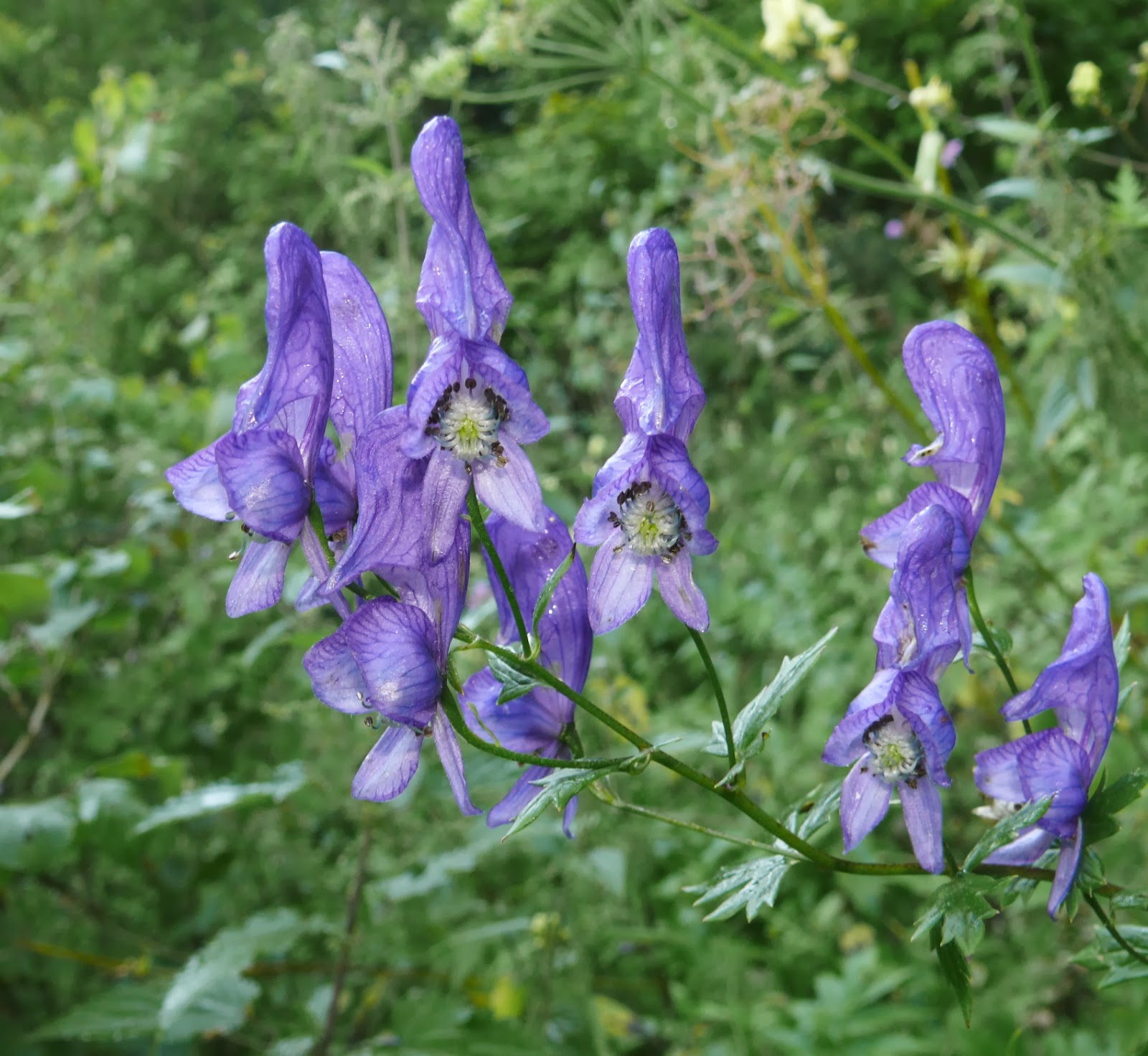
Aconite

With leaves mistaken for wild parsley and roots resembling horseradish, aconite has several names, including queen of poisons, wolf’s bane, and monk’s hood. It’s called bane for a reason. The folk used it to kill what they considered undesirable animals such as wolves and rats. And it’s had its share of human victims. Once it takes effect – about 20 minutes – it produced the classic symptoms of poisoning, vomiting and diarrhea. Death usually occurred within hours.

With these and other poisons ready to slip in food and drink, medieval aristocrats took precautions such as employing tasters. Why would anyone want such a risky job? In a time of scarcity, it ensured enough to eat.

All images via Wikimedia Commons, in the public domain or used under the terms of GNU Free Documentation License

Sources:
“Hemlock Poisoning and the Death of Socrates: Did Plato Tell the Truth?” [https://www3.nd.edu/~plato/bloch.htm] Enid Bloch, Journal of the International Plato Society, 2001

Rodale’s Illustrated Encyclopedia of Herbs

Poisons make an appearance in both of Kim Rendfeld’s novels, The Cross and the Dragon (2012, Fireship Press) and The Ashes of Heaven’s Pillar (forthcoming, Fireship Press). For more about Kim and her fiction, visit her website, http://kimrendfeld.com, or her blog Outtakes, http://kimrendfeld.wordpress.com.


11 November 2013

Herbs and their uses: The Physic Garden


By Michelle Styles

If someone was training to be an apothecary or indeed wanting to work with plants as medicine, one of the most important parts of  their training was learning to identify plants — which could harm you, which could help you and why.  Many plants look similar but their uses in medicine are very different. The question is how to learn. Herbals would have pictures of such plants. Some apothecaries might have saved pressed examples but nothing really beat seeing the plants in situ and seeing what they looked like when growing.

The name for such a place these days is a botanical garden but in earlier times, particularly in the 17th century,  they were called physic gardens. A physic garden  is a square set with beds that are dedicated to medicine rather than being dedicated to another purpose. The plants tended to be grouped according to their properties and characteristics.

The Chinese were the first to understand that plants ought to be collected for their medicinal value. It is the Emperor Shen Nong in the 28th century BC who is credited with creating the first botanical garden and causing plants to be collected, classified and studied with the major purpose being the advancement of medicine. The Egyptians and the Greeks were also interested in plants and their uses in medicine.  In the New World, it is said that Montezuma had a garden which was also dedicated it the study of plants and their uses in medicine.

Charlemagne is credited with having the first physic gardens established in the 9th century at St Gall. Other monastery herbal gardens followed but it is not until the 16th century that physic gardens  are established in Italian universities with the major purpose being to further the advancement of medicine. From Italy and its universities, the idea was taken to elsewhere in Europe. For example William Turner (1508 – 1568) was an early English herbalist as well as being an early Puritan who studied in Italy. He published a number of tracts on herbs and recommended that a physic garden be established. He had a herbal garden at Wells Cathedral until he had to flee with the advent of Mary to the English throne. He also published the first ever book dedicated to ornithology. he argued that England should have more physic gardens. But the religious upheavals prevented this from happening.

The Chelsea Physic Garden, originally known as the Apothecaries Garden was not established until the late 17th century but it remains an example of how a physic garden was set out.  It also still does important work today.

It is difficult to underestimate the importance of these gardens in allowing modern medicine to become established as the gardens were places where the plants could be gathered and  studied.  Botanic gardens still do have an important function, particularly as we learn more about how plants can be used as medicine.

You can learn more about the history of the botanic garden by reading the Arthur Hill article on The History and Functions of the Botanic Garden in the Annals of the Missouri Botanical Garden which can be found here.

Michelle Styles writes warm, witty and intimate historical romance. Her latest Paying the Viking's Price is out now. Her next book Return of the Viking Warrior will be out in May 2014. You can learn more about Michelle and her book on www.michellestyles.co.uk.

06 November 2013

Plants and Their Properties: Moorish Perspectives


When the ancestors of the Moors came out of the arid climates of Arabia and North Africa into Spain, they continually perpetuated one among many Islamic principles in their newly-conquered land; the concept of Paradise upon earth. In Arabic, the word jannah translates as heaven or a garden. The Qur'an, the Muslim holy book, described heaven or paradise as a garden of perpetual bliss. As adherents to their faith, the Moors emulated the virtues of their religion by building homes and palaces constructed around dazzling garden courtyards with central fountains. Earthly gardens, like their spiritual likenesses, were supposed to be places of contemplation and relaxation, which also served practical needs for their inhabitants. Some of the finest examples of Islamic garden planning can be found in modern Spain. As a common feature, these open spaces were divided into quarters through which four canals flowed from a central pool or fountain, each representing the rivers in heaven, thought to bring milk, honey, wine and water to denizens.

Imagining Medina Azahara
As a source of sustenance, water became critical to the Moors in the development of their gardens. To irrigate the landscape, the Moors developed innovative water wheel designs and used existing technology to create the qanat, a series of wells linked to form an underground watercourse, which allowed for the establishment of a sizable city of Madrid. In mid-tenth century Spain, the Umayyad caliph Abd-ar-Rahman III built a palatial city complete with terraced gardens. The limestone ruins of Medina Azahara, north west of his capital at Cordoba, became the crown jewel of the Umayyad dynasty for eighty years. Aqueducts from Spain's Roman period were put to use, bringing water to the terraced gardens and orchards of the caliph's new city. Around this time, Cordoba also became a center for botanical study. The Byzantine Emperor Constantine VII sent the caliph an illuminated manuscript about plants, authored by the Greek physician Dioscorides in the first century.  In 951, Abd-ar-Rahman commissioned an Arabic-speaking monk named Nicholas to translate the work.  
The Generalife

In later centuries, the Nasrid dynasty of Granada expanded on the foundations of an existing fortress and created the beautiful Alhambra along with the summer palace at the Generalife, both of which feature extensive gardens and courtyards. The Nasrids brought water along aqueducts into channels to maintain the beautiful surroundings. Their medieval buildings fared better than those at Medina Azahara, which declined as political rivalries fractured Muslim Spain. In this period, the species being introduced into the country served mainly decorative purposes. Myrtles, oleander, water-lilies, marshmallow and ivy flourished, but medicinal herbs soon joined them. Almost everything in a medieval Moorish garden had a medicinal use. The quiet, sculpted spaces we see today at Spain's Alhambra and Generalife are unlike those the Moors had designed. 

In the medieval Moorish world, gardens were places of pleasure and beauty, but also utility. Fruit trees and aromatic herbs grew alongside flowers and shrubbery, and vied with pavilions and pools to capture the imagination of inhabitants. During the 1100's, Ibn al-Awwam wrote in his Kitab al-filaha (Book of agriculture) about the cultivation and care of almost 600 plants, flowers and trees then grown in Spain, including sugar cane, pistachios, olives, bananas, saffron, figs, pomegranates, jasmine, lemons, date-palms, anise, and roses. In addition to identifying their properties and potential uses, he offered plans for laying out a garden. Volumes one and two are available here and here in Spanish and Arabic.    

The Moors introduced the cotton plant to the peninsula and harvested it in September. This material served as the basis for the tunics and leg coverings worn beneath silk or wool overgarments. Cotton went into the stuffing for mattresses or became fashioned into seasonal bedcovers. Where the best cotton once came out of Egypt, the quality of its production in Spain soon rivaled the best manufacturers in Cairo. The Moors believed layers of cotton garments were best for the climate of Spain.

Dried saffron
The country remains the world's top producer of saffron, a spice derived from the centers of crocus flowers. Most of the flowers are grown in the hinterlands of Castilla-La Mancha. Approximately 75,000 crocus flowers are necessary to make one pound of dried saffron, hence its once exorbitant price.  The Moors introduced saffron into Spain during the medieval period, where it has been used for food flavoring, perfumes and as a yellow-hued dye since at least the ninth century. Italy and France became chief importers of saffron from Muslim Spain. Demand for it grew when doctors associated saffron with possible cures for the Black Death, which first struck Spain in 1348. 

The Moors understood the properties of plants and flowering buds beyond their beauty. Islamic gardens in the west encapsulated every variety of plant life the Moors' ancestors brought into Spain, some of which changed the textile industry, improved hydraulic technology and gave us delicious foods.

Lisa J. Yarde writes fiction inspired by the medieval period. She is the author of historical novels set in medieval England and Normandy, The Burning Candle, based on the life of Isabel de Vermandois, and On Falcon's Wings, chronicling the star-crossed romance between Norman and Saxon lovers. Lisa has also written three novels in a six-part series set in Moorish Spain, Sultana,  Sultana’s Legacy and Sultana: Two Sisters, where rivalries and ambitions threaten the fragile bonds between members of a powerful family.