Showing posts with label games. Show all posts

27 July 2010

Good Times: Parlor Games

By Jennifer Linforth

In preparation to interview an escape artist, gambler, and magician for an upcoming book set in Victorian London, I stumbled into the world of Victorian parlor games. I needed one for the opening of this book and found "Poor Pussy." Strangely enough my magician's wife recalls playing a game called "Pat the Kitty" as a child.

Gathering together for parlor games was popular in the evenings in Victorian families. The central theme of many of them were games involving trying not to laugh. Poor Pussy was one of them. It involved one proper guest having to mill around on all fours amongst the seated company, meowing and stopping in front of someone who then had to say "poor pussy" without ever cracking a smile. Neither the cat or guest could smile. If one of them did the latter was the next cat.

I never recalled playing that as a child but I do remember this...

The Laughing Game where players sat in a circle and one says "ha." The next, "ha-ha" and so on until someone laughed in earnest.

Many games we know today stemmed from Victorian parlor games. Red-Light, Green Light, Simon Says, Charades and Musical Chairs. Hot Potato of today sounds very similar to the game of "Change" where an object was passed in a circle and directions shifted out of the blue.

Hunt the Thimble sounds like great fun. The mistress of the house would hide a tiny object in a room and guests would have to search for it. When they found it, they simply took their seat until one poor person was left still looking for the item.

Victorians seemed to enjoy embarrassing each other...

...or catching each other for that matter. There were many versions of Duck, Duck, Goose then called Wolf and the Lambs.

Memory games such as Grandmother's Trunk were wildly popular (hence the interview with my magician who is a master of Victorian memory games. His website is here: Dr. Wilson ) In this game a player would say "My grandmother has a trunk and in it is.... apples" or some such item beginning with the letter A. Around the room they would go, each guest having to build on this list with a new item with the following letter while remembering and reciting as well all the items before!

Way more fun than Wii? Oui?

12 July 2010

Good Times: Drinking Games of the Past

By Jeannie Lin

"Drunkenness is nothing but voluntary madness." ~ Seneca, Roman philosopher and statesman (3 BC–65 AD)

What are good times without a small discussion of drinking and the games that people play while drinking? A brief survey of the drinking games of old reveals that alcohol and the revelry in its presence is a humble yet universal link across different times and cultures.

One of the earliest written records of a drinking game was in Plato's Symposium where a group of men attend a drinking party and deliver speeches about Eros, love. The game there was simple as drinking games tend to be: fill a bowl with wine, drain it, slap it down, pass it on.


The ancient Greeks also played a game called kottabos, which involved flinging dregs of wine from their bowls onto a target at the center of the room, with prizes or penalties designated for making or missing the mark. Then there was an even simpler drinking game--endurance drinking. The host would designate a number. Anyone who couldn't hang would be banned from future games.

The ancient Chinese also had a host of drinking games to liven an evening. The basic game had an appropriately descriptive name, "Bottoms Up." The elite and educated would often play drinking games that involved spouting poetry or guessing riddles. Less literate games involved drinking based on the roll of a dice or drinking contests with referees and governors. One game involved setting up a series of puppets of dolls dressed as Westerners in the center of the room. When one fell over, whoever it pointed to had to drink.

A famous Chinese drinking game involves both coordination and rhythm. Tiger, Chicken, Worm, Board is believed to have been around since medieval times and is variant on Rock, Paper, Scissors:
  • chicken eats worm
  • tiger eats chicken
  • board hits tiger
  • worm eats board
It involves a chant, pounding out a rhythm on the table, and then shouting out of one of the items. Missing a beat or losing the battle results in a penalty drink.

A variant of the "Tiger, Chicken, etc" or "Rock, Paper, Scissors" drinking game became a popular staple of the geisha drinking culture, which flourished in 17th and 18th century Japan. Geisha were trained in the exquisite arts of dance, music, and conversation. They also had a range of parlor games and drinking contests in their arsenal to keep their guests entertained.


Sometimes simple is best. A drinking game that originated in 14th century France involved a special drinking vessel--the puzzle jug. The contestant was given a jug with holes built into the design. The goal was to tilt it just right to get to the alcohol. My guess is most of the players must have already been inebriated to start with as most of the drink inevitably poured out of the holes onto the victim to the enjoyment of all onlookers.

The pinnacle of special drinking vessels has to be the yard of ale, a one yard long glass that holds 3 pints. Most likely this practice originated in 17th century England. John Evelyn, a Fellow of the Royal Society, records the practice of toasting James II with a yard of ale in Kent in 1683. Drinking a yard of ale became a traditional pub game. As with all classical games, the rules were easy. Drink the entire yard without pausing.

The still popular "yard of ale"

In more recent history, the popular game of "beer pong" is believed to have originated in the 1950s at Dartmouth College and morphed from the practice of playing ping pong and drinking beer at the same time. The origin of the popular game of "quarters" is unknown. It belongs to antiquity.

Good times to all and remember to drink responsibly!

29 May 2008

Families & Children: Bao

By Jennifer Mueller

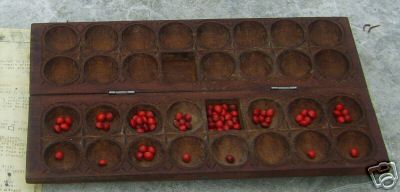
Bao. The word literally means wood or board in Swahili, but it is also a game--one of the most popular through East Africa. I learned to play after some Peace Corps volunteers brought it back when they returned from a trip to the coast. It's certainly addicting, and while it might look simple. it takes quite a bit of skill. Many have heard of Mancala--it's available in United States toy stores--but Bao is more complicated since it is played with a board double the size of Mancala. Some call Bao the "king of mancala games," as it is usually considered the most difficult and complex of them.

A Bao board consists of four rows with eight holes each. All the holes are rounded, but the fourth from the right in the middle rows is square and called the nyumba ("house"). Games can take hours, and a quicker version of the game involves putting two seed per hole to start with, instead of the 6-2-2 set up of the official rules. To start, you add a reserved seed to a space with seeds already in it, that allows you to capture from the opposite space of your opponent. You then proceed to spread out how many seeds you captured, ending in another space already with at least one allowing you to repeat the process. Your turn ends only when you land in a space without anything in it.

As all the pieces are in play after adding one per turn, you are moving quite a few seeds around. You must capture if able, but you are also allowed to have a turn to redistribute. However, if on the first move you do not capture, your entire turn must not capture. The object is to rid your opponent's front row of seeds. Regardless of how many might be on the back row, they are unable to move if there are none left in front.

Children have been known to play it with just holes scooped out of the dirt and stones, but it is a mainstay of the coasts of Kenya and Tanzania where it is played in elaborately carved boards. The game is commonly played as diversion while waiting for dinner in cafes, but there are also clubs since many cannot afford the boards to play it at home. Regular championships are held on Zanzibar and Lamu (Kenya) and in Malawi. The only tournament that was held in Europe is organized at the Mindsports Olympiad (MSO) in Cambridge, England.