A handful of historical authors brave the wilds of unusual settings, times, and characters to create distinctive, exciting novels just outside of the mainstream. Join us as we chronicle the trials and rewards of our quest - from research and writing to publication and establishing lasting careers.
J. K. Knauss's SEVEN NOBLE KNIGHTS debuted December 15 to great fanfare in the historical fiction community. The Grand Book Launch Blog Tour is still going on with more historical tidbits and short historical fiction freebies. Congratulations Jessica!
The first four of Alison Morton's Roma Nova thrillers were published by Audible UK on 15 December, just in time for Christmas! Find out more about the audiobooks Download the interview with Alison from Audible UK (free) Watch the mini interview on YouTube: The contributors of Unusual Historicals wish you a safe and happy holiday season and all the best in 2017.
This week, we're pleased to welcome author and Unusual Historicals contributor J. K. Knauss with her first historical novel, SEVEN NOBLE KNIGHTS, a saga of family, betrayal, and revenge in medieval Spain. We're giving away two signed print copies and three ebooks of Seven Noble Knightsfree. Just enter the Rafflecopter giveaway at the bottom of this post or Thursday's wedding scene excerpt for a chance to win.
Spain, 974. Gonzalo, a brave but hotheaded knight, unwittingly provokes tragedy at his uncle’s wedding to beautiful young noblewoman Lambra: the adored cousin of the bride dead, his teeth scattered across the riverbank. Coveting his family’s wealth and power, Lambra sends Gonzalo’s father into enemy territory to be beheaded, unleashing a revenge that devastates Castile for a generation.
A new hero, Mudarra, rises out of the ashes of Gonzalo’s once great family. Raised as a warrior in the opulence of Muslim Córdoba, Mudarra must make a grueling journey and change his religion, then chooses to take his jeweled sword to the throats of his family’s betrayers. But only when he strays from the path set for him does he find his true purpose in life.
Inspired by a lost medieval epic poem, Seven Noble Knights draws from history and legend to bring a brutal yet beautiful world to life in a gripping story of family, betrayal, and love.
**Q & A with J. K. Knauss**
How did you come to write about medieval Spain? For the longest time I pursued my two passions, writing and Spain, separately, as if the twain could never meet. It wasn't until after I'd completed a PhD in medieval Spanish literature that I realized I could approach this material in a more exciting way. My dissertation advisor had remarked, "You like to tell stories, don't you?" It was finally time to do something about it!
Said to be the sarcophagi of the seven noble
knights, San Millán de Suso.
Photo by J. K. Knauss
Tell us about the legend on which Seven Noble Knights is based and how you became fascinated with it. The first time I heard of the seven noble knights was during a faculty-led tour of Córdoba during a fantastic study abroad semester. "This is where they hung the heads," the professor said, pointing to an archway. That was too gruesome to interest me at the time. The next time I encountered the legend was during my PhD studies. The events may really have happened in the late tenth century, and the story ended up in thirteenth-century historical writing. In the early twentieth century, scholars noticed the historical prose rhymed and maintained a poetic meter in places! Yes, the story probably circulated orally as an epic poem or song, and yes, one character throws a bloody cucumber at another. Everything about this legend is fascinating. Many places, aside from that archway in Córdoba, lay claim to some aspect of the heroic yet familiar, dearly beloved characters.
The crest of Salas de los Infantes shows
nine of the legend's characters.
Photo by J. K. Knauss
Are many of the characters drawn from history? I had a lot of fun making up a few supporting characters based on my historical research and the needs of the drama. I don't think the hero of the novel, Mudarra, ever existed. The epic poets or the historians likely created him to satisfy their deep-seated need for revenge for the protagonists. That gave me the freedom to develop his character from an automatic revenge machine into a thoughtful, talented young man with doubts and desires of his own. On the other hand, the Count of Castile, Caliph Hisham, and Almanzor, acting governor of Andalucía—heads of state—are all verified in the historical record. The González family of the region of Lara held a high status throughout the Middle Ages, and in chancery records we find mention of Gundisalvus (Gonzalo), one of my protagonists, and one Flammula, the likely namesake of my villain, Doña Lambra. How did you find all this out? Picking up medieval law codes, chancery records, and history books might not appeal to many, but in me they have a rapt audience. I think the joy of finding an unexpected tidbit that illuminates an obscure literary passage (like the bloody cucumber) comes through in a vivid, exciting novel. AlthoughSeven Noble Knightsis realistic and historically accurate overall, there are ghosts in Part Two. Do you consider this magical realism? Seven Noble Knights is the first fiction I've written that strives for strict realism. There are, in fact, magical occurrences in the source materials. In the interest of historical realism, I explain a man regaining his sight with a detailed account of medieval eye surgery, and rather than claiming that a broken ring magically fuses together, I have the ring reforged. The medieval sources don't mention ghosts, but I based my ghosts on research about medieval Islamic and Christian beliefs about spiritual manifestations. The ghosts are real to the characters, so they're medieval realism, rather than magical realism. Seven Noble Knights will debut December 11 from Encircle Publications. And remember to enter below to win one of two signed print copies or three ebooks ofSeven Noble Knightsfree. a Rafflecopter giveaway
J. K. Knauss earned her PhD in medieval Spanish with a dissertation on the portrayal of Alfonso X’s laws in the Cantigas de Santa Maria, which has been published as the five-star-rated Law and Order in Medieval Spain. Look for her book of stories based on the Cantigas, coming 2021. A driven fiction writer, J. K. Knauss has edited many fine historical novels and is a bilingual freelance editor. Her historical epic,Seven Noble Knights, will debut on December11, 2020, from Encircle Publications. Her contemporary paranormal Awash in Talentis now available from Kindle Press. Find out more about her writing and bookish activitieshere. Follow her on Facebook and Twitter, too!
This week, we're pleased to welcome author and Unusual Historicals contributor J. K. Knauss with her first historical novel, SEVEN NOBLE KNIGHTS, a saga of family, betrayal, and revenge in medieval Spain. Join us again on Sunday for an author interview with more details about the story behind the story. We're giving away two signed print copies and three ebooks of Seven Noble Knightsfree. Just enter the Rafflecopter giveaway at the bottom of this or Sunday's post.
Spain, 974. Gonzalo, a brave but hotheaded knight, unwittingly provokes tragedy at his uncle’s wedding to beautiful young noblewoman Lambra: the adored cousin of the bride dead, his teeth scattered across the riverbank. Coveting his family’s wealth and power, Lambra sends Gonzalo’s father into enemy territory to be beheaded, unleashing a revenge that devastates Castile for a generation.
A new hero, Mudarra, rises out of the ashes of Gonzalo’s once great family. Raised as a warrior in the opulence of Muslim Córdoba, Mudarra must make a grueling journey and change his religion, then chooses to take his jeweled sword to the throats of his family’s betrayers. But only when he strays from the path set for him does he find his true purpose in life.
Inspired by a lost medieval epic poem, Seven Noble Knights draws from history and legend to bring a brutal yet beautiful world to life in a gripping story of family, betrayal, and love.
“Let Seven Noble Knights welcome you to historical fiction! …it’s a rich saga populated with characters you will grow to love (and a few you will love to hate). The ancient empires of Spain are a beautiful backdrop to the struggles of humankind across all generations of all lands: romance, revenge, war, and adventure.”
—Pushcart Prize nominee Reneé Bibby, The Writers Studio
Young Gonzalo’s uncle, Ruy Blásquez, is
receiving Doña Lambra as a bride in exchange for his service to Castile.
Gonzalo isn’t at all sure Lambra should be marrying his uncle.
Doña Sancha shooed
her sons away from the cathedral door and drew dried herbs and flowers from
pockets Gonzalo hadn’t known were inside her tunic and cloak. With a stick, she
carved a large circle on the hard earth. Doña Sancha set the herbs and flowers
inside the circle in a pattern with meanings she might have shared with a
daughter, but were a mystery to Gonzalo.
“You’ll stand here,”
she told her brother, Ruy Blásquez. “When your bride comes from that side,
you’ll step inside the circle together.” She arranged her husband and sons on
Ruy Blásquez’s side of the circle. Gonzalo ended up next to his uncle, so close
he could hear each shallow breath he took.
Count García arrived
with a full complement of knights and squires and four banners in white with
red castles, as well as a fiddler and a flutist who made ready to play. So many
people in the plaza must have been making the loudest ruckus since the city had
been won from the Moors, but Gonzalo heard nothing.
From between the
buildings at the far end of the plaza emerged forty women who walked with their
hair covered to emphasize their married status. Their laughter and singing
couldn’t distract Gonzalo from Doña Lambra, who tottered on their shoulders.
An heirloom beaded
necklace competed with her yellow hair, shining in tight plaits on her
shoulders with ornamental brass tips that looked as if they had come out of a
treasure chest long ago. A mail girdle, inlaid with brass and pieces of jet at
the edges, cinched her bright blue tunic from under her breastbone to down over
her hips. Gonzalo shivered at the thought of the bitter touch of the matching
mail sleeves, from the decorated wristlets up to her shoulders. A
burgundy-colored cloak edged with three rows of golden braid was fastened over
her shoulder with a gilded brooch in the shape of a lion rampant. A square cap,
decorated all around with braid and gold carbuncles, looked like a royal crown.
Gonzalo imagined he wasn’t at his uncle’s wedding, but that this bride had come
from the farthest reaches of Christendom to marry the King of Navarra or León.
The married women set
Lambra down in the middle of their ranks. She let the cloak fan out behind her
unsteady stride. Her face was frozen into a grimace like the one the Virgin
Mary wore as she cradled the Savior’s dead body inside the cathedral.
Gonzalo remembered
Lambra’s grin at the banquet days before, when her mouth had dripped red with
juices from the roasted bull’s testicles and the sauce-engorged bread trencher.
Each time she received the goblet, she had made sure to turn it so that her
lips didn’t touch the same spot as Ruy Blásquez’s. She didn’t take the same
precaution against Álvar Sánchez, seated on her other side. Gonzalo could
hardly taste his food through a choking desire to throw his eating knife across
the table into the gloating knight’s hand so it could never touch Lambra so familiarly
again.
There he was now, that
upstart Álvar Sánchez, wearing just as juicy a grin, so close to Doña Lambra
that the obnoxious curl on the toe of his boot intruded on the magic circle.
“What is that
blasphemous behemoth doing there? Shouldn’t a member of the groom’s family
stand next to the bride?” Gonzalo whispered to Gustio.
Gustio knocked his
elbow into Gonzalo’s ribs. “Why? Were you hoping it would be you, little brother?”
He chortled until their mother hissed at them to be silent.
Count García was
addressing the crowd. “…with these deeds, Ruy Blásquez has earned as a bride my
loveliest cousin, probably the most beautiful woman Castile has seen since my
mother joined the Kingdom of Heaven. May they live many more years and have
many loyal Castilian children.” He raised his arms, which the crowd took as a
sign to cheer and shout.
Gonzalo noticed that
his uncle had already moved into the circle and reached for Lambra’s hands. She
was looking at Ruy Blásquez, but not with love or even curiosity. It was a look
of judgment. Gonzalo tried to imagine how his uncle’s soft eyes, long nose, and
weak chin fared on Lambra’s scale.
“I receive you as mine,
so that you become my wife and I your husband,” Ruy Blásquez said. Gonzalo was
relieved to glimpse him smiling widely, displaying his straight, white teeth to
his judge in the form of a bride.
Ruy Blásquez smiled and
waited, waited and smiled. Gonzalo witnessed a thousand expressions cross
Lambra’s face like clouds in a stormy sky. At last, Lambra’s maid emerged from
the crowd and leaned over the circle. “I receive you as mine…” she prompted so
quietly that Gonzalo had to read her lips.
“I receive you as mine
so that you become my… husband… and I your… wife,” said Doña Lambra, her eyes
narrow. She pulled her hand away from Ruy Blásquez to wipe at her plump lips,
as if the words had sullied them.
She craned her neck to
look at Álvar Sánchez and Gonzalo knew she wished she had said the words to
him. His heart beat faster. Then she shifted her gaze to Gonzalo. He felt as if
he were smothered with the parsley, fennel, red carrot, and beet sauce from the
banquet. Such was the hunger he saw in her eyes, a hunger he couldn’t help but
feel, too, and which raged all the more, the more he tried to contain it. He
remembered the way the bull’s testicles had flopped onto Doña Lambra’s trencher
under their own weight and the way they deflated when she plunged her knife
into the center of the sacs.
He stopped a startled
cry in his throat.
“Long live the newlyweds!” The crowd shouted until they were the only words Gonzalo remembered ever
hearing.
Seven Noble Knights will debut December 11 from Encircle Publications. Find out some of the research involved in this wedding scene here. See the book trailer with specially commissioned art by Ayal Pinkus.
J. K. Knauss earned her PhD in medieval Spanish with a dissertation on the portrayal of Alfonso X’s laws in the Cantigas de Santa Maria, which has been published as the five-star-rated Law and Order in Medieval Spain. Look for her book of stories based on the Cantigas, coming 2021. A driven fiction writer, J. K. Knauss has edited many fine historical novels and is a bilingual freelance editor. Her historical epic,Seven Noble Knights, will debut on December 11, 2020, from Encircle Publications. Her contemporary paranormal Awash in Talentis now available from Kindle Press. Find out more about her writing and bookish activitieshere. Follow her on Facebook and Twitter, too!
• Jessica Knauss's SEVEN NOBLE NIGHTS, the epic of family and betrayal in medieval Spain, will debut on December 15. You can enter now for a chance to win one of ten proof copies at Goodreads.
• Blythe Gifford’s second Royal Wedding Story, WHISPERS AT COURT, took first place in the Historical/Regency category of the Book Buyers Best Contest, sponsored by the Orange County (California) Chapter of Romance Writers of America. RUMORS AT COURT, the third book in the series, will be released in May, 2017, in the U.S. and the U.K.
• Anita Davison announces her newest title, MURDER AT CLEVE ABBEY, the second instalment in the thrilling Flora Maguire Edwardian Cosy Mystery Series. More information at Amazon.co.uk
• On 29 October, Alison Morton will be on the "Research for Creative Writers" panel at the SilverWood Writing Day, a fringe event at the Bristol Literary Festival, UK. Alison's specialist area will be writing in extreme circumstances - she does write historical thrillers, after all!
Full details here. In addition, Alison's fourth book, AURELIA reached the final four for the Historical Novel Society's 2016 Indie Award. Not bad out of 400 possible winners!
• Kim Rendfeld’s second novel, THE ASHES OF HEAVEN'S PILLAR, will be re-released Nov. 2 in print and ebook formats. Praised by reviewers, the novel is about a Saxon peasant who will go to great lengths to protect her children — after she has lost everything else. Preorders for the ebook are available at Amazon, Kobo, Barnes and Noble, and iTunes. If you would like a note when the print edition is available, email kim [at] kimrendfeld [dot] com.
It’s something of a tradition to begin or end biographies
of Alfonso X, el Sabio, with one
historian’s sanctimonious judgment of him: “While he contemplated the heavens
and gazed at the stars, he fell on the earth.” I quote it here not to
perpetuate misconceptions, but because the wording shows the importance of the
astronomy carried out in Alfonso X’s court. In spite of the
other fields of inquiry enhanced under the wise king’s patronage, it was
the astronomy that fascinated the most people first and longest.
Alfonso’s interest in the movement of the heavens was
based, as most of his passions, in pragmatism. In Alfonso’s time, astrology
hadn’t been separated from astronomy as a scientific discipline and was even
farther from being as discredited as it is today, as many fourteenth- and
fifteenth-century medical treatises (some of which refer to Alfonsine works)
attest. The king likely believed knowledge of the stars could be an important
tool in gaining the upper hand on Earth because of their obvious, albeit
mysterious, influence on human character and behavior.
That said, many of the Alfonsine astronomy books are based
on what is still considered solid science.
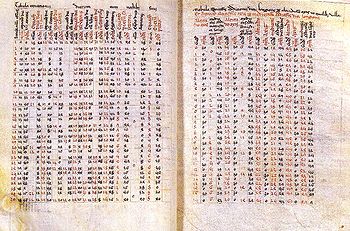
Alfonsine Tables. Spain, thirteenth century.
The Alfonsine Tablesare a set of measurements from about 1272 composed by Isaac ben
Sid and Judah ben Moses ha-Cohen that track the positions of the sun, moon, and
planets relative to Earth using Ptolemaic calculations. One of the astronomers
who worked on the Alfonsine Tables
took a copy with him in 1280 to Paris, where scholars adjusted the readings for
the Paris meridian, enabling astronomers all over northern Europe to make use
of the information for three hundred years. Copies survive today that were used
by Copernicus and Galileo. The practical applications of the Tables are what made them popular. They
well represented Alfonso X’s yearning for useful knowledge in the wider world.
The Alphonsus moon crater. Wikimedia Commons.
Composed in the late 1270s, the most extensive book, the Book
of Knowledge of Astronomy, also had the largest team behind it. The
authors and translators named within the book include Jewish physicians, Muslim
lawmen, and Italian and Castilian churchmen. The Book of the Eighth Sphere, which makes up the first part, describes
the constellations with their celestial coordinates. The second part describes
how to make and use nine different kinds of astronomical instruments, such as
the astrolabe and the quadrant. Again, even in this most extensive and
encyclopedic work, useful is paramount.
The Book of the Fixed Stars was
translated from an Arabic book by Abd al-Rahman al Sufi composed around the
year 964. In this book, the Alfonsine collaborators created a powerful
combination of Ptolemy’s astronomy, Arabic traditions, and Castilian curiosity.
The Andromeda Galaxy and the Large Magellanic Cloud, among other landmark
bodies, were introduced to the European scientific community in this
translation.
Ursa Major from a 1490 English copy of the Alfonsine Tables.
The astronomy works are exemplars of the admirable
Alfonsine traits of practicality and encyclopedism. The collaborators
translated and compiled information from the best and most reliable sources. The
majority draws from documents found in Arabic, with some information coming
into Castilian from far-flung languages such as Chaldean. Without the bridge
formed by these works, European astronomy might have had to start from scratch.
It’s much harder to see into the heavens if you’re not
standing on the shoulders of giants.
Jessica Knauss earned her PhD in medieval Spanish with a
dissertation on the portrayal of Alfonso X’s laws in the Cantigas de Santa Maria, which has been
published as the five-star-rated Law and Order in Medieval Spain. Look for her book of stories based on the Cantigas, coming 2021. A driven fiction
writer, Jessica Knauss has edited many fine historical novels and is a
bilingual freelance editor. Her historical epic,Seven Noble Knights, is available from Encircle Publications in ebook, paperback, and hardcover. Her
contemporary paranormal Awash in Talentis now available from Kindle Press. Find out more about her
writing and bookish activitieshere. Follow her on Facebook and Twitter, too!
• To celebrate the release of her contemporary paranormal novel, AWASH IN TALENT, Jessica Knauss discussed its historical underpinnings with fellow U.H. contributor Kim Rendfield. You can read the blog post here.
• Michelle Styles' novel SUMMER OF THE VIKING has been released in Norway, Sweden, and France. Also, her novel TAKEN BY THE VIKING has been re-released in the UK as part of the "Forbidden Nights" anthology. For more information, visit michellestyles.co.uk.
• M.J. Neary's new novel THE GATE OF DAWN is now available for purchase at Amazon, and is receiving great reviews. Congratulations M.J.! You can get your copy at Amazon here.
• Heather Domin is preparing a blog tour hosted by Historical Fiction Virtual Book Tours for her novel THE HEIRS OF FORTUNE, scheduled to begin July 11. More information to come.
Juan Diego portrays
Alfonso X on the
series Toledo
He has a portrait hanging in the US House of Representatives
in the Great Lawgivers series. A moon crater bears his name. His name is on the
largest unified collection of annotated medieval music. Why do so many fields
of inquiry praise the intellectual efforts of Alfonso X, el Sabio? What mark did he leave on the world to make us think he
was so learned?
The short answer: his books.
In the General Estoria,
we read: “The King makes a book, not because he writes it with his hands, but
because he outlines the facts in it, and edits it and makes it right, and shows
the way in which it is to be made… Just as we say that the King makes a palace,
we don’t say it because he constructs it with his hands, but because he ordered
it to be made…” The Book of the Sphere
discusses at length the way King Alfonso worked as general editor. He came up
with the idea for the book and what it should contain, and then went through it
to take out extraneous parts and correct infelicities.
Alfonso X oversaw these projects to give himself access to
the best knowledge in order to learn how rule his country more wisely, and a
great additional benefit was that the books were created in Castilian and in
Latin. They could then be consumed by Alfonso’s Castilian-reading subjects and
Europeans farther afield. A wise populace is the beginning of a wise kingdom,
and wise foreign friends make for smooth dealings and further the cause of that
wise kingdom.
The collaborators made use of the finest sources available.
They accurately cite Aristotle, the early Christian saints including Augustine,
and eleventh-century philosophers such as Pedro Alfonso and Aelred of Rievaulx,
to give the most basic examples. The scope of the intellectual activity has led
to many scholarly volumes. Here’s a list of highlights.
The Alphonsus Crater on the Moon. Wikimedia Commons
Lapidario—A book
of erudition about types of stones.
Alfonso X in the US House of Representatives
Law
• The Fuero Real—A
pragmatic town charter that was granted to new towns in order to begin
regularizing the rule of law throughout Alfonso’s kingdoms.
• Espéculo—Elegant
and comprehensive legal theory with practical applications as an afterthought.
• Siete Partidas—A
great book of medieval thought that also served as the basis of Spanish law for
centuries.
• Specialized books of law—The Book of Gambling Houses, the
Book of Frontier Commanders, various ordinances, etc.
History/Wisdom
• Book of Calila and
Digna—This charming book is the first work of Castilian prose narrative.
Based on ancient Indian texts via Arabic sources, two jackals (or lynxes) tell
each other fables to illustrate complex and sometimes conflicting points of
wisdom.
• Setenario—Often
classed with the legal works, this book obsessed with the number seven is an
unfinished compendium of the most secret kinds of knowledge and how to apply
them.
• History of Spain—Tells
the story of the Iberian Peninsula from the end of the Roman Empire to the
beginning of the thirteenth century.
• General History—An
astoundingly wide-reaching world history from Biblical times.
Music/Religion
• The Cantigas de
Santa Maria—The largest collection of written medieval music in the world.
More than 400 praise and miracle songs in Galician Portuguese for the Blessed
Virgin with fun melodies and gorgeous illustrations. I attempted to describe
how wonderful this collection is in this post. I investigate one exciting cantiga in this post.
Alfonso's sculpture at the National Library in
Madrid emphasizes intellect with books and a scroll.
Pastimes because
leisure is important for refreshing the intellect.
• Various cantigas de
escarnio e mal dizer—Profane, sometimes grotesque, mostly humorous, and at
least one moving account of the weariness of a king in failing health (“Non me
posso pagar tanto”).
• Libro de ajedrez,
dados e tablas—A comprehensive illustrated compendium of chess strategy for
the troubled intellectual. Ways to play dice, backgammon, and other games of
chance are not as highly regarded.
Much of this body of work had far-reaching impacts in
medieval Europe and modern world. The astronomy inspired and informed Copernicus,
and the law works influence decisions even today in the American Southwest.
In order to begin my studies of Alfonso X, I had to vastly broaden
my fields of expertise in addition to the strictly literary training I’d had up
to that time. Perhaps Alfonso X’s greatest wisdom lay in the voracity with
which he pursued all intellectual subjects. It seems there was nothing the Wise
King wouldn’t want to investigate and read about further.
Simon R. Doubledays’ biography (The Wise King, New York: Basic Books, 2015) seamlessly weaves the
trials and tribulations of Alfonso X’s life and times into the writing of the
body of work he left behind. He makes a good case that Alfonso X based his
intellectuality on the model of polymath Muslim princes. Indeed, the
translators and compilers frequently relied on rescued ancient documents in
Arabic. Doubleday’s book is an excellent overview of a fascinating king—I
learned a few things I didn’t know before.
My tribute to Alfonso's contribution to world culture, Our Lady's Troubadour, lets you experience the Cantigas de Santa Maria in a fun new way!
Jessica Knauss earned her PhD in Medieval Spanish with a
dissertation on the portrayal of Alfonso X’s laws in the Cantigas de Santa Maria, which has been
published as the five-star-rated Law and Order in Medieval Spain. A driven
fiction writer, Jessica Knauss has edited many fine historical novels and is a
bilingual freelance editor. Her historical novel, Seven Noble Knights, is available from Encircle Publications in ebook, paperback, and hardcover. Find out more her writing and bookish activities hereor here. Follow
her on Facebook and Twitter, too!
Mid-eleventh-century illumination from the
St. Sever Beatus
In the tenth century, so much definitive action took place
in northern Spain that every historical person played a fascinating role. One
of these historical persons was Ava de Ribagorza, Countess of Castile and wife
of Count García Fernández. Although an epic poem about García’s wife circulated
all over Iberia—The Traitor Countess—its
storyline bears little relation to fact. I’m writing a novel with Count García
and Countess Ava as central characters, and to write about her convincingly, I
need to make crucial decisions based on little evidence. How to separate legend
from history?
García Fernández was the second Count of Castile from his
father’s death in 970 until his own passing in 995. At the time Castile was a
territory on the fringes of the Kingdom of León and politically dependent on it.
The Castilians’ location on the frontier with the Caliphate of Córdoba meant
that by necessity, the political leaders were principally warlords. They had to
be ready at any moment to defend their hard-won territory from brutal raids
that terrified everyone from the haughtiest king to the lowliest laborer.
This is the era of Almanzor, a political opportunist and
great military strategist whom everyone in the north of the peninsula assumed
was the caliph because of his seemingly limitless power. The map shows
Almanzor’s principal forays into León, Castile, Navarra, Ribagorza, and
Barcelona (the “Christian kingdoms”) and the generous swath of territory he
took back for his prosperous empire. The constant ebb and flow of conflict was
only aggravated because the Christian kingdoms often had bloody spats amongst
themselves.
The militarization of Castilian society was so extreme that
it’s said that the men didn’t have time to take care of their own horses. That
job, and other important ones, belonged to their tough-as-nails wives.
Count García in the Plaza Mayor
of Salamanca
Ava was born circa 945, the daughter of Count Ramón II of
Ribagorza. The family name refers to the county between the France-dependent
County of Barcelona and the independent Kingdom of Navarra. The Queen of
Navarra may have helped arrange Ava’s marriage to Count García in 960 or 965.
Ava’s prime age and noble birth made it a good match that became a fruitful
union. Somehow, between battles and governance, the count and countess raised
six children to adulthood. Four of the five daughters made advantageous
marriages, one became a nun, and the son, Sancho, inherited the title and
responsibilities of Count of Castile.
Not many other facts have survived about this woman, whom
circumstance must have made extraordinary. It’s my job as a historical novelist
to breathe life into Ava on the page, but I don’t have a lot to go on. Her
death may even be more mysterious than her life.
I haven’t been able to find a record of when Ava died. There
is no mention of her in the histories after García Fernández’s passing. This
doesn’t necessarily mean she died around the same time. Because her husband’s
death meant the end of her time as Countess of Castile, she might have taken on
a lesser role at court, perhaps supporting the new count, her son, in ways no
one valued enough to write down.
As I’ve written at Unusual Historicals before, the minstrels
and then the historians who wrote down The
Traitor Countess took Ava’s absence from the historical record and ran with
it. They claimed that she wanted to elope to Córdoba with her Moorish lover, and
they set Count García’s death squarely on her shoulders. She takes advantage of
her role as horse husband by giving García’s steed food that makes it look
bulky, but actually weakens it. As Ava has planned, the horse fails the count
in battle, leading to his death on the frontier. She then attempts to poison
her son so she can leave Castile, but Sancho turns the poison back on his
mother in a scene reminiscent of Hamlet.
Presentation miniature from thirteenth-century Estoria de Espanna
It’s hard to imagine why Ava became the target of so much
scorn. Perhaps something similar to this happened and became lost to history.
Or, more likely, confronted with a vacuum in the record and well removed from
the time period, the thirteenth-century historians preferred to write down
scandalous material instead of nothing at all. A traitorous countess could
explain two things that might have puzzled them: the death of the great
warrior, Count García; and the curious fact that his youngest daughter, Oneca,
was married to Almanzor soon after García’s death.
Yes, that
Almanzor. In the tenth century, political strategy could easily have led to
such a match. In the thirteenth century, however, historians were more
concerned with presenting a coherent story of Castilian power and religious
righteousness than with the complexity of history. If they read about Oneca’s
marriage to Almanzor, terror of the north, they would have thought something
had gone terribly wrong. What better way to explain a now unsavory alliance
than by blaming a woman? The poor girl must have had a terrible mother, since
her father was a proven example of knightly virtue.
Of course, this is impossible to prove, but I imagine a lot
of drama in the scriptorium while the historians were coming up with their
narratives. It looks as if I’ll have to use some of that imagination in the
service of redeeming Ava—or further condemning her. I haven’t decided yet.
Jessica Knauss earned her PhD in Medieval Spanish with a dissertation on the portrayal of Alfonso X’s laws in the Cantigas de Santa Maria, which has been published as the five-star-rated Law and Order in Medieval Spain. A driven fiction writer, Jessica Knauss has edited many fine historical novels and is a bilingual freelance editor. Her historical novel, Seven Noble Knights, will be published December 11, 2020, by Encircle Publications. Find out more about her writing and bookish activities hereorhere. Follow her on Facebook and Twitter, too!