Showing posts with label Erastes. Show all posts

31 July 2011

Guest Blog: Erastes

This week, we're welcoming historical novelist, Erastes, as she celebrates the release of her latest novel, MUFFLED DRUM, her first release with Carina Press. Please leave a comment for a chance to win one of two generous prizes from Erastes; details below! Here's the blurb:
Bohemia, 1866
They met in a port-side tavern, their lust-filled moments stolen from days of marching and madness. After eighteen months, Captain Rudolph von Ratzlaff and First Lieutenant Mathias Hofmann have decided to run away from everything they hold dear. Resigning their commissions is social suicide, but there's no other choice. Someone will eventually see Rudolph's partiality toward Mathias.
Now their plans have gone horribly awry... When Mathias goes to Rudolph's tent after their last battle, his lover looks at him without a hint of recognition. Mathias can hardly believe the man he knew is gone. He wants to fill in so many of Rudolph's missing memories, but the doctor says a shock could result in permanent damage. The pain of seeing Rudolph on a daily basis, when Rudolph doesn't remember their love, is excruciating. Now Mathias must decide whether he wants to fight for the man he loves or forget him completely...


What makes your recent release, MERE MORTALS, an unusual historical?

It’s great to be back here!

It’s set during a period I haven’t read much fiction about—the Austro-Prussian war of 1866. More correctly called the Austro-Prussian-Italian war, or—if you are from Germany, it’s just called “the German War”! My mother did her thesis on this war and I remember her studying it, and using tapes to do the whole sleep memory thing. Perhaps something rubbed off on me, because I’ve always found the period to be quite fascinating. I thought that a campaign that was rarely mentioned, and a road trip rather than a set-piece with country houses and balls would be fun to do.

What’s it about?

It’s a story of loyalty, and friendship and how far one goes to hold on to something that may or may be gone forever. It takes the trope of amnesia as its theme, and twists it to incorporate a homosexual romance, which goes wrong in so many ways! (It is me, after all—can’t have it going smoothly!) It’s also a road trip.

What gave you the idea?

Well, partly it was from my Dad. He has Alzheimer’s you see, and although he’s still functioning in a “get up every morning and wash, dress and tidy up” kind of way, he’s slipping away from me every month and he can’t forget the simplest things like my birthday, or even my late mother’s birthday. I wanted to explore the devastating effects of memory loss, and how it might affect not only the onlookers, the person themselves.

I have to be honest, too and say that much of the inspiration came from the hussar uniforms, because they are just gorgeous!

Why is it called Muffled Drum?

It was inspired by a poem I found in The Gentleman’s Magazine published in 1805

Ah me! how sorrowful and slow,

With arms revers’d, the soldiers come—

Dirge-sounding trumpets, full of woe,

And, sad to hear, the Muffled Drum!

John Mayne, 1805, The Gentleman’s Magazine

It immediately spoke to me of memory loss, as well as the loss of comrades, and seemed a perfect title.

You tend to use war as a theme often, Transgressions was set in the English Civil War and Tributary was set between the two world wars- why is this?

Well, it’s probably a lazy writer’s way to create conflict. When you place a story in a war you have as many action scenes as you might wish, and the possibility of injury and/or death of characters, whether they are main ones or not. I like to have another edge to my stories, one that doesn’t necessarily concentrate on JUST the relationship, because that would be too limiting for me.

However, in both Transgressions and in this, the battles are pretty much all off-stage. In Muffled Drum you see the pre-battle preparation, and the aftermath—the dead, the wounded and the celebration. The way men can put horror behind them and carry on.

What’s your writing routine?

I’m lucky enough that I have been able to give up my full-time work. I look after my Dad 5 days a week (or at least, I’m with him 5 days a week, obviously I do stuff for him 7 days!) So I go over there, make us breakfast and then set to writing while Dad does his own thing. I try to write 1000 words a day, but as I said, it’s been a struggle this year, and I’m lucky if I can do a fraction of that.

I try to write two books a year, because I’d like ideally to publish two books a year and so far, that’s been happening. I just need to write another one this year, or I’m only going to have one out next year!

On that note, what have you got planned for the future?

I have another novel coming out this year (I’ve had three this year, which is a record for me!)  called Junction X. It’s set in the early 1960’s and is a love story but definitely not a romance. That’s all I’m saying. What I’m writing? A kind of spy/mercenary story set during the Blitz, and a 1920’s murder story, which is very loosely based on Hamlet. Both are kind of stalled though, I’ve been going through a rough spot this year and have written almost nothing.

My second novel for Carina will be out in March 2011, and is a vampire story set in 19th century Florence; it doesn’t have a title yet though!

Thanks for being here, Erastes—do you have anything for our readers?

Yes!  I will be giving away two prizes to commenters. The first one is a download of Muffled Drum and a goody bag sent by post, and the second is either a download of Muffled Drum or any paper book from my back catalogue. Please say which you’d prefer in the comments. I welcome questions too, so please don’t hold back!

Thanks you, Erastes. Please leave your comment to win one of these generous prizes.

28 July 2011

Excerpt Thursday: Erastes

This week on Excerpt Thursday, we're welcoming historical novelist, Erastes, as she celebrates the release of her latest novel, MUFFLED DRUM, her first release with Carina Press. Join us on Sunday, when Erastes will be here to talk about the novel and give away a copy! Here's the blurb:
Bohemia, 1866
They met in a port-side tavern, their lust-filled moments stolen from days of marching and madness. After eighteen months, Captain Rudolph von Ratzlaff and First Lieutenant Mathias Hofmann have decided to run away from everything they hold dear. Resigning their commissions is social suicide, but there's no other choice. Someone will eventually see Rudolph's partiality toward Mathias.
Now their plans have gone horribly awry... When Mathias goes to Rudolph's tent after their last battle, his lover looks at him without a hint of recognition. Mathias can hardly believe the man he knew is gone. He wants to fill in so many of Rudolph's missing memories, but the doctor says a shock could result in permanent damage. The pain of seeing Rudolph on a daily basis, when Rudolph doesn't remember their love, is excruciating. Now Mathias must decide whether he wants to fight for the man he loves or forget him completely...
*Excerpt*


Mathias sat by his tent, bone-weary and half-slumped in his canvas chair. Becher, his batman, knelt before him, struggling with the loops on Mathias’s blood-soaked jacket.


“The threads have swollen, sir,” he said. “My fingers…”


Mathias turned his face away from the man’s sour breath. “Cut them.”


“Sir?” Becher looked positively shocked at the suggestion—whether it was for the uniform or for his fingers, Mathias didn’t know.


“Cut the damned things off.” When Becher reached for his knife, Mathias took it from him. “Give it here.” He ripped the frogging apart, gold threads trailing and the brass buttons scattering around his feet. “Now. Get over to Rittmeister von Ratzlaff’s tent and see how his day went.”


“I should wash—”


“You should damned well do as you’re told, Becher, that’s what you should do!” Breathing heavily, Mathias pulled his hat from his head and leaned on his knees, listening to Becher’s footsteps squelching away through the mud. He knew he’d been too harsh, too quick with the man, but his side hurt damnably, and he’d not seen Rudolph once since right at the beginning of the battle, and even then he wasn’t sure that the man he’d picked out—the dark-haired rider galloping on the far side of the copse, riding straight and fierce—had been his lover.


Gingerly he pulled the dolman off and dumped it on the ground next to his pelisse. The blood wasn’t pouring out of him—or I wouldn’t have made it from the horse lines, I’m sure of it—but his shirt was wet to the touch. Cold, though. That has to be a good sign, surely?


Becher had a pan of salted water on the boil, and he’d put some clean rags beside it. Mathias dipped the rags into the water, then waited a moment for them to cool before wiping at the flesh under his shirt. Soldiers—officers and enlisted men—passed him as he worked, but he didn’t look up. Each man had his own concerns after a battle. One kept to oneself until one could present oneself in a better light than bloody and broken.


Damn it. Let Rudolph be alive. Please, God. Let Rudolph be alive.

He hadn’t allowed himself to think what he’d do if the reverse was true—wouldn’t even allow himself to think the words. Death was something he expected for himself, but never for Rudolph. Rudolph was one of those men who would live forever, the type who would grow huge gray moustaches and bore his grandchildren and possibly even great-grandchildren about the battles he’d been in, the charges he’d led.


Mathias knew he wasn’t half the fighter Rudolph was. While his own sword work was passable— certainly as good as most of the Regiment—Rudolph could disarm him without breaking a sweat. No matter how often they sparred, no matter how often Rudolph taught him the trick of it, he had never taken Rudolph’s sword, not once. Their horse-craft was on a par, just, but Rudolph had been born in the saddle—his family had put him on a sturdy little pony in his first months of life, while Mathias had worked hard from enlistment and trained several times a week. He was, along with all the other men, perfectly capable of guiding a horse without saddle or rein—a man didn’t stay with the hussars for long if he couldn’t master a horse by touch and voice alone—but he never achieved that perfect symbiosis that Rudolph did with his mounts.


He paused for a moment at the image of Rudolph as a fond grandfather, with those ridiculous moustaches. He hadn’t been shocked when Rudolph told him he was married. Not shocked exactly. Rudolph had—although Mathias had never met any of them—a large aristocratic family and a fortune which, although Rudolph rarely spoke of it, was something that needed to be managed. There were always letters that required answering, and sometimes—only sometimes—Rudolph would complain about the incompetence of estate managers who couldn’t manage to find their arses with both hands.


“How is it that your family allows you to risk your life the way you do?” Mathias had asked him once. It had been the only time he’d asked a direct question about Rudolph’s family, and he’d deliberately not said “wife.”


“My parents are both dead—oh, I hardly knew them. Brief visits to the drawing room, that kind of thing. They were both dead—typhus—before I was six. I’ve had the inheritance ever since, but other people have always run the place. And my life is my own to dispose of—to do with what I like. I made that very clear. My aunt Gretchen von Ratzlaff took over my upbringing. Her and a gaggle of visiting relations. Aunt Gretchen was a crotchety widow with firm views on many things. One thing she taught me was to speak my mind, so I did. And I have a healthy younger brother. I’m expendable.”


“And you prefer to do this?” That Mathias found hard to understand. A choice between luxury and comfort and servants and clean sheets—and life in the army.

05 June 2011

Guest Blog: Erastes

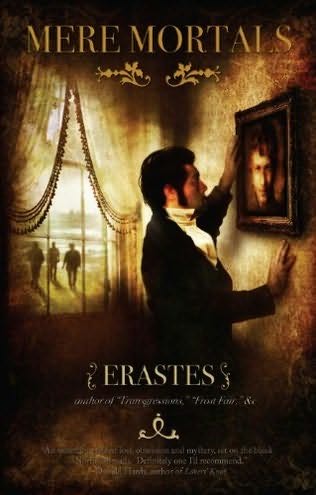
This week, we're welcoming historical novelist, Erastes, as she celebrates the release of her latest novel, MERE MORTALS, available now in print and ebook from Lethe Press, Amazon and just about everywhere. Here's the blurb:
Author Erastes' historical romance novel, Mere Mortals, is a beautifully written, haunting story about three young men who are taken in by a mysterious benefactor to live in the lap of luxury at his English countryside estate, Bittern’s Reach.

Orphaned Crispin Thorne has been taken as ward by Philip Smallwood, a man he's never met, and is transplanted from his private school to Smallwood s house on an island on the beautiful but coldly remote, Horsey Mere in Norfolk. Upon his arrival, he finds that he's not the only young man given a fresh start. Myles Graham and Jude Middleton are there before him, and as their benefactor is away, they soon form alliances and friendships, as they speculate on why they’ve been given this new life. Who is Philip Smallwood? Why has he given them such a fabulous new life? What secrets does the house hold and what is it that the Doctor seems to know? Trust acclaimed author Erastes to tell a moving story in the field of gay historical romance.

What makes your recent release, MERE MORTALS, an unusual historical?

Thanks for having me!  Well, for starters it’s set on The Norfolk Broads in England, and that’s an area that isn’t much covered by historical fiction. And it’s a gay historical which automatically gives it an “unusual” label, as despite there being hundreds more than there were five years ago, it’s a drop in the ocean when it comes to historical fiction in general.

Can you tell us a little about it?

It’s set in 1847, from November onwards. It’s told from the point of view of CrispinThorne, a rather disingenuous orphan who has been suddenly taken ward by a rich man who lives deep in the Norfolk countryside. Crispin has no idea what prompted this guardianship, as he’s never met or heard from the man before—and when he arrives at Bittern’s Reach, Philip Smallwood’s home, he finds two other young men who are also orphans, and who have more in common with Crispin than first meets the eye. The story is one of discovery, as they gradually learn more about their surroundings and their guardians character and motivation.

What inspired it?

Well, I was driving home one day and there was an interview on the radio on the BBC’s “Open Book” programme about a well-known writer (and for the life of me I can’t remember her name) who wrote a book about cloning, way back in the sixties, when cloning was still science fiction.  She said that she wasn’t really being original in the idea as the recreation of the perfect woman thing had been riffed on since the Greek Tragedies.  I’m always thinking of plots, and I suddenly thought how I could also use the idea but from a homosexual perspective.

I also wanted to shine a light on the fact that life was so cheap in Victorian (and obviously many other) times. The fact that Philip could literally take these young men out of schools because they had become an embarrassment, and take them away, and that no-one was going to check up on their welfare, made my hair stand on end.

How important are class distinctions to you when writing about your characters? For instance, the boys in Mere Mortals come across as being lower on the social scale than their benefactor. Likewise Rafe and Ambrose in Standish are from different social levels. Do you find that adds a dimension to their relationships?

When you are writing about historical periods, especially in England, it’s absolutely impossible to ignore class. Every interaction is coloured by it. If a landowner speaks to his gatekeeper you have to write it in keeping, if a vicar speaks to a peasant, then again. The young men in Mere Mortals are (probably, because it’s not explained, but they’ve all been sent to middling schools) nicely bred and they’ve had the company of their peers to teach them how to behave, but they all would feel like women did of the time, that they had no stability and their lives belonged to others. It’s not that I deliberately write unequal partnerships, but unless it’s Lord and Lord, you can’t avoid it. (and even in that case, one Lord would consider himself superior to the other.) It’s so ingrained in my English consciousness that I can’t help but be aware of it.

With your writing, which came first, the M/M or the historical?
The m/m I suppose, I started in Harry Potter fandom, but once I’d decided to write original fiction (about 2 months after starting writing in fandom) I knew that I had little interest in writing contemporary (not knowing the “scene” these days, or fantasy or sci-fi (everyone doing it far far better than I could!)

Are there any periods of history that you find so distasteful that you would never write about them?

No! LOL. Or subjects. I don’t understand writers who feel that some subjects shouldn’t be written about, such as slavery or incest or cannibalism—obviously these things should not be glorified or written for titillation (and it annoys me hugely to see slave rape done to arouse) but to ignore the problems we as humans have created in the past, and just shoving them under the mat is a grave error. If one doesn’t wish to read unpleasant subjects, that’s fine, but one should never say that a writers shouldn’t have the right write them.

I must admit, though, that I am now having a real problem with hygiene. Having watched the tremendous “Filthy Cities” recently with Dan Snow I will find it difficult to write any city/town based story prior to the 1900’s without seeing the massive amount of poo and rubbish that used to lie inches deep on the streets!

Thank you, Erastes. Please leave a comment to win a copy of MERE MORTALS!

02 June 2011

Excerpt Thursday: Erastes

This week on Excerpt Thursday, we're welcoming historical novelist, Erastes, as she celebrates the release of her latest novel, MERE MORTALS, available now in print and ebook from Lethe Press, Amazon and just about everywhere. Join us Sunday, when Erastes will be here to talk about the novel and give away a copy! Here's the blurb:
Author Erastes' historical romance novel, Mere Mortals, is a beautifully written, haunting story about three young men who are taken in by a mysterious benefactor to live in the lap of luxury at his English countryside estate, Bittern’s Reach.

Orphaned Crispin Thorne has been taken as ward by Philip Smallwood, a man he's never met, and is transplanted from his private school to Smallwood s house on an island on the beautiful but coldly remote, Horsey Mere in Norfolk. Upon his arrival, he finds that he's not the only young man given a fresh start. Myles Graham and Jude Middleton are there before him, and as their benefactor is away, they soon form alliances and friendships, as they speculate on why they’ve been given this new life. Who is Philip Smallwood? Why has he given them such a fabulous new life? What secrets does the house hold and what is it that the Doctor seems to know? Trust acclaimed author Erastes to tell a moving story in the field of gay historical romance.

***
“How long have you been Smallwood’s ward?”  
I’d expected something more personal, something impossible to answer, and the question took me by surprise. I answered him, relieved that I did not have to start my acquaintance with this man with a lie.

“I was told about it a year ago, sir.” Not for worlds would I explain the cir-cumstances of that discussion with a stranger. Just the memory—and shame—of my interview with the headmaster was enough to freeze the tongue in my mouth.

The headmaster had had his back to me, as if he couldn’t bear to look at me, and from what he’d just called me, and the expression on his face as he’d listened to my side of the story; it was clear he was revolted.

“Normally you would be sent home…in…cases like this. Archeson has al-ready been packed off and it will be up to his parents to deal with his…aberration.”

I paled. I’d met George Archeson’s father, as tall and broad and commanding as Archeson himself was slender and blond and shy—they couldn’t have been more different. I held my thumbs tightly, hoping against hope that Archeson wasn’t suffering. Wondering if we’d ever meet again, and doubting it.

“Truly, sir, you shouldn’t blame Arch.”

The headmaster rounded on me. “I do not.” The inference was clear, and I flinched under the fury of my headmaster’s gaze. “As you don’t have a home to go to, and your education is paid in full until you leave I have no alternative but to keep you, as much as I regret it.” The man returned to his desk, pulling open a drawer and removing a sheet of paper. He handled with much distaste-- as if I had written a de-scription of what Archeson and I had been doing when caught, although in truth it was little enough. “I have a letter here from Mr Smallwood, who has asked for, and has been awarded your guardianship. He wishes you to remain here for the remainder of the year.”

I felt as confused now as I had that day in the headmaster’s study. Smallwood? Who was this man? Why had he decided to become my guardian? Was it he who had paid for my education? If so, why? I had asked the headmaster these questions but the man had nothing more to tell me, or had decided not to tell me any-thing, either for reasons of his own or from sheer bloody malice.

Baynes dug a sharp elbow in my ribs. “There, lad. On your right. There’s your first sight of the Reach.” I struggled to my feet as the boat slipped quietly to-wards a wooden jetty in the distance, and gradually a house emerged from the screen of bare willows. In the year since I’d been told about a guardian I’d never met, I had imagined many houses that the man might live in: everything from a smart, four-storey townhouse in Mayfair, to a sprawling moorland farm, isolated in some bleak rolling landscape. I had not expected a huge elegant red-brick mansion with curved ornamentation to the gables. As the boat neared the jetty it became clear that behind the house the river widened considerably into a large lake, or a broad, I realised I should call them.

“Do you sail, Mr Thorne?” Baynes asked

“No, sir. That is, nothing much more than rowing. A little punting once or twice.”

“Well, you’d best learn,” Baynes said, “You can’t see it from here, but the Reach is on its own island. Boats are the horse, the carriages and carts here. You’ll find that out soon enough.” Baynes held out his hand and I shook it, gladly. “Good luck, boy.” He settled back down in his seat, leaving me no recourse but to say my farewells and to clamber ashore as gracefully as I could manage to watch the strange black boat slide away into the broad. No one waved to me from the boat, so I turned my attention to the present. My luggage was already on the jetty, such as it was, and I was about to drag it along with me when a shout sounded from the direction of the house.

“I say, leave that there, I’ll have Witheridge send someone for it later.” I turned to see a young man of a similar age to myself walking along the short path from the archway of the house. “Thorne?” The newcomer had a wide, friendly smile and as he neared the jetty he held out a hand, bare in spite of the cold, to be shaken. I did so, feeling some pleasure in at last seeing someone who seemed to be happy to see me. “Come in, you must be frozen.”

27 January 2010

Humor: The Satirical Work of James Gillray

By Erastes

He was a withdrawn, silent and lonely man, greatly slandered in his lifetime, probably by his victims and their friends. He worked in such a fury of creative energy that even his acquaintances years before his breakdown, wondered if he might be part-demented. He was so popular that there were often queues at the print shop, above which he worked, waiting for his latest cartoons and caricatures. At once the most ferocious and most brilliant caricaturist of his time, Gillray had a genius for turning public figures into monsters that were yet recognizable, his wild exaggeration being itself a criticism of their personalities.*
Born in 1757, James Gillray was educated at the cheerless and funless Moravian Academy in Bedford and later apprenticed to Harry Ashby, an engraver in the printer's district in London.

When qualified, he broke away from the engraving business and studied at the Royal Academy. He set up his own studio and intended to paint portraits but he was not patronised and eventually he had to return to the money-spinning business of engraving.

A Little Music or the Delights of Harmony

After experimenting with social subjects, such as the etching above, he started to do political satire and his popularity flourished. No-one was safe from his earlier work, neither politician nor royal prince.

The Prince of Wales

He worked exclusively for Hannah Humphreys in Bond Street, and moved into the premises.

Towards the end of his career Gillray's primary target was Napoleon Bonaparte and as "Little Boney"s power and ambition increased so did Gillray's caricatures of him become ever more extreme.

He was eventually given a "pension" by the Tory government, after which his attacks concentrated less on the Tories, and more on the Whigs... Perhaps the Whigs should have given him a pension too...

When his eyesight began to fail, and he was no longer able to create the quality of work he had been used to do, he began to drink and sink into depression.

Sadly, in 1811, Gillray attempted suicide by throwing himself from the attic of Humphrey's shop, after which he was deemed insane. Hannah Humphreys tended to him until the day he died in June 1815.

* The Prince of Pleasure, J.B. Priestley.
James Gillray Online

28 December 2009

The Seasons: The Year Without a Summer

By Erastes

One of my Regency novellas is set around the last official Frost Fair in 1814, and people have been saying how much they'd like a sequel to it. I'm not normally swayed by being asked for sequels but a couple of years after the Frost Fair, in 1816, there came another unusual event: The Year Without a Summer, and I think that I might do a sequel with the same characters set there.

These days, with geological evidence and satellite and all sorts of gadgets, the meteorologists tend to know what causes blips in the weather after the event (even if they still can't forecast it very successfully), but back then when something like the summer of 1816 happened, people must have been pretty concerned. I believe that sunspots were blamed for the unseasonable weather at the time, no-one thought for one moment that it was a volcanic eruption that had taken place the year before.

In fact, 1812-1817 were hugely active for volcanoes around the world, causing temperatures to drop all over the place but it was the volcano of Tambora that did the damage, all the way over in Indonesia.

Tambora killed 10,000 people from the explosion and another 82,000 people from related causes such as starvation and disease world-wide. To date, Tambora is the world's worst volcano disaster in recorded history. The dust from the massive explosion reached 10km high, entering into the stratosphere. Two other volcanoes had erupted previously, Saint Vincent (1812) and Mayon in the Philippines (1814), but this third explosion added more dust to the atmosphere and changing the weather throughout much of the world.

Median temperatures of around 13 degrees meant that, in England, crops failed and famine ensued. Snow was seen in June in many places, such as in New England and northwestern Europe. The lack of light contributed to the failing crops as photosynthesis struggled to take place.

Turner painted this in 1816, and even though Turner's skyscapes were often odd-coloured, this gives a real flavour as to what people were seeing that year, with the brown dust colouring the sky.

One thing related to writing did take place however. In a secluded house in Switzerland during that dark dank summer, a group of writers gathered together and with the gloomy atmosphere to inspire them, challenged each other to write ghost stories. And thus Frankenstein was born.

12 December 2009

Weekly Announcements - 12 Dec 09

After a brief hiatus--publishing news is slow as we approach the holidays--we're back with tons of great news for our authors and for readers who love Unusual Historicals!

***

The covers of two of our regular contributors, Blythe Gifford and Margaret Mallory, have been named as finalists in The Seasons' Best Historical Covers of 2009 poll. Blythe's entry is IN THE MASTER'S BED, while Margaret has two entries: KNIGHT OF DESIRE and KNIGHT OF PLEASURE.

Voting will conclude tomorrow, so take this opportunity to vote!

***

Zoe Archer's novella "The Undying Heart" in the duology she shares with Bianca D'Arc called HALF PAST DEAD received a great review in Publisher's Weekly.
Two...novellas combine themes of love and zombies. Vintage horror, high adventure, and soul-aching romance blend in Archer's compelling “The Undying Heart,” prequel to the upcoming Blades of the Rose trilogy. Cassandra Fielding, a young pistol-in-the-skirts hunter of magical artifacts, renews her childhood infatuation with Sam Reed, even though he's been turned into a cold, fierce, disillusioned, but still handsome zombie by his unscrupulous Crimean War commander. Readers [will] love Archer's powerful, polished tale.
***

Michelle Styles received a great review from Realms On Our Bookshelves, a Dutch fiction site, for her newest release, THE VIKING'S CAPTIVE PRINCESS.
Though this book was a category romance of less than 300 pages, it totally didn't have that feel, it was well rounded, well crafted and complete. Hence, praise to Michelle Styles for the delivery of another entertaining, solid Viking story and giving this historical romance lover an escape in the form of a few pleasurable reading hours.
You can read the full review here.

Also, Michelle's THE CHRISTMAS WEDDING WAGER has been released in Polish with the title PAMIĘTNA WIGILIA. It will also be released in Czech. And next month, AN IMPULSIVE DEBUTANTE will be released as Debutante Il Vlazer della Debutante, and A QUESTION OF IMPROPRIETY will be released as Una Proposta Scanalosa, both in Italy. Congratulations!

***

Erastes is happy to announce that Speak Its Name is hosting an advent calendar of sorts: a different gay historical author every day, including Stephanie Cowell, Josh Lanyon, Charlie Cochrane, and many more. There's a giveaway every day and a "bumper" bonus present for one random commenter to be announced on Christmas Day!

***

Lindsay Townsend's ancient world historical romance, BRONZE LIGHTNING, has been short-listed for a Christmas Award at Red Roses for Authors. Only twelve people have voted so far, so show your support for unusual historicals!

In addition, Lindsay has received two new covers: for her third Kensington Zebra medieval historical romance, A KNIGHT'S ENCHANTMENT, due to be published in June 2010; and from Audio Lark for her sweet historical romance, SECRET TREASURE, published as an ebook by Bookstrand and due to be published as an audio book in March 2010. Here they are:

***

Michelle Buonfiglio at the Barnes & Noble Heart to Heart Blog named Margaret Mallory's KNIGHT OF DESIRE as one of her two favorite debuts of 2009!

***

Carrie Lofty is pleased to announce that her Austrian-set historical romance will help launch Harlequin's new digital-only venture, Carina Press, in June 2010! More details to come, including lots of incredible promotional ventures. It's going to be an exciting ride!

***

Join us Sunday when Unusual Historicals will welcome Love Inspired author Carla Capshaw. She'll be talking her debut, THE GLADIATOR, and giving away an autographed copy. Don't miss it!

***

We'll also draw the winner of Michelle Styles' THE VIKING'S CAPTIVE PRINCESS. You still have time to leave a comment or question for your chance to win.

***

And stay with us through the coming weeks when we'll be featuring the best unusual historical authors! MJ Smith, Magdalena Scott, Monica Burns, and Carrie Lofty will be our guests. We hope you'll join us!

***

Have a good weekend! Remember, you don't have to be an Unusual Historicals contributor to submit good news to the weekend announcements. If it has to do with unusual historicals, we'd love to shout it out to the world! Send announcements to Carrie. See you next week...

28 October 2009

Research: Men's Underpants

By Erastes

When you write romance, particularly historical romance, you need to know a lot about the clothes. For me, part of the sensuous and pleasurable aspects of writing in eras other than our own is to picture exactly what my characters are wearing, what those clothes are made of, how they are created, dyed, woven, etc. A historical writer has to be partly geek, and would fit right in with any society of living history buffs.

When you write books which are going to have the protagonists stripping off, then you need to know what's under those clothes, and when--like me--you write about homosexual men, you need a good grounding in what men wear under those breeches, those kilts (if anything) and those dandified trousers. And how they go on. And how they come off!

So I'd like to share a little with you about things I have learned about men's undergarments whilst researching for my books. Here I cover up to the Elizabethan age, I'll share later eras perhaps in another month.

Loincloths might still be around (roll on global warming!!), but they have been found in burial sites on the bodies of men living over 7,000 years ago. Who knows what sparked man to start covering his bits--it would hardly be warmth, after all. It would offer some level of protection from thistles I suppose, but not if a sabre toothed-tiger was coming at you at groin level.

Tutankhamun was buried with 145 loincloths. This seems either a lot, or not enough, depending on your point of view of how long the afterlife is going to be. Of course by this time, the loincloth was worn under a skirt. Still--roll on global warming!

The Ancient Greeks obviously didn't have to worry about sabre-toothed tigers, and consequently didn't wear any underwear at all. Good for them! Φοβάμαι τους Έλληνες όταν είναι πηγαίνοντας καταδρομέας!*

The Romans did, though00big sissies. Possibly because their empire stretched into chillier areas. They'd wear something called a subligaculum, which in modern terms means a pair of shorts or a loincloth and was worn under a toga or tunic.

Pull-on undergarments were invented around the 13th century, large baggy drawers called "braies" made from linen were worn by men under their clothes. This style of undergarment did not really change in design for 500 years--Plus ca change...I know some men who change them about as frequently--other than to be fashioned from better, finer fabrics and to have ornamentation.

These knickers shrank considerable during the Renaissance as the familiar image of cod-piece and hose emerged. The hose themselves were an open garment--not like our tights or hose of today. Tight on the legs and open at the front and back which could not be worn openly as the privities hung lose. As the doublet became shorter clearly something else was needed! The braies shrank to show off the hose, and the codpiece was developed to protect the wearer's modesty.

Or at least at first.

Gradually the codpiece evolved, became padded, shaped to fit and as some clearly showed were frankly showing off--and obviously exaggerating. Some of the most "impressive" are those belonging to Henry 8th and shown at the Tower of London.

What is interesting about fashion today is that of showing off one's designer underwear is not a new thing at all. The rich would commission the most exquisite undershirts, and underwear, fabulously expensive fabrics and meticulously embroidered. Why, they reasoned, am I paying for such incredible work that will never be seen? Well, partly because Sumptuary Laws came into force in many European countries, restricting the sumptuousness of dress in order to curb extravagance, protect fortunes, and make clear the necessary and appropriate distinctions between levels of society.

This led to the "slashing" fashions that we see in the Elizabethan period, where the overclothes had slits, the better to show off the gorgeous clothes being worn beneath, and thus bypassing the laws.

After these excesses calmed down, and waistcoat shirt and breeches took the place of doublet and hose, men returned to wearing braies or "strossers." During the English Civil War the only difference between undergarments and overgarments were the weight of the wool they were made from.

*I fear the Greeks when they go commando.

Sources:
A history of Men's Underwear
Revival Clothing
Vintage Skivvies

09 September 2009

Scandal: Cleveland Street

By Erastes

This scandal has lost a lot of its fame due to another homosexual scandal that emerged a year or so later, about a certain Irish poet and a peer of the realm...

But in 1889, there existed a male brothel in Cleveland Street, London. It was a higher class of brothel, set in Fitzrovia, Central London, and attracted a higher range of clients. It was likely that the brothel would have continued unimpeded, for it's very probable that the constabulary were well aware of its existence had it not been for a spate of thefts at the Central Telegraph Office.

Whilst investigating these thefts, Police Constable Luke Hanks was interviewing and searching the staff. Telegraph boys were forbidden to carry personal money on them, as they had to handle money in the course of their business, and Hanks found one young man having the sum of fourteen shillings on him. A sum that was, in that time, the equivalent of many weeks work at the Telegraph Office and one that is worth around £400 in today's money.

When pressed, the telegraph boy, one Charles Thomas Swinscow, admitted that he hadn't stolen it, but had earned it as a prostitute at 19 Cleveland Street, employed by a man called Charles Hammond. He said he'd been introduced to Hammond by others in the Telegraph Office. It transpired that several young men worked for Hammond and statements were taken from them all.

Hanks realised that this matter needed to go further up the chain of command and the case was delegated to Detective Inspector Frederick Abberline. Abberline went to arrest Hammond but he'd fled--one of the young men, Henry Newlove, had tipped him off, but Newlove himself hadn't been able to get away and was taken to the police station. Once in custody, he named names--notable names--and the scandal began to leak out.

He named Henry FitzRoy, Earl of Euston, (who later successfully sued the newspapers for naming him as a client of Cleveland Street), Colonel Henry Jervois, and worst of all Lord Arthur Somerset, Equerry to the Prince of Wales. The police and government were reluctant to act due to the sensitive nature of the business and the high profile accused clients. They continued to search for other clients of the brothel, which of course had been closed down.

Then in August they went to arrest George Veck--a man who posed as a clergyman (an offence in itself) and a close friend of Hammond. A rentboy found in Veck's rooms told the police where to find him, and upon his arrest he was found to be holding incriminating letters from one Algernon Allies. When questioned, Allies said that he'd been working at Cleveland Street--and he confirmed that he'd been in a relationship with Somerset, and had been receiving money for sexual favours. After the police interviewed him, Somerset left the country for Germany.

Shortly afterward, Veck and Henry Newlove went to trial. But guess who their lawyer was? None other than Lord Somerset's own solicitor, Arthur Newton! And guess who paid the legal fees? Yep. Lord Somerset. As you can imagine, the press was having a field day by this point. NOBS NOB RENT BOYS!!! would be the headlines in the press today. The press were vitriolic about the aristocracy indulging in vice.

Due to the fact that Newlove and Veck both pled guilty to indecency, their sentences were "lenient." They were sentenced to four and nine months' hard labour. Other telegraph boys also caught up in the trial were dealt with leniently. Hammond was never extradited and the charges were eventually dropped.

As for Somerset himself--his life was never the same. He attempted several times to return to England, but risk of arrest kept him having to leave again. He eventually spent his life in France.

The trial, with its intermittent flare ups thereafter in the press, which reinforced negative attitudes about homosexuality as an aristocratic vice, kept homosexuality high in the public eye. Details had been available to the public in a way it never had been before. This didn't help Oscar Wilde when, a few years later, he was tried for gross indecency.

Despite the fact that Prince Albert Victor (pictured) had never been mentioned in the press (this was not allowed as he had not been brought into the trial--oh, HOW things have changed, eh?), speculation rumbles on from that day to this as to whether the second-in-line to the throne had ever been a customer of the notorious 19 Cleveland Street. The American press certainly seemed to have no such scruples on the matter:

07 August 2009

Weekly Announcements - 7 Aug 09

I'd like to welcome three new contributors, as well as the return of an old friend. Let me introduce them to you...

Harlequin Historicals author Blythe Gifford is a fellow member of my illustrious Chicago North RWA chapter, whose freelance work has been published in Writer's Digest and Novel Writer. Her debut novel, THE KNAVE AND THE MAIDEN was a Golden Heart finalist, and INNOCENCE UNVEILED was set in medieval Flanders! Her September release is IN THE MASTER'S BED, the sequel to her successful THE HARLOT'S DAUGHTER.

Margaret Mallory so enjoyed her guest post, in which she discussed her debut KNIGHT OF DESIRE, that she decided to stick around as a regular contributor! The next in her "All the King's Men" series, KNIGHT OF PLEASURE, will be released in December 2009.

Throughout her varied career, Kristina McMorris has been a freelance writer, wedding planner, television presenter, speechwriter, and two-time Golden Heart finalist. She recently sold her novel LETTERS FROM HOME, set in World War II Europe and on the American homefront. Its tentative trade paperback release date from Kensington is February 2011.

And finally we welcome the return of Zoe Archer, who took time off from our blog to concentrate on her writing, the result of which is her four-part Victorian "Blades of the Rose" series. Combining history, desire, romance, and high adventure, WARRIOR (09/2010), SCOUNDREL (10/2010), REBEL (11/2010), and STRANGER (12/2010) will be released by Kensington.

Welcome to all of our new members! I would also like to wish a fond farewell to three contributors whose commitments take them away from Unusual Historicals: Carol Spradling, Bonnie Vanak and Vicki Gaia. Thank you for everything, ladies!

These changes bring our strength to 25 contributors, all of whom look forward to bringing you new and interesting posts in the months and years to come.

***

Michelle Styles has release dates for her upcoming Harlequin Historical and Harlequin Mills & Boon romances: THE VIKING'S CAPTIVE PRINCESS in December 2009; SOLD & SEDUCED in February 2010; and COMPROMISING MISS MILTON in May 2010.

***

Erastes' FROST FAIR has been relaunched by Cheyenne Publishing with a beautiful new cover designed by Alex Beecroft.

***

Jeannine van Eperen, who used to be a regular contributor to this site, has released a new work of historical fiction called A NEW DAY from Wings ePress. It centers on the trials and loves of three generations of women--Caroline, Augusta and Lucy--and depicts life in Pomeranian Prussia from 1848 to 1886, and immigrant life in Chicago from 1886 to 1914.

***

Join us Sunday when author Mingmei Yip will be joining us to talk about PEACH BLOSSOM PAVILION, her gorgeous novel set in early 20th century China! You can read an excerpt here.

We'll also draw the winner of Margaret Mallory's KNIGHT OF DESIRE. You still have time to throw your name in the hat, if you haven't done so.

And stay with us throughout August when we'll be featuring authors who write everything from erotica to inspirational--but all unusual historicals! Amanda McIntyre, Christy Hubbard, Blythe Gifford, and Maureen Lang will be our guests. We hope you'll join us!

***

Have a good weekend! If you have an announcement to make for next week, email Carrie. See you next week...

05 August 2009

Men: The Macaronis

By Erastes

Yankee Doodle came to London, riding on a pony,
Stuck a feather in his cap and called it Macaroni.


When I was a child, I used to sing this song, thinking that Yankee Doodle either called his feather, his cap, or his pony Macaroni. It was a subject of some debate among the kids, at some time or other.

The truth is rather blurred in myth. Popular misconception says that it's a song by the English jeering at the unsophisticated colonial Americans, but this verse of the rather long song wasn't added until the mid-19th century. Another theory is that it refers to Oliver Cromwell--and comes from an almost identical stanza in a song called "Roundheads and Cavaliers."

However, whichever is true, a macaroni was a slang term denoting a fop, but it's even more than that.

A macaroni, or maccaroni, was a man of fashion; in fact he was what we'd refer to today as a fashion victim. The sort of person who buys Zandra Rhodes or wears tinfoil dresses just because they are the hot fashion item. They were famous for going too far in their slavish devotion to looking good, and even though men were--in centuries before our own--much more decorative than they are today, the macaronis took it twenty stages further, becoming so outrageous in their display that they became a bit of a laughing stock for being so effeminate that it was often difficult to tell their sex.

An informal club, "The Macaroni Club," was formed, and Horace Walpole wrote to a friend in 1764: "The Macaroni Club, which is composed of all the traveled young men who wear long curls and spying-glasses."

Naturally, it was the rich men who followed the fashion, and after Charles II's restoration, following years of Puritan repression, fashion exploded once more, travel became fashionable, men started to do The Grand Tour, and wigs proliferated in fashionable circles becoming ridiculously huge by the late 1600s. So much so that most older men became more conservative in their wig taste, leading to the youthful revolution that was the Macaronis.

Their clothes were so outrageous and restrictive: tightly-fitting coats and short waistcoats with enormous buttons, and exquisitely thin shoes with huge buckles of silver or gold--so thin that they even adopted a particular mincing gait. Together with the habit of carrying nosegays, they were not widely accepted by other gentlemen of the day and were continually lampooned in the press.

Perhaps the first real gender benders, in fact.