Showing posts with label Famous People. Show all posts

22 June 2011

The Entertainers: Buffalo Bill Cody

By Carrie Lofty

As with most legends of the American West, the factual details of William Frederick "Buffalo Bill" Cody's life are subject to much dispute. His autobiography claims that he began his life as an "Indian fighter" at age eleven and rode for the Pony Express at age fourteen. Facts become a little more prevalent once he joined the Union Army in 1863 as a teamster, and later went on to serve as a scout.


But his true calling was always entertainment. He made his stage debut in Chicago in 1972 at the age of 26. Eventually the play "The Scouts of the Prairie" also featured another Old West legend, James Butler "Wild Bill" Hickok, but Cody was much better suited to stage life than ambling, gambling Wild Bill.

After years touring with a company, Cody decided to found his own entourage of Western spectacles. "Buffalo Bill's Wild West" expanded from its 1883 origins to become one of the best known traveling acts to have ever toured. Featured performers included Annie Oakley, and typical shows boasted trick shooting and roping, wild animals, cowboys, horse chases, re-enactments of famous battles, stagecoaches, parades of American Indians in full regalia, and lots of Cody's trademark flare.

Eventually he renamed his troupe "Buffalo Bill's Wild West and Congress of Rough Riders of the World," which probably suited his ever-growing showmanship and fame. The troupe performed for over a million spectators on Coney Island, then traveled to England for Victoria's Jubilee in 1887, officially taking Cody's version of the Wild West to Europe. (Pictured is the troupe's visit to Rome in 1890.) Depictions of massacres and firefights became the most lasting impressions the world would have of the American frontier until Hollywood's interpretations--although most early cinematic portrayals drew heavily from the show's high drama.

The autobiography mentioned above was first published in 1879, when Cody was only 33 and still growing in popularity. He certainly knew the value of managing his own image, and he often used his fame to promote civil rights for women and American Indians, as well as conservationism. Western historians claim that he was the most famous individual on the planet at the turn of the 20th century, and his death in 1917 of kidney failure solicited condolences from the leaders of the United States, Great Britain, and Germany. He remains one of the most gifted entertainers and promoters in American history, with his popular image of the Wild West still influencing imaginations today.

What other entertainers remind you of Buffalo Bill, in that they control huge empires--even to the point of rewriting their own histories? Is that even possible in today's information-saturated culture?

SONG OF SEDUCTION's sequel from Carina Press, PORTRAIT OF SEDUCTION, is now available! Later this year watch for Carrie's new Victorian series from Pocket, as well as her "Dark Age Dawning" romance trilogy from Berkley, co-written with Ann Aguirre under the name Ellen Connor. "Historical romance needs more risk-takers like Lofty." ~ Wendy the Super Librarian

02 August 2010

Tragic Tales: Fatty Arbuckle

By Lorelie Brown

Charlie Chaplin, Buster Keaton and...Roscoe "Fatty" Arbuckle? Who the heck is that?

While almost everyone has heard of the first two, Arbuckle has all but faded from public memory, and it was all because of one woman’s death.


Fatty Arbuckle (he supposedly hated the nickname Fatty, but I can hardly make myself think of him by any other name) started in Vaudeville as a fairly young kid. He moved to motion pictures in 1909. But he didn't get his really big break until he moved to Universal Pictures in 1913 and starred in the Keystone Kops franchise. After those, Arbuckle became huge--his fame grew to match his very large body type. Arbuckle was somewhere between 250 and 300 pounds, but the remarkable part of him was that everyone remembered him as having a light graceful step that belied his large size. Along with helping to mentor Chaplin and Keaton, he also helped out Bob Hope by hooking him up with Hollywood contacts.

By 1921, Arbuckle was on top of the world, career wise. He'd moved to Paramount Studios for a then-amazing $1 million per year. Arbuckle and two friends drove up to San Francisco for Labor Day weekend and rented a total of three rooms at the St. Francis Hotel. After a few calls, illegal booze and catered food were both delivered and a party was in full swing.

Among the guests were Virginia Rappe and Maude Delmont. Though Rappe would later be described in newspapers a sweet and innocent girl, that was far from the truth. She'd clung to the outskirts of Hollywood for years, occasionally getting tiny roles and more frequently showing up at Hollywood parties. Delmont was even worse, being known for intentionally seducing men for the sole purpose of later blackmailing them.

Rappe took sick. That much is for sure. Beyond that, things are fuzzy. Arbuckle claimed he retired to his room to change clothes and found an obviously-ill Rappe in his bedroom. People were called in, ice was placed on her midsection and most everyone said she was ill from drinking too much alcohol. Several doctors treated Rappe in the hotel, and most agreed with the alcohol poisoning diagnosis. (Though what always makes my eyebrows go up is that one doc gave her morphine. For alcohol poisoning! Totally normal at the time, but now the idea of treating that with a depressant makes little sense to non-medically-educated me.) After four days in the hotel, Rappe was moved to a local hospital. She died there on 9 September of peritonitis and infection from a torn bladder.

Delmont, however, claimed that Arbuckle had raped her friend. It would be her claims that carried the day. The San Francisco Prosecutor at the time, Matthew Brady, was very ambitious and seemed to think he could ride a conviction of Arbuckle all the way to being governor of California. Prosecutors decided that Rappe's bladder had been torn by the very large Arbuckle's weight bearing down on her during the alleged rape. (In reality, Rappe's bladder was probably damaged by a botched abortion she had days before joining the Arbuckle party in San Francisco.)

Arbuckle was tried three times for Rappe's death. The first trial ended with a hung jury that was locked up at 10 to 2 for acquittal. The second was 10 to 2 for conviction. The third ended in a complete acquittal and the jury even went so far as to write Arbuckle a letter of apology that he had been put through so much.

But the damage was already done. In an ironic twist considering William Randolph Hearst's role in suppressing the 1924 Ince scandal, newspapers owned by Hearst pushed Arbuckle's guilt. Headlines had pretty much already convicted him. Articles carried lurid details and didn't hesitate to pass along rumors that Arbuckle had violated Rappe with foreign objects such as a coca-cola or champagne bottle.

Arbuckle's career was sacrificed on the pyre of public opinion. He was banned from movies for the better part of a year, but even after the ban was lifted he was never as famous again. He had a little comeback at the end of the 20s but it didn't last long. He died before he could really make it to the top again. And our collective memory lost a great actor.

27 April 2010

News and Media: Gossip Sells

By Jennifer Linforth

Newspapers are filled with stories that can be manipulated into all sorts of tales of mystery and intrigue. They are also filled with what so many love best...

...gossip and rumor.

In the 19th century gossip was an art form! It was craved as much back then and it is now. Ladies whispered of it over tea, men debated it over cigars. Lives adhered strictly to etiquette and social standing, so you can well imagine would happen if a tidbit of bad manners or ill morals seeped out to the public. It could ruin a family in a heartbeat! Gossip and rumor truly didn't leak however. Servants were often paid for their loose-lips as were members of society willing to spread untruths to expose their friends. A paper notorious for this was The John Bull, its editor also known to simply make up stories to stir the pot!

Papers reported important political issues and social affairs. By the 19th century journalism's ethics were being established. Papers were a sort of social conscience and many acted in good form. Many others did not and either way a balance was struck between truth and rumor that continues to this day. Scandal sells, and papers of the day quickly understood that, using the aristocracy to pad their pockets. Nothing has changed in this day and age...

Can you imagine a world without gossip rag? Tabloids? People getting their fifteen minutes of fame for whatever the reason? Can you see a world of nothing but facts and full truths? One summer my local news broadcasted nothing but good news once a week. Not gossip, no tragedy, no scandals or politics, just plain old good news.

It didn't last long. Why do you think that is?

27 July 2009

Greatest Hits: William Flinders Petrie

Bonnie VanakBy Bonnie Vanak

He had the personality of a curmudgeon, was known for being eccentric (showing curious tourists at the Great Pyramid his pink underwear to scare them off), read Euclid and conducted chemistry experiments when he was just a lad of 15, and authored over 1,000 books and articles on the digs he conducted.

Sir William Matthew Flinders Petrie, born in 1853 and died in 1942, is considered the "Father of Modern Archaeology." The British Egyptologist and archaeologist was the first to insist on careful, meticulous excavations and examining each handful of earth. He censured the crude methods of using dynamite to blast into ancient tombs. His scientific and mathematical method of measuring the Great Pyramid of Giza set the standard for pyramid measurement.

Before writing my first book, THE FALCON AND THE DOVE, I was researching ancient Egypt and the 18th dynasty pharaoh Akhenaten. In 1892, Petrie excavated Akhetaten, the city the pharaoh built to worship the god Aten. Petrie's work inspired me to include the dig in my book when the heroine, Elizabeth, becomes part of the historical excavation. In THE FALCON AND THE DOVE, Elizabeth, a rebel at heart, breaks Petrie's rules by riding a donkey to the dig site. History tells us Petrie ordered all his workers to walk there. He led a very spartan life while on site.

I'm so fascinated with Petrie that I decided to interview him.

Bonnie: Sir William, is it true your expeditions meant sacrificing luxury and comfortable accommodations while at the dig site?

Petrie: Pah! Who complained to you about that? Bunch of lily-livered saps. Need to buck up. Nothing wrong with sleeping in an old tomb, and eating canned meat. The work's all that matters.

Bonnie: I read that you stripped off your clothing when outside Khufu's pyramid and showed off your Calvin Kleins for the tourists to scare them off. Your PINK Calvin Kleins.

Petrie: Who is this Calvin Klein?

Bonnie: He makes men's underwear.

Petrie: Useless profession. Yes, I did and I detest tourists. Get in the way, the whole lot of them. Worse than the flea-bitten donkeys.

Bonnie: So you did measure the inside of the Great Pyramid nude?

Petrie: Damn hot inside, what else was I supposed to do? Wear a fur coat? Have you ever been inside one? Stuffy as a tomb. Considering it was a tomb.

Bonnie: You worked with Howard Carter on the dig at Akhetaten. He was working as an artist, but made some important discoveries. You're partly to thank for Carter's training that led him to discover the tomb of King Tutankhamen.

Petrie: Carter? Insignificant sap, told him he'd never be more than an artist. Never would make a good excavator. I trained many gifted archaeologists much better than Carter.

Bonnie: Amelia Edwards, who authored A Thousand Miles up the Nile, was a great admirer of yours. She funded the Edwards Professor of Egyptian Archaeology and Philology at University College, London. You had the distinct honor of being the first to take the chair.

Petrie: Yes, yes, Amelia, lovely woman, bequeathed her collection to the college. Intelligent and a very good author.

Bonnie: So where did you take it? The chair, I mean.

Petrie: (silence)

Bonnie: That was a joke.

Petrie: Pah! Are you quite done? I have work to do.

Bonnie: Almost. It's said you never did quite get the hang of Arabic. But you changed the way excavations were conducted, and as a result, archaeologists after you understood the importance of examining every bit of debris at a site, every single potsherd. You set the standard, and because of your sequence dating at Naqada, we now have the Predynastic Period of Egypt's history. You, sir, are to be commended for all your wonderful contributions to history.

Petrie: Thank you.

Bonnie: Afwan.

Petrie: What's that?

Bonnie: It's Arabic for "You're welcome."

Petrie, grumbling: Bloody show off!

31 July 2008

Famous People: Henry Winstanley

By Lisa Marie Wilkinson

A fictional interview with inventor Henry Winstanley by Lisa Marie Wilkinson.

Lisa Marie: I've selected you for inclusion in the "Famous People" category of the Unusual Historicals blog because you designed and oversaw the construction of the famous Eddystone Lighthouse. The lighthouse stood 14 kilometers off the coast of Plymouth, England until it was swept away during a violent storm in 1703. What other interesting facts do you feel make you a worthy "Famous People" candidate?

Henry Winstanley: My inventions weren't limited to lighthouses. I was an engraver, an architect, and I'd always had a fascination for hydraulics and all things mechanical. I had a house built in Littlebury for the purpose of housing some of my inventions for exhibition. My "Mathematical Water Theater," combining fireworks and fountains, was a popular attraction in London's Piccadilly during the 1690's. I was called the "Jester of Littlebury," because my house was filled with all sorts of oddities, including trap doors and chairs that came alive and ensnared those who sat in them.

Lisa Marie: Would you object to my quoting a section from my historical romance novel, FIRE AT MIDNIGHT, which describes my heroine Rachael's first impression of your lighthouse?

Henry Winstanley: No, not at all. I'm very proud of my design.

Lisa Marie: Quoting passage from FIRE AT MIDNIGHT:

Sebastién battled a strong crosswind as he steered the tiny rowboat in choppy seas. They came close enough to the great foundation of rock to which the Eddystone Light was anchored that Rachael was afforded a glimpse of its underpinnings: iron rods of at least twelve feet in length in a stone base some two dozen feet tall.

This was no ordinary lighthouse. She squinted up at the high tower as they stepped onto the landing platform that led to the front entry. The ten-sided upper section bore an artist’s impressions of the sun and moon, plus various inscriptions, mostly in Latin, Post Tenebras Lux ("After Darkness, Light"), Salutem Omnium ("For the Safety of All"), Pax En Bello ("Peace in War"), and, Glory Be To God.

Directly below the great lantern with its massive glass windows was a skillfully engraved shower of stars and the inscription, Anno Dom in bold work, flanked by a reference to the reign of William the Third.

Sebastién urged her forward, whispering that he expected to find the decor of a Parisian bordello inside. As they passed through the main door, she glimpsed another engraving in Latin, this one a proclamation that the lighthouse had been designed and constructed by Henry Winstanley.

The interior of the tower upheld the lavish style promised by its exterior. She had expected to find steep, rust-corroded spiraling stairs, drafty landings, and hard pallets tossed onto cold floors. Sebastién, evidently expecting the same, gave a low whistle when he opened a door and discovered an attractively appointed bedchamber. The room was richly gilded, with a large closet, and a small chimney. While he noted the barred outside shutters with a grunt of approval, she marveled at the fine woodwork and the quality of the tapestry rugs.
Lisa Marie: You also met my hero in a later scene, the Frenchman by the name of Sebastién Falconer.

Henry Winstanley: I'd rather not be reminded of that.

Lisa Marie: Why is that, Mr. Winstanley?

Henry Winstanley: Because I hate French privateers! When I was hard at work constructing the foundation for the first light tower to stand on the Eddystone rocks, my crew and I were attacked by French privateers and taken as hostages to France. If not for Louis XIV, I might have languished in France forever. But Louis simply ordered me returned to England, saying that, "France is at war with England, not with humanity."

Lisa Marie: Did you say, "the first light tower?" How many have there been?

Henry Winstanley: There have been a total of five. But I believe mine was the best, because it was the most beautiful design, with an octagonal tower and splendid furnishings within.

Lisa Marie: Would you share your most famous anecdote concerning the Eddystone Lighthouse with us?

Henry Winstanley: I used to say I yearned to be inside my lighthouse during the greatest storm there ever was. The lesson to be learned there is: be careful what you wish for.

Lisa Marie's closing note: Henry Winstanley and several workmen had sailed out to the Eddystone Lightouse on the night of November 27, 1703, to do repairs on the lighthouse. This was the night of what would come to be known throughout England's history as "The Great Storm." Winstanley and his crew perished when the lighthouse was swept away during the storm.

29 July 2008

Famous People: Lucheni and the Empress

By Jennifer Linforth

I swore to myself to kill some high-placed person or another, prince, king or president of a republic--it's all the same. They are all made of the same stuff.

Those were the words of Luigi Lucheni, a twenty five year old Parisian-born Italian, as he sat in a police station in Geneva. Shortly after he finished that statement, the phone rang announcing the woman he stabbed died of her wounds.

All hail to anarchism! Lucheni replied.

Luigi Lucheni would make his mark in history as the murderer of Empress Elisabeth of Austria. His original intent was to kill the King of Italy, but lacking the cash to travel the distance to Rome, he set his sites on Elisabeth instead.

How does a young man who was a respected and decent soldier in the Italian army, a musician and a hired valet for the Prince of Aragona, end up one of the most famous anarchists of all time? No one really knows. But what is known is that Lucheni was very proud of his act and made no small affair of it while in prison. He wrote several letters while awaiting trial to many prominent newspapers calling the ruling classes 'bloodsuckers of humanity,' insisting that just retribution would repeat with frequency against kings, president and ministers or anyone who suppresses humanity for their own benefit.

Oddly enough, Lucheni received more letters than he wrote--most in favor of his deed. Still, those who opposed him opposed him with vehemence:

Murderer, beast, monster, rabid animal! The women and girls of Vienna long to revenge the horrible crime which you committed against our beloved Empress. Rabid animal, do you know what you deserve? Listen you monster: we want to stretch you out on a table and we, who are so soft-hearted, want to look on while both your arms and feet are hacked off.

The investigation into Lucheni's crime was a public one and the search for accomplices long. When asked if he had any he replied, "I have none. My accomplice is here," pointing to himself. The courts wanted to show that this act was a conspiracy, yet they could not. Luigi Lucheni was a model for anarchist assassins even up to today. He alone wished to carry the deed to martyrdom.

Naturally Lucheni was convicted of this crime, being that he flat out and proudly admitted to the deed. His sentence was lifelong imprisonment to which he shouted, "Long live anarchy! Death to aristocracy!"

Six months later Lucheni admitted to being a part of a bigger conspiracy of two other Italians--one armed that day with a revolver the other a dagger. Lucheni killed Empress Elisabeth with a slender file sharpened to a deadly point. Running up to her he blocked her afternoon stroll with her lady-in-waiting. Stumbling in front of her and peering beneath her parasol to make certain he would kill the correct woman, he punctured her heart. So small was the wound that she lived for sixty minutes afterward and initially did not even know she was injured.

On October 19, 1910, eleven years after his crime Lucheni, hanged himself by his belt. A famous anarchist--suddenly forgotten.

Letters and quotes researched from The Eagles Die by George R. Marek, Harper and Row Publishers, New York.

28 July 2008

Famous People: Hollywood Fame

By Penny Ash

Hollywoodland. A name that conjures up images of glamor and fame, glitter and excitement, and even seediness and the shabby. Place of the fantastic, where a lowly waiter or maid could suddenly be "discovered" and rocket to stardom, like Lana Turner did. In Hollywood, you could stop in at a restaurant and maybe see your favorite star. Along with Las Vegas, it's a place you can mention practically anywhere in the world and find it recognized.

It started out as a planned community built where the old Spanish ranchos had been and flourished until a lack of water made it necessary to annex it to Los Angeles. Then in 1911 the first film studio arrived, The Nestor Company. Cecil B. DeMille and D. W. Griffith arrived soon after and the boom began. The area was perfect for making movies, with it's open spaces and good climate. The sign arrived in 1923 to advertise a real estate development. The arrival of the thousands of people it takes to make movies meant everyone needed a place to live.

By 1949, the sign had badly deteriorated. The Chamber of Commerce took over, fixed it up, and removed the last four letters. It wasn't long before Hollywood became the trademark for an entire lifestyle. But it didn't last. As the world changed and movie making began to compete with TV, the condition of the sign deteriorated again.

In the 1970s and early 1980s, another push was launched to "Save the Sign." People like Hugh Hefner campaigned to repair the icon, and people like Alice Cooper bought letters. It was vandalized several times and used to make political statements through the 1980s.

The sign and its condition has always been a metaphor and a mirror for the condition of the town, a beacon for those wanting fortune and fame, glamor and glitz, and fantasy. It will continue to draw people as long as people are dazzled by fame.

24 July 2008

Famous People: John Evelyn

By Anita Davison

The words 'diarist' and 'restoration' tend to conjure the name Samuel Pepys, but an equally prolific diarist of the time was John Evelyn (1620-1706). Sam Pepys wrote his diary over a period of ten years, but John Evelyn began his as a schoolboy and wrote it almost until his death. Whether he imagined his life was important enough to be recorded in detail is not certain, but he gives us a vivid picture of not only his domestic life, but Royal and political life in Restoration England. By the standards of his age, Evelyn was a man of dignity, philanthropy and loyalty. Samuel Pepys, who was usually regarded as a typical 17th century man, received bribes, (allegedly) deceived his wife and beat his servants.

Evelyn was an adult during the Civil War, lived through the Commonwealth, saw the return of Charles II, witnessed the Great Plague and the Fire of London, survived unscathed the reigns of James II, the Glorious Revolution, William III and Mary II, including the tragedy of Queen Mary's death from smallpox at the age of 32, and the beginning of Queen Anne's reign.

He was close friends with Samuel Pepys, the philosopher Robert Boyle and architect Sir Christopher Wren and also introduced the woodcarver, Grinling Gibbons to Charles II. Pepys, who occasionally found Evelyn conceited and some of his books boring, made a revealing observation of Evelyn by one of his friends, "he being a very ingenious man, and the more I know him, the more I love him," (29 April 1666).

As a Commissioner for Sick and Wounded Seamen, a post he refused to leave during the Plague Year, Evelyn was appalled at the number of maimed and destitute sailors and soldiers begging on the streets of London after the Dutch and Jacobite wars in Ireland and France. He and Samuel Pepys, Christopher Wren and Queen Mary II, founded the Greenwich Hospital where these men were offered a home for the rest of their lives. He was also a founder member of the Royal Society as well as a celebrated gardener and authority on trees.

John’s grandfather, George Evelyn, manufactured gunpowder during the latter part of the reign of Elizabeth I and grew wealthy on the proceeds. Richard Evelyn, was the only son of his second marriage, of whom George, the eldest son inherited the estate in 1640. A respected landowner, George Evelyn sat in Parliament under Charles II, and William and Mary.

In 1637, their second son, John, was admitted into the Middle Temple in London to study law and a year later went up to Balliol College at Oxford. Some of his almanacs survive and they show that, by our standards, he was barely literate.

In the years leading up the Civil War, although a staunch Royalist, Evelyn decided to: "absent my selfe from this ill face of things at home." He left England in late 1643 and spent the next few years exploring France, Italy and Switzerland and came into contact with the exiled court of Charles II. Evelyn met the king's ambassador to France, Sir Richard Browne and in 1647 married Browne's daughter Mary.

In 1649, Evelyn bought Sayes Court, Deptford from his father-in-law; a run-down Elizabethan manor-house adjacent to the naval dockyards. An insalubrious location, but the available land and its proximity to London made up for it. Their eldest son, Richard, suffered a series of fits and a fever during an appalling winter of 1658 and died at the age of five. The following morning their fourth son, seven month old George, died too. Their second son had died as an infant and only the third, John, survived to adulthood. The impassioned account of Richard's life and death in John’s diary belies our belief that parents in an age of chronic infant mortality coped better with losing a child, as Evelyn and his wife were reduced to despair.

Evelyn was one of the first environmentalists, and after the Great Fire in 1666, he presented the King with a plan to rebuild the City. His tracts "Fumifugium" and "A Character of England" had already suggested removing the pollutive industries to more distant locations. Christopher Wren also planned a remodeled city, but neither plan was put into operation with the excuse that Londoners couldn't wait for the schemes of great men and simply built their houses back on their original footprints.

Evelyn had difficulty balancing his respect for Charles II with his outrage at the decadence of the Restoration court. The drinking, gaming, and parading of mistresses were "all dissolution" to him. When news came in January 1686 that Charles's most famous former concubine Nell Gwyn had been seen attending Catholic services, his comment was quoted as: "no greate losse to the Church."

"I saw this evening such a sceane of profuse gaming, and luxurious dallying & prophanesse, the King in the middst of his 3 concubines, as I had never before," (25 January 1685).

His diary shows that he loved his wife and children, and was concerned for the welfare of his servants. When his beloved daughter, Mary died at nineteen in 1685, he mourned her deeply. That same year, his seventeen year old daughter, Elizabeth eloped with a young man from the Navy Office. Evelyn immediately disowned and disinherited her and when she contracted smallpox just weeks later, he visited her sickbed with a minister so she might take the last sacrament and seek forgiveness for her actions.

When God "took her out of this vale of misery," Evelyn's diary states that, "My Child was buried by her sister on 2d September in the Church of Deptford." He appears not to have attended the funeral, sending his youngest daughter, Susanna, instead and his words at the time were that Elizabeth's fate was God's punishment. A harsh attitude perhaps, but disobedience of a father was a grave sin in the 17th Century when children, especially daughters, were regarded as the property of their parents.

During the reign of James II (1685-88) Evelyn reached his highest official post as a Commissioner of the Privy Seal. He avoided having to apply the official seal to documents that troubled his conscience, like the printing of "Popish Books," by not turning up at meetings. Luckily James II's reign was over quickly enough for this not to be an issue.

Evelyn died in his house in Dover Street in 1702, and his wife, Mary Evelyn, three years later. Of his eight children, four lived to adulthood and only Susanna, outlived her parents.

Many of his books are stored at the British Library Museum. Some of his furniture is at the Victoria and Albert Museum and the Geffrye Museum in Bethnal Green. The monument to his son Richard and his daughter Mary is still on the wall of the church of St. Nicholas, Deptford. The private Evelyn chapel in Wotton church has been closed since 1992, when the stone sarcophagi on the chapel floor was hacked open and Evelyn's, and his wife's skulls were removed. They have yet to be recovered.

Evelyn's thoughts after the death of King Charles II:
"...He was ever kind to me & very gracious upon all occasions, & therefore I cannot without ingratitude deplore his losse, which for many respects (as well as duty) I do with all my soule," (2 October 1685).

Mary Evelyn Miscarries
"My Wife receiving a fall from a stoole, miscarried of a fine boy, to our greate trouble," (18 October 1660).

23 July 2008

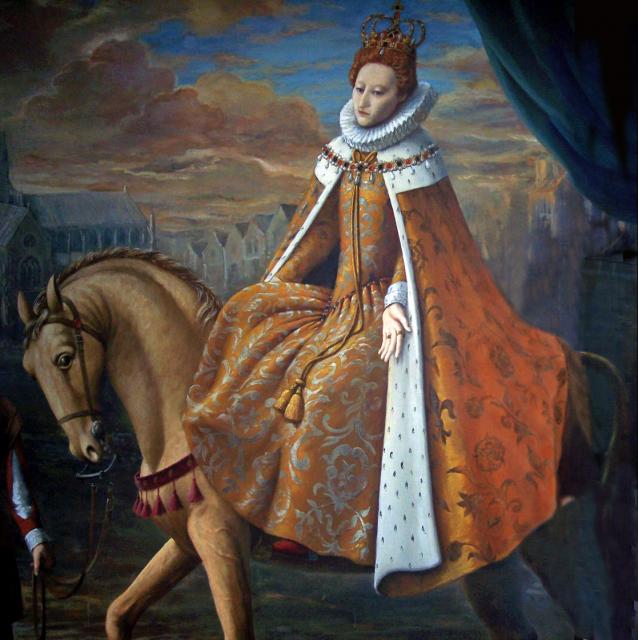
Famous People: Queen Elizabeth I

By Marianne LaCroix

"I may not be a lion, but I am a lion's cub, and I have a lion's heart." ~ Queen Elizabeth I

Instead of rewriting or summarizing the life of this fabulous and legendary Queen of England, I am going to list seven interesting (more personal) facts about her. The movies Elizabeth and Elizabeth: The Golden Age, touch on the more well known facts about her life, even though they are sensationalized by Hollywood.

1. Elizabeth was extremely fond of horseback riding. She'd spend many hours riding fast around the palace grounds much to the disapproval of her council. They feared she'd fall and kill herself by accident. Even through to her sixties, she'd tire her ladies in waiting and ride hard and fast. At the beginning of her reign, she had her Master of the Horse, Robert Dudley, import horses from Ireland because of their power and strength.

2. Elizabeth enjoyed watching tennis and one time disguised herself as one of her ladies in waiting to watch her friend Robert Dudley play a match.

3. Elizabeth loved music and dancing. She would dance the difficult and demanding dance, The Galliard, to keep fit. She enjoyed dancing with her courtiers and was fond of The Volta.

4. Elizabeth loved literature and poetry. She even wrote poetry. The following is one of those poems, and probably her best known:
On Monsieur's Departure

I grieve and dare not show my discontent,
I love and yet am forced to seem to hate,
I do, yet dare not say I ever meant,
I seem stark mute but inwardly do prate.
I am and not, I freeze and yet am burned,
Since from myself another self I turned.

My care is like my shadow in the sun,
Follows me flying, flies when I pursue it,
Stands and lies by me, doth what I have done.
His too familiar care doth make me rue it.
No means I find to rid him from my breast,
Till by the end of things it be supprest.

Some gentler passion slide into my mind,
For I am soft and made of melting snow;
Or be more cruel, love, and so be kind.
Let me or float or sink, be high or low.
Or let me live with some more sweet content,
Or die and so forget what love ere meant.
5. Elizabeth followed fashion and often wore plain, simple gowns in private. However, for public appearances, she dressed to impress. Expensive clothes were a status symbol, and no one was allowed to outshine the Queen--especially not one of her ladies in waiting. There is a story of her anger at one of her ladies who dared wear a gown much too fine in rival to the Queen.

6. Elizabeth's gowns were made of fine fabrics and heavily embroidered with colored threads. Jewels like diamonds, sapphires, and rubies were also decorated the gowns. (Can you imagine the fuss when a jewel fell off the gown?)

7. Elizabeth wore little makeup in her early years. After a smallpox outbreak in 1562, she wore heavy makeup made of white lead and vinegar upon her face to hide her smallpox scars. She also wore rouge upon her lips and painted her cheeks with red dye and egg white. Of course, the lead in her makeup was not healthy and did slowly poison her through the years. She also wore many wigs as was fashionable at the time.

Research source: http://www.elizabethi.org/

22 July 2008

Famous People: Rees Howell Gronow

By Erastes

Toward the end of his life, in the 1860s, Captain Rees Howell Gronow decided to write down his reminiscences, and I for one am absurdly grateful to him, because he lived, fought, and loved during some of the most turbulent years of the 19th Century.

Although he was not particularly tall (dubbed "No Grow" by his associates) he was a handsome man, impeccably dressed and very much the Regency Dandy. It is interesting to note that although Gronow is hardly mentioned in any other books of the time, written contemporarily, he certainly cuts a wide swathe through the ton in his own books.

Born in Wales, and educated at Eton (naturally!) Gronow was only 21 when he fought at Waterloo, as a Grenadier, which rather puts paid to the fact that Grenadiers all had to be very tall. For anyone interested in the period, and particularly of the battle itself--his work is vital, for he describes it as the maelstrom of horror it most certainly was.

It is said that he was just about the best shot in the country, with the possible exception of Captain Horatio Ross and was involved in very many duels, both as first--and as second. It was this aspect of his life that fascinated me, and I wove the good captain into STANDISH as a friend of one of the main protagonists. He stands as second for Rafe, and helps him out with correspondence and financial aid when Rafe's exiled to the continent after a homosexual scandal involving him explodes in London.

After the war he lived mostly in Paris for the rest of his life, and his insights into occupied Paris after 1815 are particularly acute.

He was careless of money, it seems, being made insolvent in 1823 and spent some time in debtor's prison--married twice and at his death he left his wife and his children "wholly unprovided for"--according to the newspapers of the day.

Another newspaper gave this epitaph: "He committed the greatest follies, without in the slightest disturbing the points of his shirt collar." Which I can't help but admire a great deal.

Sources: Reminiscences of Captain Gronow, Formerly of the Grenadier Guards and M.P. for Stafford, Being Anecdotes of the Camp, the Court, and the Clubs, at the Close of the Last War with France, Related by Himself, 1861;

Recollections and Anecdotes, being a Second Series of Reminiscences, by Captain R. H. Gronow, 1863;

Celebrities of London and Paris, Being a Third Series of Reminiscences and Anecdotes, 1865;

Captain Gronow's Last Recollections, Being the Fourth and Final Series of his Reminiscences and Anecdotes, 1866.

And Gutenberg has an online text here

21 July 2008

Famous People: Infamous Women of the Edwardian Era

By Evangeline Holland

Lady Randolph Churchill: Though known primarily as the American mother
of Sir Winston Churchill, the former Jennie Jerome is too dynamic a personality to be shunted to the footnotes of history as a mere mother. Despite the controversy that rages over her today (Did she neglect Winston? Was she promiscuous? A selfish spendthrift?), Jennie Jerome Spencer-Churchill Cornwallis-West Porch (though she preferred Lady Randolph Churchill) carved a place not only in a foreign society, but in a time where women had little rights if not little place in the public sphere.

Admired by all who met her, many people stated that had Jennie been a man, she could have ruled the world. So keen was she, it was rumored that she drafted many of Lord Randolph's rousing speeches--certainly Randolph did appreciate his wife's intelligence, and when he and other Conservative politicians formed the Primrose League in 1883, Jennie was there beside him, with her own exalted status within the organization. When Randolph died in 1895, her sons had reached their majority and they became closer. It was Jennie who was Winston's right hand as he fought his way to the top of the British Government, her political expertise and background handy for her scrappy, ambitious son. She however, passed away before she could see the fruition of the career Randolph threw away in an impulsive, foolish moment, in the form of Winston's leadership in during WWII and after.

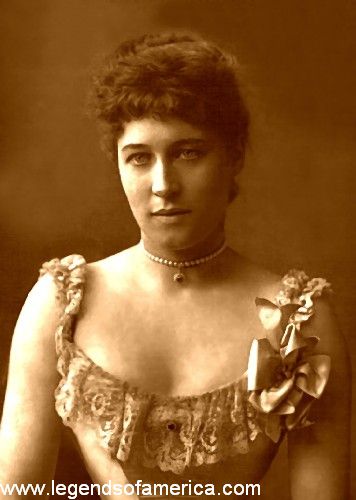
Lillie Langtry: Born Emilie Charlotte Le Breton on the isle of Jersey, Lillie Langtry was both calculating and warm-hearted. Aware of her beauty and what she desired in life, her first step to achieving success in society was to marry the first man who ferried his way into her life on his yacht. Unfortunately Edward Langtry was an alcoholic who'd mortgaged his property to the hilt to fund his yachting. Lillie however, made lemonade out of lemons and if marriage couldn't achieve her wants, her beauty would, and it did, for her first foray into society created a furor, the artists dining with her nearly expiring over her beauty and a chance to paint it.

From there, Lillie went from strength to strength, culminating in a four year affair with the Prince of Wales. After their passion cooled, Lillie used her fame and beauty to launch a successful acting career which took her throughout Britain and America. With Edward's death in 1897 and a newly discovered talent for horse-racing, Lady de Bathe (for she had married a much younger baronet), Lillie became a leading owner in the horse-racing world before retiring with her husband, quite wealthy, to Monaco.

Daisy, Countess of Warwick: She was rich, she was scandalous and she was indiscreet. She also had the notoriety of being the Prince of Wales' mistress throughout most of the 1890s. Having inherited an estate worth 30,000 pounds a year, the beautiful Daisy Maynard was so eligible a parti, Queen Victoria had hopes for a match made between she and her son Prince Leopold.

Daisy settled for something a little less stressful, marrying her darling "Brookie," in 1881. Within a few years, Daisy's predilection for acquiring what she called "admirers" in her memoirs had taken its toll on their marriage and she and Lord Brooke went their own way, as most couples did in this period. Fortunately for her, her next admirer happened to be the Prince of Wales. With a hearty dislike of boredom, Daisy's wealth and high spirits were a perfect match. So great a match that in 1914, Daisy's ruined financial status lead her to attempt to blackmail the Crown with love letters written to her by King Edward. More so than her liaison with Bertie, it was her conversion to Socialism that earned her infamy. With her heart in the right place, Daisy founded schools for girls to learn needlework or other handy crafts, and a store where the items were sold. This earned her much scorn from her own social class, sneered behind her back as "Red Countess." She plowed on, however recklessly, tirelessly fighting for socialism and the Labour Party til her death.

Mrs. Patrick Campbell: She was difficult, mercurial and vain. But she was one of the finest actresses of the period, if not the history of British theatre. Born Beatrice Stella Tanner to an English father and an Italian mother, Stella was born for theatrics. Her father a natural schemer, moved to America early in her life hoping to strike it rich. He never did, and it was this memory of poverty, and the absence of her husband, he himself in South Africa trying to strike it rich, that enticed her to enter the stage.

By the 1890s, the theatre had become respectable, as did actors and actresses. It was this time when the domination of sappy plays and Shakespeare was shaken by the "problem play." Writers like Pinero, Galsworthy, Shaw, Ibsen, Wilde, etc put on plays that probed the mores of society and highlighted hypocrisies. It was in one of these plays that Stella, known professionally as Mrs. Patrick Campbell (for it was more respectable than plain "Stella Campbell"), became a star. Pinero's The Second Mrs. Tanqueray was shown in 1893 and it was an instant hit with the crowd, the lead actress with her ghostly pallor, deep-set black eyes and lustrous hair, and most of all, marvelous voice, moved the crowd so, it became one of the most successful dramatic works of its day.

Margot Asquith: She shocked society with her indiscreet memoirs and an apocryphal but typical story has her meeting the American film actress Jean Harlow and correcting Harlow's mispronunciation of her first name — "No, no; the 't' is silent, as in 'Harlow'." When Margot Tennant made her debut into 1880s society, she was no ordinary debutante. Due to her mother's vagueness and her father's social-climbing, she and her siblings were allowed great freedom to mingle with gentlemen and form opinions (and even speak on them) long before the age of 18.

Spurred by her intellectual pursuits, Margot wasn't content with the endless round of parties, balls, and house parties and formed a group of like-minded aristocrats known as the "Souls." But it was her marriage to Liberal politician Henry Herbert Asquith that changed her life. She was his "spur to ambition," using her wit and drive to pull him into the Premiership--a goal realized in 1908. Unlike her predecessors, Margot didn't intend her new position to slow her down. Margot's independence and ready tongue got her into a bit of trouble, as the time when she hosted a show of Paul Poiret's modish gowns at No. 10 Downing Street!

Nancy Astor: That an American woman would be the first female MP to take a seat in the Commons is slightly ironic. Though, those who knew Nancy personally wouldn't have found it unbelievable. A Langhorne of Virginia, she and her sisters were renowned for their beauty and this, combined with the recently-restored family wealth boded well for a meteoric rise. Divorcing her first miserable husband, Nancy went overseas, as did all wealthy Americans, and quickly conquered society with her saucy wit and restrained behavior. Soon after her entrenchment in British society, she married Waldorf Astor, the son of expatriate William Waldorf Astor (yes, those Astors) and began life as an elite hostess.

When her husband succeeded to his father's title in 1919 and moved to the House of Lords, Nancy took up the cudgel for the constituency and campaigned for her own election. This was a bold move as at no time had a woman taken public part in politics--and with her own platform. Though women had greater freedom, they were seen as too ignorant and led by emotion to exact justice. Nancy proved them wrong. In her day, she was either loathed or loved, and personal accounts written by those close show her to be a demanding, prejudiced and arrogant woman. In spite of these defects, or rather because of them perhaps, Nancy Astor did what she wanted to do without any thought to her sex.

Mrs. Pankhurst: Widowed at 40, Emmeline continued the work she and her husband accomplished by continuing her involvement in politics. Disillusioned by the existing women's political organizations,in 1903 she founded the Women's Social and Political Union (WSPU). This changed the face of women's suffrage, for the traditional background of a suffragist was upper-middle class, professional ladies from comfortable backgrounds. From the first Emmeline the main aim of the organization was to recruit working class women into the struggle for the vote.

But it was in 1905 the break between the old guard (NUWSS) and the new guard (WSPU) ruptured: this was the rise of militancy. Pankhurst's tactics for drawing attention to the movement led to her being imprisoned 13 times between 1908 and 1914. Her daughters Sylvia and Christabel became prominent leaders in the movement, Christabel seeking temporary refuge in Paris to escape imprisonment under the terms of the Cat and Mouse Act. Hated by outsiders, Mrs. Pankhurst's ideals and actions created controversy within the WSPU, creating splits that included one from Sylvia. Her militancy did pay off, as women over 21 received the vote in 1918, and all women were enfranchised in 1928.

16 July 2008

Famous People: Flinders Petrie

Bonnie VanakBy Bonnie Vanak

He had the personality of a curmudgeon, was known for being eccentric (showing curious tourists at the Great Pyramid his pink underwear to scare them off), read Euclid and conducted chemistry experiments when he was just a lad of 15, and authored over 1,000 books and articles on the digs he conducted.

Sir William Matthew Flinders Petrie, born in 1853 and died in 1942, is considered the "Father of Modern Archaeology." The British Egyptologist and archaeologist was the first to insist on careful, meticulous excavations and examining each handful of earth. He censured the crude methods of using dynamite to blast into ancient tombs. His scientific and mathematical method of measuring the Great Pyramid of Giza set the standard for pyramid measurement.

Before writing my first book, THE FALCON AND THE DOVE, I was researching ancient Egypt and the 18th dynasty pharaoh Akhenaten. In 1892, Petrie excavated Akhetaten, the city the pharaoh built to worship the god Aten. Petrie's work inspired me to include the dig in my book when the heroine, Elizabeth, becomes part of the historical excavation. In THE FALCON AND THE DOVE, Elizabeth, a rebel at heart, breaks Petrie's rules by riding a donkey to the dig site. History tells us Petrie ordered all his workers to walk there. He led a very spartan life while on site.

I'm so fascinated with Petrie that I decided to interview him.

Bonnie: Sir William, is it true your expeditions meant sacrificing luxury and comfortable accommodations while at the dig site?

Petrie: Pah! Who complained to you about that? Bunch of lily-livered saps. Need to buck up. Nothing wrong with sleeping in an old tomb, and eating canned meat. The work's all that matters.

Bonnie: I read that you stripped off your clothing when outside Khufu's pyramid and showed off your Calvin Kleins for the tourists to scare them off. Your PINK Calvin Kleins.

Petrie: Who is this Calvin Klein?

Bonnie: He makes men's underwear.

Petrie: Useless profession. Yes, I did and I detest tourists. Get in the way, the whole lot of them. Worse than the flea-bitten donkeys.

Bonnie: So you did measure the inside of the Great Pyramid nude?

Petrie: Damn hot inside, what else was I supposed to do? Wear a fur coat? Have you ever been inside one? Stuffy as a tomb. Considering it was a tomb.

Bonnie: You worked with Howard Carter on the dig at Akhetaten. He was working as an artist, but made some important discoveries. You're partly to thank for Carter's training that led him to discover the tomb of King Tutankhamen.

Petrie: Carter? Insignificant sap, told him he'd never be more than an artist. Never would make a good excavator. I trained many gifted archaeologists much better than Carter.

Bonnie: Amelia Edwards, who authored A Thousand Miles up the Nile, was a great admirer of yours. She funded the Edwards Professor of Egyptian Archaeology and Philology at University College, London. You had the distinct honor of being the first to take the chair.

Petrie: Yes, yes, Amelia, lovely woman, bequeathed her collection to the college. Intelligent and a very good author.

Bonnie: So where did you take it? The chair, I mean.

Petrie: (silence)

Bonnie: That was a joke.

Petrie: Pah! Are you quite done? I have work to do.

Bonnie: Almost. It's said you never did quite get the hang of Arabic. But you changed the way excavations were conducted, and as a result, archaeologists after you understood the importance of examining every bit of debris at a site, every single potsherd. You set the standard, and because of your sequence dating at Naqada, we now have the Predynastic Period of Egypt's history. You, sir, are to be commended for all your wonderful contributions to history.

Petrie: Thank you.

Bonnie: Afwan.

Petrie: What's that?

Bonnie: It's Arabic for "You're welcome."

Petrie, grumbling: Bloody show off!

15 July 2008

Famous People: Harriet Quimby

By Elizabeth Lane

I first read about Harriet Quimby in one of those educational biographies they used to put in the back pages of comic books. Even as a little girl, I was hooked. Harriet was the stuff of romance heroines--beautiful, independent, daring, mysterious, and ultimately tragic.

Harriet Quimby was born in 1875 to a Michigan farm family. It's not known whether she ever married or had children. She was never open about her personal life. What's known is that by the age of 25, she was in San Francisco with dreams of becoming an actress. But it was her ability to find a story and write it that caught on. Instead of an actress, Harriet became a successful reporter as well as a script writer for some early movies.

After San Francisco Harriet moved to New York City. From 1903 to 1912 she took photographs and wrote articles for Leslie's Weekly, a popular magazine of the day. She became a drama critic and eventually an editor. By then, her beauty, charm, talent and independence had made her the toast of New York. At a time when women had barely begun to come into their own, Harriet was earning a good living, supporting herself and her parents and even driving her own automobile!

In 1911 Harriet discovered aeroplanes. Fascinated, she signed up for flying lessons at the Moisant School on Long Island. A few months later she became the first American woman to earn a pilot's license. Her aviation skills, as well as her glamour, made her an instant celebrity. She fetched high fees at air meets--especially after she became the first woman to pilot a plane across the English Channel.

For public appearances, Harriet designed her own flying costume of plum-colored silk. It had a hood to cover her hair and a lower part that could be converted from knickers to a hobble skirt with the fastening of a few buttons.

Harriet Quimby stampsOn July 1, 1912, Harriet flew an exhibition near Quincy, Massachusetts. She and the exhibition manager were flying above the bay, at an altitude of about 1,500 feet, when the plane pitched forward. Harriet and her passenger were both flung out and fell through the air, into the bay. Harriet left behind a vision of courage, glamour and intelligence.

On the Wings of Love by Elizabeth LaneIf I hadn't become aware of Harriet at an early age, I probably never would have written my book, ON THE WINGS OF LOVE (Harlequin Historicals, January 2008). Harriet Quimby was the inspiration for my heroine, Alex. But as the writing progressed, I wrote Harriet herself into the story--first as Alex's idol and role model, then as a perceived rival. It's the news of Harriet's death that brings the story to its dramatic crisis.

One more thing--when my editor asked me for a dedication, I dedicated my book to the memory of Harriet Quimby, a true heroine.

14 July 2008

Famous People: William the Conqueror

By Lisa Yarde

William the Conqueror is one of the world's most famous bastards.

Not in the contemporary sense--though his enemies might have agreed--but because he rose above his birth to become Duke of Normandy and King of England. His impact on history is reflected in English law and language, and in the dominance of feudalism.

Image: William the Conqueror

Born in 1027, William was the only acknowledged son of Robert I of Normandy, alternatively known by the epithets "the Devil" or "the Magnificent" during his life. Allegedly, Robert first saw William's would-be mother Herleva from his castle at Falaise, Normandy, while she was dyeing leather. Robert promptly fell in lust and ordered the daughter of a local tanner to his bed. His mother's heritage haunted William all his life. In 1047, at William's siege of Alençon, a buffer state between Normandy and Maine, its people hung animal skins over the walls to taunt the young duke. When William captured Alençon, he cut off the hands of his tormentors.

This occurred many years after a fraught upbringing. William's father went on pilgrimage to the Holy Land in 1035. Robert died on the return journey, but before he left Normandy, he had proclaimed his illegitimate son his heir. Raised by his paternal uncle, the Archbishop of Rouen and other guardians, William survived several assassination attempts even before he became an adult. He enjoyed the support of King Henry I of France during the early years, but rivalry between the two men led to warfare in 1054 and 1057.

William married Matilda of Flanders, who bore him four sons and at least four daughters. As with most events in William's life, his union with Matilda did not begin easily. His first envoys to the Flemish court received a stinging rejection from Matilda; as a descendant of Alfred the Great of England and the French kings, she refused to marry William because of his mother's low origins and his birth.

But William did not give up. Allegedly, he rode one summer to Flanders, pulled Matilda from her horse and beat her. Whatever her feelings about this episode, Matilda changed her mind about the bastard duke. Theirs seems to have been a long and happy union, altered only by the rebellions of their oldest son Robert against his father. Matilda died in 1083; when her bones were exhumed, she measured little more than four feet tall, one of England's smallest queens but a match for the strength of her husband.

William had connections to the English court through his great aunt, Queen Emma, the mother of England's Edward the Confessor. The English king had also spent several years in Normandy as a young man and emulated Norman dress and architecture. King Edward had married Edith, a daughter of the powerful Godwin clan. When he died childless, the succession was at risk.

His brother in-law Harold Godwinson claimed the crown, but so did William of Normandy, who claimed that not only had Edward the Confessor named him heir to the throne, but Harold had sworn an oath on holy relics to support the claim.

When William learned Harold had been crowned king in January 1066, he supposedly withdrew from an afternoon of hunting and spoke to no one for several days. But this depression did not last. He summoned a war council and planned an invasion. He arrived on England’s southern coast at an optimal time; Harold was north battling Harald Hardrada for the throne, the first of two threats the English would face that year. When Harold won his first battle, he rapidly marched his army south. The Normans and English met near Hastings in October 1066. William defeated his enemy and became King of England two months later.

Image: Battle of Hastings, from the Bayeux Tapestry

Not bad for an illegitimate son who started out with an uncertain future.

10 July 2008

Famous People: J. Edgar Hoover, the Original G-Man

By Delia DeLeest

Before there was the FBI, there was the BOI, the Bureau of Investigations. J. Edgar Hoover was the director of the BOI in 1924 and was a founder of the FBI in 1935.

Born on New Year's Day, 1895, Hoover received his law degree in 1917. During WWI, he found work with the Justice Department, became head of the General Intelligence Division which morphed into a position with the BOI in 1921. President Calvin Coolidge named him head of that agency in 1924 after the previous head was implicated in fraud.

In the 1930's, a rash of bank robberies tested his power. Because of bank foreclosures on farms and homes, these criminals became folk heroes of sorts among the common man, making their apprehension even harder. The BOI could become involved with these crimes when the thieves took stolen cars across state lines, a federal offense. After a botched attempt to capture of John Dillinger in Manitowish Waters, WI, left a civilian and an agent dead, but the culprits free to steal another day, Dillinger became a bit of an obsession with Hoover. Nobody makes fools out of the BOI and goes unpunished. Hoover only felt vindicated when Dillinger was shot down in front of the Biograph Theater in 1934.

Dillinger's death, along with the capture of many other high-profile outlaws finally brought Hoover the recognition he felt he deserved. The Bureau's powers were widened and it was renamed the Federal Bureau of Investigations, which is what it remains today.

Almost from the very start, Hoover was accused of overstepping his bounds. He would investigate people based on their political beliefs instead of any criminal activities. Under his leadership, the FBI kept tabs on many people for their possibly radical beliefs. Cointelpro, a program he developed in the mid-50's, was involved in illegal wire-tapping, burglaries and planting forged documents, among other things. The program became public in 1971 and was abolished after being declared unconstitutional.

Hoover did many good deeds also. Under him, the FBI was depository to the largest collection of fingerprints in the world. The FBI's evidence lab was expanded and became a high-tech effective crime fighting tool. Because of his leadership, he's also been hailed as the reason why the country was relatively free of sabotage or espionage during the WWII years.

Despite allegations that Hoover tended to abuse his power, both with criminals and his own agents, Hoover remained the bureau's head until his death in 1972. President's Truman, Kennedy and Johnson all considered firing him during their administrations, but the affect he could have on their political careers and those of their friends forced them to reconsider. In 1974, files were found containing dirt Hoover had collected on many political personalities. That's one way to obtain job security.

The FBI headquarters in Washington DC is named after Hoover. Due to the controversies during his rein as leader, it's been suggested that the building be renamed, but at this time, the name remains.

09 July 2008

Famous People: Mae West

By Jacquie Rogers

American stage and film actress Mae West was not only the first woman to make a million dollars in the entertainment business, her work rescued Paramount Studios from oblivion and debt. She was a formidable financial force and made a lot of money for a lot of people.

"Any time you've got nothing to do and lots of time to do it, come on up." ~ Mae West

This amazing woman was born in 1892 and by 1895 was already performing on the vaudeville stage. When she was fifteen, she was a "coltish shimmy dancer" billed as a "sex clown," so her beauty and wit were bankable early on.

"Anything worth doing is worth doing slowly." ~ Mae West

In 1918, she made it to Broadway and appeared in a musical called Sometime. She was tremendously successful as a stage actress. Miss West's early years in vaudeville and stage gave her a venue in which to hone her writing skills. She wrote nearly all her best hits, including five film credits, and her creative talent was noticeably missing on the later films that bombed at the box office.

She wrote a play called Sex and staged it in 1926. This earned her some morals charges and she was arrested twice.

"I believe in censorship. I made a fortune out of it." ~ Mae West

The real fascination with Mae West over the years probably has more to do with the time she lived. She was born in the Victorian era of corsets but society was evolving--not as radically as Miss West, for sure, but her humor certainly reflected the changing values of the day. The Roaring 20s brought a huge social revolution and Miss West was right there to promote pleasure and have fun. Maybe she gave the Depression-weary masses permission to have a good time. Who knows. But her humor struck a cord, and even though she was the first commercially successful blonde bombshell, her humor was appreciated by women as well as men.

"A woman in love can't be reasonable--or she probably wouldn't be in love." ~ Mae West
She starred in her first Hollywood film in Night After Night (1932). She held her own with Cary Grant, WC Fields, and many other leading men of the day. She was a box office hit until . . .

Will Hays of the Production Code Administration (the censors) took a special interest in suppressing her bawdy nature (purely for the good of the country and our families, of course).
...The initial screening of "Klondike Annie" elicited rigorous monitoring from the PCA (Production Code Administration) for its implications of interracial sex, representations of torture and unpunished murder [which undermined the Code's principle of "compensating moral values"], and for casting West as a prostitute...."

Source: (Archive of Cases)
With the censors watching her every move (and not in a good way), Miss West finally gave up on films and went back to the stage. Her humor could not survive the censor's red pen, and we have to surmise that she wasn't having much fun, either.

Mae West lived out her life in and out of show business, but she never quit writing. In the 50s, she wrote the review of brawny men with herself as star, and some say she singlehandedly started the bodybuilder popularity boom. To this day, we love her sometimes wise but always witty one-liners. And she even has a live jacket named after her!

"His mother should have thrown him out and kept the stork." ~ Mae West

Jacquie

Princess Keely, Star of Faery Special RomancesDown Home Ever Lovin' Mule Blues

Myspace *** Bebo *** Faery World

Faery Special Romances *** See the book video
Royalties go to Children's Tumor Foundation, ending Neurofibromatosis through Research

Coming soon: Down Home Ever Lovin' Mule Blues