Showing posts with label Idaho. Show all posts

10 July 2011

Guest Blog: Jacquie Rogers

This week, we welcome author Jacquie Rogers who has just released her new novel, Much Ado About Marshals through Melange Publishing. It's available on Amazon in Kindle and on Smashwords in all formats, and will be available in trade paperback August 15. At the end of the interview, there's a chance to win a free book.

Back cover copy for
Much Ado About Marshals

Daisy Gardner wants to be a detective, just like her favorite dime novel heroine, Honey Beaulieu. But Daisy's parents insist she marry soon, and to a farmer, heaven forbid! So she devises a brilliant solution--to marry the new marshal and become his number one detective. Only one problem: the new marshal isn't the faintest bit interested in marrying her.

Cole Richards is loyal, honest, and forthright. But thanks to his good buddy, Bosco, Cole is stuck in a lie borne of good intentions. If he doesn't go along with the people of Oreana's assumption that he's their new marshal, he and Bosco could be honored guests at a necktie party . . . and worse, a certain lady detective has marriage on her mind.

Why did you set this book in Idaho rather than in the usual western locations?
I grew up reading westerns set mostly in Texas, Wyoming, or Montana, but I also read a lot of history.  Since I lived in Idaho, that meant Idaho history.  One thing that always puzzled me was why such a huge part of the western United States was ignored by fiction.  Arizona and New Mexico get a fair share, and a few stories are set in Nevada.  There are good stories to be told in California, Oregon, and Washington State.  Idaho and Utah are even more rarely mentioned.  I needed a town that was just getting established, one that needed a new city marshal.  Oreana, in Owyhee County, Idaho Territory, fit the bill.

Did you make up the town or did you include actual buildings?
I made up most of the town but one building, Gardner's Mercantile, was a general store there.  It's now Our Lady Queen of Heaven Catholic Church.  It's a sturdy stone structure built in 1888 by John Pierson and Jim Kelly for the Grayson-Hyde outfit (ranchers) as a mercantile to serve the local area.  They also built a saloon across the street.  The building was empty for many decades until its conversion to a church in 1961.

You use dime novels in Much Ado About Marshals.  Is the Honey Beaulieu detective series real or made up?
Totally fabricated.  My friend, Judith Laik, and I were brainstorming because we knew the main character, Daisy, was a bookworm.  Earlier I'd said that the pacing was like the movie Cat Ballou, and Judy came up with a lady detective called Honey Beaulieu.  It was one of those perfect ideas that actually works.  So then of course I had to have a book cover.  To lend authenticity, I took an old Beadle's cover, one of the very few I could find with a woman in a dominant position, and created the Honey Beaulieu cover from it. 

About the cover--who is the cover model?  Tell us about the cover design and book video.
The model is, Kyle Walker.  He's a construction worker, not a cowboy, but he's a good sport and I thought he filled his chaps well. :)  Melange allowed me complete creative control over the design of the cover so I did the photoshoot myself, and Deborah Macgillivray did the cover design.  She's created over 200 covers and is extremely talented as a designer as well as an author.  As for the book video, I used pictures of Kyle from the same shoot, but of course I didn't have a heroine so I had to get creative with graphics for Daisy.  Oh, and Kyle has consented to an interview.  When that's done, it'll be posted on the Much Ado About Marshals page of my website.


The print book will be illustrated.  Who are the artists?
The artists are my son's best friends, David Angell and Peter Baker.  I'd seen their drawings when they were in high school and knew they were very talented.  Originally, I asked David to draw a backdrop so I could shoot the video for my book trailer, and he did such a wonderful job that I asked him to illustrate my book.  He then called Peter to the project, and together they drew some outstanding illustrations that will be included in the print book, which will be released in August.  I think the prints of the illustrations will be available by early autumn.

What other books do you have out now?
Nail It! The Secret to Building an Effective Fiction Writer's Platform, Level 1: Laying the Foundation, is currently available at Amazon and Smashwords.  I co-wrote this book and another: Growing Your Audience: A Workbook for Published, Unpublished, and Under-published Writers with Ann Charles.  The audience book will be available by the end of the month (we hope).  For fiction, Faery Merry Christmas came out in print last week, your you can buy it on Kindle.  And there's more to come, but fiction and non-fiction.

Where can we find you?
Website: http://www.jacquierogers.com/
Romancing The West: http://romancingthewest.blogspot.com/
1st Turning Point: http://1stturningpoint.com/
Twitter: http://www.twitter.com/jacquierogers
Facebook: http://www.facebook.com/pages/Jacquie-Rogers/18676302690

Thanks so much for having me here on Unusual Historicals.  This is one of my very favorite blogs!  I'd love to give one commenter a free digital copy of Much Ado About Marshals.  Please remember to include your email address in your comment, so I can get in touch with you in case you win!

20 June 2011

The Entertainers: Hurdy Gurdy Girls


By: Jacquie Rogers

When a man puts in over sixty hours of backbreaking labor in the mines, or punches cattle from dawn to dark every day, by the end of the week he's ready for a little entertainment. In the American West, that entertainment was provided primarily by saloons and dance halls. With the man to woman ratio of 20:1 or even worse, sometimes much worse, seeing a pretty lady was the delight of a man's week. And he spent a lot of money for the privilege. Enter: the hurdy gurdy girls.

Hurdy gurdy girls were distributed all over Europe, Australia, and North America, but this article addresses only the girls who came to the American West--Canada and USA and territories. What's a hurdy gurdy? (Find out at Chris Eaton's website) Why were they called hurdy gurdy girls, and how did this all come about? The best site to answer this is The Universe of Bagpipes.
To supplement their incomes, in the 1820s farmers and farmworkers began to make wooden brooms and fly-whisks during the winter which they, as itinerant peddlers, sold in the summers in the surrounding areas... It was soon discovered that the wares sold better when accompanied by
dancing, hurdy-gurdy playing girls. Quickly the dancing and music became ever more important and the pretty girls became ever better known...there was a lot of easy money to be made.


Hurdy gurdy girls could be found all over the West. Generally, prostitution was not involved. The girls, from poverty-stricken families in the duchies of Germany, were of strong moral fiber. They danced with men, and cajoled them to spend money on drinks, but services beyond that were taken care of by other women.

In 1913 Idaho Governor William McConnell wrote in his book Early History of Idaho:

The girls were engaged by the proprietors of the 'social resorts,' in sets of four, with a chaperone who accompanied them at all times. They were almost invariably German girls, and although they were brought into contact with rough people and sometimes witnessed even the shedding of human blood, the rude, generous chivalry of the mountain men, some of whom were always found in these resorts, was a guarantee of protection from violence, and strange as it may sound to those of modern times, these girls were pure women, who simply did the work they had bargained to do, and when their contracts expired, most of them married men whose acquaintance they had made while pursuing their vocation, the men who knew them best, and with the money they had earned by dancing with 'Wild Bill,' 'Texas Pete,' and others, helped to buy a house for themselves and husbands. The poor girls, and they danced only because they were poor, had kind hearts and wonderful patience and forbearance.
Some hurdy gurdy girls came over in family groups. Arthur Hart, Director Emeritus for the Idaho Historical Society, cited some census data in his article for the Idaho Statesman, Idaho History: Hurdy-Gurdy girls on frontier danced with all comers. Notice that this troop is called a "Hurdie Gurdie Troop" but it appears they only play violins.

The 1870 census is enlightening. In Granite Creek, Boise Basin, with its post office in Placerville, a "Hurdie Gurdie Troop" is listed as made up of Conrad Schneider, 43, his wife, Catherine, 35, and children ages 15, 11 and 2. Conrad was a violinist, as was his brother, George, 37, whose wife, Mary, was 34. A third violinist in the troop was Conrad Deihl, 19. Four dancing girls ranged in age from 15 to 27. All were from the Rhineland area of Germany.

There were two kinds of women in the Old West: good (meaning strong moral fiber) and bad (meaning sexually promiscuous). Hurdy gurdy girls were considered "good women" by men, but usually not by "respectable" ladies, the schoolmarms, and bankers' wives of the town. Because the dance hall owners had to make sure the girls were safe, hall patrons were expected to follow rules such as these posted at the Alhambra, a dance hall in Silverton, Colorado:

Rule 1. No lady will leave the house during evening working hours without permission.
Rule 2. No lady will accompany a gentleman to his lodgings.
Rule 3. No kicking at the orchestra, especially from the stage.
Rule 4. Every lady will be required to dance on the floor after the show.
Rule 5. No fighting or quarrelling will be allowed

The ladies to the left are hurdy gurdy girls in Barksville (I think), British Columbia, Canada. They danced as many as fifty dances a night, at a dollar per dance.

Later in the 19th Century, hurdy gurdy girls didn't just dance, but then they weren't from the Rhineland, either. The name became synonymous with soiled dove, and the girls' origins were not limited to a small area of Germany. However many of the original hurdy gurdy girls in the American West found husbands and made good homes for themselves and their new families.


So they had a happy ending after all.


Sources:
The Universe of Bagpipes
Arthur Hart: IdahoStatesman.com
bcheritage.ca
Jacquie Rogers writes quirky, magical romances. Available now are her contemporary western, DOWN HOME EVER LOVIN' MULE BLUES, a multi-era faery story, FAERY SPECIAL ROMANCES, and a Christmas story, FAERY MERRY CHRISTMAS. She's co-founder of 1st Turning Point, a pay-it-forward website where authors teach, share and learn promotion and marketing.

02 November 2010

Real Life Heroes: Edward C. Pulaski

By Jacquie Rogers

Edward C. Pulaski migrated west from his Ohio birthplace, and worked at several jobs before joining the Forest Service in 1908 at age 40. He knew the North Idaho mountains well, and it was a good thing because the summer of 1910 was extra dry and the entire forest was crackling tinder waiting to burst into flame. It didn't wait long.

Fires started everywhere. Hundreds of men fought them all summer, but by late August all the fires, nearly 2,000, combined into one giant inferno. Men who fought fires were caught and feared for their very lives. In Pulaski's words:
On August 20 a terrible hurricane broke over the mountains. It picked up the fires and carried them for miles. The wind was so strong that it almost lifted men out of their saddles and the canyons seemed to act as chimneys, through which the wind and fires swept with the roar of a thousand freight trains. The smoke and heat became so intense that it was difficult to breathe.
He found nearly fifty firefighters but then he had to convince them to listen to him. Fire safety techniques were not yet developed and he had to make them understand what he wanted them to do--and this is with the roaring fire and dense smoke interfering with the most basic of communication. The men were skeptical but he finally convinced them to heed his advice.

Pulaski knew about a mine tunnel and he led the men to it. The mud in the tunnel was soothing and the air was a little cooler, but the fire had sucked out a good share of the oxygen. Pulaski used his gun to threaten the men who, out of their minds, wanted to leave. In fact, some men did die in the mine tunnel that night, but many more lived. All owed their lives to Edward C. Pulaski.

The next day, several men made their way to Wallace, Idaho, which burned as well. A third of the town was lost to fire, but the men were able to get help for their comrades. As for Pulaski, his eyes were scorched and he was in the hospital, blind for a couple months.

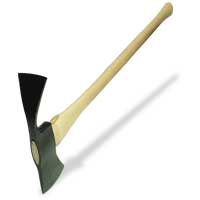
But that's not the end of his heroism. He invented the main firefighting and forestry tool used today, called--you guessed it--the pulaski. It's an axe on one side and a grub hoe on the other. It's a very handy tool and is used for everything from digging fire lines to planting trees.

He continued to work for the Forest Service for many years.

Ranger Pulaski died in 1931. Mount Pulaski, a 5,000-foot peak outside of Wallace, is named in his honor.

Sources:
Oregon Live
Polish Site
Wikipedia

Jacquie Rogers writes quirky, magical romances. Available now are her contemporary western, DOWN HOME EVER LOVIN' MULE BLUES, a multi-era faery story, FAERY SPECIAL ROMANCES, and a Christmas story, FAERY MERRY CHRISTMAS. She's co-founder of 1st Turning Point, a pay-it-forward website where authors teach, share and learn promotion and marketing.

07 September 2010

Women Did It Better: Horse Trading

By Jacquie Rogers

If someone asked you to describe the best horse trader in North America, who to this day holds to record for the largest horse trade in the USA, what would you say? Most of us think of a cigar-chewing mustached man with a derby. But we would be wrong. The Sioux City Journal of Sioux City, Iowa, described this person as "a tall stately blond, with fluffy, golden hair, large blue eyes that have quite a knack of looking clear through one, regular features and pearly teeth which glisten and sparkle when she smiles, and she has a habit of smiling very frequently. Her lips are red and full, and her mouth and chin denote a certain firmness of manner, no doubt acquired in her peculiar calling."

Her name was Katherine Caroline Wilkins and she ranched in Owyhee County, Idaho, not far from Bruneau. Most folks called her Kitty, although the media assigned various sobriquets to her, the "Queen of Diamonds" (because a diamond on the horse's shoulder was her brand) and "Horse Queen of Idaho" (from the San Francisco Examiner) among them.

Kitty grew up in Nevada. Her parents sent her to school first in Walla Walla, Washington, and then to high school at the College of Notre Dame Convent in San Jose, California. She moved with her family to Owyhee County in the early 1880s, where her family ran herds of 1,000 cattle and 700 horses. At a very early age, Kitty showed a unique talent for judging horseflesh. She was also a proficient horsewoman, capable of doing nearly everything the hired hands did, only in a dress and riding sidesaddle, and an expert marksman.

Another clipping from the Sioux City Journal in 1898:
Inured to a life on the plain since childhood, she is possessed of strength and agility that is wonderful for a woman. She can mount her pony from the ground and cast a riata as well as any of the numerous cowboys in her employ. She is an excellent shot with either a pistol or rifle, and has plenty of nerve to back her up. She is thus equipped to join the hardy Argonauts who are seeking fortunes in the new Eldorado, and under every condition which she will be able to take care of herself.
Kitty Wilkins is the only woman in the country who made her living as a horse trader during her lifetime. She holds the record for the largest horse deal: she sold several thousand horses to the US government for use during the Spanish-American War.

From the St. Louis Post-Dispatch:
A Post-Dispatch reporter called upon Miss Wilkins at the National Hotel and found her engaged in the business-like occupation of writing letters. Having heard of "Kittie" Wilkins as a woman who managed her own ranch and marketed its product, the reporter was hardly prepared to meet the tall young woman, dressed in a swell, tailor made costume, her blonde curls surmounted by a dainty Parisian creation, who greeted him with perfect self-possession and invited him to be seated. One might be excused for imagining that Western ranch life would coarsen any woman, no matter what her natural tendencies might be, but one glimpse of Miss Wilkins is enough to completely dissipate the idea. She is a strikingly attractive woman....

'We children were all born on the ranch and grew up in the midst of the wild environment that then existed, and still exists in a measure in that locality. My brothers taught me to ride and shoot, that being a necessary part of a woman's education out there in those days and I soon rivaled them in expertness. My father had, from a small beginning, accumulated a large herd of horses and on one of his trips to market he took me along. After that I always accompanied him and in a few years he said I could sell horses better than he....

'At present we have over 4,000 head on the ranch, divided into several herds according to their grade. They run wild winter and summer. Of late years we have been improving our stock very much by introducing imported stallions, and now I think that I bring the best stock to market that comes from the West. I never ship a blemished animal from the ranch. They are all sound when they leave there.'
Kitty was not only a superior judge of horseflesh, she could accurately judge buyers and always drove a hard bargain. Even so, maybe her most valuable talent of all was her ability to promote herself and her ranch. Newspapers and magazines published over 500 articles about her over 20 years, most waxing eloquently about her beauty and demeanor, while marveling about her success in a man's world. And remember, this was long before women got the vote.

The 20th Century brought new technology and drastic changes in lifestyle. Automobiles swept the nation and within a decade, her business dwindled from hundreds or even thousands of horses in a deal, to one or two sales here and there. The reign of the Queen of Diamonds was over. Kitty Wilkins retired to a small house in Glenns Ferry, Idaho, where she lived a modest life, with most of her money going to charity.

Sources:
Glenns Ferry, Idaho website
Idaho State University Magazine
Idaho Historical Society Prospector

Jacquie

Down Home Ever Lovin' Mule Blues (See the Book Video featuring Justin Saragueta)
Jacquie's Website * 1st Turning Point * Myspace * Twitter * Facebook
Faery Special Romances (Book Video) * Royalties go to Children's Tumor Foundation, ending Neurofibromatosis through Research


Read a book by Jacquie Rogers

10 December 2007

Holidays & Celebrations:
Winter Festivities in the Old West

By Jacquie Rogers

Yule Brings Celebration For All

The snow blows nearly sideways as it blankets the range. Ranch hands hunker down in their saddles, scarves over their ears and their Stetsons protecting them from the fierce wind. They dream of a warm fire and hot buttered rum. But they have livestock to save from freezing and starvation, so they ride on.

It's Christmas on the open range. Miserable for man and beast. But it isn't just another day at the office, so to speak. They whittle gifts for one another, sing a few carols as they sit around the campfire warming their hands and feet. Cook gives them a hot meal--the finest beans with maybe some meat thrown in. And with a little luck, Cook would bake an apple pie. Life couldn't be better and they thank their lucky stars for a sound horse and solid tack.

(Yes, I know these cattle are a modern breed and very fat, but it's the only picture I could find.)

Chanukkah in the mines

It's the 1860's in Silver City, Idaho. The Festival of Lights has been celebrated in the West since the beginning of frontier settlement, but not like their counterparts back East who have a warm and dry place to worship with their families. A menorah can be lit anywhere, and the Jewish silver miners do just that. They pray, play a little dreidel, and think a lot of home.

The picture to the left is the oldest continuously used synagogue west of the Mississippi. It's located in Boise, Idaho, and was built in 1896 by the Beth Israel congregation, now called the Ahavath Beth Israel congregation. Very beautiful.

Christmas on the farm

Everyone has chores to do every day. Cows needs milked, livestock needs watered and fed, eggs need gathered, and the barnyard needs to be tidied (to use a gentile term). So after the chores are done, the family can gather together and celebrate Christmas with what meager resources they have. If they don't have evergreen trees to spare, they might decorate a sagebrush with popcorn and berries. They make ornaments with precious bits of paper and scraps of cloth. Peach tins make nice ornaments, too, and they shine in the firelight.

1876 Christmas, Harper's Weekly

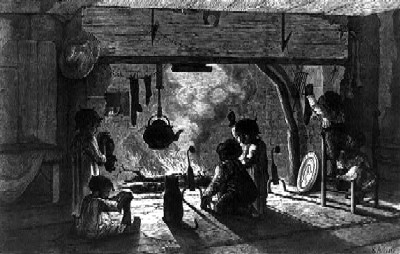
Their celebration might be more humble than those in the eastern cities, but they have a grand time, nevertheless. The women cook for days. They're resourceful and whatever they have available will do for a fine pie or stew. The Christmas feast could consist of chicken, venison, or maybe a ham, along with homemade rolls, freshly churned butter, potatoes and gravy, and pies--maybe one made with dried apples and a vinegar pie. Each family member has made modest gifts for the others and even the smallest child has labored over precious gifts--maybe a drawing or a doll made of sticks. They sing carols, maybe read the Bible, and if they're close enough to town, maybe even go to church.

For most Christian families, Christmas is a day for family togetherness and to show their love and appreciation for one another, as well as celebrating the religious aspect of the holy day.

Christmas for Outlaws, Gunslingers, and Cyprians

The saloon owner brings small gifts for the working ladies, the bartender, the resident gambler, and a few of the regulars. A few cowpunchers bring gifts for their favorite girl. They might have a nice meal together before they open for business, and even then, the customers are few. It's one night they can relax.

Happy Holidays to Everyone!

***
Enter the Name that Christmas Carol contest. It's fun!

Princess Keely, Star of Faery Special Romances

Jacquie Rogers *** Myspace *** Bebo *** Faery World
Faery Special Romances (Available now)
Take a look at the book video
Royalties go to Children's Tumor Foundation,
ending Neurofibromatosis through Research