
By Anne Whitfield
In 1770, Englishman Lieutenant James Cook charted the Australian east coast in his ship HM Barque Endeavoir. Cook claimed the east coast under instruction from King George III of England on 22 August 1770 at Possession Island, naming eastern Australia 'New South Wales'. This southern land would prove to be a dumping ground of England's unwanted--it's convicts--in an attempt to lessen the overcrowding of their jails.
 The first European settlement in Australia was at Sydney Cove in New South Wales. Arthur Phillip and the First Fleet, comprising 11 ships and around 1,350 people, arrived at Botany Bay between 18 and 20 January 1788. However, this area was deemed to be unsuitable for settlement and they moved north to Port Jackson on 26 January 1788, landing at Camp Cove, known as 'cadi' to the Cadigal people. Governor Phillip carried instructions to establish the first British Colony in Australia.
 The First Fleet was under prepared for the task, and the soil around Sydney Cove was poor. The young colony relied upon both the development of farms around Parramatta, 25 kilometres upstream to the west, and also trading food with local Aboriginal clans. The Second Fleet's arrival in 1790 provided badly needed food and supplies; however the newly arrived convicts were too ill, with many near to death, to be useful to the colony.
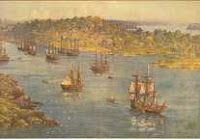 The Second Fleet became known as the 'Death Fleet'--278 of the convicts and crew died on the voyage to Australia, compared to only 48 on the First Fleet. The colony experienced many other difficulties, including the fact that there were many more men than women--around four men for every woman--which caused problems in the settlement for many years.
Between 1788 and 1850 the English sent over 162,000 convicts to Australia in 806 ships.
In 1770, Englishman Lieutenant James Cook charted the Australian east coast in his ship HM Barque Endeavoir. Cook claimed the east coast under instruction from King George III of England on 22 August 1770 at Possession Island, naming eastern Australia 'New South Wales'. This southern land would prove to be a dumping ground of England's unwanted--it's convicts--in an attempt to lessen the overcrowding of their jails.
 The first European settlement in Australia was at Sydney Cove in New South Wales. Arthur Phillip and the First Fleet, comprising 11 ships and around 1,350 people, arrived at Botany Bay between 18 and 20 January 1788. However, this area was deemed to be unsuitable for settlement and they moved north to Port Jackson on 26 January 1788, landing at Camp Cove, known as 'cadi' to the Cadigal people. Governor Phillip carried instructions to establish the first British Colony in Australia.
  The First Fleet was under prepared for the task, and the soil around Sydney Cove was poor. The young colony relied upon both the development of farms around Parramatta, 25 kilometres upstream to the west, and also trading food with local Aboriginal clans. The Second Fleet's arrival in 1790 provided badly needed food and supplies; however the newly arrived convicts were too ill, with many near to death, to be useful to the colony.
  The Second Fleet became known as the 'Death Fleet'--278 of the convicts and crew died on the voyage to Australia, compared to only 48 on the First Fleet. The colony experienced many other difficulties, including the fact that there were many more men than women--around four men for every woman--which caused problems in the settlement for many years.
 Between 1788 and 1850 the English sent over 162,000 convicts to Australia in 806 ships.


