
Showing posts with label Families and Children. Show all posts

07 February 2011

An Ordinary Day In: The Life of a Noble Roman Child

By: Stephanie Dray


In ancient Rome, the children of the poor would have awakened at daybreak by a harried mother, but nurses and slaves were the caretakers of wealthy children. Either way, once the sun was glowing in the sky, Roman children would have stumbled out of a sleeping couch and into their clothing. Noble children of both genders wore sandals and white tunics, but the tunics of the boys were bordered in crimson. It's in some dispute whether or not both boys and girls wore birth lockets known as bullas, but it's certain that boys did.

What kind of breakfast a child would have depended on how strict his or her father was. Some Romans shunned breakfast altogether during the Republic, condemning a morning meal as an effeminate practice that would weaken the moral and physical strength of their children. By their reckoning, the only thing anyone good Roman needed to greet the day was a cup of vinegar mixed with warm water. (Also known as posca.)

Other parents took a more pragmatic view and allowed their children to eat a simple breakfast of figs, porridge, or a crust of bread. Still other wealthy children were treated to every manner of indulgence at breakfast and may have feasted upon pastries, spears of asparagus, eggs, thick slices of eel or poppy-seed covered doormice. (Yes, a doormouse is exactly what you think it is.) But they would have saved the heavier, more exotic foods, like roasted ostrich and spiced sausages, for later in the day.

After breakfast, noble children would be sent off with their tutors--who were almos
t always highly educated Greeks. The children read scrolls made of papyrus or copied onto vellum and they would have practiced their letters on wax tablets, using a pointy stylus to draw the figures into the wax. If they didn't have private tutors they'd do this at school--also known as a ludus. (Poor children couldn't afford the fees to go to school, so they learned from their parents or not at all.)

After their schoolwork was done, ancient Roman noble children played much like children today. They jumped rope, played with clay dolls, and tossed balls made of sheep skin leather. Roman boys were encouraged to be warlike, so play-acted fights with wooden swords were common.
In the afternoon, Roman children may have joined their families in the public baths. Girls may have frolicked in hot and cold tubs before returning home to spin wool with their mothers--during the late Republic and early empire it was considered important even for the wealthiest and most powerful women to be seen as capable of working a loom.

While their sisters were spinning and weaving, however, it seemed that the boys lingered at the baths and exercised--the modern equivalent of a Physical Education Class. After, they would be cleaned in olive oil and scraped with a strigil, soaked clean, and sent home for the biggest meal of the day.

Through much of the Roman empire, children were to be seen not heard, so it's unlikely that they would have joined their parents for lavish banquets; Romans were constantly either having dinner guests or attending dinners given by others. Consequently, it's likely that children would have stayed home and taken their meal with the servants and slaves.

Afterwards, they may have tried to keep their eyes open, waiting for a pat on the head from their father, who would have dominion over them until he died. Or perhaps they made tribute to the family gods--often kept in a cupboard--effectively saying their prayers before bed.

As you can see, the daily life of a child in ancient Rome isn't altogether that different from the lives of children today!

Stephanie Dray's debut historical fiction novel, LILY OF THE NILE , was just release by Berkley Books. The sequel is expected to release at the end of 2011. Both novels are set in the Augustan Age and feature Cleopatra's daughter.




29 May 2008

Families & Children: Bao

By Jennifer Mueller

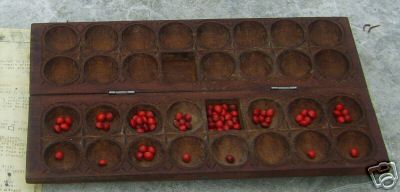
Bao. The word literally means wood or board in Swahili, but it is also a game--one of the most popular through East Africa. I learned to play after some Peace Corps volunteers brought it back when they returned from a trip to the coast. It's certainly addicting, and while it might look simple. it takes quite a bit of skill. Many have heard of Mancala--it's available in United States toy stores--but Bao is more complicated since it is played with a board double the size of Mancala. Some call Bao the "king of mancala games," as it is usually considered the most difficult and complex of them.

A Bao board consists of four rows with eight holes each. All the holes are rounded, but the fourth from the right in the middle rows is square and called the nyumba ("house"). Games can take hours, and a quicker version of the game involves putting two seed per hole to start with, instead of the 6-2-2 set up of the official rules. To start, you add a reserved seed to a space with seeds already in it, that allows you to capture from the opposite space of your opponent. You then proceed to spread out how many seeds you captured, ending in another space already with at least one allowing you to repeat the process. Your turn ends only when you land in a space without anything in it.

As all the pieces are in play after adding one per turn, you are moving quite a few seeds around. You must capture if able, but you are also allowed to have a turn to redistribute. However, if on the first move you do not capture, your entire turn must not capture. The object is to rid your opponent's front row of seeds. Regardless of how many might be on the back row, they are unable to move if there are none left in front.

Children have been known to play it with just holes scooped out of the dirt and stones, but it is a mainstay of the coasts of Kenya and Tanzania where it is played in elaborately carved boards. The game is commonly played as diversion while waiting for dinner in cafes, but there are also clubs since many cannot afford the boards to play it at home. Regular championships are held on Zanzibar and Lamu (Kenya) and in Malawi. The only tournament that was held in Europe is organized at the Mindsports Olympiad (MSO) in Cambridge, England.

27 May 2008

Families & Children: Child Rearing Manuals of 19th Century France

By Jennifer Linforth

"You see I cannot take my child into the country. Work forbids it. With a child I could not find a place there...it will not be long before I come back. Will you keep my child for me?" ~ Fantine, Les Misérables

Such was commonplace in 19th century France. Of children born in 1875, 93,000 were abandoned by their parents, and one out of fourteen was illegitimate. There were hospices in every arrondissement in Paris, and the poor often could not afford to work and care for their kin. Among the upper class, one would think life might have been a bit easier in terms of child rearing. But often that was not the case.

Ever wish parenthood came with a manual? Instead of plunging your lower body into the fiery pits of hell to push something the equivalent of alien out of your body, only to be told to to communicate with the mute pile of smiling wrinkles and enjoy it for the next eighteen years...

In 19th century France, apparently parenthood did.

For centuries, children were viewed as second class citizens--property to be dressed like adults and worked like adults. There were strict rules of conduct placed upon them. Upper class children were afforded education, but that did not make their position in the family any higher. Daughters were to learn their place in the family and society from their mothers, and coldness and distance was a characteristic relationship between some fathers and sons in aristocratic families.

A manual in 1886 titled Well Brought Up Children instructed children thusly:
When you have the honour to be admitted into the salons of your mothers, you must behave yourself in such a manner that they do not regret having accorded you this favour... You will, rightly, not dare present yourself in a salon without your gloves. Provincials are even more rigid observers of the etiquette that we.
Its counterpart, a study of Badly Brought Up Children, instructed the way to be successful in child rearing was to be an authoritarian. "By the exercise of authority, one makes one's sons respectful and men of duty." This book argued that children had one instinct--a fear of being left to suffer.

On the opposite side of such literature was Paul Janet who, in 1861, praised intimacy in the family unit. He insisted this did not ruin the strength of a family but reinforced it. In years past children were neglected, respected only as far as roles of primogeniture. By following Janet's work, parents sought to win respect by love not discipline. But like the above manual by Comtesse de Ferry, children still remained an instrument for parental aspiration and social gain for years to come.

The transformation of the family began when children rose to a position of central importance in the home, after years of neglect, and were accorded a basic right of a life different from that of their parents--when children were allowed to be seen as children and not business tools. Before this shift, there was no social gain to being a good parent or a mar to being a bad one. The family was not a sentimental unit. (Yet those manuals still were being published...)

The increase families slowly took in their children did not mean overnight liberation from strict rules or preoccupied parents. Neglect was replaced with obsessive love (many of these manual had opposing views), often resulting in increased demands on the children to act and behave as their parents desired. These manuals seemed counterproductive. According to Ryerson's Medical Advice on Rearing Children 1550-1900, it was preached that newborns should be purged, scheduled feedings were not needed, wet-nurses were preferred and cold baths were a good thing. Then came the manual that said warmth was better, sex play, masturbation, and discovering their young bodies was bad, and thumb-sucking was a horrible thing. Heaven forbid you bite on anything whilst teething! Despite all this, a parent needed to show the child affection--but not too much! It would be wrong to over stimulate them.

This author and new mom admits to buying in to the modern manuals. I had the What to Expect books, the Happiest Baby books, the millions of pamphlets provided by various doctors, teachers, and organizations. I think there is a reason children do not come with manuals.

They will only eat the paper and demand a cookie chaser.

26 May 2008

Families & Children: Egyptian Marriage

By Jean Adams

The ancient Egyptians held marriage sacred. The family was broken down into roles that each would play in order for things to run smoothly. The father would work all day while, in smaller households, the mother was in charge of all things pertaining to the house. Cooking, cleaning and watching the children were all her responsibilities. Egyptians took mates in what most often appears to be lifelong, monogamous relationships.

Marriage and a close family played an integral role Egyptian life. A bride would be young, about 14 or 15, and her husband could be anywhere from 17 to 20--older if he was divorced or a widower. The ancient Egyptians were encouraged to marry young, considering that the life span was relatively short.

Many marriages were arranged with parental consent, as they have been in all societies, especially among the upper classes. But the abundance of love poetry between young people signifies that many couples did fall in love and choose each other as mates. Women played a large role in arranging a marriage. A suitor sometimes used a female go-between to approach the girl's mother--not her father.

It's interesting that one of the most affectionate titles you could call your love was "brother" or "sister". This had nothing to do with sibling relations, but led many archaeologists and scholars to assume, wrongly, that most ancient Egyptians married their siblings. This usually occurred only among royalty--and was not common.

Nofret (left) and Rahotep, together again in my upcoming book, ETERNAL HEARTS.

The day of the marriage was simple. The bride merely moved her belongings into the home of her husband. He might be living alone or with his parents. The bride wore a long dress or tunic made of linen, which was probably covered with bead-net. If she owned any gold, silver or lapis lazuli, she would adorn herself with those. There was no official ceremony, but knowing how much the ancient Egyptians loved music, dance and food, there were usually family celebrations in honor of the couple.

Museums are full of statues and paintings showing husbands and wives with their arms around each other, holding hands or offering each other flowers or food. Love and affection was indeed a part of the Egyptian marriage, and the Egyptian bride could expect to be loved and respected by her husband.

Most marriages had a contract drawn up between the two parties. Marriage settlements were drawn up between a woman's father and her prospective husband, although many times the woman herself was part of the contract. The sole purpose of the contract was to establish the rights of both parties to maintenance and possessions during the marriage and after divorce, if it should occur.

A standard marriage contract that has been found among the numerous records left by the ancient Egyptians. It contained:

-- date (the year of the reign of the ruling monarch)
-- contractors (future husband and wife)
-- names of both sets of parents.
-- husband's profession
-- scribe who drew up the contract
-- names of witnesses

The finished document was given to a third party for safekeeping or kept among the records of the local temple.

A man could marry as soon as he was physically mature and had reached a point in his chosen career that ensured his ability to provide for his wife and for the children they could expect. Most Egyptians were content to have only one wife. Marriage was an expensive matter for the man, and the whole contract provided such far-reaching safeguards for the material rights of wives and children that most men could only afford one wife at a time.

Marriages were mostly between people of the same social class, but there seems to have been little regard given to race or even nationality. It was not unusual for a northern Egyptian to marry a Nubian, or someone even from another country.

If the marriage ended in divorce, the rights of the wife were equally protected. Generally, she was entitled to support from her husband, especially if she was rejected by him through no fault of her own. The amount might equal one third of the settlement or even more. If the bride ended up committing adultery (which was extremely frowned upon for both men and women), she still had certain rights to maintenance from her former husband. Monogamy, except for some of the higher classes and royalty, seemed to be the rule for most ancient Egyptian couples.

Marriages between kin were familiar among the common folk. Step-brothers and sisters married, as did uncles and nieces quite frequently, and cousins still more so. Between very close blood-relations, however, it was rare among ordinary people.

The tradition of brother/sister or father/daughter marriages was mostly confined to royalty. In tales from Egyptian mythology, gods marriage between brothers and sisters and fathers and daughters were common from the earliest periods, so Egyptian kings may have felt that it was a royal thing to do. However, there are also theories that brother/sister marriages may also have strengthened the king's claim to rule.

Divorce was as easily initiated as marriage. Divorce could be brought about by either party; it was a private matter and the government took no interest in it.
The most common reasons for a husband to divorce his wife included the inability to bear children, especially a son; the desire to marry someone else or that she simply stopped pleasing him. A woman could divorce her husband for mental or physical cruelty or adultery. In some cases, if the woman chose to divorce, she forfeited her right to communal property.

But there are many indications that husbands and wives in ancient Egypt were often happy and in love. There are many touching portraits and statues of families including spouses and their children that reveal marital delight and warmth within the family.

21 May 2008

Families & Children: Lady Mary Hervey

By Erastes

"As well-bred as if not married at all"
~ Lady Mary Wortley Montagu on the Hervey marriage


Sweet, pretty Mary Lepell was one of Princess Caroline's "Virgin Band," as her Maids of Honour were known. The royal chaplain had complained to the princess that her maids were causing distractions during his sermons. When attempts to discipline them failed high panels were erected around their pew to prevent them making eyes at the gentlemen of the court.

Bishop Burnet perceived that the beautiful dames
Who flocked to the chapel of hilly St James'
On their lovers alone did their kind looks bestow;
And smiled not on him while he bellowed below.
~ Lord Peterborough
Lady Mary Lepell (known as Molly) won acclaim at court for her beauty and amiable character. She was unusually well educated for a woman of her day, and developed intellectual interests which she shared with correspondents and friends.

She met with the infamous bisexual Lord John Hervey at court and was very soon his companion.

Lady Molly was one of the most popular of the Virgin Band and was celebrated in verse by great men of the day such as John Gay, Alexander Pope and Voltaire. In 1720, Gay wrote of the couple, "Now Hervey, fair of Face, I mark full well, / With thee, Youth's youngest Daughter, sweet Lepell!"

However, unbeknownst to Gay, the couple had actually been married in secret for six months. Despite the later scandals of homosexual behaviour by Lord Hervey, it can be assumed because the match was secret, and both parties were relatively impoverished, that it was a love match. The proof that Lord Hervey was not simply a homosexual followed shortly afterwards as Lady Molly bore him four children in swift succession.

However Hervey appears to have bored of his wife and sought amusements in London and Bath, and it was there, in 1727, that he met the man who was to shape the larger part of his life, Stephen Fox, universally known as Ste. Lady Molly knew both Stephen and his brother Henry but her opinion of Stephen was not high. He was a country mouse rather than a town one and as she wrote to Henry Fox, "Ste is such a country gentleman that unless one could be metamorphosed into a bird of hare he will have nothing to say to one."

She was, literally, abandoned--ordered by Hervey to remain in Ickworth, Suffolk, whilst he and Ste socialised from London to Bath, but this did not seem to dampen her love for her husband as her outpourings of letters seemed to prove. However, she could not help but sound a little bitter, adding in one, "yet I think I should in his case rather have desired, than forbid, one I loved to be with me."

Even when Hervey went abroad with his amarato, she played the dutiful wife and wrote to Ste, rather than to Hervey himself asking for news of his ill-health. If she resented Ste’s affections with her husband she was sensible enough not to speak openly of it. This loyalty paid off, as upon Hervey's return to England they were temporarily reunited, and nine months later, her fifth child was born.

This was the pattern of her life, and some have said, that her willingness to be so estranged from Hervey bored him more. Hervey's relationship with Fox continued until 1742, after which Hervey retired to Ickworth and his wife to die.

After her husband's death in 1743, Molly moved to a beautiful little house off St. James' Park where she entertained some of the great names of day, such as Chesterfield, Horace Walpole and Thomas Carlyle.

She remained good friends with Stephen Fox until she died in 1768.

20 May 2008

Families & Children: Child Labor Laws

By Jacquie Rogers

The happy-go-lucky childhood spent playing kickball and complaining about piano lessons is a modern phenomenon for all but the wealthy. Lower class children have always worked, and worked hard, especially in agrarian societies. But the Industrial Age brought machinery that could do the work of a dozen full-grown men, and a boy could run it. And so began the era of child labor and unspeakable cruelty.

Whether chimney sweeps, mudlarkers, miners, or mill house scavengers, these jobs were dangerous, oftentimes very treacherous, and required long, long hours.

In 1938, 26 boys and girls ages six to 17 died in the Huskar Pit disaster in Yorkshire. The picture on the right shows a child pushing a cart through a small shaft in a deep rock mine.

Mill house scavengers brought much controversy to early nineteenth century Britain. Frances Trollope wrote:
A little girl about seven years old, whose job as scavenger, was to collect incessantly from the factory floor, the flying fragments of cotton that might impede the work...while the hissing machinery passed over her, and when this is skillfully done, and the head, body, and the outstretched limbs carefully glued to the floor, the steady moving, but threatening mass, may pass and repass over the dizzy head and trembling body without touching it. But accidents frequently occur; and many are the flaxen locks, rudely torn from infant heads, in the process.
Charles Dickens publicized the plight of the children in Oliver Twist, as did several charitable societies and churches. By the 1880s, the U.K. and most of Europe had child labor laws in place, but the United States lagged way behind. "Children were often preferred, because factory owners viewed them as more manageable, cheaper, and less likely to strike."

According to Scholastic.com:
By 1810, about 2,000,000 school-age children were working 50- to 70-hour weeks. Most of them came from poor families. When parents could not support their children, they sometimes turned them over to a mill or factory owner. One glass factory in Massachusetts was fenced with barbed wire "to keep the young imps inside.
The "young imps" were boys under 12 who carried loads of hot glass all night for a wage of 40 cents to $1.10 per night.

After several abortive attempts, the United States enacted the Fair Labor Standards Act in 1938, a full one hundred years after England passed its first child labor laws.

In our modern era of enlightenment, children are still used and abused unfairly. The International Labor Organization estimates that worldwide, 211 million children are engaged in unlawful, dangerous, or forced labor--mostly in mining, agriculture, industry, pyrotechnics, domestic, or in the sex trade.

Jacquie

Princess Keely, Star of Faery Special RomancesDown Home Ever Lovin' Mule Blues

Myspace *** Bebo *** Faery World

Faery Special Romances *** See the book video
Royalties go to Children's Tumor Foundation, ending Neurofibromatosis through Research

Coming soon: Down Home Ever Lovin' Mule Blues

18 May 2008

Families & Children: Complicated Personal Lives of Vikings

By Michelle Styles

Vikings had complex and complicated personal lives. This fact becomes immediately obvious if you read any of the Icelandic sagas. The sagas like the Laxdoela saga or Njals saga show bitter feuds and families torn with strife. They both examines the conflict that exists within individuals due to bounds of blood, loyalty and family. Divorce appears to have been common. In Njals, one of the women divorces her husband at crucial time because he dared make a disparaging remark about her hair. Adultery, particularly on the woman's part, was harshly punished.

But what of the children from a divorce? And how does that affect the inheritance laws? Could a woman inherit a man's property if they were divorced? What happens if she is a widow? Did a woman in Viking times have any power?

It is something that fascinated me when I started writing Viking Warrior, Unwilling Wife. And the short answer is yes, a woman could inherit property from her divorced husband through their mutual child--if the child was acknowledged by the father.

Women brought a dowry and received a morning gift at the start of a formal marriage. If they divorced, they were allowed to take the dowry and the morning gift with them, but any child from the marriage belonged to the father. However, if the man died, and his child inherited and then died, the mother of that child stood to inherit.

Even if they were still married, spouses did not inherit directly from each other but had a claim on the estate. So the woman would have to inherit through her child, but her second husband would not necessarily have full claim on the estate. Sometimes through marrying successive times, women actually became very wealthy indeed. The largest find of Viking goods hails from the Osburg ship grave, the grave of a early Viking queen.

The Hillersjo Stone from Sweden tells of one complicated inheritance or how Geirlaug inherited quite a bit of wealth and was able to put a stone presumably to explain everything and why she had the farm--
Geirmund married Geirlaug when she was girl. Then they had a son before he drowned and the son died later. The she married Gudrik. Then they had children, but only one girl survived. She was called Inga. She was married to Ragnfast of Snottsta, who also died, and then the son later. The mother inherited from her son. Then she [Inga] was married to Eirik. She died there, and there Geirlaug inherited from her daughter Inga.
I found it fascinating that things could get so complicated, so quickly. It helped the Vikings seem far more real to me. Oh, and I really recommend the Laxdoela saga, a wonderful tale of revenge and powerful women.

15 May 2008

Thursday Thirteen: Families in the Old West

By Penny Ash

Here's a Thursday Thirteen about children and families in the Old West, which were not so much different from today.

1. Women, and men, married early, sometimes as early as 12 or 13.
2. Children were born in cabins or out on the trail with little or no medical help unless the family lived in a city.
3. Children spent their time doing chores or playing.
4. There was school for the kids who lived in a town that had one, or had a mother who could teach them.
5. Women cooked and cleaned, did the mending and raised the kids while their husbands worked in the fields or the store or their chosen profession.
6. Families staved off attacks from natives in the area, diseases, and attacks from outlaws and other criminals.
7. Some women were abused and sought a divorce as a remedy, something that in most places took an act of the state or territorial government. If they could be convinced.
8. Some women became entrepreneurs, traveling to the gold fields and setting up restaurants, wash houses, and rooming houses.
9. Children sometimes had to raise themselves and take care of invalid parents or siblings.
10. Some families moved into Indian Territory and did things like my great great-grandfather who traveled through the territory as a medicine man.
11. Some women turned to crime and became outlaws themselves, they set up brothels, robbed banks, and rustled cattle.
12. Boys, and some of their sisters, learned to hunt and fish as well as work in the fields. Girls, and their brothers, learned to cook and clean, make soap and grow a garden.
13. And of course girls and boys grew up to be women and men who met and fell in love and got married and started all over with their own children.

14 May 2008

Families & Children: Edinburgh's Museum of Childhood

By Sandra Schwab

When you're walking down the Royal Mile in Edinburgh, it's easy to pass by the Museum of Childhood without ever noticing it: It's a rather nondescript house, not much different from all the other houses next to it. The golden sign depicting children in old-fashioned clothes might catch your eye, though, and make you curious enough to take a peek inside what seems to be a tiny shop. Right, but the letters above the door say "Museum of Childhood", so you venture beyond the shop into a room full of display cases with old, old toys.

There's a snake whose body is made of postage stamps that have been threaded on a piece of string at some time in the 1890s. And right next to it is the Moss Man, a Russian doll made from wood and dried moss. He doesn't have any eyes, but his nose is carved out of wood, and it's prominent enough to lend him stern Viking features. Sure enough, Mr. Moss Man swings his tiny sword in a rather threatening manner. Despite his antics, the Flemish teething doll of 1865 smiles serenely on. A human tooth is pinned to its body and was supposed to absorb the pain suffered by the teething child.

Just when you're about to lean forward to take a closer look, a booming noise starts in the far corner of the room, making you almost jump out of your skin. Soon the sounds of a small orchestra -- piano, drums, cymbals, and what not -- reverberate in the room. And it's loud. Very loud. The source? An orchestra nickelodeon. Insert 50p to play tune:


And there, at the back of the room, another surprise awaits you: There's a door that leads to a staircase. A huge staircase. And that's when you start to realise that this is no itty-bitty tiny museum. It extends beyond the building on the Royal Mile, and contains five large galleries crammed full of childhood treasures from the past and the present: there are doll houses, toy theatres, toy trains, toy zoos, indoor games, outdoor games, soft toys (complete with "button in the ear" Steiff animals), and dolls of all materials and sizes. Dolls made of china, of wood, of wax, or of bones, one made from a clay pipe; another made from shoe. There's a Shirley Temple doll, a Dr. Doolittle doll, Mickey and Minnie Mouse, Rapunzel and the witch, costume dolls, soldier and sailor dolls and even a 3-in-1 doll consisting of Little Red Riding Hood, her grannie, and the wolf.

(Up here, in the third gallery, you can still hear that orchestra nickelodeon--as I've told you: It's really loud!)

The Museum of Childhood is a truly fascinating place and was once described as the noisiest museum in the world (well, yes, thanks to the aforementioned nickelodeon, no doubt! *g*). It was conceived by a local town councillor in the 1950s and was the first museum of its kind. Apart from the permanent exhibitions, it also hosts special events and temporary exhibitions, so there's always something new to discover.

And what was my favourite object in the Museum of Childhood? An old doll house which was started when the child was six years old. Over the years things were added to it, until it held over 3000 accessories and had both electric light and running water (!!!). But what I found most touching about it was the story of its inhabitants:
The Mistress of the House is Mrs Brett, who has three husbands. The first one suddenly disappeared. When he reappeared he had already been displaced and thus was made gardener (later died of broken heart). After having lost both legs in an accident, husband No. 2 became chauffeur. Now Mrs Brett lives happily with husband No. 3.

13 May 2008

Families & Children: At Home in the Harem

By Lisa Yarde

To step into an Islamic home in the Middle Ages was to enter an exotic but familiar world. Family life revolved around the sanctuary of the women. Known to the West as harem, the term referred to the inner sanctum of a house and its mainly female occupants. It was unlawful for men who had no close blood ties to the residents to enter and when the men were absent from the household, women, their families and female friends could venture where they pleased. Orientalism of the 18th and 19th centuries imagined that harems were nothing more than brothels where sensuous young women awaited the pleasure of their master. Most of the occupants found comfort and security behind the walls of their sanctuary, but some suffered a dull and restricted existence.

Harems varied in size dependent on social stature. One of the largest and most opulent was the harem of Topkapi Palace, home to the female relations and servants of the Ottoman Sultans. Begun by Sultan Mehmed II, the Topkapi complex comprised among four main courtyards and several smaller buildings. At the height of its construction, Topkapi's harem boasted three hundred rooms, including the residence of the ruler's mother, the Sultan Valide. Her apartments featured a dining room, bedchamber, reception and prayer rooms, featuring colorful glazed tiles and porcelain. Marble baths, gold lattice work and honeycombed glass ceilings completed the splendor of the harem.

Upper and middle class harems featured their own luxuries. Sofas arranged around three walls of a reception room in the harem, were covered with silk cushions. Mattresses and rugs from Persia adorned the wooden or tiled floors. Costly fabrics, such as embroidered satin and silk became decorative window and wall curtains. Carved wood, porcelain tiles and terracotta ornamentation were used to beautify the house. Copper braziers and perforated incense burners provided warmth and gave a sweet-smelling odor to any harem. Even practical items such as cosmetic containers, and ewer and basin sets were fashioned in brass or glazed pottery.

Within the harem, the women ruled. But without the status that motherhood conferred, a woman's position could not be assured. Motherhood has been a badge of honor in Islamic society and from its earliest days, tradition held that, "Paradise is at the mother's feet." In particular, the mothers of sons were esteemed. Death in childbirth and other complications were always possible. The midwife, a respected and valued member of Islamic communities, facilitated a safe delivery and maintained the health of the mother. When children were born, the Muslim call to prayer and confession of the faith were whispered in their ears. Feasting always followed the birth of a son. The new mother could not leave the harem for forty days afterward, but in most societies, her female friends traditionally visited her on the seventh day after the birth. Rich women could afford the services of a wet nurse. In Saudi Arabia today, it remains a custom that the children of women suckled by the same wet nurse are considered "milk brothers and sisters," allowed to interact without many of the societal restrictions.

Children remained with their mothers in the sanctuary of the harem; at the age of seven, boys were more likely to be drawn into their father's social sphere. Boys were circumcised by at least the age of five. Most harems were staffed by nursemaids and slaves, who served an important role in rearing and tending to children. The boys and girls played a variety of games and had toys; part of the modern celebrations at the end of the Ramadan fast is the presentation of gifts to children. There were dolls for girls, at least from the eleventh century onward, and hobby-horses for boys.

With the onset of puberty, girls had greater restrictions placed on them. They typically began to wear veils at eight or nine. Gold coins, which were given to them at birth, decorated the cloth. Their interactions with males were limited to their fathers and brothers. Sometimes they were also permitted to talk to the sons of other close blood relatives, but a potential husband could be found among first cousins. The girls learned the household arts from their mothers, until they married and perpetuated the circle of harem life.

12 May 2008

Families & Children: The Children's Aid Society

By Eliza Tucker

For kids without families in Victorian New York City, orphanages and almshouses were the only alternatives to life on the streets. In 1853, Charles Loring Brace changed the future for the city's least fortunate when he founded the Children's Aid Society.

A minister working in Manhattan's notorious Five Points district, Brace was appalled by the slum's widespread abuse and neglect. Taking advantage of the Westward push, Brace and his reformers would place nearly 100,000 children with frontier-bound families. While many of these stories ended well, as Brace hoped, some of the children in the Orphan Trains found themselves in situations similar to or worse than the ones they'd left in the East.

Brace and the Children's Aid Society (CAS) continued their outreach programs within the city, by founding and sponsoring industrial schools for boys, girls, and young women, offering free out-of-city camps and excursions, providing free lunches for children enrolled in schools, and opening the first free dental clinics in New York.


The CAS set up several lodging houses in Manhattan and one in Brooklyn, designated for the abandoned, homeless, and orphaned children. These houses offered part-time schooling, but their occupants worked during the day, often as newsies, delivery or messenger boys, in factories or shops. The children in these lodging-houses often did well for themselves later in life. Having created their own family units comprised of other urchins, former CAS kids held reunions, stayed in touch, and became successful business partners.

Today, the Children's Aid Society continues its work as a privately funded organization, helping more than 150,000 children annually through camps, after-school and weekend care, foster care, legal advocacy, health and counseling, and cultural development.

07 May 2008

Families & Children: Medieval Castilian Law

By Carrie Lofty

English law and custom regarding marriage and inheritance so thoroughly informs Anglo culture that we sometimes forget other nations did not develop the same practices. In medieval Castile, which is in present-day Spain, the Christian monarchs' plan of Reconquista--the process of reclaiming the Iberian Peninsula from the Moors, by force or by cultural influence--created an ever-changing frontier. Miles of territory in the center of the peninsula were contested for centuries. Towns fell to the Christians and were reclaimed by the Moors.

This constant state of cultural flux diminished Castilians' ability to remain rigid and fixed with regard to issues of marriage. Men greatly outnumbered women in frontier towns, and bachelor knights were considered as great a threat as Moorish invasion. Local towns enacted fueras, or laws, to promote local stability among these rogue and potentially dangerous knights, namely time off from military service after marriage, financial rewards for bearing children, and the social acceptance of illegitimate sexual relations.

A man's official mistress was called a barragana. She was afforded almost all of the rights of a wife. If the affair came to an end, the woman was not ruined. Frontier fathers still wanted their daughters to be able to find reputable matches, and frontier suitors did not want the relatively small issue of an affair to take a possible mate off the market. Any children born to such unions were considered legitimate. Even children born of slaves could be named by the father as an heir--anything to enhance stability and create domestic ties during chaos.

Not only was this relative liberality a product of near constant warfare along the frontier, it stemmed from Castilian inheritance laws, the basis for which extended back to Visigothic kings. Children inherited equally, regardless of gender. A man's six children, for example, would split his lands and worldly goods six ways. The only exception related to implements of warfare such as weaponry and horses, which went to sons alone. Daughters were compensated with gold.

With that sort of scheme in place, almost every woman stood the chance of marrying well, and sometimes even for love. Numerous records exist of so-called kidnappings, where an amorous knight would abduct a willing woman from her home and spend the night out on the frontier. These kidnappings did not hold the official status of a barragana arrangement, so families relented and let the young couple wed. In some areas, a couple simply had to declare their state of marriage--no priest, no bans, no witnesses required. Again this returns to the issue of stability. If the young knight volunteered to enter into matrimony, he became a more stable and useful member of society. However, this unspoken tradition also made proving charges of rape incredibly difficult.

The other class to suffer under these customs were known as covigeras--illegal matchmakers. On occasion, a man developed a fancy for a married woman. He sought a convigera to make contact with the woman and aid in his seduction. The matchmaker would act as a go-between to present gifts and secret notes, and would arrange a place for their tryst if the married woman consented. Because the basic function of these matchmakers was to destabilize sound marital unions, inciting community discord, they were reviled and punished with their lives.

The liberality towards sexual affairs did not extend to other religions. Even Christian prostitutes were executed after two convictions of sleeping with a Moor. Respectable Christian women lost all hope of social acceptance, banished from their families, and Christian men who slept with Moorish women were killed, the women maimed. Such affairs went against the goal of Reconquista.

06 May 2008

Families & Children: Who's Your Daddy

By Anna C. Bowling

When I was in kindergarten, back when the dinosaurs roamed, I remember my teacher asking another child in the class what his mother's last name was, and thought that was the silliest question I'd ever heard. Today, such a question is fairly common, due to changes in many families. A child today may have one or two parent/stepparent combinations or other domestic arrangements that were even less common only a couple of decades past. Which might give such a child something in common with their colonial counterparts.

In any society where the mortality rate is higher than usual, it's a part of life that not every individual will live to raise their own children to adulthood. Especially in the early days of the American colonies, any number of factors might cause what we'd call premature death. The weather and climate of a strange land, scarce or unfamiliar food, disease, injury, death in childbirth or other factors could turn a two parent family into a one parent family. Widows or widowers with young children often began the search for a new mate within weeks or in some cases, even days of their previous spouse's death. A Dutch proverb even states "the best time to court a widow is on the way home from the funeral."

For colonial families, this made sense. Beside the companionship of another adult, two extra hands to feed, bathe, and generally wrangle the young ones came in, pardon the pun, handy, and a widowed mother would find life far easier economically with the help of a husband. A widowed father, also, could benefit from having someone to care for the homestead while he worked at providing for the blended family. Before anyone gets an image of a buckskin-clad Brady Bunch, these step families of course faced the same issues blended families face today; grief for the late parent or spouse, adapting to new ways of doing things they'd always done another way, or perhaps moving to a new home and leaving their old one behind. An only child might now be the youngest, or a pair of boys might find themselves overrun by a passel of girls or vice versa. Not so different from today?

There's one exception: the high mortality rate.

Let's say John and Mary came over from England to build a new life and produced bouncing baby Elizabeth. Unfortunately, their first year didn't go well, and John did not survive a hunting accident. Mary marries Thomas, and Elizabeth gets little brother, Luke, though Mary does not survive Luke's birth. Thomas now has two children under five he has to raise, and marries Abigail, a widow slightly older than himself, with daughters Ruth and Jane. Ruth is sixteen and a comely lass, and soon catches the eye of Jacob, a young man with his own small farm. Ruth and Jacob marry, and welcome the birth of son Samuel at the same time Thomas and Abigail have baby Josiah. Things are getting crowded at Thomas and Abigail's home as Abigail is expecting again, they've had to take in her elderly mother, and it's not the best year for farming, so there's a family discussion and Luke will go live with Ruth and Jacob. Plus cousin Ezekiel's wife doesn't exactly believe he somehow found an orphaned Indian child all by itself in the woods, and really, the toddler does have Ezekiel's nose, and there is the matter of Christian charity, as well as the stipend Ezekiel is willing to give whichever family will take in the poor dear.

Phew. That might not be the last adjustment for Elizabeth and her family; subsequent deaths and remarriages anywhere along the above lines could change things yet again, or one or more of the children might leave the family home(s) for indenture or apprenticeship, or even military service for the boys once they are old enough. By the time Elizabeth is ready to start her own family, probably in her late teens to early twenties, she may have acquired a few more branches to the family tree. If her teacher asked the class to draw family trees, Elizabeth might well raise her hand to ask for more paper, and she might not be the only one in her class, either.

05 May 2008

Families & Children: Fathers in 1600s England

By Christine Koehler

It's hard to describe everyday life in a time period considered 'unusual.' Books aren't devoted to children and families of, say, the Restoration--they're devoted to Charles II and his court and their antics.

Patriarchy was incredibly important, so much so that the husband/father was despotic in nature. His word was law and there were no exceptions. Laws were enacted to this effect, while kinship ties weakened to the point where it was the nuclear family only. Children were considered submissive and molded to their father’s interests.

Of course, this wasn't new. But now that everyone believed it to be so and never questioned it, it was embraced with ever widening arms.

It was a trickle down effect--the head of the country was the sovereign, the head of the household, the husband. So the sovereign's power wasn't disputed, and neither was the husband's. James I in 1609 declared that "...Kings are compared to fathers in families: for a King is truly parens patria, the politic father of his people." In 1619 Robert Mocket's book God and the King insisted that all subjects were children of the King, therefore bound by the 5th Commandment to obey him.

According to Lawrence Stone's The Family, Sex and Marriage in England 1500-1800, even during the execution of Charles I in 1649, his subjects were dismayed at his death, looking upon it, almost as if their own father stood on the platform in Whitehall to be murdered.

No wonder sovereigns insisted they were their people's fathers, while fathers retained absolute control over their families. Any threat to the state diminished with this analogy. The nuclear family buttressed political order.

Not all households fell into his category, but the majority did. Women and children were often trapped with a man who abused them, with no option for escape. The head of house's power was all-consuming and, most importantly, right. This power was across religions and classes. Lower income families fluctuated between absolute power over their large families, and limited power over children who left home early to find work as an apprentice.

These laws were in existence until the 1900s, when war brought about social upheaval that could no longer be contained by old rules.

01 May 2008

Families & Children: The American Teenager

By Delia DeLeest

The turn of the twentieth century brought many changes to the American family structure. A World War I song summed it up best: "How You Gonna' Keep 'Em Down on the Farm After They've Seen Paree?" No longer were young people content to stay at home, following in their parent's and grandparent's footsteps. With the emergence of affordable phonograph records, automobiles and media such as books and magazines, America's young were given an exposure to the world their ancestors had never experienced. Due to the prosperous economy, a high school education was no longer an impossible dream. Children did not have to drop out at an early age to help their parents on the farm, but could continue to go on to school, thus exposing them to others their own age more regularly.

This combination of events created what is commonly known as: The American Teenager.

Spending time with their friends made America's youth aware of what others their age were wearing, what music they were listening to and how they were dancing...and it was nothing like what their elders were doing. The first generation gap had formed.

Previously, people went directly from being children to adults, there was no in-between. Adults could go to the same public event and be comfortable with square dancing, waltzes and any of the other popular dances. But with the arrival of Jazz music, the high-energy Charleston and those daring clothes, the young set themselves apart from those that came before them. Not only that, but with a Model T sitting in driveways across the country, they had the opportunity to go farther and meet more people than ever before, which only spread the culture farther.

Parents couldn't understand the slang language their children were using and were shocked and dismayed at their sons' wide-bottom trousers and daughters' rolled stockings and exposed knees. Instead of staying home and visiting in the parlor like they did during their courting days, their offspring were piling in automobiles, singing rowdy songs and seeing how many of them could fit inside a Studebaker or taking part in a four day dance marathon. Those wild, undisciplined children with their horrible manners, goofy clothes and awful music were going to cause the world to go to wrack and ruin. Sound familiar?