Showing posts with label Jacquie Rogers. Show all posts

07 November 2011

Tobacco--Puff, Chew, Snuff

by Jacquie Rogers

Tobacco is a plant native to Central and South America, migrating north with traders, eventually making its way to eastern Canada. Until Christopher Columbus and his crew introduced tobacco to Europe, the rest of the world was relatively nicotine-free. Nicotine (probably from belladonna or nicotiana africana) had ceremonial uses in Arabia and northern Africa, but wasn't a commonly consumed substance.

Leap ahead to 1492.

Christopher Columbus had no idea what the dried leaves were that the Arawaks gave him as one of the prized gifts, so he threw it overboard. A while later, crew members Rodrigo de Jerez and Luis de Torres described the method used for wrapping dried tobacco leaves, lighting the end, and sucking air through the roll. Jerez enjoyed smoking and is documented as Europe's first smoker.

Problem was, when he got home and the Spaniards saw him blow smoke from his mouth, they threw him in the slammer for seven years. When he finally gained his freedom, tobacco use was accepted and ubiquitous.

Catherine de Medici
For the next hundred years, the most popular forms of tobacco use were chew and snuff, although some did smoke cigars. Its use was considered medicinal and when Jean Nicot de Villemain sent snuff to Catherine de Medici, Queen of France, to treat her migraine headaches, she decreed tobacco Herba Regina. Withing the next twenty years, tobacco was thought to cure everything from worms to cancer.

So is everyone smoking? Not quite. Chew and snuff still held most of the tobacco market share, with cigars holding their own at #3. Ah, but you knew someone would be using the pipe soon. England had sent a few people to Virginia Colony they returned smoking pipes, which everyone thought was cool. Pipes caught on quicker than hula-hoops.

In the late 1500s, Spain monopolized the tobacco market and it upset the balance of trade in Europe. Britain needed a variety of natural resources and, well, a little gold wouldn't hurt, either. Solution: the New World. They sent ships to what is now Virginia (and to New England, too) and Jamestown was born. Problem was, the colony was more expensive to support, not to mention the 80% fatality rate, than England got back. Just when the surviving colonists had boarded ship for home, John Rolfe showed up with some teensy little seeds in his pocket.
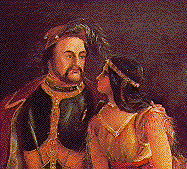
John Rolfe and Pocahontas
Within a decade, tobacco plantations were all over the place, worked mostly by indentured servants and African slaves. John Rolfe died in 1622 but the industry he established lived on, and even today the tobacco industry is important to the economy in the region. Tobacco subsidized the Revolutionary War, used as collateral for the loan from France.

When Charles II took the throne in 1660, he brought his snuff habit with him. Snuff was the drug of choice of the French aristocracy and soon spread through the English aristocracy as well, and this trend held through the next century and more. Charlotte, King George III's wife, was especially fond of it and Napolean used 7 pounds of snuff a month. Achoo!

Back to the American colonies: Pierre Lorillard's processing plant in New York City packaged snuff, pipe tobacco, and rolled cigars. P. Lorillard is still in business. From Lorillard, About Us:
Lorillard, Inc., through its Lorillard Tobacco Company subsidiary, is the third largest manufacturer of cigarettes in the United States. Founded in 1760, Lorillard is the oldest continuously operating tobacco company in the United States.

Bull Durham loose tobacco
 During the 1700s, several surgeons reported health risks. John Hill said snuff could cause cancer of the nose, Benjamin Rush said that smoking or chewing tobacco leads to drunkenness. Not many paid heed to these warnings. From Historian.org:
1762: General Israel Putnam introduces cigar-smoking to the US. After a British campaign in Cuba, "Old Put" returns with three donkey-loads of Havana cigars; introduces the customers of his Connecticut brewery and tavern to cigar smoking (BD)
In the 1800s, cigar use prevailed. When cigars weren't available, the roll-your-own cigarettes had to make do. When you think of the Old West, you think of Stetson hats, Arbuckles Coffee, and Bull Durham tobacco [Delbert Trew]. But when the cowhands got to town, they still wanted a fine cigar. Chewing was still popular, too, and in 1890 US residents chewed three pounds of tobacco per capita a year.

Pall Mall ad, 1926
It should be mentioned that the Women's Temerance Movement had tobacco on their hit list because it dried the mouth and made men crave alcohol.

For the sake a brevity, we'll skip ahead. Cigarettes had never been the most popular form of tobacco use. But in World War I, the soldiers received cigarette rations, and when they came home, a huge percentage were addicted. Bull Durham advertises, "When our boys light up, the Huns will light out." [Historian.org]


Joan Crawford
 Cigarette smoking became prevalent, and, in the Roaring Twenties, even women started smoking. The flappers delighted in long-stemmed cigarette holders, considered quite chic. "I'd Walk a Mile for a Camel" successfully advertised Camel cigarettes, a slogan used for decades. To compete, Marlboro was introduced as a woman's cigarette, "Mild as May." Lucky Strikes targetted women, also, using female stars of the day as spokeswomen. Many other brands that still exist today were introduced in the 1920s.

By 1939, 66% of the men under age 40 smoked. In World War II, the troops were again provided with cigarettes in their rations. Everyone puffed happily away, but the health risks were piling up. Many of the most popular television shows were sponsored by tobacco companies. Magazine ads showed doctors testifying that the advertised brand was the healthiest. In 1954, the Marlboro Cowboy was introduced. Marlboro cigarettes had a .25% market share at the time, probably one of the most successful ad campaigns ever.

Marlboro Man
But in the 1950s, the lawsuits from those adversely affected by tobacco started rolling in. Scientific evidence against smoking piled up. In the 1960s, reports of cigarettes causing lung cancer came from everywhere, including the US Surgeon General. Still, tobacco companies denied the risks and battled in the courts to deny culpability in tobacco user's ills. In 1969, cigarette ads were banned from the airwaves.

Just when you think cigarette-smoking might abate, Virginia Slims comes out for women, advertising, "You've come a long way, baby." At the same time, health warnings had to be printed prominently on cigarette packages. And Joe Camel swept on the scene. At one time, Joe Camel was the second-most recognized animated character by schoolchildren, right behind #1, Mickey Mouse.

Currently, smoking is prohibited in public buildings in nearly all states, and where I live, smoking is very politically-incorrect, even in private. The cost is steep, both in cigarette prices and in health risks. John Rolfe made it possible to finance the Revolutionary War, but it sure would have been healthier for all of us if he could've done it with maize instead of tobacco.

Sources
American Tobacco
CNN.com
Healthliteracy
Historian.org
Lorillard, Inc.
North Carolina State University
Tobacco.org

Jacquie Rogers writes quirky, magical romances. Available now are:
Western historical romance, MUCH ADO ABOUT MARSHALS
Contemporary western, DOWN HOME EVER LOVIN' MULE BLUES
Multi-era faery story, FAERY SPECIAL ROMANCES
Christmas story, FAERY MERRY CHRISTMAS

She's owner of Romancing The West, featuring the best of the Old West--romance, traditional, we love it all.

29 August 2011

The Children of Mark Twain

by Jacquie Rogers

Mark Twain (Samuel Langhorne Clemens) is probably the best-known American author of all time. He was curious (a close friend of Nikola Tesla) and he had a case of the wonderlust that served his writing well. He was a popular speaker, novelist, and he promoted his works relentlessly. Twain made a lot of money from his writing, but he wasn't so hot at investing, so spent a good share of his time scraping by.

In 1870, he married Olivia Langdon, the sister of Twain's friend, Charles Langdon. They first lived in Buffalo, New York, and then moved to Hartford, Conneticut, where they built a house and settled. Their first child, a son named Langdon, was born prematurely in 1870 and died in 1872 of diptheria.

Next came Olivia Susan Clemens, called Suzy. She suffered from poor health all her life but was a very intelligent child, penning a biography of her father when she was only thirteen. This biography was included in Twain's Chapters from my Autobiography. Suzy attended Bryn Mawr University and was active in theater, writing plays, acting, and singing. She left after a year, but continued writing.

Most sources say she was the apple of her daddy's eye, but she had difficulty living under the umbrella of Mark Twain's daughter. In August of 1896, she contracted spinal meningitis and died three days later at the age of 24. Her parents were devastated, and Mark Twain never did get over his losss.

In 1874, a third child was born to Samuel and Olivia Clemons: contralto Clara Langhorne Clemens Samossoud. Clara had the distinction of being the only one of her siblings to live a long life. She was a talented singer and studied voice and piano in Vienna and elsewhere in Europe. Her debut European performance was in Florence, Italy. She performed frequently in the United States as well.

Clara married Ossip Gabrilowitsch, a pianist, conductor, and composer. They had a daughter, Nina, and Gabrilowitsch died in 1936 of stomach cancer. In 1944, she married symphony conductor Jacques Samossoud, a man twenty years younger than she.

Because she was the only child who survived, Clara managed the Mark Twain estate until her death. Her daughter died four years later of a possible drug overdose.

The last child born was Jane Lampton Clemens, called "Jean." She contracted scarlet fever at age two and was never healthy after that. From the time she was ten years old until her death, she suffered seizure, later diagnosed as epilepsy. She spent many years in and out of sanitariums, and died of a heart attack caused by a seizure when she was bathing. She was only 29.

There are no surviving direct descendants of Samual and Olivia Clemens.

Sources:
Steamboat Times
Twaintimes
Wikipedia: Clara
Virginia.edu


Jacquie Rogers writes quirky, magical romances. Available now are: Western historical romance, MUCH ADO ABOUT MARSHALS 
Contemporary western, DOWN HOME EVER LOVIN' MULE BLUES
Multi-era faery story, FAERY SPECIAL ROMANCES
Christmas story, FAERY MERRY CHRISTMAS.

She's co-founder of 1st Turning Point, a pay-it-forward website where authors teach, share and learn promotion and marketing.

27 July 2011

Photo Essays: 19th Century Boom Town


By: Jacquie Rogers

Many of my western historical romances are set in the Silver City area of Idaho Territory, in Owyhee County (a large county in southwest Idaho with area about the same as New Jersey, but with one person per square mile).  This was a wild and wooly area of the West. 

The gold and silver strike sent prospectors, gamblers, painted ladies, merchants, Chinese miners and merchants, bankers, and newspapermen to Ruby City.  Problem is, the creek liked to flood there so the residents packed up the town, buildings and all and moved them to the Silver City site, where it still stands.

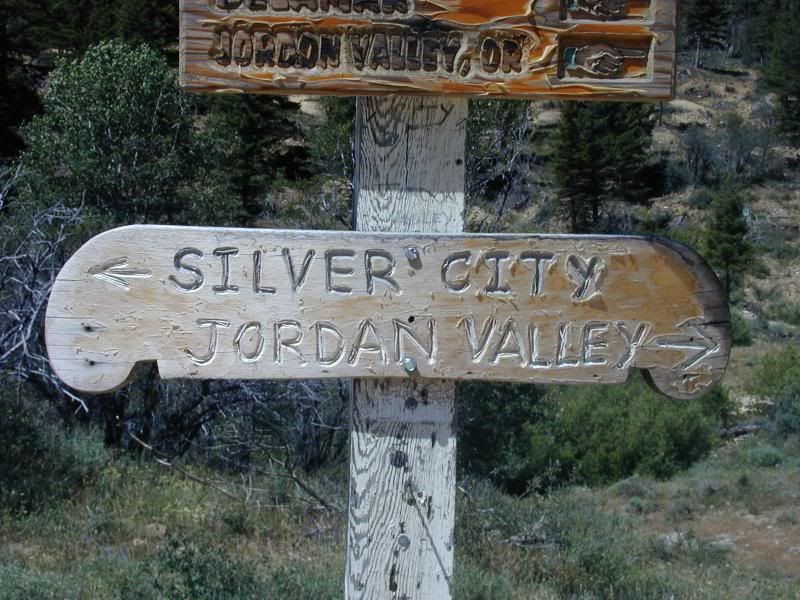
So let's take a tour.  On the right is the sign that tells you how to get there.  I'd advise not to miss the sign.  Oh, wait, there's only one road.  I'd advise you to stay on that road.  If you get lost, you have to pay Owhyee County to hunt for you.  They had to implement this because so many city people got themselves into fixes they couldn't get themselves out of.  It got costly, and the budget just didn't have room for people's errors in judgment.

These pictures are all taken by my daughter, Mercedes Christesen.  Special thanks to her husband, Rodney, for using his day off to chase after pictures for his mother-in-law.  Yes, you get points for that.

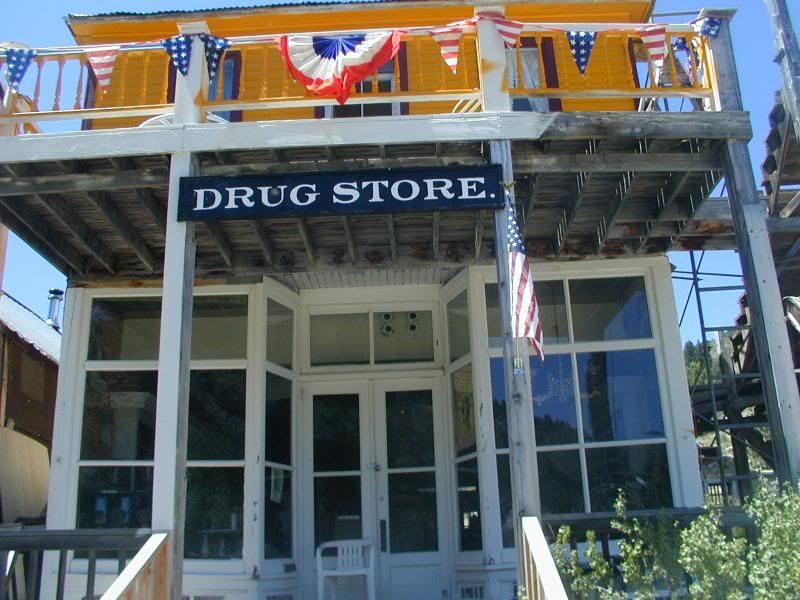
Drug Store
Here's the Drug Store.  She wasn't able to get any history on it, but it was either called the Knapp Drug Store or the Model Pharmacy.  Or maybe it was one and then the other.  I think it's just called the Drug Store now.  It's not open for business anymore.  It's a residence now, as so many formerly commercial buildings are. 

There's an open house the weekend after Labor Day every year.  I've been there--great fun!

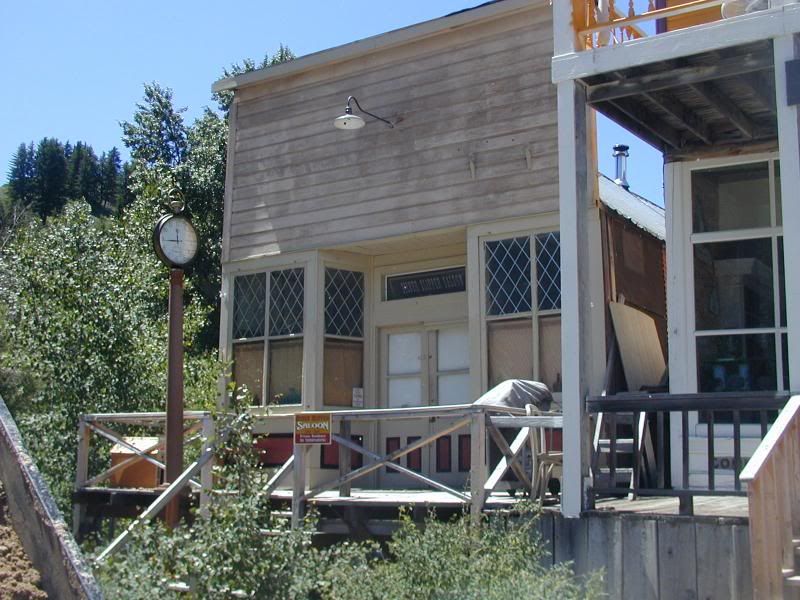
Silver Slipper Saloon
To the right is the Silver Slipper Saloon.  This is a 20th Century saloon, open from 1918 to the early 1940s but it still looks cool so I included it.  Silver City had many, many saloons and of course also had cribs and a street called Virgin Alley where ladies of ill-repute plied their trade.  On Ghosttowns.com, you can see an older photo of this saloon and the drug store above.

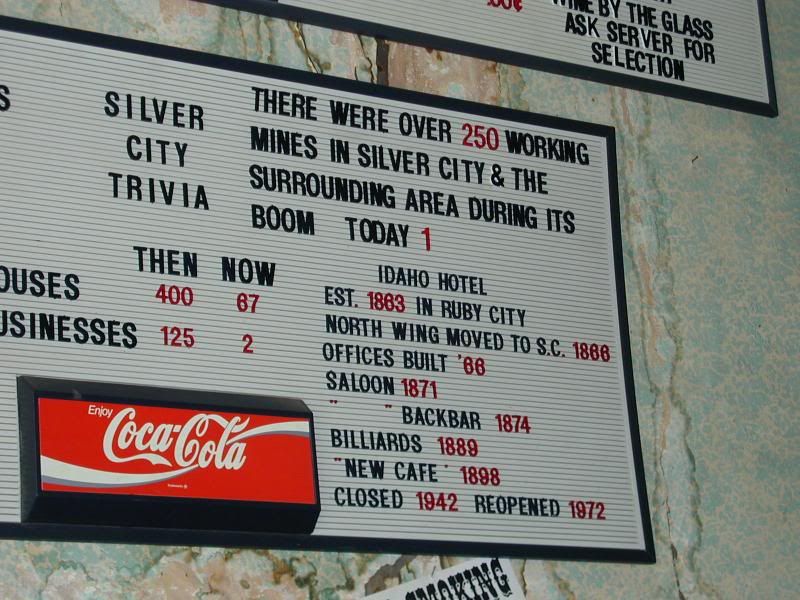
Silver City Trivia:
Houses at its peak, 400: now, 67.  Businesses at its peak, 125: now, 2.  Working mines at its peak, 250: now, 1.  This informaton comes from a sign on the menu at the Idaho Hotel.  The building was constructed in Ruby City and moved to Idaho City in 1866.

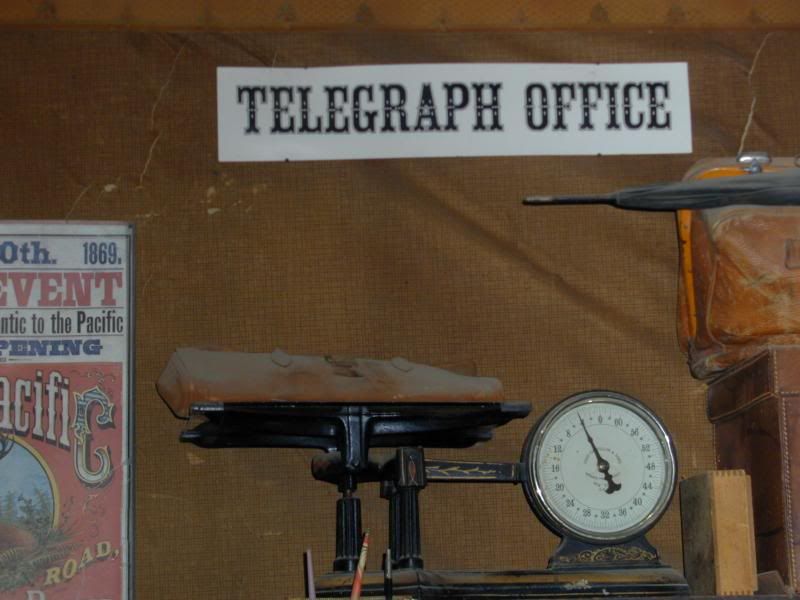
Even though Silver City had telephone service by 1880, the telegraph business was thriving for longer distances.
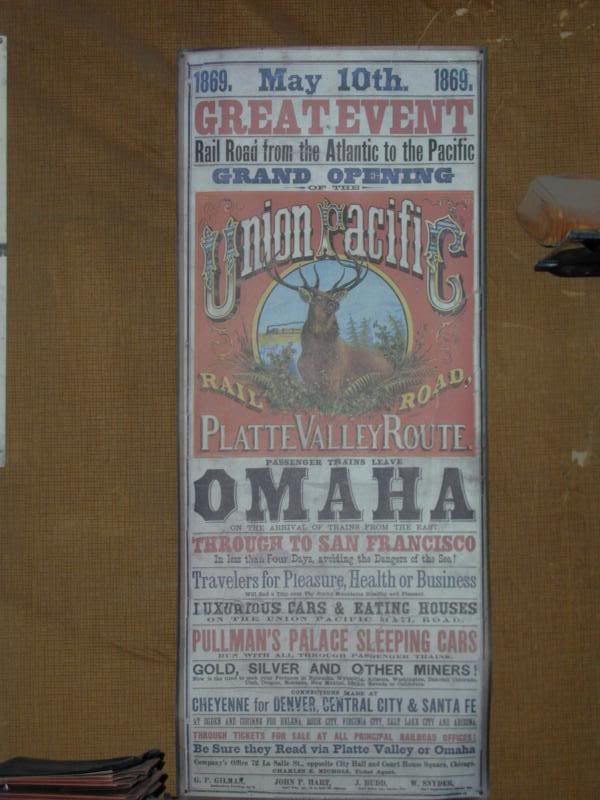
Silver City, Idaho Territory, never did have rail service, but the train service was within a stage ride.  Here's a Union Pacific train ticket:

May 10th. 1869
GREAT EVENT
Rail Road from the Atlantic to the Pacific
GRAND OPENING
of the
Union Pacific Rail Road
Platte Valley Route

Passenger trains leave
OMAHA
on the arrival of trains from the East

THROUGH TO SAN FRANCISCO
In Less than Four Days, avoiding the Dangers of the Sea!
Travelers for Pleasure, Health or Business

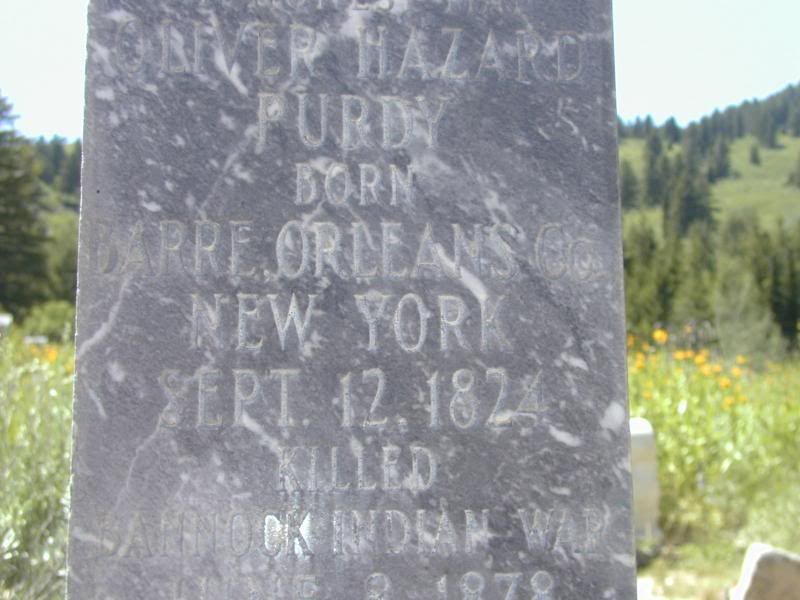
Life was hard in the Old West, especially when you're a couple hundred miles off the beaten path, at over 6,000 feet in elevation.  But this wasn't empty country. A long-standing population of Native Americans from the Bannock and Paiutes were not all that happy about Europeans coming in and ruining their livelihood and cultures.  The next photo is the gravestone of Oliver Hazard Purdy, born September 12, 1824, and killed during the Bannock Indian War in 1879.

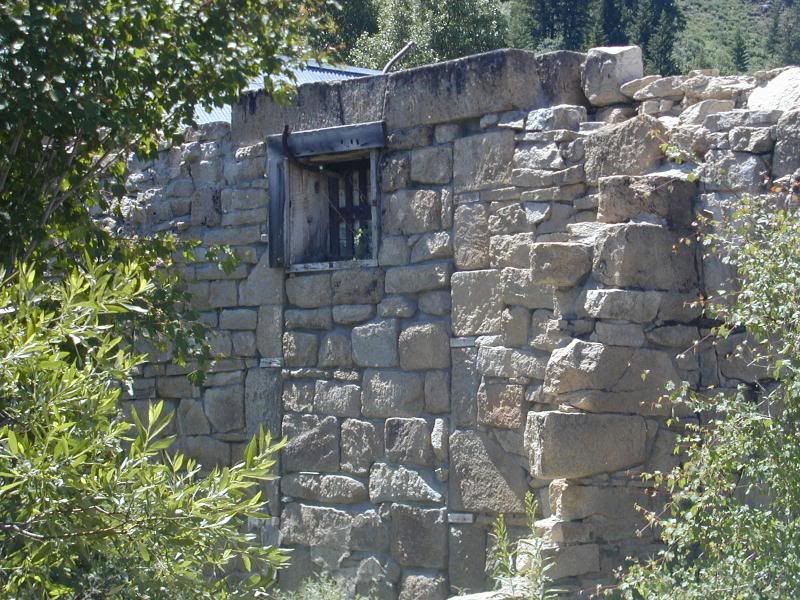
Sometimes bad things happen but instead of dying, the perpetrators were put in jail.  It looks as if this jail wouldn't be too secure these days, but it was formidible in its time.


For more cool photos and accompanying descriptions, I highly recommend EdnaPurviance.org and GhostTowns.com.  You can see the school and the church, too, where services are still held.  The Masonic Lodge is still in good condition and is in use as well.

I'll leave you with the coolest hotel ever.  I mean EVER.  This is the Idaho Hotel that I talked about above (menu board trivia).  Yes, you can still stay there--they have 13 rooms in service.  Go to the hotel's website for more cool history about Silver City.

 
Idaho Hotel, in Silver City, Idaho

Much Ado About Marshals takes place in Oreana, Idaho Territory, but the pre-story takes place right here in Silver City.  Stay tuned because another book in the Much Ado series will be set in Silver, and you can bet these buildings will have a strong say-so in how the story goes. :)

Jacquie Rogers writes western historical and fantasy romance.  Her latest release, MUCH ADO ABOUT MARSHALS, debuted #1 in Western Romance at Smashwords, and #2 in Humor. Available also are her contemporary western, DOWN HOME EVER LOVIN' MULE BLUES, a multi-era faery story, FAERY SPECIAL ROMANCES, and a Christmas story, FAERY MERRY CHRISTMAS. She's co-founder of 1st Turning Point, a pay-it-forward website where authors teach, share and learn promotion and marketing.

10 July 2011

Guest Blog: Jacquie Rogers

This week, we welcome author Jacquie Rogers who has just released her new novel, Much Ado About Marshals through Melange Publishing. It's available on Amazon in Kindle and on Smashwords in all formats, and will be available in trade paperback August 15. At the end of the interview, there's a chance to win a free book.

Back cover copy for
Much Ado About Marshals

Daisy Gardner wants to be a detective, just like her favorite dime novel heroine, Honey Beaulieu. But Daisy's parents insist she marry soon, and to a farmer, heaven forbid! So she devises a brilliant solution--to marry the new marshal and become his number one detective. Only one problem: the new marshal isn't the faintest bit interested in marrying her.

Cole Richards is loyal, honest, and forthright. But thanks to his good buddy, Bosco, Cole is stuck in a lie borne of good intentions. If he doesn't go along with the people of Oreana's assumption that he's their new marshal, he and Bosco could be honored guests at a necktie party . . . and worse, a certain lady detective has marriage on her mind.

Why did you set this book in Idaho rather than in the usual western locations?
I grew up reading westerns set mostly in Texas, Wyoming, or Montana, but I also read a lot of history.  Since I lived in Idaho, that meant Idaho history.  One thing that always puzzled me was why such a huge part of the western United States was ignored by fiction.  Arizona and New Mexico get a fair share, and a few stories are set in Nevada.  There are good stories to be told in California, Oregon, and Washington State.  Idaho and Utah are even more rarely mentioned.  I needed a town that was just getting established, one that needed a new city marshal.  Oreana, in Owyhee County, Idaho Territory, fit the bill.

Did you make up the town or did you include actual buildings?
I made up most of the town but one building, Gardner's Mercantile, was a general store there.  It's now Our Lady Queen of Heaven Catholic Church.  It's a sturdy stone structure built in 1888 by John Pierson and Jim Kelly for the Grayson-Hyde outfit (ranchers) as a mercantile to serve the local area.  They also built a saloon across the street.  The building was empty for many decades until its conversion to a church in 1961.

You use dime novels in Much Ado About Marshals.  Is the Honey Beaulieu detective series real or made up?
Totally fabricated.  My friend, Judith Laik, and I were brainstorming because we knew the main character, Daisy, was a bookworm.  Earlier I'd said that the pacing was like the movie Cat Ballou, and Judy came up with a lady detective called Honey Beaulieu.  It was one of those perfect ideas that actually works.  So then of course I had to have a book cover.  To lend authenticity, I took an old Beadle's cover, one of the very few I could find with a woman in a dominant position, and created the Honey Beaulieu cover from it. 

About the cover--who is the cover model?  Tell us about the cover design and book video.
The model is, Kyle Walker.  He's a construction worker, not a cowboy, but he's a good sport and I thought he filled his chaps well. :)  Melange allowed me complete creative control over the design of the cover so I did the photoshoot myself, and Deborah Macgillivray did the cover design.  She's created over 200 covers and is extremely talented as a designer as well as an author.  As for the book video, I used pictures of Kyle from the same shoot, but of course I didn't have a heroine so I had to get creative with graphics for Daisy.  Oh, and Kyle has consented to an interview.  When that's done, it'll be posted on the Much Ado About Marshals page of my website.


The print book will be illustrated.  Who are the artists?
The artists are my son's best friends, David Angell and Peter Baker.  I'd seen their drawings when they were in high school and knew they were very talented.  Originally, I asked David to draw a backdrop so I could shoot the video for my book trailer, and he did such a wonderful job that I asked him to illustrate my book.  He then called Peter to the project, and together they drew some outstanding illustrations that will be included in the print book, which will be released in August.  I think the prints of the illustrations will be available by early autumn.

What other books do you have out now?
Nail It! The Secret to Building an Effective Fiction Writer's Platform, Level 1: Laying the Foundation, is currently available at Amazon and Smashwords.  I co-wrote this book and another: Growing Your Audience: A Workbook for Published, Unpublished, and Under-published Writers with Ann Charles.  The audience book will be available by the end of the month (we hope).  For fiction, Faery Merry Christmas came out in print last week, your you can buy it on Kindle.  And there's more to come, but fiction and non-fiction.

Where can we find you?
Website: http://www.jacquierogers.com/
Romancing The West: http://romancingthewest.blogspot.com/
1st Turning Point: http://1stturningpoint.com/
Twitter: http://www.twitter.com/jacquierogers
Facebook: http://www.facebook.com/pages/Jacquie-Rogers/18676302690

Thanks so much for having me here on Unusual Historicals.  This is one of my very favorite blogs!  I'd love to give one commenter a free digital copy of Much Ado About Marshals.  Please remember to include your email address in your comment, so I can get in touch with you in case you win!

07 July 2011

Excerpt Thursday: Jacquie Rogers

This week on Excerpt Thursday, we welcome author Jacquie Rogers who has just released her new novel, Much Ado About Marshals through Melange Publishing. It's available on Amazon in Kindle and on Smashwords in all formats, and will be available in trade paperback August 15. Check back on Sunday for Jacquie's interview and a chance to win a free book.


Back cover copy:


Daisy Gardner wants to be a detective, just like her favorite dime novel heroine, Honey Beaulieu. But Daisy's parents insist she marry soon, and to a farmer, heaven forbid! So she devises a brilliant solution--to marry the new marshal and become his number one detective. Only one problem: the new marshal isn't the faintest bit interested in marrying her.

Cole Richards is loyal, honest, and forthright. But thanks to his good buddy, Bosco, Cole is stuck in a lie borne of good intentions. If he doesn't go along with the people of Oreana's assumption that he's their new marshal, he and Bosco could be honored guests at a necktie party . . . and worse, a certain lady detective has marriage on her mind.

Cole has just regained consciousness after being shot. He's in the doctor's office, surrounded by several Oreana townspeople.


1885: Oreana, Idaho


“Yes, he’s definitely the one.” Her sweet tone belied her accusation. Most robbery victims wouldn’t be so cheerful. Was he in jail? The aroma of sagebrush and alkali had been replaced by tincture of iodine, so he could be in the doctor’s office.

“Fits the description exactly.”

Cole’s hopes sank at the lady’s certainty. While he’d never had a doubt he and Bosco would be caught, he’d hoped to make it back to the ranch to set things right. And the lady didn’t have to sound so damned happy about it.

“You’re sure about that?” a man’s voice asked.

“Well, Doc, he’s tall, so he matches the six-foot-two height, he has dark brown hair, brown eyes, and he’s wounded on the right leg just like the wire said.”

Cole hoped that at least Bosco had made it to the ranch. He was goodhearted, a loyal friend, but not all that quick on the draw.

“Yes,” the lady continued, “he’s our new marshal, all right.”

New marshal? Hell, he was wanted for bank robbery! This didn’t seem exactly the right time to mention it, though.

“Good,” the man named Doc responded, “then I’ll bill the city for his care. The wife will be happy to hear I finally have a cash customer.”

“You don’t have a wife.”

The doctor chuckled. “No, Miss Daisy, but I’d sure like you to change that.”

“Not a chance,” she teased.

They both laughed, but Cole knew how the doctor really felt. Some men were born to be alone.

A cool cloth smelling of borax mopped his forehead. He forced his eyes to open. He blinked a couple of times and focused on a beautiful woman, her brow wrinkled with concern.

“Come here, Doc,” she said with quiet enthusiasm. “He’s awake.”

Cole heard water pouring as he stared at the lady who belonged to the sunny voice. Her green-eyed gaze bathed him with compassion and reminded him of sunset on Sinker Creek, where the rays glanced off the rapids, and the rippling of the water made a man’s heart feel pure.

He wondered what she’d look like if he loosened her auburn hair that was pulled tightly into a bun. She was a beauty, all right.

A slight man dressed appropriately for a doctor, or an undertaker, rubbed his brown handlebar mustache while he mulled over Cole’s condition. “His color’s much better, Daisy, don’t you think?”

“I’ll go tell Dad that he won’t have to rush over here for the marshal’s last prayers.” She pulled on her gloves and tossed a cloak over her shoulders.

Damn, a preacher’s daughter. What a waste of womanly flesh.

“Look for him at your Aunt Grace’s house,” the doctor advised. “When I picked up the wire telling us the new marshal was riding in, Rayburn told me that your sister had just come home. Seems like some yahoos tried to hold up her bank--put quite a scare into her, too.”

Daisy clapped her gloved hands to her cheeks. “Oh, no! Is Iris all right?”

“She’s fine,” replied the doctor, “but I hear one of the would-be robbers is somewhat worse for the wear. She claims she shot one.”

“Oh, my!” Daisy picked up her parasol and reticule. “I’ll get over there right away. She may need me!”

Cole’s throat tightened as Daisy hurried to the door. She’d put two and two together as soon as she talked to her sister.

“God works in wonderful ways,” she exclaimed triumphantly as she unlatched the door. “It’s a miracle that our new marshal showed up when he did.” She swept out of the room like a queen.

Stay calm and think. So Daisy’s sister was the woman who’d shot him. What lousy luck. He had to get the hell out of here.

Especially since Miss Daisy thought he was the town’s new marshal.

He didn’t even know what town.


---


Jacquie Rogers is an Idaho native and loves to write stories set in the countryside of her childhood.  Her previous release, a contemporary western, is also set in Idaho.  She's a former software designer, campaign manager, deli clerk, cow milker, but always a bookworm.  Jacquie currently lives in Seattle with her husband, ornery cat, and dying refrigerator.

1st Turning Point: http://1stturningpoint.com/

20 June 2011

The Entertainers: Hurdy Gurdy Girls


By: Jacquie Rogers

When a man puts in over sixty hours of backbreaking labor in the mines, or punches cattle from dawn to dark every day, by the end of the week he's ready for a little entertainment. In the American West, that entertainment was provided primarily by saloons and dance halls. With the man to woman ratio of 20:1 or even worse, sometimes much worse, seeing a pretty lady was the delight of a man's week. And he spent a lot of money for the privilege. Enter: the hurdy gurdy girls.

Hurdy gurdy girls were distributed all over Europe, Australia, and North America, but this article addresses only the girls who came to the American West--Canada and USA and territories. What's a hurdy gurdy? (Find out at Chris Eaton's website) Why were they called hurdy gurdy girls, and how did this all come about? The best site to answer this is The Universe of Bagpipes.
To supplement their incomes, in the 1820s farmers and farmworkers began to make wooden brooms and fly-whisks during the winter which they, as itinerant peddlers, sold in the summers in the surrounding areas... It was soon discovered that the wares sold better when accompanied by
dancing, hurdy-gurdy playing girls. Quickly the dancing and music became ever more important and the pretty girls became ever better known...there was a lot of easy money to be made.


Hurdy gurdy girls could be found all over the West. Generally, prostitution was not involved. The girls, from poverty-stricken families in the duchies of Germany, were of strong moral fiber. They danced with men, and cajoled them to spend money on drinks, but services beyond that were taken care of by other women.

In 1913 Idaho Governor William McConnell wrote in his book Early History of Idaho:

The girls were engaged by the proprietors of the 'social resorts,' in sets of four, with a chaperone who accompanied them at all times. They were almost invariably German girls, and although they were brought into contact with rough people and sometimes witnessed even the shedding of human blood, the rude, generous chivalry of the mountain men, some of whom were always found in these resorts, was a guarantee of protection from violence, and strange as it may sound to those of modern times, these girls were pure women, who simply did the work they had bargained to do, and when their contracts expired, most of them married men whose acquaintance they had made while pursuing their vocation, the men who knew them best, and with the money they had earned by dancing with 'Wild Bill,' 'Texas Pete,' and others, helped to buy a house for themselves and husbands. The poor girls, and they danced only because they were poor, had kind hearts and wonderful patience and forbearance.
Some hurdy gurdy girls came over in family groups. Arthur Hart, Director Emeritus for the Idaho Historical Society, cited some census data in his article for the Idaho Statesman, Idaho History: Hurdy-Gurdy girls on frontier danced with all comers. Notice that this troop is called a "Hurdie Gurdie Troop" but it appears they only play violins.

The 1870 census is enlightening. In Granite Creek, Boise Basin, with its post office in Placerville, a "Hurdie Gurdie Troop" is listed as made up of Conrad Schneider, 43, his wife, Catherine, 35, and children ages 15, 11 and 2. Conrad was a violinist, as was his brother, George, 37, whose wife, Mary, was 34. A third violinist in the troop was Conrad Deihl, 19. Four dancing girls ranged in age from 15 to 27. All were from the Rhineland area of Germany.

There were two kinds of women in the Old West: good (meaning strong moral fiber) and bad (meaning sexually promiscuous). Hurdy gurdy girls were considered "good women" by men, but usually not by "respectable" ladies, the schoolmarms, and bankers' wives of the town. Because the dance hall owners had to make sure the girls were safe, hall patrons were expected to follow rules such as these posted at the Alhambra, a dance hall in Silverton, Colorado:

Rule 1. No lady will leave the house during evening working hours without permission.
Rule 2. No lady will accompany a gentleman to his lodgings.
Rule 3. No kicking at the orchestra, especially from the stage.
Rule 4. Every lady will be required to dance on the floor after the show.
Rule 5. No fighting or quarrelling will be allowed

The ladies to the left are hurdy gurdy girls in Barksville (I think), British Columbia, Canada. They danced as many as fifty dances a night, at a dollar per dance.

Later in the 19th Century, hurdy gurdy girls didn't just dance, but then they weren't from the Rhineland, either. The name became synonymous with soiled dove, and the girls' origins were not limited to a small area of Germany. However many of the original hurdy gurdy girls in the American West found husbands and made good homes for themselves and their new families.


So they had a happy ending after all.


Sources:
The Universe of Bagpipes
Arthur Hart: IdahoStatesman.com
bcheritage.ca
Jacquie Rogers writes quirky, magical romances. Available now are her contemporary western, DOWN HOME EVER LOVIN' MULE BLUES, a multi-era faery story, FAERY SPECIAL ROMANCES, and a Christmas story, FAERY MERRY CHRISTMAS. She's co-founder of 1st Turning Point, a pay-it-forward website where authors teach, share and learn promotion and marketing.

14 March 2011

Crime & Law Enforcement: Fingerprinting


By: Jacquie Rogers

Fingerprinting has only been utilized for criminal identification for about the last hundred years, but the study of fingerprints has gone on for centuries. The practice was well known, and I used it in my western historical romance that will be released in July, Much Ado About Marshals.

I was teetering on the edge of anachronism and I knew it. My story takes place in 1885 and the conflict revolves around the likelihood of the criminal being identified by fingerprinting. This wasn’t a stretch because the heroine is rabid dime novel mystery reader, and in 1883, Life on the Mississippi by Mark Twain featured a murderer who as identified by this method. I figured if Mark Twain could use it in 1883, I could use it in 2011.

Let’s take a brief walk through the history of fingerprint identification.

In 2011, we consider fingerprinting the most failsafe identification system for the money. Fingerprint evidence is accepted in every court worldwide, but it was not always so. Other methods of identification were used for that purpose, and fingerprinting was used for signatures and that sort of thing long before it was every considered for use in law enforcement.

People have used fingerprints for a long time—the Ancient Babylonians used them for contract signatures. There’s evidence that the builders of the Egyptian pyramids used them, and the Chinese have used fingerprints as identification on official documents since at least 300 BC.

Europeans lagged a bit, and first started looking into fingerprinting in the 1600s. In 1684, Dr. Nehemiah Grew and Professor Marcello Malpighi both wrote papers describing in detail the fingerprint ridges. The Malpighi layer of skin is named after the latter. To take fingerprint studies a step further:
“In 1823, Professor Johannes Evangelist Purkinje published the most detailed description of fingerprints to have appeared anywhere up to that time. Professor Purkinje's thesis entitled A Commentary on the Physiological Examination of the Organs of Vision and the Cutaneous System describes, with illustrations, nine fingerprint patterns classified in Latin. From his illustrations, it can be seen that the Latin classifications refer to what Henry would later name arches, tented arches, loops, wholes and twinned loops. Purkinje's research was purely anatomical, and he made no mention of individuals being identified by the patterns that he described. However, he recommended further research, and others soon took up his challenge.”

(The quote is from The Thin Blue Line)

Off we go to India where Sir William Herschel kept a record of all the handprints used to "sign" contracts after the Indian Rebellion of 1857. He was also in charge of the jails and kept fingerprint records of each prisoner. Herschel was the first European to observe that all fingerprints were unique. But . . .
A Scottish doctor by the name of Henry Faulds was a contemporary of Hershel, albeit a sworn enemy, as both men tried to solidify their place in history by claiming they each were the "Father of Fingerprinting." Faulds' body of work was impressive and valuable. While working in a hospital in Tokyo, Japan, in 1874, Faulds kept records of fingerprints and concluded that fingerprint patterns were unchangeable and immutable and that the technique of rendering a set of fingerprints could best be done with printer's ink on a smooth board. Faulds was also able to lift a fingerprint from a bottle of whiskey, and thus received credit for the first identification of a fingerprint.

That's from fingerprinting.com.

Faulds sent his findings to Charles Darwin (yes, that one), who sent them on to his cousin, Sir Francis Galton. He identified and classified the minutia of fingerprints in his book appropriately titled "Fingerprints," and concluded that fingerprints were unique to an individual, and stayed the same throughout a person's lifetime.

Juan Vucetich used Galton's findings for his own police work: the first to use fingerprints to solve a crime, and his method is still used by Latin American countries to this day. From wikipedia:
In 1892 Vucetich made the first positive identification of a criminal in a case where Francisca Rojas had killed her two sons and then cut her throat, trying to put the blame on the outside attacker. A bloody print identified her as the killer.
Then in 1897, British India adopted fingerprinting as the official means of criminal identification based on the work and research of Sir Edward Richard Henry. Scotland Yard adopted the Henry Classification System in 1901 and this system is still in use in English speaking countries.

Various police departments in North America began adopting this method, and by 1905, the US Army did, too. The first central repository for fingerprint records was formed in 1911 by the Dominion Police Force in Ottawa, now maintained by the Royal Canadian Mounted Police. The US Congress established the identification division of the Federal Bureau of Investigation in 1924.

Today, the Department of Homeland Security stores over 100 million prints in their AFIS (Automated Fingerprint Identification Systems). The FBI has IAFIS (Integrated AFIS) where 60 million prints are stored. Fingerprints are used for identification of missing persons, murder victims, criminals, and unknown deceased persons.

While DNA testing has also been shown to be very valuable, fingerprint identification is still the most widely used tool for identification.


Sources:

Fingerprinting.com
Fingerprint America
History of Fingerprinting
The Thin Blue Line
Sir Francis Galton
Online Digital Education Connection
Wikipedia


Jacquie Rogers writes quirky, magical romances. Available now are her contemporary western, DOWN HOME EVER LOVIN' MULE BLUES, a multi-era faery story, FAERY SPECIAL ROMANCES, and a Christmas story, FAERY MERRY CHRISTMAS. She's co-founder of 1st Turning Point, a pay-it-forward website where authors teach, share and learn promotion and marketing.

15 February 2011

An Ordinary Day In: The Life of A Chuck Wagon Cook

By Jacquie Rogers

The first rays of dawn are peeking over the horizon, and a few moos from the waking cattle herd tell the cowboys it’s time to mount up and tend to business. Life for both man and beast is hard on a cattle drive.

But one man had been hard at work long before the cowhands awoke--the cook, or Cookie, has he was often called (or cousie, by those who spoke Spanish).

About Chuck Wagon Cooks

Before we get into Cookie's day, let's take a look at who he was. Most chuck wagon cooks were ex-cowboys who were either too old (meaning in their 30s and sometimes 40s) for cowpunching or were injured. Either way, he was experienced in all aspects of the cattle drive and no one, not even the trail boss, questioned his authority around the campfire if they knew what was good for them.

Most cooks were considered surly old coots. Of course, with the terrible working conditions, the injuries, the heavy lifting, the rigid schedule of long working hours and short nights, it would be hard for nearly anyone to maintain a sunny disposition. In return for their efforts, cooks made nearly as much money as the trail boss and double that of the average cowhand--but they earned every penny of it.

Food was (and always will be) important to young men, and most cowboys were 14 to 25 years old, so hiring the best cook helped the trail boss recruit the most accomplished cowboys. That's another reason why trail bosses didn't give a good cook any guff, or let the cowhands get out of line. Once he lured a good cook onto his crew, he did his best to keep him.

About Chuck Wagons:

Chuck is defined by Etymology Online as a "piece of wood or meat," 1670s, probably a variant of chock "block." The "meat" sense is the source of American English chuck wagon, from approximately 1880. The date is, of course, wrong, since Charles Goodnight is credited for inventing the chuck wagon in 1866, and it was called a chuck wagon, so the correct date should be 1866.

While companies did make chuck wagons (Studebaker, for one), most were converted farm wagons with a chuck box on the back. A hinged lid with folding legs on the chuck box served as a fold-out work bench, and there was generally hooks for a canvas at the top of the wagon to use as a sun shade. Underneath the chuck box was the boot, where they carried the Dutch ovens, tin plates, forks, knives, spoons, and cups, and whatever else they could get in there. Various hooks and fasteners on the sides of the wagon held the water barrel, large pots and tubs, axes, the coffee pot, and the like.

Underneath the wagon was another canvas or cowhide called the possum belly. Sometimes two or three. This is where they kept the firewood (or buffalo or cow chips) collected along the way for the evening fire. They also kept the kerosene for the lanterns here, usually in a separate boot. Inside the wagon, they hauled the flour, beans, coffee, dried fruit, canned goods, and other foodstuffs to last 30 days, as well as cowhands' bedrolls and personal effects, and whatever else was needed on the trail drive.

A Day in the Life of a Chuck Wagon Cook

Three in the morning comes pretty early when you put in an eighteen-hour day before, and before that, and before that... But while the cook got away with a considerable amount of crankiness and general orneriness, one thing that the cowhands wouldn't put up with was late meals. First order of the day is to build the fire and put on the coffee. Then he'd "build the biscuits," meaning he'd mix up the biscuit dough and set it to rise. Those two things were the mainstays no matter whether he was cooking for a cattle drive or a roundup. After that, he'd fry some sowbelly (bacon) and maybe a few potatoes if he had them, or maybe sourdough flapjacks. It took a good two hours to get breakfast ready.

Once the cowboys ate, they tossed their dishes in the wreck pan and off they went to the herd. But the cook's job has just begun, and he didn't get to sit down all day to do it, either. He had to clean up the dishes and pots, pack everything away, hitch up the team (usually four mules), and head to the noon destination at a pretty good clip, because he had to have dinner (served midday) ready before the herd got there. The business of the chuck wagon moseying along with the herd just wasn't true. In reality, he started an hour later, but had to be there two hours earlier than the herd, so it was sometimes a wild ride with a lot of cussing and hollering.

Once at the destination, he unpacked everything, started the fire and put on the coffee. He made coffee by boiling the water and then tossed a couple handfuls of ground coffee in and let it simmer. It's said that if you dropped a horseshoe in the pot and it sank, the coffee hadn't boiled enough yet. This meal usually consisted of warming up whatever was left over--just enough food to keep the hunger at bay. Maybe some son-of-a-bitch stew or the some other kettle food.

After he did the dishes and disposed of the food scraps, he packed everything up again and drove hell-bent-for-election to the evening camp, collecting firewood and other materials to use for camp fire fuel along the way.

Once he got there, you guessed it, he unhitched the team, unpacked everything all over again, started the campfire, put on the coffee, built the biscuits, slapped some steaks on the grill (for roundup, usually didn't have steak on a cattle drive), and, if the cowhands were lucky, maybe he'd make a vinegar pie or a tasty dessert out of dried fruit.

While the cowhands were sitting around the campfire drinking coffee and shooting the breeze, the cook was cleaning up, feeding his sourdough starter, and getting ready for the next day--more of the same.

But the cook didn't just cook. He was also the doctor, banker, referee, often the letter writer, and father figure.

Once the fire was out, the cowhands were bedded down, the cook could go to bed, too. He got the prime sleeping spot--under the chuck wagon, but in just a few hours, another grueling day would begin.

Just for fun, here's some cow camp etiquette lessons:

Cowboy etiquette, known by all except the greenest of green horns, dictated that:

-- Riders always stayed downwind of the chuck wagon so as not to get dirt in the food.

-- Horses were not to be tied to the chuck wagon.

-- There was no using the worktable as the dining table.

-- Cowboys were very careful not to let the lid touch the dirt while serving themselves from the pot.

-- Never take the last of anything unless everyone had been served.

-- Always scrape your plate clean and stack it in the wreck pan to be cleaned (when water was scarce, they were cleaned with sand.)

Sources:
Carter Museum
Lone Hand Western: Reliving History
Phudpucker
Muller's Lane Farm
My Wooden Spoon
Friona Star

Jacquie Rogers writes quirky, magical romances. Available now are her contemporary western, DOWN HOME EVER LOVIN' MULE BLUES, a multi-era faery story, FAERY SPECIAL ROMANCES, and a Christmas story, FAERY MERRY CHRISTMAS. She's co-founder of 1st Turning Point, a pay-it-forward website where authors teach, share and learn promotion and marketing.

01 December 2010

Accidents: The Great Seattle Fire

By Jacquie Rogers

It was 1851. The first family group of European descent to settle in what is now Seattle (Alki Point, more accurately) in the Puget Sound was the Denny Party. Trees, trees trees! The pioneers might have been lacking in conveniences, but they sure had a lot of trees! More settlers showed up and lumber was the gold.

Henry Yesler built a sawmill on the pier at the beginning of Mill Street (now Yesler Way) in 1853. The road went up a good-sized hill, all forested. The lumberjacks cut the timber and skidded the logs down the street (origin of the term "skid row") to be processed. San Francisco was booming and hungry for timber and they bought a good share of it from Yesler.

Money poured into the town, and by 1869 over 2,000 people called the incorporated City of Seattle home. Resources were plenty. Besides trees, coal was discovered south of Lake Washington and of course the fisheries in the Puget Sound were plentiful. Salmon is still king.

The city grew exponentially and 500 new buildings were constructed in March of 1889 alone. All wood. So you can see where this is going. Bustling city, lots of buildings all made of wood, lots of lanterns...

The fire was started on June 6, 1889 by John E. Back, in the shop of Clairmont and Company cabinet maker located in the basement of a building on Madison and Front Streets. It was, of course, an accident:
I cut some balls of glue and put them in the glue pot on the stove...[and] went to work about twenty-five feet away, near the front door. After a while somebody said "Look at the glue." Another fellow, a Findlander from New York, then took a piece of board and laid it on to smother the glue, but the board caught fire. Then I run and took the pot of water to smother the fire and poured it over the pot of glue, which was blazing up high. When I throw the water on, the glue flew all over the shop into the shavings and everything take fire."
The fire consumed nearly all of the city's wharves, a dozen brick buildings, and 29 square blocks of wooden buildings. Rudyard Kipling was visiting the area and wrote this description: "...a horrible black smudge, as though a Hand had come down and rubbed the place smooth. I know now what being wiped out means."

It was an accident that turned into a disaster and ultimately changed Seattle from a town to a city. The townspeople agreed to widen the streets and implement a fire code, requiring buildings of a certain size to be "fireproof." They put in a city-wide water system and created the infrastructure for the robust city Seattle is today.

And whatever happened to John E. Back, the man who started the fire? An unidentified lady who witnessed the fire was recorded at a MOHAI (Seattle's Museum of History and Industry) event in 1950: "The man who started the fire was a roomer in our house... They were going to lynch him if they found him." He left town and was never heard of again.

Sources:
City of Seattle
MOHAI
History Link
KUOW

Jacquie Rogers writes quirky, magical romances. Available now are her contemporary western, DOWN HOME EVER LOVIN' MULE BLUES, a multi-era faery story, FAERY SPECIAL ROMANCES, and a Christmas story, FAERY MERRY CHRISTMAS. She's co-founder of 1st Turning Point, a pay-it-forward website where authors teach, share and learn promotion and marketing.