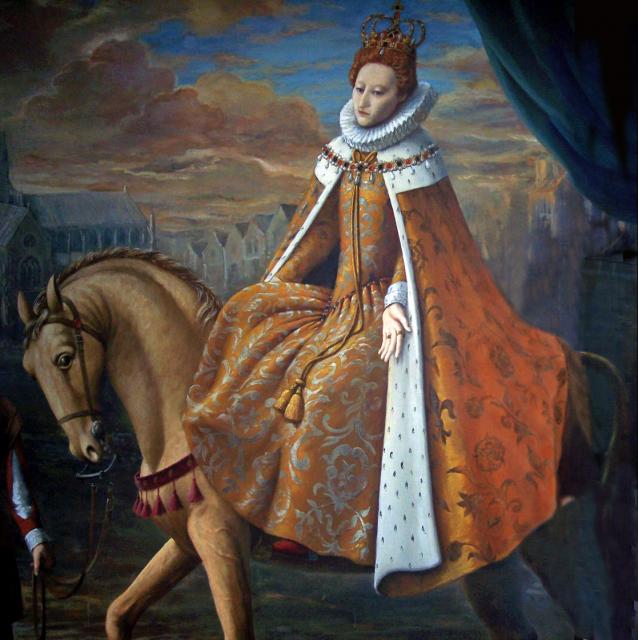
We're happy to welcome back Harlequin Historicals author Amanda McCabe as she celebrates the release of her Elizabeth-set Christmas romance, THE WINTER QUEEN What a gorgeous cover for such an evocative title!

"A delightful holiday gift of romance and intrigue! McCabe mixes in historical fact with fiction to create a fascinating page-turner of a novel" -- Fresh Fiction Reviews
***
When Elizabeth I became Queen of England in 1558, she inherited from her half-sister Queen Mary a war and religion-torn country on the verge of bankruptcy. It was an unpromising beginning, but Elizabeth was a brilliant politician, and she understood that what England needed was sparkle and pageantry. A majestic Court, with herself as its shining star and her ladies as her foils, would be her backdrop for a renewed and empowered England. Not all of her ladies were content to be mere background, though--and most of them didn't care to emulate Elizabeth in her famous virginity.
 By 1564, the year when my story THE WINTER QUEEN takes place, the structure of the Royal Household had become very elaborate, with a definite hierarchy of service. There were the heights--the Ladies of the Bedchamber; the middle--the Ladies of the Privy Chamber; and the lowest (but still pretty good)--the Ladies of the Presence Chamber. The latter seem to have had no set duties except to attend on the Queen when she wanted to impress someone, such as a foreign ambassador.
The six unmarried Maids of Honor (the position of my heroine, Rosamund) went with the Queen on her morning walks and to church services, clad in the regulation white and silver. When the Queen took the throne, her old nursery maid Blanche Parry was named Chief Gentlewoman of the Privy Chamber, while a Mistress Eglionby had the unenviable task of shepherding the Maids of Honor.
Obtaining a place at Court was very difficult, with fierce competition whenever a position came open. It was especially tough in Elizabeth's time, as hers was the only household. (When there was a king and a queen, and presumably royal children, there were many more households with more attendants required). In return for their services, the ladies received modest stipends. Privy Chamber ladies got 34 pounds a year, while the Maids of Honor received 40 (as they were usually of very high families). In addition, the Court was responsible for their room and board while they were on duty, and they had a lively social life and a measure of influence they wouldn't have otherwise.
Not that life was all banquets and strolls in the garden! Elizabeth was a very strict employer. Ladies couldn't be absent from Court without the Queen's permission, which was hard to obtain (she was very possessive). She also liked to berate her ladies, "her sarcastic tongue and withering wit...combined to render her an object of terror to her apprehensive attendants" (Somerset). She also sometimes threw things at them in a fit of Tudor temper, which couldn't have been much fun!
 The housing was also not the most luxurious. The Maids of Honor lived in one dorm-style room, and a palace could only be lived in for a short time before the stench of so many inhabitants became overwhelming. Several of the Queen's ladies defied her by indulging in love affairs with her courtiers, and some (like her cousins Katherine Gray and Arbella Stuart) paid for it with stints in the Tower.
Despite those drawbacks, the life of lady-in-waiting gave upper-class women an opportunity they could find nowhere else. They were at the very center of power in Renaissance England at a pivotal moment in history. All the intrigue and glamour also makes it a terrific backdrop for novels!
Here are a few fun sources I used to research THE WINTER QUEEN:
Ladies in Waiting by Dulcie M. Ashdown (Arthur Barker, 1976)
The Palaces and Progresses of Elizabeth I by I. Dunlop (Jonathan Cape, 1962)
Elizabeth and Leicester by Sarah Gristwood (Viking, 2007)
Tudor Women by Alison Plowden (Weidenfeld & Nicolson, 1979)
Elizabethan Renaissance: The Life of a Society by A.L. Rowse (Macmillan, 1971)
Elizabeth I by Anne Somerset (Knopf, 1991)
Ladies in Waiting: From the Tudors to the Present Day (Orion, 1984)
The Life of Elizabeth I by Alison Weir (Ballantine, 1998)
Queen Elizabeth's Maids of Honor by Violet A. Wilson (Bodley Head, 1922)
***
*sigh* I just love history. Thanks so much for sharing with us, Amanda. Now readers: If you leave a question or comment for Amanda, you'll be entered to win a copy of THE WINTER QUEEN of your own--just in time for holiday reading! Void where prohibited. I'll draw a winner next Sunday. Best of luck, and thank you again to Amanda for sharing with us today!

Sent to Serve...***
As Queen Elizabeth's lady-in-waiting, innocent Lady Rosamund is unprepared for the temptations of Court. She is swept up in the festivities of the Yuletide season and, as seduction perfumes the air, Rosamund is drawn to darkly enticing Anton Gustavson...
Seduced By A Master!
With the coming of the glittering Frost Fair, they are tangled in a web of forbidden desire and dangerous secrets. For in this time of desperate plots and intrigues, Anton is more than just a handsome suitor--he may have endangered the life of the woman he is learning to love...
"A delightful holiday gift of romance and intrigue! McCabe mixes in historical fact with fiction to create a fascinating page-turner of a novel" -- Fresh Fiction Reviews
***
When Elizabeth I became Queen of England in 1558, she inherited from her half-sister Queen Mary a war and religion-torn country on the verge of bankruptcy. It was an unpromising beginning, but Elizabeth was a brilliant politician, and she understood that what England needed was sparkle and pageantry. A majestic Court, with herself as its shining star and her ladies as her foils, would be her backdrop for a renewed and empowered England. Not all of her ladies were content to be mere background, though--and most of them didn't care to emulate Elizabeth in her famous virginity.
 By 1564, the year when my story THE WINTER QUEEN takes place, the structure of the Royal Household had become very elaborate, with a definite hierarchy of service. There were the heights--the Ladies of the Bedchamber; the middle--the Ladies of the Privy Chamber; and the lowest (but still pretty good)--the Ladies of the Presence Chamber. The latter seem to have had no set duties except to attend on the Queen when she wanted to impress someone, such as a foreign ambassador.
 The six unmarried Maids of Honor (the position of my heroine, Rosamund) went with the Queen on her morning walks and to church services, clad in the regulation white and silver. When the Queen took the throne, her old nursery maid Blanche Parry was named Chief Gentlewoman of the Privy Chamber, while a Mistress Eglionby had the unenviable task of shepherding the Maids of Honor.
Obtaining a place at Court was very difficult, with fierce competition whenever a position came open. It was especially tough in Elizabeth's time, as hers was the only household. (When there was a king and a queen, and presumably royal children, there were many more households with more attendants required). In return for their services, the ladies received modest stipends. Privy Chamber ladies got 34 pounds a year, while the Maids of Honor received 40 (as they were usually of very high families). In addition, the Court was responsible for their room and board while they were on duty, and they had a lively social life and a measure of influence they wouldn't have otherwise.
Not that life was all banquets and strolls in the garden! Elizabeth was a very strict employer. Ladies couldn't be absent from Court without the Queen's permission, which was hard to obtain (she was very possessive). She also liked to berate her ladies, "her sarcastic tongue and withering wit...combined to render her an object of terror to her apprehensive attendants" (Somerset). She also sometimes threw things at them in a fit of Tudor temper, which couldn't have been much fun!
The housing was also not the most luxurious. The Maids of Honor lived in one dorm-style room, and a palace could only be lived in for a short time before the stench of so many inhabitants became overwhelming. Several of the Queen's ladies defied her by indulging in love affairs with her courtiers, and some (like her cousins Katherine Gray and Arbella Stuart) paid for it with stints in the Tower.Despite those drawbacks, the life of lady-in-waiting gave upper-class women an opportunity they could find nowhere else. They were at the very center of power in Renaissance England at a pivotal moment in history. All the intrigue and glamour also makes it a terrific backdrop for novels!
Here are a few fun sources I used to research THE WINTER QUEEN:
Ladies in Waiting by Dulcie M. Ashdown (Arthur Barker, 1976)
The Palaces and Progresses of Elizabeth I by I. Dunlop (Jonathan Cape, 1962)
Elizabeth and Leicester by Sarah Gristwood (Viking, 2007)
Tudor Women by Alison Plowden (Weidenfeld & Nicolson, 1979)
Elizabethan Renaissance: The Life of a Society by A.L. Rowse (Macmillan, 1971)
Elizabeth I by Anne Somerset (Knopf, 1991)
Ladies in Waiting: From the Tudors to the Present Day (Orion, 1984)
The Life of Elizabeth I by Alison Weir (Ballantine, 1998)
Queen Elizabeth's Maids of Honor by Violet A. Wilson (Bodley Head, 1922)
***
*sigh* I just love history. Thanks so much for sharing with us, Amanda. Now readers: If you leave a question or comment for Amanda, you'll be entered to win a copy of THE WINTER QUEEN of your own--just in time for holiday reading! Void where prohibited. I'll draw a winner next Sunday. Best of luck, and thank you again to Amanda for sharing with us today!