Showing posts with label board games. Show all posts

16 December 2013

Children's Pastimes: Knucklebones & Counting Stones


by Heather Domin

In ancient Rome, children played with the same toys as kids of most eras and cultures: dolls, balls, hoops, kites, hobby horses, toy weapons, etc. There were also creative toys like building blocks, models, miniatures, and a Roman version of Play-Doh made from colored wax. Boys might build toy boats or chariots for war games; girls might string beads or make knotted rag dolls. Both genders enjoyed sports and ball games, and to keep the mind fit there were educational toys like carved letters, brain teasers, and even an ancient ancestor of tic-tac-toe. Board games were hugely popular with both adults and children – while games of chance were associated with gambling, which was frowned upon for children (and for women, though they did it anyway), in theory everyone could play board games.

Roman board games were generally two-player strategy games, played on a table made of stone or wood and using enough counters, markers, pieces, and dice to fill any nerd's D&D box. (No 20-siders though, alas.) Game boards and pieces have been found in homes, temples, barracks, and public spaces all over the Roman world, and we know how to play several of them. Here are three of the most common games, along with some of their variations.

Astragaloi (Knucklebones)

a young Roman girl playing
knucklebones. (source: Wiki)
Ever wonder why jacks are shaped the way they are? Google "sheep ankle bones". Jacks is the direct descendant of knucklebones, one of the most ubiquitous and frequently mentioned Roman games – true, it's not really a board game, but it was so popular that it deserves top spot in this post. It was originally played with the astralagus bones of animals, which were replaced by pieces carved from wood, stone, bone, or even glass. As with jacks there were many game variations, some involving coins or other types of game pieces. Knucklebones weren't just for kids, though – they were also used by adults for gambling, fortune-telling, and casting omens. (Hence "roll the bones", a metaphor for risk-taking as well as an excellent Rush song). Today knucklebones are still made from actual bones in Mongolia, where the game remains popular with kids.

Latrunculi (Little Brigands)

my latrunculi set - pebbles in a storage
bag that doubles as a board. thanks Ine!
This game is often called "Roman chess": two opponents captured each other's pieces by moving around a grid one square at a time. The size of the board determined the difficulty; the bigger the grid, the more pieces were used, and the more skill it took to win. Advanced players arranged their pieces all over the board to start (rather than lined up on each end), which required even more strategy. There were also much simpler variations like Calculi (Counters), which was essentially Roman Connect Four, except you connected five. Like knucklebones, latrunculi pieces were made from a variety of materials, and boards could be anything from a marble table to a grid scratched in the dirt. I have my own latrunculi set, sent to me by a friend from a Roman souvenir shop in Egypt. It makes me even prouder of my title as Connect Four champion of the 5th grade.

XII Scripta (12 Marks)

XII Scripta table circa 2nd cent CE
(source: wiki)
This game combined strategy with dice, using a board marked with three lines of twelve squares each. Not much is known about how it was played, but we know it was popular because boards have been found all over the Roman world. Ovid mentions this game in The Arts of Love, where he assures young ladies that boys dig gamer girls: "It is bad for a woman not to know how to play [games], for love often arises during play." (True that.) Some boards used letters instead of squares, but we know even less about this version; such a game would be useful for teaching children, but it seems to have been reserved for adult wit and sarcasm. (See this collection for some great examples – my favorite is the menu.)

So in addition to a toy collection that any child today would recognize, little Romans would have grown up playing many of the same games as their parents. As we might expect from a culture so enamored with sports, contests, and gambling, the ancient Romans were serious gamers, and that love of gaming started in childhood.


Heather Domin writes historical, romantic, and speculative fiction. She is the author of The Soldier of Raetia, set in Augustan Rome, and Allegiance, set in 1922 Dublin, and is currently finishing up The Heirs of Fortune, a sequel to The Soldier of Raetia.

16 December 2008

Sports & Entertainment: Viking Board Games

By Michelle Styles

It is very tempting to think of the Vikings as always out raiding or fighting. However, the Vikings had many leisure activities including playing musical instruments, reciting of sagas, composing poetry and playing board games. Many grave sites include some evidence of game playing. With boards or counters being found in a number of graves across the entire Viking world.

The board games were important as they helped to teach strategy, a skill that many Viking warriors would have needed when deploying their men. They are not the sort of game where you simply followed a path, but pitted one opponent against another. From the sagas we know that women also played the games and so they were not simply a male preserve. Board games were often a place where men and women could pit their wits against each other.

Chess is a late 11-12 century addition to Viking board games. The famous Lewis chessmen which were discovered on the Island of Lewis in 1831 date from the early 12 century and are thought to be a lost Viking hoard. Uig, the place where they were discovered is windswept white sand and things rapidly become buried or hidden as I know from nearly losing a shoe on the beach. They are not sure if the chessmen were owned by a Viking, or if they were part of a Viking trader's stock.

The 93 pieces are divided between the Scottish National museum and the British museum and are considered to be part of Britain's great treasures. They are made from whale's teeth and show little sign of use. It is possible to buy replica sets. The rooks have berserker type fury on their faces and the queen simply looks glum.

In Old Norse chess was called skak-tafl and took the Viking world by storm, rapidly displacing other perhaps more pagan board games.

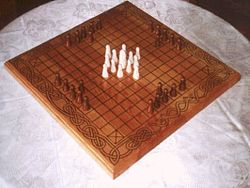
Prior to the introduction of chess, tafl referred to hnefatafl or king's board/table. No one is quite sure how it was played but there have been many guesses based on a variety of clues and riddles left in the sagas and the incomplete boards that have been found. The hnefa is thought to refer to the king piece who is surrounded by eight maidens. Scholars are not sure if dice were used in the game or not. Thud, a game from Terry Pratchett's disc world owes something to tafl, and perhaps gives the most flavour of what it could be like to play.

Other games in the Viking period included a variation on fox and geese (a complex game where one player has one piece and the other tries to surround him) and nine men morris.

However the games were played, they were a popular pastime and required a great deal of intellectual thought and a knowledge of the rules.

11 December 2008

Excerpt Thursday: Delia DeLeest

Thursdays on Unusual Historicals mean excerpts! Here's one from Delia DeLeest. She writes:

To go along with my post yesterday on popular games of the 1920s, I thought I'd post an excerpt from my Wild Rose Press release It Takes Moxie. This is almost, word for word, from a conversation I was an unwilling participant of when a group of people were trying to convince me to join club they were a part of. My husband said I'd be nuts to not share it with the rest of the world. Ben and Moxie are on the run from thieves and gangsters, but that doesn't stop them from making a few new friends along the way.

***

The man was old, veteran of the Revolutionary War old, Methuselah old. He may have known King Tut personally. He was stooped over, his clothes clinging to his bony frame in a last ditch effort to prevent him from totally crumbling into a pile of dust at their feet. He gave them a good-natured, though a bit gummy, smile.

"I said, you have something of mine," he repeated.

"We do?" Ben looked at Moxie accusingly.

"Don't look at me like that. I didn't take anything of his. I've never seen him before."

"Our cribbage peg. It slipped off our table and bounced under your chair. The girls and I play cribbage here every afternoon." He gestured towards a table of elderly woman, one of whom gave them a little wave. Ben gave her a weak smile in return. "I was wondering if I could bother you to move your chair so I could get the peg."

"Let me get it for you," Moxie offered.

"I'll get it."

Ben and Moxie both reached under the chair at the same time and banged their heads. Ben quickly pulled back and managed to crack his head on the bottom of the table in the process.

"Are you all right? Let me look at you." Moxie jumped out of her chair and fingered his head looking for a lump.

Ben used his arm to push Moxie away. "I'm fine. Don't try to help me anymore. Please." He scooped the peg off the floor and placed it into the old man's gnarled paw.

"Thank you kindly. Say, would you folks be interested in joining our little group? We meet here at one o'clock every weekday. There used to be more of us, but our charter members keep dying. We could use some fresh blood."

A picture of the man in a Dracula cape attempting to bite, or in his case, gum, someone's neck, had Moxie erupting into a bubble of giggles.

Ben looked at her curiously, then shook his head. "Thanks for the offer, old bean, but we're just passing through. We don't live around here."

"That's too bad. The girls and I would have loved to have you and your wife join us."

"She's not my-"

"Maybe we'll have to start our own cribbage group at home, won't we, Honey?"

"Moxie-"

"So sorry, but we have to be going," Moxie explained to the old man. "My husband and I have a lot of driving ahead of us yet, don't we dear?"

10 December 2008

Sports & Entertainment: 1920s Game Time

By Delia DeLeest

The prosperity of the Industrial Age brought something new the average man or woman hadn't experienced much of in the past--free time. With electric vacuum cleaners and washing machines, a reduced work week and a general exodus from farm life to city and small town living, people had more time on their hands than ever before. Then, they needed to find something to do to fill that void. They found the answer in games and puzzles.

The first crossword puzzle was made in 1913, by the 1920s, the crossword craze was sweeping America. Everywhere you went, people were sitting, pencil in hand, filling in those little squares. The New York Times claimed they were a "sinful waste in the utterly futile finding of words the letters of which will fit into a prearranged pattern, more or less complex. This is not a game at all, and it hardly can be called a sport...people get nothing out of it except a primitive form of mental exercise, and success or failure in any given attempt is equally irrelevant to mental development." Most were sure the crazy fad would soon be forgotten.

Even bigger than crossword puzzles was Mahjong. Mahjong originated in China, but made its way to the Western world in the late 1800s. Its popularity in the States reached its peak in the 1920s where people, mainly women, spent hours at the game. Though there are many different versions, the one mostly played during this time was Chinese Classical Mahjong. Basically it consists of each player being dealt a number of tiles and through a series of draws and discards. They must match their tiles, with the winner pulling the final tile that completes their hand. The rules are so diverse and complicated that entire books have been written. The difficulty in learning the game didn't stop people from all over the country from investing up to three hours of their time playing a single game.

Board games were becoming popular during this time also. Halma, a cross between checkers and Chinese checkers became very popular. Parcheesi, cribbage, Snakes and Ladders, as well as a variety of other games were also stocking peoples' cupboards and using up all that extra free time.

Though the Great Depression slowed the sales and interest in board games, they came back with a vengeance in the second half of the century. Even today, in an effort to foster togetherness, many families have instituted "Family Game Night," and there are store aisles dedicated entirely to board games. With new games being invented all the time, I don't foresee the craze stopping any time soon.