Showing posts with label 15 Minutes of Fame. Show all posts

31 May 2011

15 Minutes of Fame: Medieval Fashion

By Lindsay Townsend
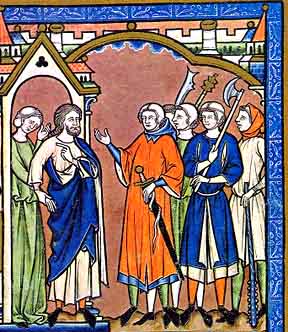
For many centuries in the Middle Ages the basics of fashion for men and women remained the same - a gown for women and a long or short robe or tunic for men. Fashions for sleeves, hats and shoes could be more fleeting or even extreme and it's those I'm looking at today, particularly in Britain.

The sleeveless tunic, based on a knight's surcoat, was a popular clothing choice for medieval men. Then in the middle of the 13th century there was a brief fashion which added wide sleeves to the tunic and sometimes a hood, turning it into a garment called a gardecorps. This was intended to replace the surcoat and cloak, combining both into a single item, however it never really caught on. Still with sleeves and male fashion, the bag-sleeve for men, a wide, baggy sleeve snug at the wrist and shoulder, was popular for about twenty years around 1400, but again never really caught on.

For medieval women, hair and headdresses tended to be 'the thing'. Between 1130-50 there was a fashion for noble women to wear their hair long in plaits and for them to sheath these plaits in silk, usually white with red circular stripes. These sheaths were called fouriaux. However it was with headdresses that medieval noble-women especially indulged and which set the medieval clerics scolding about excess and vanity. A brief fashion, lasting roughly thirty years, was the heart-shaped head-dress, a headgear designed with two 'horns' on either side of the woman's head. Sometimes these headdresses became even wider, which caused a cleric of the time to remark: "She is hornyd like a kowe... for syn." At Ludlow, within the church of St Laurence, there is a misericord carved with a woman portrayed as a scold - and wearing a horned headdress. Women in later years wore the steeple headdress or hennin, a tall cone arrayed with long, flowing veils, although this tended to be a European than British fashion. This was also railed against by clerics, particularly in France.

All classes craved fashion, as can be seen by the various sumptuary laws passed in 1363 and 1463 which tried to stop 'lower' classes dressing in furs and certain fabrics and aping their 'betters'. Such acts made no difference as people loved to dress up.

Men's vanity was often shown in shoes. Piked shoes - shoes with points - were popular with men in the Middle Ages, although the length of the points varied through the years. The truly exaggerated points were a short fashion. The idea that men wore the long points with chains attached to their knees to stop them tripping up may simply have been a mistake or a later urban myth. However, such cramped shoes did cause medieval people to have real problems with their feet, similar to those found in women of the 1950s who wore pinching, pointed-toed stilettos. An archaeologist working in Ipswich found evidence in a medieval cemetery of people with painful feet as a result of their shoes.

Everyone, it seems, suffers for fashion, no matter how short-lived that fashion may be.

Lindsay Townsend writes historical romance set in medieval England and the ancient Mediterranean. Her latest is A KNIGHT'S ENCHANTMENT, available now. She lives in Yorkshire with her husband.

30 May 2011

15 Minutes of Fame: Lucius Cornelius Balbus

By: Stephanie Dray

With the wicked Egyptian seductress dead, the Romans had every reason to believe the Republic would return to normal. Oh, some might argue that Cleopatra’s conqueror now meant to destroy the Republic and rule as king. He had, after all, begun to call himself Augustus (the illustrious one). But now that the civil wars were over, up-and-coming politicians like Lucius Cornelius Balbus bet that everything was going to return to normal.

Though Balbus was born in Spain, he’d been granted Roman citizenship, and had every reason to believe that he had a great future as a leader. He wasn’t a nobody after all. He was from the plebian side of gens Cornelia. Which is to say, he was related, in the complicated way of the Romans, to the Cornelii, a family who had, thus far, produced more Roman leaders than any other.

For nearly five-hundred years Rome had been ruled by her citizenry through elected bodies, governed by a carefully constructed constitution of checks and balances. Unlike our own Constitution, it didn’t guarantee equal opportunity for all--but Balbus believed it gave him a decent chance! Since Rome had done away with kings long ago, an ambitious young man could reach the pinnacle of power by working hard for the public. Young Romans started upon what was known as the cursus honorum (a course of offices) starting with military service and lowly magistracies and stretching all the way to the lofty heights of the consulship of Rome. If a young man had a taste for military life, he might become a pro-consul or governor of a province, and if he won a successful war, he would even be granted a giant military parade known as a triumph

This military parade was one of Rome’s highest honors and a man who was granted one of these would be known as a triumphator for the rest of his life! The Senate had never allowed anyone to celebrate a triumph who hadn’t been born a Roman citizen, but Balbus thought he might have a shot, if only there were a foreign war to be found.

He’d started his military career serving under Julius Caesar. When the dictator was assassinated, Balbus appears to have gone off to find his fortune in Mauretania at the side of King Bogud. Mauretania was just across the straight from Balbus’ home town of Gades and it was a land of plenty. Good fishing, lots of natural resources, and big plantations on which Balbus could grow wheat. Not a bad place to settle down--if Balbus had been the settling kind.

Before long, Mark Antony fell in love with Cleopatra and both of them went to war with Rome. So when King Bogud sided with Mark Antony and Balbus may have been with them both at Actium. Whatever the truth of the matter, when the war was over, instead of returning to Spain, Balbus decided to make a name for himself in Africa.

Africa was, after all, Rome’s latest obsession. Once Augustus chose to marry Cleopatra’s daughter to King Juba II and make them both the rulers of Mauretania, it became clear that Africa was the hip and happening place to be. Balbus may have travelled with the court of Juba II & Cleopatra Selene. As an able soldier and veteran of the wars, he’d have been the natural choice for a Roman advisor to the new monarchs. He almost assuredly had land there and would have wanted to be on good terms with the new folks in charge. Especially since Juba and Selene were nominal members of Augustus’ extended family

Juba and Selene were indebted to Augustus and sought to honor him at every turn. They had realized what Balbus had not; the Republic was on its way out. Augustus was about to form a monarchy in fact if not name, and “the new Caesar” didn’t look kindly upon rivals. Augustus had no intention of ever allowing another Roman--especially not one born in Spain like Balbus--to have any true independent power.

But Balbus still had big plans. He accepted a post as the Pro-Consul of Africa Nova--a province just to the east of Mauretania. There he waged an aggressive war against the Garamantes, a Berber tribal people of ferocious spirit. And when he captured their settlements, collected their loot, and dealt them a decisive defeat, he appealed to the Roman Senate to grant him a triumph.

Now, as mentioned before, Augustus didn’t like rivals. The so-called First Citizen appears to have decided that he should be the only man allowed to celebrate triumphs anymore. Consequently, when Marcus Licinius Crassus (grandson of the more famous triumvir) returned from a very successful campaign in the Balkans, Augustus tried to block him from celebrating a triumph. Crassus also disappears from the historical record shortly thereafter. This is unlikely to be an accident, considering the fate that befell others outside of the Julio-Claudian family who sought military honor. (Another example is the Praefect of Egypt, Cornelius Gallus, who was forced to commit suicide for boasting of his military achievements.)

Fortunately for Balbus, when he made his request for a triumph, Augustus happened to be out of town. (The would-be-emperor was off in the East poised for war with the Parthians and perhaps a little bit out of the loop.) In what would be one of their last independent acts, the Senate granted Balbus his heart’s desire. With high hopes and ambitions, Balbus apparently went to Rome with his soldiers, rode through the streets in a chariot, his face painted crimson, a slave whispering behind him a reminder that he was still a mortal. Balbus was the first non-Roman-born general to celebrate such an honor.

He was also the last.

He showed off his prisoners and loot, was hailed as an imperator, and saw the pinnacle of his career. He was treated like a king for a day. And then he was more or less never heard from again.

As far as Augustus was concerned, the legions all belonged to him now. Roman generals were only borrowing the army from him--not from the state--and therefore, every victory was actually his victory. Henceforth, only smaller celebrations and honors and ovations were allowed to those outside the imperial family. Returning from the East with the battle-standards that had been captured by Parthia in previous wars, Augustus snuffed out the Republic’s last breath and became the first emperor of Rome.

Stephanie Dray's debut historical fiction novel, LILY OF THE NILE , was just release by Berkley Books. The sequel is expected to release at the end of 2011. Both novels are set in the Augustan Age and feature Cleopatra's daughter.

27 May 2011

15 Minutes of Fame: The Emperor Who Wasn't

By Anna Randol

In November 1825, Tsar Alexander I died unexpectedly of typhus while taking his sick wife to a southern Russian city. The heir to the throne was Alexander’s younger brother Constantine. Coins were immediately minted with Constantine’s image. Nicholas, a third brother, swore an oath of allegiance followed by a large portion of the military.

There was only one problem— Constantine didn’t want to be the Emperor.

Constantine had been content with his life as a military man and in his more recent post of viceroy of Poland. His marriage to a delicate Polish countess also strengthened his ties to Poland, and since the countess was not of royal birth, no children of their union could ever be heirs to the throne. In fact, shortly after his marriage several years earlier, Constantine had sent a letter to his brother Alexander declaring his intent to abdicate. Constantine had flatly stated that he did not “possess the genius, the talents, or the strength necessary to qualify [him] for the dignity of sovereign”.

Unfortunately for all those involved, the letter wasn’t made public. It was stored away to be opened upon Alexander’s death along with a letter accepting the abdication and a letter naming their younger brother, Nicholas, emperor. It is unclear whether Nicholas knew of the change in succession in advance, but after reading the letters, he declined the crown and sent an envoy to try to convince his brother to change his mind. But the envoy was met by a messenger carrying Constantine’s adamant refusal to accept the empire.

Revolutionaries took advantage of the uncertainty to stir up discontent, accusing Nicholas of unjustly usurping the throne. With full-blown revolution brewing, Nicholas finally agreed to rule. Instead of taking a new oath of allegiance, the revolutionaries convinced 3,000 soldiers to march in the streets in defense of Constantine’s rule. On December 14th, the same day Nicholas was crowned, he ordered the rebellion crushed. Constantine later arrived to swear allegiance to his younger brother in person, thus ending his twenty day rule of the Russian empire.

Anna Randol writes sexy, fast-paced, Regency romances for Avon. Her debut novel set in Constantinople, Secret in Her Kiss, will be published in February, 2012.

25 May 2011

15 Minutes of Fame: Richard Trevithick

Michelle Styles
When most people think of the railway or even the horseless carriage, they consider it happen long after the beginning of the 19th century. George Stephenson who built the first commericial railway and whose locomotives won the Ranhill trials is sometimes wrongly credited with inventing the locomotive but in reality he owed a huge debt to Richard Trevithick.

In 1801, Richard Trevithick, the son of a Cornish engineer and an engineer himself decided to see if he could improve on James Watt's steam engine. Part of the trouble with the Watt engine was that it used low steam pressure. Trevithick decided to use a much higher pressure and in doing so was able to get rid of the huge boilers and cumbersome condenser. It meant for the first time a truly portable engine could be made.

By the end of 1801, he was road testing a steam road carriage. The inital trials went great until they decided to celebrate. The engine was not shut off properly. And while they were at the pub celebrating, the test engine burnt to a crisp.  Undaunted as he felt it was due to operator error, he tried again. This time, he tried in North London with a working horseless carriage but the roads were too uneven and the machine was difficult to steer. Equally it was thought that it would cost too much to run and who would ever be interested in such a contraption? With no significant backers, Trevithick abandoned his idea of a horseless road carriage and set his sights on the waggonways and using steam along rails as steering would not be such a problem.

Little is known of his first few attempts, although there is a tanlizing clue that a successful travelling steam engine was built in Penydarren for a bet but it broke the iron plate rails. In 1805, Trevithick tried again and built a prototype for Christopher Blackett of Wylam colliery. However, Blacket was using wooden rails and the engine did not work how he envisioned.  Blacket declined to order it.

Trevithick then tried one last go in 1808 when he built 'Catch Me If You Can' for London. It was a circular demonstration track with an engine pulling carriages. It failed to make money and derailed. Nothing of its ilk would  be seen again until the Rainhill trials twenty years later.
 In 1809, Blacket wrote to Trevithick asking him to help design a new engine as he had replaced his track with iron plate. Trevithick declined as he was busy with other projects and did not fancy going up to the North East. How different the world might have been if he had gone!
He continued to work on engineering projects but died penniless in Dartford in 1833.

Later, his contribution to engineering was recognised (including a stained glass window in Westminster Abbey in 1888) but although he is probably the father of modern locomotion, he is nowhere near known as well as he should be.

Michelle Styles writes historical romances for Harlequin Historical in a wide variety of time periods including Regnecy and early Victorian. She is interested in the development of the railway and engineering. Her recent A Question of Impropriety and Impoverished Miss, Convenient Wife revolved around the development of a travelling engine. Her next novel To Marry A Matchmaker features an inventor hero.

24 May 2011

15 Minutes of Fame: Grace Metalious, Author of Peyton Place

Anna C. Bowling
Petyon Place. Even for those who haven’t read the book, seen the movie or watched the television adaptation, the name brings to mind a seething sea of murder, incest, illegitimacy and abuse underneath the picturesque exterior of a small town. Its author, Grace Metalious, would have fit into her own creation as though she were born to it.

In a way, she was. Grace, a housewife and mother of three, burst onto the literary scene in 1955 when a literary agent sold her first novel, originally titled The Tree and the Blossom. Retitled Peyton Place, the salacious tale became an overnight sensation, gaining nationwide interest. Since childhood, Grace had sought respite from her turbulent personal life in her writing, but it was her writing that turned her life into a media frenzy.

Not only did the literary world sit up and take notice of Grace’s raw yet naive writing style, but her own community found several aspects of Grace’s book hit very close to home. Tom Makris, a colleague of Grace’s school principal husband, George, sued Grace for using his name and physical description for the book’s male lead. The plotline of an abused teen who kills her abusive stepfather directly mirrored the case of a local girl, and locations in the novel had strong similarities to places in Grace’s hometown of Gilmanton, NH.

Grace and her family moved to a larger house, paid for by Peyton Place’s royalties, but her marriage to George ended in divorce after he moved to another town, leaving Grace and the children on their own to face the storm of controversy. Grace began an affair with a neighbor, then married and divorced disk jockey TJ Martin, before reuniting with George, only to separate again. In her star writer persona, she spent money as fast as she made it, staying at the Plaza and Algonquin, flirting with the rich and famous. The film adaptation of her novel, heavily sanitized, reignited Lana Turner’s career and gained the legendary actress her lone Oscar nomination.

As quickly as Grace’s star rose, her life began a downward spiral. Her marriage to TJ crumbled under alcohol abuse and violent outbursts from both parties, and Grace’s lavish spending took a large bite out of her bank account. The sequel, Return to Peyton Place, did not match the success of its predecessor, even with its own adaptation for film. Reviews turned savage and a planned publicity tour was shelved.

Grace wrote two more novels; The Tight White Collar was published in 1961 and No Adam In Eden in 1963, but neither made any appreciable impression. She tried her hand at business, purchasing a motel she dubbed The Peyton Place Motel, but the venture soon folded due to lack of guests.
By 1963, when Grace began an affair with British journalist John Rees, friends described her not only as frequently drunk, but delusional and at times incoherent. That year would be her last. Grace died in 1964, of cirrhosis of the liver, her debts exceeding two hundred thousand dollars. Despite protests, Gilmanton’s most infamous citizen was interred in the Smith Meeting House Cemetary.

While the fame of Grace Metalious’ iconic work lives on, Grace herself had only a short while in the limelight, a pattern seen all too often in today’s young luminaries who rise quickly to fame they may not be equipped to handle. If Grace were to begin her career in the twenty first century, would things have gone any differently for her? Would we see her go through rehab and make a comeback, or would social media have brought about her downfall all the quicker?

Writing historical romances allows Anna C. Bowling to travel through time on a daily basis and make the voices in her head pay rent. Her current release, ORPHANS IN THE STORM, is available from Awe-Struck E-books.

23 May 2011

15 Minutes of Fame: Clara Bow

by Lorelie Brown

Clara Bow was the It Girl of a generation, and yet today people hardly know her name.

Born in a Brooklyn tenement in 1905, Clara did not have an easy life. Her mother, Sara, had suffered a head injury at 16 and suffered from “psychosis due to epilepsy.” As if that wasn’t bad enough, Clara’s father was apparently a useless case who couldn’t keep a job and often disappeared for long periods. Clara became Sara’s primary caretaker through psychotic episodes and fits of madness. In 1922, Clara even woke up to a butcher knife held at her throat by Sarah.

Unsurprisingly, Clara didn’t have a lot of friends. She lived for the movies and went as often as she could. She entered a talent contest run by movie magazines and won it in 1921 at 16. The terms of the contest were supposed to get her a movie part, but it seems like hanging around the New York studios eventually proved the better part of valor. She pestered them into giving her a real role. Luckily it turned out she could act. Handy, that was.

Over the next few years, Clara Bow took the movies by storm. First working out of New York (yeah, did you know that Hollywood wasn’t the original home of the movies? Nope, certainly weren’t.) she moved to California in 1923 to work for Preferred Pictures as a contract actress.

Bow was first cast as a flapper, the eponymous female of the 20s generation, in 1923’s “Black Oxen.” Reviews on Bow’s performance were mixed, but one thing was for sure. Clara was apparently the perfect flapper. Free spirited, lively, with a messy mop of red hair (she used henna to amp up her natural color) and a lush mouth that was perfectly accented with lipstick. Such a naughty girl! That air of naughtiness always kept her set slightly apart from most of Hollywood’s social elite. She wasn’t fancy enough, essentially. Cussing like a sailor tends to mark a girl out as...let’s say rougher class, shall we? Beyond that though, Clara wasn’t really that bad. A few love affairs, a couple broken engagements that were partly publicized to emphasis her flapper-girl status. But her outsider status as a whole left her vulnerable to vicious rumors.
Despite that, Clara kept working at a steady pace. The apex of her career was 1927, when she starred in “It,” as the most famous flapper role ever. (For the record, “it” is sex appeal, which had been only very sparingly used in the movies prior to Clara, who had it in spades.)

General assumption is that Clara didn’t make the transition to the talkie pictures well due to her Brooklyn accent and slight stutter. But that’s not true at all. She actually starred in eleven talking pictures.[Image] The real problem came in 1931 when she had a nervous break down. The stress of making too many pictures at once, combined with her slightly fragile mental health to begin with, became too much. She was checked into a mental health facility for a stay. Still, she was well enough by the end of the year to marry cowboy star Rex Bell. They semi-retired to Nevada, where they owned a ranch and Bell entered politics. Still, Clara was never exactly well. She returned to the screen in 1933 for only two pictures, driven by financial needs, but afterwards went back to her ranch to have two children. She fought mental health issues most of her life, eventually dying in California at the age of 60.

Lorelie Brown's first book, JAZZ BABY, is currently available from Samhain Publishing in both e-book and paperback formats. Her second romance, an 1880s-set western, will be published by Carina Press on 18 July.

16 May 2011

15 Minutes of Fame: The Rebellion of 1088

By Lisa Yarde

After the death of William the Conqueror in 1087, his sons Robert, William Rufus and Henry vied for the greatest share of their father's inheritance. The disposition of gold coins for Henry, and the duchy of Normandy to Robert and the kingdom of England to William Rufus did not resolve the matter as easily as William the Conqueror might have intended. Instead, many magnates with properties and castles on both sides of the Channel found their loyalties divided.

At the end of March 1088, around Easter, more than half of the largest landowners in England were determined to unite the Anglo-Norman aristocracy under one leader. Their choice was Robert of Normandy, who had coveted England for years. Perhaps they favored him because of his famed generosity to his supporters, as he often lavished wealth on mercenaries and knights in his retinue. Or, they thought he would be a more agreeable king than the current one. In the first six months of his reign, Robert's younger brother William Rufus had made himself one of the most hated monarchs in English history. The Anglo-Saxon Chronicle states, he was "hateful to almost all his people and odious to God."

Men of the king's own family led the rebellion; his uncles Odo de Bayeux and Robert de Mortain, the younger brothers of William the Conqueror. Others included Robert de Mowbray, Roger Bigod, Robert de Montgomery and his son Robert de Belleme, as well as Eustace of Boulonge. They all expected Duke Robert would sail from Normandy, but he had run out of money and appealed to his younger brother Henry for help. Henry gave Robert half of his inheritance from their father and for his trouble, he gained a county. Robert used the funds to raise reinforcements for his supporters in England, but in an unexpected move, William Rufus rallied and gained support. He besieged his uncle Odo at Pevensy Castle and captured him. Bad weather and a stalwart defense from the English navy weakened Duke Robert's invasion force. By July 1088, William Rusfus had also captured Rochester Castle. The rebellion was over, six months after it had begun. Some rebels, like Roger de Montgomery, took the bribes William Rufus offered and abandoned the cause. Other magnates, including Robert de Belleme and Roger de Bigod, forfeited their property for several years or went into temporary exile. Robert de Mowbray and Robert de Mortain received pardons, but William Rufus reserved the worse punishment for his uncle Odo. He deprived Odo of all his land and banished him from England.      

Lisa J. Yarde is a historical fiction author. Her novels ON FALCON'S WINGS, an epic medieval novel chronicling the starstruck romance between Norman and Saxon lovers, and SULTANA, set during a turbulent period of thirteenth century Spain, are available now.

11 May 2011

15 Minutes of Fame: Regina Strinassachi

By Carrie Lofty

On April 29, 1784, a young woman performed with Mozart for Joseph II, the Holy Roman Emperor. But that woman, Regina Strinassachi, did not play pianoforte as most ladies were wont to do. She played violin, with Mozart on piano. Together they debuted Mozart's newest composition, Sonata in B flat for Violin and Keyboard (K. 454), which he had written for her.

By all accounts, K. 454 is a rather difficult piece, which speaks to Mozart's high opinion of Strinassachi as a performer. He often wrote "puff" pieces for influential patrons' children who had mediocre talent, but this was not one of them. In a letter to his father, Mozart wrote: "We now have here the famous Strinasacchi from Mantua, a very good violinist. She has a great deal of taste and feeling in her playing. I am this moment composing a sonata which we are going to play together on Thursday at her concert in the theater."

The concert was noted, however, not for Strinassachi's virtuosic performance, but because Mozart performed from blank pages. He had been in too great a hurry to write down his part, instead performing from memory. Later years would elevate this duet to the stuff of legend, with Mozart reputed to have composed his portion on the spot.

Regina Strinassachi, 1795But who was Strinassachi?

The nuns at Venice's famous Ospedale della Pietà--founded by Antonio Vivaldi as a refuge for orphan girls, or perhaps for the illegitimate daughters of wealthy nobleman--constantly obscured the year of Strinasacchi's birth. As a child prodigy, if she could pass for ten years old, that would wow the audiences more than if she was actually 16. The fact she had a surname adds to the mystery of her origins, because most of the girls at the Pietà took on the names of their preferred instruments--Anna della Violin from Barbara Quick's Vivaldi's Virgins is one famous example.

Strinasacchi toured Italy, France and Germany, performing on both violin and guitar, before arriving in Vienna in 1784, where she met Mozart. In 1785, she married Johann Conrad Schlick, a famous cellist and konzertmeister of the Gotha ducal band. Some speculate that her marriage may have been one of a professional nature, because she became the first woman in Europe to perform full-time with an orchestra, rather than as an occasional soloist. She may have also composed. Their daughter Caroline, born in 1786, grew up to play piano as part of a family trio, and they split their time between Gotha and tours that reached as far as Russia.

Here I imagine Mathida Heidel, the heroine of my first book with Carina Press, SONG OF SEDUCTION, meeting Regina before a concert.
The pair reached Arie where he stood next to an elegant woman in her early forties. She wore an exquisite gown of ice-blue silk and ivory lace trim. Gray-streaked black hair arranged in an elaborate coiffure of spirals and curls accentuated the graceful lines of her neck and slender face. Magnetic black eyes shone from beneath heavy dark lashes. An oblong bruise along her left jaw marred her otherwise flawless olive skin.

Mathilda had never seen such an arresting woman.

"De Voss, there you are," Haydn said.

"Gute Abend, Kapellmeister. And Frau Heidel. Lovely to see you." Arie bowed deeply, his air bright and amused. He turned to present the elegant woman. "Allow me to present Frau Regina Schlick."

"I am honored to meet you both," the woman said. Her lilting Italian accent created melody out of plain speech. "Herr De Voss has told me you perform exquisitely."

"Thank you." She smiled broadly at the unexpected compliment. That he would speak of her in glowing terms to this exotic woman warmed Mathilda from top to toes. "The maestro flatters me."

"Nonsense. He recognizes talent almost as well as he composes."
Their son Johann was born in 1801--when Strinassachi would have been nearly 40--and became a cellist and instrument maker. Caroline married and became an actress. Upon her husband's death in 1818, Strinassachi moved with her son to Dresden. She died in 1839, having lived through 80 tumultuous years--from the old Georgian and Classical periods, through the Napoleonic era, and into mid-19th century Victorian Europe.

But few remember Regina Strinassachi today. In fact, I was the person who wrote her Wikipedia entry, based on my research for SONG OF SEDUCTION. If the prodigal female violinist is remembered at all, it's because of that fateful day in 1784 when she found out what it meant to play second to Mozart.

SONG OF SEDUCTION's sequel from Carina Press, PORTRAIT OF SEDUCTION, is now available! Later this year watch for Carrie's new Victorian series from Pocket, as well as her "Dark Age Dawning" romance trilogy from Berkley, co-written with Ann Aguirre under the name Ellen Connor. "Historical romance needs more risk-takers like Lofty." ~ Wendy the Super Librarian

10 May 2011

15 Minutes of Fame: Queen for Seven Weeks

Blythe Gifford
James V of Scotland is remembered primarily for being the father of Mary, Queen of Scots, but Mary, born six days before his death, was the daughter of his second wife. His first wife, Madeleine of Valois, arrived in Scotland in May of 1337. Seven weeks later, she was dead at the age of sixteen.

She had been James’ wife for less than seven months.

The cause of death was not foul play, but “consumption,” or what we would call tuberculosis. She had apparently been delicate all her life and her father, Francis I, king of France, initially proposed another member of the French nobility to be James’ bride.

James himself was only twenty five when they were married, but he had already fathered several illegitimate children. According to the Treaty of Rouen between Scotland and France, signed when he was five, James was to marry a French princess. The sickly Madeleine was the only princess available.

Negotiations went on for years and James did consider other brides in the meantime. He had had no shortage of options. Eighteen names were suggested as marriage partners, from Mary Tudor (Henry VIII’s daughter and later Mary, Queen of England) to Christina of Denmark.

But France and Scotland had been allies against England for centuries by this time, and James finally came back to the French option. At Francis’ insistence, James initially contracted to marry Mary of Bourbon in Madeleine ’s stead, but when he met Madeleine , the pair seemed to be smitten. Whether their union was ultimately a love match or merely the execution of a treaty is not entirely clear, but given Francis’ concern for his daughter, she must have lobbied him to let her marry young James. Her father obviously loved her very much, for as part of the marriage negotiations, he agreed to pay her an annual pension in addition to providing her with a dowry.

James and Madeleine were married January 1, 1537 at Notre Dame Cathedral. The wedding was an impressive affair, followed by days of jousting at the Louvre and commemorated by poems celebrating the occasion. Their marriage began with a trip to Rouen, where he paid 1100 crowns for a diamond for her ‘spousing’ ring. (A handsome sum, exceeded by the 1600 crowns he spent on fine, red Bordeaux wine.) He could afford it. Madeleine’s dowry was reported to be 225,000 livres.

Yet in Rouen, Madeleine fell ill. They delayed the return to Scotland to allow her to regain her strength, and finally landed May 19. Edinburgh had planned a celebration of her arrival and a coronation. Instead, she went immediately to Holyrood Palace, never to leave its walls alive.
In June, perhaps not wanting her father to worry, she wrote, that she was “much recovered.” But on July 7, she died in Holyrood, an uncrowned queen of a kingdom she inhabited for all of seven weeks.
She must have spent most of that time, ill in her chamber, looking out the window at a country she would never live to rule.

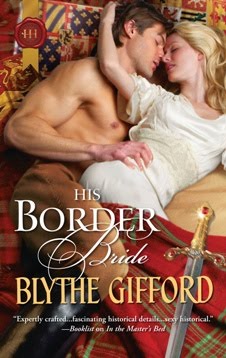
Blythe Gifford has written five, 14th century medieval romances for Harlequin Historicals featuring characters born on the wrong side of the royal blanket, most recently HIS BORDER BRIDE. The Chicago Tribune called her work "the perfect balance between history and romance." She is working on her next book, which will again be set on the Scottish Borders.