.jpg)
By Carrie Lofty
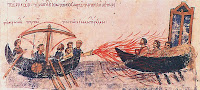 Throughout the years, it has been referred to as Roman fire, Byzantine fire, liquid fire, and sea fire. Thought to have been the creation of the Byzantines in the 6th century, drawing from the Alexandrian school of early chemists, Greek fire was an incendiary weapon that burned even in water. The formula became a treasured Byzantine secret, passed down by emperors and their scientists. While the exact formula is not known, historians believe it was either a form of quicklime that increased its heat when exposed to water, or a floating hydrocarbon such as naphtha.
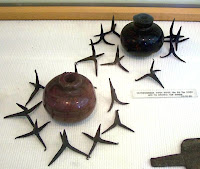 No matter its composition, Byzantine armies used Greek Fire throughout the Middle Ages, particularly in sea battles where the opposition could be destroyed while trapped in narrow straights or against rocky shores. Some delivery methods included barrels flung via catapult, arrows laced with the substance, or primitive grenades--metal or glass canisters hurled at the opposition. Crusaders returned home to England and France with wild tales of fire that only grew stronger in water. Western science trailed those eastern innovations by such an extent that such a thing could not be believed, let alone recreated.
(How does Meg, my heroine, know the formula? She has a very convincing connection to a gentleman named Adelard of Bath.)
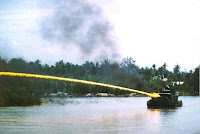 Eastern cultures including the Persians and Chinese also had a type of Greek Fire, but many historians believe the formula differed from that of the Byzantines. The modern equivalent, napalm, is actually a sticky version. Incendiary petroleum splashed too easily, so the addition of the napalm bonding agent helped to jelly the flammable fuel, making it stick while burning. The weapon was used to famously horrific results during the Vietnam Conflict. Napalm victims asphyxiate or suffer third degree burns that destroy layers of skin and shut down the immune system, and survivors suffer burns called keloids--growths of tissue around the scar site, which permanently impair motor function.
All around nasty stuff.
Robin pulled a special arrow from his quiver. Instead of barbed metal, the head was made of tightly wound and knotted wool. More like a slender torch than an arrow, he drenched it in the gelatinous solution. The man in charge of that barrel quickly dropped the leather cover back in place, keeping it clear of the rain.In WHAT A SCOUNDREL WANTS, the blind alchemist, Meg, uses an ancient formula to produce Greek Fire for her husband, Will Scarlet, and the legendary Robin Hood to use against their enemies. While the BBC's newest "Robin Hood" television series made the mistake of claiming it to be gunpowder, Greek Fire was actually a forerunner of modern napalm.
He marveled at the magic he witnessed. Each drop of water landed upon the coated shaft and sizzled. When he dipped the saturated wool into the open drum of rainwater, it burst into flames. The downpour did nothing to extinguish the fire and, in fact, strengthened its mysterious heat. All around him, he heard his men--sound men of long experience in battle--wonder and fret about the unnatural blaze.
But then the hoardings opened. Archers began their assault on Will's team.
Robin watched the trap unfold, neither surprised nor discouraged. At least Will and a few of his accomplices made it inside the gate. "Archers! On me!"
A line of men stood ready, wielding the flaming arrows no water could douse.
"On the hoardings! Ready! Fire!"
Curving over the shallow glade, blazing arrows glowed against the deep gloom of the evening storm. While a few flew wide in the wind, most of the points met their mark and embedded in the wooden galleries that shielded the opposing archers. The arrows burned and burned. No amount of water quenched their hunger, until even the rain-soaked wood fell victim to the tremendous heat and caught fire.
 Throughout the years, it has been referred to as Roman fire, Byzantine fire, liquid fire, and sea fire. Thought to have been the creation of the Byzantines in the 6th century, drawing from the Alexandrian school of early chemists, Greek fire was an incendiary weapon that burned even in water. The formula became a treasured Byzantine secret, passed down by emperors and their scientists. While the exact formula is not known, historians believe it was either a form of quicklime that increased its heat when exposed to water, or a floating hydrocarbon such as naphtha.
  No matter its composition, Byzantine armies used Greek Fire throughout the Middle Ages, particularly in sea battles where the opposition could be destroyed while trapped in narrow straights or against rocky shores. Some delivery methods included barrels flung via catapult, arrows laced with the substance, or primitive grenades--metal or glass canisters hurled at the opposition. Crusaders returned home to England and France with wild tales of fire that only grew stronger in water. Western science trailed those eastern innovations by such an extent that such a thing could not be believed, let alone recreated.
(How does Meg, my heroine, know the formula? She has a very convincing connection to a gentleman named Adelard of Bath.)
 Eastern cultures including the Persians and Chinese also had a type of Greek Fire, but many historians believe the formula differed from that of the Byzantines. The modern equivalent, napalm, is actually a sticky version. Incendiary petroleum splashed too easily, so the addition of the napalm bonding agent helped to jelly the flammable fuel, making it stick while burning. The weapon was used to famously horrific results during the Vietnam Conflict. Napalm victims asphyxiate or suffer third degree burns that destroy layers of skin and shut down the immune system, and survivors suffer burns called keloids--growths of tissue around the scar site, which permanently impair motor function.
All around nasty stuff.


