Showing posts with label Feasts. Show all posts

28 September 2012

Feasts: Bronze Age Solstice Feast by J.S. Dunn

By J.S. Dunn

“Mead distilled sparkling, its praise is everywhere.”
From Welsh myth, Song to Mead

What did the ancient Irish eat at 4,000 years ago? And, what about the peoples in what is now Spain’s Costa Verde, and up the Bay of Biscay to the Morbihan and Brittany’s coasts? At first, researching prehistoric foods looks daunting.

The Dindshenchas, a medieval text of oral histories, has clues to the early diet: the sacred salmon of knowledge, the hazelnut which also imparts wisdom, cereal grains for porridge and brewing, and various berries. The ancients made milk and butter from their herd animals. To this day, well-formed oak casks holding Bronze Age butter turn up at digs in the Irish bogs, the contents still smelling of dairy---though no one samples!

Meats of early domesticated sheep and cattle, and cuts of wild deer and boar, show in the bone counts from archaeological digs. Fish were trapped in wattle river weirs long before the Bronze Age. The north Atlantic produces a diverse marine life that is richer than the Mediterranean, and the Atlantic peoples consumed shellfish in great numbers per the remains in ancient shell middens: mussels, whelks, periwinkles, oysters, lobster.


Despite an ancient prohibition on killing swans in Irish myths, there is evidence that swans were indeed eaten for food, and swans winter at the river Boyne and other areas in great numbers. The prohibition re: swans was perhaps politically motivated or may have been an early conservation measure.

The ancients’ knowledge of edible seeds, roots, and herbs, would far exceed our own based on paleobotany surveys at excavations. They collected and dried the wild apple, and berries, which were used for beverages in addition to mead from fermented honey.

In warmer latitudes like ancient Spain, the Bronze Age people began to cultivate the olive and other fruiting shrubs. There is evidence they knew which acorn varieties to collect, and ground those into flour. Spain’s meltingly tender acorn-fed ham of today may have begun in antiquity given their early use of the abundant acorns.

The richness of the environment held bounty for those who well knew how to utilize it. For these ancients, a feast was literally a sacrament of life. The reborn winter solstice sun showed the ancients that spring’s bounty would return.

Boyne solstice feast:
Smoked salmon, smoked haddock
Dried apples stewed with fresh or dried swan
Wild boar, venison, joint of beef ; boiled or roasted
Meal cakes of finely ground hazelnuts, seeds, and grains, sweetened with honey
Soft white cheese, sweet butter
Mead, herbal infusions, primitive beer and cider

Juniper reduction sauce for modern roast wild game:

Here is a simple (and relatively low-fat) reduction sauce if you happen to be serving wild boar or venison for winter solstice or a more modern holiday. Juniper berries impart a flavor like rosemary with a citrus hint. The berries should be dried and crushed before use. Note, buy in a shop—don’t try to harvest your own; some juniper varieties are toxic.

Roast or sauté the meat, keep warm. Deglaze the pan with around ½ cup of red wine (or Calvados, or Guinness, or whatever!), and simmer that mixture in a heavy saucepan until the essence reduces by half in volume. The sauce should coat a spoon. Add one chopped shallot ( or wild garlic shoots if you have those at hand ) and  8 fluid ounces of beef consommé ( not bouillon) and reduce again. If desired, butter (3 tbsp) can be added for a smoother, shiny sauce or to correct overcooking! Add the crushed juniper berries when almost ready to serve the sauce. 4-6 portions.  

J.S. Dunn lived in Ireland during the past decade, on 12 lovely acres fronting a salmon river. The author continues to research and travel the Atlantic coasts and recently  enjoyed wonderful seafood on the Cotes d’Armor, and in Cornwall, and at the famed Lobster Pot restaurant in County Wexford, Ireland.

26 September 2012

Feasts: Christmas and Easter feasting and the medieval peasant

By Lindsay Townsend

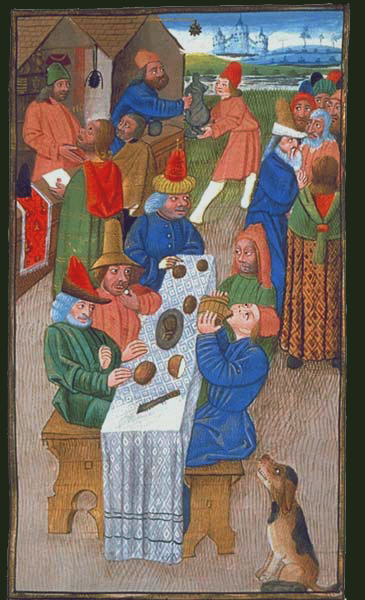
Feasting for a noble or a king in the medieval period could be a splendid, lengthy, expensive affair, where dishes were produced and shown to display wealth and power. What about feasts for the bulk of the population who lived on the land?

In an age without freezers and only limited storage methods – smoking, salting, drying, preserving, keeping – all foodstuffs had to be produced in time to the rhythms of the farming year. In the Middle Ages, that meant the Christian calendar. Feasts were allied to the high points of harvests, saints’ days, Christ’s life, the change of the seasons and the winter and summer solstices.

Christmas especially, covering the darkest time of the year and preceded by the fast of Advent, was celebrated for almost two weeks by all classes. No work was done in that ‘quiet’ season of the farming year and people celebrated by dancing, singing, story-telling, drinking and eating.

In the countryside, some lucky peasants might be fed within their lords’ manor houses over Christmas as part of the Christian tradition of charity and share in rich dishes and strong beers. Other peasants would feast at home. Meat, as a luxury, would certainly be enjoyed, usually in the form of bacon, salted beef or mutton. Such cuts would be made into stews or slow roasted. Pepper was used as a spice by all classes and at Christmas carefully hoarded spices such as ginger, some dried herbs from the kitchen garden and perhaps even exotic fruits such as dried raisins might be added to the stews to add different flavours. We know that peasants had access to exotic spices and dried fruits because the Sumptuary Laws forbade indulgence in both rich clothes and expensive foods by the ‘lower’ classes.

Fine wheat bread, if peasants could produce it (by grinding the flour in secret away from their lords’ mill) would be a treat. River fish or eels would make a change from the usual salted dried cod of winter-time. Waterfowl, chickens, and – once they had escaped and bred from their specially constructed warrens – rabbits, could be caught, roasted or turned into stews and pies.

Hard cheese, which would keep through the winter, might have been part of a peasant’s Christmas feasting and certainly there would have been pottages, vegetable one pot stews made from the cut and come again greens and root vegetables (not potatoes yet) from the kitchen garden.

As well as food treats, peasant households would decorate their homes for their Christmas feasts. Holly, ivy and mistletoe were cut and brought indoors to make the Christmas Bush that hung from the rafters. And after Christmas there was the festival of wassailing in cider apple districts. People would gather in the orchards and light fires under the trees, dance round them and drink to them.

The lengthening days of early spring were often times of sparse commons for everyone as winter stores were eaten and the new crops and growth were still not ready. The hard fasting of Lent, and before that the feast of Shrovetide when all the dairy food ‘luxuries’ not allowed during the fasting time were used up, gave way at last to Easter.

Richer peasants might feast on lamb or suckling pig, served with the first spring greens. Eggs featured heavily since they symbolised the stone rolled away from the tomb of Christ. Pace or paschal eggs, coloured with onion skins and wine, were part of the Easter feast, which, like Christmas, could last over several days.

(Pictures from Wikimedia Commons.)

Lindsay
http://www.lindsaytownsend.net
http://www.twitter.com/lindsayromantic

18 September 2012

Feasts: Medieval Feasting in the 21st Century


With most of the people I talk with about things medieval, any glimmer of interest they have is satisfied by a sentence or two of describing research I’ve done, books I’ve enjoyed, or places and people I find intriguing. If I go on, more often than not their eyes begin to glaze, they feel a sudden need for something from the kitchen, or spot another person they meant to talk with. Papal politics of the late 13th century seems to leave them cold.

I shared my excitement with some friends after attending the International Congress on Medieval Studies in Kalamazoo, Michigan as a treat for my fiftieth birthday. One friend stared, incredulous, as I described the delights of the world’s largest gathering of medieval historians. “When I turned fifty,” she said, “I went to Disneyland.”

Same thing, really. To me.

Count Thomas the Heartless Bastard and
Lady Winnifred the Longsuffering,
with Brother Vern and the hostess,
Lady Alessandra of Frykhaven
However, one effort to share my medieval mania was a smashing success: a Michaelmas feast. Using a fancy font like Old English Text, I sent this invitation: “Lord Vern and Lady Alessandra of Frykhaven request your company for a celebration to mark Michaelmas, the feast day of St. Michael the Archangel.” Following the details of date, time, and location, I included this note: “Medieval garb is encouraged, but not required.”

Perhaps you should know that I don’t take readily to playing dress up myself. My husband is the actor—in fact he is on stage tonight in the leading role of a play about Vince Lombardi, the legendary football coach. But I was determined to be as medieval as I reasonably could, and began sewing a bodice as the basis of a costume I planned to wear. Then I found some maroon Naugahyde and made a hat, and ordered a costume Vern chose: a Franciscan monk’s robe.

The menu was developed mainly from sources on the internet, and was provided to the guests.
* First Remove  *
Bread, butter, blackberry jam
Cheese selection
Figs and dates
*  Second Remove  *
Roast Chicken with Cameline Sauce
Wortes in Marrow Boats
Gingerbread and walnuts
*  Third Remove  *
Pork loin with Blackberry Sauce
Frumenty
Brie Tarts
Pickled onions
Sotelte
*  Fourth Remove  *
Blackberry-Apple Crumble
Blackberry Pie
Apple Rice Pudding

St. Michael slaying the dragon;
Source - Wiki Commons
The emphasis on blackberries in the menu allowed me to explain the legend—the medieval truth—that when Michael the Archangel cast Satan from heaven, he landed on earth in a blackberry bramble, and cursed the berries. It became the rule of thumb that blackberries must be picked prior to Michaelmas, September 29.

The menu called for some additional explanations of medieval food. What is frumenty, anyway? It’s a cracked wheat dish, something like bulgur, though I omitted the porpoise one recipe called for. Cameline sauce? A spicy wine sauce thickened with bread crumbs. Wortes are green leafy vegetables, and I served them in giant zucchini (marrow) boats.

The costumed revelers enjoyed the feast
perhaps a bit more than the others!
I had the most fun making the sotelty, or “subtlety”, a sculpture made from edible ingredients, not necessarily intended to be eaten, but meant to delight the guests with a visual treat. I made a castle of sugar cubes, topping the towers with bright striped candles.

Perhaps you are wishing—I certainly am!—that I had taken photos of the food, but sadly I did not. I was distracted by the demands of serving a four course meal to 35 guests. But neither the guest list nor the menu need to be so elaborate, to create a fun evening when your medieval enthusiasms can have free reign. And there are plenty of feast days throughout the year to play with.

I also prepared a quiz of ten questions about Michaelmas.

1.       Michaelmas has been celebrated since:
a.      Daniel prophesied about Michael (Daniel Chapter 10).
b.      he appeared to an Italian bishop in 492 on Mount Gargano.
c.       the French chivalric “Order of St. Michael” was founded in 1469.
d.      Michaelmas daisies were discovered in Africa.

2.      The traditional meat for Michaelmas is:
a.  rabbit stew             b.  wild boar    c. goose     d.  venison

3.      Michaelmas was one of the medieval “quarter days” of the year when:
a.      rents were collected
b.      debts were paid
c.       fairs were held
d.      all of the above

4.      The angel Michael is known for:
a.      leading the worship of God in heaven.
b.      announcing Mary’s pregnancy to her.
c.       wrestling with Jacob.
d.      casting Satan out of Heaven.

5.      Michaelmas marked:
a.      the end of fishing season.
b.      the completion of the annual harvest.
c.       the beginning of winter curfew.
d.      the time to hire new servants and laborers.

6.      True or False?  Michael is recognized in Christian, Jewish, Islamic, and New Age religions.

7.      True or False?  The name Michael means “Who is like God?”

8.     True or False?   Michael is commonly depicted is artwork with a raised sword, holding Satan to the ground with his foot on Satan’s neck.

9.   True or False?   “Harvest Moon” is the full moon nearest to Michaelmas.

10.  True or False?   Michael is the patron saint of England, grocers, paratroopers, the German people, soldiers, the city of Brussels, Papua New Guinea, and the Archdiocese of Seattle, Washington.

The kitchen staff, Vassal Braden von Dungeness
and Sir Soren of Queen Anne,
provided vital help with serving the meal.
As our guests arrived, we were delighted to see how many had made some concession to costume, and for those who hadn’t, we provided hats for a medieval photo op anyway. I loved having the opportunity to immerse my friends in the medieval history I enjoy so much, and to have the extra reward of their enjoyment too!

(Answers to the quiz: 1-b, 2-c, 3-d, 4-d, 5-b, 6-T, 7-T, 8-T, 9-T (but keyed to equinox, not the feast), 10-F (but yes to grocers, paratroopers, Brussels, and Papua New Guinea)

10 September 2012

Feasts: The Mead-Hall of Anglo-Saxon Tradition

By Lisa J. Yarde

In the Anglo-Saxon epic poem, Beowulf, King Hrothgar's warriors enjoyed feasts and drowned their sorrows and fears in the finest mead served at Heorot, the king's mead-hall. The mead-hall originated in Europe as a gathering place for the community, where the rulers lived and administered daily functions, and their warriors served as faithful retainers. With the fifth century invasions of Angles from the Jutland peninsula and the Saxons from Germany, tribes brought the traditions of the mead-hall to England.In the early Anglo-Saxon period before Christianity gained influence, a  ruler summoned his household for a ritual gathering, where the men drank, made boasts or binding oaths in the service of their lord and received gifts of land from him. As in subsequent centuries, alcohol flowed freely at these gatherings. Guests consumed mead, fermented from a mix of honey and water flavored with herbs, and beer, cider and malted ale all day or over a period of three days. A general understanding assumed that alcohol could cause guests to become boastful, but even drunken oaths were upheld and the safety of those in attendance at feasts safeguarded by the lord. 

Drinking scene on an image stone;
Source: Wiki Commons
The Anglo-Saxons constructed long mead-halls of timber with thatched roofs to accommodate hundreds of guests. Typically, there were no windows and one or two access doors at most. Wall hangings and a central hearth kept guests warm, but the hall would have likely been very smoky as a result. Meat such as pork, beef or venison could be roasted over the fire pit on a spit, fish like herring or eel on a griddle, or a stew or pottage could be boiled in a cauldron. Bread made from rye or wheat baked in a clay oven, fruits such as crab apples and plums, and vegetables like peas, beans, parsnips and cabbage might have accompanied the meal.  Guests sat according to their social on benches arranged along rows of tables that went around the hall. Bards were always on hand to entertain the guests with tales of heroism, accompanied by musicians who played the flute and harp. Remnants of the Anglo-Saxon halls have been found and attempts at reconstructing them have been made at West Stow in Suffolk and Yeavering in Northumberland. 

There were everyday gatherings but feasts to celebrate battle victories, special events, seasonal festivals and religious observances must have offered food and drink in copious quantities.Feasts were the means for rulers to forge strong ties between people in a communal setting. They demonstrated the lord's wealth, support and protection of his community, meant to bind them together in his service.
  
Lisa J. Yarde writes fiction inspired by real-life events. She is the author of historical novels set in medieval England and Normandy, The Burning Candle,based on the life of Isabel de Vermandois, and On Falcon's Wings, chronicling the star-crossed romance between Norman and Saxon lovers. Lisa has also written Sultana and Sultana’s Legacy, novels set during a turbulent period of thirteenth century Spain,where rivalries and ambitions threaten the fragile bonds between members of a powerful family. 

03 September 2012

Feasts: The Roman Banquet


By Heather Domin


When most people think of a Roman banquet, they probably imagine one of those smoky slow-motion orgies with the History Channel Players eating piles of dormice and puking in the vomitorium between courses. That makes for nice TV, but it's just not very accurate. When people talk about what the Romans did, what they usually mean is what wealthy Romans did, since the rich people are the ones in the history books—the vast majority of Romans did not hold wild parties every night spent sprawled across each other eating grapes off the fingers of dancers. But they didn’t need to, because your average everyday Roman banquet was still a pretty impressive feast.
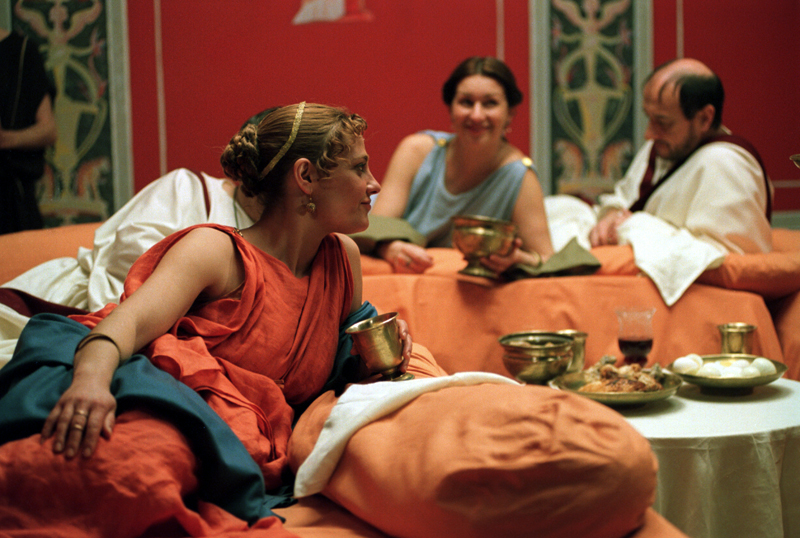
Reproduction of a small triclinium; Source: Wiki Commons

The customary dining-room setup in ancient Rome was the triclinium, communal benches or couches arranged in a three-sided bracket around an open center. Diners sat on cushions and leaned back on one elbow while eating; each person might have their own table, or there could be several mid-size tables or one low platform for everyone. (Conservative Romans might segregate men and women in separate dining rooms, but by the time of Augustus this convention was dying out.) A social banquet would begin just after the bath hour, around 5pm, so that guests would be freshly primped and have plenty of time to socialize after dinner while they enjoyed their mulled wine and digestives.

So what did they eat? As a wise man once said: there is too much, let me sum up. Starters might involve cheese, olives, eggs, mushrooms, sausages, and other finger foods; after that would come a selection of legumes, boiled or pickled vegetables, stewed greens, or salads (which were quite dense and mushy, not a side salad). The main course was where you brought out your big guns. The principal meat was pork, boiled or roasted and served with a dizzying array of sauces; and as for seafood, the Romans ate just about anything they could pull out of the ocean. They also ate poultry and fowl, game like deer and rabbits, and goats or sheep if they were plentiful (if not, they'd be saved for non-food purposes, which is why the Romans almost never ate beef). Bread was present throughout the meal, and all courses included a variety of condiments, the most popular being olive oil, vinegar, and the infamous fish sauce garum. Romans were enormously fond of sauces and seasonings, as well as chutneys, relishes, dips, and spreads. The beverage of choice was wine diluted with water or fruit juice; flavored wines were popular, as were mixed punches and herbal tisanes. Desserts were based on fruits, nuts, cheese, honey, and baked goods, all served with warm spiced wine.

Historical reenactors stage a Roman banquet;
Source: Wiki Commons
And now the moment I know you’ve been waiting for: what about those dormice? Yes, it’s true; roast dormouse is an actual Roman recipe. (They were even bred for this very purpose!) When you wanted to impress your guests, you splurged on the kind of extravagant dishes that would ensure your feast would be talked about. Among the list of recorded delicacies: stuffed sow’s uterus, rabbit fetuses, peacock tongues, milk-fed snails, pickled sea urchins, and dormouse-on-a-stick. But really, none of these should be considered part of a typical Roman banquet—think of them as the escapades of the Roman 1% trying to keep up with the Julians. Oh, and those between-course barfing rooms? They didn't exist. A vomitorium is the hallway you use to exit a coliseum. Recreational bulimia as a Roman pastime is a figment of historical imagination.

Below are five banquet-worthy recipes taken straight from ancient Roman writers. Any of these dishes would be worthy of gracing the table at your next Roman feast. (If you try any of them, try the globi. Trust me.) Enjoy!

Boiled Egg Appetizer [Apicius 328]
Sauce for boiled eggs: pepper, lovage, and soaked nuts; add honey and vinegar, mix with garum. Serve with the eggs.

Mixed Salad [Columella 12]
Put savory in a mortar with mint, rue, cilantro, parsley, leeks, lettuce, arugula, thyme, catnip, pennyroyal, and salted cheese. Crush everything together and add peppered vinegar. Serve on a plate and pour oil over it.

Boiled Parsnips [Apicius 117]
Cook parsnips in this sauce: celery seed, rue, honey, pepper, sweet wine, garum, and oil; thicken with flour, sprinkle with pepper, and serve.

Scallop Fritters [Apicius 46]
Cook some scallops and remove the undesirable parts; mince these very fine and mix with spelt flour and eggs. Season with pepper, shape in caul, fry them and serve with garum.

Cheese Dumplings (Globi) [Cato 79]
Make globi this way: mix cheese and spelt flour, enough to make the desired amount. Put lard in a hot copper vessel. Fry one or two at a time, turning with two rods, remove when done, spread with honey, sprinkle with poppy seeds, serve.

Heather Domin is the author of The Soldier of Raetia,set in Augustan Rome, and Allegiance, set in 1920s Dublin. She is currently up to her eyeballs in revisions on the sequel to The Soldier of Raetia, in which Drusus Germanicus plays a major role. You can usually find her procrastinating on Twitter, procrastinating on Livejournal, or procrastinating staring at pictures of Tom Hiddleston on Tumblr.