Showing posts with label Meet My Protagonist. Show all posts

25 January 2017

Meet My Protagonist: Leova, from THE ASHES OF HEAVEN’S PILLAR


Leova is an ordinary medieval woman but not a typical protagonist for historical fiction set in early medieval times. Nor are people like her found in the annals, which ignore commoners, portray pagans as brutes, and treat war captives like booty.

When I wrote THE ASHES OF HEAVEN’S PILLAR, I wanted to tell the story about the 8th century wars between the Christian Franks and the pagan Saxons from a peasant’s point of view, and I wanted to delve more into the slavery that existed at the time. I needed Leova.

My heroine looks good for her age, 28, but is not a blooming maiden. Although illnesses and the possibility of famine make conditions tough by 21st century Western standards, Leova thinks she had a good life. At the beginning of the story, she has a loving husband, two healthy children, a small farm, and a freedom she takes for granted.

She is a pagan who believes the Saxons will ultimately triumph as long as the sacred pillar, the Irminsul, stands. Her religion involves human sacrifice—a thanksgiving to the war god for triumph in battle. It’s a reality she accepts. Like the Christians of her time, she believes supernatural beings are responsible for all that happens in her world, from a fruitful harvest to an illness to a military victory.

Everything falls apart in 772 with Charlemagne’s first war in Saxony. The Frankish king’s soldiers burn the Irminsul, and she loses her faith and all that makes her life good—except for her children. For their sake, she refuses to surrender to the blackness threatening to overwhelm her as the pyres claim her brother then her husband. Her son and daughter, Deorlaf and Sunwynn, come first.

After the family is sold into slavery by relatives, she will set aside her pride and kneel before a master she fears and loathes to prevent her children from starving. She will let a kinder master use her body for his pleasure if that keeps her family intact. And she will risk the slow strangulation of hanging to protect her daughter from a lustful count and being sealed in a barrel and drowning as a witch while she begs one of her old gods to bring her lost son back to her.

There is a lot to like in Leova: her devotion to her children, her willingness to sacrifice, her courage, her determination, and a strength she draws on despite her lack of power and privilege.

**An Excerpt from The Ashes of Heaven's Pillar**

July 772, Eresburg, Saxony

Leova fought the urge to seize her children's hands and bolt out of the longhouse. No, she thought, listening to her husband's quick strokes of the whetstone, we will need food; we will need knives.

Dust clouded the sunlight from the open door and stuck to Leova's face and hands. Her home's wooden walls could not keep out the clamor from the village—the women's screams, babies' cries, hooves pounding on hardened earth. Through the noise, a deep voice bellowed, "Invasion from the west! Invasion from the west! Men to arms! Women and children to the forest!"

Her guts clenching, Leova blindly threw barley bread and dried beef into her bag. She had abandoned her bean stew, still simmering in the hearth. The warrior's shouts added little to the earlier message from the fortress's horns.

Leova's slender twelve-winter-old son scowled. "I should be fighting," Deorlaf said.

Derwine set aside the knife he was sharpening against the whetstone and slapped his son with the back of his weathered hand. "Stop wasting time! Release the swine and pull carrots and onions like your mother told you!" He raised his hand again. "Now, Deorlaf!"

Deorlaf looked down, mumbling "not fair." Snatching a sack, he grabbed a wooden trowel and stomped out of the longhouse.

"Father?" whimpered Sunwynn.

Leova dropped her sack, marched two steps, and shook her fair nine-winter-old daughter. "Father is busy," she hissed.

"But the night terrors," said Sunwynn, her body rigid.

"Our charms will protect us," Leova replied, hoping it was true.

* * *

Kim Rendfeld is the author of THE ASHES OF HEAVEN’S PILLAR and its companion, THE CROSS AND THE DRAGON, both set in the early years of Charlemagne’s reign. Connect with Kim on her website (kimrendfeld.com), her blog (kimrendfeld.wordpress.com), Facebook (facebook.com/authorkimrendfeld), and Twitter (@kimrendfeld).

16 January 2017

Meet My Protagonist: Aurelia Mitela - woman and warrior

Older Aurelia
Fifteen hundred years after the end of the Roman Empire, one last (imaginary) part still survives in the 20th century – Roma Nova. Its people are tough, uncompromising in defending their country and guard their Roman cultural values tightly. However, due to the grim times of their early history, women had to take up gladius and scutum (shield) and fight by the side of their menfolk. And they never lost the status this struggle gave them. In the late 1960s in this egalitarian yet still Roman society, Aurelia Mitela is the archetypal Roma Novan... 

Aurelia came to life when I was writing the first Roma Nova thriller, INCEPTIO. Then, she was the clever experienced grandmother of Carina, the book’s heroine. Let Carina tell you in her own words of her first impression of Aurelia:
She’d been so concerned for me, but not in a soppy way. Direct and ‘no-nonsense’ fitted her perfectly, but her smile had been warm. I couldn’t help speculating how it would have been to grow up with her instead of the Browns.

 I started tapping the keys, surfing for 'Roma Nova' while I was drinking and thinking. I couldn’t leave it alone. My grandmother’s name shot out at me. Fascinated, I loaded the English translation. The screen displayed a list of her business interests. Sketchy on detail, it gave some personal stuff at the end: head of the influential Mitela family, senator and government advisor, cousin to the current imperatrix. She really was a big hitter.”

In PERFIDITAS, we see Aurelia, the cool ex-Praetorian, holding the family together after they’d been falsely arrested:
“[Aurelia to Carina] ‘I’ve been through a great deal worse. I’m not a little old lady out of some genteel novel.’ 

 No, she truly wasn’t. She’d been Praetorian Guard Special Forces in her time, even led the attack to retake the city during the civil war. Although now in her mid-seventies, she definitely belonged to the“tough gals” league. She gave me a close description of the arresting party. What a difference it made when the victim was a trained professional and could give you precise, detailed information. She’d printed off her statement and signed it already.

Throughout the first three books, INCEPTIO, PERFIDITAS and SUCCESSIO, set in the present we catch references to Aurelia’s early life, but more intriguingly, a whole range of questions are thrown up. What did she do in the Great Rebellion nearly twenty-three years before the time of INCEPTIO? Why is she so anxious when she compares the villain in SUCCESSIO to Caius Tellus, the brutal ‘First Consul’ who instigated the rebellion all those years ago? Who was the great love of Aurelia’s life that Carina only learns about in SUCCESSIO?

1960s Berlin
In AURELIA, the fourth book which takes us back to the late 1960s, we watch Aurelia as a young woman. She's 28 years old and is accused of murder during a mission to Berlin.While on remand in a Prussian prison, she has to undergo a hostile psychological assessment. Here’s the report on her:

Subject is highly rational, quick-minded and a natural leader. She sees nothing is impossible given enough time and resources. Subject has the confident personality and willpower to pursue and implement her goals, easily bringing others with her. A dominant personality.

Strategic thinker, curious, innovative, able to grasp and deal with problems with determination and precision. Energetic and excellent communication skills, happy to confront and negotiate with others. Intelligent enough to recognise other people’s talents, and work with them. Requires challenges and even failures, or her self-confidence could easily turn into arrogance and condescension.

Personalities of this type cannot tolerate inefficiency or those whom they perceive as lazy or incompetent. They can be chillingly cold and ruthless when the situation arises, operating purely on logic and rationality. 

They interact very well with others, often charming them to their cause, and paying attention to other people’s feelings – or at least pretending that they do. Most mature and successful personalities of this type are genuine in this aspect to some extent, even though their sensitivity may hide a cold and calculating mind.

This is a slant on the classic ENTJ personality  profile from the Myers-Briggs Type Indicator, a psychometric test system popular in business to indicate psychological preferences about how people perceive the world and make decisions. I needed to make the report negative for the story, but positive aspects of this type of personality are that they are conceptual and global thinkers, able to see connections where others don’t, and to think ahead. Couple this with the intuition and sense of fair play many ENTJs possess, it  can make life frustrating for this personality when people around them don’t  grasp things the way they do. Of course, this conflict is a gift for a writer…

In essence, Aurelia is a blood-and-bone Roma Novan whose values are based on traditional ancient Roman ones; tough, loyal with a strong sense of duty and fully aware of her responsibilities as head of a great family. But her desire to keep all the balls juggling in the air with precise timing leads to her being riven by guilt if she doesn’t perform a hundred percent.

Aurelia has one vulnerability, her love for her frail daughter, Marina. But along with her determination to serve her country, Aurelia's willingness to sacrifice everything for Marina is also her greatest strength. It motivates her even when she's experiencing her darkest moments.

Is she sympathetic? Yes, because under all that resolution and toughness, she is still a human being who experiences fear, love, despair and grief. She bitterly misses the strong comradeship of her earlier military career and is exhilarated when going back into action. And then there is her devotion to her life-long love, elusive though he sometimes proves to be...

--------------------------------------------------------------

Discover more about AURELIA


Late 1960s Roma Nova, the last Roman colony that has survived into the 20th century. Aurelia Mitela is alone – her partner gone, her child sickly and her mother dead – and forced to give up her beloved career as a Praetorian officer.

But her country needs her unique skills. Somebody is smuggling silver – Roma Nova’s lifeblood – on an industrial scale. Sent to Berlin to investigate, she encounters the mysterious and attractive Miklós, a known smuggler who knows too much and Caius Tellus, a Roma Novan she has despised and feared since childhood.

Barely escaping a trap set by a gang boss intent on terminating her, she discovers that her old enemy is at the heart of all her troubles. She pursues him back home to Roma Nova desperate now he has struck at her most vulnerable point – her young daughter.

Available as
- eBook from Amazon,  iBooks,  Kobo,  B&N Nook
- audiobook from Audible
- paperback, author signed paperback and from other retailers

HNS indie Editor’s Choice Autumn 2015 
Shortlisted for the 2016 HNS Indie prize, then Finalist (one of four)
B.R.A.G. Medallion, October 2015 
Discovered Diamond January 2016

--------------------------------------------------------------

Alison Morton is the author of the acclaimed Roma Nova thrillers INCEPTIO, PERFIDITAS, SUCCESSIO, AURELIA and the latest, INSURRECTIO

Connect with Alison on her Roma Nova site: http://alison-morton.com
Twitter https://twitter.com/alison_morton @alison-morton

11 January 2017

Meet My Protagonist: Thaddeus Dombrowski in The Gate of Dawn


By M.J. Neary

I am very thankful for this opportunity to share some obscure insights into the gender dynamic in the Polish-Lithuanian community as explored in my novel The Gate of Dawn. In light of the recent political developments, "patriarchy" and "male privilege" have been frequent buzz words. Any time we talk about any sort of privilege or -archy, it's implied that there is a flip side, an alternative. One particular group is presumed to be in a position of advantage, but there is a possibility that the roles will flip. My readers will find it refreshing that in today's post I will talk about an essentially matriarchal society and the awkward place men held in it. 

As an insider - my biological father being a Pole - I can ponder how Poland's history and geographic location affected the distribution of power and responsibilities between the genders. Sandwiched between two strong and menacing neighbors, Germany and Russia, Poland had been run over, occupied and partitioned. It went on and off the map, though the sense of Polish ethnic identity remained. Over the course of the centuries, certain gender-specific expectations developed. Boys grew up with the idea of being "little soldiers". They were either trying to stage a liberating rebellion, or they were being drafted to serve in the army of one of the occupiers. Either way, they were not expected to have long lives. And the women who loved and married them were assumed to keep it in the back of their collective mind. The odds of them becoming widows with small children were rather high, so they had to be equipped to carry on. Women who were not ready to embrace those risks were better off becoming nuns. Because there was such pressure on boys to be "brave little soldiers", they were to some extent excused from the burden of making decisions in times of relative peace. Men were not expected to become level-headed, practical, disciplined or good with money. Those responsibilities usually fell on women. Boys fight - girls do everything else. It is my personal belief, shared by many other people, that Poland as a nation owes its survival to the tenacity, resilience, and adaptability of its women. 

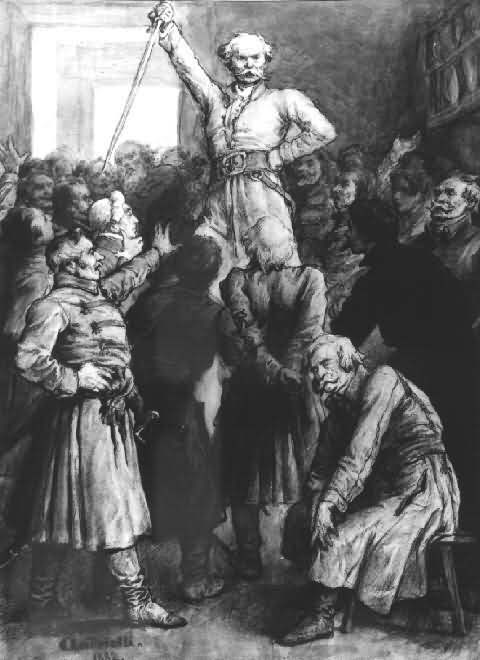
Here are some images depicting Polish manhood:

http://image.toutlecine.com/photos/p/a/n/pan-tadeusz-1999-05-g.jpg

http://upload.wikimedia.org/wikipedia/commons/a/ae/Andriolli_Pan_Tadeusz_1.jpg
Thaddeus Dombrowski is one of the main characters in The Gate of Dawn. He is the demure, impractical, guilt-ridden husband of the female protagonist, a German heiress named Renate Lichtner. Their marriage is arranged by Renate's dying father and at first appears to benefit both sides, but as with many hasty arrangements, things go horribly awry. Aged thirty in the beginning of the novel, Thaddeus is exactly twice as old as his child bride. Those thirty years had been filled with sorrow and bereavement - he had buried his wife and four children. Despite the sorrow, he retains some juvenile naivete. Having spent his whole life on a remote rural estate called Raven's Bog, he is not a very worldly man. The novel takes place in the 1880s, twenty some years after the abolition of serfdom in Eastern Europe. Thaddeus, born into landed gentry, feels guilty about all the atrocities his peasants had suffered in the hands of his tyrannical father and believes it is his mission is to atone for the sins of his ancestors. He rejects social hierarchy and treats his servants as family members. His fifteen-year-old bride, on another hand, is very cosmopolitan and erudite. She is a German who was born and raised in the dynamic and diverse Vilnius. She is keenly aware of the socioeconomic and ethnic pyramid. The sight of her aristocratic Polish fiance eating and drinking with his Lithuanian servants appalls her. Renate certainly does not believe that all people are equal and deserve to sit at the same table and eat the same food. She endorses the notion of Russian and German supremacy over Poles and Lithuanians. All the more appalling she finds his impracticality and lack of business skills. After a string of crop failures, Raven's Bog is in danger of being confiscated by the Russians for failure to pay taxes. Russian imperialist agents kept a close eye on struggling properties. If the original owner proved to be incompetent, they would confiscate the land. And that's just the kind of mess young Renate walks into. The inheritance she brings into the marriage provides temporary relief but does not solve the underlying issue of her husband having no clue on how to cultivate the land and negotiate profitable prices. 

Thaddeus Dombrowski is a quintessential Polish man. The archetype is still relevant. He is deeply religious and exuberantly sexual, though his sexuality, as one can imagine, is confined to marriage and directed at procreation. He does not shy away from hard physical work or pain. He is quick to embraces self-sacrifice and martyrdom. In addition to impracticality, his flaws include a propensity for self-destruction and alcoholism. Polish men are known for being accident prone. It's an unflattering and darkly humorous stereotype, but it's rooted in reality. Because Polish men are taught that being able to withstand physical pain and grin through injuries is an attribute of masculinity, they often neglect safety measures. Throughout the novel, Thaddeus suffers several freak accidents that could have been easily prevented. His male servants are guilty of the same.  

This is how I envisioned my protagonist. This is a still from a film based on Adam Bernard Mickiewicz's novel that also has a protagonist named Thaddeus. 

http://media-cache-ak0.pinimg.com/736x/30/d6/12/30d6126394f2bd2aa8c16d24ca257a3e.jpg

In social situations, women clearly take the lead. When a woman speaks, her man must remain silent. Unless a man is talking about war or religion, he should sit quietly with his eyes downcast. Arguing with a woman is both disrespectful and demeaning. A real man must not engage in conversations of philistine nature. He must preserve his strength for a potential military engagement. He must be seen but not heard. 

http://mafab.hu/static/2014t/285/01/13410_38.jpg


03 January 2017

Meet My Protagonists - The Love Story of Moraima and Muhammad in Sultana: The White Mountains

Sultana: The White Mountains, set in late fifteenth-century, is the story of the protagonists Moraima and Muhammad, based on historical figures of the same name. The hero Sultan Muhammad XI (more commonly known as Boabdil in Spanish history) is aged 24 at his introduction. He faces a struggle that will determine his family’s fate and the future of Islamic rule in Spain. He is the eldest son of the Moorish Sultan Abu’l-Hasan Ali (Muley Hacén) of Granada and his wife Sultana Aisha. Born a prince in 1458, Muhammad ascends the throne as a Sultan in 1482. Born in 1465, Sultana Moraima is the youngest daughter of Ali ibn Ibrahim ibn al-Attar, governor of Loja and his late wife Mahjuna. Aged 17 at the novel’s opening, she is also the sole wife and mother of the only children of Sultan Muhammad XI, whom she married in when she was 15. How can Moraima protect her small family from their enemies within and outside the kingdom of Granada?

Granada's Alhambra Palace, where the real Muhammad and Moraima lived
Sultana: The White Mountains, the final novel of the six-part Sultana series, begins at a tumultuous time in history, the last period of Muslim rule in Spain. Spanish chroniclers of the era recorded several details about the real Moraima and Muhammad as the one-time ruler of Moorish Granada and his young wife. Both have also been portrayed onscreen, most recently in the Spanish dramatic series, Isabel, about the unification of the kingdoms of Castile and Aragon. There are even brief depictions of the turbulent life of Muhammad and Ahmad, his eldest son with Moraima, in the 2016 fantasy film, Assassin’s Creed.

Muhammad XI, as depicted by Alex Martinez
in the Spanish series, Isabel
History has deemed Muhammad XI as a hapless pitiful pawn, caught up in the machinations of his mother Aisha, who reviled his father Abu’l-Hasan Ali and rebelled against him so their son could take the throne. A famous legendary saying of his mother upbraided him with, “Do not weep like a woman for what you could not defend as a man” – a ridiculous fable considering the woman who presumably spoke those words, but for some reason, the association has remained. Moraima comes down through the ages as a wilting wallflower, the sweet but pretty daughter of an aged provincial governor, overwhelmed by marriage into the Nasrid royal family and the ambitions of its powerful members. On her wedding day with Muhammad, she described by the historian Lafuente Alcantara as having “… borrowed dresses and jewelry. A chronicler invited to the wedding feast indicated that the bride wore a cloth skirt and black shawl and a white veil that almost covered her face…’pity because her features are pleasing and seductive.’ And a Muslim poet added Moraima had large expressive eyes in an admirable face, and conjectured, ‘through thick clothes one could guess the shoulders, arms, hips and waist contours as classic and opulent.”

Moraima, as depicted by Alba Garcia in
the Spanish series, Isabel
But just because Moraima and Muhammad’s past is already etched in the annals of history doesn’t mean their full story has been revealed. They enjoy a love match, rare among those of the Nasrid rulers. Muhammad is a poet at heart and often expresses his feelings in verses for his wife. While no actual record of poetry by the historical figure exists, the inspiration for the behavior of the fictional character comes from another Sultan who lived in the next century, the Ottoman Suleiman the Magnificent who wrote verses for his greatest love, Hurrem Sultan. While Moraima and Muhammad's union occurred after a chance meeting in the previous novel, their mutual regard endures across the pages of Sultana: The White Mountains, as Muhammad comes to the throne during a coup against his father. In the quest to ensure the viability of his reign, and ultimately, the survival of their family, Moraima seeks out his erstwhile allies and sometimes his rivals. Even in defiance of her husband’s wishes. More than twenty years of study has revealed the power of the Nasrid queens, many of whom were anything unlike the stereotypical view of Muslim wives, veiled and secreted behind harem walls. If Muhammad’s mother could successfully plot against a reigning monarch, it’s not outside the realm of possibility that Moraima played her part in dynastic intrigue as well.

What else can readers expect of the protagonists in the novel? In keeping with the theme of the series, Moraima and Muhammad not only share a deepened respect for each other, but they want the same goal – the consolidation of their familial interests in the survival of Moorish Spain. Readers can anticipate there will be dangerous enemies attempting to thwart their plans, who pose threats inside the Moorish kingdom and outside its borders. The novel features its most powerful nemeses in Queen Isabella of Castile and King Ferdinand of Aragón, whose marriage for Spanish hegemony over the Iberian Peninsula has direct consequences in Moraima and Muhammad’s lives. There are rival court ministers and incompetent generals, dutiful bodyguards and faithful servants. Muhammad’s mother, an inherent schemer, also impacts several events. An intimate connection for Moraima also occurs with a wily former courtesan to Sultans, called The Thousander – readers will be entertained by her antics, including how she got that strange name!

Now, meet Moraima and Muhammad in the first chapter of Sultana: The White Mountains.


The House of God
Sultana Moraima

Gharnatah, Al-Andalus or Granada, Andalusia
29 Jumada al-Thani 887 AH / August 15, AD 1482

Moraima stirred just as Muhammad nuzzled her cheek. His husky voice whispered in her ear, “The ornament of the world, my precious jewel. The center of my thoughts. My immortal garden, my fragrant rose. The fulfillment of the heart. My music, my song….”
She rolled beneath the damask coverlet and reached for his hand on her shoulder. His thumb skimmed her flesh. “My guide, the brilliance of a thousand suns. My sweet waters, the solace of my soul.”
How many mornings in the past two years had they awoken like this in the bedchamber they shared? Each subsequent day had seemed the happiest of her life, though always surmounted by the arrival of the next dawn.
She sighed as he bent his head and kissed her closed eyelids. “The abode of bliss. My opulence formed in purest gold. My elegance arrayed in finery. You, who have bound me in your spell. Do not relinquish the heart, which never ceases to love.”
Her eyelids flickered and she smiled up at him. Beyond the bed, faintest morning light seeped through the lattice-covered window. She caught his bearded face between her hands and silenced him with soft pecks on his lips. Cinnamon mingled with sugar, from the dafair loaves shared at dinner, lingered on his breath.
Then Muhammad laughed against her mouth. “Were this morning’s verses so poorly composed, so unworthy of the one who inspires them?”


Lisa J. Yarde writes fiction inspired by the Middle Ages in Europe. She is the author of two historical novels set in medieval England and Normandy, The Burning Candle, based on the life of one of the first countesses of Leicester and Surrey, Isabel de Vermandois, and On Falcon's Wings, chronicling the star-crossed romance between Norman and Saxon lovers before the Battle of Hastings. Lisa has also completed a six-part series set in Moorish Spain, Sultana, Sultana’s Legacy, Sultana: Two SistersSultana: The Bride Price, Sultana: The Pomegranate Tree, and Sultana: The White Mountains, where rivalries and ambitions threaten the fragile bonds between members of a powerful family. Her short story, The Legend Rises, which chronicles the Welsh princess Gwenllian of Gwynedd’s valiant fight against English invaders, is also available.