Showing posts with label Strangely Wonderful. Show all posts

24 November 2010

Real Life Heroes: Sir Richard Burton

By Karen Mercury

Sir Richard Burton (born 1821) was a man a hundred years ahead of his time. A megalomaniac, brilliant, and brutal, he is mostly known for having the nerve to bring the Kama Sutra and the 1001 Nights to the civilized world. Even as a youth he was fearless and reckless. He once broke his trumpet over the head of his instructor because he wanted to play piano instead. He joined the army in India, where he became known for dressing in Arab garb and going into backwoods districts where no one else would dare tread.

He read prolifically, became an expert in all things Oriental, and by the end of his life spoke at least 20 languages fluently. He traveled to the Holy City of Mecca and was the first white man to write about it, being able to pass for Arab. He was nearly caught, certain death for a white man, when he lifted his robe to pee instead of squatting like an Arab. During some of his many leaves from the Army, he learned falconry and wrote The Book of the Sword, so detailed it is still used by fencers today.

But oddly enough he chose to marry an extremely prudish and upright woman, Isabel Arundel. His translation of the Arabian Nights took him years, and Isabel was extremely mortified about "those activities" of his, his interest in the Kama Sutra. Being a widely traveled ethnologist, most biographers posit that he tried all the techniques he wrote about, and with all of the tribes he visited.

Burton defended himself vociferously. "To those critics who complain of my raw vulgarisms and puerile indecencies, I can reply by quoting what Dr Johnson said to the lady who complained of naughty words in his dictionary: 'You must have been looking for them, Madam!'"

In India, he went undercover for General Napier to a brothel where English soldiers "frequented" young boys. His resulting incredibly detailed report caused a scandal and it was quickly buried--like so much of his "deviant" writing would later be buried by his prudish wife. Naturally everyone assumed Burton participated in the activities to obtain such details, but I guess we'll never know.

In 1854 he joined up with John Hanning Speke to travel to Somalia, backed by the Royal Geographical Society. Burton proposed to discover a large interior lake he'd heard about. Burton accomplished the first leg alone, and would set out on the second leg with Speke and two other lieutenants. Before they could leave they were attacked by Somali warriors. Speke was wounded in eleven spots by spears, one lieutenant was killed, and Burton had a javelin thrust through his jaw. Although Burton was cleared of culpability, it was another black mark on his army record. Soon after in the Crimea, his unit mutinied, another black mark that led to a lifelong frustration with being unable to advance in the army.

His most famous trip left out of Zanzibar to "discover" the source of the Nile. Speke amazingly agreed to accompany him--the two were like oil and water, but worked well together on expeditions. They set out in 1857 and suffered various travails--Speke was blind for several weeks and partially deaf due to an infection, and Burton was unable to walk and had to be carried on a litter which ruined his enormous pride. It was actually Speke alone who found Lake Victoria, and Burton refused to believe it was the source of the Nile, since he had been unable to see it himself.

Speke returned home before Burton and published his own account first, which led to one of the great debates of all time. Speke didn't know any African languages and didn't keep nearly as detailed notes as Burton. Speke had an Imperialist attitude toward Africans and Burton was appalled at the way he randomly killed animals and left the meat sitting there. All of this led to a great rift, and when Speke gave his lecture first at the Royal Geographical Society, breaking their promise to present their findings together, Burton challenged him to a debate. It was all-out war by then, with Burton being the most suspicious character due to his "going native." In 1864 they had a date to debate in front of a society, but the day before, Speke was found dead in a bizarre hunting accident. Many people believe he couldn't handle the stress of going up against Burton who was a superior public speaker.

Burton managed to obtain consul positions at Fernando Po and Brazil, bringing Isabel with him and spending much time traveling. He was sent to Damascus where once again he made many enemies, continuing to translate and write many more books. He died in Trieste in 1890--the cloud of another controversy surrounding him when his friends believed Isabel forced him to convert to Catholicism on his deathbed. She had always tried to protect his image, and one of the first things she did upon his death was burn many of his "pornographic" writings, including a final chapter of The Perfumed Garden on pederasty, leading many to term her "the most hated woman in literature."

Karen Mercury's first three historicals, including STRANGELY WONDERFUL were set in precolonial Africa. Her latest, WORKING THE LODE, due out in January 2011, is an erotic romance set during the California gold rush.

17 January 2009

Weekly Announcements - 16 Jan 09

The Romance Reader Connection awarded Michelle Styles' VIKING WARRIOR, UNWILLING WIFE 4 1/2 stars and had the following to say:

The depth of characterization combine with the scope of the story and provide the reader with a profoundly rich historical romance experience not always found in the Harlequin Historical line. The author has quite a flair for strong females as well as noble and compelling heroes, each character right for their time and space.
In addition, SOLD AND SEDUCED was released in Greece in November as O EMPHOPOS THS POMHS .

***

Elizabeth Lane received the cover for her April Harlequin Historical release, SUBSTITUTE BRIDE, which is set against the backdrop of the 1906 San Francisco Earthquake.

***

For her novel STRANGELY WONDERFUL, Karen Mercury received 4-stars from the Historical Romance Club in this review.

***

Join us tomorrow when Elaine Levine will be here to talk about RACHEL AND THE HIRED GUN, set in 1867 Dakota Territory.

***

We'll also draw the winner of Isabel Roman's MURDER & MAGICK. There's still time to leave a comment for your shot at winning!

***

Have a good weekend! If you have an announcement to make for next week, email Carrie. See you next week...

12 August 2008

Weapons and Armies: The Cantonese Water World

By Karen Mercury

Before 1793, China had a relaxed, complacent attitude toward their mellow pirates, when an imperial junk could easily round them up or scare them off. The Emperor declared, "In Kwangtung there are no urgent affairs...the pirates have gradually withdrawn and not a trace of them remains." Such sanguinity of mood was abruptly changed with the organization of large fleets that overwhelmed the coasts for more than a decade and became the biggest maritime menace since the conquest of Taiwan and the suppression of Koxinga more than a decade earlier.

Kwangtung province was the hotbed of piracy, where 50,000 to 70,000 pirates took charge of fishing and coastal trade. They moved into interior waterways, extorting payments from towns, burning those who wouldn't pay. They nearly brought about the demise of all Kwantung trade by dissolving communication between Canton and Macao, causing runaway inflation, and bottoming out the foreign market. In a decade, the radical escalation of piracy from the Han River basin reaching into Vietnam had transformed from a trivial annoyance into an international peril.

Most pirates began as fishermen or sailors themselves, unmarried Cantonese-speaking "water people" who voluntarily adopted the vocation. The riparian geography and island chains made it easy for them to hide. There were few roads, so the denizens of the Cantonese water world could move with impunity in the complex network of creeks linking hamlets, villages, and towns. The pirate junks seemed as though floating on green waves through the watery rice plains, much to the terror of those farmers who viewed them.

A Western pirate in my 1827 novel Strangely Wonderful describes the scene thusly:
"Now, them ricemen, you've seen how they comport themselves. They's not exactly high flown themselves. Why, Wenkai's men mix their putrid gunpowder--much less sparky than ours, and given to failing to ignite--into their beverages! Makes 'em choke and turn red, and they think it looks bluff. We used to see the outcomes of their raids, aye. The 'Black Squadrons' would raid villages, Miss, not just other vessels, and take harmless old women with their feet wrapped so tight they had to be dragged, plundered their sorry old fishtanks and gardens. Can't tell you how many of them prisoners we set free when we'd gain a junk as a prize. No, Cap'n Balásházy's more like the kind pirates of the Île Sainte-Marie, back in the glory days. Not one on his crew as wants to leave."
The average prizes were the cargoes of the two-masted sea-going hai-ch'uan junks, transporting lumber, charcoal, cotton, silk, and barnyard animals. Late eighteenth and early nineteenth century was the height of the "Straits' produce" monopoly--rattan, seaweed, and pepper, the pirates' bread and butter. Adding to the confusion were Portuguese missionaries, men actually mostly interested in trade, then British, Swedish, French, German, and American ships. Canton being the sole port through which European trade was allowed, a wild mishmash of vessels clogged the waterways, trading the grand prizes of salt, knives, cotton, cattle--such a torrent of items Western handbooks could only mention a few.

These ricemen operated undetected from the gun-slinging frontier headquarters of Chiang-p'ing, the Sino-Vietnamese equivalent of Jean Lafitte's Barataria, the markets overflowing with pirate produce. Aside from sailors and fishermen, Chiang-p'ing attracted scores of urban misfits and criminals who populated the gambling parlors, opium dens, and floating bordellos. They brandished simple weapons: knives, bamboo pikes, and cutting blades. It was easy to outfit an expedition when the employees were completely familiar with every sandbar, hidden rock, and tide. They struck with guerrilla swift blows, retreating before the shocked victims realized what was happening.

My cabin boy successfully strikes terror into the heroine's heart by proclaiming:
"Celestine mines?" Bellingham gaped. Half-standing, he waved a cautioning hand in the direction of the kitchen. "Miss, your brother can't go up there, not with these bilgey ricemen jaunting about the island! Why, they've got those swords what are sharpened on both sides, and even the lubberly junkmen give what they call ling chih. I didn't tell you this before so as not to scare you, that's 'death by a thousand cuts,' where they slice off one part of your body at a time, say a nose or a finger, and--"
By 1801, Tay-son sponsorship radically boosted piratical battle skills, and they learned how to wield weapons and make stands at sea. These pirates now had plans, joined forces, and sailed each spring from Kwangtung, returning each autumn to Vietnam, coordinating with shore bandits. Suddenly they were elevated from "scum of the sea" to "sailors in the King's navy, "receiving rank, honor, and recognition, many pirates holding titles such as "King of the Eastern Seas" or "King Who Pacifies the Waves." The desperadoes of Chiang-p'ing became the mariners of Tonkin, and they set to building "great war junks to transport Vietnamese war elephants to Canton."

The monumental pirate junks had masts more than 80 feet tall, and sides armored with layers of ox-hide to repel shot and spears, and nets to prevent boarders. Hearty vessels that mounted 30 cannon or more, these ironwood ships ran more than 150 feet in length and could carry up to 400 men. They seemed to Westerners to be "rudely constructed" and most comparable to American schooners or Portuguese brigs and snows, two-masted ships or less than 200 tons.

The captain and his often 6 wives (aggressive pirate women with unbound feet who sometimes held rank and commanded their own junks) occupied the poop, and the rest of the crew crammed into cargo holds under the main deck, odoriferous, dark, and stuffy "cabins" divided only by feeble screens. Once they targeted their victims, the pirates surprised with cutlasses slung over their shoulders and knives sheathed under their arms. If thwarted from directly boarding, they'd plunge into the water to attack from the sea. Resisters were rewarded most commonly by being stripped, hands tied behind their backs, hoisted above the deck, and beaten with twisted rattan rods.

Occasionally pirates would fire their guns when close to their prey, pitiful cannon that I described:
The junk had evidently remasted with the assistance of the friendly Frogs in the Île Sainte-Marie, but it was the usual yang-ch'uan ocean-going junk with guns that were mounted by a rope rove through a hole in the gunwale and made fast to the muzzle of the gun, stationery rigs with no train tackle to allow room for reloading. Since most could not be maneuvered at all, the Kwangtungmen were compelled to position their junks with the enemy in their sights. By the time Broadhecker had hove into view and let loose with his bow guns, mauling the junk square amidships, the best the junkmen could do was elevate their guns. These were guns of the roughly cast pai-tzu turtledove type, badly made and smelted from scrap iron, so disgracefully inaccurate the junk was only able to get off a volley of nails and iron pot fragments that roundly hit a mark--a gaggle of ducks in the center of the bay.
Their small arms included the Chinese blunderbuss. With a barrel seven feet long and weighing 12 pounds, it had to be steadied on someone's shoulder or mounted on a tripod. (Much less likely to burst than other period small arms, it was still used in China in 1945.) They also possessed a medley of old matchlocks and fowling pieces of which they knew little, sometimes capturing Westerners simply in order to learn their usage. The worst were the matchlocks, fired by holding a slow-burning cord over the hole, or the small caliber muskets ("wretched things") with touch holes large enough to admit a tenpenny nail. In the end, Chinese pirates relied mostly on hand-to-hand combat, hurling bamboo pikes like javelins, or fighting with shorter pikes and knives. Of gunpowder and shot they had plenty, carelessly strewn about deck in huge chests where they sat to smoke.

16 November 2007

Weekly Announcements - 16 Nov 07

Erastes sold a short Victorian story to Cleis Press for an Erotic Alphabet Anthology J IS FOR JEALOUSY, and another short 1950s historical to Men Magazine. In addition Fleury, a character from STANDISH, did an interview on "In Their Own Words," a blog where authors can do interviews with their characters from their books. Congratulations!

***

Karen Mercury has received a nice review for her newest African historical, STRANGELY WONDERFUL:

The setting gives this novel all the strangeness the reader could desire, and is written with a sly irony by the author, who received high acclaim for her previous books, The Hinterlands and the Four Quarters of the World.

C.L. Rossman of Armchair Interviews
***

Join us Sunday when we'll have a release party for Michelle Styles' holiday tale, A CHRISTMAS WEDDING WAGER.

***

Happy Friday, and have a good weekend! Remember, if you don't get your announcements to me, I can give you your dues! If you have an announcement to make for next week, email Carrie! See you next week...

12 November 2007

Strangely Wonderful Winner

We have a winner for Karen's Strangely Wonderful release party: Angela Willis! Contact Karen by e-mail to get her your home addresses. Prize must be claimed by next Sunday or another winner will be drawn. Please stop back later to let us know what you thought of her newest release. Congratulations!

04 November 2007

Release Party: Strangely Wonderful

Strangely Wonderful by Karen Mercury
It's 1828, and life is good for the pirates Of Madagascar...

On Tuesday, Karen Mercury's third Medallion release, STRANGELY WONDERFUL, hit the shelves. So of course we had to feature her today! Here's the cover copy:

Their Captain is the Hungarian Count Tomaj Balashazy, a refugee from the United States Navy. Count Balashazy rules the coast from his tropical plantation, a fortress built against enemies he's made cruising the Indian Ocean. Tomaj feels guilt at the loss of his family in New Orleans, and he wallows in clouds of opium, soothed by courtesans. When the American naturalist Dagny Ravenhurst, seeking the dreaded and mystical aye-aye lemur, falls into Tomaj's lagoon, it's the beginning of the end of arcadian bliss on the island.

In the central highlands, the French industrialist Paul Boneaux commands his empire of factories. As the special pet of psychotic Malagasy Queen Ranavalona, Boneaux enjoys a monopoly over all manufacturing, commerce, and his mistress. Beholden to Boneaux, Dagny and her two brothers need his patronage to survive. Dagny's joyless scientific heart melts for the Count's poetic nature, pitting the two adversaries against each other. Boneaux yearns for progress and industry, Tomaj for liberty and peace.

When the King dies--or is he murdered?--the Queen gives free reign to her merciless anti-European impulses.The island boils with blood, and only one world can emerge triumphant. In Madagascar's utopian paradise, all is...STRANGELY WONDERFUL

Here's our Q&A with author and world traveler extraordinaire Karen Mercury:

STRANGELY WONDERFUL is your third historical fiction set in Africa. What drew you to writing about Africa?

I honestly think it's a past life thing. When I was four, there was a little Norwegian boy across the street who constantly talked about "Acica." He averred there were "dinosaurs in the sky" there, and for about a year, we lived in this entire realm involving volcanoes in "Acica." As will happen with small kids, it was reality to us. Steiner moved away. Then out of the blue, when I was about eleven, I had this vivid dream. I was a black man on a pristine white beach, and this fellow ran out of the jungle yelling "The mountain exploded!" As my mind's eye pulled back, I saw this flat-topped snowy mountain, and a voice whispered in my ear one word: Kwale. Kwale. I instantly knew how to spell it, and when I awoke, I zoomed to my mother's atlas.

Kwale is a small town on the coast of Kenya. About 500 miles away from Mt. Kilimanjaro, an extinct flat-topped snowy volcano.

Could "science" explain this? My mother tried to tell me I'd seen a TV show on it, somehow. No, I didn't. There had to be some other answers, so talk about literally following your dreams, when I was 21 I got a one-way plane ticket to Africa. In other matters, I'm so dense--that just now writing this--I made the connection between Steiner's volcanoes and the one in my dream.

So yes, the Cliff's Notes version is, I've traveled overland across sub-Saharan Africa a few times. I started in Cairo once, took a leaky dhow up the Nile through the Aswan High Dam, and I don't particularly feel any affinity for Egypt. Your soap is burning hot at four in the morning! I have absolutely no interest in Egyptian history, although I do enjoy Bonnie Vanak's books for their adventure. I feel much more at home in the "miasmatic swamps" of Central Africa. I've never felt more at home. I finally sat on a beach in Kwale and realized that.

What was the most surprising thing you discovered while researching Madagascar?

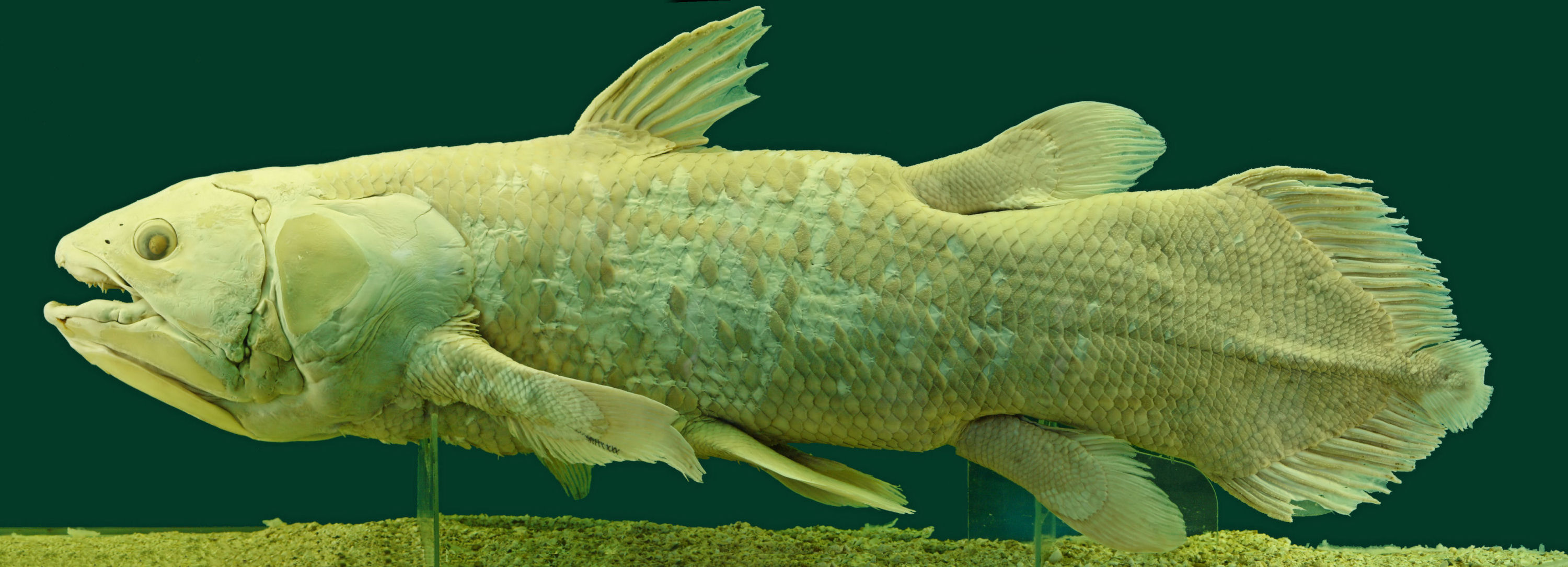
CoelacanthYou know, the strangest thing happened--usually I first delve into the political history of a country. With Madagascar, I realized off the bat the most interesting thing was the natural history of the island--the lemurs, the extinct dodo birds and the coelacanth--the bizarre "Cretaceous" fish that still occasionally washes up around the Comoros. I'm not sure which is the oddest. Scientists still theorize that Madagascar busted away from the mainland a trazillion billion years ago (sorry, once again, not a scientist, but would LOVE to pretend to be one on TV), and as a result you have "strange extinct animals, sprouting a wild assortment of endemic beings found nowhere else: fragile orchids that could only live under glass, coral masquerading as swords and lace, mythical underground caverns where translucent blind fish bumped into rocks, and animals without backbones fell over..."

So, of course, I made my heroine a naturalist, which is what they used to call a botanist and biologist--back then they didn't specialize. She meets the hero while she's climbing onto a branch to collect the rarest of rare orchids...and falls into his pirate lagoon.

John Cleese, of all people, made the best Madagascar video ever, and it's going for like $78 on eBay! I finally obtained a copy, and he saw first-hand how the lemurs adapted to the "spiny forest" environment of Southern Madagascar. These lemurs have this Darwinian ability to leap twenty feet from thorny tree to thorny tree and somehow avoid all of the spikes, and then do some amazing sashaying dances on the ground, and to this day, no one knows how they do it. Well, if John Cleese is amazed, then I'm amazed.

Your books contain a lot of humor. To what do you attribute that?

The Hinterlands by Karen MercuryIt's not something I intended. As a teenager, I realized that most of the scenes I'd written that I wished to read over and over were mostly humorous. Once I realized I wanted to become a "serious" writer, I eviscerated all of the "humorous" scenes from my manuscripts. "None of that allowed in here! This is some serious shit here!" THE HINTERLANDS, my first published book, was the first book where I just allowed the humor to stay in. Apparently everyone liked it.

Humor is inexplicable. I don't consider myself a humorous writer. Sometimes I'll be writing a funeral scene, and in the middle of nowhere, a character will bust out with the most hysterical stuff I've ever seen in my life. (Yes, I am one of those writers who thinks their characters act independently of them). Conversely, I'll be writing a scene where I'm certain comedy might come into the picture, and it turns out like a funeral scene, with Dostoevskian characters busting in making dramatic statements and everyone acting dour.

I have no idea where it comes from. I do believe that humor isn't something Abbott + Costello suddenly invented. There was a lot of humor in history. Just like we didn't suddenly invent sex. Just ask Sir Richard Burton.

I don't purposefully set out to be humorous--I'm afraid that might ruin it, if I purposefully tried. I just let the shit fall where it may. I'd hate to be a stand up comedian who had to be "on" all the time--how on earth do they do that? That must be more stressful than being a historical fiction author.

What books are you reading now?

Not having much time for fiction, I need an entire TBR room (don't we all?). I'm a member of the Historical Novel Society and just attended their conference in New York in June, so I picked up a bunch of great stuff there. I absolutely adored THE SWEET BY AND BY written by Jeanne Mackin. I talk that book up every chance that I get. She wrote about the Fox sisters, who inadvertently started the Victorian Spiritualism movement. Gorgeously written book--just a pleasure to read. I recently speed-ordered SWITCHING TIME, a nonfiction about a shrink who treated a gal with seventeen personalities. Could not put it down.

What's next for you?

I just finished writing a historical erotic paranormal set in Zanzibar in 1876, a time and place I know well. A lot of this alleged comedy came out while I wrote it. As is turns out, this wandering showman who is a marionettist and a puppeteer is the Assistant Consul at the American Embassy there, and when the real Consul shows up, and a bunch of dead bodies appear, the shit hits the fan. It involves the Sultan of Zanzibar, bath houses, levitation, and Spiritualism.

Any advice?

Never try to "write to the market." Stay true to yourself. Your own voice will come through, and allow that to happen. A lot of readers don't like explicit sex. Nothing wrong with that. There's always a market for what you have to say.

***

Thanks for your thoughtful answers, Karen!

You can purchase STRANGELY WONDERFUL online through Amazon, Barnes & Noble, Amazon.co.uk, Amazon.ca, or Books-a-Million.

Ask your own question or leave a comment for the chance to win a copy of STRANGELY WONDERFUL. One random commenter will be chosen this time next week. Check back to see if you've won.

02 November 2007

Weekly Announcements

This is Week 5 of Jacquie Rogers' Great Holiday Contest Fest. Go to her homepage and click on "Contest" to enter. You could win the newly released WARRIOR'S BRIDE by American Title II winner Gerri Russell.

***

Carrie Lofty won the "Through the Garden Gate" historical contest from The Wild Rose Press, in the vintage category (1950s-60s). This time travel short, "SUNDIAL," tells the story of Mark Lacey, a New Yorker from 1987. He's been trapped in 1950s Sorrento, Italy for four years, since he was 16. Thirty-year-old Australian Amber Schulman--daughter of a globe-hopping, thrice-divorced ambassador father--is from 2007. She just arrived in 1958, and they're trying their best to make sense of the crazy mixed-up thing that is time travel, love and life. And then they have The Hot, Hot Sex.

Click here for an excerpt. Updates to come on "Sundial"'s publication.

***

Carrie Lofty's first sale, "Redeeming Will Scarlet," has been retitled WHAT A SCOUNDREL WANTS and will be a Zebra Debut from Kensington in December '08. What are your thoughts on the title?

***

Strangely Wonderful by Karen MercuryKaren Mercury's newest book from Medallion, (The) STRANGELY WONDERFUL (Tale of Count Balashazy), was released on Tuesday--a month ahead of schedule. Eep!

In Madagascar in 1828, a refugee from Jean Lafitte's band has built a pirate colony that he rules through a bitter opium haze until the arrival of an American naturalist and her two eccentric brothers tears his utopian paradise asunder. With the King's death, the psychotic Queen begins a rampage of anti-European persecution.
We'll be featuring Karen and her new historical adventure on Sunday's guest blog. Hope you can make it!

***

Christmas Wedding Wager by Michelle StylesMichelle Styles is a busy, busy lady. Her seasonal release, THE CHRISTMAS WEDDING WAGER has gone on sale at eHarlequin, both print and ebook. Retail sales will begin in December, so look for her release party later this month.

***

Our "Standards of Beauty" month is off to a great start with yesterday's list of 13 historical beauties. Check back all month for exposés on beauty practices from ancient Egypt to the US 1920s, from underwear to the influence of art. Great stuff!

Happy Friday, and have a good weekend! Remember, if you don't get your announcements to me, I can give you your dues! If you have an announcement to make for next week, email Carrie! See you next week...