Showing posts with label history of science. Show all posts

20 July 2016

Beyond Our Stars: The Thirteenth-Century Astronomy Patronized by Alfonso X

Gemini. Spain, thirteenth century. 

It’s something of a tradition to begin or end biographies of Alfonso X, el Sabio, with one historian’s sanctimonious judgment of him: “While he contemplated the heavens and gazed at the stars, he fell on the earth.” I quote it here not to perpetuate misconceptions, but because the wording shows the importance of the astronomy carried out in Alfonso X’s court. In spite of the other fields of inquiry enhanced under the wise king’s patronage, it was the astronomy that fascinated the most people first and longest.

Alfonso’s interest in the movement of the heavens was based, as most of his passions, in pragmatism. In Alfonso’s time, astrology hadn’t been separated from astronomy as a scientific discipline and was even farther from being as discredited as it is today, as many fourteenth- and fifteenth-century medical treatises (some of which refer to Alfonsine works) attest. The king likely believed knowledge of the stars could be an important tool in gaining the upper hand on Earth because of their obvious, albeit mysterious, influence on human character and behavior.

That said, many of the Alfonsine astronomy books are based on what is still considered solid science.
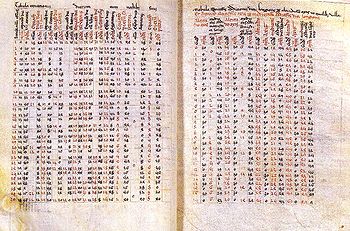
Alfonsine Tables. Spain, thirteenth century. 
The Alfonsine Tables are a set of measurements from about 1272 composed by Isaac ben Sid and Judah ben Moses ha-Cohen that track the positions of the sun, moon, and planets relative to Earth using Ptolemaic calculations. One of the astronomers who worked on the Alfonsine Tables took a copy with him in 1280 to Paris, where scholars adjusted the readings for the Paris meridian, enabling astronomers all over northern Europe to make use of the information for three hundred years. Copies survive today that were used by Copernicus and Galileo. The practical applications of the Tables are what made them popular. They well represented Alfonso X’s yearning for useful knowledge in the wider world.

The Alphonsus moon crater. Wikimedia Commons. 
Composed in the late 1270s, the most extensive book, the Book of Knowledge of Astronomy, also had the largest team behind it. The authors and translators named within the book include Jewish physicians, Muslim lawmen, and Italian and Castilian churchmen. The Book of the Eighth Sphere, which makes up the first part, describes the constellations with their celestial coordinates. The second part describes how to make and use nine different kinds of astronomical instruments, such as the astrolabe and the quadrant. Again, even in this most extensive and encyclopedic work, useful is paramount.

The Book of the Fixed Stars was translated from an Arabic book by Abd al-Rahman al Sufi composed around the year 964. In this book, the Alfonsine collaborators created a powerful combination of Ptolemy’s astronomy, Arabic traditions, and Castilian curiosity. The Andromeda Galaxy and the Large Magellanic Cloud, among other landmark bodies, were introduced to the European scientific community in this translation.

Ursa Major from a 1490 English copy of the Alfonsine Tables
The astronomy works are exemplars of the admirable Alfonsine traits of practicality and encyclopedism. The collaborators translated and compiled information from the best and most reliable sources. The majority draws from documents found in Arabic, with some information coming into Castilian from far-flung languages such as Chaldean. Without the bridge formed by these works, European astronomy might have had to start from scratch.

It’s much harder to see into the heavens if you’re not standing on the shoulders of giants.


Jessica Knauss earned her PhD in medieval Spanish with a dissertation on the portrayal of Alfonso X’s laws in the Cantigas de Santa Maria, which has been published as the five-star-rated Law and Order in Medieval Spain. Look for her book of stories based on the Cantigas, coming 2021. A driven fiction writer, Jessica Knauss has edited many fine historical novels and is a bilingual freelance editor. Her historical epic, Seven Noble Knights, is available from Encircle Publications in ebook, paperback, and hardcover. Her contemporary paranormal Awash in Talent is now available from Kindle Press. Find out more about her writing and bookish activities here. Follow her on Facebook and Twitter, too!


20 April 2016

The Intellectuals: Alfonso X’s Contribution to World Science and Culture


Juan Diego portrays
Alfonso X on the
series Toledo
He has a portrait hanging in the US House of Representatives in the Great Lawgivers series. A moon crater bears his name. His name is on the largest unified collection of annotated medieval music. Why do so many fields of inquiry praise the intellectual efforts of Alfonso X, el Sabio? What mark did he leave on the world to make us think he was so learned?

The short answer: his books.

In the General Estoria, we read: “The King makes a book, not because he writes it with his hands, but because he outlines the facts in it, and edits it and makes it right, and shows the way in which it is to be made… Just as we say that the King makes a palace, we don’t say it because he constructs it with his hands, but because he ordered it to be made…” The Book of the Sphere discusses at length the way King Alfonso worked as general editor. He came up with the idea for the book and what it should contain, and then went through it to take out extraneous parts and correct infelicities.

Alfonso X oversaw these projects to give himself access to the best knowledge in order to learn how rule his country more wisely, and a great additional benefit was that the books were created in Castilian and in Latin. They could then be consumed by Alfonso’s Castilian-reading subjects and Europeans farther afield. A wise populace is the beginning of a wise kingdom, and wise foreign friends make for smooth dealings and further the cause of that wise kingdom.

The collaborators made use of the finest sources available. They accurately cite Aristotle, the early Christian saints including Augustine, and eleventh-century philosophers such as Pedro Alfonso and Aelred of Rievaulx, to give the most basic examples. The scope of the intellectual activity has led to many scholarly volumes. Here’s a list of highlights.

The Alphonsus Crater on the Moon. Wikimedia Commons
Astronomy
• Alfonsine Tables
• Picatrix
Book of Knowledge of Astronomy
Book of the Forms and Images
Book of the Fixed Stars
Book of the Sphere, etc.

Other Science
Lapidario—A book of erudition about types of stones.

Alfonso X in the US House of Representatives
Law
• The Fuero Real—A pragmatic town charter that was granted to new towns in order to begin regularizing the rule of law throughout Alfonso’s kingdoms.
• Espéculo—Elegant and comprehensive legal theory with practical applications as an afterthought.
• Siete Partidas—A great book of medieval thought that also served as the basis of Spanish law for centuries.
• Specialized books of law—The Book of Gambling Houses, the Book of Frontier Commanders, various ordinances, etc.

History/Wisdom
• Book of Calila and Digna—This charming book is the first work of Castilian prose narrative. Based on ancient Indian texts via Arabic sources, two jackals (or lynxes) tell each other fables to illustrate complex and sometimes conflicting points of wisdom.
• Setenario—Often classed with the legal works, this book obsessed with the number seven is an unfinished compendium of the most secret kinds of knowledge and how to apply them.
• History of Spain—Tells the story of the Iberian Peninsula from the end of the Roman Empire to the beginning of the thirteenth century.
• General History—An astoundingly wide-reaching world history from Biblical times.

Music/Religion
• The Cantigas de Santa Maria—The largest collection of written medieval music in the world. More than 400 praise and miracle songs in Galician Portuguese for the Blessed Virgin with fun melodies and gorgeous illustrations. I attempted to describe how wonderful this collection is in this post. I investigate one exciting cantiga in this post.

Alfonso's sculpture at the National Library in
Madrid emphasizes intellect with books and a scroll.
Pastimes because leisure is important for refreshing the intellect.
• Various cantigas de escarnio e mal dizer—Profane, sometimes grotesque, mostly humorous, and at least one moving account of the weariness of a king in failing health (“Non me posso pagar tanto”).
• Libro de ajedrez, dados e tablas—A comprehensive illustrated compendium of chess strategy for the troubled intellectual. Ways to play dice, backgammon, and other games of chance are not as highly regarded.

Much of this body of work had far-reaching impacts in medieval Europe and modern world. The astronomy inspired and informed Copernicus, and the law works influence decisions even today in the American Southwest.

In order to begin my studies of Alfonso X, I had to vastly broaden my fields of expertise in addition to the strictly literary training I’d had up to that time. Perhaps Alfonso X’s greatest wisdom lay in the voracity with which he pursued all intellectual subjects. It seems there was nothing the Wise King wouldn’t want to investigate and read about further.


Simon R. Doubledays’ biography (The Wise King, New York: Basic Books, 2015) seamlessly weaves the trials and tribulations of Alfonso X’s life and times into the writing of the body of work he left behind. He makes a good case that Alfonso X based his intellectuality on the model of polymath Muslim princes. Indeed, the translators and compilers frequently relied on rescued ancient documents in Arabic. Doubleday’s book is an excellent overview of a fascinating king—I learned a few things I didn’t know before. 


My tribute to Alfonso's contribution to world culture, Our Lady's Troubadour, lets you experience the Cantigas de Santa Maria in a fun new way! 

Jessica Knauss earned her PhD in Medieval Spanish with a dissertation on the portrayal of Alfonso X’s laws in the Cantigas de Santa Maria, which has been published as the five-star-rated Law and Order in Medieval Spain. A driven fiction writer, Jessica Knauss has edited many fine historical novels and is a bilingual freelance editor. Her historical novel, Seven Noble Knights, is available from Encircle Publications in ebook, paperback, and hardcover. Find out more her writing and bookish activities here or here. Follow her on Facebook and Twitter, too!

18 April 2010

Guest Author: Cat Lindler

This week on Unusual Historicals we're welcoming Medallion Press author Cat Lindler as she talks about her adventure romance STARLIGHT & PROMISES, set in 1891 Tasmania. How exciting! Here's the blurb:

During a voyage to an uncharted isle in the Furneaux Islands near Tasmania, Lord Richard Colchester finds a living saber-toothed tiger, an animal believed to have been extinct for over ten thousand years. His discovery will astonish the world...that is, if he ever makes it back to England.

When Lady Samantha learns that her Uncle Richard has disappeared under suspicious circumstances, she enlists the help of Professor Christian Badia, a noted zoologist and animal tracker who specializes in wild cats. Not only does she intend to organize the expedition, she plans to join in the treacherous search.

Christian is a hot-tempered man and a notorious recluse, so the last scenario Samantha anticipates is a romantic interlude. But she is drawn unexpectedly into a world of physical passion, and she soon realizes this enigmatic man is her soul mate. When Christian embarks Tasmania abruptly, leaving Samantha behind, she fears she may forever lose her new found love.

Unable to sit idly by and wait for his return, Samantha launches her own investigation—and finds herself in grave danger. Will Christian find her...before it's too late?
***

"Lindler writes in a smooth style, providing evocative descriptions and compelling historical details as well as a satisfying surprise ending." ~ Publisher's Weekly

"The passionate couple and engrossing storyline will stay in your heart for some time" ~ Romantic Times

***

A search for a saber-toothed tiger is a very unusual subject. How did you come up with it?

I'm a zoologist by education, and I've always been fascinated by scientists discovering new species and rediscovering "extinct" species. It seems like every year or so, even large species are being found in poorly explored parts of the world. I thought it to be a perfect quest for a fictional scientist. At first, the animal I chose was the thylacine, the Tasmanian tiger, a marsupial which is thought to have gone extinct in the early Twentieth Century. However, while I was writing this book, thylacines were found in Australia in an undisclosed location. Good for the marsupials, but bad for my plot. So I had to turn to an animal that had no chance whatsoever of being found alive: the Smilodon, the saber-toothed tiger.

Would a scientist of that day have believed that a Smilodon actually existed?

Scientists are the ultimate optimists, and even the remotest possibility that a Smilodon existed would be enough to lure a reluctant scientist out of retirement. We have to look at the state of biological knowledge during the late Victorian and how much of the world scientists had actually explored in detail. Before the modern age, many parts of the world remained unknown and inaccessible. It wasn't quite the "sea monsters be here" days of the Vikings or the "falling off the edge of a flat earth" days of Columbus, but knowledge was limited and selective. Fossils were rare, and means of dating them unreliable. It wasn't until the modern age that we knew the saber-toothed tiger evolved and existed only in the Americas.

What influenced you to set the book in Tasmania? How did you research that area?

I had to think about where a large cat could exist and escape discovery by any means other than accidentally. One area of the world garnered little intense exploration: the thousands of South Sea islands and the wild, dangerous land of Tasmania, for explorers had no hope of finding gold (their primary quarry) or other fabulous wealth--only cannibals, headhunters, and pirates. And exploration was seldom undertaken solely for scientific knowledge. Governments financed expeditions, and they expected a return on their investment.

As for research, I haunt used book stores that stock a large variety of very old books. While on one such trip, I came across a wonderful book, Early Tasmania (1914). At the time, I had no plans to write a book on Tasmania, but I loved the book, which was on the order of a journal and contained amazing hand-drawn maps. I also researched cannibals during that time, flora and fauna, ships, ocean currents, and everything else I needed to know. I use mostly books, for Internet sources can be incorrect, and I also consult the Library of Congress Ask a Librarian service when I have a specific question for which I can't find an answer.

***

Thanks for stopping by, Cat! If you'd like to be entered to win a copy of STARLIGHT & PROMISES, just leave a question or comment for Cat. (I'd like to know why more romances aren't set in colonial Australia and New Zealand, but that may not be something Cat can answer!) I'll draw a winner at random next Sunday. Void where prohibited. Best of luck!

10 May 2007

Historical Medicines

I suffer from migraines, very bad, very life-interrupting ones. I'm on medication, I meditate, exercise, drink lots of tea, actually cut back on my chocolate consumption (let me tell you, no easy feat), have certain scents to help with the pain (lavender), use eye packs in hot and cold for some small amount of help, and I've completely stopped eating rye bread based on one particularly debilitating migraine. (I never did figure out if it was the rye or just a bad day, but would you want to experiment with something like that?) I'm seriously worried about my liver, I take so many pain medications, and I drink enough water to fill the Atlantic at least once a year.

One thing I've never had done, and will fatally maim the first person to try it on me, is trepanation. You know, where they drill a hole in your head!

Celsus (215-300 AD) correctly described typical migraine triggers: "drinking wine, or crudity (dyspepsia), or cold, or heat of fire, or the sun." He forgot to add drops in barometer. Yup, a rainstorm'll get you every time.

Abulcasis (Abu El Quasim) (936-1013 AD)suggested putting a hot iron to the head or inserting garlic into an incision made in the temple. Please see my reactiuon to trepanation.

Ebn Sina (Avicenna) (980-1037) described migraines in his textbook El Qanoon fel Teb as "...small movements, drinking and eating, and sounds provoke the pain...the patient cannot tolerate the sound of speaking and light. He would like to rest in darkness alone." Yes please, this is perfect. Darkness and QUIET!

Abu Bakr Mohamed Ibn Zakariya Râzi (864-930 AD) noted the association of headache with different events in the lives of women, "...And such a headache may be observed after delivery and abortion or during menopause and dysmenorrhea." Er...no.

I take wonderful pain medication for this. Lovely knocks me out so I-can't-feel-a-thing drugs. Thank you modern science!

But medicine then still has a basis in today's world. I drink tea (nasty awful stuff I wouldn't wish on my worst enemny...wait, let me think. Yes, yes I would.) that has ginger, willowbark, and white-something in it. No, not white bark, that's licorice. And herbal Chinese tea that's even nastier. But hey, it works.

What ailemnts have your characters encountered? What did you use to treat them?

A History of Migranes
Avicenna
Al-Razi
Choler
Another Migraine History

05 May 2007

World's Fair 1939

The World's Fair of 1939 was held in Flushing Meadows in northern Queens, New York featured optimism and futurism as its theme.

Westinghouse took on the huge project of collecting items for a time capsule to be retreived 5000 years in the futue! The contents were chosen based upon how well they captured life in America in 1939. Some of these items are still considered essential today albeit more advanced:

Alarm clock
Bifocals
Can opener
Nail file
Keys
Silverware
Toothbrush

A few items in the time capsule I found telling of the early 20th century:

"Pertaining to the Grooming and Vanity of Women"
Woman's hat, style of Autumn, 1938 (designed specially by Lilly Dache)Cosmetic make-up kit (Elizabeth Arden Daytime-Cyclamen ColorHarmony Box, including two miniature boxes of face-powder, lipstick, rouge, eye shadow)
Rhinestone clip (purchased at Woolworth's)

"Pertaining Principally to the Grooming, Vanity or Personal Habits of Men"
Container of tobacco
Electric razor and cord (Remington-Rand Close Shaver with Westinghouse motor, General Shaver Corp.)
Package of cigarettes
Safety razor and blades (Gillette Aristocrat one-piece razor, Gillette Safety Razor Co.)
Smoking pipe (Drinkless Kaywoodie, Kaywoodie Company)
Tobacco pouch, closed with zipper (Alfred Dunhill of London)

One might think all men of 1939 did was shave and smoke!

Among other time capsule items: textiles and materials, an essay in microfilm, a newsreel, money, asbestos, toys, poker chips, seeds sealed in glass tubes, special messages from important men of the time including Albert Einstein.

Another sample of the contents of the capsule:

Our Education and Educational Systems
147.Introduction
148.Education: Encyclopedia Britannica, Vol. 7, pp. 964-1005149.
All The Children: 39th Annual Report of the Superintendent of Schools, New York City, School Year 1936-1937VIII.

Our Sciences and Techniques
150.Introduction
151.Science: Encyclopedia Britannica, Vol. 20, pp. 115-123152.
Scientific Method: Encyclopedia Britannica, Vol. 20, pp. 127-133153.
The Story of Science, by David Dietz: Dodd, Mead: 1938154.
The Smithsonian Physical Tables: Washington: Smithsonian Institution, Publication 3171, 1934155.
Meteorology: Encyclopedia Britannica, Vol. 15, pp. 343-356156.
Mathematics: Encyclopedia Britannica, Vol. 15, pp. 69-89157.
Portraits of Eminent Mathematicians, by David Eugene Smith:New York: Scripta Mathematica, portfolios 1 and 2158.
Telescopes: Encyclopedia Britannica, Vol. 15, pp. 904-909159.
Microscopes: Encyclopedia Britannica, Vol. 15, pp. 433-443IX.

Our Earth, Its Features and Peoples
160.Introduction
161.The World Atlas: New York: Rand McNally
162.Our Races: Introduction
163.The World's Races: Encyclopedia Britannica, Vol. 2, pp. 41-50164.
Explanation of the Fundamental Triangulation Net of the UnitedStates (with map)
165.Methods of Surveying: Coast & Geodetic Survey booklets, Nos.502, 529, 562, 583, Spec. No. 23, Dept of Commerce
166.Geology: Encyclopedia Britannica, Vol. 10, pp. 155-173167.
Exploring Down, by Sherwin F. Kelly, reprint from the Explosives Engineer, Sept.-Oct. 1935168.
The Earth: Chester A. Reeds, New York: The University Press,First Trade Edition 1935X.

Our Medicine
Public Health, Dentistry and Pharmacy
169. Introduction
170.Frontiers of Medicine, by Dr. Morris Fishbein: Baltimore: Williams & Wilkins, June 1933171.
Men of Medicine: The March of Time, Issue No. 11, Vol. IV172.
Work of the United States Public Health Service, Reprint 1447173.
Report of the Surgeon General of the United States, June 30, 1937174.
Dentistry: Encyclopedia Britannica, Vol. 7, pp. 222-225175.1937
Year Book of Dentistry
176.United States Pharmacopeia177.X-Ray and Fluoroscopy: catalogues of the Westinghouse X-Ray Company

For infomation go to
http://www.nytimes.com/specials/magazine3/items.html

27 April 2007

Two Longs, a Short, and a Long

Communications has been a priority since the invention of larynxes. Long-distance communication could be achieved by yodeling, pounding on a drum, or some sort of visual signal.

We've come a long way, baby. So let's talk gadgets.

The firsteffective long-distance communication method was developed by Samuel Morse in ~1835 to 1845. Yep, the telegraph. He used the inventions of William Sturgeon and Joseph Henry to develop the "magnetized magnet," and a year later, developed Morse Code, which made the electrical pulses actually mean something.

Telegraph-History.org has many excellent articles, some of them contemporary. If you want to know how a telegraph works in lay language, try History, Theory, & Construction of the "Electric Telegraph. A good general info site is The History of the Telegraph.

Onward we go. Let's skip telephones for now and go right to teletype. It's a little hard to get to, but an excellent recap of the invention of teletype is The Teletype Story. The teletype machine was invented by several people, instigated by Frank Pearne and developed by Charles L. Krum and a few others. By 1915, a machine could type 30 to 50 words per minute.
Back a few years, the phone's ringing. Is that Alexander Graham Bell calling? Telephone History: The Early Years 1876-1900 tells about the rapid expansion of Bell Telephone (without the help of Bell). Originally, all calls went to a switchboard with teenage boy operators. Because of their rudeness, within a few years they were replaced by women, and there weren't any other male operators until the 1960s.

Using a telephone is second nature to us now, but when it first came out, people were just as technophobic about them as some are about computers now. There were other concerns as well. Henry Yesler, one of Seattle's founding fathers, wanted to know whether or not "one could swear over that thing." Still, telephone systems spread like wildfire. Here's a timeline.

I was in the midst of writing a western set in Silver City, Idaho, a city in such rugged country they couldn't even run a train there. But they did have telephones in the mid-1880s. Messed up my whole scene.

Jumping forward about 50 years, most urban homes had a phones, and phones were becoming more and more common in the rural areas, as well. I grew up in Owyhee County about six miles from Homedale, Idaho, and I remember the party lines. Each family had its own "ring." Ours was two longs, a short, and a long. Anyone could pick up the phone and listen to your conversation. Ah, the joys of a party line!

In 1962, we were introduced to another revolutionary development, the princess phone. This is the forerunner of the small phones we have today. At the time, it was considered miniscule.

And this is my point. Technology has progressed a tremendous amount in the past 150 years, especially in communications. When writing stories from 1850 on, the author has to check for technological advancements as well as availability.

Wow, what an awesome time for those whose lifetimes spanned most of the 20th Century. My grandfather was born in 1901 and died in 1999. During his lifetime, we went from horses to rockets to the moon, from corsets to thongs, from hollering across the field to cellphones. No other generation has seen what his did.

I'm astounded every time I think about it!

Jacquie
myspace layouts, myspace codes, glitter graphics
Jacquie Rogers
2006 PEARL Award Winner, Best Short Story
Keely's blog
Faery Special Romances (May 2007)
Royalties go to Children's Tumor Foundation, ending Neurofibromatosis through Research

01 March 2007

Chemistry and History -- Having Fun Yet?

I am no chemist. I took two semesters of chemistry in high school and did quite well, but with me in a classroom setting, that didn't mean much. Doing well was my intention, not long-term retention.

For my current WIP, set in 1199 AD England, I am having to re-learn and just plain learn quite a bit for my heroine's profession: alchemy. My goal for this MS is to manage all manner of fantastic and explosive happenings, but without any paranormal elements. To have Meg cast spells and be an actual witch (as opposed to "accused of witchcraft," which does take place) just seemed too goofy and ordinary for me, so I hit the books. Any excuse for more research!

My initial goal was to find a legitimate source of information for her. Arab, Indian, and Chinese scholars knew much about all of my "fantastic and explosive happenings," including gunpowder, acids, making fake gold and gems, and medicine. For example, an Arab or possibly Persian scientist named Jabir ibn Hayyan, better known as Geber (c.721-c.815), pictured left, is credited with the first modern scientific inquiry. In addition, he formulated the process to synthesize hydrochloric and nitric acids. Useful and cool. Another scientist, a Persian named Al-Razi (865-925), codified modern distillation techniques and drew from previous works to revolutionize how minerals are classified.

Al-Razi, pictured right, also worked extensively on the transmutation of metals -- turning base metals into precious ones. And Geber believed strongly in takwin -- the creation of artificial life in a laboratory setting. At the heart of their hard science, the goal for most of these great minds remained materialistic. Gold. Everlasting life. Fortune and glory. I like the parallels to today. No scientist can live by altruism and inquiry alone!

However, my difficulty was not pure knowledge, but the proliferation of knowledge. How to get that information to England? Kevin Costner relied on Morgan Freeman's Moorish sidekick in Robin Hood: Prince of Thieves, but what could I manage for Meg? I didn't just want to twang her with more goods than would have been available. I might as well make her a witch.

In my travels through wondrous stacks of library books, I discovered a little-known man named Adelard of Bath (c.1116-c.1142). In his brief life, Adelard traveled to Spain and North Africa where he became fluent in Arabic, studied at Arab universities, and translated seminal works into Latin -- including Euclid's Elements, which had only survived as an Arab translation of the original Greek. Adelard believed the earth is round, theorized that matter cannot be destroyed, and studied atmospheric pressure and the vacuum. To say he was ahead of his time is an understatement.

When he returned to England, Adelard became a tutor to King Henry II. He also corresponded extensively with a nephew in letters that were discovered centuries later and subsequently lost. The identity of the nephew is not a matter of consensus. Most believe he was a lay-scientist, perhaps a man with a keen mind and interest in the subject, but without the means or desire to pursue the subject as extensively as had his uncle.

In the twelfth century, because texts were so rare and difficult to produce, a person who owned a dozen books was rich beyond imagination. Correspondences such as those between Adelard and his nephew would have become a near-sacred heirloom for their progeny, full of questions, theories, translations, and knowledge of practical chemistry.

Ta-dah! A light bulb moment. I had discovered a legitimate means of bringing Arab knowledge of chemistry to England at the time of my WIP. Yes, although far-fetched, I decided to make the mystery nephew my heroine's grandfather.

That's my story. Sticking to it. Next month: how medieval folks blew things up.