By Evangeline Holland
On the heels of the news that costume drama aficionado Keira Knightley was tapped to star in a remake of the 1965 musical, My Fair Lady, I delved back in history, past Audrey Hepburn, Julie Andrews and Wendy Hiller, to the original 'Liza Doolittle--Mrs Patrick Campbell.
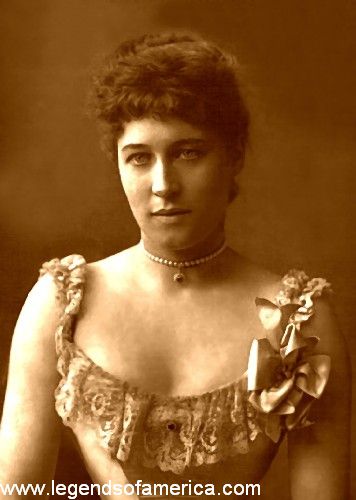
 In fact, George Bernard Shaw wrote the play Pygmalion specifically for the celebrated Anglo-Italian actress, with whom he'd become involved in one of his many romantically platonic affairs. Born Beatrice Stella Tanner to a sensitive Italian mother and an adventurous English father who spent most of Stella's childhood attempting to make his fortune in America, Stella--as she was known to her family--was headstrong, passionate and willful, and determined to fight her way out of the dingy impoverishment of her childhood.
 A shot-gun marriage to the father of her eldest child, Beo, gave her a first taste of independence, though Patrick Campbell was as ill-fated and poor as her father. They produced another child, Stella, before Pat traveled to South Africa to make his fortune. In his absence, Stella began acting for both an outlet and for money, and by 1888 had become a competent enough actress to make a debut at the Adelphi Theatre in London two years later. With her dark beauty, deep-set eyes and tall, statuesque figure, Stella, who chose to act under the name "Mrs Patrick Campbell" fit the mold of the typical heroine of the "problem play," which characterized the theatre of the 1890s.
 The problem play emerged during the 19th century and reached its pinnacle in the last decade of the 19th century, as seen in the witty, urbane plays of Oscar Wilde, and the penetrating realism of Henrik Ibsen. It dealt with social issues through debates between the characters on stage, who typically represent conflicting points of view within a realistic social context. Heroines of problem plays were no longer the typical shrinking violets, many of them adulterous wives, former prostitutes, and disappointed mothers. Mrs Patrick Campbell wowed audiences as Paula Tanqueray, in Pinero's The Second Mrs. Tanqueray, in 1893, and never looked back.
Accordingly, George Bernard Shaw, a fussy, self-educated playwright trapped in a sexless marriage, was bowled over by Stella as well. They engaged in a passionate, teasing correspondence, and Shaw was determined to write a play specifically for her. By the 1910s, Shaw was an established playwright and from this success and his infatuation with Stella, Pygmalion was born. Though written in 1912, the first English production finally opened at His Majesty's Theatre, London on April 11, 1914 and starred Mrs Campbell as Eliza and Sir Herbert Beerbohm Tree as Henry Higgins; it was directed by Shaw himself. The play was a rousing success, though Eliza's use of the word "bloody" was shocking, and could have ruined Stella's career.
 The story of Pygmalion could have ended here, as Shaw forbade any musical adaptation of his works based on his hatred of the musical adaptation of Arms and the Man (1894), entitled The Chocolate Soldier (1908). It was only after his death in 1950, that the Broadway musical My Fair Lady could be produced, which introduced not only the marvelous Julie Andrews, but gave us an iconic performance from Audrey Hepburn (and Rex Harrison), and the Ascot Gavotte musical sequence, where Cecil Beaton nearly outdid himself with the sumptuous black and white costumes.
By Evangeline Holland
In my quest to experience as much of what typical upper-class Edwardians experienced, I enrolled in a fencing class this past spring. The duel is a popular concept in fiction--it was symbolic of honor, masculinity and justice. From the 16th century and even into the 20th, the duel and its sportier sibling, fencing, were held in high esteem. Though dueling was outlawed in many countries by the mid-nineteenth century, in places like Germany, the American South and in France, the Code Duello was the handbook for the settlement of offenses. No turning the other cheek here; an eye for an eye was the style.
The cult of dueling was most prevalent amongst the officers and university students of Germany. One wasn't considered a man unless one had dueled and more importantly, suffered a wound (facial scars the most coveted). So revered was the duel, many German aristocrats opted to pay a doctor or surgeon to slice open his cheek or forehead, or create a wound on another part of the body, to impress both ladies and their contemporaries.
However, no where was the duel more popular than in belle époque France. Nearly everyone dueled: politicians, artists, authors, journalists, etc, and apparently, over 200 were fought annually. In 1870, Édouard Manet challenged the art critic Louis Edmond Duranty after Duranty had written only the briefest of commentary on two works of art that Manet had entered for exhibition.
The frustrated Manet collared Duranty at the Café Guerbois and slapped him. Duranty's demands for an apology were refused and so the men fought a duel with swords in the forest of Saint-Germain three days later on the 23rd. Émile Zola acted as Manet's second and Paul Alexis acted for Duranty. After Duranty received a wound above the right breast the seconds stepped in and declared that honor had been satisfied. The men remained friends despite the encounter.
In 1897, the frail, reclusive Marcel Proust challenged the effete gossip journalist Jean Lorrain to a duel when the latter, under the name "Raitiff de la Bretonne" insinuated that Proust and the young son of Alphonse Daudet were having an affair. For his seconds, Proust chose the painter Jean Beraud, and Gustave de Borda, whose dexterity and finesse in so many duels had earned him the nickname "Sword-Thrust Borda," while Lorrain chose painter Octave Uzanne and the novelist Paul Adam. When a meeting between seconds could not come to an agreement, the duel was arranged to be fought with pistols on Saturday, February 6, in the forest of Meudon, just ouside of Paris. Proust's primary worry was not the bullets, but having to rise, dress and go out in the morning. Thankfully, his seconds were able to arrange an afternoon confrontation. In the end, the pistols were discharged in the general vicinity of one another (though Proust apparently aimed at Lorrain, for the bullet hit the ground next Lorrain's right foot), and honor was satisfied.
The most explosive challenge ever was in 1911: Arria Ly versus Louis Casalé. Ly was an ardent feminist in a time where the movement hadn't taken to Continental Europe as it had Britain and America. She gained extensive controversy in the French national press with the publication of her article "Vive 'Mademoiselle!'" in THE FEMINIST JOURNALIST. In it, she stated:
...that a new class of single, professional women practice permanent sexual abstinence and adopt the title "Mademoiselle" as an exalted expression of the "purity, independence, and pride" attached to the state of virginity. Ly insisted that only by breaking the psycho-sexual chains that bound them to men could women hope to achieve sociopolitical and legal autonomy. Emphasizing the relevance of celibate singleness for the French women's movement, Ly affirmed that "more and more, we will recruit the elite of our adepts and militants from these noble freethinkers, these inspiring rebels" who were not legally "under their husbands' authority" or otherwise restricted by familial obligations.
The response was scathing, Casalé, a writer for the weekly radical-socialist newspaper the Toulouse Reporter, attributing Ly's proposal to her degenerate personality and to an:
...old maid's hatred for the man who never desired her, an anticipated disgust of men due to an overly-exclusive love of women (Lesbos stood in for Cythera many times), a morbid aversion felt by the de-sexed neurotic, cerebral over-excitation due to the abuse of anesthetics, or more simply, the affected attitude of the politicienne.
Ly's challenge was further ridiculed and Casale felt secure enough in his opinion, which was supported by the majority of people who wrote in to the newspaper, to ignore it and continue his abuse of Ly and other "voluntary virgins" who were depicted--naturally--as shriveled, wrinkled old women.
The duel is now generally seen as a romantic gesture, a relic from the Victorian era to be snickered at. But the practice was taken very seriously by all involved and even into the 20th and 21st centuries, the duel is considered a proper--in fact, the only manner for a gentleman-step towards solving insult.
By Evangeline Holland
Lady Randolph Churchill: Though known primarily as the American mother of Sir Winston Churchill, the former Jennie Jerome is too dynamic a personality to be shunted to the footnotes of history as a mere mother. Despite the controversy that rages over her today (Did she neglect Winston? Was she promiscuous? A selfish spendthrift?), Jennie Jerome Spencer-Churchill Cornwallis-West Porch (though she preferred Lady Randolph Churchill) carved a place not only in a foreign society, but in a time where women had little rights if not little place in the public sphere.
Admired by all who met her, many people stated that had Jennie been a man, she could have ruled the world. So keen was she, it was rumored that she drafted many of Lord Randolph's rousing speeches--certainly Randolph did appreciate his wife's intelligence, and when he and other Conservative politicians formed the Primrose League in 1883, Jennie was there beside him, with her own exalted status within the organization. When Randolph died in 1895, her sons had reached their majority and they became closer. It was Jennie who was Winston's right hand as he fought his way to the top of the British Government, her political expertise and background handy for her scrappy, ambitious son. She however, passed away before she could see the fruition of the career Randolph threw away in an impulsive, foolish moment, in the form of Winston's leadership in during WWII and after.
 Lillie Langtry: Born Emilie Charlotte Le Breton on the isle of Jersey, Lillie Langtry was both calculating and warm-hearted. Aware of her beauty and what she desired in life, her first step to achieving success in society was to marry the first man who ferried his way into her life on his yacht. Unfortunately Edward Langtry was an alcoholic who'd mortgaged his property to the hilt to fund his yachting. Lillie however, made lemonade out of lemons and if marriage couldn't achieve her wants, her beauty would, and it did, for her first foray into society created a furor, the artists dining with her nearly expiring over her beauty and a chance to paint it.
From there, Lillie went from strength to strength, culminating in a four year affair with the Prince of Wales. After their passion cooled, Lillie used her fame and beauty to launch a successful acting career which took her throughout Britain and America. With Edward's death in 1897 and a newly discovered talent for horse-racing, Lady de Bathe (for she had married a much younger baronet), Lillie became a leading owner in the horse-racing world before retiring with her husband, quite wealthy, to Monaco.
 Daisy, Countess of Warwick: She was rich, she was scandalous and she was indiscreet. She also had the notoriety of being the Prince of Wales' mistress throughout most of the 1890s. Having inherited an estate worth 30,000 pounds a year, the beautiful Daisy Maynard was so eligible a parti, Queen Victoria had hopes for a match made between she and her son Prince Leopold.
Daisy settled for something a little less stressful, marrying her darling "Brookie," in 1881. Within a few years, Daisy's predilection for acquiring what she called "admirers" in her memoirs had taken its toll on their marriage and she and Lord Brooke went their own way, as most couples did in this period. Fortunately for her, her next admirer happened to be the Prince of Wales. With a hearty dislike of boredom, Daisy's wealth and high spirits were a perfect match. So great a match that in 1914, Daisy's ruined financial status lead her to attempt to blackmail the Crown with love letters written to her by King Edward. More so than her liaison with Bertie, it was her conversion to Socialism that earned her infamy. With her heart in the right place, Daisy founded schools for girls to learn needlework or other handy crafts, and a store where the items were sold. This earned her much scorn from her own social class, sneered behind her back as "Red Countess." She plowed on, however recklessly, tirelessly fighting for socialism and the Labour Party til her death.
 Mrs. Patrick Campbell: She was difficult, mercurial and vain. But she was one of the finest actresses of the period, if not the history of British theatre. Born Beatrice Stella Tanner to an English father and an Italian mother, Stella was born for theatrics. Her father a natural schemer, moved to America early in her life hoping to strike it rich. He never did, and it was this memory of poverty, and the absence of her husband, he himself in South Africa trying to strike it rich, that enticed her to enter the stage.
By the 1890s, the theatre had become respectable, as did actors and actresses. It was this time when the domination of sappy plays and Shakespeare was shaken by the "problem play." Writers like Pinero, Galsworthy, Shaw, Ibsen, Wilde, etc put on plays that probed the mores of society and highlighted hypocrisies. It was in one of these plays that Stella, known professionally as Mrs. Patrick Campbell (for it was more respectable than plain "Stella Campbell"), became a star. Pinero's The Second Mrs. Tanqueray was shown in 1893 and it was an instant hit with the crowd, the lead actress with her ghostly pallor, deep-set black eyes and lustrous hair, and most of all, marvelous voice, moved the crowd so, it became one of the most successful dramatic works of its day.
 Margot Asquith: She shocked society with her indiscreet memoirs and an apocryphal but typical story has her meeting the American film actress Jean Harlow and correcting Harlow's mispronunciation of her first name — "No, no; the 't' is silent, as in 'Harlow'." When Margot Tennant made her debut into 1880s society, she was no ordinary debutante. Due to her mother's vagueness and her father's social-climbing, she and her siblings were allowed great freedom to mingle with gentlemen and form opinions (and even speak on them) long before the age of 18.
Spurred by her intellectual pursuits, Margot wasn't content with the endless round of parties, balls, and house parties and formed a group of like-minded aristocrats known as the "Souls." But it was her marriage to Liberal politician Henry Herbert Asquith that changed her life. She was his "spur to ambition," using her wit and drive to pull him into the Premiership--a goal realized in 1908. Unlike her predecessors, Margot didn't intend her new position to slow her down. Margot's independence and ready tongue got her into a bit of trouble, as the time when she hosted a show of Paul Poiret's modish gowns at No. 10 Downing Street!
 Nancy Astor: That an American woman would be the first female MP to take a seat in the Commons is slightly ironic. Though, those who knew Nancy personally wouldn't have found it unbelievable. A Langhorne of Virginia, she and her sisters were renowned for their beauty and this, combined with the recently-restored family wealth boded well for a meteoric rise. Divorcing her first miserable husband, Nancy went overseas, as did all wealthy Americans, and quickly conquered society with her saucy wit and restrained behavior. Soon after her entrenchment in British society, she married Waldorf Astor, the son of expatriate William Waldorf Astor (yes, those Astors) and began life as an elite hostess.
When her husband succeeded to his father's title in 1919 and moved to the House of Lords, Nancy took up the cudgel for the constituency and campaigned for her own election. This was a bold move as at no time had a woman taken public part in politics--and with her own platform. Though women had greater freedom, they were seen as too ignorant and led by emotion to exact justice. Nancy proved them wrong. In her day, she was either loathed or loved, and personal accounts written by those close show her to be a demanding, prejudiced and arrogant woman. In spite of these defects, or rather because of them perhaps, Nancy Astor did what she wanted to do without any thought to her sex.
 Mrs. Pankhurst: Widowed at 40, Emmeline continued the work she and her husband accomplished by continuing her involvement in politics. Disillusioned by the existing women's political organizations,in 1903 she founded the Women's Social and Political Union (WSPU). This changed the face of women's suffrage, for the traditional background of a suffragist was upper-middle class, professional ladies from comfortable backgrounds. From the first Emmeline the main aim of the organization was to recruit working class women into the struggle for the vote.
But it was in 1905 the break between the old guard (NUWSS) and the new guard (WSPU) ruptured: this was the rise of militancy. Pankhurst's tactics for drawing attention to the movement led to her being imprisoned 13 times between 1908 and 1914. Her daughters Sylvia and Christabel became prominent leaders in the movement, Christabel seeking temporary refuge in Paris to escape imprisonment under the terms of the Cat and Mouse Act. Hated by outsiders, Mrs. Pankhurst's ideals and actions created controversy within the WSPU, creating splits that included one from Sylvia. Her militancy did pay off, as women over 21 received the vote in 1918, and all women were enfranchised in 1928.
By Evangeline Holland
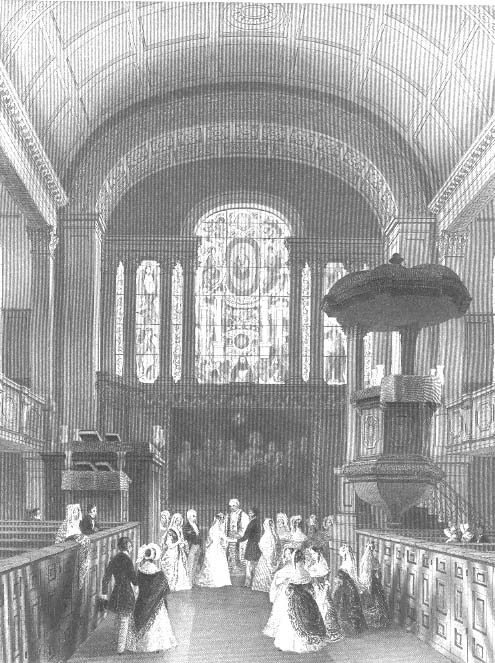
Religion played its part in the conventional role in the ceremonies for passage rites in all groups, for birth, confirmation, marriage, and death. Though the upper classes felt it their duty to lead the masses in an outward show of piety, by the Edwardian era, religion played a smaller role in the life of society.  However, in London, the Sunday morning church parade in Hyde Park was a social event not to be missed, and the upper classes would expect their servants to attend morning prayers, neatly-attired and somber as they marched to chapel--albeit early enough to return and attend to the toilettes and meals of the just-awakening family. But newer habits began to pervade all stratus of society, and week-ends began to eat into church-going habits, and the Anglican churches especially found it difficult to recruit clergymen.
 For the Edwardian, there were three religious paths open to her or him: Roman Catholicism, Anglicanism, and Chapel (or the conglomerate of Non-conformist sects). Roman Catholicism did cause a little flutter of horror in the breasts of die-hard Anglicans, but the Catholic sect in English aristocracy did create its own niche, particularly as the highest position in the land (Earl Marshal) had been held by the Catholic Dukes of Norfolk since the 14th century.
Chapel found favor with middle- and lower-middle class society, whilst the Church of England could be divided between High Church and Low Church. Those belonging to High Church were conservative, more aristocratic and had a great fondness for ritual, while those inclined towards Low Church, preferred worship be simpler and to touch the heart.
 As church was another social event where one would see and be seen, aristocratic society had its places marked for fashion. In London, favored churches were St George's in Hanover Square, St Paul's in the upper-middle-class neighborhood of Knightsbridge, Holy Trinity in Sloane Street, and St Peter's in Eaton Street. Woe betide anyone who wasn't sitting in their family pew on Sunday in an ultra-fashionable church!
 In fact, George Bernard Shaw wrote the play Pygmalion specifically for the celebrated Anglo-Italian actress, with whom he'd become involved in one of his many romantically platonic affairs. Born Beatrice Stella Tanner to a sensitive Italian mother and an adventurous English father who spent most of Stella's childhood attempting to make his fortune in America, Stella--as she was known to her family--was headstrong, passionate and willful, and determined to fight her way out of the dingy impoverishment of her childhood.
 A shot-gun marriage to the father of her eldest child, Beo, gave her a first taste of independence, though Patrick Campbell was as ill-fated and poor as her father. They produced another child, Stella, before Pat traveled to South Africa to make his fortune. In his absence, Stella began acting for both an outlet and for money, and by 1888 had become a competent enough actress to make a debut at the Adelphi Theatre in London two years later. With her dark beauty, deep-set eyes and tall, statuesque figure, Stella, who chose to act under the name "Mrs Patrick Campbell" fit the mold of the typical heroine of the "problem play," which characterized the theatre of the 1890s.
 The problem play emerged during the 19th century and reached its pinnacle in the last decade of the 19th century, as seen in the witty, urbane plays of Oscar Wilde, and the penetrating realism of Henrik Ibsen. It dealt with social issues through debates between the characters on stage, who typically represent conflicting points of view within a realistic social context. Heroines of problem plays were no longer the typical shrinking violets, many of them adulterous wives, former prostitutes, and disappointed mothers. Mrs Patrick Campbell wowed audiences as Paula Tanqueray, in Pinero's The Second Mrs. Tanqueray, in 1893, and never looked back.
 The story of Pygmalion could have ended here, as Shaw forbade any musical adaptation of his works based on his hatred of the musical adaptation of Arms and the Man (1894), entitled The Chocolate Soldier (1908). It was only after his death in 1950, that the Broadway musical My Fair Lady could be produced, which introduced not only the marvelous Julie Andrews, but gave us an iconic performance from Audrey Hepburn (and Rex Harrison), and the Ascot Gavotte musical sequence, where Cecil Beaton nearly outdid himself with the sumptuous black and white costumes.