 By Erastes
Absinthe is notorious--a drink with a scandalous reputation. Beloved of the artists of La Belle Epoque in the late 1800s and early 1900s, it has turned men mad.  Absinthe is the French word for wormwood, which together with Florence fennel and green anise, make the drink unique. It is the tiny amount of thujone, found in wormword, which causes its alleged hallucinogenic effects.
If Absinthe were a woman, it would be one of those tattered, slightly too-old-for-the-business French demi-monde escorts, with the straps of her dress falling around her arms. It was invented in Switzerland in 1797 by Dr. Pierre Ordinaire. Monsieur Pernod, better known these days for...well, Pernod, started to distill absinthe in bulk, opening a factory in France in 1805.

But why did the bohemians make it their favourite tipple?
It originally had a wine base and was an expensive purchase, and although the upper class had already adopted it, that's where it stopped. But around the 1870's things changed. There was a grape blight. There simply wasn't wine available, and it forced the makers of absinthe to base it with grain alcohol. This made it cheap and the bohemians hoovered it up. By 1910, they were drinking over 30 million litres a year, compared to 5 million litres of wine!
Absinthe divided society. The artistic types loved it, and the conservatives sought to ban it. Devotees numbered such famous names such as Charles Baudelaire, Paul Verlaine, Arthur Rimbaud, Vincent van Gogh, Oscar Wilde, and Aleister Crowley. It was probably the notoriety of these bad boys of the artistic crowd, rather than the drink itself that caused people to hate it.

By 1915 it was banned in many countries, including the United States.
But it's back. Countries around the world are legalising it again, so you might find a green fairy at your table one day soon.
Absinthe Buyers Guide

By Jennifer Linforth
As many bloggers know I cannot edit without vast amounts of strawberry Quik in my system. When I knuckle down and write, however, my heart belongs to my amber love... cognac.
If you can imagine a brandy so exquisite it demanded its own name--then you have sipped cognac. Crafted in the Cognac region of France, its history is as rich as its bouquet. Courvoisier is the imperial crown of cognacs, created by Emmanuel Courvoisier and Louis Gallois. After Napoleon Bonaparte visited their facility in 1811 and he rewarded his troops with this eau de vie a new era in cognac was born. Proclaimed by British soldiers as the Cognac of Napoleon after a legend that had him shipping several hundreds of bottles of Courvoisier to himself after the 1815 defeat at Waterloo; it is still referred to as such today.
 Chateau de Jarnac is home to the Courvoisier legacy nestled deep in the Cognac region of France. Recognized as the finest cognac in the world, Chateau de Jarnac now was tasked with the title of "Official Supplier to the Imperial Court" by the order of Napoleon's nephew, Napoleon III. This locked in Courvoisier's position as the superior cognac in the world and spread to become the choice of royal courts across Europe.
Cognac is a brandy, but not all brandy is cognac. French law has strict regulations on its darling creation. It must be produced entirely in the cognac region and adhere distillation and aging requirements. The Simon family took over the reins of Courvoisier in 1909 and crafted the classic logo of Napoleon's silhouette which adorns every bottle to this day.
Unusual Historicals is delighted to welcome regular contributor Michelle Styles back to talk about her latest Mills & Boon historical, IMPOVERISHED MISS, CONVENIENT WIFE.
***

His unexpected bride...
Wealthy landowner Simon Clare shuns Northumbrian society. With his son gravely ill, the last thing Simon needs is an interfering woman assuming command of his household and nursing young Robert--no matter how sensuous her figure, or how tempting her luscious lips.
Phoebe Benedict knows what it is to struggle, and finds herself drawn to the badly scarred recluse. Despite his tough exterior, she knows that Simon is a father who yearns for his son to recover--and a man who misses the tender embrace of a woman...
***
Welcome back Michelle and what is this book about?
This book is the second part of my Regency duo and is set in 1814 Northumberland. It is the story of Simon Clare whom readers might have met in A Question of Impropriety. The book can be read as a stand alone, but the two books are linked. Basically the only way I could get Simon Clare to be silent in A Question of Impropriety was to promise him his own story!
Thus far the reaction has been positive. Pearl from Realms on Our Bookshelves gave Impoverished Miss, Convenient Wife 4 stars and wrote: Michelle Styles writes Regency romance as it is meant to be: moving, fitting the time-period in historical details, plotlines and emotional conflict. I was enthralled by her writing style that reads easily but is far from boring. A style that's supported by a solid historical background sending you back to the time she writes about and her descriptions are complementary rather than disrupting and further adding to the genuine sympathy provoked by the characters and their story.
You have a reputation for writing Unusual Historical, so why are you writing a Regency?
It is set in the Northeast of England and features a self-made man as the hero, dealing with the development of the locomotive. So in many ways, it is not a typical Regency. I like stories that take place in a wide variety of settings. I have always been interested in the Industrial Revolution and why Great Britain became such a leader. Thus, I jumped at the chance to explore the world further.
Rather than concentrating on the ton, I have been able to explore society in the Northeast. At that time, the Northeast of England was one of the more vibrant places where fortunes were made and lost. Also there seems to be this notion that somehow industrialisation only happens after Queen Victoria takes the throne. Industrialisation and the rise of consumerism, plus the pressures from the Peninsula War, are what drove the Regency and why it was such a time of change.
Will there be any more Vikings?
Yes, the third Viking will come out in the US in December 09. It has not been titled yet and I do not have a UK release date. This is Ivar's story and deals with the border between Norway and Sweden.
Do you know if any more of your Romans will be released in the US?
My editors and I have discussed this. The remaining Romans (A Noble Captive and Sold and Seduced) will be going in the Direct Programme. So they will be available in e-book format and through e-harlequin, rather than going into North American retail. This is for a variety of technical reasons, but my editors are keen to get the books out into the North American marketplace. I think this will be happening in early 2010.
What is next for you?
I have just signed a four book contract and am working on the third book. This is a linked book to my 1837 governess book. Then I am doing a trilogy which is going to be set in late Regency/early Victorian times.
Oh, I am taking part in the Hexham Literary Festival on 2 May 2009 and the Middlesborough Library "Girls Night In" on 25 June. At both venues, I am giving a talk on the challenges and pleasures of writing romance in the 21st century.
It sounds like you are going to be busy!
I hope so. I enjoy writing and creating my worlds. I only hope that readers enjoy my writing as well!
***
Thank you for being here, Michelle and best of luck for the future.
Michelle is giving away a copy of Impoverished Miss, Convenient Wife to one lucky poster. So please leave a comment. Michelle would like to know what you think about e-books and are you starting to buy more of your books as e-books?
 Carrie Lofty is hosting a spring contest, so hop on over to her website for the chance to win a $25 gift certificate to either B&N or Amazon. Contest ends March 31.
***
Michelle Styles has learned that her untitled third Viking book will be a Dec 2009 release in the US. Also, she'll be appearing as part of the Mills & Boon panel at the Hexham Book Festival on 2 May.
***
Unusual Historicals would like to offer our hearty congratulations to Kimberly Killion and Anthea Lawson for their "Best First Book" nominations in the 2009 RITA contest sponsored by Romance Writers of America. They were guests of ours in 2008, Kimberley for HER ONE DESIRE and Anthea for PASSIONATE, both of which are Zebra Debut releases from Kensington. You can read their interviews here (Kim) and here (Anthea). Congratulations and best of luck! Three cheers for unusual historicals!
***
 Join us Sunday when veteran Harlequin Mills & Boon author and long-time contributor Michelle Styles will be here to talk about her latest release, IMPOVERISHED MISS, CONVENIENT WIFE, which comes out April 3rd in the UK. Don't miss it!
***
We'll also draw the winner of Bonnie Vanak's THE SCORPION AND THE SEDUCER. There's still time to leave a comment for your shot at winning!
***
Have a good weekend! If you have an announcement to make for next week, email Carrie. See you next week...

Thursdays mean excerpts on Unusual Historicals, and this one come to us from contributor Michelle Styles from her April 3rd release, Impoverished Miss, Convenient Wife. We'll be featuring Michelle as our guest author on Sunday, so be sure to check back for your chance to win a copy!
In this scene, Phoebe Benedict has arrived at Ladywell to look after the ill son of Simon Clare, a wealthy Northumbrian landowner, but things are not as she first thinks.
***
A soft noise woke Phoebe from where she slumbered on a narrow cot. It took a few moments to work out where she was. She forced her muscles to relax as she realized that it was not Atherstone Court and she would not have to see her sister-in-law today.
She listened again, hoping against hope that Robert was not about to experience another fit. The noise appeared to have stopped. She nodded and forced her breathing to come easy.
She was safe here. No men would come knocking at the door, demanding money for unpaid bills, no step-mother would look at her with injured eyes when she suggested economies. No sister-in-law to roll her eyes when Phoebe suggested starting a dressmaking or millinery shop, rather than sinking slowly into the mire of impoverished gentry.
Here, she was giving James a chance. He had not asked for Father to go walking on the frozen Thames. He had not been the one to refuse to join him on that stroll, preferring to stay at home and trim a bonnet. She knew who bore that guilt. And he had not caused Charles to take the corner too fast and overturn his carriage on his way to mediate a dispute between her and Alice. She trusted that Lord Coltonby would do as he promised. Then there would only be Edmund to worry about. She hoped all of them understood the sacrifices she was making and why. Far too often they seemed to take her feelings for granted. Phoebe pushed away the thought. They were the only family she had and belonging to a family was important. She would keep her mind only on the good things, the way forward.
She'd concentrate on the little boy and his unfeeling parent. Imagine having your only child look after by a creature like that and in such conditions. It was not as if they lacked money. The whole house screamed money, but it lacked love and tenderness. It lacked a heart.
The noise sounded again. It appeared to be half way between a sob and a wail. Phoebe's hear sank. She did not want to think about confronting Mr Clare at this hour and explaining why after all her brave words, she had been unable to cope.
She wondered if Mr Clare had been true to his word. Robert could be alone in there or with someone as unfeeling as that miserable maid. She refused to let that happen.
The boy needed help.
In the moonlight, Phoebe fumbled for her shawl and wrapped it around her body. She lit a candle and held it aloft as she tiptoed over to the door that separated her from Robert. She opened the door slightly but kept to the shadows.
Robert appeared to be asleep but a figure knelt at the side of the bed, head bowed and arms stretched out on the coverlet.
She raised the candle light higher, trying to discern who was there. The too long hair and finely moulded shoulders could only belong to one man. Simon Clare. For confirmation, she spied the cane lying by the side of the bed. She started to tiptoe out when she heard a hoarse whisper.
'Let me take his place. Please...I will do anything. Punish me, not him.'
Phoebe put her hand to her mouth. She had inadvertently intruded on this man's grief. How she could have thought him uncaring? A sudden fear gripped her. 'Is everything all right, Mr Clare? Is Robert...?'
At the sound of her voice, the groans ceased. He lifted his head. His white shirt was open at his throat, revealing his golden skin. In the darkness, his face had become all shadows and planes but she could clearly see how handsome he was. He was no monster but the personification of masculinity.
'Robert is asleep. All is well, Miss Benedict.' His voice held a singular raw note.
'That is good to hear. I...I heard a noise.'
'I regret having disturbed you.'
'You...that is...I am light sleeper. Years of practice with my step-brothers, I am afraid.' She gave small shrug and felt the shawl started to slip off her shoulder. Her hand clutched it tighter about her.
'You looked after them.'
Phoebe wet her lips. 'Someone had to. My step-mother was not precisely maternal and the maids unreliable, even before my father died.'
'How good it is that someone cared.'
He stood up, filled the room. His gaze slowly travelled down her body, then back up to her face. She clung on to the thin shawl, aware suddenly she was dressed only in her nightgown; her hair flowed over her shoulders and her bare toes peeped out. Hurriedly she smoothed her gown, and covered her feet. She wished that she had thought to wear a cap. Her hand shook slightly, causing the wax to drip on her wrist. She stifled a cry.
'You should be more careful, Miss Benedict. Wax burns.'
Copyright 2009 Michelle Styles and Harlequin Enterprises
 By Elizabeth Lane
In history, literature and movies, the name Delmonico's has been synonymous with elegance, class, fine wines and decadent gourmet dining. Here, briefly, is the story behind that famous name.
Delmonico's Restaurant was one of the first continuously run restaurants in the United States and is considered to be one of the first American fine dining establishments. It opened in New York City in 1827, originally in a rented pastry shop at 23 William Street. It was first listed as a restaurant in 1830. Unlike the inns that existed at the time, a restaurant like Delmonico's would permit patrons to order from a menu (à la carte), rather than requiring its patrons to eat fixed meals. Later, Delmonico's was also the first in the United States to use a separate wine list.
 The restaurant was opened by the brothers John and Peter Delmonico, from Ticino, Switzerland. In 1831, they were joined by their nephew, Lorenzo Delmonico, who eventually became responsible for the restaurant's wine list and menu. In 1862, the restaurant hired Charles Ranhofer, considered one of the greatest chefs of his day. Beginning in the 1850s, the restaurant hosted the annual gathering of the New England Society of New York which featured many important speakers of the day. In 1860, Delmonico's provided the supper at the Grand Ball welcoming the Prince of Wales. Supper was set out in a specially constructed room; the menu was French, and the pièces montées represented Queen Victoria and Prince Albert, the Great Eastern and Flora's Vase. The New York Times reported, "We may frankly say that we have never seen a public supper served in a more inapproachable fashion, with greater discretion, or upon a more luxurious scale."
Famous patrons included Jenny Lind (who, it was said, ate there after every show), Theodore Roosevelt, Mark Twain, "Diamond Jim" Brady, Lillian Russell (usually in the company of Diamond Jim), Charles Dickens, Oscar Wilde, J.P. Morgan, James Gordon Bennett, Jr., Walter Scott, Nikola Tesla, Edward VII (then the Prince of Wales), and Napoleon III of France.
 The restaurant was so successful that it soon expanded to four New York locations and eventually to other major cities. A scene from my April Harlequin Historical, HIS SUBSTITUTE BRIDE, takes place in the San Francisco Delmonico's. That restaurant initially survived the disastrous 1906 earthquake and fire, but during the military occupation that followed, some celebrating soldiers, feasting on leftover food and wine, accidentally set the place on fire and burned it down.
Eventually the restaurant fell on hard times. In 1923 Delmonico's closed its doors for good and lost the exclusive rights to its name. No restaurant named Delmonico's today is connected to the original.
Some of the dishes first served at Delmonico's are still famous today. Lobster Newberg and Delmonico Potatoes were invented at Delmonico's restaurant, and possibly Chicken à la King, but it was most famous for Delmonico steak. Eggs Benedict were also said to have originated at Delmonico's; although, others claim that dish as well.
 A chef named Alessandro Filippini incorporated many of the original recipes into a cookbook. Here's one recipe you probably won't want to try.
Delmonico's Recipes from a "Gilded Age"
An 1894 Thanksgiving Terrapin, a la Gastronome
From The Table, by Alessandro Filippini
Take live terrapin, and blanch them in boiling water for two minutes. Remove the skin from the feet, and put them back to cook with some salt in the saucepan until they feel soft to the touch: then put them aside to cool. Remove the carcass, cut it in medium-sized pieces, removing the entrails, being careful not to break the gall-bag.
Put the pieces in a small saucepan, adding two teaspoonfuls of pepper, a little nutmeg, according to the quantity, a tablespoonful of salt, and a glassful of Madeira wine. Cook for five minutes, and put it away in the ice-box for further use. Put in a saucepan one pint of Espagnole sauce and half a pint of consommé. Add a good bouquet, one tablespoonful of Parisian sauce, a very little red pepper, the same of nutmeg, and half a glassful of Madeira wine. Boil for twenty minutes, being careful to remove the fat, if any; add half a pint of terrapin and boil for ten minutes longer. Then serve with six slices of lemon, always removing the bouquet.
By Delia DeLeest
Mother's in the kitchen
Washing out the jugs;
Sister's in the pantry
Bottling the suds;
Father's in the cellar
Mixing up the hops;
Johnny's on the front porch
Watching for the cops.
(Mendelson and Mello, 1985, p. 86)
Not everyone during Prohibition was able or even wanted to go to a speakeasy to obtain their hit of liquor. Some preferred to do their drinking at home, and if they didn't have access to their friendly, neighborhood bootlegger, they made their own.
There were a couple ways to do this. My favorite was the company who manufactured a juice called Vine-Glo and put this warning label on their bottle:
"Warning: do not store a full bottle of this product in a cool, dark place for 60-80 days or it will ferment and become alcohol."
Nope, we wouldn't want that to happen, would we? They got a little more daring as time went on and soon were making claims "the product would come up to the standard of any pre-War wine," taking advantage of a loophole in the law that although you couldn't buy, sell or transport alcoholic beverages, you could make them. That line would become Vine-Glo's downfall, however, and the courts, sick of ambiguities, forced Vine-Glo's parent company, Fruit Industries, to take it off the market. Donald D. Conn, Managing Director for Fruit Industries responded that the company would no longer sell Vine-Glo and the company's other concentrates--Virginia Dare, Wine-Haven, Guasti--would be sold as soft drinks only. "If anyone still wants to let Virginia Dare, Wine-Haven or Guasti sit 60 days and ferment like Vine-Glo into wine, Fruit Industries will not and does not want to know anything about it." Sounds like he learned HIS lesson, didn't he? (Time Magazine, 1931)
If you were more of a do it yourselfer, there were other options open. You could always make Bathtub Gin. I've read conflicting information regarding bathtub gin. Some say that it was so-called because the ingredients needed to be mixed and steeped in a large tub and the bootleggers bathtub fit the bill--though I wouldn't want to stand downwind of the guy after he'd been using his bathtub for brewing purposes only for any length of time. Another report said that it wasn't made in a bathtub at all, but, because the long-necked bottles used for storage were too tall to fit under the kitchen tap, thus they got the water they needed from the bathtub.
As long as you mixed, brewed and drank your concoctions at home, you were okay. But the minute you tried to sell or transport them, you suddenly found yourself on the wrong side of the law, though it was a law that many scoffed at. I think old Mrs. Jeske said it best when my husband, who, when he was painting her house, found an old copper still up in her attic. With a little blush and a giggle, she said, "Well, you know, times were hard in those days, and you did what you could to make money."

By Jean Adams
If there was one thing the ancient Egyptians loved, it was a good party. In fact almost every day of the year was dedicated to one religious festival or another, although I doubt many of them were an excuse for a good knees-up.
One interesting fact I discovered was that their equivalent of December 25 was celebrated as the birth of Horus, the holy child. Hmm. Interesting.
Food was plentiful especially a vast amount of grains, fish, vegetables, and fruits. They enjoyed beef and other red meats very much, but the common people could not afford them. The arid land made it very hard to raise grazing animals, so beef was expensive and eaten only at special banquets. The primary food of their diet was grain, because it could be used for many purposes.
Grains offered an endless supply of food and could be stored with little spoiling. The grain was taken and stored in local community granaries and could be used for making bread, pastries, and cakes, a favourite being honey cakes. The breads would be flavoured by adding honey, fruits, nuts, and oils to the dough before baking.
Fruits and vegetables were also a major part of the diet. Vegetables included leeks, onions, garlic, cucumbers, lettuce, cabbage, and radishes. Onions and garlic were a major part of their diet because they believed they were especially good for the health. Cabbage was considered a delicacy, boiled and eaten before the rest of the meal. Green vegetables were often served with an oil and vinegar dressing to enhance the flavour. Few fruits could be grown in Egypt because of the hot, arid climate, but the most popular grown were grapes, figs, pomegranates, melons, and dates. Olives which could not be grown, were imported for oil.
Fish, like grain, was a part of most Egyptian's daily diet, although eating fish was shunned by some of the upper class Egyptians. Fish was served boiled, fried, roasted, or dried.
Meat was eaten by the common people only on special occasions, because of the high price and scarcity of cattle, although the rich could have it at every meal. These included beef, pork, geese, duck, various birds, sheep, and goats.
Honey was a great addition to the Egyptian diet, used for many applications. It would be added to different breads and cakes to enhance their sweetness.
Beer was the preferred drink of humans and gods, of rich and poor, of grown-ups and children.
"The mouth of a perfectly contented man is filled with beer." -- Inscription dating to 2200 BC
Water along the Nile was rarely in short supply, though its quality was often poor. While the river was not used as a sewer, human excrement did enter it and with it pathogenic agents. This, of course, was unknown to the ancient Egyptians, who thought of disease as the result of daemonic activity; but people, aware of unseen dangers lurking in water--in the hereafter at least--prayed to the gods.
Milk, considered a delicacy by many, was kept in egg-shaped earthenware jars plugged with grass as protection against insects and was drunk shortly after milking. It is often assumed that milk not destined for immediate consumption was processed into something similar to yogurt.
Wine was known to the Egyptians before 3000 BC. On festive occasions, such as the yearly Hathor Celebrations at Bubastis, Hathor being the goddess of love, joy and drunkenness, wine was drunk by everyone, as seen here.


We have a winner for Anna C. Bowling's ORPHANS IN THE STORM guest blog. She's giving away a copy to:
RachieG!
Contact Anna to give her your address. The book must be claimed by next Sunday or another winner will be drawn. Please stop back later to let us know what you thought! Congratulations!
Today, our fantastic author is long-time contributor Bonnie Vanak, known for her Egyptian-set historicals published by Dorchester, her sexy werewolf series from Harlequin Nocturne, and her globe-trotting efforts to help the world's poorest citizens. She's a busy lady and took time out this week to talk about her latest release, THE LADY AND THE LIBERTINE.
***

NOBLE IN ALL BUT NAME
Anne Mitchell, born illegitimate and raised in a workhouse, sold by her mother and packed off by her father to the East, had every reason to lose faith. But in Egypt she found identity with the Khamsin, a tribe of Bedouin warriors. Greater even than the secret they entrusted to her was her newfound honor, and for that she would give all.
NOBLE IN ALL BUT ACTION
Nigel Wallenford was an earl. He was also a thief, a liar and a libertine. Regaining his birthright of Claradon had been a start. Next he required wealth, and he knew of just the fabled treasure...and its key's guardian was a ripe fig waiting to be plucked. Never before had he scrupled to cheat, steal or even murder. One displaced Englishwoman, no matter how fair, would hardly be his match.
***
THE LADY AND THE LIBERTINE is your seventh Egyptian historical. Would you tell us a little about it?
In this book, a displaced English earl seduces a virginal beauty in order to steal the pharaoh's treasure she guards in Egypt. I pitted Nigel, a thief, liar and libertine, who was cheated out of his birthright as earl, against Anne/Karida, who has sworn to be upright and moral. Karida was born in England and taken to live with my Khamsin warriors of the wind in Egypt. They entrusted her with a ruby that unlocks the key to a fabulous treasure buried in the sands.
Nigel was fascinating to write and complex. He does the wrong things for the right reasons. He's very naughty, and just when you think he'll change, he turns around and does something wicked again.
What kind of research do you do for your historicals?
Lots! I love researching about Egypt, and with each book, I find new material to incorporate into the novel. In this book, I loosely based the pharaoh's treasure tomb on the Valley of the Golden Mummies in the Bahariya Oasis, four tombs of about 105 mummies excavated by Dr. Zahi Hawass.
I needed a treasure tomb in the western desert for Nigel and Karida to seek. The tomb inside is all my imagination, from the traps I put there to the caskets filled with lots of gold.
Are there any more plans at this time for another Egyptian historical?
Sadly, no, I'm taking a break from writing them and concentrating on writing my werewolf Nocturnes. Right now I have too much on my plate with the Nocturnes, the day job (I work as a writer for a large international charity) and travel for the job. As I'm writing this, I'm packing to leave for another visit to Haiti!
There may be more in the future, but as of right now, The Lady and the Libertine will be the last.
Could you tell us the order of your Egyptian historicals?
Sure! They are as follows:
The Falcon and the Dove
The Tiger and the Tomb
The Cobra and the Concubine
The Panther and the Pyramid
The Sword and the Sheath
The Scorpion and the Seducer (Nigel makes an appearance in this book)
The Lady and the Libertine
Each book can be read out of order, as it stands alone, but I recommend reading The Scorpion and the Seducer before reading The Lady and the Libertine.
Thanks for having me! On my website, I have excerpts of all my books. They're all in print and can be ordered online through Amazon and Barnes and Noble.
Reviews
An exotic backdrop sets the stage for Vanak's newest novel. With a few twists, she combines an English lord, scarred in body and soul; an illegitimate young Englishwoman; a ruby and enough adventure, pathos, secrets and betrayal to keep you turning the pages of this sexually charged romance. Four stars.
--Romantic Times
As always, Vanak creates her romantic scenes with daring sensuality and the intimate scenes between Nigel and Karida were no exception. Especially well done was the initial scene when Karida revealed the burn scars received during her childhood after falling into a fire. Vanak has a knack for creating strong, imperfect heroines and her characterization of Karida bears witness to her genius in giving life to her unforgettable characters.
The author kept the non-stop action perfectly paced and flowing well along with the suspense of whether Nigel would or could change his wicked ways and become a better man. Vanak also includes a scrupulously good amount of historical research making this series as well as this installment a highly entertaining and recommended read.
-- Marilyn Rondeau, C2K KWIPS AND KRITIQUES
Excerpt
Khamsin camp, Eastern desert of Egyp
1908
He would not be the virile groom tenderly deflowering her on their wedding night.
He would never cause a sigh a passion to wring from her slender throat as he caressed her virgin breasts, now hidden beneath the modest white kuftan.
The sparkling ruby dangling between them stood out like a blood droplet against a snowy bank. His hands, accustomed to stroking the skin of whores, were not worthy of touching her. They were, however, quite capable of stealing the ruby, as they had swiped other priceless Egyptian antiquities.
Crouched beneath the shade of a cigar-shaped ben-tree, Nigel Wallenford, rightful earl of Claradon, studied his prey as he clutched an oily rifle in his sweating palms. The silent woman picked up scattered seeds on the ground. Karida was her name. She guarded the ruby he needed to complete the key and locate the treasure of the sleeping golden mummies.
All week, during his visit here on the pretext of buying Arabian mares, he'd heard her relatives praise her virtue and honor as if she were not a living, breathing woman but a limestone statue. Nigel wouldn't have cared if she was as corrupt as he; he cared only about the ruby.
Ben-trees, acacia trees, and yellow-green plants peppered the water source near the Khamsin camp. The burning yellow sun played off jagged mountain peaks and peach-colored hills of sandstone. A cooling breeze chased away the sultry afternoon heat shimmering off the tawny sands. Black mountains and endless desert ringed this part of Egypt's eastern desert.
Jabari bin Tarik Hassid, the Khamsin sheikh, thought Nigel was currently at the water source to kill desert hares, but he had chosen the spot to pursue Karida. Each afternoon since his arrival, she came here to gather seeds. Like a good hunter, he'd learned her habits, knew her movements. Like a hare struck down by a bullet, Karida would never know what hit her.
The ruby would soon be his.
Karida kept stealing glances at him. Her face, hidden by a half-veil out of courtesy to the visiting al Assayra tribesmen, was expressionless.
A good hunter knew how to disarm his prey, make them feel false security. Nigel set down the rifle and offered his most charming smile. He gestured to the bullet-hard seeds she dropped into her goatskin bag but kept his gaze centered on the ruby. His fingers itched to swipe the stone. Soon.
"Are those for eating?"
Karida blinked, as if startled to hear a human voice. "Samna. Cooking oil."
Like her Uncle Ramses and the rest of her family, she spoke perfect English. Yet her accent was odd, as if she'd lived somewhere other than here in Egypt.
"I'm marrying tonight. This will be my last time gathering the seeds." She gave a little sigh, as if pondering her fate.
"Do you love him?' Nigel blurted, then could have kicked himself. A rude question. But he was a foreigner; maybe she'd forgive him.
"I do not know him." Karida gave a little laugh, as sweet and musical as the jingling of gold bracelets. "I was informed I was chosen as a bride, but I don't know who has chosen me. All the al Assayra warriors are honorable and noble, however, and so my husband will be." Her large, golden-brown eyes, so exotic and mysterious, seemed to pierce him. "He will never lie to me or steal, and he will be admirable all his days."
Nigel stared at Karida in sudden bleakness, feeling the shadows of old ghosts smother him. She was so damn perfect, an angel compared to the demon lurking inside him. His gaze dropped to his hands, and he rubbed them violently against his khaki trousers, knowing he wasn't fit to touch her.
You would never marry me. I can't father your children. My own sire lied about my birthright because I was sterile, and though I was older, I could not give him an heir like my twin brother. I wouldn't give you my heart, but I could steal away yours.
Or worse. I could kill you.
Screams echoed down a rocky mountainside in Nigel's mind, then silence. Nigel tensed against the memory, guilt swallowing his soul until nothing remained but an inky darkness. He could just shoot Karida, take the damn stone, and leave her corpse here, festering in the blistering heat. One more crime to add to his list.
She glided over to a small brown rock to pluck out the few seeds scattered there. Each movement held an inborn grace. As sinuous as a serpent, so lovely. Unlike Nigel, Karida was not scarred from painful surgeries to fix an arm that would never work quite right. Her skin was flawless, her body smooth and unmarked.
Her exotic gaze centered on him as she straightened. "You won't see many hares at this time. It's too hot. Like the scorpions and the vipers, they like to hide."
"Like Englishmen should," he joked. "Ground's hot enough to poach an egg."
His gaze dropped to her feet, and he wondered if her toes and ankles were as perfect as the rest of her. Fabric billowed in a sudden gust of wind as the gods answered his prayers, revealing a flash of shapely ankles and well-shaped feet in silver sandals. Nigel licked his lips, imagining his fingers stroking her delicate skin and tickling her toes.
As she moved toward the tree, his eyes caught a sudden movement in the rocky sand. "Christ, watch out!" he yelled.
He raced forward, hooked an arm about her waist, swept her off her feet, and waltzed her away as if they were dancing in a ballroom. The goatskin bag tumbled from her fingers and fell to the ground with a smack just as the viper's head emerged from its sandy nest. Fangs struck the bag instead of her ankle.
Trembling, she remained in his embrace. Nigel became aware of those soft breasts pressed against his chest, the rapid pounding of her heart. A fragrance of orange blossoms and almonds filled his nostrils. For a wild moment, he wanted to rest his cheek against the top of the scarf covering her head and stay there, holding her in his arms.
Reluctantly he set her down and turned, watching the snake disturbed from its afternoon nap. He hunted for a rock to kill it.
"Use this."
Karida handed Nigel a nearby stick he'd seen the Khamsin use for shaking acacia leaves loose to feed their camels and sheep. He grasped it, and his fingers tentatively brushed hers.
Nigel trembled violently at the sizzling contact. Drawing in a sharp breath, he curtly told her to stand back.
He lifted the sturdy pole to strike the viper. It lifted its head and, for a moment, its cold, beady gaze seemed to reflect the blackness inside him. Then Nigel struck. Again and again he beat the snake, even after it lay motionless on the ground. Blow after blow, the misery and self-loathing inside him exploded like gunpowder.
A gentle hand tugging on his jacket sleeve caused him to stop. "That's enough, Thomas. I think it's past dead."
Her gentle, teasing tone caught him off guard, almost as much as her use of his false name. Nigel tossed away the stick and turned to stare at her. Dryness filled his mouth.
Bloody hell, she was beautiful. Pure as polished ivory. Radiant as the sun. His gaze dropped to his hands. Hands that killed more than just snakes. Nigel scrubbed them against his trousers.
"Are you all right?" he asked hoarsely.
Karida gave a little nod. She stared back with frank interest.
Rapt, he leaned forward. Was it his imagination, a trick of fading sunlight, or did her eyes widen as if she liked what she saw and wanted him as well?
His pulse quickened. Nigel wished he could see more of her face. Was her mouth thin and flat? Did she have a wart on her nose? The flimsy veil was a fabric barrier between his curiosity and answers.
Take it off, he silently ordered. He began chanting in his mind: Take it off.
***
If you'd like to enter for a chance to win a copy of THE SCORPION AND THE SEDUCER, leave a comment or question for Bonnie. A winner will be selected next Sunday. Good luck!
If you live in Britain, be sure to check out Erastes on the radio, discussing TRANSGRESSIONS and gay historical fiction. The "Afternoon Delight" program will air between 2-4pm on April 3 on Radio Yare at 1350 kHz AM (medium wave) or 222m metres.
***
 Debut author Lisa Marie Wilkinson received a 5 Blue Ribbon review from Romance Junkies. "FIRE AT MIDNIGHT is full of suspense, passion, characters you'll either love (or love to hate) and a plot so thick that you'll feel like you're a part of it by the time the story ends. Beautifully written Ms. Wilkinson!"
Lisa also received the cover for her next novel from Medallion Press, STOLEN PROMISE.
***
 To add to an already impressive list of great reviews, DOWN HOME EVER LOVIN' MULE BLUES by Jacquie Rogers has two new reviews this week: a 5 Moon review from Mystique Books and a 5 Heart review from Satin and Lace Reviews.
Also, the Night Owl Romance Web Hunt continues until April 1! Jacquie Rogers is a participating author, and you can find out more by going to her contest page. Win prizes, autographed copies, and lots of other good stuff in four prize packages.
***
 Carrie Lofty has received the cover and release info for THROUGH THE GARDEN GATE, a print anthology featuring "Sundial" and the three other winners of The Wild Rose Press's 2007 "Through the Garden Gate" short story contest. December 4, 2009 is the scheduled release date. Info on all four stories and authors can be found here.
***
 Join us Sunday when veteran Dorchester and Harlequin author Bonnie Vanak will be here to talk about her latest Egyptian-set romance, THE LADY AND THE LIBERTINE, which comes out on March 31st. Don't miss it!
***
We'll also draw the winner of Anna C. Bowling's ORPHANS IN THE STORM. There's still time to leave a comment for your shot at winning!
***
Have a good weekend! If you have an announcement to make for next week, email Carrie. See you next week...
Jen Black's novel DARK POOL is available now, and her current release is FAR AFTER GOLD, which we'll be featuring later this spring.
***

Finlay of Alba is not in the best of tempers when he walks into Lord Sitric's stronghold of Dublin to demand the return of Eba of Bundalloch. Stolen by Dublin Vikings, Eba faces a forced marriage or the slave market. Can Finlay find her before it is too late? Or will Eba spend her life as a Viking's bed-mate? Follow the adventures of this spirited young girl in an exciting tale of war-torn Dublin.
***
Escaping from one tight spot, Eba promptly falls straight into another when Aralt, one of Sitric Silkenbeard's Viking warriors finds her trying to get back to Dublin . He takes her to the men's longhouse with every intention of making her his bed fellow. Exhausted and weak with hunger, Eba faints on arrival. When she wakes, she is in Aralt's bed, naked.
Eba stirred in a brief, incoherent way and then woke with a jerk. She was naked beneath the wool blanket and a man she did not know stood within the cubicle; thankfully his back was to her, but he was so close she could have touched him. Beyond him, a crowd of men laughed and talked round the long hearth out in the open hall.
Her wet clothes hung from a peg in the wall, well out of her reach. The man ran a wad of straw gently up and down the blade of his sword, stripping it of dried mud, and took no notice of her. With her gaze fixed on his broad back, Eba gripped the edge of the blanket, pulled it tight around her and shuffled cautiously across the bed platform until she got her back against the wall. The straw mattress squeaked and rustled beneath her, but his own work masked the sound and he did not turn.
Eba curled her knees in close to her belly and looked at the man. He was tall and broad across the shoulders. A memory of his rain drenched, mud splattered face filled her mind, and she remembered he had dragged her to a ruined shed of some kind. He would have raped her if she had not fainted. Her heart leapt in her chest, and the air vanished from her lungs as the thought struck her that he would probably do it now.
He hung the sword belt on a convenient wall peg, jerked a rough leather curtain across the front of the cubicle and laughed softly when the simple act provoked a roar of outrage from men deprived of their entertainment. The sickening realization struck Eba that most likely they had already had a fine view of her when he had removed her clothes.
She watched him hitch his sodden linen tunic up and over his head and toss it onto a small wooden chest. He toweled his hair, face and throat, and Eba's gaze flicked nervously over the shadowed ridges of his chest and stomach. He half turned, noticed she was awake and smiled. He tossed the rough cloth to her.
Eba ignored it, and huddled so far back into the corner of the bed space that the wattle wall pressed into her back. Fear rose through her in spiralling waves. Torquil had captured her, but he had commanded his crew and kept them away from her. He had kept her safe until she met Kimi. Even then, Annikki and Conn had kept a careful eye on her. Now there was no one at all. She was alone in a hall filled with rough men.
Fear magnified her senses. She registered the rumble of conversation outside in the big hall, and the mixed and jumbled smells of pine, wet wool and smoke in the air around her head. She thought she might be sick. The curtain twitched to one side and admitted a pair of large and dirty hands offering two steaming wooden bowls between curtain and wall.
"You wanted to feed the lassie, Aralt. Here's broth for you."
Light gleamed on Aralt's shoulders as he took the bowls with a word of thanks, nudged his tunic off the chest and set the bowls down in its place. "Dry your hair," he said. "I want to see what color it is."
Eba's stomach rolled so violently at the rich smell of food she was surprised he did not hear it. He got up and Eba's gaze flickered from the bowls to Aralt and back again. He sat on the bed and by the time he had tugged off both boots, she still had not moved.
"Well, if you won't, I'll have to." He put one knee on the bed and leaned forward, the towel in both hands. Eba lurched sideways. A warm, musky aroma clouded the air about her and two large palms clapped the towel to her head and began to rub. A memory of her mother drying her hair in the same fashion flashed across her mind, though her mother's gentle hands could never have achieved this roughness. Thought was impossible; her brains were being churned like butter and her ears would be ripped off. Terror turned to indignation. Eba lifted clenched fists and swung at anything of him she could reach.
"Stop it!" she howled. "Stop! Stop!"
Aralt sat back, the damp towel suspended between his hands.
Eba gulped and stared at him. She had struck him! Jesu, but he might take off her head with that sword! She bit down on her lip and tried to hide her terror. Lewd suggestions in raucous male voices hurtled in from every side. Aralt cocked his head, listened and a grin spread across his lean face. Eba heard them, too, and she flushed with color from throat to brow. She ducked her head and clutched the blanket to her chin.

By Lisa Yarde
In the estates, manors and castles of medieval lords and high-ranking clergy, the hall with its central hearth was the hub of activity, especially at mealtime. The fine fare served at such tables was a feast for the senses. For instance, in the 1290s manorial accounts for John de Sawtry, Abbott of Ramsey indicated his feast-day diet included "larks, ducks, salmon, kid, and chickens at Easter, a boar at Christmas, and capon and geese on other occasions." Breakfast was eaten early in the morning, after sunrise, dinner in the mid morning to early afternoon period and supper after sunset. With entertainment provided by minstrels or, and wine or ale accompanying the meal, the medieval lord was at his leisure to enjoy his food. But what of those who labored to prepare his meals? What did the medieval peasant eat?
 There is little evidence for the diet of the average villager or peasant, though you can guarantee it was nowhere near what his lord enjoyed. For cottagers with a small patch of land just outside the house, they might grow a small field of peas, onions, turnips, leeks or beans to supplement their diets. But for most, sustenance came chiefly from bread, porridge or pottage.
The manor lords had white bread from wheat flour, but for the peasants, there was maslin bread, which weighed about four pounds. It was a dark and heavy loaf made from a mixture of rye and wheat flour, or barley and rye. Also, they ate pottage with bread or when it was not available. Pottage is a soup made from oats or barley, with a little onion or garlic added for flavoring. If the medieval peasant was lucky enough, he might have some bacon fat or salted pork to add to the pottage, but never the meat of hares, deer, rabbits or boars, which were reserved for hunting sport. There were strict laws allowing only medieval lords to hunt certain game animals. Also, peasants were barred from fishing for trout or salmon. A peasant who poached could have a hand chopped off, be blinded or have his testicles severed.
Ale or dank water accompanied almost every peasant meal. Sometimes, barley grains were boiled, sweetened with honey and drunk as barley water, but most often, the barley was fermented to make ale. To do so, the villager soaked barley in water and then germinated to create malt. The malt was dried, ground and added to hot water.
 The medieval peasant might also receive some butter or cheese, a hen or some pork to supplement his poor diet. But toiling away on his lord's land, or worse in the hot kitchens, he would have been constantly aware of the disparity between the food he ate and the fare his lord enjoyed.

By Vicki Gaia
World War II had come to an end, Europe was in shambles, and New York City had become the New World View. Eating out, listening to music, drinking and dancing, theater, movie houses--whatever your pleasure, you could find it in Manhattan.
Good ol' American food could be found at many of the restaurants. The Plaza offered boiled salt mackerel, fried hominy grits, pecan waffles, clam juice, little pig sausage and fried cornmeal mush. You had the modest delis serving Jewish bagels and lox with cream cheese and hot pastrami. If you liked to stroll in Central Park on Sundays, you could dine at the Essex House on summer prune juice, cherrystone clams, Scotch woodcock, sweetbreads, creamed finnan haddie on toast.
 Drinking became an obsession after the repeal of Prohibition on December 5, 1933, which was only twelve years before. Every neighborhood had its local saloons, and many trades had their favorite hang outs. Mad men, those advertising gurus, hung out at the East Side piano bars, newspapermen at Bleeck's, next door to the Herald-Tribune. Cedar Tavern on University Place catered to artists, and you could find writers drinking at their favorite bar of the Algonquin Hotel or Costello's on Third Avenue. And for the sailors and seamen, their home away from home was The Horse.
When I think of the forties, I think of cocktails. This weekend I had a bittersweet orange Manhattan at PF Chang's. Served in a wide fluted glass, I sipped the elixir and thought of my mother's generation. The Manhattan was invented at the Manhattan Club, or so it's said. One part vermouth, two parts whiskey, a dash of bitters, stirred with ice and garnished with a cherry. But the cocktail of the forties was the dry martini. Barely touched with vermouth, it was mostly pure gin.
Cafe Society thrived. A mix of theater people, old families, musicians, sportsmen, actors, sprinkling of military men, and a few writers, and of course, the gossip columnists who reported on their comings and goings. The society could be seen listening to jazz at the Cotton Club in Harlem; sipping afternoon tea at the Plaza; dancing at the Starlight Roof on a perfect summer night; dining at Sardi's; or drinking at the El Morocco.
After the war, New York City heralded the new way of life in America. For a few years it held its "... particular mixture of innocence and sophistication, romance and formality, generosity and self-amazement...", quoted from Manhattan '45' by Jan Morris.
Picture of Sardi's taken by Walter Sanders was published in Life Magazine.

By Anna C. Bowling
Dear Dairy...
No, that is not referring to the way I started my first diary entries in my misspelled youth. While writing my current release, ORPHANS IN THE STORM, I had my English characters in Dutch exile, renting a house that shared land with an old dairy farm. This reminded me of one inescapable fact of the historical writer's job: a working if rudimentary knowledge of how dairy products worked in centuries past. My characters are going to need milk, butter and cheese as well as meat and leather. If I'm writing historical, I need to know my way around a cow.
 My first historical, MY OUTCAST HEART, set in colonial New York, included a recalcitrant bovine. ORPHANS IN THE STORM has the old dairy, and a secondary character who projects his dislike of exile onto the cows. (Don't worry, no animals were harmed in the writing of this novel.) In my current time travel manuscript, my sixteenth century Scottish hero comes from a family that raises, you guessed it, cattle. The hero of the historical I'm currently in the pre-writing stages of (Regency era, but still unusual) has done military service in India, where cows are sacred.
Thankfully, I have a primary research source close at hand. Young adult historical author M. P. Barker is a friend, critique partner, and former historical interpreter at Old Sturbridge Village. Her expertise saved me from several fictional dairy related blunders such as:
** A colonial character denting the milk bucket by giving it a good, solid kick. This wouldn't work, as the bucket would be wood. Knock it over, sure, but dent? Nope.
** Characters who have apparently mastered either time or transdimensional travel in order to separate the cream from the milk at a physically impossible rate.
** A character approaching the cow from such a direction and grasping the udders in such a way that she would be more likely to get a kick in the head than the morning's milk. Having one's heroine bleed out in chapter two does not make for a compelling romance.
My husband, a food service professional, has always maintained that it's important to respect the animals we get our food from (or plants, for the non-carnivores), and the importance of the cow to the daily lives of my characters, no matter their class or status, has certainly reminded me of that. Even so, I do have notes for a turn of the century story where the hero finds work in the Chicago stockyards. Maybe I'm not ready to get that close a view of the food chain just yet.
Photo by Neil Hoskins.
We have a winner for Emily Bryan's VEXING THE VISCOUNT guest blog. She's giving away a copy to:
PAM P!
Contact Emily to give her your address. The book must be claimed by next Sunday or another winner will be drawn. Please stop back later to let us know what you thought! Congratulations!
This week we're talking with long-time contributor Anna C. Bowling about her latest release from Awe-Struck Press, ORPHANS IN THE STORM. Welcome!
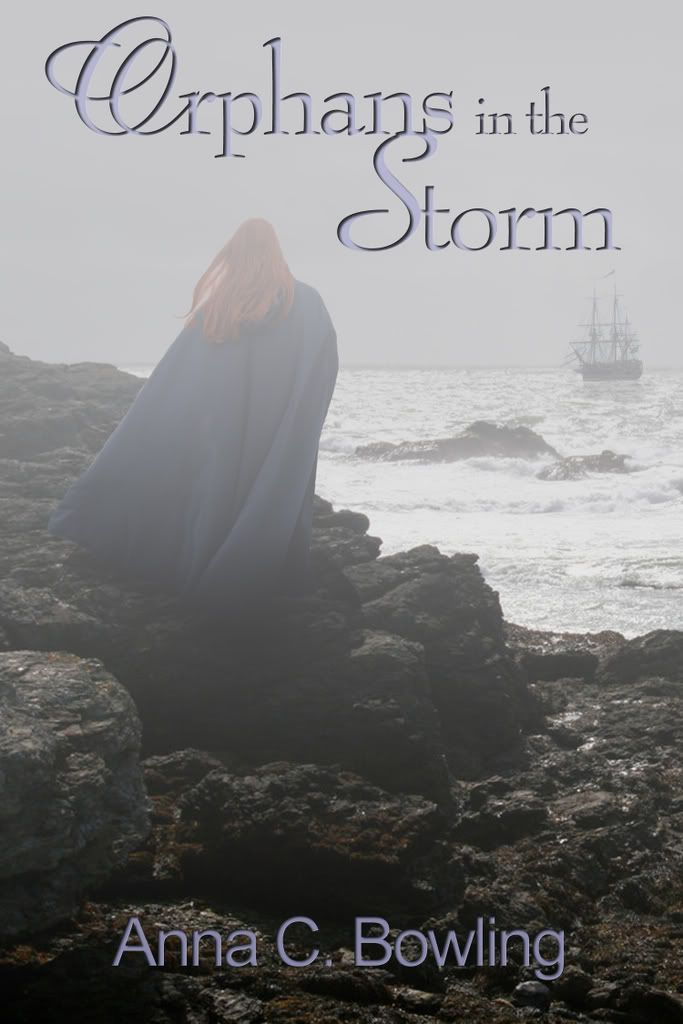
The Hidden Countess:
A black robe brought Jonnet Killey to the Isle of Man and a black robe would take her away to the noble English family she has never known.
The King's Man:
All Simon Burke wants is to carry out his mission to return Jonnet to her birth mother and secure the funds to help finance Charles Stuart's return to British soil.
An Adventure in Exile:
A new life awaits Jonnet, with a mother on the brink of madness and a treacherous uncle who will stop at nothing to keep Jonnet's inheritance to himself. While the end of exile nears, danger mounts. Can Simon and Jonnet depend on their new found love to sustain them while the storm of treachery rages around them?
***
So, how did you get started with this latest project?
Every novel has a story of how it came to be, and ORPHANS IN THE STORM does owe a tip of the hat to a roleplaying game that didn't work. A friend had been wanting me to play for a while, and gave me some parameters for the game. My character had to be a native of the British Isles, but not English, Scots or Irish. Hmm, that would mostly leave Welsh or Manx. I'd never done much research on the Isle of Man, but what the heck, it was for a game...only it wasn't.
Due to various vicissitudes of life, the game, which had a fantasy element, didn't pan out, but my character, who introduced herself right off as Jonnet, wasn't quite done with me. She was, however, done with the fantasy element, and by this time, the Isle of Man had begun to pull me in like the yellow fog known as Mananan's Cloak. Which is how Jonnet first sets eyes on Simon Burke, a hero who definitely made an impression on me. Though I borrowed his family name from a favorite character in a classic old school romance, Simon is very much his own man, driven by an unflagging sense of right and wrong, and weighed down by regret. When these two met, I knew I'd found my next couple and they would lead me somewhere special.
What is different about the research for this book?
British Isles historicals have always been my first love, but another project with a collaborator fanned the flame of my interest in Dutch history, and as things would have it, British and Dutch history met in a very convenient time and place for Jonnet and Simon to begin their journey. I've always loved English Civil War historicals by authors such as Bertrice Small and Valerie Sherwood, so the chance to write one of my own was too good to pass up. I wanted to do something different, though, and so Jonnet and Simon's view of the conflict is from a special seat on the fringes.
The impoverished Charles II took refuge during his exile in the Low Countries, where his sister was queen, sometimes in her good graces, sometimes not. Loyal British subjects like my Simon Burke marshaled all the resources they could to fund Charles' return to British soil, and that sparked the perfect way for Simon and Jonnet to meet.
You have a special connection to your heroine in this story, yes? What is it?
Yes, Jonnet has a rather personal connection to me, because we are both adopted. While I have met a birth relative (Hi, Sally!)I know it's likely I may not meet others, and I wanted to explore something we don't often see in fictional depictions of reunions of birth parent and child; when things don't go well. Jonnet has always longed to meet her birth family, but her mother, Jacoba, trapped by grief and madness in a world of her own, can't see Jonnet for the fantasy she's woven of her ideal child. Not to mention an uncle who will stop at nothing to get what he believes is his.
Many of my stories deal with themes of identity, and of course a story dealing with the English Restoration is a natural for themes of, well, restoration. Here, Jonnet grapples with the question of what makes her, her. Is it nature or nurture or a bit of both, and how will she deal with receiving a birthright she didn't know she had? Simon must learn to let crippling guilt go if he is to accomplish anything of value, and the rest of their families in Dutch exile face the prospect of returning to an England vastly different from the one they left. I hope you will consider joining Jonnet, Simon and company on their adventure.
***
Thanks, Anna! ORPHANS IN THE STORM is available now through Awe-Struck Press, but leave a comment or question for Anna and you'll be entered in a drawing for a free copy. We'll pick a winner next Sunday. Good luck!
Carrie Lofty was featured last week on Mama Writers, a fun new blog for writers who balance their work against the daily trials of motherhood. And just for fun, Carrie and her partners in crime were featured in April's issue of RT for their pastiche short stories.
***
 Join us Sunday when author Anna C. Bowling will be here to talk about her 17th century romance ORPHANS IN THE STORM. Don't miss it!
***
We'll also draw the winner of Emily Bryan's VEXING THE VISCOUNT. There's still time to leave a comment for your shot at winning!
***
Have a good weekend! If you have an announcement to make for next week, email Carrie. See you next week...
This Sunday, we'll be helping Anna C. Bowling celebrate the release of her newest romance from Awe-Struck, ORPHANS IN THE STORM. Until Sunday, enjoy this excerpt!

The Hidden Countess:
A black robe brought Jonnet Killey to the Isle of Man and a black robe would take her away to the noble English family she has never known.
The King's Man:
All Simon Burke wants is to carry out his mission to return Jonnet to her birth mother and secure the funds to help finance Charles Stuart's return to British soil.
An Adventure in Exile:
A new life awaits Jonnet, with a mother on the brink of madness and a treacherous uncle who will stop at nothing to keep Jonnet's inheritance to himself. While the end of exile nears, danger mounts. Can Simon and Jonnet depend on their new found love to sustain them while the storm of treachery rages around them?
***
At sea, en route to the Netherlands
1659
Simon advanced on the plaid-swathed bundle of woman that stood at the rail, still and stalwart. "We have a cloak for you below." He bit back the rest. Jacoba Albyn had sent a fine cloak, a lady's cloak, but Jonnet never wore it. Dark brown woolen with enough fur trim that it might belong to a respectable merchant's wife. There were dozens, hundreds of such cloaks in Breda, or England, or all the world. It was a world in which a blanket of bright yellows and blues was a good as a bonfire. Yet no seamstress or furrier could dress Jonnet in something as fine as that blanket looked now.
"I know." The wind tugged stray wisps of reddish gold about her face. Her knuckles grew white where she clutched the edges of her wrap together. "I wanted to be Jonnet one more time."
"You will always be Jonnet."
The eyes she turned on him were wide and mournful as a scolded dog. "No. It is Easter Hastings who must step off this ship. Easter Hastings who will be welcomed with open arms. Easter Hastings who will fetch a fine purse from Englishmen loyal and true. God bless Easter Hastings, for I do not know who she is."
Simon folded her into his arms and felt her tremble. Her whole body shook as she fit her head into the space between his shoulder and chin. "You will always be Jonnet to me." In that moment, he knew it to be true. "As generous as your," he could no longer say mother, "Lady Albyn has been, no matter how good a teacher Eben may be, nobody can change the way God made you." Nor would I wish it. The shaking lessened as he spoke, so he continued. "My wild Manx Jonnet, tart-tongued and stubborn and strong." And beautiful. So very beautiful.
Jonnet braced both hands on the front of his coat before she pulled back. "But that is not what she will pay for. If I could talk to her the way I talk to you, I could bear that. I fear we will have nothing in common. Mother Mawd and I knew," small white teeth bit down into her lower lip. "Know each other. We have a history. With Lady Albyn," she sounded out the name as she often did, as though making sure she had it right. "All I have is this." She drew the small leather volume from the folds of her blanket.
"You've read more." The ribbon marker was nearly at the end now. She held it like an offering he was loathe to take, and yet he did. His hand brushed against hers, fingertips on knuckle for a heartbeat longer than needed. Her hand was as chilled as the air, but the pulse beneath the skin was steady. "Worry solves nothing."
"Action. I know. What action do I take next? What if she turns me away because I am not what she wanted? My feet are hard and my skin is brown and I would not know her if I passed her on the street. I would go home if I could, now, today." Jonnet shut her eyes, lashes wet against her cheeks.
Simon swallowed. She could, if she wanted. What man could refuse a request from those eyes, that lilt of her voice? As for coin, she had a name to barter now, and enough of noble ways to give at least an illusion of means. "Will you?" Father God, make her say no.
She took in a ragged breath and met his gaze. "I cannot. Something in me has changed. I have to do this. She is in here. The woman who bore me is in here, and whatever else she may be, she is a mother. If I had a chance," she broke off, took in a sharp breath. "A chance to bring one of Mother Mawd's babes back to her for one day, for her to hold them one more time, I could not deny her that."
"And so you will give that to Lady Albyn?"
Her nod was his only answer.
He looked over her head at the line of tall, slender houses coming into view. "We have a few days before that. You'll meet my sisters first, and my mother." And father, but she would not be there for that. Nor would he be there for what followed. A month ago, even a week, the thought would not have troubled him, and now would it not be the same as leaving one of his own hands? He shut off the thought. Any more down that road, and he would not sleep a minute until well into summer.
The mission was still the same, deliver the woman, collect the money, bring it to Charles Stuart. Only the man to carry it out had changed. I will be back as soon as I can, he wanted to tell her, but he could not give a word that might be broken before it even left his tongue. This was for England, and none of their lives were their own to give. "You will be all anyone could ask for," he managed instead.
Jonnet rewarded him with a tremulous smile. She dashed the back of her hand across her eyes that were now rimmed with red. "Will you promise to remind me who I am if I start to forget? If Easter Hastings must live, will you help me make sure Jonnet Killey doesn't fade away?"
The answer sprang so readily that it was a mere breath before Simon covered Jonnet's mouth with his own. "Always."

By Jacquie Rogers
As anyone who has ever worked with young men in their late teens and early twenties knows, food is an important part of keeping them happy, healthy, and productive. The early days of the cattle trails were hard on these men. Generally, they'd roll meat in tortillas and stuff the food in their pockets. This led to spoiled food, discontent, and let's face it, difficult recruiting for the trail bosses.
 Charles Goodnight and his fellow ranch owner Oliver Loving had a huge herd to push north to the train station in Kansas. He needed good men, and to get them, they wanted good food. So Mr. Goodnight bought a Studebaker wagon and fitted it with a box with several compartments, lots of hooks and places to stash things, an arched top covered with oiled cowhides, and an nice fold-down worktable on the back. The wagon carried flour, molasses, salt, bacon, maybe a string of garlic, lots of pots and some dutch ovens. It had a lard bucket, a water barrel, and a tarp on the under-carriage to hold firewood or buffalo chips for the fire.
When we think of a cattle drive, we think of a chuckwagon, a dozen cowboys, and a herd of cattle, all moseying along the trail. But that doesn't even make sense considering it took a half an hour to set up, get the pans and food out, get the fire started (probably had to gather firewood or chips), prepare the food, which could include sourdough biscuits, beans, and maybe a slab of meat--elk, venison, or maybe beef. And of course the coffee, which was the first thing prepared after the set up.
 That's a lot of work--at least two hours worth. What this means is that the wagon had to get there two or more hours before the herd did, and that means some fancy driving. So the real story is, once the breakfast dishes were done and the wagon was packed up, a Cookie drove hell-bent for election to the next watering hole or stopping spot. This required sturdy animals, which is why chuckwagons were often pulled by mules--they're stronger, take less food, and can tolerate a greater range of heat than horses can.
The job of a cook was not an easy one. Not only was his work back-breaking with long hours, he was also the doctor, barber, secretary, and banker. Around the chuckwagon, his word was law and even the trail boss yielded to his often temperamental demands. There are three reasons for that: 1) the best cooks drew the best hands; 2) he might spit in your beans if you're not careful; and 3) he had a tough job and no one wanted to be railroaded into it. On the other hand, the cook made twice as much money as the drovers, but they knew he earned it.
Want a few trail recipes?
Sonofabitch Stew
Mock Apple Pie
And here's my own recipe for sourdough pancakes:
2 cups starter
1 Tbs. oil
1 tsp salt
1 tsp baking soda
1 tsp sugar
1 egg
Mix up and fry on a greased medium skillet--these days, that's 350 degrees, but in the old days, it was when a drop of water skittered across the skillet.
To make the starter if you don't have one:
2 cups flour
2 cups water
2 Tbs yeast
1 tsp sugar
Mix up with a wooden spoon and store in a crock for 2 days.
Mix, add:
1 cup flour
1 cup water
Mix and let sit another day or two. And voila! you have a starter.
Some tips and tricks:
1. Never use metal for either stirring or storing.
2. Always keep at least one cup of starter for next time
3. If you're not going to make anything with it for more than three days, store the starter in the refrigerator, but be sure to get it out the night before you plan to use it next.
4. If you care for your starter properly, it will last indefinitely, and get better with time. I know of starters that are 200 years old.
Sources:
Chuckwagon Central
Handbook of Texas Online
The West
Trails West (a list of trails)
Hard times in the old West: cattle drives
The Wild West
May your saddle never slip!
Jacquie


Myspace *** Bebo *** Faery World
Faery Special Romances *** See the book video
Royalties go to Children's Tumor Foundation, ending Neurofibromatosis through Research
Available Now: Down Home Ever Lovin' Mule Blues
 Absinthe is the French word for wormwood, which together with Florence fennel and green anise, make the drink unique. It is the tiny amount of thujone, found in wormword, which causes its alleged hallucinogenic effects.


