Showing posts with label book party. Show all posts

19 April 2009

Book Party: Jennifer Mueller

Jennifer Mueller is celebrating the release of two new books this month: A RUINED SEASON, which is a hardcover Regency from Robert Hale, and HISTORY LESSONS, a contemporary e-book that collects multiple historical stories, published by Phaze.

***

Ayda Rogers can't believe her luck. She's been invited to a Scottish castle for the summer to research her doctoral thesis. When she gets there she finds that with 800 years of history to contend with, the past is always present. Steamy tales of previous castle owners meld within the modern story as she learns all she needs for her paper. And sometimes it's not the past but the present which makes you change your whole way of thinking, especially when it comes in the form of the future duke named Hunter.
***

Today Elise Sinclair, Dowager Duchess of Cairnmuir, has stopped by to tell a little about the family that lives in Am Binnean Castle. Inhabited since 1252 by the Sinclair family, there are tales enough to entertain many a cold Scottish night.

Now, Elise, I see here you live in Scotland. Were you part of the British effort in the war, then?

Elise: (a bit of laughter) No, I was one of those odd Americans who were caught in Paris as it fell. My college roommate's boyfriend was quickly part of the resistance, and he recruited me for a special purpose. There was a German general in Paris who needed a secretary, and with my degree in languages and having been a model, he figured I would be a shoe-in for the position.

What is he up to now? This boyfriend that snagged you into the job?

Elise: Unfortunately, he was killed in the same betrayal that sent me into hiding. If not for that, I never would have ended up on the shores of Am Binnean castle. Marie, my roommate, was killed as well, and who knows what happened to his family. I put the marker for his grave up myself when I realized there was no one to do it.

I suppose the readers would like to know if you ever fell in love with the enemy. If so, how did the relationship end?

Elise: (real laughter) No, I was able to keep my skirt down when it came to Germans. Pretending I was one, working in an office with them, yet not sleeping with them was about the only way I could keep some bit of me reminded I wasn't German. I guess I knew that getting involved with any of the resistance members, even just civilians, would put me in a position I didn't want to have to explain to my German bosses.

So you were part of the Special Operations Executive then?

Elise: No, the Resistance group I belonged to just reported to them. François didn't want there to be any leaks with the group, so he was the only one I was in contact with. The SOE had my name; it was supposed to be safer that way. I was at the doctor's sick when the Germans started killing everyone on the SOE's ranks. Someone had given up the names. You know that all the details of that time in my life were written down in a story called "Once Upon a Spy." Ayda Rogers, who came to conserve the family art collection, seems to be collecting all the stories the family knows. I have a feeling that she'll make a story of her own to add, what with the way my grandson looks at her every time she's in the room.

Stories? You mean there's more than one? Tell me about those.

Elise: With a castle inhabited since 1252, how could there not be stories? There are more stories than hard fact. A lot can be forgotten in 800 years.

Which ones has she found out then? The ghost perhaps? I've heard talk of a castle ghost.

Elise: Heavens, which ones has she heard? I'm certain she's seen the ghost, actually. She jumps now and then when there is a noise. I know the cook, Mary, let loose about the naughty "Unexpected Relatives," such as Eaduin Sinclair who rebuilt the castle after it was regained from the English. He fought with Robert the Bruce, you know.

The family has long been involved in politics. "Politics of Marriage" is another she's collected. The castle might look picturesque after centuries of quiet, but in 1714, it was embroiled in the beginning of the Stuart claims to the throne. It was a sad day when so many men were killed that it kept the family from the risings.

Hunter has told her of our "Rose Among the Heather," a favorite story of mine, perhaps because it mirrors my own circumstances--a commoner catching the eye of the duke. Edward had just returned from fighting Napoleon only to find a house party that kept him from forgetting the horrors of battle. Heavens, I just realized all of
those are rather naughty! My own, of course, I could never tell such details, and I think she's researching a new one come to light only recently.

Five? That's all there is in 800 years?

Elise: (more laughter) She's only been here a few months, and she's been busy with a painting she's found. If it's what she thinks it is, that will be quite the coup for us--a missing Titian hidden for who knows how long. It is a working visit after all. I do know that she's found a most intriguing story set long before the Sinclairs and even the Vikings invaded the area. Romans and Picts! It's hard to believe this little part of the world far from everything has had so much history. She posted it online with an author friend of hers. I'm sure more stories will come to light, especially if Hunter is able to woo our guest. I'm certain his heart is lost already. Ayda's is harder to guess.

Then you know of more stories yourself?

Elise: Well, of course, my dear. So many years in the castle without a television leave many an evening to hear them all. I suppose you'll ask what? "A Faire Lass" is a short little tale of one of our ancestors falling in love at first sight. It's a most unusual problem when she sells iron goods in the market. "In Search of the Picturesque" brings a little scandal into the family. It's not the lack of title, either, nor is it without other misunderstandings. I'm getting tired though. I'm not as young as I once was when I survived a shipwreck and found my way to these shores. Perhaps another time.

Of course. I'd never want to tire you. I don't suppose Ayda would ever tell these tales though you have me quite intrigued.

Elise: (a vague smile) She's had help from that author friend of hers. They've written all the stories down and they'll even be published on April 27th. I think Ayda's even confided her decision of how she feels about my grandson Hunter. Now I really should have a nap before the nurse comes with my medication. She'll never be happy if she finds me worn out.

***

Thanks for stopping by today, Elise. I'm sure Jennifer is pleased to have you speaking about HISTORY LESSONS on her behalf. If you're intrigued by a story that takes you through the history of a great Scottish castle--and all the mischief and romance that takes place--then leave a comment or question for Jennifer. Next week, I'll pick a random name and that person will win a copy of HISTORY LESSONS. Good luck!

12 April 2009

Book Party: Erastes

It's Sunday on Unusual Historicals, which means it's time to meet another author and win a book! This week our author is Erastes and her new release is TRANSGRESSIONS, an M/M romance set in the English Civil War. She's giddy about the release of the book which, together with Alex Beecroft's FALSE COLORS, are the first gay romances to be released in the mainstream. Both novels can be found in the romance section of bookshops across the US.

***

David Caverly's strict father has brought home the quiet, puritanical Jonathan Graie to help his dreamer of a son work the family forge. With war brewing in Parliament, the demand for metal work increases as armies are raised.

The indolent and deceitful David Caverly is bored by his father's farm and longs to escape, maybe to join the King's Army, mustering at Nottingham. David finds himself drawn to Jonathan, and after a passing cavalry trooper seduces the beautiful David and reveals his true nature, he determines to teach Jonathan what he's learned.

When David is forced to leave the farm, and the boys are separated by mistrust and war, they learn the meaning of love and truth as they fight their way across a war-torn country, never thinking they'll ever see each other again.
***

Tell us a bit about TRANSGRESSIONS.

It's the story of two very ordinary young men who just happen to live in Kineton, Warwickshire, England.

The story begins in the summer of 1642, David Caverly is bored of living in a place where nothing exciting happens. War seems inevitable and--as there hasn't been a major war in Britain since the Wars of the Roses 200 years previous--people were MUCH interested in it. Unbelievably, people actually went along as sightseers to watch the battle of Kineton, treating it as a day out. I deal with this in the book, although it's not quite the jolly day out that my characters expect, but rather carnage.

The story deals with David and his new friend Jonathan, who has been brought to the forge has an apprentice, their burgeoning friendship (which turns to love) and the consequences of that. Needless to say it doesn't all take place on a farm in Warwickshire, but spreads out across England, as does the war.

How do you deal with the fact that homosexual love was illegal at this time?

Obviously in 17th century England, a homosexual love affair was never going to be tolerated. Buggery was made a felony by the Buggery Act in 1533, during the reign of Henry VIII. The punishment for those convicted was the death penalty right up until 1861. Not only was it prohibited by law but by the church too--an abomination. The title "Transgressions" applies to this, and everything else that is going on in this fascinating, bloody time.

What is the main theme of the book?

It started out as David's story, as David was the character who came to me first--but after a while it really warped into Jonathan's story, as I think he has the longest journey to take. He's such an innocent in many ways, and while David finds his father's ways and the church's restrictions easy to side-step, Jonathan battles against every misdemeanour and truly suffers for it. When he finds himself falling in love with another man, it almost breaks him--and his journey becomes harder for it. What he seeks is the truth, and after a while he thinks he's found it in Matthew Hopkins' Witchfinders, but he eventually finds out that he's been looking in the wrong places.

Where do you look for inspiration?

I don't really look for inspiration. Writing is generally on my mind all the time, like an undermining sickness. And it can strike at any time--seeing a lighthouse on the horizon, hearing an author talk about her own book on the radio and where she got her inspiration from, or in conversations with people, or overheard from people. A painting, a song...I'll suddenly think--Oh, that's an idea...

The inspiration for TRANSGRESSIONS was simply the title and the concept. My mother, having read and loved STANDISH, said, "For your next one, how about the English Civil War?" That sort of set sparks off in my head, I could immediately see a summer, blissful, warm and safe, all about to be turn to pieces by a war that would tear families to pieces. The idea of two young men ending up on different sides of the war isn't an original one, of course, but it hasn't been done in gay romance before. I do highly recommend Maria McCann's "As Meat Loves Salt" though, if anyone wants to know more about the era. It's a wonderful book about this era, and again, another gay love story. I can't say that it's a "romance" though, but a stunning read.

Why do you like to write gay historical?

I don't think I'd be interested in general historical. The reasons why I am fascinated with gay historical is that it's generally wide open. When you look at the list on Speak Its Name, there's a tiny amount of books available in the genre. I'd like to see anyone try and list all the heterosexual historical fiction there is out there! Every period is ripe for writing about. There might be a top-heaviness of Regency for example, but there's so many stories yet to be told. It's an exciting time to be in the genre--a genre that no-one even acknowledged as existing a few years ago. Now it's going mainstream.

Unusual Historicals...right up your street. Do you think you could ever write a usual historical?

No, definitely no. Although I hope that gay historical will soon become non-unusual!


What's been the single most difficult thing to research?

Gah. Not the war itself in fact, because there are hundreds and hundreds of sites and books about the war. You can find out who all the main players were, what everyone was wearing, flags, munitions, how to load a musket, how to fight with a pike, how to do wheeling and counterwheeling in formation, but there's very, very little about the everyday life of a man keeping his family fed. In the end I had to approach living history groups who were hugely helpful. They helped with food and clothing and all the little things needed for this kind of book.


What was the closest you came to committing a 'great historical clanger'?

I've yet to hear what I've done wrong in TRANSGRESSIONS, but I'm sure I've made historical errors. The worst one I know of is in STANDISH. Ambrose is reading a book that wasn't published at the time. The annoying thing is that I researched it when I was writing, realised it was anachronistic and took it out--or at least I thought I'd removed all mention of it, because if you read on later in Standish, he refers to Polidori's Vampyre, which was published at the time. but I missed one reference to Dracula...Oh, the shame! The readers soon let me know! I hope to goodness that I haven't done something similar in TRANSGRESSIONS, but I'm sure that if I have, the re-enactors will let me know!

How do you research the fighting?

That was pretty easy, actually. There are so many resources about that. There must have been battle geeks even back in the 17th century because there are painstainking illustrations of the battles and descriptions of what happened during each battle.


Something inevitably seemed to go wrong, though, which struck me as very human. In the battle of Edgehill, for example, which was the first official pitched battle of the ECW, the entire cavalry charged after a retreating brigade and to loot the Parliament's baggage train. This blunder left the infantry unprotected and could have caused an inconclusive result, which in turn caused the war not to be decided on that one day.

Here's a previous post I did on the subject, which shows some of the munitions and fighting research I had to do.

How do you deal with endings? It's not like your characters can get married.

No, and that's the quandary that the gay romance author faces. I hope that this is a more satisfying ending for the reader than STANDISH, which was open ended in the same way Gone with the Wind is. But I haven't "cheated." There's the obligatory HEA, but I think that the ending will still make the reader think and that's the point. One has to worry about how any gay romance will work, especially in this bloody century.

There are further snippets on her website, together with free bookmarks and lots more. Here's the book trailer:


***

Thanks so much, Erastes, for joining us today, and good luck launching this new subgenre of historical romance!

Readers, if you'd like to win a copy, simply leave a comment or question. Have you read any M/M romances? Are you curious? I'll draw a name at random next Sunday. (Some patience may be required as Erastes has not received her author copies yet!) Good luck!

22 March 2009

Book Party: Bonnie Vanak

Today, our fantastic author is long-time contributor Bonnie Vanak, known for her Egyptian-set historicals published by Dorchester, her sexy werewolf series from Harlequin Nocturne, and her globe-trotting efforts to help the world's poorest citizens. She's a busy lady and took time out this week to talk about her latest release, THE LADY AND THE LIBERTINE.

***

NOBLE IN ALL BUT NAME
Anne Mitchell, born illegitimate and raised in a workhouse, sold by her mother and packed off by her father to the East, had every reason to lose faith. But in Egypt she found identity with the Khamsin, a tribe of Bedouin warriors. Greater even than the secret they entrusted to her was her newfound honor, and for that she would give all.

NOBLE IN ALL BUT ACTION
Nigel Wallenford was an earl. He was also a thief, a liar and a libertine. Regaining his birthright of Claradon had been a start. Next he required wealth, and he knew of just the fabled treasure...and its key's guardian was a ripe fig waiting to be plucked. Never before had he scrupled to cheat, steal or even murder. One displaced Englishwoman, no matter how fair, would hardly be his match.
***

THE LADY AND THE LIBERTINE is your seventh Egyptian historical. Would you tell us a little about it?

In this book, a displaced English earl seduces a virginal beauty in order to steal the pharaoh's treasure she guards in Egypt. I pitted Nigel, a thief, liar and libertine, who was cheated out of his birthright as earl, against Anne/Karida, who has sworn to be upright and moral. Karida was born in England and taken to live with my Khamsin warriors of the wind in Egypt. They entrusted her with a ruby that unlocks the key to a fabulous treasure buried in the sands.

Nigel was fascinating to write and complex. He does the wrong things for the right reasons. He's very naughty, and just when you think he'll change, he turns around and does something wicked again.

What kind of research do you do for your historicals?

Lots! I love researching about Egypt, and with each book, I find new material to incorporate into the novel. In this book, I loosely based the pharaoh's treasure tomb on the Valley of the Golden Mummies in the Bahariya Oasis, four tombs of about 105 mummies excavated by Dr. Zahi Hawass.

I needed a treasure tomb in the western desert for Nigel and Karida to seek. The tomb inside is all my imagination, from the traps I put there to the caskets filled with lots of gold.

Are there any more plans at this time for another Egyptian historical?

Sadly, no, I'm taking a break from writing them and concentrating on writing my werewolf Nocturnes. Right now I have too much on my plate with the Nocturnes, the day job (I work as a writer for a large international charity) and travel for the job. As I'm writing this, I'm packing to leave for another visit to Haiti!

There may be more in the future, but as of right now, The Lady and the Libertine will be the last.

Could you tell us the order of your Egyptian historicals?

Sure! They are as follows:

The Falcon and the Dove
The Tiger and the Tomb
The Cobra and the Concubine
The Panther and the Pyramid
The Sword and the Sheath
The Scorpion and the Seducer
(Nigel makes an appearance in this book)
The Lady and the Libertine

Each book can be read out of order, as it stands alone, but I recommend reading The Scorpion and the Seducer before reading The Lady and the Libertine.

Thanks for having me! On my website, I have excerpts of all my books. They're all in print and can be ordered online through Amazon and Barnes and Noble.

Reviews
An exotic backdrop sets the stage for Vanak's newest novel. With a few twists, she combines an English lord, scarred in body and soul; an illegitimate young Englishwoman; a ruby and enough adventure, pathos, secrets and betrayal to keep you turning the pages of this sexually charged romance. Four stars.
--Romantic Times

As always, Vanak creates her romantic scenes with daring sensuality and the intimate scenes between Nigel and Karida were no exception. Especially well done was the initial scene when Karida revealed the burn scars received during her childhood after falling into a fire. Vanak has a knack for creating strong, imperfect heroines and her characterization of Karida bears witness to her genius in giving life to her unforgettable characters.

The author kept the non-stop action perfectly paced and flowing well along with the suspense of whether Nigel would or could change his wicked ways and become a better man. Vanak also includes a scrupulously good amount of historical research making this series as well as this installment a highly entertaining and recommended read.
-- Marilyn Rondeau, C2K KWIPS AND KRITIQUES
Excerpt

Khamsin camp, Eastern desert of Egyp
1908


He would not be the virile groom tenderly deflowering her on their wedding night.

He would never cause a sigh a passion to wring from her slender throat as he caressed her virgin breasts, now hidden beneath the modest white kuftan.

The sparkling ruby dangling between them stood out like a blood droplet against a snowy bank. His hands, accustomed to stroking the skin of whores, were not worthy of touching her. They were, however, quite capable of stealing the ruby, as they had swiped other priceless Egyptian antiquities.

Crouched beneath the shade of a cigar-shaped ben-tree, Nigel Wallenford, rightful earl of Claradon, studied his prey as he clutched an oily rifle in his sweating palms. The silent woman picked up scattered seeds on the ground. Karida was her name. She guarded the ruby he needed to complete the key and locate the treasure of the sleeping golden mummies.

All week, during his visit here on the pretext of buying Arabian mares, he'd heard her relatives praise her virtue and honor as if she were not a living, breathing woman but a limestone statue. Nigel wouldn't have cared if she was as corrupt as he; he cared only about the ruby.

Ben-trees, acacia trees, and yellow-green plants peppered the water source near the Khamsin camp. The burning yellow sun played off jagged mountain peaks and peach-colored hills of sandstone. A cooling breeze chased away the sultry afternoon heat shimmering off the tawny sands. Black mountains and endless desert ringed this part of Egypt's eastern desert.

Jabari bin Tarik Hassid, the Khamsin sheikh, thought Nigel was currently at the water source to kill desert hares, but he had chosen the spot to pursue Karida. Each afternoon since his arrival, she came here to gather seeds. Like a good hunter, he'd learned her habits, knew her movements. Like a hare struck down by a bullet, Karida would never know what hit her.

The ruby would soon be his.

Karida kept stealing glances at him. Her face, hidden by a half-veil out of courtesy to the visiting al Assayra tribesmen, was expressionless.

A good hunter knew how to disarm his prey, make them feel false security. Nigel set down the rifle and offered his most charming smile. He gestured to the bullet-hard seeds she dropped into her goatskin bag but kept his gaze centered on the ruby. His fingers itched to swipe the stone. Soon.

"Are those for eating?"

Karida blinked, as if startled to hear a human voice. "Samna. Cooking oil."

Like her Uncle Ramses and the rest of her family, she spoke perfect English. Yet her accent was odd, as if she'd lived somewhere other than here in Egypt.

"I'm marrying tonight. This will be my last time gathering the seeds." She gave a little sigh, as if pondering her fate.

"Do you love him?' Nigel blurted, then could have kicked himself. A rude question. But he was a foreigner; maybe she'd forgive him.

"I do not know him." Karida gave a little laugh, as sweet and musical as the jingling of gold bracelets. "I was informed I was chosen as a bride, but I don't know who has chosen me. All the al Assayra warriors are honorable and noble, however, and so my husband will be." Her large, golden-brown eyes, so exotic and mysterious, seemed to pierce him. "He will never lie to me or steal, and he will be admirable all his days."

Nigel stared at Karida in sudden bleakness, feeling the shadows of old ghosts smother him. She was so damn perfect, an angel compared to the demon lurking inside him. His gaze dropped to his hands, and he rubbed them violently against his khaki trousers, knowing he wasn't fit to touch her.

You would never marry me. I can't father your children. My own sire lied about my birthright because I was sterile, and though I was older, I could not give him an heir like my twin brother. I wouldn't give you my heart, but I could steal away yours.

Or worse. I could kill you.


Screams echoed down a rocky mountainside in Nigel's mind, then silence. Nigel tensed against the memory, guilt swallowing his soul until nothing remained but an inky darkness. He could just shoot Karida, take the damn stone, and leave her corpse here, festering in the blistering heat. One more crime to add to his list.

She glided over to a small brown rock to pluck out the few seeds scattered there. Each movement held an inborn grace. As sinuous as a serpent, so lovely. Unlike Nigel, Karida was not scarred from painful surgeries to fix an arm that would never work quite right. Her skin was flawless, her body smooth and unmarked.

Her exotic gaze centered on him as she straightened. "You won't see many hares at this time. It's too hot. Like the scorpions and the vipers, they like to hide."

"Like Englishmen should," he joked. "Ground's hot enough to poach an egg."

His gaze dropped to her feet, and he wondered if her toes and ankles were as perfect as the rest of her. Fabric billowed in a sudden gust of wind as the gods answered his prayers, revealing a flash of shapely ankles and well-shaped feet in silver sandals. Nigel licked his lips, imagining his fingers stroking her delicate skin and tickling her toes.

As she moved toward the tree, his eyes caught a sudden movement in the rocky sand. "Christ, watch out!" he yelled.

He raced forward, hooked an arm about her waist, swept her off her feet, and waltzed her away as if they were dancing in a ballroom. The goatskin bag tumbled from her fingers and fell to the ground with a smack just as the viper's head emerged from its sandy nest. Fangs struck the bag instead of her ankle.

Trembling, she remained in his embrace. Nigel became aware of those soft breasts pressed against his chest, the rapid pounding of her heart. A fragrance of orange blossoms and almonds filled his nostrils. For a wild moment, he wanted to rest his cheek against the top of the scarf covering her head and stay there, holding her in his arms.

Reluctantly he set her down and turned, watching the snake disturbed from its afternoon nap. He hunted for a rock to kill it.

"Use this."

Karida handed Nigel a nearby stick he'd seen the Khamsin use for shaking acacia leaves loose to feed their camels and sheep. He grasped it, and his fingers tentatively brushed hers.

Nigel trembled violently at the sizzling contact. Drawing in a sharp breath, he curtly told her to stand back.

He lifted the sturdy pole to strike the viper. It lifted its head and, for a moment, its cold, beady gaze seemed to reflect the blackness inside him. Then Nigel struck. Again and again he beat the snake, even after it lay motionless on the ground. Blow after blow, the misery and self-loathing inside him exploded like gunpowder.

A gentle hand tugging on his jacket sleeve caused him to stop. "That's enough, Thomas. I think it's past dead."

Her gentle, teasing tone caught him off guard, almost as much as her use of his false name. Nigel tossed away the stick and turned to stare at her. Dryness filled his mouth.

Bloody hell, she was beautiful. Pure as polished ivory. Radiant as the sun. His gaze dropped to his hands. Hands that killed more than just snakes. Nigel scrubbed them against his trousers.

"Are you all right?" he asked hoarsely.

Karida gave a little nod. She stared back with frank interest.

Rapt, he leaned forward. Was it his imagination, a trick of fading sunlight, or did her eyes widen as if she liked what she saw and wanted him as well?

His pulse quickened. Nigel wished he could see more of her face. Was her mouth thin and flat? Did she have a wart on her nose? The flimsy veil was a fabric barrier between his curiosity and answers.

Take it off, he silently ordered. He began chanting in his mind: Take it off.

***

If you'd like to enter for a chance to win a copy of THE SCORPION AND THE SEDUCER, leave a comment or question for Bonnie. A winner will be selected next Sunday. Good luck!

15 March 2009

Book Party: Anna C. Bowling

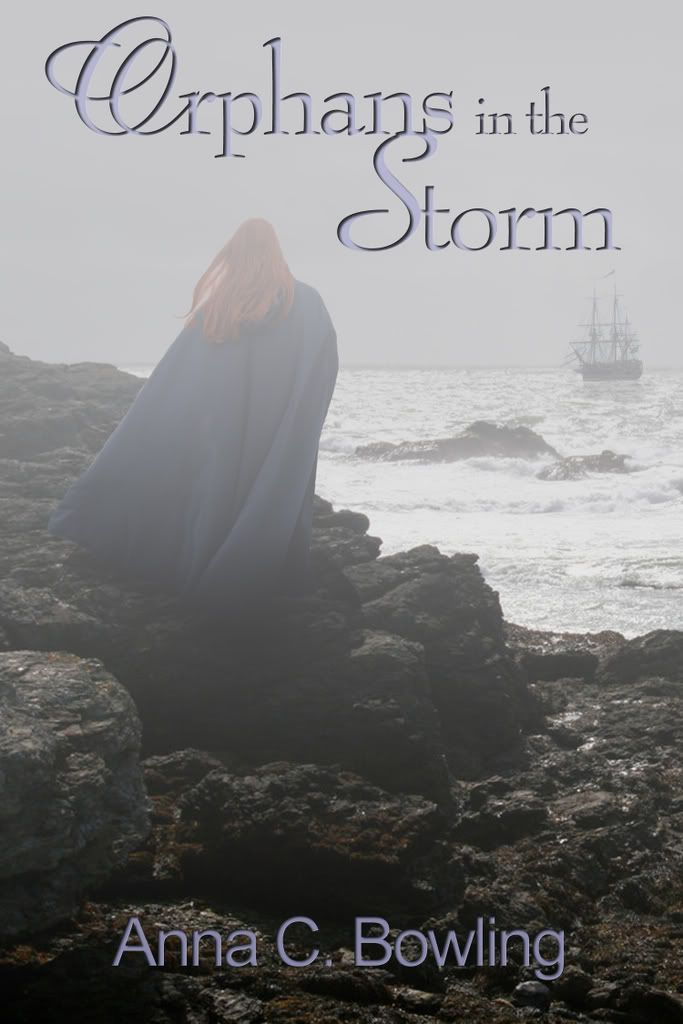
This week we're talking with long-time contributor Anna C. Bowling about her latest release from Awe-Struck Press, ORPHANS IN THE STORM. Welcome!

The Hidden Countess:
A black robe brought Jonnet Killey to the Isle of Man and a black robe would take her away to the noble English family she has never known.

The King's Man:
All Simon Burke wants is to carry out his mission to return Jonnet to her birth mother and secure the funds to help finance Charles Stuart's return to British soil.

An Adventure in Exile:
A new life awaits Jonnet, with a mother on the brink of madness and a treacherous uncle who will stop at nothing to keep Jonnet's inheritance to himself. While the end of exile nears, danger mounts. Can Simon and Jonnet depend on their new found love to sustain them while the storm of treachery rages around them?
***

So, how did you get started with this latest project?

Every novel has a story of how it came to be, and ORPHANS IN THE STORM does owe a tip of the hat to a roleplaying game that didn't work. A friend had been wanting me to play for a while, and gave me some parameters for the game. My character had to be a native of the British Isles, but not English, Scots or Irish. Hmm, that would mostly leave Welsh or Manx. I'd never done much research on the Isle of Man, but what the heck, it was for a game...only it wasn't.

Due to various vicissitudes of life, the game, which had a fantasy element, didn't pan out, but my character, who introduced herself right off as Jonnet, wasn't quite done with me. She was, however, done with the fantasy element, and by this time, the Isle of Man had begun to pull me in like the yellow fog known as Mananan's Cloak. Which is how Jonnet first sets eyes on Simon Burke, a hero who definitely made an impression on me. Though I borrowed his family name from a favorite character in a classic old school romance, Simon is very much his own man, driven by an unflagging sense of right and wrong, and weighed down by regret. When these two met, I knew I'd found my next couple and they would lead me somewhere special.

What is different about the research for this book?

British Isles historicals have always been my first love, but another project with a collaborator fanned the flame of my interest in Dutch history, and as things would have it, British and Dutch history met in a very convenient time and place for Jonnet and Simon to begin their journey. I've always loved English Civil War historicals by authors such as Bertrice Small and Valerie Sherwood, so the chance to write one of my own was too good to pass up. I wanted to do something different, though, and so Jonnet and Simon's view of the conflict is from a special seat on the fringes.

The impoverished Charles II took refuge during his exile in the Low Countries, where his sister was queen, sometimes in her good graces, sometimes not. Loyal British subjects like my Simon Burke marshaled all the resources they could to fund Charles' return to British soil, and that sparked the perfect way for Simon and Jonnet to meet.

You have a special connection to your heroine in this story, yes? What is it?

Yes, Jonnet has a rather personal connection to me, because we are both adopted. While I have met a birth relative (Hi, Sally!)I know it's likely I may not meet others, and I wanted to explore something we don't often see in fictional depictions of reunions of birth parent and child; when things don't go well. Jonnet has always longed to meet her birth family, but her mother, Jacoba, trapped by grief and madness in a world of her own, can't see Jonnet for the fantasy she's woven of her ideal child. Not to mention an uncle who will stop at nothing to get what he believes is his.

Many of my stories deal with themes of identity, and of course a story dealing with the English Restoration is a natural for themes of, well, restoration. Here, Jonnet grapples with the question of what makes her, her. Is it nature or nurture or a bit of both, and how will she deal with receiving a birthright she didn't know she had? Simon must learn to let crippling guilt go if he is to accomplish anything of value, and the rest of their families in Dutch exile face the prospect of returning to an England vastly different from the one they left. I hope you will consider joining Jonnet, Simon and company on their adventure.

***

Thanks, Anna! ORPHANS IN THE STORM is available now through Awe-Struck Press, but leave a comment or question for Anna and you'll be entered in a drawing for a free copy. We'll pick a winner next Sunday. Good luck!

01 March 2009

Book Release: Lisa Marie Wilkinson

This week we're helping one of our contributors, Lisa Marie Wilkinson, celebrate the release of her debut novel, FIRE AT MIDNIGHT, available now from Medallion Press. Congratulations, Lisa Marie!

***

It is 1703 and Rachael Penrose is confined to Bedlam insane asylum in London after discovering her uncle Victor plans to kill her brother in order to inherit the family fortune. Victor leads a gang of criminals and uses French privateer/smuggler Sebastién Falconer as the scapegoat for his crimes. When Victor spreads the lie that Rachael informed on Falconer's smuggling activities, Falconer vows revenge on the girl.

A dangerously ill Rachael escapes from Bedlam only to find shelter in Sebastién's carriage and ends up in his care. It is a twist of fate that will alter both their lives. With these two characters at cross-purposes, what ensues is a tangled web of deceit, suspense, derring-do, and a passionate love story as Sebastién gradually begins to believe in Rachael's innocence and Rachael gets to know the tortured soul beneath the gruff Frenchman’s exterior.
***

Welcome, Lisa Marie! Can you tell us about your early successes with FIRE AT MIDNIGHT?

Yes! FIRE AT MIDNIGHT won numerous awards on the Romance Writers of America chapter contest circuit, and was the Grand Prize winner of the Maryland Writers Association Novel Contest. It also won a Bronze award in the Pacific Northwest Writers Association Literary Contest, and was a finalist for the Daphne duMaurier award.

What have advance reviewers and readers had to say about FIRE AT MIDNIGHT?

I've been really pleased with the responses so far! Here are a few:

A stunning historical debut by Lisa Marie Wilkinson, FIRE AT MIDNIGHT is a fast-paced read filled with mystery, intrigue and passionate characters who will captivate readers until the last page. The heart-wrenching opening made a lot of promises, and the story delivered every one!
--Stacey Kayne, author of GUNSLINGER'S UNTAMED BRIDE
Lisa Marie Wilkinson weaves deep emotion, tenderness and sensuality into a rich historical tapestry in this sweeping romance of adventure and intrigue.
--Christine Wells, author of THE DANGEROUS DUKE
4 Stars! Romance, action and suspense differentiate this tale of adventure and love. Wilkinson creates the right combination of believable characters, snappy dialogue and fast-paced storytelling. The protagonists are not only passionate about their separate causes, they're passionate about each other too.
--Romantic Times BOOKReviews
Anything else you'd like to share with us?

An excerpt from FIRE AT MIDNIGHT was posted earlier this week on Unusual Historicals. Leave a comment and be entered to win an autographed copy! A winner will be chosen next Sunday, so good luck!

01 February 2009

Guest Blogger: Jacquie Rogers

Jacquie Rogers is the author of DOWN HOME EVER LOVIN' MULE BLUES, and you can read an excerpt posted on Unusual Historicals last Thursday. Her previous release was FAERY SPECIAL ROMANCES, for which all royaties go to the Children's Tumor Foundation, ending neurofibromatosis through research. She has been with Unusual Historicals since its inception, and presents an online class on writing at Texty Ladies every Monday.

DOWN HOME EVER LOVIN' MULE BLUES is narrated by a mule named Socrates. Why did you write the book that way?


I'm not so sure I had a choice. Socrates is rather pushy, you know. When I first set out to write this book, I was trying to write for the market, but characters have a tendency to see the market in their own ways. Socrates, for instance, thought he should be the star. He's a performer and quite a handsome mule, so no reason not to. Besides, he made me laugh. He's rather persistent when he wants something, even having his own email, blog, Facebook, and Myspace page. His next goal is to get his own Hollywood Star.

Tell us a little about your background and why this book is so authentic.

I grew up in southwest Idaho where rodeo is extremely popular and lots of people there participate in the sport. Fast forward many years, and our family became friends with Jim O'Keefe, a retired rodeo clown and bullfighter. So I've been a fan my entire life, even dabbled in barrel racing myself, and then the extensive discussions I had with Jim on every aspect of bullfighting, cowboy protection, and clown entertainment just made me need to write this book.

Jim's claim to fame wasn't a mule, it was a moose, believe it or not. But another famous bullfighter and rodeo clown named Leon Coffee did have a mule, and the two of them were hysterically funny. That man was truly astonishing--he could make anyone laugh, but then the next minute he's risking his life by putting his body between a beat-up cowboy and a 2,000-pound bull. He was incredibly athletic, and a heckuva good entertainer.

I never did see Jim O'Keefe perform, so I actually based a lot of Brody's fancy moves on Leon, but then all the particulars, like how to get a cowboy released when he's "hung" on the bull rope, that sort of thing, came from Jim. He explained things two or three times until I understood. To tell you the truth, I don't think anyone who hasn't stood in front of a charging, snorting bull can understand. These men are beyond gutsy.

So everything in the book is made up, as are the characters, but the actual rodeoing scenes are based on the real deal, all the way from the Grand Entry, to the dance after the show.

This book is a drastic departure from FAERY SPECIAL ROMANCES, which was ten short stories, from medieval to futuristic. What exactly do you write?

My genre is lighthearted romance, and I don't care if it's fantasy, western, or Mesopotamian. Same with my reading. If you make me laugh, I'll buy your books for life. Why? Because I think laughter is the second most important thing we do each day--the first being hugs. Laughing while hugging is even better yet! My goal is to put a few hours of sunshine in your life, a few hours when you don't have to think about the bills, the kids, the mother-in-law, or any of the bazillion stressful things that can bog down our world. Laughter feeds your soul in a way nothing else can.

How have your books been received?

Very well. DOWN HOME EVER LOVIN' MULE BLUES has received PNR Staff Top Pick from ParaNormal Romance, and won the TRS 5-Heart Sweetheart from The Romance Studio. FAERY SPECIAL ROMANCE has finaled in several contests. One story, "Faery Good Advice," won the 2006 PEARL Award, and another story, "The Duchess and the Dirtwater Faery," finaled in the 2007 PEARL. FAERY SPECIAL ROMANCES was also the Fall 2007 NOR Award winner for Best Print Sci-fi/Fantasy Romance.

So is your next story more like DOWN HOME EVER LOVIN' MULE BLUES, or like FAERY SPECIAL ROMANCES?

Neither. I'm currently writing a dragon-shifter, then I'm writing a pirate story, and meantime I'm working on a series that I'm writing on spec. So every project is completely new and different to me (yes, I have a short attention span), except they all are light in tone, all are romance, and all have a guaranteed Happily Ever After.

Speaking of short attention spans...

Yes, yes, I know. It's time for the contest!

Any commenter this week will be eligible to win an autographed copy of FAERY SPECIAL ROMANCES, along with a DOWN HOME EVER LOVIN' BLUES T-shirt. Plus, my sister is a shopaholic so you never know what else she'll throw in the box. Good luck!

And where can readers contact you?

Here are links for my Webpage, Contest & News Group, Myspace, Facebook, Twitter, and IWOFA.

Thanks for inviting me to be Unusual Historicals' featured blogger today. I'm really happy to be involved with such an informative blog--I look forward to each day's post because there's always new and fascinating information.

11 January 2009

Book Release: Isabel Roman

Sundays on Unusual Historicals mean a guest author spot, and this week we're featuring longtime contributor Christine Koehler as she releases her first book, writing as Isabel Roman. The book is MURDER AND MAGICK, the first in a series called "The Dark Desires of the Druids I," released through Ravenous Romance. Congratulations!

***

Losing her virginity can mean ruin for a Victorian lady. For Raven Drake, it means freedom to explore her sexuality. As a magicker in hiding, Raven subscribes to her culture’s less prudish philosophy. She wants to experience every erotic sensation imaginable.

Malcolm, Lord Preston, desires her from the moment he sees her, and doesn't allow society’s rules to stand in his way. More than happy to introduce Raven to the pleasures of sex, he doesn't expect to fall in love with her.

Their tryst is a welcome distraction from witch hunters and political maneuverings. But can it overcome the weight of another man’s ring on her finger?
***

What makes your story an Unusual Historical?

It's unusual in that I borrowed from the Victorian time period, but it's really an alternate universe historical. In my universe, the Spanish Inquisition was replaced by the Great Purification. All people possessing any kind of magick were burned at the stake, any book related to magick was burned with them, and those who survived were scattered across the world.

In present day 1882, Witch Hunters are experiencing a resurgence. Through the usual means: lies and twisting of the truth, fear and superstition, and most of all political power, they've managed to create a superstitious society where magickers are feared and hunted.

What kind of research did you do for this story?

It was actually a lot of fun. There's a lot on the Victorian culture online and in a vast array of books. Once you get started on one topic, it’s easy to jump to others. Very easy. I'd say 98% of what I depict in the culture is true. The other 2% is fictionalized based on my universe.

You have a strong female character, was it difficult to have the hero equally as strong?

Not really. They complimented each other very well. Yes, there was a tendency to have Raven do everything, take all the credit, but Mac was her match in every way. Though not a magicker, he is no fool and can hold his own in any fight.

Will there be any further stories in this series?

YES! I'm working on editing the second book now, The Dark Desires of the Druids II: Sex & Subterfuge. This one takes place in late 1882 Philadelphia. There are cross over characters, but it can stand-alone. I also have two more stories lined up in this series.

What about more Unusual Historicals?

I have a contract with The Wild Rose Press for a werewolf story. It was part of their Got Wolf? Contest (and won first place!). In 1934 Germany, The Arminius Clan is running for their lives. Hitler has just declared himself Führer, the Night of the Long Knives has just shattered what little security Germans have, and the SS are everywhere. Worse yet, the SS has discovered the existence of werewolves and want to create an army of them for the Nazis.

The anthology will be available in June 2009.

Not unusual, but I also have a Civil War story coming out with my Slip into Something Victorian blog group in Summer 2009.

I also have a Wicked Seduction Series set in various time frames where the women set out to seduce the men they want: 1774 Boston, 1810 England, 1918 London, 1932 Hollywood, 1954 Los Angeles, and present day New York.

I've never heard of your publisher, who are they?

They're new, that's true. Ravenous Romance is an e-publisher who just launched in December. Their stories are erotic with strong romantic themes.

How can readers find out more about you?

I have a website and a blog.

***

Thanks! What to win a copy? Just leave a comment, and I'll randomly draw a name next Sunday. Since all Isabel's stories are downloadable, she can either send you a gift certificate or a burned copy for your reading pleasure. Your choice.

14 December 2008

Book Party: Erastes

Today we celebrate the release of our contributor Erastes' latest release, FROST FAIR. Enjoy!

***

Gideon Frost is willing to do whatever it takes to earn enough money to save the printing shop that was left to him by his father. But when faced with the prospect of having to engage in acts society deems unnatural and the law declares punishable by death, he realized there are limits as to how far he'll go. Then he meets the privileged and handsome Joshua Redfern, the one man who tempts Gideon to break his own rules.

Joshua Redfern has no title or important relations, but his independent fortune allows him a life that is more than comfortable. And more importantly, it enables him to offer assistance to the unfortunate but beautiful Gideon just when the man needs it most. Joshua realizes his interest in Gideon is far more than charitable, but is the man similarly attracted or merely indebted?

When the Thames freezes over and London hosts the great Frost Fair of 1814, trouble and necessity bring Gideon and Joshua together. But just as ice is destined to eventually crack, will the circumstances break these two men as they learn that life isn't always fair?
***


Once upon a time, before all this nasty global warming, the River Thames freezing over was a pretty regular occurrence. When William the Conqueror was still on the throne, it wasn't unusual for the Thames to be solid ice for weeks at a time.

In 1564 the first Frost Fair was held-although there's not that much recorder evidence of it, but we can rely on the Londoner's sense of free theatre, they'd have flocked to anything new. There were probably street vendors galore, cock fights, bear baiting and the like.

Why did the Thames freeze then and not now?

It was all to do with the bridges. Once, all the bridges had small arches, so when the ice formed in large enough clumps it couldn't flow easily under the bridges, so it piled up and the water behind it froze. Once the bridges were replaced by ones with larger spans this ceased to be a regular occurrence. The Thames did freeze occasionally after the Regency period but there was never to be a giant Frost Fair again--the last one was in 1814, and it's around this week-long event that my book FROST FAIR concerns itself.

How is this an Unusual Historical?


It's a break from a "traditional" Regency romance (and not only because it's a gay romance!) in that there's no aristocracy, no balls, no pump rooms, nothing like that. The main protagonist, Gideon Frost, is an impoverished printer and engraver eking out an existence and not making any profit. Sometimes he simply runs out of money completely and finds himself forced to frequent the sites of male prostitution (Lad Lane, Cock Lane and St Paul's Churchyard, which were all notorious) to earn a few shillings to make ends meet. (Pardon the pun!)

He falls in love--hopelessly he feels--with a customer, Joshua Redfern, a wealthy man who comes to his shop one day, little knowing that Redfern shares his predilections and is as in love with Gideon as Gideon is with him. However, this being 1814, it's not exactly something one can bring up in conversation! Redfern has already lost one lover to the hangman, and it's not a risk he wants to take again.

Stir in a returning character from Hard & Fast the devilish Finbarr Thouless, a cockney shop-assistant and a dastardly plot and you have Frost Fair.

It's at the top of the bestseller's list at Linden Bay Romance, (of which, out of the Ten Ten, four are gay historical romances) which makes me happy!

Would you like to share an excerpt? If so, set it up for us.

Yes! Redfern's just met Gideon for the first time.

Thouless raised one darkly handsome eyebrow. "Well, then," he said with the exquisite patience and subtlety of a rhinoceros, "perhaps Mr. Frost might be persuaded to do a commission. Were you not saying that you were thinking of getting some pictures done? Of the house?"

Redfern could feel himself coloring, as for the third time, and, convinced he looked like some cork-brained nincompoop, all he could find to say was, "Yes. Yes, I was."

Somehow, he'd snapped himself out of his shock, and in moments, the young man--Gideon Frost--had written down Redfern's name and address in, Redfern could not help but notice, an elegant hand, and had promised to call within a very few days. He'd explained that his assistant was unwell but he had every hope that his recovery was imminent. Redfern left the shop with a spring in his step he hadn't had for many a month and found it difficult not to smirk. Thouless--damn his questing eyes--commented favorably on Frost's talents all the way back to Fleet Street.

To cover up his interest in the young man, Redfern said, "Are you trying to shock me, Finn? To hear you speak, I'd think you were smitten by young Frost."

Finbarr hailed a hackney, and as it trundled along the street toward them, he said, "I appreciate art, Joshua. That young man creates it, and his Creator has made it in him. If you tell me you did not see the beauty in him, I will call you a bowyer and as such I will never believe anything you say again."

Redfern had grunted something, enough to placate his friend and make him change the subject onto the ball of that night, and that had been the end of the matter between them. When Frost came to sketch the house, there was no archly sarcastic wag to confuse matters. But it did no good. For all that Redfern wanted to be the charmer, the urbane friend to Frost that Thouless was to him, he found it impossible. He was not so much tongue-tied, but seemingly tongue-less in the young man's presence and all he had been able to do was give the engraver carte blanche to sketch where and how he liked. He sounded curt and gruff even to his own ears, and he knew that it was self-protection; better to appear an arrogant nouveau-riche than to give any hint of his true feelings. For from the moment he'd seen Frost again he knew that he was violently, passionately attracted to the young man, in a way that he hadn't felt for many years.

He left Frost to sketch, and forced himself not to trouble his work. He stayed in his library, giving orders to the staff that he had left the house and that he would call on the engraver presently. He sat and wrestled with the burgeoning attraction for the man he'd seen twice. What good would it do to moon after the young man? What good had it ever done? He'd learned harsh lessons in his life, that his predilections had brought nothing but danger and misery to all concerned. He'd long been of the opinion that it was better to live like a monk than to put one more man at risk.

So what, he wondered, as he stood outside Frost's shop on a freezing day, had led his footsteps back here? There was nothing in their business that could not have been done by servants or by correspondence but here he was. Before he gave it another thought, and talked himself out of it, he pushed open the door, and suddenly, as he saw the engraver stand with a welcoming smile on his face, he was warm.
What's next for you, Erastes?

A very exciting book release in April 2009. An imprint of Perseus Books--Running Press--is releasing a line of M/M Romance as mainstream romance for the first time ever. They'll be available in the women's romance section of books and marketed specifically at women with "proper romance covers". My English Civil War romance TRANSGRESSIONS and Alex Beecroft's Age of Sail adventure, FALSE COLORS are to be the pathfinder releases and they are lining up more releases to follow.

Sadly I can't show you the covers yet, but I'll keep you all posted! I hope you give FROST FAIR a try and enjoy it if you do.

***

Thanks so much to Erastes for stopping by today. We're giving away a copy of FROST FAIR to a random commenter when we return from the holiday break on December 28. Leave a comment or question for your chance to win. Good luck!

07 December 2008

Book Party: Michelle Styles

Unusual Historicala takes great pleasure in welcoming back Michelle Styles to discuss her latest North American release, VIKING WARRIOR, UNWILLING WIFE, her second book set in the early Viking period.

***

With the war drums echoing in her ears, and the sharp northern light glinting off the sharpened swords, Sela stood with trepidation on the shoreline. The dragon ships full of warriors had come, ready for battle and glory.

But it wasn't the threat of conquest that shook Sela to the core. It was the way her heart responded to the proud face and chiseled body of Vikar Hrutson, jaarl, leader of the invading force--and Sela's ex-husband!
***

Anything you are excited about, Michelle?

One of the great things Harlequin has done for the release of Viking Warrior, Unwilling Wife is to create a book widget. Mostly it is just the passion lines which get widgets, so it was a real honour to be chosen. A widget means you can read the entire first chapter as well as my author's note at the back. The note deals with divorce in Viking times, as well as giving a list of some of the books I found useful when I was doing my research.

Was divorce common in Viking times?

Because of the lack of written information, it is difficult to accurately determine how wide spread divorce was. If you read the sagas, you will see women could divorce for basically any reason and divorce is often used for dramatic purposes. One of the big problems for women was their children belonged to their husband. This is something Sela, the heroine of Viking Warrior, Unwilling Wife, strongly objects to, and she tries to circumvent the system. She believes that she has succeeded until her former husband sails up the fjord...

So you were looking at divorce in Viking times, what else intrigued you when you were writing?

One of the things that really interests me is how much truth there is in a saga and how things get changed and altered through time. For example, it was through looking at Homer's Iliad that Heinrich Schliemann discovered the city that is now thought to be Troy. Deciding what is the truth about the legends holds the key to Sela and Vikar's survival.

Are there any more Vikings in your future?

The third book, which is Ivar's story, is currently sitting on my editor's desk. It has been revised twice, but I am hopeful that I finally have cracked it. I want the story to be super strong and a worthy successor to the other two. After that, it depends really on the sales and if a story really strikes me.

Are some books harder to write than others?

Short answer--yes! But ultimately, it is all about getting the story right for the reader. The goal is always to give as powerful a read as possible. This is where the eye of an experienced editor really helps as they can see the holes or possible problems. Sometimes, it is not about getting it right the first time, but getting it right finally. Allowing words to harden like cement can be a problem for some writers, particularly aspiring authors.

Was Viking Warrior, Unwilling Wife hard to write?

It was fun to write! When the revisions came (there are always revisions), I could see how they would make the story stronger. For example, I had just finished writing A CHRISTMAS WEDDING WAGER and my editors pointed out that perhaps I had forgotten that this was not a sweet Christmas story set in Victorian times, but a passionate Viking.

I duly made changes, and I was thrilled when Romantic Times said, "A family in conflict, an ambitious hero bent on vengeance and a bold woman hiding a secret quest for salvation combine for a heady, tension-filled, passionate sequel to TAKEN BY THE VIKING."

It is just great when revisions work!

Are Vikings popular?

They seem to be. Certainly, I have had a lot of reader feedback saying how much they enjoyed Taken by the Viking and now Viking Warrior, Unwilling Wife. Sometimes a myth goes around that a time period is dead or whatever, but really the Viking period has always been a popular one for Harlequin Historical. Ultimately, it is all about crafting a story that people enjoy and hopefully readers will enjoy this one.

***

Thank you, Michelle, for dropping by. Leave a comment and have a chance to win a copy of Viking Warrior, Unwilling Wife (or any of Michelle's back list). To help you out: Do you think there is any truth to legends and myths? A winner will be chosen at random next Sunday. Good luck!

09 November 2008

Book Party: Jennifer Linforth

Debuts are fun! This week we're talking with contributor Jennifer Linforth as she celebrates the release of her debut, MADRIGAL, available now from Highland Press.

***

Years ago he faked his death and vowed the Phantom would never again haunt the Opera Garnier. But strange packages left by Anna, an unwanted Samaritan turned unlikely friend, causes Erik to desire the unattainable--love.

When Anna's haunted past puts Christine Daaé in danger, Erik is falsely accused of the vicious crime. The Phantom is reborn as Erik, forced to the brink of insanity, revisits his passion for Christine--the woman he once swore to possess. Fighting the injustice against Erik, Anna struggles to prove his innocence. Standing in the way is her past that cannot be transcended, and years of prejudice labeling Erik more monster than man.

Battling the nobleman determined to lock him away, Erik must save Christine, control his demons, and tame a heart unexpectedly beating for two opposite women. Christine, who he longs to love, and Anna: the woman who saw beyond his bitter soul to the man beneath the mask. In the midst of a brutal manhunt, can he be loved for himself or is he condemned to be The Phantom of the Opera?

Murderer, Maestro, Magician, Mastermind.
***

MADRIGAL is a continuance of Gaston Leroux's The Phantom of the Opera. Why expand a work of classic literature? How long did this take?

Certain stories transcend time leaving many more questions than answers. No author made me question as much as Gaston Leroux. My love for The Phantom of the Opera stemmed from a deep respect for a book that was a mystery, horror and romance rolled into one. How utterly frustrating and wonderful is it to read a book that makes you ponder what happened after the final page? How many readers have thought about the nuptials of Darcy and Elisabeth after Jane Austen put down her quill? There are those readers who are merely content to question and those readers who seek answers...

After revisiting Leroux's novel for the third time the questions in my head would not go away. A voracious researcher, I began to read about France in the Victorian era which led to me studying the history of opera. This fostered a desire to understand Leroux on a deeper level. Why set this book in an opera house? What motivated him? How did he view France during the time of this novel? Much of Leroux's body of works focused on political satire and class differences. Why--as a jurist--did he leave so many unanswered questions?

While innocently poking around in my research I stumbled across a book which continued Austen's Pride and Prejudice. I loved every minute of it. In my opinion it flawlessly wove the original story with Austen's tale. From there I found other writers who continued classic literature: Brooks, Rhys... I was horrified at first--a bit shocked that authors would have the guts to expand upon a work in the public domain. But I had a way now to answer those unanswered questions. It took three solid years of research and revision to do, but was worth every moment.

The Phantom of the Opera has an enormous fan base. What was your biggest challenge in writing MADRIGAL?

By far breaking down the walls erected by Andrew Lloyd Webber. His musical sensation and 2004 movie staring Gerald Butler created an iconic image of both The Phantom and the story as a whole. Webber got his start through Leroux, and Leroux's original is quite different from the romantic, sexual tale millions of fans saw and fell in love with.

When I wrote MADRIGAL, I wanted to adhere as closely as possible to Leroux's original vision of a sensual madman. Erik (the Phantom) was not a sexy, buff man hidden behind a petite white half-mask. He was the central character in a Death and the Maiden tale. Erik was hideously deformed, hid behind a full black mask and slept in a coffin. Very different from the image of the mildly deformed gentleman with the famous romantic "swan bed" crafted by Webber .While he possessed the same genius Webber capitalized on, he was also a murderously vengeful soul. Despite that, he was a repressed and ardent gentleman seeking the most basic of human emotions--love. Yet how can one when love society sees you as nothing more than a deviant of the underground?

Webber said in an interview that he stripped down Leroux's original to the most basic love story. In doing so I found he lessened many elements that made this classic unique. Elements such as the social differences of the time period and the clash of the classes, Erik's inherent madness and Christine's push and pull between the loves of two men. Naturally certain elements of Leroux's story were changed to suit the limits of my imagination, but I tried to bring the reader back to Leroux.

I have received numerous emails from readers stating after reading MADRIGAL they purchased Leroux's original. That is a true reward!

Do your readers have to understand Leroux's original to be able to read MADRIGAL?

Absolutely not, and that is why it is so rewarding to know readers are seeking out Leroux's work. That is one of the reasons it took three years to research and polish this book. I wanted MADRIGAL to be able to stand on its own independent of Leroux's story. Just enough back story of Leroux's original is woven into MADRIGAL to be able to give the reader a flavor for The Phantom of the Opera.

The title itself is unique. Can you explain? I understand this is first in a series.

Opera and its history play a huge role in Leroux's original novel.

The story for MADRIGAL grew out of two elements. The first was my unending curiosity over one of Leroux's secondary characters, Philippe Georges Marie, the Comte de Chagny. His death in the original book at the hands of Erik never did sit well with me. Leroux wrote Philippe as an important secondary character, but never revealed much about his role in the plot. Why? Leroux was a jurist. Details and proof were his life yet he offered the reader no proof about this murder. I kept digging in-between the lines of his prose in order to uncover more about Philippe de Changy. Though not seen in book one, Philippe de Chagny's life and death play a large role in the series.

Coupled with my questions regarding Chagny was a bit of inspiration from opera itself. Philippe was the primary patron of the Opera Garnier and a high ranking nobleman of his time. In the 16th century the primary source of entertainment for nobles were madrigals--a type of secular vocal composition. The early madrigalists strung four madrigals together to weave a complete story via song. This became the foundation for modern day opera. Voices in a madrigal could be manipulated in such way the singer appeared to be crying, laughing or yelling in anger etc.

This to me was the inner workings of Erik's mind and madness. Mingled with the music consuming him were these voices of beauty, but they were coiled underneath the noise of his madness. The emotion behind MADRIGAL's madrigal was based off of Shakespeare's Sonnet twenty-nine. (When in disgrace and fortune in men's eye, I alone beweep my outcast state...) A story that is a lament relaying a man's deepest urges for popularity though his desires and wants are hidden and repressed beneath envy and suffering.

MADRIGAL is the first in a three book series (The Madrigals). There is a possibility for a fourth if readers desire.

Do you only write works that expand upon classic literature?

The Madrigals are only some of my unusual historicals. I write historical fiction and historical romances that focus on the social mores of the 19th century. My passion lies in Austrian culture and I have several historicals set in the Habsburg empire during the reign of Franz-Josef.

***

Reviews:

"Ms. Linforth has written a love story sure to please Phantom fans old and new alike." ~ Amanda Ashley, NYT Bestselling author

"Reading MADRIGAL by Jennifer Linforth has been a wonderful experience. As a Phantom of the Opera lover, I've been able to read all the books based on this story and Ms. Linforth's work including plot, characters, and style makes this novel a gorgeous and unique creation. Ms. Linforth's love for the Phantom legend can be felt in every page, in every word which makes her novel a wonderful experience and a delight to the senses." ~ Sandra Andrés Belenguer, historian and creator of the foremost Phantom of the Opera history and fan site

***

We featured an excerpt of MADRIGAL on Thursday, which you can read here. Interested in getting your hands on a copy? Leave a comment or question for Jennifer, and we'll draw a name from among the commenters.

02 November 2008

Book Party: Elizabeth Lane

This week we welcome one of our newest Unusual Historicals contributors, Elizabeth Lane, as she celebrates the release of her newest book from Harlequin Mills & Boon, THE BORROWED BRIDE, set in 1899 Colorado.

***

Footloose young Quint Seavers runs off to the Klondike, not knowing that he's left his childhood sweetheart Hannah in a family way. When Quint can't be reached, it's up to his older brother Judd to do the right thing and marry the poor girl—in name only of course, and just until Quint comes home.

The marriage catapults Hannah into a new life. The big house on the Seavers Ranch is like a palace, ruled by Quint's antagonistic mother. Judd, her new husband, is brusque and remote. But something in his haunted eyes cries out for Hannah's understanding. What will happen when she finds herself falling in love with the husband who's vowed to treat her as a sister?
***

Tell us about yourself.

I'm a westerner by birth and upbringing. My grandparents lived like pioneers, and my great-grandparents were pioneers. I grew up in a small town, in a family of people who loved the outdoors. Maybe that's why writing Western romance comes so naturally to me. But I can and do write other things. My earliest books were historical sagas. Then the market changed and I found a new home at Harlequin Historicals. Counting a couple of ghost writing projects, I'm coming up on 32 books. Twenty-five of those have been for Harlequin--three of them contemporaries, the rest historicals.

Tell us about your new book, THE BORROWED BRIDE.

THE BORROWED BRIDE is a November 2008 release from Harlequin Historicals. It has just been nominated for Best Western of 2008 by the Love Western Romances.

Since it's set in the American West, what qualifies THE BORROWED BRIDE as an unusual historical?

This classic love story could take place almost anywhere and in any time period. I chose to set it on a Colorado ranch on the cusp of the 19th and 20th Centuries. As one reviewer put it, the two brothers in the story symbolize the changing times. Quint is a throwback to the adventurous, pioneering 1800s. Judd's focus is forward, to the growth of the future and what it will do for his family.

What do you do when you're not writing?

I love adventure. Over the years I've lived in Mexico, Guatemala, Panama and Germany and traveled to such exotic spots as China, Nepal, Tanzania and Peru. I've chased whales in a rubber boat, rafted the grand canyon and taken a flying lesson. When I'm not writing I like to be moving--I belly dance, hike and do yoga. I also volunteer as a zoo docent and enjoy teaching children about animals. After 23 years working as an educational software designer, I finally get to write full time. I like to think my writing career is just getting started!

***

REVIEW QUOTES:

"THE BORROWED BRIDE is another breathtaking, romantic story by Elizabeth Lane. With Mrs. Lane's masterful penmanship the characters come alive weaving a flawless story the reader won't be able to put down." Dina Smith, Romance Junkies

"5 Spurs! With well-crafted characters and a difficult dilemma, this story will keep you turning the page as it captures your heart." Carol, Love Western Romances

"If you have never read one of Elizabeth Lane's books before prepare yourself for a poignant emotional attack. I am always amazed by the impact her books have on me. Without fail, she finds the perfect words to convey a complete picture. You feel the force of not only the emotions of her characters but their setting as well." Kim Swiderski, Writers Unlimited

***

We posted an excerpt of THE BORROWED BRIDE last week for our Thursday Excerpts feature. Check it out.

***

High praise for a much-anticipated Western. If you'd like a shot at winning a copy of THE BORROWED BRIDE, leave a comment or questions for Elizabeth. We'll draw the lucky winner in one week. Thanks for stopping by!

21 September 2008

Book Release: LIGHT IN A HOLLOW PLACE

This week's guest is long-time contributor Vicki Gaia, here to discuss the third in her Warring Hearts trilogy, LIGHT IN A HOLLOW PLACE.

***

Light in a Hollow Place by Vicki Gaia
LIGHT IN A HOLLOW PLACE is the final book in Vicki Gaia's World War II Trilogy, "Warring Hearts." In a Parisian hospital, Richard Hart fears that his blindness may be permanent, as well as the nightmarish episodes. Faced with his disability and fearing he's losing his grip on his sanity, the last person he wishes to see is his fiancée, Claire O'Neill.

Claire comes to Paris, convinced her love will lead Richard through this, and resolute about starting their life together after the war. But as Richard's episodes grow worse, he pushes Claire further away. When a dashing stranger shows an interest in Claire, she fears the gulf between her and Richard may be too great to overcome. German Ratlines, puzzle boxes, love triangles, and intrigue lead up to the final conclusion of Warring Hearts.
***

Tell us what motivated you to write historical fiction.

I've been writing short stories for a couple of years when I decided to attempt a novel-length story. I've always been fascinated with history and enjoyed research. I grew up watching 30s and 40s movies. It seemed like such a romantic time but also a time of harsh realities. I wanted to find out more about World War II and so I sketched out a story based on a woman in her early twenties. The war years would shape her life and her decisions.

From my imagination, Claire O'Neill was born. A woman who grew up without a mother, raised by her famous author father, Jack. A woman who wanted to become an artist. A woman who didn't want to fall in love and get married, afraid it'd stamp out the passion within.

Cradle the Light by Vicki GaiaI had to create a strong counterpart to Claire for her romance interest. A man who was as stubborn and would fight for Claire in his own way. I came up with Richard Hart. An intelligence officer who'd been fighting the war since 1939 in Europe. A man who had mental difficulties from being a prisoner of war but strived to overcome them. A man who needed love but didn't deserve love. A man who had to chose duty over all other emotions if he was to live with himself.

From this story, Cradle the Light, first of the "Warring Hearts" trilogy, took life. The final book came out this summer--Light in a Hollow Place--concluding the story of Claire and Richard, and the end of the war.

You can read excerpts for all of my books at my website.

What did you learn from writing a WWII trilogy?

That I didn't know anything about the war! I didn't realize how ignorant I was until I began reading true accounts from this era. I spent a year reading history books and biographies and trying to infuse my story with the realities of war, not just the sentimental journey. The trick was staying true to keeping it a romance.

Fragments of Light bt Vicki GaiaEach book has the same characters, but each is a stand alone and takes place in a different city. Cradle the Light begins in London during the Blitz and ends in San Francisco at the start of the U.S. entering the war. Fragments of Light is set in New York City during the middle of the war. The subplot touches on the black market of confiscated works of art stolen from the Jews and other 'undesirables' deemed by Hitler's death squads. The final book, Light in a Hollow Place, finds Richard injured and recuperating in a Paris hospital. The story begins after the liberation of Paris. The war is winding down, and 'ratlines' are forming--escape routes for Nazi officers and collaborators who must flee Europe or else face trial. Richard and Claire have a choice, to deepen their love or part ways.

Have you tackled other eras besides the 1940s?

Eliza's Hope by Vicki GaiaBetween writing "Warring Hearts," I'd published Eliza's Hope, a book set in the Edwardian Era in New York City. A very fun book to write! I loved researching Greenwich Village and the bohemians and suffragettes who defied tradition.

Long Strange Trip by Vicki GaiaMy first book published was Long Strange Trip, about a young professor who is about to trip the light fantastic with Rose Red during the Summer of Love in San Francisco. I was born in Northern California, therefore I set many of my stories in San Francisco, a city rich in history.

Now that you finished the final book in your trilogy, what are you working on?

Whew! That book almost did me in. It was very difficult to write and it went through several rewrites before it was completed. My poor critique partner was tearing her hair out as we went through plot change after plot change. Once I handed the final edits to my editor I went into a total writing funk.

I couldn't write a word and didn't want to. I had the summer looming ahead and no stories in the works, no books contracted. My slate was wiped clean but this only made writing more daunting.

Did I even want to write anymore?

After a month went by, I decided to leave behind my pity party! I gave myself permission to take time off and do what I love--travel, read, review manga, have fun with friends and family. I took two fantastic writing classes from Margie Lawson--Deep Editing and Empowering Character Emotions. This jump-started my creative juices and relit the passion for writing. Writing became fun again.

Now that you're back to writing, what's next?

I needed a challenge. Tired of writing straight historical romances, I wanted to try a new genre. I've always loved ancient history and have visited several ancient sites in my travels--Knossos, Pantheon, Roman Forum, Stonehenge, Carnac, Neolithic 'goddess' sites in Malta. I'm drawn to a good mystery, esoteric philosophy and the goddess religion.

It's recommended when you don't know what you want to do with your life, go back to the things that you love. Combining my love for research with my personal interests, I decided to write an Urban Fantasy set in San Francisco. It's about gods and goddesses and angels. What is very different from my other writings is it's written in first person perspective, from the viewpoint of my female antagonist.

While this isn't a historical fiction, it is based on mythology, and my research is as intensive. I have a thick binder sorted by several categories--gods, goddesses, ancient civilizations, mythical creatures. Writing this book has put fun back into my writing life. I don't have it contracted yet, but I hope to by next year.

Unedited excerpt from WIP, In the Shadow of the Goddess, copyright Vicki Gaia 2008:

Across the bay, the Golden Gate's trestles flickered from behind gray mist. A cold picture of orange-red steel illuminated by the full moon and street lamps. Strange were the black mass of ravens clustered around the bridge struts. I pulled at the collar of my thick wool sweater, a deep black mass of fear overwhelming my confidence.

Tendrils of fog rose up the cliffs like clinging ivy. Any moment I'd be shrouded in damp, dreary mist, blotting out the twinkling lights of the city. I prayed this wasn't an omen of things to come. I prayed my courage would be enough. I prayed my secret didn't destroy me.

I prayed but didn't believe.

The overhead branches rustled and the angel stepped out from the shadows. My neck cramped from looking up. Long disheveled hair glittered silver in the moonlight, dusting his shoulders, creating a cobweb of tangles. A face ageless and beautiful, and ravaged by eternity.

"The ravens lining the bridge struts failed to herald your entrance," I said, using my sarcasm to sharpen my wit.

The angel bowed, his arm sweeping in an arch. "Your goddess sends her most trusted servant to meet with me. I'm honored."

"I'm no servant, and you asked for me." I spit out the words through clenched teeth. The angel's terrifying beauty smothered my breath, slowly. "Why did you ask for this meeting?"

"Information, of course."

The angel's insufferable white-toothed smile provoked me. Angels weren't fluffy sweet cherubs strumming their harps in the sky. By nature, they were dangerous and cunning and shrewd.
Any final words?

I have a list of positive affirmations I keep on my desk. It keeps me in the right mind when I begin my day. I've learned this past year, it's the journey that's important, not the destination.

I want to thank all my readers for their support. I love writing a good story and hope to continue in the future.

I have several ways for readers to get in touch with me: my website, MySpace, and blog. If you want to receive my newsletter list, email me and I'll be happy to add you to the list.

Reviews:

"LIGHT IN A HOLLOW PLACE is an emotionally driven story that is loaded with descriptive details of a war-torn France, just barely coming to life again after the war. Exceptional plots and incredible characters weave an exciting tale of one couple who is trying to save their love while still fighting the after effects of the war." -- Wateena, for Coffee Time Romance

"Vicki Gaia does an excellent job guiding readers through this intricate story, introducing us gradually to the large cast of characters. Postwar Paris provides a vivid backdrop, historical details setting the scene yet not detracting from the plot. And what a plot!" -- Kimber, for Fallen Angels

***

Thanks for joining us, Vicki! She's giving away an e-book copy of the first in the "Warring Hearts" trilogy, Cradle the Light. Tell us if you find any aspect of the WWII era romantic and why, or just leave a comment or question. A winner will be drawn next Sunday.