Showing posts with label customs. Show all posts

08 November 2015

Author Interview & Book Giveaway: CASTLES, CUSTOMS & KINGS, Volume II - True Tales of English Historical Fiction Authors

This week as a special feature, we're offering insight into Castles, Customs, and Kings: Volume II - True Tales of English Historical Fiction Authors, The Second Volume of a Special Anthology. The works of fifty authors are included.  The authors will offer a free copy of Castles, Customs, and Kings to a lucky blog visitor. Here's the blurb:


An anthology of essays from the second year of the English Historical Fiction Authors blog, this book transports the reader across the centuries from prehistoric to twentieth century Britain. Nearly fifty different authors share the stories, incidents, and insights discovered while doing research for their own historical novels. 

About the Anthology


From medieval law and literature to Tudor queens and courtiers, from Stuart royals and rebels to Regency soldiers and social calls, experience the panorama of Britain’s yesteryear. Explore the history behind the fiction, and discover the true tales surrounding Britain’s castles, customs, and kings.


For those who have read Volume 1, you know this book will contain great information, a book you can pick up when you have ten minutes to spare, but a book that will be hard to set down. Fifty authors contributed articles on British history from pre-Roman times through World War II, not dry dates and documents, but the interesting stuff.

In both volumes, the book starts with the authors and their biographies, a list of their historical novels, and then begins a parade of persons from the past, from druids moving freely across tribal boundaries to the uncovering of Lady Godiva to Sir Geoffrey Luttrell who commissioned the Luttrell Psalter to the London life and paintings of John Singer Sargent—truly a varied and fascinating ensemble.


**Q&A with Debra Brown, editor of Castles, Customs and Kings

– Volume II**

Thanks for being our guest. How does this volume differ from the previous issue?
Thanks for having me!

Volume II is mostly articles from the second year of the English Historical Fiction Authors blog by fifty histfic authors. Like Volume I from the first year, it is set up chronologically with articles on history topics from pre-Roman times to World War II. Many of the same authors from Volume I contributed as well as numerous others, some indie, some mainstream published.
What would you like to readers to know most about this volume?

Like Volume I, it is full of surprises and interesting tidbits from history. Each topic is a few pages in length, so it is a good book to pick up during a coffee break or in bed for a short read before the lamp goes off. The Volume I  25+ hour audio book has sold very well, so that is in the works for the second as well if all goes as planned.
How were the contributions compiled?

They were originally posts on the blog. It was quite a bit of work to sort through the 365 excellent posts and select few enough to make up what is, even so, a big book. Since topics on the blog vary widely from day to day, the next project was to organize them.
Why do you believe this publication is important for historical fiction readers?

Most histfic readers enjoy history and want to learn more about past customs that seem strange now, amusing laws, interesting people, and happenings that have sometimes led to today’s traditions. Since authors try not to write too much of the history into their books, which would be tiresome to better informed readers, but to give a flavor of living in the midst of it, readers will enjoy the novels more if they know the history behind the story.
Any plans for a future volume?

That is on our minds, assuming the new Volume II is as well received as Volume I has been. Though the posts are on the blog, reviewers have stated that they enjoy the convenience of having them organized in a beautiful book for easy access. Authors have commented that some of the articles are good fuel for a novel, or that they have included what they learned in their books.

05 November 2015

Excerpt Thursday: CASTLES, CUSTOMS & KINGS, Volume II - True Tales of English Historical Fiction Authors

This week as a special feature, we're offering insight into Castles, Customs, and Kings: Volume II - True Tales of English Historical Fiction Authors, The Second Volume of a Special Anthology. The works of fifty authors are included.  Join us again on Sunday for an author interview, with more details about the story behind the story. The author will offer a free copy of Castles, Customs, and Kings to a lucky blog visitor. Here's the blurb:


An anthology of essays from the second year of the English Historical Fiction Authors blog, this book transports the reader across the centuries from prehistoric to twentieth century Britain. Nearly fifty different authors share the stories, incidents, and insights discovered while doing research for their own historical novels. 

About the Anthology


From medieval law and literature to Tudor queens and courtiers, from Stuart royals and rebels to Regency soldiers and social calls, experience the panorama of Britain’s yesteryear. Explore the history behind the fiction, and discover the true tales surrounding Britain’s castles, customs, and kings.


For those who have read Volume 1, you know this book will contain great information, a book you can pick up when you have ten minutes to spare, but a book that will be hard to set down. Fifty authors contributed articles on British history from pre-Roman times through World War II, not dry dates and documents, but the interesting stuff.

In both volumes, the book starts with the authors and their biographies, a list of their historical novels, and then begins a parade of persons from the past, from druids moving freely across tribal boundaries to the uncovering of Lady Godiva to Sir Geoffrey Luttrell who commissioned the Luttrell Psalter to the London life and paintings of John Singer Sargent—truly a varied and fascinating ensemble. Some interesting excerpts follow; each is but a paragraph from an essay:

**Excerpts from Castles, Customs, and Kings: Volume II**

From Mark Patton’s “The Flavian Palace at Fishbourne: Luxury Unparalleled in Europe North of the Alps”:

“Close to the modern city of Chichester is a Roman Palace that bears comparison with Nero’s ‘Golden House’ and the Palace of Domitian in Rome itself. Much of it is now hidden beneath modern housing, but in its heyday it had a larger footprint than Buckingham Palace. Not only is it, by far, the most lavish Roman dwelling ever built in Britain, it is also one of the earliest, having been built within a few decades of the Roman invasion of 43 A.D.”

This article goes on to discuss the palace, and it is followed by fascinating information about what existed inside a Roman home, including reason to believe that graffiti and even sexually explicit paintings adorned the walls. It is nice to have an archeologist in our group of authors!

Patricia Bracewell, in her article “The Science of History” brings out the horror of an unknowable (at the time) event:

“Part of the entry for 1014 reads: ‘his year, on the eve of St. Michael’s day, came the great sea-flood, which spread wide over this land, and ran so far up as it never did before, overwhelming many towns, and an innumerable multitude of people.’

“Anyone reading this today would recognize it as a description of a tsunami. We’ve already experienced two such massive sea floods in this young century, and we knkow what devastation such events can cause. The word itself would not be incorporated into the English language until the nineteenth century, thanks to the Japanese who, like the English, live surrounded by water. But although the word we use today did not exist in 1014, the great sea-flood of that year was corroborated all over southern Britain by annalists writing in Wales, Cornwall, Kent, Sussex, and Hampshire. In addition, a chronicl written at the Convent of Quedlinburg Abbey in Saxony states that in that year a great flood struck Juteland, Holstein, Friesland, the Netherlands, and Belgium.”

Patricia goes on to explain what apparently caused the tsunami; perhaps not what you think.

For Tudor lovers, the book has, among other essays, “Unveiling Marie Stuart: The Poetry of the Queen of Scots” by Linda Root.

“It is small wonder that one of Scotland’s two contributors to the list of technically accomplished royal poets of the sixteenth century wrote her verse in French.
“It is more puzzling to explain how easily the creative aspect of her character is trivialized. The poet of whom I speak is Marie Stuart, a woman we know as the French Queen Consort and anointed Queen of Scots, but often forget that she was a student and life-0long confidante of Pierre Ronsard, the leader of the Pleiade, frequently called the Prince of Poets, and that both Ronsard and the scholar-historian Brantome acknowledged her expertise….”

Linda goes on to write about the poetry of the French child and the later Regnant Queen of Scots.

To see more of the variety of topics and to meet the authors in each of the volumes, please see the Table of Contents of each using Amazon’s Look Inside feature.


26 September 2013

Excerpt Thursday:CASTLES, CUSTOMS & KINGS, Volume I - True Tales of English Historical Fiction Authors

This week as a special feature, we're offering insight on Castles, Customs, and Kings: True Tales of English Historical Fiction Authors, which made its debut this month. The work of more than fifty authors are included. NOTE: There is no giveaway of this title scheduled. Here's the blurb:

A compilation of essays from the English Historical Fiction Authors blog, this book provides a wealth of historical information from Roman Britain to early twentieth century England. Over fifty different authors share hundreds of real life stories and tantalizing tidbits discovered while doing research for their own historical novels. From Queen Boadicea’s revolt to Tudor ladies-in-waiting, from Regency dining and dress to Victorian crime and technology, immerse yourself in the lore of Great Britain. Read the history behind the fiction and discover the true tales surrounding England’s castles, customs, and kings.


**An Excerpt from Castles, Customs, and Kings: 
True Tales of English Historical Fiction Authors**


FALLING IN LOVE WITH ENGLAND AND ITS HISTORY
By Stephanie Cowell

It began when I was very young; I felt I did not belong in New York City where I was born but somewhere across the sea in that land called England. But what was England to me? Any place for which we long is formed from fragments which mysteriously arrive and become part of us.

My first sense of England was literature, of course: Sara Crewe in A Little Princess and Mary Lennox in The Secret Garden in beautifully illustrated editions. I read them until the words almost wore away. I was Sara coming from her attic to be discovered at last as the little girl everyone had been looking for. I was Mary exploring the deserted rooms of the manor house on the moors. In my early teens it was the poetry (all of Shakespeare) and the great Victorian novels. I told myself, “That is where I belong; that is where I must be.” England had formed in my mind as the place where I could find my true self.

I painted a picture of “this earth, this realm, this England,” as Shakespeare calls it. It was a mixture of lovers running over the moors, a beautiful young queen, London attics, hot milky tea and servants always on hand to make it, and a great mysterious line of kings described as “the Unready” or “the Confessor” and queens who always looked ready to have their portraits painted and who each possessed a far more glamorous wardrobe than that within my schoolgirl closet; tombstones, ancient churches, an orderly way of being and doing things. (I was looking for the orderly; I passed by Henry VIII and his disorderly coterie of marriages. I am glad others felt differently! What would we do without Anne Boleyn?)

And so I saved and saved and finally went to England, and the England I expected was waiting for me. I walked all over London. I visited the Tower on an overcast day when it was not crowded and was properly awed by the tiny rooms and thick walls. Still, the heart of my England was literature not royalty even though I love the stability and ceremony of a monarch, a world in which everyone had their place.

I looked for writers—the new Globe had not been built, but I walked where Shakespeare had walked and found the old streets he had known: Cheapside, Love Lane. I visited Dickens’ House. I found and touched what was left of the London City Walls.

I went to Haworth and walked in the parlor where Charlotte Bronte had walked with her sisters. I climbed about the moors and heard the wind wuthering. I went to Oxford where my great heroes had studied and heard the choirboys sing in the little cathedral as they had done for hundreds of years. I longed for medieval houses, for London fog, for wonderful names of villages. (I shall not forget my first bus ride to Yorkshire and passing the signs for the town of Giggleswick.) I was looking for something that I felt had been waiting for me. I believe it was.

My husband came with me as I visited the places I love. When we stood in the old city, though, he saw the tall financial buildings and I saw the long-gone, half-timbered houses. Upon taking a tour bus, I became increasingly emotional at every sight, and when we finally passed Temple Bar where Fleet Street, City of London, becomes the Strand, Westminster, and where the City of London traditionally erected a barrier to regulate trade into the city (and traditionally the Lord Mayor of London must meet and allow entry to the monarch), I burst into a flood of tears. My husband was patient, comforting, and bewildered; he has often repeated this story to friends of how his wife could cry because someone walked a street in London three hundred years ago.

All of us who write on this blog or read it are English or have longed for England so intensely that we have made it a major part of our creative and emotional lives. Its present and past are rooted in us in a way we cannot fully explain; it calls to each of us in a slightly different way. How has it called you and for what reasons?

“This royal throne of kings, this sceptered isle…
This happy breed of men, this little world,
This precious stone set in the silver sea…
This blessed plot, this earth, this realm, this England.”


—Richard II (Shakespeare)

Castles, Customs, and Kings: True Tales of English Historical Fiction Authors - Available Now for Kindle and in paperback! 

20 July 2010

Good Times: Food Fight

By Zoe Archer

No, Bluto, not that kind of food fight.

It seems that as long as there have been cultures blessed with a surplus of food, there have been food fights. Frenetic, messy, anarchic food fights. A collective release of aggression that also, mysteriously, builds community. One moment, you’re throwing tomatoes at your neighbor’s head, the next moment, you wrap them in a tomatoey, pulpy hug.

Our food fight tour begins first in Spain, where the famous Tomatina Food Fight is held in the village of Buñol, near Valencia. If you happen to be in Buñol on the fourth Wednesday of August, be sure to wear clothing you don’t mind getting stained. La Tomatina is a fairly recent event, its earliest origins dating to somewhere in the 1940s. Apparently, a civil disturbance in the town lead to a confrontation with local police, and this degenerated (or evolved) into a tomato fight.

That food fight was so popular that it became an annual occurrence, and is now a huge tourist attraction, drawing more than 20,000 eager tomato-throwers from around the world. A week-long fiesta culminates in a climactic tomato battle. Trucks laden with 90,000 pounds of tomatoes rumble into town, and people on the backs of the trucks throw tomatoes into the crowd. The crowd retaliates, and soon a full-blown batalla takes place between anyone and everyone who happens to be in throwing distance. Within thirty minutes, the battle is over, and combatants/celebrants all head down to the river for a good wash.

For those of you who need more vitamin C, we head to the small Italian town of Ivrea, 40 miles north of Turin. Here, during Carnival, the local citizens commemorate an 1194 insurrection against a local despot with a Battle of the Oranges. Popular lore has it that the tyrant attempted to exercise his droit de seigneur with an unwilling maiden on the eve before her wedding. The maiden, Violetta, turned the tables on her would-be assailant and decapitated him, after which, the populace stormed and destroyed the castle.

The event and assertion of independence is celebrated by teams of Aranceri (orange handlers) on foot throwing oranges at Aranceri riding in carts. Originally, beans were thrown by the celebrants, but some time in the 19th century oranges became the projectiles of choice--which are considerably harder than beans, especially after a winter frost. No wonder many of the Aranceri wear helmets.

Stretching the definition of "food fight," we head north, to Cooper’s Hill, near Gloucester in England. During the Spring Bank Holiday, local citizens and tourists make a mad dash down a steep hill for a wheel of Double Gloucester cheese. It’s estimated that the event is over two hundred years old, though between 1941 and 1954, a wooden cheese took the place of the actual cheese due to rationing. During the event, a round of cheese is rolled down Cooper's Hill and, one second later, competitors race after the cheese. The hill is very steep, and not only does the cheese reach high velocity, so do the racers. Sprains and broken bones are not uncommon. Separate races are run for men, women and children, with the winners receiving small monetary compensation as well as a wheel of cheese--but everyone who tumbles down Cooper's Hill in pursuit of Double Gloucester is a winner. Surely Wallace would agree.

21 December 2009

The Seasons: Duanwu and the Dragon Boat Festival

By Jeannie Lin

The fifth day of the fifth month on the lunar calendar is celebrated as both the Duanwu summer solstice festival, as well as the Dragon Boat festival. Also known as "double fifth," the celebration usually falls between late May and mid-June on the western Gregorian calendar.

Dragon boat racing originated in China over 2000 years ago and is most known for the colorful, canoe-like boats powered by 40 to 50 paddlers to the rhythmic beat of a drum. Today, dragon boat racing is regulated by the International Dragon Boat Federation and has become a popular competitive sport.

The summer Duanwu festival celebrates health and renewal. In Chinese mythology, the number five is a sacred number representing, of many things, the five elements: earth, fire, water, wood, and metal. On the summer solstice, people would throw food and offerings into the rivers to appease the dragon kings. They would also drink wine and hang herbs in their households to restore balance and case away sickness. Nowadays, people celebrate by eating triangular wrapped rice cakes called zongzi, drinking wine, and racing boats carved to resemble dragons.

This early practice was combined with the commemoration of the drowning of famous poet, Qu Yuan. In 277 BC, the poet wrote a lament about the fall of the imperial capital and then committed suicide by walking into the river. According to the legend, villagers raced out in boats to try to save him and threw rice and offerings into the river to ward the fish away from his body. Later versions of the legend embellished his death and claimed that he was consumed by a river dragon, merging it with the earlier folklore surrounding Duanwu.

In a final fascinating twist, the "double fifth" is also believed to be the day when all demons must reveal their true selves, making the Duanwu celebration a fascinating blend of Chinese numerology, folklore, and history.

12 November 2008

Social Taboos: Branded

By Anna C. Bowling

In the days of the original thirteen colonies, every healthy adult was needed, and a viable penal system was not on the top of the settlers' to do list. Still, human nature being human nature, when there are laws, as in any society, there will be those who don't abide by them. While the usual practice is to segregate miscreants from the mainstream of society, when that's not a possibility, or the law-breaker has special skills needed for survival, there have to be other means.

Punishments such as the stocks or pillory served as deterrents and temporary restraints for the guilty party, and a moral lesson or cause to for amusement for passersby, depending on their temperament. Still, Some offenses needed a longer lasting solution. For the eighteenth century colonist, this often meant permanent body alterations. As American citizens in many areas can recognize prison work crews from special uniforms, the colonist could know the criminal past of those who had one.

In my colonial historical romance, MY OUTCAST HEART, Tabetha Small knows that Christian Dalby has been convicted of thievery before he's even said a word to her. The "T" branded onto his hand (as in the picture above) makes that plain. The brand was placed so that anyone with occasion to shake hands with someone who bore the mark would be sure to see it. Though Dalby finds a way to obscure his brand, other marks were much harder to hide, such as brands on the cheek or forehead, cropped ears, or even having one's tongue bored through with an iron rod. The infamous Hester Prynne of Nathaniel Hawthorne's THE SCARLET LETTER. could well be considered to have gotten off easy; her letter was only worn on her clothing.

Whipping, tarring and feathering, and the ever-popular being ridden out of town on a rail were not considered cruel or unusual in their time, but necessary ways to carry out the law of the land. Whether or not those to whom the punishment was meted learned their lesson, the effects of a youthful offense would be plain as the nose (or lack thereof) on a man's face for the rest of his life.

To read more about Colonial crime and punishment, visit the official site of Colonial Williamsburg.

03 June 2008

Religious Beliefs: Nice Guys, Jerks, and the Romance Writer

By Anna C. Bowling

The topic of religious beliefs comes to Unusual Historicals at a very appropriate time. Right now, I am moderating an online workshop on writing the inspirational romance, and preparing to give the message (others might use the term "sermon" or "teaching") at house church this week. Faith is an important part of my life, and that carries over into my writing. Though I haven't written for the inspirational market before, who knows what the future will bring? For the moment, I'm having fun with general market historicals and dabbling in time travel.

A little personal information before we get into the topic proper. I consider myself nondenominational Christian. I prefer a more intuitive sort of worship, but the DH likes more structured prayers. Among our friends, we have those of the Jewish persuasion; secular, Reformed and Messianic sorts; others who would class themselves as some combination of Buddhist, Wiccan or different pagan paths; the not-really-spiritual; plus Catholic and various protestant and non-denoms. When I wore my Blackbeard t-shirt with the infamous pirate's flag on it into a local store this past autumn, the clerk commented that it was the "time for the scaries" celebrations back in his home in India, around the same time as we have Halloween here in the USA. I've learned a lot from all of them, even though we don't agree on everything. Some things, yes. Some things, maybe. And some, well, we have to agree to disagree, and carry on carrying on.

Today, we might call such a mix of friends normal and have, as I did, an interesting discussion with the clerk over different celebrations. Some of the best conversations can be among friends of differing outlooks, sharing why they walk the path they do. In that, I think I can safely say we're blessed (or lucky, if you prefer), but in previous times (and some parts of the world even today, sadly) where different faiths might make friendships difficult, not to mention love affairs and even--gasp--marriage. Families on either side might have something to say against such a relationship, and even take drastic measures to keep it from happening, while others might prefer to find common ground and respect differences.

Henry VIII broke from the Catholic church so he might divorce his barren first wife and seek a more fertile bride...and kept on seeking. Houses in England constructed during that time might have had priest holes--secret rooms, sometimes no more than a closet or the size of a coffin, where Catholics hid from those seeking to do them harm. Catholics and Puritans didn't mix well during the Protectorate of Oliver Cromwell, and yet both found themselves faced with losses during the English Civil War.

Merely being Jewish during the time between world wars in Europe meant incredibly high stakes, never knowing when the knock on the door would end life as they knew it. Even so, bonds of friendship, love and marriage have formed across faiths for centuries, with no signs of stopping. Similarly, ask any member of a congregation, meeting, synagogue, coven, etc, about the group dynamics, and you'll hear about annoyances, betrayals, pet peeves, and bad habits, as well as heartwarming stories of support, generosity and going the extra mile. At a given moment, that depends largely on the individuals involved. This is what I've found most important in exploring a character's spirituality: the individual.

Plainly put, there are nice guys and jerks in all belief systems. While it's easy to rely on stock figures--the wise, mystic Easterner who sounds like he moonlights as a fortune cookie writer; the dour Puritan who never smiles, hates everything, and probably has never read his Bible because he's too busy smacking people with it; and so on--a writer can get far more mileage by showing the individual rather than the stereotype. For example, what images come to mind when I say "the Pope"? For some, the leader of their faith. For others, someone they wouldn't invite to dinner unless something lethal were on the menu.


For me, the first thing that I think of is Pope John Paul II wearing Bono's sunglasses, with both men looking appropriately impressed. That picture touches on a side of the man many may not think of at first, but doesn't it make him all the more human?

Which, of course, is a great tool for writers, especially those of romance. One of my favorite uses of spirituality in romance is Laura Kinsale's SHADOWHEART, where Allegretto, the hero, believing himself to be damned already, finally gives in to the heroine's pleas to go to confession. She won't until he will, and he believes there's still hope for her. He won't put her soul in jeopardy, and so he changes. Annette Blair's Amish historical, THEE I LOVE, shows an Amish community making a difficult decision to place what is right above a circumstance that might force them to do otherwise. Francine Rivers' "Mark of the Lion" trilogy shows a wide spectrum of first-century spirituality and good, bad and ugly behavior among not only the early Christian Church, but Jewish, Roman and German communities of the period.

It's the variety of the individual that makes every relationship unique, and as romance writers, that's one of our biggest goals: to make our couples stand out as lovers, so that readers will long remember them and want to visit again and again. Religion may play a small, large or somewhere-in-between part in a particular character's life, and those around them may have a wide range of faiths, but all have the same needs: to love and be loved. Individuals read our stories, and that's a special relationship, one to nurture. No matter what a character's religious persuasion (or lack thereof), if we as writers can make a reader connect with their deepest feelings, cry with their losses and rejoice in their triumphs, then we've done our job.

06 May 2008

Families & Children: Who's Your Daddy

By Anna C. Bowling

When I was in kindergarten, back when the dinosaurs roamed, I remember my teacher asking another child in the class what his mother's last name was, and thought that was the silliest question I'd ever heard. Today, such a question is fairly common, due to changes in many families. A child today may have one or two parent/stepparent combinations or other domestic arrangements that were even less common only a couple of decades past. Which might give such a child something in common with their colonial counterparts.

In any society where the mortality rate is higher than usual, it's a part of life that not every individual will live to raise their own children to adulthood. Especially in the early days of the American colonies, any number of factors might cause what we'd call premature death. The weather and climate of a strange land, scarce or unfamiliar food, disease, injury, death in childbirth or other factors could turn a two parent family into a one parent family. Widows or widowers with young children often began the search for a new mate within weeks or in some cases, even days of their previous spouse's death. A Dutch proverb even states "the best time to court a widow is on the way home from the funeral."

For colonial families, this made sense. Beside the companionship of another adult, two extra hands to feed, bathe, and generally wrangle the young ones came in, pardon the pun, handy, and a widowed mother would find life far easier economically with the help of a husband. A widowed father, also, could benefit from having someone to care for the homestead while he worked at providing for the blended family. Before anyone gets an image of a buckskin-clad Brady Bunch, these step families of course faced the same issues blended families face today; grief for the late parent or spouse, adapting to new ways of doing things they'd always done another way, or perhaps moving to a new home and leaving their old one behind. An only child might now be the youngest, or a pair of boys might find themselves overrun by a passel of girls or vice versa. Not so different from today?

There's one exception: the high mortality rate.

Let's say John and Mary came over from England to build a new life and produced bouncing baby Elizabeth. Unfortunately, their first year didn't go well, and John did not survive a hunting accident. Mary marries Thomas, and Elizabeth gets little brother, Luke, though Mary does not survive Luke's birth. Thomas now has two children under five he has to raise, and marries Abigail, a widow slightly older than himself, with daughters Ruth and Jane. Ruth is sixteen and a comely lass, and soon catches the eye of Jacob, a young man with his own small farm. Ruth and Jacob marry, and welcome the birth of son Samuel at the same time Thomas and Abigail have baby Josiah. Things are getting crowded at Thomas and Abigail's home as Abigail is expecting again, they've had to take in her elderly mother, and it's not the best year for farming, so there's a family discussion and Luke will go live with Ruth and Jacob. Plus cousin Ezekiel's wife doesn't exactly believe he somehow found an orphaned Indian child all by itself in the woods, and really, the toddler does have Ezekiel's nose, and there is the matter of Christian charity, as well as the stipend Ezekiel is willing to give whichever family will take in the poor dear.

Phew. That might not be the last adjustment for Elizabeth and her family; subsequent deaths and remarriages anywhere along the above lines could change things yet again, or one or more of the children might leave the family home(s) for indenture or apprenticeship, or even military service for the boys once they are old enough. By the time Elizabeth is ready to start her own family, probably in her late teens to early twenties, she may have acquired a few more branches to the family tree. If her teacher asked the class to draw family trees, Elizabeth might well raise her hand to ask for more paper, and she might not be the only one in her class, either.

06 March 2008

Maladies & Treatments:
Writing with Folk Cures

By Anna C. Bowling

Growing up as the child of older (both were over forty when they adopted me; the photo is of me, at three, on the blacktop where I skinned pretty much everything) first generation American parents must have hardwired me for unusual historicals right from the start. Many of the treatments for the minor childhood illnesses or injuries I had in the 1960s/70s were as likely to come from the traditions my mothers and aunts, one of whom who worked as a nurse, learned from their mother, who learned them from her mother back in Italy in the early 20th century.

As a child, I'd often wondered what my mother grew that patch of mint for (aside from the delightful smell) but when puberty hit, I found out it was a natural remedy for menstrual cramps. By then we had moved away from the house with the fresh mint in the garden, so it had to come from a store, but it still worked, and the mint tea also worked to help with nausea.

Sore throats were as likely to be treated with licorice as commercial medications, which may be why I still like licorice today, and I will long remember the discussion my parents had when my father wanted to give me a hot toddy (mostly rum) to help ease the discomfort of a bad case of chicken pox when I was ten. They left it up to me, and I declined.

One of my strongest memories of my mother's Aunt Anna, who I only knew as an elderly woman who spoke a fast stream of Italian was the time when I'd talked a neighbor child into splitting a bar of Ex-Lax (to be fair, I was five and the grownups had described it to me as chocolate.) Being sorely lacking in my Italian, I can't vouch for anything said that day, but Aunt Anna refused to let my mother take me to the doctor, instead pounding an endless supply of ice with a hammer and pouring it down my throat before depositing me in the bathroom with even more tall glasses of ice. When I asked my mother to translate, she said this was Aunt Anna’s treatment for loose bowels, something she learned back in Italy.

Since I survived and turned out okay, my foremothers must have been on to something, so when characters in my historicals now have the need for doctoring, I turn to the state of the art medical care of their time. Often, such as in colonial settlements, the most advanced medical treatments meant calling in whoever had dealt with the illness or injury before. If the need was something the person hadn't encountered before, common sense was often the best guess.

In my colonial historical romance, MY OUTCAST HEART, the hero, Dalby, suffers third degree burns to one hand. Today, witnesses would call 911 and paramedics would rush him to the burn unit, where trained professionals would examine him and use a variety of treatments and procedures to find out how bad the damage was, how much mobility he might be able to retain and even address cosmetic repair. In 1720, Dalby was lucky this occurred in winter, so heroine Tabetha can drag him outside and stick his hand in a snowbank. The cold would help, but the "everybody knows" medicine of the time--likely coating the burn in butter or bear grease--we now know would have the exact opposite effect.

Looking at the folk medicine of the times I write about, and consulting with several friends who work in the medical field of today as well as visiting living history museums lets my characters have the best--or worst--of both worlds, depending on what the story needs. Good thing a great read is excellent medicine in any time.

21 February 2007

Helau! Carnival in Germany (2)

Here are a few more pics of this year's Rose Monday parade in Mainz. Enjoy!


Ranzengarde with horsies


Ranzengarde from above

state theatre with VIP audience

even more of the Ranzengarde: the musicians


the provisions of the Ranzengarde


Mainzer "Schwellköpp" (swollen heads)

the wagon of the cooks of Mainz


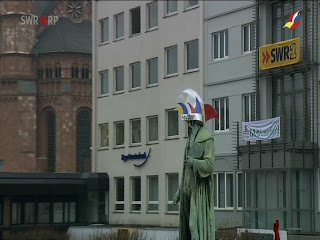
Mr. Gutenberg, too, likes to celebrate carnvial :)

Helau! Carnival in Germany (1)

Last night the German carnival came to an end as today, Ash Wednesday, marks the start of lent in the Catholic calendar. Since the Middle Ages the weeks before have been used for celebrations and fool's days on which the traditional social order was turned upside down. The instutions and rituals of the Church were parodied in "ass masses" and the choosing of a "pseudo-pope". Thus, in reference to Augustine's teachings of the two states, the Church interpreted carnival as civitas diaboli, the State of the Devil, in contrast to Lent, which was seen as civitas dei, the State of God.

In many German areas these carnival customs were lost after the reformation since the Protestant church got rid of the days of lent before Easter. In Catholic areas, however, carnival continued to be celebrated. In the towns the festivities were organized by the guilds, while the nobility held balls and masquerades in their palaces and estates. Carnival masks and costumes became more and more intricate and elaborated and were influenced by the Italian commedia dell' arte. The modern forms of carnival can be traced back to the 19th century during the years of political restoration in Germany. Modern carnival emerged as a middle-class effort with strong elements of parody of politics and the military.

Today you can find two very different forms of carnival in Germany: on the one hand you have the (political) Rhinelandish carnival (Karneval, Fasnacht, Fassenacht) with show events which combine song, dance, and speeches, and carnival parades. The strongholds of the Rhinelandish carnival are Cologne, Düsseldorf and Mainz, where the parades are held on Rose Monday, the Monday before Ash Wednesday. On the other hand, you have the Allemanic Fasnacht in southern Germany, where at the beginning of the 20th century the old forms of carnival with wooden masks were renewed. By now, each village, town and city has its own figures and masks. Here's a pic of the witches of Waldkirch (a small town in the Black Forest, which I used as a model for my fictional town of Kirchwalden in CASTLE OF THE WOLF) during the witches' sabbath on the market square:
Since those masks are rather heavy, they're usually worn only by men.


In the following you can see some pictures of the Rose Monday parade in Mainz:

the parade curves around Christ Church

the big tower of the old cathedral with the parade down below

The Ranzengarde is the oldest of the carnival guards in Mainz.
Obviously, the guards are military parodies and many of the uniforms
are modelled on the uniforms of real historical regiments.

This year about half a million people saw the parade in Mainz, and more than 9000 people took part in it and marched 7 kilometers through the city, shouting "Helau!" all the way and throwing sweets into the audience (this is why many people bring umbrellas to these parades: held upside down an umbrella is perfect for catching sweets!)