Showing posts with label Jeannie Lin. Show all posts

29 October 2012

Executed: In the Tang Dynasty

by Jeannie Lin

Despite many tantalizing stories about cruel and unusual punishments in ancient China, for instance the practice of lingchi, also known as slow slicing or death by a thousand cuts, the Tang Dynasty (618-907 AD) actually had one of the most detailed and systematic punishment systems in the ancient world.

The Five Punishments detailed how various crimes should be sentenced. Though not every magistrate necessarily adhered to this code, it prescribed a systematic way for the judicial system to hand down punishment.


The punishments continued to evolve from ancient times and by the Tang Dynasty, the five levels were the following:
  1. Caning with the light rod
  2. Beating with the heavy rod
  3. Penal servitude (forced labor)
  4. Exile
  5. Death
Punishment for women differed from men however and female criminals were subjected to their own Five Punishments.
  1. Forced labor grinding grain
  2. Squeezing of fingers between sticks
  3. Beating with a wooden staff
  4. Permission to commit suicide
  5. Confinement
Punishments were determined by a magistrate at a tribunal
 It's surprising to see that at one point during Tang Dynasty, the death penalty was actually abolished. During the reign of Emperor Xuanzong, only the emperor could sentence a convict to death. This resulted in a low number of executions throughout the empire, with only 24 executions in 730 and 58 executions in 736. In the year 747, the emperor abolished the death penalty altogether. However, after his reign was toppled by the An Lushan rebellion, the death penalty was brought back.

But it's no fun to read about how people weren't executed in the Tang Dynasty.
 
The two most common methods of execution were strangulation or beheading. Of the two, beheading was considered to be more cruel since it rendered the body incomplete and unfit for reincarnation.

The cruelest punishment involved not merely execution, but what was known as the nine familial exterminations. This practice was in effect long before the Tang Dynasty and originally dictated the extermination of a criminal's clan or tribe, which constituted an extended family. During the more "humane" times of the Tang Dynasty, the nine familial exterminations were limited to only executing parents, children above sixteen years of age, and other close relatives. Family executions were reserved for the worst of criminals: traitors to the state.

No matter what the law dictated, the one person who was above the law was the Emperor. Surprisingly, one of the cruelest executions in the Tang Dynasty was not sentenced by an Emperor. Rather, it was an execution ordered by an Empress who was going against the Emperor's wishes.


Portrait of Empress Wu Zetian
Empress Wu Zetian (625 - 705 AD) had her rivals, the former Empress Wang and Consort Xiao, accused of witchcraft  and imprisoned in the palace. When the Emperor came to see them, the two women begged for mercy and asked him to remember their past together. The Emperor showed signs of wavering and promised to release them, which only angered Empress Wu more.

She had the two women caned and then cut off their hands and feet. Then she ordered them put into two large wine jars. The two women remained in the jars for days before dying there.

Empress Wu was vilified by later generations as a usurper who tried to start her own Zhou Dynasty in the middle of the Tang Dynasty and so it's possible that stories of her cruelty might be exaggerated, but the story of having two of the Emperor's ex-wives thrown into a wine jar is an execution fit for the ages.

There is a final Halloween twist to the tale: Consort Xiao cursed the Empress before dying, threatening to be reincarnated as a cat and the Empress a mouse so she could, for ever and ever, grab her throat. The Empress banished all cats from her palace after that and was said to be plagued by nightmares of the two woman appearing with tangled hair and bloody limbs to try to kill her.


Vengeful Ghost
The moral of the story is: If you're going to be executed, come up with a curse. And make it a good one.

Happy Halloween! 


Jeannie Lin writes historical romances set in Tang Dynasty China. Her next release, THE SWORD DANCER (June 2013), explores crime and punishment and rip-roaring revenge in imperial China. Her current release, MY FAIR CONCUBINE, is currently available from Harlequin Historical. For more information about her books, go to http://www.jeannielin.com

27 March 2012

Women Who Ruled: Toregene Khatun of the Mongol Empire

Jeannie Lin

Due to the demands of living out in the harsh conditions of the steppe, Mongolian women often shared the responsibilities of hunting and herding with the men. They knew how to ride horses and shoot. With the men frequently absent to wage war, women began to wield more influence, with some notable women assuming control as rulers. 

One such woman was Toregene Khatun. Khatun is a title meaning ‘queen’ or ‘empress’. Toregene was married to Genghis Khan’s third son Ogedei and served as regent after her husband’s death from 1241 until 1246, ruling over the largest empire in the world.


Toregene was a part of the Merkit clan, but when Genghis Khan conquered the Merkits, she was given to Ogedei as second wife. She gave birth to Ogedei’s oldest son and thus acquired a higher status than his first wife.

Ogedei was known to be a drunkard and it’s believed that Toregene began to exercise influence in his absence. The oldest recorded evidence of Toregene’s authority was an order to print Taoist texts which was issued in 1240 while Ogedei was still alive, which shows that she had already established herself within the Mongol court before his death.
By custom, after the khan’s death, it was up to the khatun, his wife, to summon the Mongolian nobility to an assembly to appoint the next ruler. Toregene postponed calling the assembly and handing over command to a successor. Instead, she dismissed Ogedei’s ministers and appointed her own and the most powerful role in her court was given to another woman, Fatima, who became her chief advisor.
During her five years as regent, she showed herself to be a capable ruler, negotiating with and eventually invading the powerful Song Dynasty and fighting them to a ceasefire. Toregene may have also had a hand in shaping the political development of the region. Toregene supported Emir Arghun Aqa, who went on to be one of Persia’s most long-serving and effective governors.
When Toregene did hand over the throne, it went not to Ogedei’s favored son and chosen successor, Kochu, but to her eldest son Guyuk, who she supported. After Guyuk took the throne, he turned around and undermined her authority, having Fatima executed for witchcraft and replacing her appointed ministers. Toregene herself died a year after his succession.
Historians Juvaini and Rashid ad-Din cast Toregene as a cunning and ugly shrew – but it makes one wonder whether this was in reaction to a woman who dared to seize power and take command in an empire controlled by men.
Mongolian noblewoman: The costumes in Star Wars prequels were inspired by Mongolian clothing.
References:
Lockhart, Andrew G. “Women Behind the Throne.” http://www.andrewglockhart.co.uk/Women%20Behind%20the%20Throne%20excover.pdf (March 15, 2012)
Weatherford, Jack. “The Women Who Ruled the Mongol Empire.” The Globalist. http://www.theglobalist.com/StoryId.aspx?StoryId=4601 (June 20, 2005)
Jeannie Lin writes historical romances set in Tang Dynasty China. Her current release, CAPTURING THE SILKEN THIEF, is an ebook novella available from Harlequin Historical Undone. Her upcoming novel, MY FAIR CONCUBINE, will be available June 1, 2012 from Harlequin Historical. For more information about her books, go to http://www.jeannielin.com

14 June 2011

The Entertainers: Disciples of the Pear Garden

Jeannie Lin

The Tang Dynasty was a golden age for the arts in imperial China and the theater was no exception. In the 8th century, Emperor Xuanzong formed the first national opera troupe which primarily performed for the Emperor's pleasure. The troupe was dubbed the "Pear Garden" and opera performers to this day are referred to as "Disciples of the Pear Garden."

Throughout the Tang and Song dynasties, opera was performed in Classical Chinese, however the during the Yuan Dynasty, operas performed in the vernacular became popular. Today there are 368 forms of Chinese opera, the Beijing form being the most popular.

Chinese opera is a combination of song, instrumental music, dance, acrobatics and martial arts. The training is quite strenuous with performers usually starting at a very young age. In historical tradition, a schoolmaster would take on all the costs of training and raising the disciples. As a result, the performers would incur debt which they would repay later on as they started to perform. Jackie Chan received vocal, acrobatic, and martial arts training as a child in a Beijing Opera School. So we can credit his crowd-pleasing stunts to his operatic background. I hear he's not a bad singer either.

In traditional Beijing opera, there are specific roles: Sheng (male), Dan (female), Jing (painted-face male), Chou (comedic). Within those categories, there are further sub-categories which correspond to common archetypes, for example the elderly man, the virtuous woman, the young male, the general, the warrior. The elaborate costumes, headdress and makeup are specific to each archetype and serve to help identify the character to the audience.

One of the most famous roles in the Chinese opera is that of the Monkey King. This role requires someone with acrobatic and martial arts ability as well as great comic timing.

Much like in early Shakespearean theater, female or dan roles were played by male actors. Their costumes were modified to make the actors appear more feminine such as special shoes to make their feet appear smaller. This practice waned after women were started appearing on stage in the 1870s, though the female actors continue to play the traditional roles as they were originally written -- which was for a man impersonating a woman.

Research into the North Hamlet, the entertainment district of the Tang Dynasty, yielded some very colorful characters which will hopefully be unveiled in upcoming books.

Jeannie Lin writes sweeping historical romances set in Tang Dynasty China, featuring sword play, politics, and, above all, honor. Her Golden Heart award winning debut, BUTTERFLY SWORDS, and the linked short story "THE TAMING OF MEI LIN" are currently available from Harlequin Historical.

08 March 2011

Crime & Law Enforcement: Judge Dee

Jeannie Lin

The Tang Code was a complex legal system of offenses and punishments established during the Tang Dynasty (618-907 A.D.) Consisting of twelve sections and 500 articles, the written code was considered the pinnacle of Chinese traditional law. It became the model system for subsequent dynasties as well as other governments in East Asia such as Japan and Korea.

The code was adjudicated by an array of magistrates who played a part in the investigation of crimes as well as the meting out of punishment. The most famous of such officials is arguably Di Renjie (630-700 A.D.), a statesman and magistrate of the Tang Dynasty who was highly revered by Empress Wu Zetian for his logical nature and honesty.

During part of his career, Di Renjie served as magistrate in Pengze County before promotion to prefect and eventually becoming a trusted and longtime adviser to the Empress herself. Yet despite his illustrious imperial career, he would be relatively unknown to the West save for an interesting turn of events.

In the Ming Dynasty (18th century), a Chinese historical detective novel was written about a crime solving magistrate called Judge Dee, a figure based on Di Renjie. Robert van Gulik, a Dutch diplomat and writer, found a copy of the novel, titled Dee Goong An, in a used bookstore. He later translated the novel into English and published it as The Celebrated Cases of Judge Dee.

During the effort, van Gulik translated the text faithfully, but he recognized that the supernatural element and the heavy application of philosophy might alienate western readers. On top of that, the murderer in one of the cases was revealed at the beginning with all of his motivations laid out! What fun was that for mystery readers?

Inspired by the tales, Robert van Gulik proceeded to write his own detective stories, borrowing the figure of Judge Dee. The first one, titled The Chinese Maze Murders, contains three mysteries: "The Case of the Sealed Room", "The Case of the Hidden Testament", and "The Case of the Girl with the Severed Head". All three were based on actual Chinese casebooks and van Gulik often drew from documented cases for his material.

The series contains sixteen books featuring the crime solving Judge Dee, who uses his sharp instincts and keen judgment to investigate the crimes and piece together the mystery. True to traditional Chinese detective novels, each book usually features the investigation of three seemingly unrelated crimes. A common theme is the introduction of a seemingly supernatural element, though logic and rationality prevails in the end. Along with the mystery, readers explore the ancient Chinese landscape (though the details often represent Ming rather than Tang culture) and get a glimpse of the imperial justice system.

As a result of the popular series, Judge Dee is often referred to as the Chinese Sherlock Holmes, a sharp mind with a boxer's physique. The books feature a cast of secondaries such as Dee's three wives (it's good to be a magistrate) and the thugs and bandits who Dee is able to impress into his service with his integrity. Not to mention an array of courtesans, entertainers, merchants, noblemen, and officials. In typical whodunit fashion, the books start out with a strange murder or disappearance. Dee's mode of operation is to investigate and interrogate each witness and suspect personally, making his way through the colorful city as he chases down clues and red herrings.

Jeannie Lin writes sweeping historical romances set in Tang Dynasty China, featuring sword play, politics, and, above all, honor. Her Golden Heart award winning debut, BUTTERFLY SWORDS, and the linked short story "THE TAMING OF MEI LIN" are currently available from Harlequin Historical.

18 January 2011

Movie Adaptations: Red Cliff

By Jeannie Lin

I went to watch the US release of John Woo's Red Cliff in the theatres with my little sister. During one breathtaking battle, the film goes to ultra-dramatic slow motion as a spear flies through the air. The general leaps, his hand closes around around spear. He lands and proceeds to knock out an entire battalion single-handedly.


"Right." I hear my sister mutter beside me.

I look at her. We giggle.

Having grown up with Asian cinema, we're accustomed to the melodrama and the over-the-top heroism in "historical" movies, but even this seemed a bit much. I later remarked about the outlandish portrayal of these supermen to someone who had read the entirety of The Romance of the Three Kingdoms. She actually set me straight. These generals and soldiers were portrayed as superhuman in the written version as well. This wasn't just movie-making, Matrix-loving action.

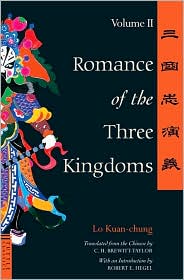
The Romance of the Three Kingdoms is considered one of the four classical novels of Chinese literature. The historical novel was written in the 14th century by Luo Guanzhong and revolves around the historical events at the end of the Han Dynasty (206 B.C. – 220 A.D.) which ushered in the Three Kingdoms period. During this period, three rival states: Wei, Wu, and Shu--represented by a cast of generals and warlords--fought for control of the Han empire.

The novel is considered a work of fiction, however it relied on historical events depicted in the Records of the Three Kingdoms, which is considered the official account as documented by historian Chen Shou in the 3rd century. Chen Shou's history is considered to be the more authentic one as it was chronicled within the same century. However, Chen Shou was assigned to document the events by the Kingdom of Wei after the kingdoms of Wu and Shu had fallen. Thus within this early chronicle, the Wei rulers were held up as emperors, while the leaders of Wu and Shu were undermined and referred to as lords or simply by name. By the time the story was retold in the 14th century, the generals and strategists of the Wu and Shu kingdoms emerge as heroes. From the beginning, the retelling of these events were a mix of fact, legend, and propaganda.

With over a thousand years of documented history, something that Chinese historians knew very well was that history was malleable; it could be changed and repackaged with each subsequent era. It was quite common for Chinese emperors to commission new historical records of previous eras and essentially rewrite history. The character of the warlord Cao Cao is depicted as a villain who is blind-sided by ambition in the movie version of Red Cliff. Throughout history, Cao Cao is either depicted as a cruel tyrant or military genius, depending on the historian.

The addition of popular culture adds another angle. Several critics of the John Woo movie have pointed out that in previous versions, including the historical records, the strategist Zhuge Liang of Wei (played by Takeshi Kaneshiro) emerges as the greater figure. Zhuge Liang is depicted in the picture the the right with his signature fan. However in the movie, military general Zhou Yu of the Wu kingdom (played by Tony Leung--depicted in foreground in poster) seems to come out on top. Perhaps this was due to Tony Leung's greater "star power"?

So it seems that in ancient Chinese historical re-tellings as well as modern ones, the figures are turned into legends, alternatively talked up or undermined, and ultimately modified for the benefit of the story. The movie adaptation of Red Cliff in this context becomes the next step in this common and ancient tradition of historical storytelling.

Jeannie Lin writes sweeping historical romances set in Tang Dynasty China, featuring sword play, politics, and, above all, honor. Her Golden Heart award winning debut, BUTTERFLY SWORDS, and the linked short story "THE TAMING OF MEI LIN" are currently available from Harlequin Historical.

15 December 2010

Accidents: Tea, From Antiquity to Modern Times

By Jeannie Lin

There are two legends about the discovery of tea: First, that it was discovered accidentally by Shen Nung, the second Emperor of China when leaves from a tea plant accidentally fell into his cup of hot water. He tasted the brew and found that it not only tasted good, but had medicinal properties.

The second legend is more fantastic. A legend dating back to the Tang dynasty states that the Buddhist monk Bodhidharma fell asleep while meditating. When he woke up, he was so upset with himself that he cut off his eyelids and threw them to the ground. Tea plants grew where they landed, providing a beverage that would keep monks and other people refreshed and alert.

In either case, tea has a long and complex history that spans the globe and includes many happy accidents:

Tea was introduced to Europe in the 17th century by Dutch and Portuguese merchants trading in China. It was originally scarce and available only to the aristocracy.

In the 19th century, China remained the sole exporter of tea to the British empire until tea was "rediscovered" also growing naturally in the Assam region of India. In 1823, Robert Bruce, a Scottish explorer traveling through, noted that the local tribespeople would brew a drink from the leaves of a local plant. He sent the leaves to botanical experts for classification and it wasn't until after his death that the verdict was returned: this was indeed a variety of the tea plant previously only found to grow in China.

Indian black tea had a stronger, darker taste than the China green tea. As a result, tea drinking habits evolved to incorporate milk and sugar.

The invention of the tea bag was itself an accident. Thomas Sullivan, a coffee merchant, sent out samples of tea in small silk sachets. He meant for the customers to open the bags and empty the contents into a teapot to steep. Instead people put the entire bag into hot water and the tea bag was born.

The tea trade influenced much of the history of East/West relations. Have you heard of any other tea "accidents" that shaped the world?

Jeannie Lin writes sweeping historical romances set in Tang Dynasty China, featuring sword play, politics, and, above all, honor. Her Golden Heart award winning debut, BUTTERFLY SWORDS, and the linked short story "THE TAMING OF MEI LIN" are currently available from Harlequin Historical.

11 December 2010

Weekly Announcements - 11 Dec 2010

First up, great news! The winner of yesterday's prize package is: GAIL! Email Carrie (contact AT carrielofty DOT com) to provide your information. Congratulations!

Join us tomorrow when we wrap up our massively awesome Fourth Anniversary Bash! We'll have OMG TWELVE books up for grabs. See you then!

***

In the meantime, former guest author Jan Scarbrough is back to help us celebrate Christmas early. She's giving away an ebook copy of the novella collection A GROOVY CHRISTMAS . Written by Jan and two other authors, the novellas are set in 1944, 1968, and 1975. Very cool! Just leave your comment in this post. I'll draw the winner on Monday morning, after all the Anniversary Bash hubbub has died down!

***

If you haven't seen this week's posts at the RT Book Reviews blog, do check them out. Carrie Lofty, Blythe Gifford, Elizabeth Lane, Michelle Styles, and a couple intrepid Unusual Historicals contributors all wrote new material to celebrate our anniversary week.

Among those posts, Elizabeth revealed the cover to her March release, THE WIDOWED BRIDE, set in the 1920s. In addition, Michelle's post on the international market for Harlequin was linked to by Dear Author.

***

Congratulations to Zoe Archer, whose second "Blades of the Rose" book, SCOUNDREL, was selected by Smart Bitch Sarah Wendell as one of her top picks for 2010. Jeannie Lin's BUTTERFLY SWORDS was also chosen! What a cool pair of selections to represent the best in exotic historical romance. We're very proud!

You can read the entire list on the Kirkus Romance Blog.

***

UH reader and author Kelly Heckart wrote in to ask that we announce the release of her latest paranormal historical romance, set in 6th century Scotland. Happy to, Kelly! BELTAINE'S SONG is the second book in the "Dark Goddess" trilogy, available now from Awe-Struck.

***

Would you like an early Christmas present? Bookstrand has Lindsay Townsend's romance, FLAVIA'S SECRET on offer as a free ebook from now until Valentine's Day. FLAVIA'S SECRET is set in ancient Roman Britain in 206AD. If you haven't tried one of Lindsay's books yet, here's a chance!

***

We'll also draw the winner of Michelle Styles's trio of romances from Harlequin Mills & Boon. You still have time to leave a comment or question for your chance to win.

***

Stay with us through the coming weeks when we'll be featuring the best unusual historical authors! Michelle Beattie, Elizabeth Lane, Alix Rickloff, and Lorelie Brown will be our guests. Join us!

***

Remember, you don't have to be an Unusual Historicals contributor to submit good news to the weekend announcements. If it has to do with unusual historicals, we'd love to shout it out to the world! Send announcements to Carrie. See you next week...

09 December 2010

Anniversary Bash: Day Four!

First things first and that would be yesterday's winners! RomanceLover88, you win the pack from Michelle Styles. Zai Abd Rahman, you get the ebooks. You each have 24 hours to contact myself (lorelielong at gmail dot com) or Carrie Lofty (contact at carrielofty dot com) to collect your prizes.

It's Thursday and the work week is almost over. What better way to celebrate than winning a hefty stack of books from Unusual Historicals authors? Personally, I don't think you can beat that with a stick. Today's prize is a big ole stack of eight books, and all but one are signed! Isn't that cool?


Beverly Jenkins:

Wild Sweet Love


The Horseman's Bride


Maureen Lang:

Whisper on the Wind


Jade Lee:

Wicked Surrender


Jeannie Lin:

Butterfly Swords


Blythe Gifford:

Innocence Unveiled


Alex Beecroft:

False Colors (I don't know if y'all care, but this was one of my favorite books of last year.); Captain's Surrender


Personally, being able to give away all these great books is definitely putting me in the holiday spirit. It's practically Christmas, right? So to be entered in today's drawing, tell me what you want for Christmas.


Pseudo-lawyer disclosures: These books can only be shipped within the US. All entries must be accompanied by a valid email address. Void where prohibited. Don't take candy from strangers.


***


Lorelie Brown's first book, JAZZ BABY, is currently available from Samhain Publishing and will be released 4 January in paperback. Her second romance, an 1880s-set western, will be published by Carina Press in Summer 2011.

09 November 2010

Real Life Heroes: Tenzin Gyatso, the Dalai Lama

By Jeannie Lin

To be honest, the idea for this post came from a Twitter feed. Every morning the Dalai Lama sends out a message to the world. One such message: "Anger may bring extra energy, but it eclipses the best part of our brain: its rationality. The energy of anger is almost always unreliable."

Though I doubt His Holiness is personally typing his tweets every day, the fact that the Dalai Lama is on the interwebs made me wonder about the complexities of being a political and spiritual leader in modern times.

According to author Thubten Samphel-Tendar in the The Dalai Lamas of Tibet, the leaders Tibet sent a delegation to meet with Genghis Khan in 1207. As a result, the Mongol ruler spared Tibet from his conquest of most of Asia. Subsequently, a symbiotic relationship formed between the Mongols and Tibet where the Tibetans served as spiritual advisers while the Mongols provided protection.

In accordance with such a relationship, the title of "Dalai Lama" was first bestowed in 1578 by the Mongol ruler, Altan Khan, to Sonam Gyatso, who is actually known as the Third Dalai Lama. The title was posthumously applied to Sonam Gyatso's two previous incarnations.

1st Dalai Lama

The Dalai Lama is traditionally believed to be the reincarnation of the Bodhisattva Guan Yin. A "bodhisattva" is a person who has achieved enlightenment, but has chosen to stay on this earth to guide others. There have been 14 recognized incarnations of the Dalai Lama.

The Dalai Lama is the leader of the Guleg or Yellow Hat sect of Buddhism and has traditionally served as the head of the Tibetan government. For this reason, the position is both a spiritual and a political one. Since the position's inception, there have been rival and puppet Lamas propped up in power struggles to control Tibet. Many were suspected of being poisoned or assassinated.

The 13th Dalai Lama took more active part in government and issued a formal Declaration of Independence for Tibet from China. He attempted to establish an autonomous government and modernize Tibet. The 14th and current Dalai Lama, Tenzin Gyatso, was not crowned until 1950; 17 years after the previous Dalai Lama's death. His Holiness Tenzin Gyatso took the position in a time of turmoil. China invaded Tibet in 1950 and nine years later, the Dalai Lama fled the country to establish a "government in exile" in India.

Despite coming from a pacifist religion and a monastic culture that was traditionally isolated and hidden from the public, the current Dalai Lama has taken an active role in the world stage, drawing awareness to the plight of Tibet and proposing plans before the UN, the U.S. Congress and the European Parliament to negotiate peace between China and Tibet and convert Tibet into a zone of peace within Asia.

As a leader of the Tibetan government in exile, he's worked to develop a plan for a democratic Tibet and has instituted an election to democratically select the leaders of Tibet. The Dalai Lama has declared that once Tibet is free, he will step down as its leader and relinquish that position to a democratically elected president.

In 1989, His Holiness Tenzin Gyatso received the Nobel Peace Prize. In his acceptance speech, he stated: "Although I have found my own Buddhist religion helpful in generating love and com passion, even for those we consider our enemies, I am convinced that everyone can develop a good heart and a sense of universal responsibility with or without religion."

This all-encompassing message of openness and peace is why the Dalai Lama is recognized as an influential leader, thinker, and advocate with a message that resonates with millions of people all over the globe.

18 October 2010

BUTTERFLY SWORDS Winner!

We have a winner for Jeannie Lin's BUTTERFLY SWORDS guest blog. A free copy goes to:

CID!

Contact Carrie to provide your mailing address. The book must be claimed by next Sunday or another winner will be drawn. Please stop back later to let us know what you thought! Congratulations!

15 October 2010

Weekly Announcements - 15 Oct 2010

An excerpt of Jean Adams' Egyptian time travel romance, ETERNAL HEARTS, is available here, along with her guest blog "Write Like An Egyptian."

***

Jeannie Lin's debut novel, BUTTERFLY SWORDS, was released on October 1. It received a four star review from RT Book Reviews, as well as 9 1/2 stars from The Season and Top Pick for October.

From The Season: "The world of Tang Dynasty China Lin creates is far different from the ballrooms of Regency England or the Scottish cliffs of a highlander novel. But this historical romance is as unique and spellbinding for its meticulously researched and sweeping setting as for its suspenseful danger, and its themes of love, family, and honor. Not to mention the hero is hands down a Hero To Die For!"

Dear Author and Kobo Books are partnering in a special promotion in October. Purchase a copy of BUTTERFLY SWORDS from Kobo Books between October 1 and October 31 and be entered in a giveaway drawing. One random person will be selected to receive a free Kobo Reader. Details here.

In addition, Jeannie is continuing her road show with a signing at Barnes & Noble in Crestwood, MO on October 16, along with authors Jim and Shannon Butcher. Jeannie will also be signing at the NJRW conference literacy signing on October 23. For more info on signings, click here.

***

Margaret Mallory's KNIGHT OF PLEASURE won the Georgia RWA's prestigious Maggie award in the historical category.

***

The second of Zoe Archer's "Blades of the Rose" series, SCOUNDREL, has been making big news. It received an in-depth review from Dear Author, a fantastic 88 from Mrs. Giggles, and was selected as Smart Bitch Sarah's Sizzling Book Club Selection for October.

***

Congratulations to Lindsay Townsend, who just accepted an offer of representation from the Roberta Brown Literary Agency.

***

Michelle Styles' THE VIKING'S CAPTIVE PRINCESS has been translated into Italian as IL SEGNO DEL PECCATO, available here.

***

Join us Sunday when RENEE RYAN will be here to chat about her WWII-set romance, DANGEROUS ALLIES. She'll also be giving away a copy to one lucky commenter! Be sure to join us then.

***

We'll also draw the winner of JEANNIE LIN's BUTTERFLY SWORDS guest appearance on Sunday. You still have time to leave a comment or question for your chance to win.

***

Stay with us through the coming weeks when we'll be featuring the best unusual historical authors! BETH TRISSEL, DELIA DeLEEST, JANE GOODGER, and LAURA NAVARRE will be our guests. Join us!

***

Have a good weekend! Remember, you don't have to be an Unusual Historicals contributor to submit good news to the weekend announcements. If it has to do with unusual historicals, we'd love to shout it out to the world! Send announcements to Carrie. See you next week...