
Showing posts with label San Francisco. Show all posts

25 August 2010

Tragic Tales: Chinese Slave Girls of the Barbary Coast

By Jacquie Rogers

The California gold rush of 1849 brought men from all over the world, including China, to find their fortune. The next gold rush was of a different nature--those who provided services to the miners...for a pinch or two of gold dust.

Barbary Coast was the section of San Francisco that harbored the red light district. It was rife with gambling, prostitution, pickpockets, and violent crime. The streets were crowded with brothels, gambling houses, saloons--this was where the rowdiest of the rowdy men went to kick up their heels. The Barbary Coast was also home to the cribs--low-class prostitution housing--and small Chinese girls pleading for the men walking by to use her services.

In China girls weren't valued, and many girls, even babies, were sold to "entrepreneurs" who took them to America to be used as sex slaves. In San Francisco, girls were bought and sold--a baby sold for a little over $100. These girls were raised to prostitute themselves.

This is from The Virtual Museum of the City of San Francisco, quoted from A la California: Sketch of Life in the Golden State by Albert S. Evans:
These poor creatures are all slaves, bought with a price in China, and imported by degraded men of their own race, who, despite our laws, contrive to hold them to a life-long servitude, which is a thousand times more hopeless and terrible than the negro slavery of Louisiana or Cuba could ever be. They have been reared to a life of shame from infancy, and have not a single trace of the native modesty of women left. They are, as we have said, mere children in point of intellect, having no education whatever, and no experience of the world outside of the narrow alleys in which they have always lived, and the emigrant ship in which they were brought over to this country...

The girls cost $40 each in Canton, but are valued here at about $400, if passably good-looking, young and healthy, and readily sell at that figure in cash, or approved paper. Each colony of half a dozen girls is under the immediate control of an "old mother," herself a retired prostitute, who jealously watches over each, and receives from them the wages of their shame as fast as earned.
Officials looked the other way for two reasons. First, they were paid off by the Chinese merchants, and second, they didn't consider the Chinese all the way human. Chinese girls were no more significant, and less valuable, than a horse. Once a girl was sold into slavery, there was no help for her.

These girls were also called sing-song girls and worked in small rooms lining the cribs alleyways. The girls would bare their breasts to passers-by. If they didn't attract enough customers, they were often physically punished. During their periods, if they had any, they were considered sick and that missed time was added to her contract.

This is from http://www.foundsf.org/:
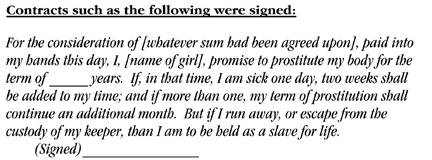
Opium was administered to them for every ailment, and many girls were addicted. Once a girl's looks had faded and/or her health deteriorated, usually before age 20, she was placed in a room with a vial of narcotics. She could either take the overdose, starve, or if she wasn't dead when they came for her corpse, she was murdered. These murders weren't reported or even noted by the authorities.

One white woman who didn't look the other way was Donaldine Cameron, the Angry Angel of Chinatown. She was born in New Zealand and came to California with her parents when she was a child. At 18 she was engaged, but no one seems to know why she never married. In 1895 she took a position as a sewing teacher at the Occidental Mission Home for Girls and became a crusader for these abused girls no one else cared about. Over a period of 40 years, she was instrumental in the rescue and education of over 3,000 Chinese girls. Miss Cameron used sledgehammers and axes to get to the girls, and learned early on to find more girls in hidden in walls and under the floor boards. Of course the slavers hated her, calling her Fahn Quai--white devil.

History books teach that slavery ended in the United States with the Civil War, but that wasn't so for the sing-song girls of the Barbary Coast, who, in many cases, worked in worse circumstances than the slaves of the South, with a far shorter life expectancy. Finally, 75 years after the Emancipation Proclamation, the Chinese slave trade ended. It's a blight on American history that we should never forget.

Jacquie

Down Home Ever Lovin' Mule Blues (See the Book Video featuring Justin Saragueta)
Jacquie's Website * 1st Turning Point * Myspace * Twitter * Facebook
Faery Special Romances (Book Video) * Royalties go to Children's Tumor Foundation, ending Neurofibromatosis through Research


Read a book by Jacquie Rogers

03 May 2010

Disasters: The San Francisco Earthquake

By Elizabeth Lane

In 1906, San Francisco's fire department was one of the most modern and efficient in the world. At the sound of alarm bells, the superbly-trained firemen could hitch the horses, fire up the steam pump and be on their way to a fire in ninety seconds. They had to be good. In a city built mostly of wood, even a small fire could blaze out of control in no time.

The 58 fire companies were on constant alert to keep the city safe. The man responsible for them all was their legendary chief, Dennis Sullivan. A vigorous man of 53, Sullivan had been at his post for 13 years. His men loved him, and there was nothing about fighting fires he didn't know. He had lobbied the city government for years to get the failing water pipes and cisterns repaired and to build a line to pump water from the bay in case of a big fire. "This town," Sullivan had declared, "is in an earthquake belt. One of these fine mornings we'll get a shake that will put this little water system out, and then we'll have a fire. What will we do then?"

His prediction came true on April 18, 1906 at 5: 12 a.m. The animals sensed it first--dogs barking, horses shifting and whinnying. Then, as a distant rumbling rose to a deafening roar, the quake thundered through the city. The first shock lasted forty seconds, followed by a brief silence and another twenty-five second shock--little more than a minute in all. But to the million Californians who felt it, the quake seemed to last forever. The heaving, cracking earth toppled chimneys and towers, splintered rows of frame houses, twisted steel rails, bridges and pipelines. People and animals were crushed by collapsing buildings and falling brick walls.

Dennis Sullivan and his wife Margaret were asleep in their rooms on the third floor of the Bush Street fire station. The dome of the California Hotel next door toppled onto the roof of the fire station, crushing the building. When Sullivan sprang out of bed to find his wife, who'd been sleeping in the next room, he fell through the floor, all the way to the basement, where he was scalded by the steam boiler. His men dug him out of the rubble and rushed him to a hospital. Mrs. Sullivan survived, but Dennis Sullivan never recovered from his injuries. He would die four days later.

In the silence that followed, survivors poured into the streets, gaping in horror at the damage. The scene that met their dazed eyes looked like the end of the world. But the worst was yet to come. Fueled by broken gas mains, fires began to flare in the city. The firemen rushed to do what they could. But the odds were stacked against them. Water was in short supply, the water mains broken, the cisterns in such poor condition that many of them were empty. And the men had lost their beloved chief.

The wooden buildings burned like tinder. The heroic firemen were driven back as fire swept through the towering office buildings and hotels in the downtown area. The wealthier neighborhoods had suffered little damage from the quake because they were built on solid rock. Now, with water gone, the military commander, General Funston, ordered that many of these homes be dynamited to create firebreaks.

Unfortunately the one man who knew how to use dynamite in fighting fires--Chief Sullivan--was gone. As a result, many buildings were blown up unnecessarily, and some fires were even started by the dynamite. The fires raged for three days. By the time the Saturday evening rain dampened the ashes, 490 blocks, totaling 2831 acres, had been burned and more than 450 lives had been lost. Perhaps the most tragic loss of all was the man who, had he lived, might have been the hero who saved much of the city.

But the spirit of San Francisco was undaunted. Within days, aid was pouring in, and the cleanup and rebuilding had started. The city was on its way to becoming even greater than before.

My April 2009 Harlequin Historical, HIS SUBSTITUTE BRIDE, is set against the backdrop of 1906 San Francisco in the last days before the quake and fire. It's a story of devotion, danger and sacrifice. I hope you'll enjoy it.

12 April 2009

HIS SUBSTITUTE BRIDE Winner!

We have a winner for Elizabeth Lane's HIS SUBSTITUTE BRIDE book release party. A free copy goes to:

MARIE!

Contact Elizabeth to give her your address. The book must be claimed by next Sunday or another winner will be drawn. Please stop back later to let us know what you thought! Congratulations!

05 April 2009

Book Party: Elizabeth Lane

It's Sunday on Unusual Historicals, which means time to talk with another wonderful author and try to win a free book. Weekends, they are good! This week we're featuring contributor Elizabeth Lane as she celebrates the release of her latest book, HIS SUBSTITUTE BRIDE, set during the 1906 San Francisco earthquake.

***

Dashing but cynical Quint Seavers lives for danger. A past betrayal has made him wary of love, and he has no idea that independent, practical Annie Gustavson holds a secret longtime passion for him. Nor does he realize that the only reason Annie has traveled to San Francisco is to win his love--or walk away forever. When disaster strikes the city, Annie's courage and determination match his own--and suddenly Quint knows that she's exactly what has been missing from his life all along...
***

Tell us about yourself, Elizabeth!

I'm a westerner by birth and upbringing. My grandparents lived like pioneers and my great-grandparents were pioneers. I grew up in a small town, in a family of people who loved the outdoors. Maybe that's why writing Western romance comes so naturally to me. But I can and do write other things. My earliest books were historical sagas. Then the market changed and I found a new home at Harlequin Historicals. Counting a couple of ghost writing projects, I'm coming up on 33 books. Twenty-six of those have been for Harlequin--three contemporaries, but the rest historicals.

What can you tell us about your newest book, HIS SUBSTITUTE BRIDE?

HIS SUBSTITUTE BRIDE is an April 2009 release from Harlequin Historicals. Those of you who met the Seavers brothers, Judd and Quint, in THE BORROWED BRIDE will be happy to know that in this sequel, set six years later, Quint and Annie finally get their chance to fall in love.

The story takes place in 1906 San Francisco in the days prior to the catastrophic earthquake and fire. Quint, a crusading reporter, has invited Annie to bring Clara, the little girl he fathered in the previous book, to San Francisco for a visit. The three of them become enmeshed in a web of intrigue and danger--a danger that will demand the ultimate sacrifice.

What was it like to research this book?

Researching HIS SUBSTITUTE BRIDE was fascinating work. The 1906 earthquake and fire are so well documented that I had no excuse for not getting it right. I found some wonderful books filled with authentic photographs and personal accounts. There are so many stories about the quake, so many tales of tragedy, irony and heroism. In addition to the books I read, I found a couple of excellent documentary films. Even the old movie San Francisco with Clark Gable and Jeanette McDonald gave me some ideas to add to the flavor of the book.

I also paid a visit to present day San Francisco. Since my daughter lives in the Bay area, I was able to combine my research with a family visit. She and I trekked all over the city, looking for historic spots and having a wonderful time.

One of my biggest challenges was finding an accurate map of 1906 San Francisco. The street layout was much the same as it is today, but entire neighborhoods and many important sites were destroyed by the earthquake and fire. When I finally found the map that could help me I kept it in front of me the entire time I was writing the book. Since setting plays such an important role in this story, I hope my research will add to the reader's understanding and enjoyment.

What do you do when you're not writing?

I love adventure. Over the years I've lived in Mexico, Guatemala, Panama and Germany and traveled to such exotic spots as China, Nepal, Tanzania and Peru. I've chased whales in a rubber boat, rafted the grand canyon and taken a flying lesson. When I'm not writing I like to be moving--I belly dance, hike and do yoga. I also volunteer as a zoo docent and enjoy teaching children about animals. After 23 years working as an educational software designer, I finally get to write full time. I like to think my writing career is just getting started!

***

REVIEW QUOTES:
HIS SUBSTITUTE BRIDE is a beautifully written story about discovering the true gift of love. Annie has loved Quint for so long it was heartbreaking to think that her dream would never come to be, but in the end Quint proved what a true hero he is. Elizabeth Lane first introduced Annie and Quint in the previous story THE BORROWED BRIDE and since that time I have been anxiously waiting for Annie and Quint's story. As impatient as I am I have to say that HIS SUBSTITUTE BRIDE was well worth the wait and truly deserving the five blue ribbon rating that I am giving it.
--Dina Smith, Romance Junkies

"...Author Elizabeth Lane has set a first rate suspense against the background of 1906 San Francisco and the earthquake that defined that city. She's also created a sensual romance where secrets won't stay buried. With a hero who has to learn boundaries and a heroine who needs to spread her wings, Ms. Lane gives readers characters who tug at your heart strings as they face danger around every corner. Especially poignant is the little girl Clara, blissfully unaware of the threats swirling about her. A captivating romance, an intriguing suspense and characters that make you care."
Carol, Love Western Romance
***

Thanks for being with us, Elizabeth!

If you'd like a shot at winning a copy of HIS SUBSTITUTE BRIDE, leave a comment or question for Elizabeth. I'm particularly interested in what Elizabeth's done by setting a novel in the urban West, which is hardly ever seen. Would you be interested in Westerns set in cities? Or are you a ranch-and-cowboys sort of reader? Open up! Let us know! We'll draw a winner at random next Sunday.

02 April 2009

Excerpt Thursday: Elizabeth Lane

This week for Excerpt Thursday, we're featuring a choice morsel from Elizabeth Lane's newest release, HIS SUBSTITUTE BRIDE, which is set during the 1906 San Francisco earthquake.

HIS SUBSTITUTE BRIDE is available from Harlequin Historicals as an April 2009 release. Join us again on Sunday when Elizabeth will be discussing her book and giving away a copy!

***

San Francisco, April 13, 1906

By the time Quint found the woman, she was dying. She lay face-up on the checkered linoleum, a dollar-sized crimson stain oozing through the fabric of her plain white shirtwaist. It appeared she'd been stabbed.

"Virginia!" Quint crouched beside her, clasping her hand. "Can you hear me? It's Quint Seavers!"

The blood-frothed lips moved slightly, but no sound emerged. She was a slight creature, about thirty, he judged, her plain features made plainer by the thick spectacles that lay askew on her nose. Quint was meeting her in person for the first time. But he already knew Virginia Poole to be honest and brave. The man responsible for this was damned well going to pay.

"The letter, Virginia!" His fingers tightened around hers. "Where is it? Can you tell me?"

But she was already gone, slipping away without a sound.

Releasing her hand, Quint cast his eyes around the shabby one-room apartment. The place had been ransacked. Furniture had been toppled, clothes thrown helter skelter. Kitchen cupboards had been emptied, their contents strewn on the floor. The Murphy bed, which took up one wall, had been lowered, the mattress, quilt and pillow ripped to pieces.

Feathers eddied in the gas lit room, blown by a chilly draft from the open window. Whoever was here hadn't been gone long. They'd probably climbed over the sill when they'd heard Quint pounding on the door. Judging from the mess, and the hasty departure, he'd bet good money they hadn't found what they were looking for.

And neither would he.

Quint cursed in frustration. The handwritten letter, linking Supervisor Josiah Rutledge to a crooked scheme involving funds for the city's water system, would provide enough evidence to bring Rutledge down. Even more important, it would alert the public that this critical work wasn't being done.

Quint had written more than a dozen articles for the San Francisco Chronicle, stressing the urgent need to repair the city's crumbling network of pipes, aqueducts and cisterns and build a line to pump water out of the bay. Just last week he'd interviewed Dennis Sullivan, the city's longtime fire chief, who'd stated that, given the faulty water system, a major fire could destroy much of the city, with loss of life in the hundreds, if not the thousands.

For a balanced perspective, he'd also interviewed Mayor Eugene Schmitz and Supervisor Rutledge. Both had insisted that repairs were being made in good order.

And pigs could fly, Quint had groused as he left City Hall. Schmitz was almost as crooked as Rutledge. The whole mess stank like rotten fish. But he couldn't just start making accusations. He needed solid proof.

The key to that proof had come yesterday, in the form of a phone call to his desk at the Chronicle. Virginia Poole, a clerk on Rutledge's staff, had, by sheer accident, come across the damning letter in a stack of papers she'd been given to file. Knowing what she had, and being a woman of conscience, she'd called Quint and offered to give the letter to him.

He'd arranged to meet her the next evening in a book shop off Portsmouth Square. When she'd failed to show up, Quint, who'd had the foresight to ask for her home address, had sensed that something was wrong.

Sadly, his instincts had been right.

Leaving by the back stairs, Quint slipped into the alley and cut a meandering course down Telegraph Hill to Montgomery Street. The mist-shrouded night was damp and chilly, the lighthouse a great blinking eye in the darkness behind him. Foghorns echoed mournfully across the bay.

Thrusting his hands into his pockets, Quint lengthened his stride. Tomorrow at work he would call in some favors, find out whether Virginia's murder was being investigated or merely hushed up. He would also make inquiries about her daily routine, talk to her friends, her family if she had any. With luck, maybe he could--

Oh, bloody hell!

Quint halted as if he'd slammed into a brick wall.

Tomorrow morning Clara and Annie would be arriving by train, all the way from Dutchman's Creek, Colorado. Quint had arranged to take the entire week off. He had cleared his calendar of appointments, freeing his time to show them the city.

For weeks he'd looked forward to the visit. Six-year-old Clara was the most important person in Quint's life. Every minute with the little girl was a gift. And Annie Gustavson, her maternal aunt, was always pleasant company. Neither of them had ever been to California. They were eager to experience the marvels of San Francisco.

Now this mess had dropped into Quint's hands, and he had no choice except to deal with it.

It was too late to postpone the visit. Their train would be arriving at the Oakland terminal at 11:00 tomorrow morning. After such a long trip, he could hardly put them back on board and send them home. Nor could he walk away from a story so rife with urgency.

What the devil was he going to do?

Quint hailed a cab to take him back to his Jackson Street apartment. Somehow, for the coming week, he would have to be in two places at once. If it meant working early mornings and late nights, or leaving Clara and Annie on their own once in a while, that couldn't be helped. Virginia Poole had given her life to expose Rutledge. Whatever it took, Quint vowed, he would make sure she hadn't died in vain.

***

You can read the rest of chapter one here!

25 March 2009

Food & Drink: Dining at Demonico's

By Elizabeth Lane

In history, literature and movies, the name Delmonico's has been synonymous with elegance, class, fine wines and decadent gourmet dining. Here, briefly, is the story behind that famous name.

Delmonico's Restaurant was one of the first continuously run restaurants in the United States and is considered to be one of the first American fine dining establishments. It opened in New York City in 1827, originally in a rented pastry shop at 23 William Street. It was first listed as a restaurant in 1830. Unlike the inns that existed at the time, a restaurant like Delmonico's would permit patrons to order from a menu (à la carte), rather than requiring its patrons to eat fixed meals. Later, Delmonico's was also the first in the United States to use a separate wine list.


The restaurant was opened by the brothers John and Peter Delmonico, from Ticino, Switzerland. In 1831, they were joined by their nephew, Lorenzo Delmonico, who eventually became responsible for the restaurant's wine list and menu. In 1862, the restaurant hired Charles Ranhofer, considered one of the greatest chefs of his day. Beginning in the 1850s, the restaurant hosted the annual gathering of the New England Society of New York which featured many important speakers of the day. In 1860, Delmonico's provided the supper at the Grand Ball welcoming the Prince of Wales. Supper was set out in a specially constructed room; the menu was French, and the pièces montées represented Queen Victoria and Prince Albert, the Great Eastern and Flora's Vase. The New York Times reported, "We may frankly say that we have never seen a public supper served in a more inapproachable fashion, with greater discretion, or upon a more luxurious scale."

Famous patrons included Jenny Lind (who, it was said, ate there after every show), Theodore Roosevelt, Mark Twain, "Diamond Jim" Brady, Lillian Russell (usually in the company of Diamond Jim), Charles Dickens, Oscar Wilde, J.P. Morgan, James Gordon Bennett, Jr., Walter Scott, Nikola Tesla, Edward VII (then the Prince of Wales), and Napoleon III of France.

The restaurant was so successful that it soon expanded to four New York locations and eventually to other major cities. A scene from my April Harlequin Historical, HIS SUBSTITUTE BRIDE, takes place in the San Francisco Delmonico's. That restaurant initially survived the disastrous 1906 earthquake and fire, but during the military occupation that followed, some celebrating soldiers, feasting on leftover food and wine, accidentally set the place on fire and burned it down.

Eventually the restaurant fell on hard times. In 1923 Delmonico's closed its doors for good and lost the exclusive rights to its name. No restaurant named Delmonico's today is connected to the original.

Some of the dishes first served at Delmonico's are still famous today. Lobster Newberg and Delmonico Potatoes were invented at Delmonico's restaurant, and possibly Chicken à la King, but it was most famous for Delmonico steak. Eggs Benedict were also said to have originated at Delmonico's; although, others claim that dish as well.

A chef named Alessandro Filippini incorporated many of the original recipes into a cookbook. Here's one recipe you probably won't want to try.

Delmonico's Recipes from a "Gilded Age"
An 1894 Thanksgiving Terrapin, a la Gastronome
From The Table, by Alessandro Filippini

Take live terrapin, and blanch them in boiling water for two minutes. Remove the skin from the feet, and put them back to cook with some salt in the saucepan until they feel soft to the touch: then put them aside to cool. Remove the carcass, cut it in medium-sized pieces, removing the entrails, being careful not to break the gall-bag.

Put the pieces in a small saucepan, adding two teaspoonfuls of pepper, a little nutmeg, according to the quantity, a tablespoonful of salt, and a glassful of Madeira wine. Cook for five minutes, and put it away in the ice-box for further use. Put in a saucepan one pint of Espagnole sauce and half a pint of consommé. Add a good bouquet, one tablespoonful of Parisian sauce, a very little red pepper, the same of nutmeg, and half a glassful of Madeira wine. Boil for twenty minutes, being careful to remove the fat, if any; add half a pint of terrapin and boil for ten minutes longer. Then serve with six slices of lemon, always removing the bouquet.

25 February 2009

Humans in Nature: City Parks

By Vicki Gaia

It seems when we live within steel and cement, we need to a place where we can escape and just breathe. Parks have interesting histories. During major eras, parks have served beyond being pleasure playgrounds.

Every major city has it's city park--a natural landscape for the residents where the traffic noise dims, life slows down and a person can think beyond the mundane daily tasks that takes up one's life. Nature feeds the creative soul of humanity. We cannot live in a world separated from Earth's bountiful nature.

London is amazing for all the green belts scattered throughout the great metropolis. Hyde Park, once Henry VIII's hunting ground, covers 350 acres. On any given day, you see horseback riders, joggers, people picnicking to capture the rare sunshine.

During WWII, statues were replaced by anti-aircraft guns. One could hear the ack-ack fire from the park during the terrifying Blitz. The park transformed in wartime to serve the needs of Londoners besides being a place of escape.

Royal Parks

New York has its Central Park designed by Frederick Law Olmstead and Calvert Vaux in 1853-1878. A Victorian landmark, it became the prototype of the city park movement that spread throughout Victorian America. Families could stroll along the trees, meadows and waterways, listen to concerts and go boating.

Olmstead believed pleasure parks were necessary, "in a direct remedial way to enable men to better resist the harmful influences of ordinary town life and to recover what they lose from them."

The practical purpose of a city park was to prevent the spreading of infectious diseases, curb alcoholism, promote civic pride and control the 'masses' from getting out of control.

Central Park

Golden Gate Park is one of San Francisco's crown jewels. You have the untamed wild beauty mixed with manicured landscapes dotted with museums, botanical gardens and a Japanese Tea garden. I've spent many afternoons in the park, listening to music, visiting an art exhibit, hiking the trails through Eucalyptus groves.

During the Sixties, it was the 'in place' to hang out. Several famous rock bands played for free. The Human Be-In, billed The Gathering of the Tribes in "a union of love and activism," took place in the park. It was 1967, the Summer of Love. The quintessence SF bands, Jefferson Airplane and the Grateful Dead rocked the crowd. Allen Ginsberg sang alone, and Timothy Leary told everyone to "turn on, tune in, and drop out!"

National Golden Gate Recreation Area

18 February 2009

Humans in Nature: San Francisco in Flames

By Elizabeth Lane

Thursday, April 18, 1906, 5:12 a.m.

San Francisco, the Paris of the West, was just awakening to a new day when disaster struck. The animals sensed it first--dogs barking, horses shifting and whinnying. Then, as a distant rumbling rose to a deafening roar, the quake thundered through the city.

Witnesses described how they could actually see the quake coming. "The whole street was undulating," police officer Jesse Cook recalled. "It was as if the waves of the ocean were coming toward me, billowing as they came."

The first shock lasted forty seconds, followed by a brief silence and another twenty-five second shock--little more than a minute in all. But to the million Californians who felt it, the quake seemed to last forever. The heaving, cracking earth toppled chimneys and towers, splintered rows of frame houses, twisted steel rails, bridges and pipelines. People and animals were crushed by collapsing buildings and falling brick walls.

In the silence that followed, survivors poured into the streets, gaping in horror at the damage. The scene that met their dazed eyes looked like the end of the world. But the worst was yet to come.

Fueled by broken gas mains, fires began to flare in the city. San Francisco's superbly trained firefighting crews, the best in the nation, rushed to do what they could. But the odds were stacked against them. Water was in short supply, the water mains broken, the cisterns in such poor condition that many of them were empty. And their beloved chief, Dennis Sullivan, who had trained and led his crews for years and who knew more about fighting fires than anyone in the city, lay dying in an emergency hospital, mortally injured in the quake.

Most of the structures in San Francisco, especially in the vast working class neighborhoods, were made of wood. They burned like tinder. One of the worst blazes, known as the Ham and Eggs Fire, was started when a woman lit her stove to cook breakfast. Soon much of the city was ablaze. The heroic firemen were driven back as fire swept toward the towering office buildings and hotels in the downtown area.

The wealthier neighborhoods had suffered little damage from the quake because they were built on solid rock. Now, with water gone, the military commander, General Funston, ordered that many of these homes be dynamited by the army to create firebreaks. Unfortunately the one man who knew how to use dynamite in fighting fires--Chief Sullivan--was gone. As a result, many buildings were blown up unnecessarily, and some fires were even started by the dynamite.

By that afternoon the downtown area was on fire, its tall buildings going up like torches. People were leaving the city by the thousands, burdened with their most precious possessions. Some were herded to refugee centers set up in the parks and in the Presidio, where the military base was located. Some took the long road south, out of the city. Others trooped toward the waterfront--saved by the navy fireboat crews--and lined up for the ferry to Oakland. From the safety of the water they looked back on a city ablaze from horizon to horizon.

The fire raged for three days. By the time the Saturday evening rain dampened the ashes, 490 blocks, totaling 2831 acres, had been burned and more than 450 lives had been lost.

But the spirit of San Francisco was undaunted. Within days, aid was pouring in, and the cleanup and rebuilding had started. The city was on its way to becoming even greater than before.

My April Harlequin Historical HIS SUBSTITUTE BRIDE, is set against the backdrop of 1906 San Francisco in the last days before the quake and fire. It's a story of devotion, danger and sacrifice. I hope you'll enjoy it.