Showing posts with label Mexico. Show all posts

15 June 2014

Author Interview & Book Giveaway: Claudia H. Long on THE DUEL FOR CONSUELO

This week, we're pleased to welcome author Claudia H. Long with her latest novel, THE DUEL FOR CONSUELO. The author will offer a free copy of The Duel for Consuelo to a lucky blog visitor.  Be sure to leave your email address in the comments of today's author interview for a chance to win. Winner(s) are contacted privately by email. Here's the blurb.

The second novel of the Castillo family, The Duel for Consuelo is the gripping, passionate story of a woman struggling to balance love, family, and faith in 18th century Mexico - a world still clouded by the Inquisition.

History, love, and faith combine in a gripping novel set in eighteenth century Mexico. In this second thrilling story of the Castillo family, the daughter of a secret Jew is forced to choose between love and the burdens of a despised and threatened religion. The Enlightenment is making slow in-roads, but Consuelo’s world is still influenced by the dark cloud of the Inquisition. Forced to choose between protecting her ailing mother and the love of a dashing Juan Carlos Castillo, Consuelo’s personal dilemma reflects the conflicts of history as they unfold in 1711 Mexico. It's a rich, romantic story illuminating the timeless complexities of family, faith, and love.


**Q&A with Claudia H. Long**

You've written three historical novels. How are they related?

Josefina's Sin is about a young landowner's wife in 1690 Mexico. She goes to the Vice-Royal Court and meets the famous poetess, Sor Juana. She discovers the treacherous worlds of illicit love, duty, poetry and the terrors of the Inquisition. The Harlot's Pen jumps to 1920 in San Francisco, where the Labor Movement is just starting to include women. At the same time, the brothels are being closed down in a big "clean up" effort, and women are being cast into the street. Our heroine becomes an "embedded" reporter, literally ;) to write about the real conditions of working women. The Duel for Consuelo follows Josefina's Sin now in 1711, where Consuelo is trapped between the secret practices of hidden Judaism and Inquisition-imposed Christianity, between family and love, trapped between two men with secrets of their own.

Why did you choose to write about 1700 Colonial Mexico? (It's a pretty unusual setting for historical fiction!)

I grew up in Mexico City and wrote my undergraduate thesis in 1972 on Sor Juana Inés de la Cruz, Mexico's famous poet. She was a true feminist, a passionate defender of women's right to study, read and write in an era where that was beyond radical. In Mexico she is considered a national treasure, and as a college student I couldn't help but fall in love with her. So the time period of 1675-1725 in Mexico was a natural place for my imagination to live. People don't think of Mexico as having the allure of historical fiction that say, Regency England does, but the passions of the time, the terrifying and inspiring history and rich detail are incredible.

So Consuelo is the descendant of Conversos?

As practically everyone knows, the Jews were exiled from Spain in 1492, at the time that the Muslims were expelled as well. Persecution had gone on for centuries, of course, but Jews, Christians and Muslims lived in an uneasy peace until the expulsion edicts finally put an end to co-existing. 

But not all Jews left the only homes they had ever known. Having lived in Spain for four hundred years, it was as much their country as America can be to any of us. Contradictory edicts made it impossible to leave, mandatory to leave, requiring conversion, denying the merits of the conversion, all with the drumbeat of confiscation of wealth behind the acts. So not only were Jews required to leave or convert, they often were prevented from exercising either choice. If they were "lucky" they converted and eventually got out, often as financial advisers, to the New World.

Two-hundred-and-fifty years later, Consuelo would be a distant descendant of the original converts. But the strain of the old religion ran deep, and families could still be forced to "prove" their allegiance to the new religion. Any hint of Judaizing, or secretly practicing their old religion, was ruthlessly ferreted out by the Inquisition, which led Conversos to the practice of haciendo sábado, or "doing the Sabbath." This involved ostentatiously working on Saturday so the neighbors could see them, eating pork in public, and putting on other displays of Christianity.

1711 was a tumultuous year in New Spain. The new Viceroy, Duke of Linares, arrived ready to clean out corruption. Of course, that was a monumental and thankless task as those with funds, long used to a free hand, opposed him at every juncture. Throughout Europe the Enlightenment movement was growing, but in Spain, both a cash-strapped king who had waged war with France, England, and Holland, and the weakening Inquisition used their last gasps of power to stifle any "new thinking." Those new thinkers, unflatteringly called novaderos, looked to the rest of Europe for inspiration in the burgeoning sciences, streamlined poetry and prose, and a new social order.  In Mexico, ideological change was slower to come, but the freedoms of being far from the source made for independent and at time strange ways of thinking.

Consuelo is caught between both worlds. She lives in fear of discovery, all the while not knowing much about the beliefs of a secret Jew. She's a Catholic in her mind, but when the consequences of her heritage come home to roost she is forced to make the most difficult choices of her life.

What are some things you'd like your readers to know about you?

1.       People say writing is a painful, or lonely process. I don't find that to be the case for me. In fact, it's sometimes the only time I get to myself so I relish the solitude. And as for painful, what's the opposite of painful? My big secret is that I find writing physically pleasurable!
2.      I tend to take up hopeless hobbies. I play the violin as the acknowledged worst violinist in America. I'm small and not terribly coordinated, so I took up Tae Kwon Do and got my black belt after ten years, twice as long as it should take. I then embarked on belly dancing, which at my age is funnier than I'd like to admit.
3.      I never give up on what I want. I am terminally optimistic, and will toil for years to achieve something if it's important to me. And I never stop believing.


Learn more about author Claudia H. Long
The Duel for Consuelo
www.claudiahlong.com/blog

12 June 2014

Excerpt Thursday: THE DUEL FOR CONSUELO by Claudia H. Long

This week, we're pleased to welcome author Claudia H. Long with her latest novel, THE DUEL FOR CONSUELO. Join us again on Sunday for an author interview, with more details about the story behind the story. The author will offer a free copy of The Duel for Consuelo to a lucky blog visitor.  Be sure to leave your email address in the comments of today's post or Sunday's author interview for a chance to win. Winner(s) are contacted privately by email. Here's the blurb.


The second novel of the Castillo family, The Duel for Consuelo is the gripping, passionate story of a woman struggling to balance love, family, and faith in 18th century Mexico - a world still clouded by the Inquisition.

History, love, and faith combine in a gripping novel set in eighteenth century Mexico. In this second thrilling story of the Castillo family, the daughter of a secret Jew is forced to choose between love and the burdens of a despised and threatened religion. The Enlightenment is making slow in-roads, but Consuelo’s world is still influenced by the dark cloud of the Inquisition. Forced to choose between protecting her ailing mother and the love of a dashing Juan Carlos Castillo, Consuelo’s personal dilemma reflects the conflicts of history as they unfold in 1711 Mexico. It's a rich, romantic story illuminating the timeless complexities of family, faith, and love.

**An Excerpt from The Duel for Consuelo**


She was sure she saw a light flicker before she actually heard the door open. She lifted her head, for a moment unsure of where she was. The aroma of the herbs and spices reminded her that she was in the Castillo pantry, an odd enough location to warrant disorientation, without taking into account her exhaustion after the stresses of the past two days. She waited silently, intending to let the approaching figure take whatever it was she was looking for. She assumed it was Cayetana, or even Doña Josefina, come looking for some staple from the pantry. Perhaps a green to make a tea from, to soothe a troubled tummy or a restless sleeper.
The figure turned to the side, going around the couch where Leila lay in deep, sound slumber, and Consuelo started with surprise. The figure was a male, and in an instant she had no doubt it was Juan Carlos. "What are you doing here?" she whispered.
"Shh." He put the candle down on the desk. Consuelo looked up from the pallet. It was on the floor of the pantry so she was at Juan Carlos' feet. She moved to sit, pulling the heavy blanket up with her. She was wearing only her chemise, and her long chestnut hair was braided loosely down her back. This was no way to receive a visitor.
Juan Carlos knelt on the edge of the pallet. "Shh," he repeated. "Don't make a sound. You will wake your mother."
"What do you want?" Consuelo said quietly.
"Consuelo," he said. She waited. "I've been gone so long. I didn't know what I would find on my return." He put his hand on her shoulder and she leaned her face into his arm. She felt her pulse race.
"There is time for this in daylight," she whispered.
"I leave at dawn." He stroked her hair. "Our futures. They are forever intertwined."
Consuelo held her breath, waiting for the words that would justify this visit. No further words came. "Is that what you want?" she asked.
His hand lingered on her shoulder, then slid down to her breast. Her breath caught in and her whole body tensed. "I think you know." He slipped his hand under her chemise.
"Are you out of your mind?" she hissed.
He put his fingers to her lips. "Your mother's hard won rest should not be disturbed. There are few guests left so she would be the only one on this side of the house who would hear us. We could go to my room but I am still sharing it with Leandro and I have no intention of sharing you as well."
"We are not going anywhere. You must have lost your mind." And yet she could not pull away from him. She felt her heart in her ears, her throat close. His hand trailed over her breast and she felt the tip quiver under his fingers, and the icicle of sensation travel down her body.
"You want me. I want you."
"This is madness. We can't."
"Don't be afraid," he whispered.
How can I not be afraid? My life, my world hangs in the balance. He bent down and kissed her on the lips.

Learn more about author Claudia H. Long
The Duel for Consuelo
www.claudiahlong.com/blog

30 April 2014

Freedom Fighters: The Inspirations for Zorro

By Jessica Knauss
From the 1990's series Zorro, the most colorful,
cheesy incarnation of the legend
(and my guilty pleasure)
I feared it would be difficult to think of freedom fighters I would enjoy writing about. I focus on medieval Spain, and records for actual freedom fighters in that time and place are few, and none of them successful.

Then I remembered that one of my favorite characters of all time is a Hispanic freedom fighter. A fictional compilation of several stirring figures, Zorro successfully fights for freedom in my home state of California, and is well educated, skillful, and charming in all his many incarnations.

Wikimedia Commons.
Three historical personages may have inspired Johnston McCulley’s 1919 serialized novel The Curse of Capistrano, which spawned all the movies, series, and later books.

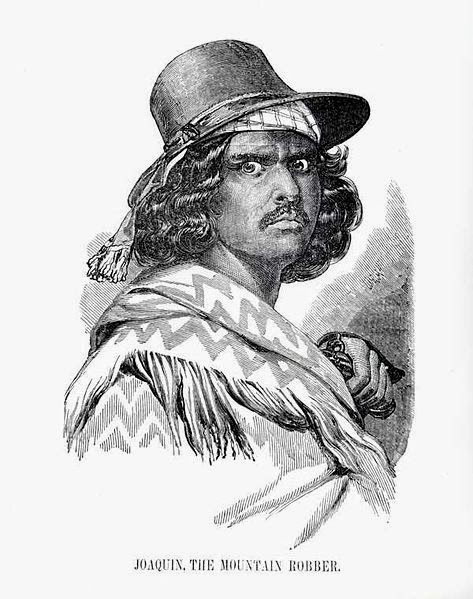
Terrifying portrait of Joaquín Murrieta
that appeared posthumously in the Sacramento
newspaper. Wikimedia Commons.
Joaquín Murrieta (c. 1829 - c. 1853) was a Mexican national who came to California during the gold rush. Legends and dime novels sprouted up after his death, making it difficult to discern the truth about his life. The most certain fact is that his actions (“outlawry”) made the new State of California very upset and spurred the incorporation of the California rangers. They hunted down and killed three men, one of whom may have been Murrieta. Murrieta’s presumed head then became part of a strange continuation of medieval relic worship. After serving as proof of Murrieta’s death so the rangers could receive the reward money, the head was preserved in brine and displayed for paying customers. Today, some people interpret Murrieta’s bandidos and their alleged marauding as resistance to Anglo dominance in California and an attempt to recuperate for Mexico the territories lost via the Treaty of Guadalupe Hidalgo. The 1998 movie The Mask of Zorro pays tribute to Murrieta’s contribution to the Zorro legend by naming the main character Alejandro Murrieta.

Statue of Hidalgo in
Coyoacán (D. F.), México.
Wikimedia Commons.
An earlier (and less likely) possibility for inspiration for the Zorro character is Father Manuel Hidalgo y Costilla (1753 – 1811). The most widely recognized freedom fighter in this group, Hidalgo gave the speech known as the Grito de Dolores during Mass on September 16, 1810, calling on the people to overthrow the Napoleonic government and restore the Spanish monarchy in Mexico. A national hero, he needs no more explanation, but in this context, it’s worth noting that his sharp wit merited him the nickname El Zorro (the Fox) and, like our fictional character, he supported the Spanish monarchy against perceived foreign encroachment in Mexican (or former Mexican) territory.

The most fascinating possible real-life Zorro is William Lamport (1615 - 1659), an Irishman who fought for indigenous rights in Mexico. Vicente Riva Palacio wrote a novel about Lamport in 1872 that could easily have influenced McCulley’s first Zorro book. The Irish Zorro by Gerard Ronan is the 2004 biography of this unique figure. What is it about the seventeenth century that it produced such learned swashbucklers? Always clever (like a fox), Lamport is said to have spoken at least fourteen languages fluently, but never seemed to know when to keep his mouth shut. He fled the British Isles, where he had been sowing sedition and his wild oats, to spend some time as a pirate and end up at the Spanish court. The Conde-Duque de Olivares, the most powerful man in Spain at the time, sent Lamport to Mexico as a spy. While there, he took at least one noble lover and came to sympathize with the enslaved Indians. He’s said to have written the first declaration of independence in the Indies. This document promised land reform, equality of opportunity, racial equality and a democratically elected monarch more than a century before the French Revolution. Lamport was imprisoned for plotting against Spain and escaped for two days, during which he plastered Mexico City with anti-Inquisition pamphlets. The Inquisition later burned him at the stake as a heretic, but it’s said he resisted to the end, strangling himself before the flames could take him.

In spite of my consuming interest in history related to Spain, I might never have known about these extraordinary freedom fighters if it hadn’t been for the fictional character they (could have) inspired. I doubt Johnston McCulley had anything on his mind beyond profiting from writing, but inadvertently, he ensured the legacies of Murrieta, Hidalgo, and Lamport would live on.

A driven fiction writer, Jessica Knauss has edited many fine historical novels and is currently a bilingual proofreader at an educational publisher. Find out more about her historical novel, Seven Noble Knights, and her other writing and bookish activities here. Follow her on Facebook and Twitter, too!


15 October 2008

Expansion & Invasion: La Malinche

By Elizabeth Lane

That a small force of Spaniards, under Hernan Cortes, was able to conquer Mexico in 1519 was due to several factors. The first was an incredible stroke of luck. They arrived a time of transition in the Aztec calendar, when momentous events had been foretold. For a time the Indians believed them to be gods. Also, the ruling Aztecs had many enemies among the tribes they'd conquered. Cortes was able to unite these tribes against their overlords. Diseases brought by the Spaniards played a major role as well. But the real outcome of the conquest hung on the abilities of one remarkable woman--the woman christened Marina and known as La Malinche.

Much of her life story relies on legend. She was born the daughter of a chief into a tribe whose people spoke Nahuatl, the language of the Aztecs. While she was still a young girl her father died. Her mother remarried and gave birth to a son. Wishing her son to become chief, the woman sold her daughter to some traders, who, in turn, sold her to another tribe on the coast. These people spoke a different language, similar to the one used by the Mayans. Thus she grew up with a knowledge of two languages.

Her new tribe was among the first to meet the Spaniards. As a gesture of friendship, the chiefs presented the newcomers with a group of beautiful girls, who were promptly baptized, given Christian names, and passed around to the conquistadors to be their mistresses. Marina, as she was named, was given to Alonso Puertocarrero, one of Cortes's young lieutenants. Her abilities went unnoticed until after the Spaniards picked up a castaway from an earlier expedition. Geronimo de Aguilar, a monk had lived among another Mayan-speaking tribe and spoke their language.

Marina's value became clear when Cortes received a delegation from the Aztecs. Only Marina could understand their language. With her translating into Mayan for Aguilar, and Aguilar translating into Spanish, communication became possible. Cortes took her for himself, and Marina rapidly learned Spanish, so she could translate directly between Spanish and Nahuatl.

The story of the conquest is far too long to relate here. Marina remained at Cortes' side while the Aztec empire crumbled. During that time she bore him a son, whom he later took to Spain. When her usefulness came to an end, Cortes married her to Juan Jaramillo, one of his loyal soldiers. About 1527, few years after giving Jaramillo a daughter, Marina evidently died.

Mistress of the Morning Star by Elizabeth LaneMarina's pivotal role is still open to dispute. Some view her as a traitor who turned against her people (even though she had no choice in the matter). Others view her as a heroine who protected her people and prevented the conquest from being even bloodier than it was. She is the figure behind La Llorona, the legendary weeping woman of Mexico.

Marina was the subject of my very first novel, MISTRESS OF THE MORNING STAR, which was published in 1980. The book has been reissued by ereads.com and is still available.

11 June 2008

Religious Beliefs: Baja California

By Karen Mercury

It's widely believed the island of California was named after a queen in a Spanish novel. Calafia ruled over black Amazons rich in gold, and these rumors fueled the imaginations of Spanish conquistadors. Cortés the Conqueror in 1532 sent a series of expeditions from the Mexican mainland to find this island, making landfall somewhere in Baja near La Paz. These voyages ultimately failed when they discovered, rather than nubile women handing them maps to the gold mines, crowds of equally naked but angry bajacalifornianos with pointy weapons, and the survivors were forced back to the mainland.

CortesIn 1539 Cortés sent over Ulloa, who first determined that Baja was a peninsula (although cartographers continued to depict California as a group of islands: Las Californias), naming the "Sea of Cortés" in his patron's honor. Ulloa rounded the peninsula's point in an attempt to find a Northwest Passage to the St. Lawrence, but on the return voyage his ship vanished without a trace, becoming one of those bizarre "Lost Ships of the Desert," legendary vessels that inexplicably began emerging from the sands of the Colorado River around 1870, to believe newspaper accounts of the time.

Cabrillo (who lent his name to yet another colorful San Francisco street), commissioned by the Viceroy of New Spain to find China, cruised by in 1542, and continued up the coast to the Russian River, completely missing what would be San Francisco, as many did owing to the thick blanket of fog hiding the inlet of that pacific bay. Lower California was left to the next wave of conquistadors: pirates.

Selkirk
The turbulent peninsular point became a watering hole for the "Manila galleon" trade ships plying the Acapulco to Manila route beginning in 1565. Spain looked to establish a permanent port, especially after avaricious Dutch and English pirates got wind of the richly laden trade route and began to methodically board and plunder, Sir Francis Drake one of the first of these rowdy buccaneers, adventurers attracted by word of the pearl beds. Woodes Rogers' fleet lay at La Paz to refit with Alexander Selkirk as sailing master, having been rescued the previous year. In desperation, the Spanish crown in Mexico City sent Vizcaíno to stop the ransacking and find a safer port, but about all he did was found La Paz.

Thwarted every step of the way in their efforts to colonize Baja, Spain tried a new approach: sending in the army of God in the form of Jesuit missionaries. The "Pious Fund of the Californias" was amassed with private and churchly contributions. The vice-regal license was given to undertake the conversion of natives, to enlist and pay soldiers, and to appoint or remove officials--on the condition that all be done at the Jesuit's own expense, but that possession be undertaken in the name of the King of Spain.

Mission of Our Lady of LoretoJesuits had success in 1697 when in Loreto on the Sea of Cortés they founded the first of the jewels of the California coast--Misión de Nuestra Señora de Loreto Conchó. "Here the inhospitability of Lower California had finally been conquered and a colony had taken root in the face of hunger and mishap," John Steinbeck wrote of Loreto, the first city where Spanish was spoken in California. Hefting the image of the Virgin of Our Lady of Loreto in a sober ceremony, their quest to claim the area for Spain had begun. More Jesuits poured in, eventually establishing a network of 23 missions over the next 70 years.

The strategy for founding missions was first of all to find a site with water, difficult enough in that country "unattractive, indeed repellent, and without elements of riches." Also important was land with good soil and a considerable native population nearby, to give them someone to convert. At first, the Jesuits approached the bajacalifornianos with a peaceful attitude and won their trust with "slight rations of grain and porridge." Later the neophytes resisted control and began to steal, and commit "personal attacks, often repeated, of murderous intent." Along with God and promising pastures, the missionaries brought microbes, and by the end of the Jesuit epoch, the native population was less than 8,000. Although the missionaries forbade fostering the treasure of the pearl fisheries, rumor persisted that the friars were hoarding fortunes and engaging in smuggling.

Copper Canyon and the Sea of Cortes
In 1767, after a series of top-secret meetings in Spain, Kind Carlos III expelled all the Jesuits, sometimes at gunpoint. The king acted upon "urgent, just, and necessary reasons, which I reserve in my royal mind" to suppress the order throughout Spain's colonies. Since the Spanish missions of California were so remote, the decree didn't reach them until much later that year, but by the end of '68, Jesuits were dispossessed throughout Spanish dominions. Instantly the "black robes" of the Jesuits were replaced by the "gray robes" of the Franciscans with their divide and rule policy, and then by Dominicans in 1773.

While the Jesuits limited lay Spanish-Mexican settlement on the peninsula, afraid of corrupting influences and competing power centers, the missions under the Franciscans and Dominicans had to accept a growing lay presence and increased control from central New Spain. Kicking out the Jesuits opened up these territories to settlement and development--such as the founding of Los Angeles in 1781.

The first severe epidemics occurred in 1800-1810. The friars held the belief that epidemics were a punishment from God, so their hands were tied with acquiescence. Why try to alter God's will? Suffering only prepared Indian converts for a superior life in heaven. The mission came to an end in 1829, by which time the native neophyte population throughout Baja California Sur had become extinct.