Showing posts with label history of Spain. Show all posts

20 July 2016

Beyond Our Stars: The Thirteenth-Century Astronomy Patronized by Alfonso X

Gemini. Spain, thirteenth century. 

It’s something of a tradition to begin or end biographies of Alfonso X, el Sabio, with one historian’s sanctimonious judgment of him: “While he contemplated the heavens and gazed at the stars, he fell on the earth.” I quote it here not to perpetuate misconceptions, but because the wording shows the importance of the astronomy carried out in Alfonso X’s court. In spite of the other fields of inquiry enhanced under the wise king’s patronage, it was the astronomy that fascinated the most people first and longest.

Alfonso’s interest in the movement of the heavens was based, as most of his passions, in pragmatism. In Alfonso’s time, astrology hadn’t been separated from astronomy as a scientific discipline and was even farther from being as discredited as it is today, as many fourteenth- and fifteenth-century medical treatises (some of which refer to Alfonsine works) attest. The king likely believed knowledge of the stars could be an important tool in gaining the upper hand on Earth because of their obvious, albeit mysterious, influence on human character and behavior.

That said, many of the Alfonsine astronomy books are based on what is still considered solid science.
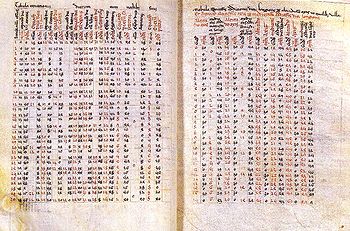
Alfonsine Tables. Spain, thirteenth century. 
The Alfonsine Tables are a set of measurements from about 1272 composed by Isaac ben Sid and Judah ben Moses ha-Cohen that track the positions of the sun, moon, and planets relative to Earth using Ptolemaic calculations. One of the astronomers who worked on the Alfonsine Tables took a copy with him in 1280 to Paris, where scholars adjusted the readings for the Paris meridian, enabling astronomers all over northern Europe to make use of the information for three hundred years. Copies survive today that were used by Copernicus and Galileo. The practical applications of the Tables are what made them popular. They well represented Alfonso X’s yearning for useful knowledge in the wider world.

The Alphonsus moon crater. Wikimedia Commons. 
Composed in the late 1270s, the most extensive book, the Book of Knowledge of Astronomy, also had the largest team behind it. The authors and translators named within the book include Jewish physicians, Muslim lawmen, and Italian and Castilian churchmen. The Book of the Eighth Sphere, which makes up the first part, describes the constellations with their celestial coordinates. The second part describes how to make and use nine different kinds of astronomical instruments, such as the astrolabe and the quadrant. Again, even in this most extensive and encyclopedic work, useful is paramount.

The Book of the Fixed Stars was translated from an Arabic book by Abd al-Rahman al Sufi composed around the year 964. In this book, the Alfonsine collaborators created a powerful combination of Ptolemy’s astronomy, Arabic traditions, and Castilian curiosity. The Andromeda Galaxy and the Large Magellanic Cloud, among other landmark bodies, were introduced to the European scientific community in this translation.

Ursa Major from a 1490 English copy of the Alfonsine Tables
The astronomy works are exemplars of the admirable Alfonsine traits of practicality and encyclopedism. The collaborators translated and compiled information from the best and most reliable sources. The majority draws from documents found in Arabic, with some information coming into Castilian from far-flung languages such as Chaldean. Without the bridge formed by these works, European astronomy might have had to start from scratch.

It’s much harder to see into the heavens if you’re not standing on the shoulders of giants.


Jessica Knauss earned her PhD in medieval Spanish with a dissertation on the portrayal of Alfonso X’s laws in the Cantigas de Santa Maria, which has been published as the five-star-rated Law and Order in Medieval Spain. Look for her book of stories based on the Cantigas, coming 2021. A driven fiction writer, Jessica Knauss has edited many fine historical novels and is a bilingual freelance editor. Her historical epic, Seven Noble Knights, is available from Encircle Publications in ebook, paperback, and hardcover. Her contemporary paranormal Awash in Talent is now available from Kindle Press. Find out more about her writing and bookish activities here. Follow her on Facebook and Twitter, too!


16 March 2016

First Ladies: Ava de Ribagorza, a Traitor Countess?

By Jessica Knauss 


Mid-eleventh-century illumination from the
St. Sever Beatus

In the tenth century, so much definitive action took place in northern Spain that every historical person played a fascinating role. One of these historical persons was Ava de Ribagorza, Countess of Castile and wife of Count García Fernández. Although an epic poem about García’s wife circulated all over Iberia—The Traitor Countess—its storyline bears little relation to fact. I’m writing a novel with Count García and Countess Ava as central characters, and to write about her convincingly, I need to make crucial decisions based on little evidence. How to separate legend from history?

García Fernández was the second Count of Castile from his father’s death in 970 until his own passing in 995. At the time Castile was a territory on the fringes of the Kingdom of León and politically dependent on it. The Castilians’ location on the frontier with the Caliphate of Córdoba meant that by necessity, the political leaders were principally warlords. They had to be ready at any moment to defend their hard-won territory from brutal raids that terrified everyone from the haughtiest king to the lowliest laborer.

This is the era of Almanzor, a political opportunist and great military strategist whom everyone in the north of the peninsula assumed was the caliph because of his seemingly limitless power. The map shows Almanzor’s principal forays into León, Castile, Navarra, Ribagorza, and Barcelona (the “Christian kingdoms”) and the generous swath of territory he took back for his prosperous empire. The constant ebb and flow of conflict was only aggravated because the Christian kingdoms often had bloody spats amongst themselves.

The militarization of Castilian society was so extreme that it’s said that the men didn’t have time to take care of their own horses. That job, and other important ones, belonged to their tough-as-nails wives.

Count García in the Plaza Mayor
of Salamanca
Ava was born circa 945, the daughter of Count Ramón II of Ribagorza. The family name refers to the county between the France-dependent County of Barcelona and the independent Kingdom of Navarra. The Queen of Navarra may have helped arrange Ava’s marriage to Count García in 960 or 965. Ava’s prime age and noble birth made it a good match that became a fruitful union. Somehow, between battles and governance, the count and countess raised six children to adulthood. Four of the five daughters made advantageous marriages, one became a nun, and the son, Sancho, inherited the title and responsibilities of Count of Castile.

Not many other facts have survived about this woman, whom circumstance must have made extraordinary. It’s my job as a historical novelist to breathe life into Ava on the page, but I don’t have a lot to go on. Her death may even be more mysterious than her life.

I haven’t been able to find a record of when Ava died. There is no mention of her in the histories after García Fernández’s passing. This doesn’t necessarily mean she died around the same time. Because her husband’s death meant the end of her time as Countess of Castile, she might have taken on a lesser role at court, perhaps supporting the new count, her son, in ways no one valued enough to write down.

As I’ve written at Unusual Historicals before, the minstrels and then the historians who wrote down The Traitor Countess took Ava’s absence from the historical record and ran with it. They claimed that she wanted to elope to Córdoba with her Moorish lover, and they set Count García’s death squarely on her shoulders. She takes advantage of her role as horse husband by giving García’s steed food that makes it look bulky, but actually weakens it. As Ava has planned, the horse fails the count in battle, leading to his death on the frontier. She then attempts to poison her son so she can leave Castile, but Sancho turns the poison back on his mother in a scene reminiscent of Hamlet.

Presentation miniature from thirteenth-century Estoria de Espanna
It’s hard to imagine why Ava became the target of so much scorn. Perhaps something similar to this happened and became lost to history. Or, more likely, confronted with a vacuum in the record and well removed from the time period, the thirteenth-century historians preferred to write down scandalous material instead of nothing at all. A traitorous countess could explain two things that might have puzzled them: the death of the great warrior, Count García; and the curious fact that his youngest daughter, Oneca, was married to Almanzor soon after García’s death.

Yes, that Almanzor. In the tenth century, political strategy could easily have led to such a match. In the thirteenth century, however, historians were more concerned with presenting a coherent story of Castilian power and religious righteousness than with the complexity of history. If they read about Oneca’s marriage to Almanzor, terror of the north, they would have thought something had gone terribly wrong. What better way to explain a now unsavory alliance than by blaming a woman? The poor girl must have had a terrible mother, since her father was a proven example of knightly virtue.


Of course, this is impossible to prove, but I imagine a lot of drama in the scriptorium while the historians were coming up with their narratives. It looks as if I’ll have to use some of that imagination in the service of redeeming Ava—or further condemning her. I haven’t decided yet.


Jessica Knauss earned her PhD in Medieval Spanish with a dissertation on the portrayal of Alfonso X’s laws in the Cantigas de Santa Maria, which has been published as the five-star-rated Law and Order in Medieval Spain. A driven fiction writer, Jessica Knauss has edited many fine historical novels and is a bilingual freelance editor. Her historical novel, Seven Noble Knights, will be published December 11, 2020, by Encircle Publications. Find out more about her writing and bookish activities here or here. Follow her on Facebook and Twitter, too!

14 October 2015

Myth & Folklore: Lobisome, the Galician Werewolf


Art by picsfair.com 
The werewolf is a manifestation of fear in folklore all over the world. Some scholars believe the werewolf legend got its start in proto–Indo-European times, when warriors wore the skins of their animal totems. Such intimacy with the spirit of the wolf leads me to believe that more than fear of the unknown, the werewolf represents the dread that comes from recognition. In ancient times, and in rural areas today, wolves come sneaking in the night to kill livestock or babies and often the only evidence of their presence is a corpse found in the morning. When our ancestors did catch sight of a wolf, it stirred something deep inside, making an eerie connection between human and wolf in spite of their eternal antagonism. Don’t we all have a little wolf in us?

If the werewolf is universal, what makes the lobisome, the Galician werewolf, special? Perhaps it’s that in Galicia, a werewolf ended up in court to answer for his crimes.

Shrouded in ancestral Celtic lore, Galicia in the northwest is the most mythic region of Spain. On a rocky, windswept coast, Galicia is pelted by rain that leaves tendrils of mist where liminal beings, neither man nor wolf, might jump out at any moment to seize a lonesome traveler.

Manuel Blanco Romasanta didn’t have to do any jumping. In 1852, he was accused of pretending to be a guide for several women and their children, sending letters to their families to let them know that the victims had reached their destination while in reality killing them and using their fat to make fine tallow soap.

Romasanta is not the only man to have been accused of the bizarre (yet plausible at the time) tallow soap accusation. He is, however, the only accused to admit to the crime and present lycanthropy as a defense.

A 2004 film dramatizing the Romasanta case.
Romasanta was Spain’s first serial killer on record, but the most interesting aspects of his case are the ones that have a mythical or folkloric feel. Just as a werewolf is neither man nor wolf, but both, Romasanta is said to have been raised as a girl until he was six years old. People perceived him as effeminate throughout his life, something his short stature (under 4' 11'') probably encouraged. He seems to have always lived in-between.

Werewolf folklore in Galicia specifies that the seventh child of any union is likely to be afflicted with a curse. If the child is a girl, she’s liable to become a witch; if a boy, a werewolf. The godfather may ward off the curse by saying certain prayers at the baptism. Generally the curse doesn’t manifest until later in life. An afflicted werewolf will feel compelled to undress at a crossroads and wallow in the mud. If a wolf has already wallowed there, the transformation occurs and the werewolf uncontrollably attacks and eats defenseless people and babies. The most reliable way to reverse the curse at this point is to take the discarded clothing and burn it. Given this preoccupation with clothes and how they show or conceal one’s identity, it’s interesting that Romasanta also worked as a tailor.

His case was brought to trial in Allariz in October 1852. Romasanta admitted to killing thirteen people while in wolf form with two other wolves. According to him, their first spree lasted five days, and when he returned to his human form, he was surprised to see that the other wolves were also men, both from Valencia.

When asked to undergo the transformation in court, Romasanta claimed that his curse had lasted thirteen years, and the time period was over just the previous week, so he could no longer transform at all.

A page from Romasanta's phrenology report,
courtesy Wikimedia Commons.
The claims were believable enough that the court ordered an investigation. Using phrenology, court-appointed doctors concluded that Romasanta displayed no signs of lycanthropy and that his crimes were committed by choice. The court found Romasanta guilty of nine of the slayings to which he had confessed and sentenced him to death. A French hypnotist who had been following the case was convinced he could cure Romasanta, who was merely suffering from monomania. After a few unsuccessful appeals, the hypnotist obtained a royal commutation of the death sentence from Queen Isabel II so Romasanta could be studied.

Unfortunately, Romasanta’s psychology will always remain a mystery. He died only weeks after his sentence was commuted. Although his cause of death was likely stomach cancer, there was still enough belief in the possibility of werewolves that it was rumored Romasanta was shot by a guard who wanted to see him transform.

Having based his defense in a myth, Romasanta himself gave rise to a legend: the Sacaúntos, a boogeyman who murders children for their fat, has been scaring Galician kids into good behavior ever since.

Jessica Knauss earned her PhD in Medieval Spanish with a dissertation on the portrayal of Alfonso X’s laws in the Cantigas de Santa Maria, which has been published as the five-star-rated Law and Order in Medieval Spain. A driven fiction writer, Jessica Knauss has edited many fine historical novels and is a bilingual freelance editor. Her historical novel, Seven NobleKnights, will be published in December 2020 by Encircle Publications. Find out more writing and bookish activities here. Follow her on Facebook and Twitter, too!


17 June 2015

Weddings in History: Ritual and Financial Exchange in Tenth-Century Christian Spain

By Jessica Knauss 


Image by Gerard Belfast (Flickr)
Chaucer's Wife of Bath speaks of having husbands "at church door." She couldn't have even considered the interior of a church as a venue for her five weddings, not because the husbands' families weren't religious, but because marriage was not yet a formal sacrament of the Catholic Church.

Because I'd read the Canterbury Tales long before, when it came time for me to write about the tenth-century wedding where things start to go wrong in Seven Noble Knights, I knew what the ceremony wouldn't look like... but, like Judith Starkston, I knew I couldn't just skim over what could be some dramatic, tension-filled, character-building moments. The Fourth Lateran Council of 1215 required a priest to bless the union and the publication of banns, but my novel takes place more than 200 years before that.

In Seven Noble Knights, the wedding (and especially the bride) is observed by the bride's new nephew-in-law, a fifteen-year-old who may not understand everything he sees, but is a keen observer. So I delved into what little we know about early marriage ceremonies.


Statue of Isidore of Seville outside the Biblioteca Nacional, Madrid
No wedding could take place without a betrothal. Isidore of Seville (560–636), the most influential and prolific Latin writer after Augustine (and more or less a "local boy" for Seven Noble Knights) described many features of a betrothal: The woman is escorted by married women to the wedding site; the couple joins hands, which are bound with a cord; an officiant spreads a veil over the couple, untying the woman's hair; the couple receives crowns or garlands; the bride and groom exchange rings in an Iberian display of equality; and the bride is escorted to her new home. Isidore also recommended that the engagement ring be worn on the fourth finger because a vein led directly from it to the heart. Isidore doesn't mention it, but most other sources report a kiss or some other physical sign of commitment.

The betrothal in Seven Noble Knights is off-the-cuff because the bride and groom are just meeting for the first time. Although the groom's sister is prepared with a cord for the handfasting, the groom is too astounded with the bride's beauty to seal the promise with a kiss. I reserved the other rituals for the wedding itself because there is so little written about these ceremonies, which seem to have held less legal importance than the first promises of the betrothal.


A magic circle preserved in stone outside the cathedral door in Arcos de la Frontera.
The presence of the clergy at a wedding in 974 might have seemed unusual. A priest might bless the couple and spread incense smoke over the bridal bed, because the emphasis is still on the consummation of the union. I included these elements in my tenth-century wedding, but the lack of Church presence also left space for rituals of pre-Christian origin.

Because the Visigoths, who took over the peninsula at the fall of Rome, were so Romanized, Spain lacks a lot of the pagan/Catholic syncretism that defines other European versions of Christianity. That must be why I was so impressed with a magic circle I saw outside the cathedral door in Arcos de la Frontera. It was said to be used for the ritual cleansing of infants before baptism. In Seven Noble Knights, the married women escort the bride into a magic circle the groom's sister has just drawn and decorated with pungent herbs.

I knew my readers wouldn't believe a wedding without some kind of set vow, but it shouldn't include any mention of God or eternity for this secular ceremony. The earliest vow I found came from the twelfth-century jurist, Gratian. His preoccupation with weddings is restricted to the explicit willingness of both bride and groom, and his words work well: "I receive you as mine, so that you become my wife and I your husband." It emphasizes the equality of the participants, but also that this is an economic exchange above all.

Continuing with the economic theme, in my version of a tenth-century wedding, the bride and groom discuss dowry and bride price and the Count of Castile orally confirms which lands the couple will govern together after they've said the vows. They also pass coins back and forth to each other in a reflection of a ritual still seen in Spanish weddings today.

The lack of knowledge about weddings in the early Middle Ages, at first frustrating, ended up giving me an exceptional opportunity to link the present and past creatively with new meanings appropriate to the story.

Jessica Knauss earned her PhD in Medieval Spanish with a dissertation on the portrayal of Alfonso X’s laws in the Cantigas de Santa Maria, which has been published as the five-star-rated Law and Order in Medieval Spain. Look for her book of short stories based on the Cantigas, coming 2021. A driven fiction writer, Jessica Knauss has edited many fine historical novels and is a bilingual freelance editor. Her historical novel, Seven Noble Knights, will be published in December 2020 by Encircle Publishing. Find out more about it here, and her other writing and bookish activities here. Follow her on Facebook and Twitter, too!

05 April 2015

Author Interview & Book Giveaway: Joan Fallon on HOUSE ON THE BEACH

This week, we're welcoming author Joan Fallon again, whose latest title is HOUSE ON THE BEACHOne lucky visitor will get a free copy of House on the Beach in ebook format - this giveaway is open internationallyBe sure to leave your email address in the comments of today's author interview for a chance to win. Winner(s) are contacted privately by email. Here's the blurb.


This is the story of Rocio and Inma, two girls who first meet as children and despite coming from very different social backgrounds become close friends. Rocio is the daughter of an Andalusian peasant, who makes his living from the land, growing olives and keeping goats; Inma is the daughter of a rich businessman, who lives and works in Madrid.

We follow the lives of these two girls from childhood to maturity, as they share happiness, fears, disappointments, broken hearts and betrayals. Rocio is a shy and trusting girl, who becomes easily seduced by a handsome foreigner, while Inma, confident and manipulative, is the one who saves her from disgrace and the inevitable expulsion from the family home.  But when Inma too becomes pregnant, things take a more sinister turn and her subsequent actions have a devastating affect on Rocio and her husband. 

This social drama of two women trying to take control of their lives, despite living under a harsh dictatorship, offers a glimpse of what life was like in an authoritarian State, with an ever watchful Catholic Church and the close strictures of society.

**Q&A with Joan Fallon**

Why did you decide to write the novel The House on the Beach and where did the inspiration come from?
I have always been interested in social history and when I began to live in Spain I found my interest moving to what had happened to people in Spain, particularly women, during and after the Spanish Civil War. 

When I first arrived in Spain I was impressed by the way the Spanish women I met had embraced the freedom of modern life in the short period since the death of Spain's dictator General Franco in 1975.  The years went by and I began to realise that if I wanted to write about it I had better make a start soon, most of the women I wanted to interview would be dead.  So in 2007 I began to interview as many women as I could; I began with friends, then they introduced me to their mothers, aunts, neighbours and so it grew.  I also read all that I could lay my hands on about the Spanish Civil war and the Franco era and I started to write a non-fiction book called ‘Daughters of Spain’.

The women I interviewed were from all walks of life and spanned a wide range of ages.  The result is a mosaic of their lives, a vivid and unique picture of what life was really like for women in Spain over the past seventy years, of the hardships they endured and their aspirations for a more egalitarian future.

When the book was finished and published I realised that the things I had been told by these women was rich material that I could turn into a novel.  That was when I decided to write ‘The House on the Beach’ about two girls growing up in Franco’s Spain.   All the things that happened to my two main characters had happened to people that I knew.

There must be a lot of research involved in writing a novel like this.  Can you tell us what was involved.
Yes, there is a lot of research but much of it was first hand research that I got from talking to women about their lives: their marriages, their childhood, their education and most importantly of all, what life was like for women at that time.  I also read books about the period and found lots of useful information on the internet.  For example one of the girls gets caught up in the student riots in Madrid in the 1960s; I needed to know exactly when the riots took place and what was involved.

It seems to me that many authors of historical fiction write trilogies.  Have you considered making The House on the Beach part of a trilogy?
No.  I don’t think it would work.  The book is a saga where we follow the stories of two women who meet as children and maintain a troubled friendship throughout their lives.

Were you influenced by any other writers when you planned this novel?
Not really.  As I have said it was inspired by another of my own books, ‘Daughters of Spain’ - a factual account of the lives of Spanish women during the years 1950-1970.  I have since read a book by an Italian author which is very similar in style; it is called “My Brilliant Friend’ by Elena Ferrante.

What is it about writing historical fiction that you find so interesting?
I have always been interested in history, especially social history.  I am a History graduate and when I was a teacher, my favourite lessons were teaching history to primary-age children.  With young children the knack of making history interesting is to bring it to life and to let the children imagine they are living in a different time.  It is a very similar process when writing a historical novel; you want the reader to feel that they are there, experiencing the same things as your characters.

Have you written any other novels that could be classified as Unusual Historical Fiction?
Yes, ‘The Only Blue Door’.  This is a novel about three young English children who are sent as child evacuees to Australia during World War II; the story traces their experiences in a strange land and their search for their mother. 

Buy House on the Beach at:

Learn more about author Joan Fallon


Joan says of her latest novel, “I was inspired to write this novel after interviewing a number of Spanish women for my book Daughters of Spain. The things they told me about life after the Spanish Civil War was rich material for a novel.”  

02 April 2015

Excerpt Thursday: HOUSE ON THE BEACH by Joan Fallon

This week, we're welcoming author Joan Fallon again, whose latest title is HOUSE ON THE BEACHJoin us again on Sunday for an author interview, with more details about the story behind the story. One lucky visitor will get a free copy of House on the Beach in ebook format - this giveaway is open internationallyBe sure to leave your email address in the comments of today's post or Sunday's author interview for a chance to win. Winner(s) are contacted privately by email. Here's the blurb.


This is the story of Rocio and Inma, two girls who first meet as children and despite coming from very different social backgrounds become close friends. Rocio is the daughter of an Andalusian peasant, who makes his living from the land, growing olives and keeping goats; Inma is the daughter of a rich businessman, who lives and works in Madrid.

We follow the lives of these two girls from childhood to maturity, as they share happiness, fears, disappointments, broken hearts and betrayals. Rocio is a shy and trusting girl, who becomes easily seduced by a handsome foreigner, while Inma, confident and manipulative, is the one who saves her from disgrace and the inevitable expulsion from the family home.  But when Inma too becomes pregnant, things take a more sinister turn and her subsequent actions have a devastating affect on Rocio and her husband. 

This social drama of two women trying to take control of their lives, despite living under a harsh dictatorship, offers a glimpse of what life was like in an authoritarian State, with an ever watchful Catholic Church and the close strictures of society.

**An Excerpt from House on the Beach**

Inma’s knees hurt from the hard floor; she peeped through her fingers to see if anyone else felt as uncomfortable as she did but those she could see without turning her head were all deep in prayer. 
“.....Give us a diligent and obedient spirit, quickness of apprehension, capacity of retaining and the powerful assistance of Thy holy grace that what we hear or learn we may apply to Thy honour and the eternal salvation of our own souls,” the young voices chanted in unison then lifted their voices to heaven as they sang, rather than intoned, a heartfelt “Amen”. 
The Mother Superior stood, still facing the image of the Virgin Mary that dominated the classroom wall, and genuflected before turning to look at the kneeling girls.  She paused to allow the solemnity of the moment to sink in then said:
‘Very well girls, you may rise and take your seats.  Remember no talking.’
Inma rose with the others, brushed her plaid skirt back into place and pulled up her regulation navy socks.  Three of the other nuns came in and, like so many magpies, fluttered around their leader in her long black habit with its stiff white yoke.  The Mother Superior whispered their instructions to them and they passed between the rows handing out the test papers.
Inma felt restless, there was only one more week to the holidays but before that there were the exams.  The first was this morning, arithmetic.  She looked over her shoulder at her best friend, Susana, she seemed on the point of tears.  Inma smiled at her and gave a little wave of her hand.  They had spent all the previous evening together revising for the exam but still Susana could not grasp the concept of long division.  She had gone to bed in tears and nothing Inma could say would console her.  She whispered a short prayer for them both, touching the silver cross that hung beneath her uniform.
  Her father had given her the cross a few months before when she was confirmed.  She had gone home for the confirmation.  Papi had come to collect her in the car because Mama wanted her confirmed in the same church as all the rest of the family, the Iglesia de San Andres.  It had been her best day ever.  Mama had bought her a beautiful dress of white muslin, with a long, full skirt, that swayed when she walked and white satin shoes.  Afterwards they had gone to a restaurant for lunch and all her brothers and sisters were there, but not Adolfo, and all her cousins and aunts and uncles.  Susana had been confirmed in the school chapel with some of the other girls; her mother would not let her go home but she did come and visit her and bring her a present.
  Just five more days, this time next week she would be in her own home again; a wave of longing escaped from her chest like a silent sigh.  She missed her own house, her cat, her rows of now neglected dolls, her mirror with its furbelow of gold and pink wood, the dolls’ house that her eldest brother had sent her from Argentina and most of all her own bedroom with its flouncy, pink curtains and a bedspread that matched, with its white painted wardrobes where all her pretty dresses hung.  She had not been home since the beginning of May.
The Mother Superior rapped on her desk with a ruler.
‘Right girls, you have forty minutes to complete this arithmetic paper.  Remember there is to be no talking and no looking across at your neighbour.  Good luck.  Now turn over your papers and begin.’

Learn more about author Joan Fallon


Joan says of her latest novel, “I was inspired to write this novel after interviewing a number of Spanish women for my book Daughters of Spain. The things they told me about life after the Spanish Civil War was rich material for a novel.”