Showing posts with label Lovers. Show all posts

27 February 2015

Lovers: The Princess and The Hostage

By Blythe Gifford

King Edward III of England had a total of nine children who lived to adulthood, and he worked hard to make sure they made marriages that would serve his medieval kingdom well.  For the most part.  But he had a soft spot for his eldest daughter, Isabella and although many matches were proposed for her, at age 28, she was still unwed.  Most historians suggest this was by her own choice and that she was content to remain at home with her parents, their favorite daughter, living in comfort, luxury, and with all the royal status of her rank.

Her parents provided her with enough lands and holdings to give her an independent means of support.  And when that did not suffice (often, it did not, for Isabella was known as a profligate spender), the king covered her debts.  She settled into a comfortable, if unorthodox life for the time. “The Exception Who Proves the Rule,” as historian Jessica Lutkin called her. 

Then, in 1359, England captured the king of France in a major battle, which entitled England to demand an enormous ransom for his return.  As part of the resulting complex treaty, a number of French noblemen were sent to England, to be held hostage until the money was paid.

Chateau de Coucy, France
One of these was Enguerrand, Lord de Coucy.  A powerful French lord, he had inherited his title at a young age and began his career on the battlefield at 15.  By the time he was 18, he was commanding men to suppress an uprising of French peasants.  When he arrived in England as a hostage, he was only 21, seven years younger than Isabella.

According to the rules of chivalry, these French hostages were treated more like guests than prisoners and treated to a succession of feasts and celebrations throughout their captivity.  (For my post on this see:  )  De Coucy, in addition to his prowess in war, excelled at the courtly arts.  According to Jean Froissart, recorder of all events of King Edward’s reign, "...the young lord de Coucy shined in dancing and caroling whenever it was his turn. He was in great favor with both the French and English..."

What woman could help but notice such a man?

History does not record when or how Enguerrand and Isabella met.  Did she admire him in the dance and call him over?  Did he present himself with a flourish?  Did their eyes meet and then…

Sadly, Froissart recorded none of this.  And so, when I wrote WHISPERS AT COURT, I was forced to create my own explanation.

But the spinster princess was obviously taken with the young Frenchman.  It is difficult to believe that the relationship could have developed without her active encouragement.  Was she suddenly thinking, as she reached 30, that she wanted a family of her own? 

Isabella had nearly wed at 19, a man of her own choosing, who was also a Frenchman, but one allied with the English.  Her parents had agreed and settled on the details, providing her with a huge and extravagant trousseau.  Five ships were loaded and waiting to whisk her away to Gascony, where the ceremony was to take place.  Then, at the last minute, Isabella refused to go. 
 
Why?  No one seems to know.  While they describe her trousseau in great detail (the silk mantle, lined with ermine, stitched in silver and gold embroidery, the robes of cloth of gold and crimson velvet), they do not record why a young woman who had chosen her own husband would turn back at the docks at the last minute.

So the aging princess who met the charming French hostage had a history of getting what she wanted, no matter what the cost.  Did she pursue him?  Some have said she married for love alone.  Others have suggested her father nudged her along.  Though England and France were, for that moment, at peace, having a key nobleman as part of the family could help balance the French king’s supporters.

And what of de Coucy?  Perhaps he the hunter.  And if so, what drew to this woman?

De Coucy's English arms as Earl of Bedford
Upon their marriage, he did have restored to him some English lands his family had once held.  He received an English title and had his ransom forgiven.  Those things were not trivial, but they hardly seemed to equal his life in France, where he had one of the grandest chateaux, dominion over vast lands, and was widely respected position as a leader of men.
 
But married they were, in July, 1365, at Windsor Castle in a lavish ceremony.  The amount spent on their wedding far exceeded that for Edward’s other daughters, yet more evidence that Isabella was, by far, his favorite.  Once again, history tells us more about the couple’s possessions than their emotions.  Apparently, the groom, as well as the bride, was given a crown. 
 
She was 33.  He was 25.

A few months later (was it reluctantly on her part?), Isabella and Enguerrand left for France, with official word from the king that “that all children, male or female, who at any time may be born to them abroad, shall be considered capable of inheriting lands in England, and shall be as fully naturalized as though they were born in the realm, all ordinances, establishments, customs, or usages .of the kingdom, notwithstanding.”

There were children.  Two daughters were born to them in France, but for Enguerrand and Isabella, there was no lifelong happy ending.  When Edward III died in 1377, de Coucy gave up his English title and lands and returned his loyalty to the French king.  Isabella, who had traveled back to England frequently, returned home for good with their two daughters, and the couple lived apart for the rest of her life.  She died in 1382.  After her death, Enguerrand remarried, another Isabelle, this one the daughter of a French duke.  They also had a daughter, who did not live to adulthood.

De Coucy spent the rest of his life in wars and fighting, finally dying of the plague in 1396, after being taken prisoner while on crusade in Turkey.

And their children?  Marie de Coucy, born nine months after their wedding, married a French nobleman.  Philippa de Coucy married an English lord.  Somehow, seeming to prove that England and France had not, perhaps could not, be fully reconciled.  Even by love.


After many years in public relations, advertising and marketing, Blythe Gifford started writing seriously after a corporate layoff. Ten years and one layoff later, she became an overnight success when she sold her first book to the Harlequin Historical line.  Since then, she has published ten books, primarily set in England and on the Scottish Borders, most revolving around real historical figures and events.  WHISPERS AT COURT, which revolves around the romance between Isabella and Enguerrand, will be released in June, 2015. For more information, visit www.blythegifford.com

Author photo Jennifer Girard

Illustration credits: "Sir Enguerrand de Coucy, 1st Earl of Bedford, KG" by Rs-nourse - Own work. Licensed under CC BY-SA 3.0 via Wikimedia Commons - http://commons.wikimedia.org/wiki/File:Sir_Enguerrand_de_Coucy,_1st_Earl_of_Bedford,_KG.png#mediaviewer/File:Sir_Enguerrand_de_Coucy,_1st_Earl_of_Bedford,_KG.png

"Dessin Château-de-Coucy Rempart 011" by Collectionneur: Destailleur, Hippolyte (1822-1893) - Bibliothèque nationale de FranceCote : BNF Richelieu Estampes et photographie Rés. Ve-26j-Fol. DestailleurProvince, t. 5 , n. 1281 . microfilm A031428Identifiant: 07741283(Originally uploaded at fr.wikipedia; description page is/was here.). Licensed under Public Domain via Wikimedia Commons - http://commons.wikimedia.org/wiki/File:Dessin_Ch%C3%A2teau-de-Coucy_Rempart_011.jpg#mediaviewer/File:Dessin_Ch%C3%A2teau-de-Coucy_Rempart_011.jpg

20 February 2015

Lovers: Harold Godwinsson and Edith Swan-neck

By Lisa J. Yarde

Harold Godwinsson, the last of England's great Anglo-Saxon kings and a national hero is remembered as much for his valiant stand at Stamford Bridge and his ultimate defeat at Hastings, as he is for the great love he shared with the presumably beauteous Edith Swan-neck, also called Edith the Fair. Harold, one among six sons of the powerful Earl Godwin Wulnothsson of Wessex and his Danish wife Gytha, was born between 1020 - 1022. The family came to power during King Canute's reign, but would endure some of its greatest trials during the reign of King Edward the Confessor, who married Harold's sister. After their father's death in 1053 at Winchester, Harold inherited Wessex while he had also held the earldom of East Anglia in his own right from at least the mid-1040's. He battled the Welsh on the western borders of England. Such a warrior must have seemed attractive to the women of his day, but supposedly, Harold's heart belonged to Edith Swan-neck. 

No one knows when or where Harold and Edith Swan-neck met, but their relationship lasted over twenty years. If Edith Swan-neck was the same person as Edith the Fair, then she was a great heiress of lands throughout Wessex, Harold's domain, which then encompassed the lower third of England. Harold and Edith Swan-neck were not united by any recognized Church laws. Their marriage is often referred to as having occurred in the Danish manner, more Danico, or Edith Swan-neck is called Harold's hand-fasted wife under a formal agreement that she and Harold considered each other man and wife. Whatever the appropriate term, this meant that any children from their marriage would be considered Harold's legitimate heirs. And there were children, at least three sons Godwin, Edmund, and Magnus, as well as daughters. There was Gunnhild who first went to Wilton Abbey like her aunt Edward the Confessor's wife, but through a later abduction or escape became the wife of a Norman, Alan Rufus. There was also Gytha, who escaped to Sweden (instead Denmark; thanks to author Carol McGrath for that correction) with two of her brothers and might have married Vladimir II Monomakh, the Grand Prince of Rus, part of a dynasty that would rule Russia until the 16th century. The union between the children's parents also allowed more than one wife, or permitted the husband to easily put aside the wife or keep her in the background, which is an important aspect considering how Harold and Edith Swan-neck's history unfolded. 


Edward the Confessor's death in January 1066 and Harold's selection as king of England by the rudimentary parliament set the stage for conflict with the Normans in northern France, but also led to more personal tragedy. For reasons, which remain unclear, Harold married a second time to another Edith, this time the daughter of Earl Aelfgar of Mercia, widowed in 1064. The bride's perspective on her new husband can only be guessed at; she might not have held a favorable view of Harold since he had spent the previous years attacking her first husband, the Welsh ruler Gruffydd ap Lywelyn. How did Edith Swan-neck feel about this union? There's no doubt she remained in Harold's life, but what must she have felt to see another woman call Harold husband and become his official queen-consort, especially one who would soon become pregnant and give Harold more children?  


Whatever turmoil might have existed in his private life, Harold had to turn his attention to the defense of England when his enemies King Harold Hadrada of Norway and Duke William the Bastard of Normandy decided to invade England in the fall. Harold defeated the Norwegian king at Stamford Bridge in September 1066, only to lose his life and kingdom to the Normans in the following month. After the battle, Edith Swan-neck had the terrible task of identifying her lover's body because the Normans had mutilated the king so as to make him unrecognizable, yet they needed to eliminate any possibility the English people would continue to revolt if they thought Harold yet lived. It's said Edith Swan-neck identified Harold by a marks or marks on his body that only she who had shared his intimate life would have immediately recognized.  

***

Image of Harold from the Bayeux Tapestry, public domain, sourced from Wiki Commons

Resources include The Anglo-Saxon Chronicle1066: The Year of the Conquest by David Howarth, 1066: The Battles of York, Stamford Bridge and Hastings by Peter Marren and The Godwins: The Rise and Fall of a Noble Dynasty (The Medieval World) by Frank Barlow.

Lisa J. Yarde writes fiction inspired by the Middle Ages in Europe. She is the author of two historical novels set in medieval England and Normandy, The Burning Candle, based on the life of one of the first countesses of Leicester and Surrey, Isabel de Vermandois, and On Falcon's Wings, chronicling the star-crossed romance between Norman and Saxon lovers before the Battle of Hastings. Lisa has also written four novels in a six-part series set in Moorish Spain, Sultana, Sultana’s Legacy, Sultana: Two Sisters, and Sultana: The Bride Price where rivalries and ambitions threaten the fragile bonds between members of a powerful family. Her short story, The Legend Rises, which chronicles the Welsh princess Gwenllian of Gwynedd’s valiant fight against English invaders, is also available.

13 February 2015

Crossed-Dressed Lovers: Omphale and Hercules


Omphale is best known as the woman who subjugated the mighty Hercules. After all the recent fuss in the media about fantasies of female oppression—er, “submission”—it may be salutary to consider the opposite: a man enslaved to a woman.

Slavery, it must be said, is the far from ideal footing on which to base a relationship. Hercules didn’t exactly take to the idea of bondage but he’d made his bed. He would have to lie in it—for three years (give or take).

After murdering his friend Iphitus and stealing the Delphic tripod, Hercules had a lot on his conscience. Driven by remorse, he sought out an oracle to find out what must be done to redeem himself.  The oracle turned him over to Hermes, who sold him to Omphale, a queen. 

Despite her royal status, Omphale would not have been considered worthy of Hercules.  She was a mere woman. He was a demigod. Hercules slayed monsters, brought scoundrels to justice, and displayed immense courage.  He was the embodiment of the noble warrior. After her husband was gored to death by a bull, Omphale ruled over the kingdom of Lydia in Asia Minor. Greeks had a word for such people, particularly those who hailed from Asia Minor: “barbarians.”  Hercules enslavement to a barbarian queen was a form of public shaming. By his own hand, he had debased himself—and he would have to suffer the consequences. 

Myths evolve over time and the story of Omphale and Hercules is no different. Hercules’ enslavement has its roots in ancient Greek storytelling; it took Roman poets and playwrights to popularize the tale.  Once in Omphale’s possession, our hero becomes the queen’s domestic servant.  He works the loom, holds her mirror—and is forced to wear women’s clothing.  He serves the queen in bed as well.

As lovers, Omphale and Hercules appear to thwart the conventions of power and gender. Omphale is often depicted draped in Hercules’ lion skin and holding his club (his defeat of the Nemean lion being one of his most famous victories).  While a man donning female dress is not unheard of in Greek and Roman culture, Hercules is no doubt one of the more famous heroes to do so.  Many artists have tried to create a true romance from this myth.  Hercules represents the slave bound not only by contract but love. Omphale wields complete power over him, making outrageous and transgressive demands as a way of testing his devotion.

The mistress/slave relationship lives on in cult classics. Readers of Leopold von Sacher Masoch’s Venus in Furs will recognize Severin and Wanda, the gender-bending protagonists of the novel as a variation of the myth of Omphale and Hercules. Readers have observed that it is Severin, the male protagonist, who brings out the dominatrix in Wanda—thus confirming the predominant belief that women are deeply uncomfortable in positions of power. They find release in fantasies of subjugation because it coincides with entrenched ideas about femininity. But Wanda is far from conflicted. Her role in Masoch’s narrative, which is three parts fairy tale, comedy, and erotic fantasy, is to redeem Severin.  She must bring him back into line with societal norms—and to that end, has him yoked to plow and thrown into a pit. Given Severin’s persistence, Wanda is forced to go to extremes to beat some sense into him.  When she runs off with another man, Severin decides he has had enough.  

Omphale is the prototype for women who must save their men from erotic impulses that defy societal norms. She represents the barbarous side of Hercules’ nature that must be tamed.  When he has been sufficiently restored to his senses, he moves on—leaving Omphale behind and their child. (Women take note.)

What are we to make of this story of these two star-crossed, cross-dressed lovers? Social convention and morality trumps sexual abandon, that much is certain. And yet, Omphale and Hercules, with their exchange of masculine and feminine roles, serve as a reminder that normative conceptions of gender, while serving male interests, may be subverted if women so desire.

As for love?  The heart wants what it wants. 

Kathryn A. Kopple, author of Little Velásquez, a novel set in 15th century Spain.

11 February 2015

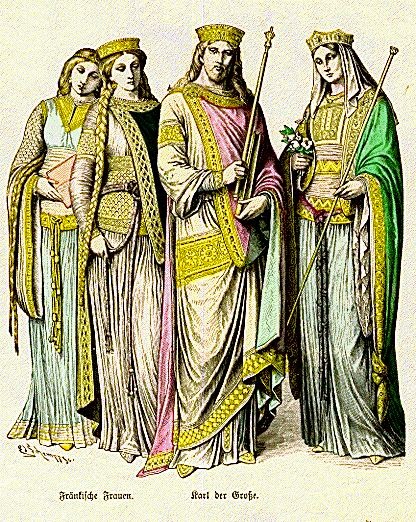
Lovers: Charlemagne and Fastrada

By Kim Rendfeld

It’s an unlikely love story: a teenager and a 35-year-old widowed father of seven. Child No. 8 with a girlfriend was on the way, and the man was also twice divorced. The teenager is Queen Fastrada, and the much older man is King Charles, whom we today call Charlemagne.

To those who are familiar with Fastrada, she seems to be an unusual choice for the lovers theme. After all, Charles’s biographer Einhard blames her cruelty as the cause of two conspiracies against the king, including one involving Charles’s eldest son, Pepin. Never mind that both sets of conspirators had other reasons to rebel. Or that Einhard never elaborates on what she did. Or that Charles and Fastrada were dead when Einhard wrote those words.

My take on Fastrada is that she was maligned, the victim of a backlash against strong women and the inspiration for my work in progress. Yet the reason I want to write about this queen is her relationship with Charles. Or more accurately, the relationship the sources hint at.

Fastrada’s birth date is not known, but she likely was between the ages of 13 and 19 when she wed Charles in 783, a few months after Queen Hildegard’s death. Charles was still fighting the Saxons, and the probable reason behind the marriage was to solidify a Frankish alliance east of the Rhine, where Fastrada was from.

But there seems to be more than politics in the couple’s union. The 787 entry in the Royal Frankish Annals includes: “The same most gracious king reached his wife, the Lady Fastrada, in the city of Worms. There they rejoiced over each other and were happy together and praised God’s mercy.”

Those two sentences are very unusual for Frankish annals. Most of the time, the authors write about wars and politics. They don’t trouble themselves with how a couple felt about their reunion after months apart. Might Fastrada have been overseeing the annals and making sure they included that information?

Another clue of the affection the couple shared comes from Charles himself in a surviving letter to Fastrada, composed before he went to war with the Avars in 791. Charles greets her as “our beloved and most loving wife.” Perhaps that can be dismissed as a flourish by the person who actually put quill to parchment. (Charles and the vast majority of Franks couldn’t write, but the monarch was among the minority who could read.) Yet the letter gives the impression the greeting is not a mere platitude.

Charles describes the litanies to ensure victory and asks Fastrada to make sure the prayers and rituals are carried out at home, adding that she can decide for herself if she’s well enough to abstain from wine and meat. Gotta like a man who says his wife can make up her own mind.

Then Charles says he is surprised he hasn’t heard from his wife lately. “As to which, it is our desire that you should notify us more frequently concerning your health and other matters.” Not the sentiment of an apathetic husband.

Did Charles and Fastrada’s love survive the heartbreak of his son’s plot to overthrow him? In 794, two years after the conspiracy, the annalists are more concerned with an assembly that Charles held with the pope’s envoys in Frankfurt and the heresy of a cleric named Felix. But the entry also mentions that Fastrada died there and was buried with honors at St. Albans in nearby Mainz.

The rites around Fastrada’s death were similar to those of Charlemagne’s third wife, Hildegard, whom he also loved. Fastrada’s remains were interred within a church – the most desirable of hallowed ground, a monument was dedicated to her, land was donated to the Church on her behalf so that she wouldn’t spend time in purgatory, and Charles commissioned an epitaph. The writer, Theodulf, called Charles “the better part of her soul.” 

In this case, “better half” doesn’t mean “superior”; its original meaning is more than half of one’s being such as an intimate friend. So, Theodulf was acknowledging the couple’s close relationship in an age where love was not a requirement for marriage.

Charles and Fastrada’s story shows us love can thrive, even where it seems unlikely.

Sources

Carolingian Chronicles, which includes the Royal Frankish Annals and Nithard’s Histories, translated by Bernhard Walter Scholtz with Barbara Rogers

Charlemagne: Translated Sources, P.D. King

A History of Charles the Great (Charlemagne), Jacob Isidor Mombert

A Dictionary of Slang and Its Analogue

Kim Rendfeld is writing a novel about Fastrada. It will be her third set in eighth-century Francia, joining The Cross and the Dragon (2012, Fireship Press) and The Ashes of Heaven’s Pillar (2014, Fireship Press). To read excerpts and the first chapters her published books, visit kimrendfeld.com. You’re also welcome to check out her blog Outtakes of a Historical Novelist at kimrendfeld.wordpress.com, like her on Facebook at facebook.com/authorkimrendfeld, or follow her on Twitter at @kimrendfeld, or contact her at kim [at] kimrendfeld [dot] com.