Showing posts with label Rites of Winter. Show all posts

28 December 2011

Rites of Winter: Origins of Hogmanay

By Anita Davison


A lifelong resident of England, I have never celebrated Hogmanay, though the importance of this annual festival always made itself evident, by the fact every Scot I have ever known heads north straight after Christmas, determined not to miss such an important celebration.

Hogmanay evolved from several pagan celebrations, namely:  the Norse winter solstice, the Gaelic Samhain, and the Roman Saturnalia, the Vikings Yule, which later contributed to the Twelve Days of Christmas, or as the Scots referred to them, the "Daft Days". There was also the Norman French "hoguinané" which survives on Guernsey as "hoginono",  "aguillanneuf, meaning the "eve of the new year", or "homme est né" meaning "Man is born".

Immigrant weavers from the Low Countries had the Flemish "hoog min dag", "great love day", and Anglo-Saxons, "haleg monath", "holy Month", or  Gaelic, "oge maidne", "new morning".

During the Roman celebration of Saturnalia, slaves would switch roles with their masters for the feast, a practice that continued in the Medieval Catholic Church where young monks were waited on by priests during the 12 days of Christmas. This tradition is also observed in Scottish army regiments, with officers waiting on the men at special dinners.

During the Middle Ages, the pagan winter festivals were overshadowed by the feasts surrounding Christmas, and the New Year was moved to coincide with Christian holy days. Following the reformation in Scotland, after 1638, the General Assembly set Christmas aside, so the gift-giving and took place at New Year and gave rise to the uniquely Scottish celebration of Hogmanay. In 1693 the church recorded:

"It is ordinary among some Plebians in the South of Scotland, to go about from door to door upon New Year`s Eve, crying Hagmane."

Christmas was also banned in England and Wales during the interregnum under Oliver Cromwell, but in Scotland, Christmas was not celebrated for almost 400 years, only developing with returning prosperity after WWII.

The best known tradition is the linking of arms for the last verse of "For Auld Lang Syne"

For auld lang syne, my dear,
For auld lang syne,
We'll tak a cup of kindness yet,
For auld lang syne!

The second famous Scottish New Year custom is, ‘first footing, where the first person to cross the threshold of a friend or neighbour after midnight with the giving of symbolic gifts such as salt, coal, shortbread, whisky, and black bun (a rich fruit cake) intended to bring certain kinds of luck to the recipient. Food and drink are offered to the guests, and this ritual continues into the early hours of January 1st. Traditionally, tall dark men are preferred as the first-foot which, it is said, echoes a time when a blonde-haired stranger on one's doorstep meant a visit from Viking raiders, and spelt bad luck.
Many Scottish towns have their own traditions, for instance, in Stonehaven, just south of Aberdeen, the locals make up giant  'balls' of chicken wire filled with old newspaper, sticks, rags, and flammable material.  Spectators are entertained by a ‘fire poi’, a pipe band, and street drumming, and as the Old Town House bell rings in the new year, the balls are set alight and the ‘swingers’ set off up the High Street from the Mercat Cross to the Cannon and back, swinging 20 pound burning balls on five foot poles around their heads. 


This custom stemmed from a pre-Christian custom of the Winter Solstice where fireballs signified the power of the sun, to purify the world and consume evil spirits.  Any fireballs still burning at the end of the ceremony are cast into the harbour, followed by a firework display.

In Burghead in Moray, there is the ‘burning the clavie’; a cask or basket filled with tar, lit and carried flaming round the village and up to a headland upon which stands the ruins of an altar, the Douro. When the burning tar-barrel falls apart, spectators scramble for a lighted piece with which to kindle the New Year's fire on their cottage hearth. The charcoal of the ‘clavie’ is collected and pieces put up chimneys to keep spirits and witches from coming down.

In the Highlands, celebrations include the saining (Scots for 'protecting, blessing') of the household and livestock. Early on New Year's morning, householders firstly drink, then sprinkle 'magic water' from 'a dead and living ford' around the house (a river ford routinely crossed by both the living and the dead). The house is sealed up and lit branches of juniper carried through the house and byre. When everyone is coughing and sneezing, the doors and windows are flung open to let in the fresh air of the new year. The woman of the house then administers 'a restorative' from the whisky bottle, and the household sits down to its New Year breakfast.

Hogmanay and Ne'erday [New Years Day] are regarded as more important than Christmas, and although Edinburgh has no historical connection with Norse invaders, a Viking longship is burned during the Ne’erday celebrations.

On the Isle of Lewis, in the Outer Hebrides, young boys form themselves into opposing bands, the leader of each wears a sheep skin, while a member carries a sack. The bands move through the village from house to house reciting a Gaelic rhyme. On being invited inside, the leader walks clockwise around the fire, while everyone hits the skin with sticks. The boys would be given some bannocks - fruit buns - for their sack before moving on to the next house.

The first Monday of the New Year in Scotland was called Handsel Day, celebrated by an employer giving presents to his staff, parents to their children and teachers to their students, and a roast dinner eaten.  Handsel was the word for gift box, although this tradition has died out in modern day Scotland.

In Shetland, ‘Up Helly A’ began in the 1880’s in Lerwick, on the last Tuesday in January. A series of marches and visitations, it culminates in a torch-lit procession and a party where a Viking galley is set alight.

Cited from www.scotland.org


Anita Davison is an historical fiction author with a love of 17th century England. DUKING DAYS: REBELLION was released in 2007 and the sequel, DUKING DAYS: REVOLUTION in 2008. TRENCARROW SECRET, a Victorian Gothic romance, is available from MuseItUp Publishing.

21 December 2011

Rites of Winter: Stille Nacht - The Humble History of a Carol

 By Jennifer Linforth

As a child my older brother would glare at me each time I sang “Silent Night” at church in German. I spoke the language and being the teen I was, I thought it hip to sing it in its original language and to annoy my brother.

Christmas creates many creative stories about how this timeless carol came into being, from mice eating the bellows of an organ forcing the need for the hymn to be accompanied by a guitar to Joseph Mohr having to write the words in haste due to a broken organ. The story has been sensationalized through the years in film and books, but the reality of this hymn is humble in its origins.

"Silent Night" was written by Joseph Mohr in 1816, a young priest assigned to a pilgrimage church in Mariapfarr, Austria. Christmas eve of 1818, Mohr visited the home of Franz Gruber. He showed his friend the poem he wrote and asked him to write a melody for it for the Midnight Mass. Later that night the first stanzas of “Stille Nacht! Heilige Nacht!” were heard.

An organ does tie into the tale as master organ builder, Karl Mauracher, did work at Mohr’s church several times over the years. While doing his work Mohr’s church, he obtained a copy of the composition and took it home with him. Thus, the simple carol began its journey around the world in the hands of an organ builder.

Naturally the melody of so long ago changed over the years, but how? In December of 1832 two traveling families of folk singers, similar to the Trapp Family Singers, did a concert in Leipzig. Several musical notes were changed at this concert and the carol evolved into the melody we now know. According to historical documentation the song was performed before an audience Emperor Franz I and Tsar Alexander I. By 1839 “Stille Nacht" was performed for the first time in America at the Alexander Hamilton Monument outside Trinity Church in New York City.

Without doubt it will be performed this holiday season in churches across the globe.

Ein frohes Weihnachtsfest und alles Gute zum neuen Jahr!
Jennifer Linforth expands the classics by continuing The Phantom of the Operaand her books are available now. Look for future books based on the classics, in addition to her unique historical romances. "Ms. Linforth's prose is phenomenally beautiful and hauntingly breathtaking." ~ Coffee Time Romance 

14 December 2011

Rites of Winter: Medieval Christmas Revels

By Lindsay Townsend
Make we mery, both more and lasse,
For now ys the tyme of Chrystymas
(From a 15th century carol)

When Christianity developed in the ancient Roman world, the winter solstice was already marked at 25th December. Followers of Mithras believed in the ‘unconquered sun’ and also held a feast-day for the sun on December 25th.

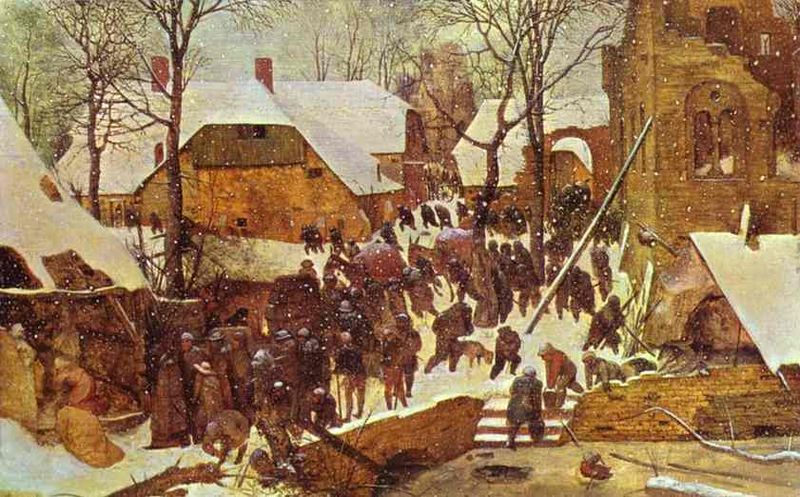
Pieter Breugel the Elder - 'The Visit of the Magi at Christmas'
The gospels did not give a date for the birth of Jesus, but ancient beliefs in the Roman Saturnalia, the solstice and sun-worship led to the church choosing December 25th as the time of his nativity.

‘Christmas’ means ‘Christ’s Mass.’ In England in the Middle Ages three masses were celebrated on December 25th - the Angel’s Mass at Midnight, the Shepherds’ Mass at dawn and the Mass of the Divine Word during the day.

Before the three masses of Christmas there was the forty days of Advent. Advent was similar to lent, a time of spiritual reflection and preparation for the coming of Christ. Feasting and certain foods such as meat and wine were meant for be abstained from during advent (something the evil Denzils ignore in my forthcoming Yuletide novel, The Snow Bride).

The feasting and revelling time of medieval Christmas began on Christmas Eve and lasted 12 days, ending on Twelfth Night. There was no work done during this time and everyone celebrated. Holly, ivy, mistletoe and other midwinter greens were cut and brought into cottages and castles, to decorate and to add cheer.

The most important element of the revels was the feast. Christmas feasts could be massive – Edward IV hosted one at Christmas in 1482 when he fed and entertained over two thousand people. For rich medieval people there was venison or the Yule boar, a real one, and for poorer folk a pie shaped like a boar, or a pie made from the kidney, liver, and other portions of the deer (the umbles) that the nobles did not want – to make a portion of ‘umble pie'. Carefully hoarded items were also brought out and eaten and other special Christmas foods made and devoured. Mince pies were made with shredded meat and many spices. ‘Frumenty,’ a kind of porridge with added eggs, spices and dried fruit, was served. A special strong Christmas beer was usually brewed to wash all this down, traditionally accompanied with a greeting of 'wes heil' ('be healthy'), to which the proper reply was 'drinc heil'.

There were also other entertainments apart from eating and drinking – singing, playing the lute or harp, playing chess, cards or backgammon and carol dancing.

Presents and gift giving was originally not part of Christmas but of New Year. Romans gave gifts to each other at Kalends (New Year) as well as a week earlier at Saturnalia, and by the twelfth century it seems that children were already receiving gifts to celebrate the day of their protecting saint, St. Nicholas, and the practice soon began to extend to adults as well, initially as charity for the poor. As the Middle Ages wore on, the custom grew of workers on medieval estates giving gifts of produce to the estate owner during the twelve days of Christmas - and in return their lord would put on all those festivities.

Wes heil!

Lindsay Townsend
http://www.lindsaytownsend.net/

05 December 2011

Rites of Winter: How to Make Saturnalia Cookies!


By Stephanie Dray


In my debut novel, Lily of the Nile: A Novel of Cleopatra’s Daughter, my heroine’s first Saturnalia is a thing of wonder. Though her father was Mark Antony, the famed Roman general, Selene had been raised a Princess of Egypt, which meant that many ancient Roman traditions would have been as unusual to her as they are to us. In the book, Saturnalia is the first time since being taken as an orphaned prisoner of war that Selene starts to find her place with her new Roman family.

It’s the scents and the sounds of the Saturnalia festival that allow Selene to bond with the emperor’s daughter, Julia, and of course the food. We can’t forget the food. The holiday feasts we all enjoy today are but a pale mimicry of ancient Roman banquets.

Part of the enjoyment I get out of researching ancient times is discovering the way they ate and celebrated. One Saturnalia tradition that figures into the novel is when all the guests take a Saturnalia pastry and the guest whose pastry has a bean hidden inside of it is named the King of the Saturnalia or the Lord of Misrule. I thought it might be fun to reproduce this tradition for the holiday season.

The Romans did have pastries and they enjoyed sweet deserts, but they were different from those we enjoy now because the Romans didn’t use butter or sugar, and they didn’t have baking soda or baking powder. They did, however, have other substitutes. For butter, they often substituted a sweet creamy cheese. For sugar, they used honey. For leavening they sometimes used eggs. This led them to create hearty and rustic pastries with flours, seeds, fruit, oil.

To make a Saturnalia cookie, one might take any sort of modern oatmeal cookie and hide a raisin inside one of them. That’s the easy way, and given the Roman penchant for practicality, they would approve wholeheartedly.

However, if you want to go the old fashioned route, try this recipe:

Roman Globuli Pastries

½ Cup Flour
½ Cup Ricotta Cheese (Whole Milk)
¼ Cup Honey
⅓ Cup Olive Oil
1 Raisin

Mix the Flour and Ricotta Cheese in a bowl with a fork until it forms a stiff dough. With wet fingers, roll dough into 1 inch balls. Inside one of those balls, hide a raisin. Heat oil in a pan on high, then lightly fry the dough balls until golden brown. When the dough balls are cooked through, roll them in honey. Chill and Serve.

I made these tonight and they result in a light doughy pastry, perfect with marsala wine! Perfect to enjoy while reading my latest novel, Song of the Nile!


Stephanie Dray's SONG OF THE NILE, sequel to her debut historical fiction novel, LILY OF THE NILE, is available now from Berkeley Books. Both novels are set in the Augustan Age and feature Cleopatra's daughter.