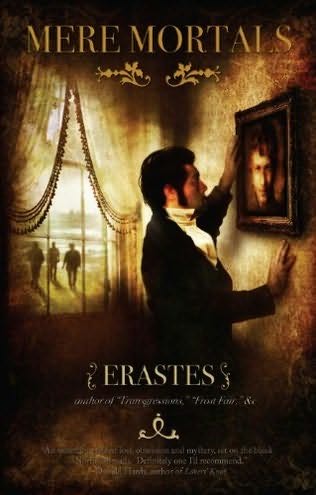
This week, we're welcoming historical novelist, Erastes, as she celebrates the release of her latest novel, MERE MORTALS, available now in print and ebook from Lethe Press, Amazon and just about everywhere. Here's the blurb:

Author Erastes' historical romance novel, Mere Mortals, is a beautifully written, haunting story about three young men who are taken in by a mysterious benefactor to live in the lap of luxury at his English countryside estate, Bittern’s Reach.
Orphaned Crispin Thorne has been taken as ward by Philip Smallwood, a man he's never met, and is transplanted from his private school to Smallwood s house on an island on the beautiful but coldly remote, Horsey Mere in Norfolk. Upon his arrival, he finds that he's not the only young man given a fresh start. Myles Graham and Jude Middleton are there before him, and as their benefactor is away, they soon form alliances and friendships, as they speculate on why they’ve been given this new life. Who is Philip Smallwood? Why has he given them such a fabulous new life? What secrets does the house hold and what is it that the Doctor seems to know? Trust acclaimed author Erastes to tell a moving story in the field of gay historical romance.
What makes your recent release, MERE MORTALS, an unusual historical?
Thanks for having me! Well, for starters it’s set on The Norfolk Broads in England, and that’s an area that isn’t much covered by historical fiction. And it’s a gay historical which automatically gives it an “unusual” label, as despite there being hundreds more than there were five years ago, it’s a drop in the ocean when it comes to historical fiction in general.
Can you tell us a little about it?
It’s set in 1847, from November onwards. It’s told from the point of view of CrispinThorne, a rather disingenuous orphan who has been suddenly taken ward by a rich man who lives deep in the Norfolk countryside. Crispin has no idea what prompted this guardianship, as he’s never met or heard from the man before—and when he arrives at Bittern’s Reach, Philip Smallwood’s home, he finds two other young men who are also orphans, and who have more in common with Crispin than first meets the eye. The story is one of discovery, as they gradually learn more about their surroundings and their guardians character and motivation.
What inspired it?
Well, I was driving home one day and there was an interview on the radio on the BBC’s “Open Book” programme about a well-known writer (and for the life of me I can’t remember her name) who wrote a book about cloning, way back in the sixties, when cloning was still science fiction. She said that she wasn’t really being original in the idea as the recreation of the perfect woman thing had been riffed on since the Greek Tragedies. I’m always thinking of plots, and I suddenly thought how I could also use the idea but from a homosexual perspective.
I also wanted to shine a light on the fact that life was so cheap in Victorian (and obviously many other) times. The fact that Philip could literally take these young men out of schools because they had become an embarrassment, and take them away, and that no-one was going to check up on their welfare, made my hair stand on end.
How important are class distinctions to you when writing about your characters? For instance, the boys in Mere Mortals come across as being lower on the social scale than their benefactor. Likewise Rafe and Ambrose in Standish are from different social levels. Do you find that adds a dimension to their relationships?
When you are writing about historical periods, especially in England, it’s absolutely impossible to ignore class. Every interaction is coloured by it. If a landowner speaks to his gatekeeper you have to write it in keeping, if a vicar speaks to a peasant, then again. The young men in Mere Mortals are (probably, because it’s not explained, but they’ve all been sent to middling schools) nicely bred and they’ve had the company of their peers to teach them how to behave, but they all would feel like women did of the time, that they had no stability and their lives belonged to others. It’s not that I deliberately write unequal partnerships, but unless it’s Lord and Lord, you can’t avoid it. (and even in that case, one Lord would consider himself superior to the other.) It’s so ingrained in my English consciousness that I can’t help but be aware of it.
With your writing, which came first, the M/M or the historical?
The m/m I suppose, I started in Harry Potter fandom, but once I’d decided to write original fiction (about 2 months after starting writing in fandom) I knew that I had little interest in writing contemporary (not knowing the “scene” these days, or fantasy or sci-fi (everyone doing it far far better than I could!)
Are there any periods of history that you find so distasteful that you would never write about them?
No! LOL. Or subjects. I don’t understand writers who feel that some subjects shouldn’t be written about, such as slavery or incest or cannibalism—obviously these things should not be glorified or written for titillation (and it annoys me hugely to see slave rape done to arouse) but to ignore the problems we as humans have created in the past, and just shoving them under the mat is a grave error. If one doesn’t wish to read unpleasant subjects, that’s fine, but one should never say that a writers shouldn’t have the right write them.
I must admit, though, that I am now having a real problem with hygiene. Having watched the tremendous “Filthy Cities” recently with Dan Snow I will find it difficult to write any city/town based story prior to the 1900’s without seeing the massive amount of poo and rubbish that used to lie inches deep on the streets!
Thank you, Erastes. Please leave a comment to win a copy of MERE MORTALS!
Thank you, Erastes. Please leave a comment to win a copy of MERE MORTALS!