Showing posts with label His Border Bride. Show all posts

13 April 2011

Cowards: The Douglases at the Battle of Poitiers

Blythe Gifford

The words "Scotsman" and "coward" are rarely used in the same sentence, but if you look deeply enough, you'll find one or two Scotsmen who chose to "live to fight another day." Among them were Lord William Douglas, who was a minor character in my book, HIS BORDER BRIDE, and his cousin, Archibald the Grim.

William, later the first Earl of Douglas, and Archibald, later the third earl of Douglas, traveled to France in 1356 with forty knights, ostensibly on pilgrimage. Scotland may have been the Douglas home, but according to Michael Brown in The Black Douglas, William grew to manhood in France and "was as much a French as a Scottish noblemen." As a result, he and Archibald found themselves fighting on the French side of the Battle of Poitiers, one of the decisive conflicts of the Hundred Years War.

Thinking himself the expert in fighting the English, Lord William Douglas advised King John to have his knights fight on foot, instead of on horseback, since English archery was devastating to mounted troops.

The result was disaster.

The English won a decisive victory, even capturing the French King John.

And the Douglases? Well, they were luckier.

According to the chronicler Froissart, William "for some time fought very valiantly; but, when he perceived that the discomfiture was complete on the side of the French, he saved himself as fast as he could; for he dreaded so much being taken by the English..."

Other, perhaps more sympathetic accounts, say his own men forced him off the field.

And Archibald? He was captured by the English, presumably wounded. Scottish historian Fordun relates that his armor was an immediate tip off to his captors that here was a man worth a handsome ransom.

Fortunately for Archie, Sir William Ramsay a fellow knight, happened along. Seeing Douglas, Ramsay started cursing, accusing him of being a "base knave" who had murdered his master and stolen his armor. Archibald apparently held his tongue and played along. Ramsay held out his foot, forcing Douglas to remove his boot, and then he hit Douglas with it.

The English were taken in and Douglas was ransomed for forty shillings, a relative pittance, appropriate to the rascal Ramsay made him out to be.

And so both Douglases lived to fight another day. And to die of natural causes.

Blythe Gifford has written five, 14th century medieval romances for Harlequin Historicals featuring characters born on the wrong side of the royal blanket, most recently HIS BORDER BRIDE. The Chicago Tribune called her work "the perfect balance between history and romance." She is working on her next book, which will again be set on the Scottish Borders.

30 June 2010

What Surprised Me: Scotland is a Different Country

By Blythe Gifford

Even those of us who study history regularly have our blind spots. Scotland was one of mine. Until I started researching for HIS BORDER BRIDE, I thought that Scotland was the Highlands and then the Lowlands, where people were pretty much like the English except sort of not. I knew something about the Borders, that no-man's buffer between England and Scotland, because it was the home of my hero from IN The MASTER'S BED, so I thought in choosing that setting, I wouldn't have much new to learn...

Surprise! Scotland really IS a different country. And for a lifelong Anglophile, it was a huge switch of worldview.

I didn't know what I didn't know until I got into the story and had to learn the "back story," if you will, of a whole country. And much of what I had to learn was what I had to UN-learn. In my time and place, whiskey, tartan, and clans did not exist.

However during this period, and for several hundred years to follow, Scotland was more closely allied with France than with England. Even such important Scots as the first Earl of Douglas were fostered in France and fought on the French side at Poitiers, where they and their French allies were soundly defeated. (I ended up using this fact as a plot point.) The Franco-Scots "auld alliance" made a difference in the Scottish court, culture, law, and politics and these differences ultimately influenced my story.

So my prejudiced views of Scotland were upended and I learned a lot. (But not enough that I wasn't surprised all over again when I started to research the setting of my next book. But that's a story for another day.)

26 May 2010

Disasters: The Black Death

By Blythe Gifford

A family member, alive and normal in the morning, was dead by nightfall. Nearly one third of the population of Europe died in less than three years. And no one knew why, or how to stop it. That was the pandemic we now call the Black Death or the Black Plague. Europe just called it The Death, and it cleaved the 14th century, indeed, the whole medieval world, into Before and After.

Most of us learn that it was spread by fleas that rode on rats that lived on ships that carried the rats from Cathy to India to the shores of Italy. A map of the spread of the disease shows a relentless, unstoppable march: Constantinople (December, 1347), Paris (June, 1348), London (June 1349). Scotland thought it was immune to the "English disease," until it, too, was hit in 1350.

People died faster than they could be buried. Whole villages were wiped out. Conventional wisdom now is that The Death was a combination of several varieties of the plague: bubonic, pneumonic, and septicemic. (Some current writers have speculated it was caused by something similar to the Eboli virus.)

Primitive as medical knowledge was, they suspected "bad air," and indeed, pneumatic plague is airborne. Bubonic and septicemic plague were spread by the fleas too ubiquitous to be noteworthy.

Sometimes death came so swiftly there was barely time for symptoms. Those, the victims of septicemic plague, were the lucky ones. Pneumonic plague has more flu-like symptoms. For those stricken by bubonic plague, swelling lumps throughout the body turned black, split open, and disgorged putrid pus and blood. Black spots covered the body. The victim bled inside as well as out. Pain was constant. The only blessing was that death came in a week or less.

While some victims did recover, no one knew why some lived when most died. In a time when God was the answer to all questions, they wondered whether He had sent the pestilence as punishment for the world's evils. It seemed the end of the world had come.

Finally, the scourge waned. But the impact on the second half of the 14th century and beyond is nearly as interesting as the plague itself. Priests had died in great numbers, many as a result of tending their flock, thereby putting themselves in harm's way. There was no way to replace them with men of equal stature and education. The shortage of trained priests meant that less educated (and sometimes less godly) men were recruited.

(In HIS BORDER BRIDE, set half a dozen years after The Death hit Scotland, I have a brief reference to the wedding being delayed to find "a priest educated enough to perform the nuptial mass.")

In the aftermath, people lost faith in the Church and its priests, who had been neither been able to prevent or explain what had happened. People could find neither justice nor mercy in it. Good people died. Evil people lived. It was a blow from which the Church never fully recovered. The unwavering faith of the high middle ages eroded, arguably opening the way for the Renaissance and the Reformation.

The huge loss of population also created a labor shortage, and not just among the priesthood. The architects and skilled craftsman who designed and built the churches were lost. Serfs were also in short supply, which shook the foundations of the feudal system. For the first time, serfs were able to leave the land and they saw their standard of living improve. Wages and prices rose. Kings tried to introduce price controls, with the usual success, and raise taxes, with the usual popularity. The Peasant Revolt of 1381 was among the results.

Overall, nobles and the clergy were losers. Kings and peasants were winners. And the Danse Macabre, or the Dance of Death, lingered in the minds of all for generations.

16 May 2010

HIS BORDER BRIDE Winner!

We have a winner for Blythe Gifford's HIS BORDER BRIDE guest blog. A free copy goes to:

TILI S.!

Contact Carrie to provide your mailing address. The book must be claimed by next Sunday or another winner will be drawn. Please stop back later to let us know what you thought! Congratulations!

14 May 2010

Weekly Announcements - 14 May 2010

Blythe Gifford and Carrie Lofty a having a race on Facebook! When they both reach 200 followers, they're going to give away a pair of one another's books. To enter, you just need to "like" their Facebook fan pages. Full details here!

***

In addition, Carrie Lofty's SCOUNDREL'S KISS is now available on Kindle!

And in other fantastic news, Carrie signed with Pocket's fabulous Executive Editor, Lauren McKenna, for a two-book contract to publish her new Victorian series! FLAWLESS, the first, is set in South Africa, and SHAMELESS, the second, is set in Australia. Release dates will be late 2011 or early 2012. Here's the prologue to FLAWLESS.

***

Join us Sunday when Samhain author Ali Katz will be here to chat about her Roman-set novella, "DAMON'S PRICE". She'll also be giving away a copy to one luck commenter! Be sure to join us then.

***

We'll also draw the winner of Blythe Gifford's HIS BORDER BRIDE guest appearance on Sunday. You still have time to leave a comment or question for your chance to win.

***

Stay with us through the coming weeks when we'll be featuring the best unusual historical authors! Diane Whiteside, Isabelle Santiago, Lindsay Townsend, and Margaret Mallory will be our guests. Join us!

***

Have a good weekend! Remember, you don't have to be an Unusual Historicals contributor to submit good news to the weekend announcements. If it has to do with unusual historicals, we'd love to shout it out to the world! Send announcements to Carrie. See you next week...

09 May 2010

Guest Author: Blythe Gifford

This week on Unusual Historicals we're celebrating with one of our contributors, Blythe Gifford, as her latest book hits the shelves. Blythe is the author of five medieval romances from Harlequin Historical. She specializes in characters born on the wrong side of the royal blanket. With HIS BORDER BRIDE she crosses the border and sets a story in Scotland for the first time, where the rules of chivalry don't always apply. Her 2009 release, IN THE MASTER'S BED, has just finaled in the Readers Crown contest. You can also visit her at her Facebook page.

Royal Rogue: Gavin Fitzjohn is the bastard son of an English prince and a Scotswoman. A rebel without a country, he has darkness in his soul.

Innocent Lady: Clare Carr, daughter of a Scottish border lord, can recite the laws of chivalry, and knows Gavin has broken every one.

Clare is gripped by desire for this royal rogue--could he be the one to unleash everything she has tried so hard to hide? These persuasive urges have stayed safely dormant--until now...
***

"Oh, ye'll take the High Road and I'll take the Low Road...
...And I'll get to Scotland a-fore ye."

Isn't that how the song goes?

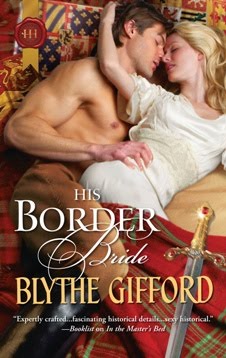
Well, when I announced that my next book would be set in Scotland, I knew I would face some stern questions from the crew here. It's called HIS BORDER BRIDE and has plaid on the (very beautiful!) cover. How can that possibly be called 'unusual'?

Well, I kept my Unusual Historicals badge. How?

Because I took the "low road." My book is set in the Lowlands, not the Highlands.

What's the difference? Well, perhaps I can define better what Borderers are not in comparison to the Highlanders romance readers know and love. (Caution: All generalizations are false. Including these.)

They are not Celtic. Their ancestry tends to be more Viking, although there's a mix of everything.

They don't speak Gaelic. They speak Scots, which they will defend to the death as a separate language from English.

They don't have red hair and green eyes. Well, I suppose some of them do. But they don't have the stereotypical Scots coloring. (Remember the Viking blood I just mentioned?)

They do not live in clans, although the Border families had similar loyalty.

They did not wear kilts.

They did not wear plaide, at least not in the 14th century. The only tartan in sight is on my cover. (And technically, a plaide is a garment and the tartan would be the design.) In fact, I've been told, a Borderer would not be caught dead in a tartan.

They spent as much time warring with the English as with each other. Certainly, there were family feuds and raids a-plenty, even in my time period. (And even in my book.) But by definition, a "border" is a boundary between two things. So those who lived on the boundary with England took the brunt of each invasion and gave as good as they got. Certainly, later wars extended into the Highlands, but during the 14th century, when my story is set, the fighting was concentrated on the border.

In fact, as I did my research, I came to the conclusion that Scotland and England are not two countries, they are three. And the folks on both sides of the Scots-English Borders have more in common with each other than with their fellow countrymen, the Highlanders in the north and the English from the south.

And I became so fond of them that you may find another Blythe Gifford book set on the Borders in the future.

***

Thanks for stopping by, Blythe! Readers, Blythe is giving away to one lucky poster a signed copy of HIS BORDER BRIDE. To start the discussion: Do you read Scottish-set historical romance? What appeals to you about the setting? We'll draw one lucky winner at random next Sunday. Void where prohibited. Best of luck!

Cover Art used by arrangement with Harlequin Enterprises Limited. All rights reserved. ® and T are trademarks of Harlequin Enterprises Limited and/or its affiliated companies, used under license. Copyright 2010. Author photo by Jennifer Girard

06 May 2010

Excerpt Thursday: Blythe Gifford

This week on Excerpt Thursday we're celebrating with one of our contributors, Blythe Gifford, as her latest book hits the shelves. Blythe is the author of five medieval romances from Harlequin Historical. She specializes in characters born on the wrong side of the royal blanket. With HIS BORDER BRIDE she crosses the border and sets a story in Scotland for the first time, where the rules of chivalry don't always apply. Join us Sunday when Blythe will be here to answer questions and give away a signed copy!

Royal Rogue: Gavin Fitzjohn is the bastard son of an English prince and a Scotswoman. A rebel without a country, he has darkness in his soul.

Innocent Lady: Clare Carr, daughter of a Scottish border lord, can recite the laws of chivalry, and knows Gavin has broken every one.

Clare is gripped by desire for this royal rogue--could he be the one to unleash everything she has tried so hard to hide? These persuasive urges have stayed safely dormant--until now...
***

From Chapter One
On the Scottish Border, 1356

Morning's warmth had ebbed, and a chilly mist huddled in the valley and obscured the hills, reminding her of the dangers that lurked all around. The Inglis army might be far away, but the Inglis border was not.

That was her last thought before he rose out of the fog, a golden man on a black horse, like a spirit emerging from the mist.

A man without a banner.

A man without allegiance.

The hound barked, once, then growled, as if cowed.

The man's eyes grabbed hers. Blue they were, shading as a sky does in summer from pale to deepest azure. And behind the blue, something hot, like the sun.

Like fire.

Any words she might have said stuck in her throat.

Next to her, Euphemia gasped, then giggled. "Where are you going good sir?"

Clare glared at her. The girl was hopeless. They'd be lucky to get her married before she was with child.

"Anywhere that will have me." He answered Euphemia, but his eyes touched Clare.

Her cheeks burned.

Beside her, young Angus drew his dagger, the only weapon he was allowed. "I will defend the ladies."

"I'm sure you will." The stranger's smile, slow, insolent, was at odds with the intensity in his eyes. "That's a handsome dirk and I'm sure you could wield it well against me, but I would ask that you not to harm my horse."

His tone was oddly gentle. Where was his own squire? "Who's with you?"

"No one."

"A dangerous practice." Did he lie? An army could hide behind him in this mist. Her fault. She had ridden out alone and unarmed and put them all at risk. "Don't you know Edward's army still rides?"

He frowned. "Do they?"

His accent confused her. It held the burr of the land closer to the sea, but there was something else about it, difficult to place. Yet over the hill, in the next valley, each family's speech was different. He might be a Robson from the other side of the hill, scouting for one last raid before the spring, or loyal to one of the Teviotdale men who had thrown their lot with Edward. "You're not an Inglisman, are you?"

"I have blood as Scots as yours."

"And how do you know how Scots my blood is?"

"By the way you asked the question."

Did her speech sound so provincial to Alain? She winced. She wanted to impress the visiting French knight, not embarrass him. "What's your name, Scotsman?"

"Gavin." He paused. "Gavin Fitzjohn."

Some John's bastard, then. Even a bastard bore his father's arms, but this man carried no clue to his birth. No device on his shield, no surcoat. Just that unkempt armor that, without a squire's care, had darkened with rust spots.

No arms, no squire. Not of birth noble enough for true knighthood then.

"Are you a renegade?" On her wrist, Wee One bated, wings flapping wildly. Clare touched her fingers to the bird's soft breast feathers, seeking to calm them both.

His slow smile never wavered. "Just a tired and hungry man who needs a friendly bed." His eyes traveled over her, as if he were wondering how friendly her bed might be.

"Well, you'll not find one with us."

"I didn't ask. Yet."

Did he think she'd offered to be his bedmate? She should not be talking to such a man at all. "Well, if you do, I'll say you nae."

"I don't ask before I know whether I'm speaking to a friend or an enemy."

"And I don't answer before I know the same." Her voice had a wobble she had not intended.

"Are you a woman with enemies?"

"Three kings claim this land. We have more enemies than friends."

"Aye," he said, nodding, a frown carving lines in his face. He flexed his hand as if it itched to reach for his sword. "Who are yours?"

Her eyes clashed with his. She should have asked him first. Where was his loyalty? To the Balliol pretender, recently dethroned? To David the Bruce still held for ransom by the Inglis Edward? Perhaps he had lied about his blood and was Edward's man himself.

Next to her, the young girl sighed. "This is Mistress Clare and I'm Euphemia and I have nay enemies."

"Euphemia!" Was she batting her lashes? Yes, she was. "Do you want us to be killed?"

"He wouldn't do that. A knight is sworn to protect ladies, aren't you?" She fluttered her eyelashes at him, then turned to Clare. "Don't treat him as an unfriend."

"If I do, it's because I have a brain in my head."

If she kicked the horse into a gallop, could she outrun the man? Not with Angus and Euphemia in tow and Wee One on her wrist.

She lowered her voice to a whisper. "He looks like a dangerous ruffian, not a knight. He wears no markings and he's wearing dirty armor with rust spots!" The man, if he knew the maxims of chivalry, cared little for them.

Euphemia shrugged and turned to the man. "You're not dangerous and dirty, are you?"

Something darkened his face before a smile waved it away. "Well, that may depend on how you mean the words, but I'd say Mistress Clare has a gift for judging character."

Cover Art used by arrangement with Harlequin Enterprises Limited. All rights reserved. ®and T are trademarks of Harlequin Enterprises Limited and/or its affiliated companies, used under license. © 2010 Excerpt © Wendy Blythe Gifford 2010 Permission to reproduce text granted by Harlequin Books S.A.

23 March 2010

Arts and Music: The Falcon in Medieval Art

By Blythe Gifford

As I researched HIS BORDER BRIDE, my May release, I studied the ancient sport of falconry for the first time and became so fascinated that I used it as a symbol throughout my story.

In medieval times, hawking, whether with a falcon or another bird of prey, was not just a leisure pastime. It was a status symbol and the height of "conspicuous consumption." The imagery and language of the hunt permeated art, poetry, language, and even Shakespeare's plays.

Once you become aware of it, you can see references to this "noble sport" in many pieces of medieval art.

First, I'm including an image of a French tapestry from 1500 called Leaving for a Solitary Hunt. (Often, hunts were not solitary jaunts, but huge, elaborate affairs, more like processions than sport.) This beautiful tapestry shows the lord with his falcon, dogs, and an attendant and includes the beautiful millefleur, or "thousand flower" style of background. In this case, the subject is what it seems: the lord going on a hunt alone.

But in other cases, the art carried hidden meaning, for the complex dance of the falcon and the quarry was an oft-used symbol of love. Both men and women participated in the sport, though the most prized hunting falcons were female, not male. In an image, the bird could stand for the woman, the man, or love in the abstract.

The second example here, about 100 years earlier than the previous one, shows a woman holding a falcon being approached by a man who carries a small heart. Because she is holding the falcon, the interpretation is that she has control--that is he loves her more than vice versa, since he is bringing her his heart.

Those symbols may seem obvious, but some of the others in this work are less so. The falcon here represents the noblest of man's aspirations; the flower, the woman's virginity. We also see the lady's dog leaping up on her lap. This would have been understood to stand for male sexuality, as the "lap dog" was where the lover would like to be.

In addition, there are three rabbits woven into the scene. Why? Because in the French of that day, rabbits were called con, which was also the French word for the female sexual organ. (Think of a four letter word in English beginning with 'C' and you'll get the idea.) So while this lovely scene seems chaste, it carries an explicit message about love and sex.

The next image comes from a codex, or a series of bound medieval pages. Here, the woman holds the man and he holds the falcon, who seems to be nibbling on a snack. The interpretation is less clear here. She is in the "dominant" position, but he has control of the falcon, so it may be that he's in charge and has bent her to his will, e.g. she eats at his hand.

These examples are from France, the Netherlands, and Germany. But my book is set on the Scottish border, far from where such beautiful and costly pieces were created. I did discover an image, however, that captured my imagination and served as an important symbol for my book, and my heroine.

This final piece is a fragment of an aumônière, or pouch, embroidered with gilt thread, silk, and satin. It was created in the first half of the fourteenth century, and I like to think that something very much like it could have found its way to Scotland.

Labeled "The Falcon's Return," it shows a lover flying back to his mistress as a falcon would return to her. His arms are long and distorted; his hood and her cloak billow like wings.

To me, the piece is a reminder that even the most well-trained bird is still a wild thing, no more "owned" by the hunter than a lover. Each time the bird returns to the falconer's fist is a choice, as is each return of a faithful lover. No amount of training or force can capture a wild heart.

It must be given. Was this what the artist intended? Well, this is my interpretation. Read into it what you will.

Some of the analyses here were gleaned from THE MEDIEVAL ART OF LOVE, by Michael Camille, published by Harry N. Abrams, New York, in 1998.

22 January 2010

Weekly Announcements - 22 Jan 10

Blythe Gifford's IN THE MASTER'S BED and Margaret Mallory's KNIGHT OF PLEASURE are both up for Best Historical of 2009 at The Season. You can vote now!

***

The cover of Blythe Gifford's HIS BORDER BRIDE is now available--and it's gorgeous! We'll have more information soon.

***

Join us Sunday when Unusual Historicals will chat with contributor Michelle Styles. She'll be discussing her latest US release, SOLD & SEDUCED, set in ancient Rome! She'll also be giving away a copy. Don't miss it!

***

We'll also draw the winner of Zoe Archer's HALF PAST DEAD. You still have time to leave a comment or question for your chance to win.

***

And stay with us through the coming weeks when we'll be featuring the best unusual historical authors! Carla Capshaw, Jennifer Linforth, Amanda McCabe, and Sandra Hill will be our guests. We hope you'll join us!

***

Have a good weekend! Remember, you don't have to be an Unusual Historicals contributor to submit good news to the weekend announcements. If it has to do with unusual historicals, we'd love to shout it out to the world! Send announcements to Carrie. See you next week...