Showing posts with label Accidental Discoveries. Show all posts

30 July 2013

Accidental Discoveries: The Mystery of the Alba Bible

By Kathryn A. Kopple

In 1492, Isabel I and Fernando II of Castile and Aragón signed the “Alhambra Decree,” the edict that ordered the expulsion of the Jews from Spain.  Five hundred years later, King Juan Carlos of Spain would nullify the order.  His retraction of the decree was accompanied by the unveiling of a facsimile of an illuminated manuscript of the Pentateuch (the Christian term for “Torah”) that has come to be known as the Alba Bible.   As a gesture of reconciliation for the suffering inflicted upon the Jews by their Majesties Isabel and Fernando, in accordance with the wishes of the Holy Office (commonly known as the Inquisition), the commissioning of such a project represented an act of religious and historical significance.  The Sephardic Jews were no longer stigmatized; their long contribution to Iberian culture as a people of learning and piety (not to mention the arts and sciences) honored by the restoration of a sacred artifact of importance to world culture.

The Alba Bible is lauded as one of the earliest translations of the Torah into a romance language—or, as the case may be, Castilian.  It would be more accurate to say that the Alba Bible is one of the oldest translations from Hebrew into a romance language to have survived to present day.  Sergio Fernández López writes that, during the Middle Ages, Spanish Jews undertook numerous “traducciones romances” (romance translations) of the Scripture.  The majority of these labors would be destroyed by the Inquisition.  One version, however, did manage to surive : “manuscrito 399 de la biblioteca del Palacio de Liria” (manuscript 399 in the library of the Liria Palace).   Fernández López goes on to say that manuscript 399 has received the greatest attention due the quality of the work, as well as the accompanying rabbinical commentary.

The Alba Bible dates back to the early 15th century.  Luis de Guzmán, master of the Order of Calatrava, wished to have a version of the Old Testament translated directly from Hebrew into Castilian.  He sought out the services of Rabbi Moses Arragel of Guadalajara. Correspondence between the nobleman and the rabbi conveys the difficulties the project represented for Arragel.  Unlike Latin or Greek, a translation from Hebrew would certainly earn the rabbi unwelcome attention by the censors of the Holy Office; nor could he be assured that even one as powerful as Guzmán could keep him safe.  Nonetheless, Guzman persisted.  In a letter cited by Fernández López, we read that Guzmán  persuades Moses Arrangel to do as he asks because the romance bibles in circulation are unreliable translations.  Also, they lack the rabbinical commentary—without which much of the Torah remained obscure—and even threatening—to those of the Christian faith.  After expressing his reluctance—making explicit reference to his Sephardic-Hebrew origins and his concern that a translation of the Scripture would only bring more hardship upon his people—the rabbi acquiesced.  He agreed to take charge of the translation and commentary while two cousins of Guzmán oversaw the illuminations.  Begun in 1422, the Alba Bible would not be finished until 1433.  According to Fernández López, Arragel sent his translation from the villa de Maqueda in 1430 to Toledo, where the illuminations and final corrections were to be made.  It would take another three years to complete the project.  And yet, after 1433, the translation that has come to be known as the Alba Bible vanished, along with its translator.

Historians confirm that the rabbi finished the manuscript on Friday 2 June 1430 in Maqueda.  There seems to be some confusion as to whether he was paid for his work.  As for his disappearance, by the end of the 15th century, many of the Jews of Maqueda had converted to Christianity.   Arragel’s name, however, does appear in the registry. Were it not for the Alba Bible, Rabbi Moses Arragel would have passed into obscurity.  His disappearance makes even more urgent the question:  what happened to the Alba Bible?
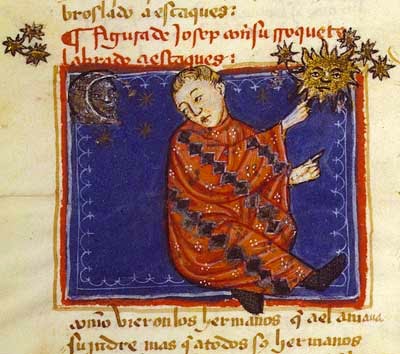
The Alba Bible went missing for two hundred years, only to resurface in the 17th century.  Very few versions of the Torah translated from Hebrew into Castilian seem to have sparked such interest. In addition to Arragel’s meticulous commentary, the rabbi had included a fifty page preface (known as the “memorandum”) and a “glossary for the perplexed.”  The commentary alone would have raised the suspicions of the Inquisition.  The Jews of Spain, we must remember, were expelled for Judaizing (among other alleged wrong-doings)—or preaching the Jewish religion to Christians, in particular to Jewish converts to the Catholic faith.  Any specifically Jewish interpretation of the Old Testament could be seen as a tool for persuading those who had abandoned the “old religion” to return to the fold. 

As with any mystery—in this case the disappearance of the Alba Bible—theories abound.  Fernández López states that in 1624 the Grand Inquisitor don Andrés de Pacheco gave the bible to the Count-Duke Olivares in return for “favors,” most likely donations of one sort or another.  After which, the bible made its way to the House of Alba.  

Did the Inquisition have the bible in its possession for more than two centuries?  17th century documents referring to a romance bible seem to validate this theory.  Investigations were launched.  Jerónimo de Courbes was the first to be interrogated.  Courbes then named Hernando de Salazar, saying that, quite unintentionally, he had seen a “biblia romance” (romance bible) on his lectern.  Salazar was subsequently interrogated; he confessed that he had not studied the bible in great detail but gave it to a friar of the Carmelite order, who had a license to read banned texts.  He adds that, nearly a year later, the friar returned the bible to him.  After that, the House of Olivares came into possession of the bible. 

Book burning was a specialty of the Inquisition, which operated in a number of European countries.  They were dramatic events in which banned books were torched as onlookers watched in public squares.  The faithful were reminded of the flames of hell; a fate that no doubt awaited the authors’ of such works, and treated to sermons railing against heresy.   The Burning of the Books or St. Dominic de Guzman and the Albigensians, a painting by Pedro Berruqete (1450-1504), depicts one such scene to great effect.  The Inquisition was nothing if not zealous when it came to books.  Was the Alba Bible seen as an exception in the minds of the Inquisitors?  Certainly, it was in the interest of those who were detained by the Holy Office to provide assurances that the Alba Bible contained nothing that would denigrate the Catholic faith.  Indeed, the bible would not exist were it not for don Luis de Guzmán, the head of one of Spain’s most powerful military-religious orders.  Was this reason enough to prevent the Inquisition from burning it? 

Fernández López thinks not. Surprising as it sounds, in an era in which the Inquisition couldn’t have been more active—the 15th century--Renaissance humanism also flourished in Spain.  Humanist scholars would have recognized the value of Arragel’s bible for all the reasons cited above.  Could copies of the bible been made, and if so, by whom?  Fernández López  suggests that at the very least two copies existed: one which would eventually be confiscated by the Inquisition and another—the actual Alba Bible—which was safeguarded by a Spanish nobleman, who passed it on to his heirs.  If what he asserts is true, we have the humanists to thank for the conservation of one of the world’s most exquisite romance bibles.

SOURCES

See Facsimile Editions, The Alba Bible, http://www.facsimile-editions.com/en/ab/ (last consulted 7/27/2013.

Fernández López, Sergio, ALGO MÁS SOBRE LA SUPUESTA BIBLIA DE ALBA.

EL HEBRAÍSTA PEDRO DE PALENCIA INTERROGADO POR LA INQUISICIÓN , Universidad de Huelva, n.d.

Kathryn A.Kopple is the author of Little Velásquez, a novel set in 15th century Spain.   

26 July 2013

Accidental Discoveries: THE ANTIKYTHERA - STILL CRAZY AFTER ALL THESE YEARS


When the Greek sponge diver rose from the blue in 1900 with a battered box ill-treated by saltwater immersion for two thousand years, the ugly wood box caused little excitement. This artifact was neither a bronze statue nor a precious vase nor jewelry, and the crew's first impulse was to toss it back to the deep. The sponge divers were risking their lives to bring up treasure from a Roman shipwreck.

Instead the item made it ashore and into museum storage for decades, almost unknown to the scientific world much less popular imagination. Cursory examination in 1902 showed it had some type of gear mechanism. Nothing further happened. The x-ray had yet to be used on artifacts. Then, in the 1970s, an American and a Greek researcher collaborated to x-ray the badly corroded bronze lump.

The lump turned out to contain 30 bronze gears, and may have had more gears. Of astonishing complexity, the Antikythera machine functioned in astronomy. In our jargon, it had a lot of “apps.” Further study provoked the usual debate about whether and how those oh-so-simple ancients could have made such a mechanism, and that debate continues. Those familiar with the Nebra sky disk recognize this bias that favors our own meager accomplishments at the expense of clever forebears who did so much and with much less.

Proponents of its function cite ancient texts describing other automated mechanical wonders in “prehistoric” times and specifically during Hellenistic Greece; and suggest the inventor was Archimedes, Hipparchus, or a student of either. Whoever designed the Antikythera had other examples of automata for inspiration and had access to a wealth of astronomy---if one ignores the naysayers. Various papers and replicas since 1974 attempt to establish exactly how the Antikythera mechanism works. If one understands calculus or simply plows through, the academic papers can be a good read in themselves and reveal how very intricate is this device that tracks lunar, solar, and planetary movements, possibly eclipses, and perhaps even the Olympic games in its day.* Replicas show that the original device was aesthetically pleasing; it might have also included precious metals and stones.

The Antikythera embodies someone's great passion if not a lifelong obsession. Now that this remarkable object has literally resurfaced, it carries an inherent challenge to tell the human story of how it came to be, including who carted it off as spoils for a Roman emperor along with gorgeous statues and vases. This unassuming collection of bronze gears from the first century BCE that we today scarcely understand continues to challenge notions of progress, if not of who we are, in the greater scheme of human history.

* See Nature article, 31 July 2008, vol 454. For the latest finds at the Antikythera wreck site, see : http://www.guardian.co.uk/science/blog/2013/mar/18/return-to-antikythera-divers.
  
J.S. Dunn lived in Ireland during the past decade, on 12 lovely acres fronting a salmon river. The author continues to research and travel the Atlantic coasts and recently  enjoyed wonderful seafood on the Cotes d’Armor, and in Cornwall, and at the famed Lobster Pot restaurant in County Wexford, Ireland.

15 July 2013

Accidental Discoveries: Quinine


By Anita Davison

No one would undertake to bring into England a medicine coming from the Spanish colonies, sponsored by the Vatican, and known by the abhorrent name of the Jesuits’ powder’ Oliver Cromwell


Oliver Cromwell
In my novel about Elizabeth Murray, I included a connection between the family which concerned the question, ‘Did Oliver Cromwell take quinine, or ‘Devil’s Dust’ for his malaria in secret, or did he hold out against his belief it was a Jesuit plot to undermine the Anglican church?’

In the 17th Century, Malaria was widespread in Northern Europe and had been for two hundred years. Malaria,now known as a disease of the tropics, badly weakened the Roman Empire and Emperor Nero drained the swamps near ancient Rome, in order to rid the city of that bad-air disease. Known as ‘marsh fever’, or the "Ague", it was endemic in places like the Cambridgeshire Fens and the Kent and Essex marshes.

The name means "bad air," because people originally believed the disease came from bad swamp air. Cold winters reduced the incidences of fever, and although William Shakespeare was born at the start of a cold spell lasting several years, he mentioned the disease in eight of his plays.

Cromwell wasn’t the only famous sufferer. Charles II contracted it,as did the Dauphin of France, son of Louis XIV, and Alexander the Great. In the summer of 1623, ten cardinals and hundreds of their attendants died in Rome while gathered to elect Pope Urban VIII.
Galen

Galen, or Claudius Galenus of Pergamum [131-201 AD] a Greek physician, believed that the vomiting that accompanied malaria was the body's attempt to expel poisons, and that ‘humoral balance’ could be restored by bleeding, purging, or both. The bleeding supposedly rid the body of "corrupt humors." This treatment was accepted without question for the next fifteen hundred years, but was rarely a cure. It made the anaemia caused by malaria much worse, and additional purgatives often killed off most sufferers. Only the poor, unable to afford medical help, were more likely to survive

One 13th Century ‘cure’ developed by Albertus Magnus, a German Dominican friar,  was to allow insects to devour 77 small cakes made from a dough prepared by mixing flour and the patient's urine. Another was for the matron of a noble family to cut the ear of a cat, add three drops of its blood to brandy along with some pepper and administer it to the patient. Rubbing the patient's body with chips from a gallows on which a criminal had been recently executed was yet another method. Needless to say these were ineffective.
Alexander The Great

Evidence suggests that malaria did not exist in the New World before the arrival of the Spanish in the 16th Century. There they found the natives had used powdered Cinchona bark to treat fevers for hundreds of years, using it as a muscle relaxant that halted shivering due to low temperatures.

One tale attributed to its discovery, was the natives noted that sick mountain lions chewed on the bark of certain trees. Another, that a member of a Peruvian Spanish garrison, overcome by malaria, was left behind to die by his comrades. Tortured by thirst, he crawled to a shallow pond, where he drank the water before falling asleep. He woke to find his fever had disappeared, and then he remembered that the water had a bitter taste from a tree trunk, split by lightning, that had fallen into the pool.

The fourth Count of Chinchón was appointed by Philip IV to rule the Spanish South American Empire and arrived with his wife, Señora Ana de Osorio, in Lima in 1629. Shortly afterwards, the countess became severely ill with tertian fever and was given the tree bark. The countess recovered,and ordered a large quantity of the bark to be given to the sick. The grateful sufferers, now cured, named the new remedy los polvos de la condeça, "the countess' powder." In 1639, according to Bado, the countess returned to Spain, bringing a large quantity of bark with her.

Spanish Jesuit priests got natives to harvest the bark, and that for every tree they cut down, the worker had to replant five trees, arranged in the shape of a cross.

By 1645, the bark was taken to Rome, but because it was supported by the Vatican it was not accepted in England, regarded the ‘Devil’s Dust’ as a Popish plot against the Anglican church. Also, the use of a hot, bitter drink to someone experiencing high fever conflicted with Galenic medicine and common sense, so the bark took a while to be accepted.

The Austrian governor general of the Netherlands, Archduke Leopold William was given cinchona with excellent results by his physician. But when the malaria recurred a month later, the archduke blamed the cinchona, refused to take more and subsequently died. This didn’t help cinchona’s reputation in Europe, and the doctors pronounced it "fixed the humors" while reducing the fever, making recurrence and certain death likely.

Robert Talbor

Robert Talbor entered St. John's College but dropped out at the age of twenty-one, becoming apprenticed to a Cambridge apothecary from whom he first learned of cinchona. Aware the bark was effective but unpopular, he set himself up in London as a "feverologist" by treating malaria patients with his 'secret remedy'.

This was an infusion of cinchona powder in wine and opium to disguise the bitter taste, which cured many sufferers in the Fens and Essex marshes. To avoid his use of 'Jesuit's bark' becoming known, he made slurs against it, and warned:  "Beware of all palliative Cures and especially of that known by the name of Jesuits powder..... for I have seen most dangerous effects following the taking of that medicine."
Charles II

Charles II appointed Talbor Physician Royal in 1672 and he was knighted in 1678. The Royal College of Physicians tried to have Talbor prosecuted for practicing medicine without a license, but Charles II protected him, and took his remedy when he fell ill with malaria in 1679.

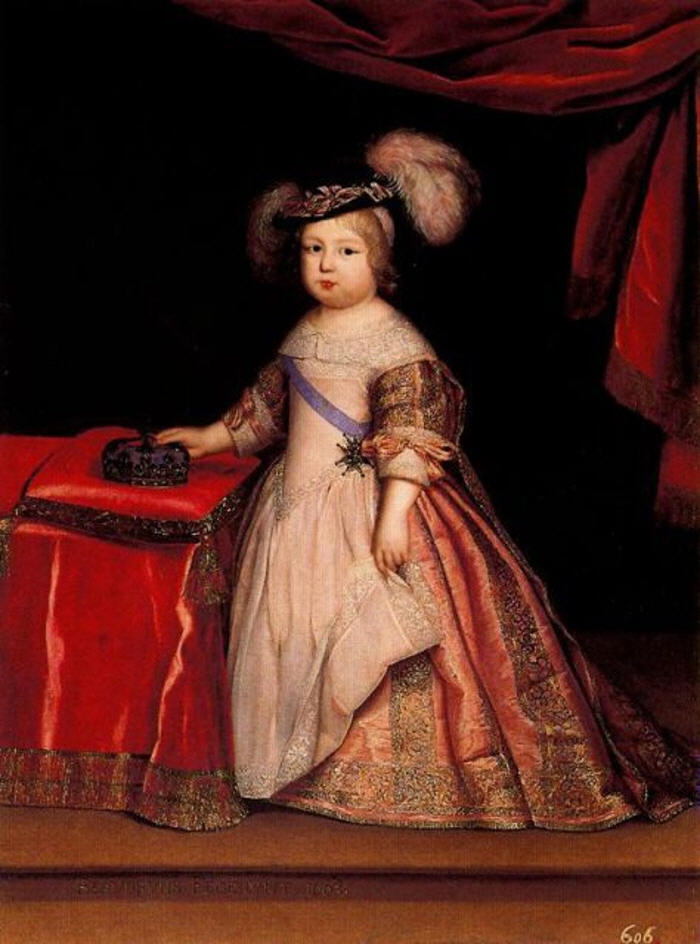
When the dauphin, son of Louis XIV, became ill with fever, Charles II sent Talbor to the French court. With his son cured, the grateful king have Talbour the title of Chevalier Talbot, and paid him 3000 gold crowns, and a large pension in exchange for the secret remedy. Talbor agreed, on the condition the formula would not be revealed during his [Talbor’s] lifetime.
Le Grand dauphin

Talbor also cured Louisa Maria, Queen of Spain, the Prince de Condé, the Duc de Roche-Foucauld, and many other royals and aristocrats. His practices angered physicians in Paris and Madrid. "What is fever?" they asked. "I do not know," replied Talbor. "You gentlemen may explain the nature of fever; but I can cure it, which you cannot."

After returning to England, Talbor cornered the cinchona market by buying all the bark he could find, but did not live long enough to enjoy his wealth. He died in 1681 at the age of thirty-nine, and was interred in Cambridge's Holy Trinity Church. After his death, Louis XIV immediately released the formula, and in 1682 it was published in London.

Quinine is an alkaloid, and was isolated from the bark in 1820 by French chemists Pelletier and Caventou-a monument in Paris commemorates this achievement. Quinine is a powerful antipyretic, which lowers body temperature. Malaria sufferers experience bouts of extreme chills and then burning fever that can reach 107 degrees F.
   
Seeds of quinine plants were smuggled out of South America by Charles Ledger in 1865, and quinine plantations established in Java. This destroyed the South American monopoly and established a new Dutch monopoly. The native who helped Ledger, Manuel Incra Mamani, was jailed, beaten, and eventually starved to death for his participation in the scheme.

Malaria killed thousands of British troops fighting Napoleon in 1809 and many soldiers on both sides of the American Civil War.

In 1823, Dr. John Sappington of Philadelphia acquired several pounds of quinine and issued "Dr. Sappington's Fever Pills." He persuaded ministers in the Mississippi River Valley to ring the church bells every evening to alert people to take the pills

Construction by the French on the Panama Canal was halted in 1881 by malaria. The US took over the project in the early 20th century and their temporary control of mosquitoes by DDT allowed the work to be completed.

Approximately 60,000 U.S. troops died in Africa and the South Pacific from malaria during WWII. The world supply of cultivated quinine trees in Indonesia and Java was captured by Japan in 1942, while Germany acquired the quinine reserves in Amsterdam. Before the fall of the Philippines, the U.S. managed to remove four million seeds, germinating them back in Maryland and then transplanted in Costa Rica and other parts of Latin America. Also, a botanist, Raymond Fosberg secured vast quantities of Cinchona bark in 1943/44 for the Allies from forests and plantations in northern South America.

As for my original question, Did Cromwell take quinine, which was only available in France in 1645? It is still open to debate, but Elizabeth Murray’s father was at the French court with King Charles I during that time, so I like to think my heroine, who was reputedly a spy for The Sealed Knot, made the most of her opportunities.

Anita Davison is a Historical Fiction Author whose latest release, ‘Royalist Rebel’ a biographical novel set in 17th Century England, is released by Claymore Books under the name Anita Seymour

12 July 2013

Accidental Discoveries:Mauveine

By Ginger Myrick

William Perkin was born in London, England on March 12, 1838. In the early years of his education, he exhibited a keen scientific mind and entered the Royal College of Chemistry in 1853 at the tender age of 15. Under the tutelage of a German chemist, August Wilhelm von Hofmann, Perkin began experimenting with the intent to synthesize quinine. At the time quinine was a substance in high demand for the treatment of malaria, which had become a common affliction due to European colonial expansion into tropical climes. Quinine was very expensive, and its synthesis was a pet project of von Hofmann.

During a break from classes when his mentor was visiting his homeland, Perkin took the project into his own hands in a most unofficial way. He set up a rudimentary laboratory in his apartment and began his own experiments. Unable to establish the same controlled environment of the facility at the college, his tests failed time after time. It seemed that some manner of impurity was finding its way into his solution and reacting with the aniline, a by-product of coal tar and the organic compound being used as a base for the trials. It kept producing a thick black substance, signifying that his attempts at synthesis had failed. As he swished some alcohol around the flask to clean it, Perkin noticed that the mixture yielded a deep purple color. The young man had artistic tendencies toward painting and photography, so instead of scrapping the outcome of the flubbed quinine synthesis, he clandestinely began to explore the possibilities of the resultant violet fluid.

Eventually he was convinced that the stuff could be used as a dye. During some of his very first experiments, Perkin found that this aniline purple proved more colorfast than organic substances when applied to silk. He sent out some samples to a dye man, who had spent his life in the trade, and got a very enthusiastic response. He was awarded a patent for his discovery in 1856 at just 18 years of age.

Up until Perkin stumbled upon aniline purple, or Tyrian purple as it was originally called, all cloth had been colored using natural materials. The process to extract these substances was generally costly and very involved, for purple even more so than others. The resource in demand to produce this deep hue came from a certain sea snail called Murex. In ancient times, it was gathered in large numbers, ideally at a certain time of year, and left to decompose then processed in a long and detailed manner. Tyrian purple had ever been a color associated with royalty and wealth, because it was so expensive and labor intensive to produce. By the year 1859, Perkin’s new synthetic dye, then called mauve and later renamed mauveine by chemists, revolutionized the textile industry.

Compared to the synthesis of a drug to alleviate the acute misery of malaria, the discovery of a dye might seem insignificant, but exploring alternative uses of the base compound, aniline, actually helped spur advances in the fields of chemistry and medicine. A direct result from the competition between Perkin and the German scientists at a burgeoning BASF, a subsequent dye called methylene blue was discovered and developed for use as a staining agent in laboratories. It aided in the identification of the bacteria that caused cholera and tuberculosis. The dyes, which had previously been novelties perhaps even considered to be frivolous, had now become essential to scientific research. These newfound applications furthered chemistry even more. Aniline dyes are still used in modern research labs to this very day, and all of it is owed to Perkin’s original, inadvertent discovery of mauve.

Besides, purple is such a pretty color! Mauve became quite the rage a few years later in 1862 when Queen Victoria—whose impeccable good taste dictated the direction of English fashion during her reign—wore a silk gown dyed with mauveine to an official function. This event along with all of Perkin’s hard work early on—his efforts to raise funds, build a factory, manufacture the dye, and give technical advice to others in the field—made him a very popular figure in the now booming industry of textiles. He became an even bigger influence when he devised a way to adapt the color for cotton, which in turn had a favorable effect on stimulating European economy.

Perkin continued to make an impact in other areas of chemistry that had practical applications in the ever-popular field of beauty products. He researched and developed many other dyes in various colors. He discovered a way to synthesize a sweet smelling compound called coumarin, one of the first manmade substances to be used in perfumes. The chemical process that produced the stuff was even named the Perkin reaction. And he usually found a way to manufacture his products more efficiently than similar ones and thus more economically. Soon the science he had helped to champion became too competitive for him, and in 1874 Perkin sold the factory he had built from the ground up. Needless to say, by then he was a very rich man and free to follow his own pursuits. So, he devoted the rest of his life to his true love: research.

He left pure chemistry behind and began to explore in the related field of electrochemistry, eventually moving deeper into the physical science of electromagnetism. He was equally brilliant and successful in his new area of study. Where other renowned names in the business, Gladstone and Bruhl to name two, were busy with the principles of dispersion and refraction, Perkin occupied himself with the property of chemicals to rotate a plane of polarized light, basically the precursor to of the study of molecules, which in turn paved the way for the likes of Albert Einstein.

This subject kept Perkin busy until the time of his death in 1907. By then he had amassed many awards and honors. In 1866 he was put forth as a Fellow of the Royal Society. In 1879, he was awarded their Royal Medal and ten years later a Davy Medal.In 1906 he was knighted and honored with the first Perkin Medal. It is the highest tribute in American industrial chemistry, originally established to celebrate his development of mauveine, the accidental discovery that started it all.

Ginger Myrick was born and raised in Southern California. She is a self-described wife, mother, animal lover, and avid reader and knitter. Along with the promotion for THE WELSH HEALER, and EL REY, she is currently crafting her third novel, which takes place during the U.S. Civil War. She is a Christian who writes meticulously researched historical fiction with a ‘clean’ love story at the core. She hopes to persevere with her newfound talent and show the reading community that a romance need not include graphic details to convey deep love and passion.


05 July 2013

Accidental Discoveries: The Staffordshire Hoard

By Lisa J. Yarde

The Staffordshire Hoard dates from the 7th or 8th century, the time of the kingdom of Mercia, most known for its ruler Offa's construction of a dyke to keep the Welsh out of his countryside. The artifacts discovered in Lichfield, Staffordshire, which was the religious center of the Mercian kingdom, have been called the largest hoard of Anglo-Saxon gold and silver ever found. An amateur treasure hunter with metal detector in hand, Terry Herbert, started unearthing gold crosses, silver and gold sword hilts and pommels, rings, sheet metal and helmets in July 2009. What Herbert found changed how we once thought of the Dark Ages in England, which would prove to be a richer place with gold and silversmiths whose talents we could not imagine.


Chain
The Dark Ages commonly covers the 5th - 10th centuries in Europe, the period immediately after the fall of Rome as the dominant world power. During this time, Angles and Saxons from modern Germany who gave their culture and language to modern England, along with Jutes from modern Denmark, succeeded in controlling most of the areas once held by Romano-British people. Mercia emerged as a powerful Anglo-Saxon kingdom in the Midlands, governed by pagans who later converted to Christianity in the 7th century, one of the last Anglo-Saxon territories to hold out against Christian beliefs. What's been found to date as part of the Staffordshire Hoard reflects the religion and warrior culture of the Anglo-Saxons, who generally maintained power in England until the Norman invasion on 1066.            

Part of sword hilt, inlaid with garnet
Until the discovery at Lichfield, most of what we knew of early Anglo-Saxon culture, particularly the arts, came from illuminated manuscripts like the Lindisfarne Gospel, or from another famous discovery, the ship burial at Sutton Hoo, which pertained to the East Anglian kingdom. The artifacts from  Sutton Hoo included weaponry, but also personal items like gold buckles and shoulder clasps, and some domestic objects like textiles. The difference with the Staffordshire find is that it is not associated with the burial of some important Anglo-Saxon personage. Also, unlike Sutton Hoo, the gold and silver metalwork overwhelmingly represents elements of warfare; the number of sword hilts and pommels dwarfs almost everything else recovered.


Sword fitting with garnets
The question remains; why did the Anglo-Saxons bury so much in a field? Are these relics of battles? That seems unlikely given the high quality of the metals found, which the average Anglo-Saxon infantryman or fyrdman would not have had access to, especially for military display. Were these offerings buried in tribute to the gods, which the pagan peoples of Mercia worshiped until the 7th century? If so, the offerings represent different periods in the kingdom's history, given the Christian crosses included in the hoard. Were the artifacts hidden en masse because of an invasion or some other calamity that befell this part of England? Scandinavian invaders managed to carve out significant portions of land in the 9th century, particularly in the Danelaw, which included parts of north and eastern Mercia. A strip of metal found in the hoard includes the following Biblical inscription in Latin, "Rise up, O Lord and may thy enemies be dispersed and those who hate thee be driven from thy face."  

Learn more about the Staffordshire Hoard. All images provided by Wikimedia Commons.
 

Lisa J. Yarde writes fiction inspired by the medieval period. She is the author of historical novels set in medieval England and Normandy, The Burning Candle, based on the life of Isabel de Vermandois, and On Falcon's Wings, chronicling the star-crossed romance between Norman and Saxon lovers. Lisa has also written three novels in a six-part series set in Moorish Spain, Sultana,  Sultana’s Legacy and Sultana: Two Sisters, where rivalries and ambitions threaten the fragile bonds between members of a powerful family.