Showing posts with label California. Show all posts

30 April 2014

Freedom Fighters: The Inspirations for Zorro

By Jessica Knauss
From the 1990's series Zorro, the most colorful,
cheesy incarnation of the legend
(and my guilty pleasure)
I feared it would be difficult to think of freedom fighters I would enjoy writing about. I focus on medieval Spain, and records for actual freedom fighters in that time and place are few, and none of them successful.

Then I remembered that one of my favorite characters of all time is a Hispanic freedom fighter. A fictional compilation of several stirring figures, Zorro successfully fights for freedom in my home state of California, and is well educated, skillful, and charming in all his many incarnations.

Wikimedia Commons.
Three historical personages may have inspired Johnston McCulley’s 1919 serialized novel The Curse of Capistrano, which spawned all the movies, series, and later books.
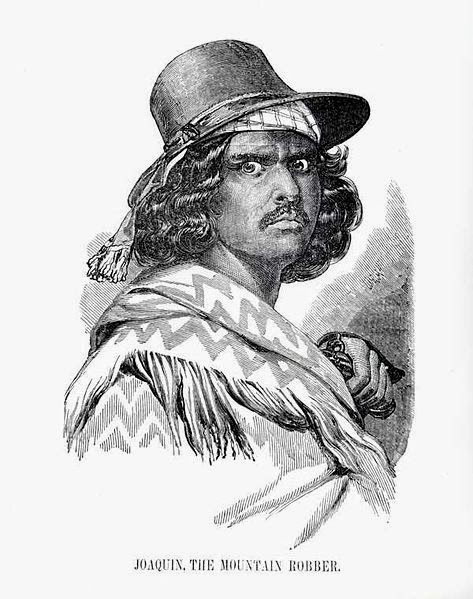
Terrifying portrait of Joaquín Murrieta
that appeared posthumously in the Sacramento
newspaper. Wikimedia Commons.
Joaquín Murrieta (c. 1829 - c. 1853) was a Mexican national who came to California during the gold rush. Legends and dime novels sprouted up after his death, making it difficult to discern the truth about his life. The most certain fact is that his actions (“outlawry”) made the new State of California very upset and spurred the incorporation of the California rangers. They hunted down and killed three men, one of whom may have been Murrieta. Murrieta’s presumed head then became part of a strange continuation of medieval relic worship. After serving as proof of Murrieta’s death so the rangers could receive the reward money, the head was preserved in brine and displayed for paying customers. Today, some people interpret Murrieta’s bandidos and their alleged marauding as resistance to Anglo dominance in California and an attempt to recuperate for Mexico the territories lost via the Treaty of Guadalupe Hidalgo. The 1998 movie The Mask of Zorro pays tribute to Murrieta’s contribution to the Zorro legend by naming the main character Alejandro Murrieta.

Statue of Hidalgo in
Coyoacán (D. F.), México.
Wikimedia Commons.
An earlier (and less likely) possibility for inspiration for the Zorro character is Father Manuel Hidalgo y Costilla (1753 – 1811). The most widely recognized freedom fighter in this group, Hidalgo gave the speech known as the Grito de Dolores during Mass on September 16, 1810, calling on the people to overthrow the Napoleonic government and restore the Spanish monarchy in Mexico. A national hero, he needs no more explanation, but in this context, it’s worth noting that his sharp wit merited him the nickname El Zorro (the Fox) and, like our fictional character, he supported the Spanish monarchy against perceived foreign encroachment in Mexican (or former Mexican) territory.

The most fascinating possible real-life Zorro is William Lamport (1615 - 1659), an Irishman who fought for indigenous rights in Mexico. Vicente Riva Palacio wrote a novel about Lamport in 1872 that could easily have influenced McCulley’s first Zorro book. The Irish Zorro by Gerard Ronan is the 2004 biography of this unique figure. What is it about the seventeenth century that it produced such learned swashbucklers? Always clever (like a fox), Lamport is said to have spoken at least fourteen languages fluently, but never seemed to know when to keep his mouth shut. He fled the British Isles, where he had been sowing sedition and his wild oats, to spend some time as a pirate and end up at the Spanish court. The Conde-Duque de Olivares, the most powerful man in Spain at the time, sent Lamport to Mexico as a spy. While there, he took at least one noble lover and came to sympathize with the enslaved Indians. He’s said to have written the first declaration of independence in the Indies. This document promised land reform, equality of opportunity, racial equality and a democratically elected monarch more than a century before the French Revolution. Lamport was imprisoned for plotting against Spain and escaped for two days, during which he plastered Mexico City with anti-Inquisition pamphlets. The Inquisition later burned him at the stake as a heretic, but it’s said he resisted to the end, strangling himself before the flames could take him.

In spite of my consuming interest in history related to Spain, I might never have known about these extraordinary freedom fighters if it hadn’t been for the fictional character they (could have) inspired. I doubt Johnston McCulley had anything on his mind beyond profiting from writing, but inadvertently, he ensured the legacies of Murrieta, Hidalgo, and Lamport would live on.

A driven fiction writer, Jessica Knauss has edited many fine historical novels and is currently a bilingual proofreader at an educational publisher. Find out more about her historical novel, Seven Noble Knights, and her other writing and bookish activities here. Follow her on Facebook and Twitter, too!


13 December 2010

Accidents: James Dean

By Lisa Marie Wilkinson

"Along came a Spyder and picked up a rider
Took him down the road to eternity..."
~ Lyric from "James Dean" (by J.D. Souther, Jackson Browne, Glenn Frey, Don Henley)

Nothing secures a place in the land of legends more securely than exceptional talent extinguished by violent, untimely death.

James Dean had accumulated a relatively small but impressive body of work by the time of his tragic death at age 24 as the result of massive injuries sustained in a car crash, including starring roles in three films that have gone on to become recognized as classics: Rebel Without a Cause, East of Eden, and Giant.

A student of the famous Lee Strasberg Actor's Studio, the gifted method actor was a renowned racing enthusiastic, and his racing career ran concurrently with his film projects. He purchased a race-ready MG TD when he secured the part of Cal Trask in East of Eden, and later upgraded to a Porsche 356 Speedster, earning second, third, and fourth placements on the California racing circuit.

While filming Rebel Without a Cause, Dean began searching for the perfect race car, settling on a Porsche 550 Spyder when production on his first choice, the Lotus MK X, was delayed. The level of personal risk associated with racing fast cars was not lost on the Hollywood studios that employed him, and Dean was contractually forbidden to race while filming Giant.

Ironically, once filming was completed, Dean was free to race again, and he died on September 30, 1955 while in route to compete in a car race being staged in Salinas, California. His final film, Giant, was released posthumously in 1956.

The car in which Dean was killed, the Porsche 550 Spyder, has attracted its own share of myths and legends, including rumors that the car was cursed. Dean hired designer George Barris (who would later design the original Batmobile) to add custom touches. The finished version included racing stripes and the moniker "Little Bastard" painted on the car.

As with any tragic event, there are always the eventual "what-ifs" that arise. What if Dean had stuck with his original plan to drive his station wagon and tow the race car, instead of making the last minute decision to drive the racer, in order to become more familiar with the car before the race? What if the other driver, 23-year-old student Donald Turnupseed, had not crossed into Dean's lane when moving to take the fork onto State Route 41 near Cholame, California, hitting Dean's vehicle nearly head on? What if Dean had heeded the warning impulsively offered by actor Alec Guinness? His words to young Dean upon viewing the racer were, "If you get in that car, you will be found dead in it by this time next week."


In a final irony, it was announced in 2010 that the strip of highway known as "Blood Alley" where Dean met his end fifty-five years earlier, will be widened due to its notorious history of fatal car crashes.

Lisa Marie Wilkinson is an IPPY Gold Medal winning author of historical adventure-romance. Her latest novel, STOLEN PROMISE, featuring vibrant Gypsy characters and breath-taking romance, is available now.

25 August 2010

Tragic Tales: Chinese Slave Girls of the Barbary Coast

By Jacquie Rogers

The California gold rush of 1849 brought men from all over the world, including China, to find their fortune. The next gold rush was of a different nature--those who provided services to the miners...for a pinch or two of gold dust.

Barbary Coast was the section of San Francisco that harbored the red light district. It was rife with gambling, prostitution, pickpockets, and violent crime. The streets were crowded with brothels, gambling houses, saloons--this was where the rowdiest of the rowdy men went to kick up their heels. The Barbary Coast was also home to the cribs--low-class prostitution housing--and small Chinese girls pleading for the men walking by to use her services.

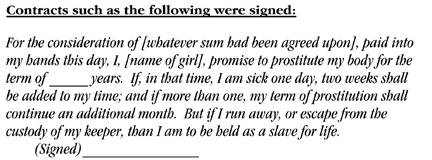
In China girls weren't valued, and many girls, even babies, were sold to "entrepreneurs" who took them to America to be used as sex slaves. In San Francisco, girls were bought and sold--a baby sold for a little over $100. These girls were raised to prostitute themselves.

This is from The Virtual Museum of the City of San Francisco, quoted from A la California: Sketch of Life in the Golden State by Albert S. Evans:
These poor creatures are all slaves, bought with a price in China, and imported by degraded men of their own race, who, despite our laws, contrive to hold them to a life-long servitude, which is a thousand times more hopeless and terrible than the negro slavery of Louisiana or Cuba could ever be. They have been reared to a life of shame from infancy, and have not a single trace of the native modesty of women left. They are, as we have said, mere children in point of intellect, having no education whatever, and no experience of the world outside of the narrow alleys in which they have always lived, and the emigrant ship in which they were brought over to this country...

The girls cost $40 each in Canton, but are valued here at about $400, if passably good-looking, young and healthy, and readily sell at that figure in cash, or approved paper. Each colony of half a dozen girls is under the immediate control of an "old mother," herself a retired prostitute, who jealously watches over each, and receives from them the wages of their shame as fast as earned.
Officials looked the other way for two reasons. First, they were paid off by the Chinese merchants, and second, they didn't consider the Chinese all the way human. Chinese girls were no more significant, and less valuable, than a horse. Once a girl was sold into slavery, there was no help for her.

These girls were also called sing-song girls and worked in small rooms lining the cribs alleyways. The girls would bare their breasts to passers-by. If they didn't attract enough customers, they were often physically punished. During their periods, if they had any, they were considered sick and that missed time was added to her contract.

This is from http://www.foundsf.org/:

Opium was administered to them for every ailment, and many girls were addicted. Once a girl's looks had faded and/or her health deteriorated, usually before age 20, she was placed in a room with a vial of narcotics. She could either take the overdose, starve, or if she wasn't dead when they came for her corpse, she was murdered. These murders weren't reported or even noted by the authorities.

One white woman who didn't look the other way was Donaldine Cameron, the Angry Angel of Chinatown. She was born in New Zealand and came to California with her parents when she was a child. At 18 she was engaged, but no one seems to know why she never married. In 1895 she took a position as a sewing teacher at the Occidental Mission Home for Girls and became a crusader for these abused girls no one else cared about. Over a period of 40 years, she was instrumental in the rescue and education of over 3,000 Chinese girls. Miss Cameron used sledgehammers and axes to get to the girls, and learned early on to find more girls in hidden in walls and under the floor boards. Of course the slavers hated her, calling her Fahn Quai--white devil.

History books teach that slavery ended in the United States with the Civil War, but that wasn't so for the sing-song girls of the Barbary Coast, who, in many cases, worked in worse circumstances than the slaves of the South, with a far shorter life expectancy. Finally, 75 years after the Emancipation Proclamation, the Chinese slave trade ended. It's a blight on American history that we should never forget.

Jacquie

Down Home Ever Lovin' Mule Blues (See the Book Video featuring Justin Saragueta)
Jacquie's Website * 1st Turning Point * Myspace * Twitter * Facebook
Faery Special Romances (Book Video) * Royalties go to Children's Tumor Foundation, ending Neurofibromatosis through Research


Read a book by Jacquie Rogers

03 May 2010

Disasters: The San Francisco Earthquake

By Elizabeth Lane

In 1906, San Francisco's fire department was one of the most modern and efficient in the world. At the sound of alarm bells, the superbly-trained firemen could hitch the horses, fire up the steam pump and be on their way to a fire in ninety seconds. They had to be good. In a city built mostly of wood, even a small fire could blaze out of control in no time.

The 58 fire companies were on constant alert to keep the city safe. The man responsible for them all was their legendary chief, Dennis Sullivan. A vigorous man of 53, Sullivan had been at his post for 13 years. His men loved him, and there was nothing about fighting fires he didn't know. He had lobbied the city government for years to get the failing water pipes and cisterns repaired and to build a line to pump water from the bay in case of a big fire. "This town," Sullivan had declared, "is in an earthquake belt. One of these fine mornings we'll get a shake that will put this little water system out, and then we'll have a fire. What will we do then?"

His prediction came true on April 18, 1906 at 5: 12 a.m. The animals sensed it first--dogs barking, horses shifting and whinnying. Then, as a distant rumbling rose to a deafening roar, the quake thundered through the city. The first shock lasted forty seconds, followed by a brief silence and another twenty-five second shock--little more than a minute in all. But to the million Californians who felt it, the quake seemed to last forever. The heaving, cracking earth toppled chimneys and towers, splintered rows of frame houses, twisted steel rails, bridges and pipelines. People and animals were crushed by collapsing buildings and falling brick walls.

Dennis Sullivan and his wife Margaret were asleep in their rooms on the third floor of the Bush Street fire station. The dome of the California Hotel next door toppled onto the roof of the fire station, crushing the building. When Sullivan sprang out of bed to find his wife, who'd been sleeping in the next room, he fell through the floor, all the way to the basement, where he was scalded by the steam boiler. His men dug him out of the rubble and rushed him to a hospital. Mrs. Sullivan survived, but Dennis Sullivan never recovered from his injuries. He would die four days later.

In the silence that followed, survivors poured into the streets, gaping in horror at the damage. The scene that met their dazed eyes looked like the end of the world. But the worst was yet to come. Fueled by broken gas mains, fires began to flare in the city. The firemen rushed to do what they could. But the odds were stacked against them. Water was in short supply, the water mains broken, the cisterns in such poor condition that many of them were empty. And the men had lost their beloved chief.

The wooden buildings burned like tinder. The heroic firemen were driven back as fire swept through the towering office buildings and hotels in the downtown area. The wealthier neighborhoods had suffered little damage from the quake because they were built on solid rock. Now, with water gone, the military commander, General Funston, ordered that many of these homes be dynamited to create firebreaks.

Unfortunately the one man who knew how to use dynamite in fighting fires--Chief Sullivan--was gone. As a result, many buildings were blown up unnecessarily, and some fires were even started by the dynamite. The fires raged for three days. By the time the Saturday evening rain dampened the ashes, 490 blocks, totaling 2831 acres, had been burned and more than 450 lives had been lost. Perhaps the most tragic loss of all was the man who, had he lived, might have been the hero who saved much of the city.

But the spirit of San Francisco was undaunted. Within days, aid was pouring in, and the cleanup and rebuilding had started. The city was on its way to becoming even greater than before.

My April 2009 Harlequin Historical, HIS SUBSTITUTE BRIDE, is set against the backdrop of 1906 San Francisco in the last days before the quake and fire. It's a story of devotion, danger and sacrifice. I hope you'll enjoy it.

17 February 2010

Love Affairs: Henry & June

By Karen Mercury

Henry Miller, "Just a Brooklyn Boy," was born in 1891 "under a lucky star." He followed his strict German tailor father's directives to get a conventional job, and found work as a personnel director in charge of messengers at the "Cosmodemonic Telegraph Company"-- a pseudonym for Western Union. But Henry was "always merry and bright," anything but conventional , and loved to party with his friends, to womanize, and to write semi-autobiographical tales. One day when the Vice President was bawling him out for his absenteeism, the manager suggested that Henry write an Horatio Alger book about the messengers.
I thought to myself 'you poor old futzer, you, just wait until I get it off my chest, I'll give you an Horatio Alger book...' I saw the army of men, women and children that had passed through my hands, saw them weeping, begging, beseeching, imploring, cursing, spitting...I saw the tracks they had left on the highways, lying on the floor of freight trains, the parents in rags, the coal box empty, the sink running over, the walls sweating...I will give you Horatio Alger as he looks the day after the Apocalypse, when all the stink has cleared away.
He married a woman Beatrice, a very cold-hearted and disapproving fish--they even had a child Miller always referred to as "the child"--who saw his "scribbling" as a waste of time, which gave Henry even more reason to stay out late at vaudeville shows and dance halls, where taxi girls would dance with one for a small fee.

In 1923, Henry met June (referred to in his novels as Mona), a taxi dancer at the Orpheum Dance Palace in Times Square. She was a gorgeous, flamboyant, and unstable woman who had sex with Henry in the back seat of the cab on the first night they met, and he was instantly smitten, calling her "June, Julia, Henriette, and She" (after one of his favorite Rider Haggard novels).

Henry was never sure which of June's stories to believe, whether she was born to a Romanian gypsy in Sherwood Forest, how many of her rich lovers truly existed, but when she whispered, "You must be a great writer--for me!" the flattery sent him into a dizzy whirl. Whatever she is, I love her, and for the moment she is mine, he thought. Henry married her the next year after unceremoniously dumping Beatrice. Claiming to be variously an actress, artist, and also a bisexual, June invited her friend Jean Kronski to move in with them, although all Jean seemed to do all day was craft puppets that were apparently not very attractive or marketable, dragging along "Count Bruga" wherever they went.

Having walked out the door of the Cosmodemonic Telegraph Company without a word, now Henry attempted to make a living solely as a writer, selling prose poems from door to door. They struggled to exist in cold water flats, June remaining as a taxi girl and entertaining strange men to make ends meet, "gold-digging with a vengeance." Henry thought Paris might be the place for them, and so the trio departed with ten dollars in their pockets. "I have no money, no resources, no hopes," Henry wrote. "I am the happiest man alive."

Everyone, apparently, was in love with June. Jealousies between Henry, June, Jean and their many "admirers" led to the womens' return to New York--June's despicable treatment of men had led at least two of her lovers to suicide. Henry's gregarious, friendly, and relaxed personality led to some important Parisian associations such as Blaise Cendrars, Alfred Perles, Man Ray, Lawrence Durrell, and, most importantly, in 1931, Anaïs Nin. Henry began a fling with Anaïs, but when June returned to Paris, Anaïs also fell under her inexplicable spell. Anaïs wrote:
A startlingly white face, burning eyes. June Mansfield, Henry's wife. As she came towards me from the darkness of my garden into the light of the doorway I saw for the first time the most beautiful woman on earth...As I sat in front of her I felt that I would do anything she asked of me. Henry faded. She was color, brilliance, strangeness.

By the end of the evening I was like a man, terribly in love with her face and body, which promised so much, and I hated the self created in her by others. Others feel because of her; and because of her, others write poetry; because of her, others hate; others, like Henry, love her in spite of themselves.
Henry and June divorced by proxy in Mexico in 1934.

His first novel, Tropic of Cancer, was not published until 1934 in Paris, instantly famous and, of course, banned in all English-speaking countries. It was his Horatio Alger story, "the blood-soaked testament revealing the ravages of my struggles in the womb of death." When it finally was released in the US in 1961 it caused a sensation, leading to obscenity trials that debated pornography. I recall my mother had all of his 60s books on her shelf and I'd sneak looks at the "sex parts." I soon realized the writing was pretty darned interesting, and wound up reading them all of the way through.

Henry lived in Big Sur, dealing with the hordes of fans showing up at his door, and hanging out with admirers such as Jack Kerouac, Emil White, and Jean Varda. He saw June only once more in 1961, although he sent her money her entire life. He was shocked at her deteriorated appearance, as she'd spent many years in boarding houses and sanitariums, receiving electric shock treatments, and having broken some bones after falling off one such table. Henry died at the age of 89, after divorcing his fifth and final wife, Hoki, a Japanese woman 47 years his junior, smoking cigarettes and living it up until the end.

10 November 2009

Dynasties: Californios

By Karen Mercury

Before Manifest Destiny, when Americans poured into California in the early 1800s--trappers, explorers, backwoodsmen, whalers, and merchants who stumbled into the area prior to the 1848 annexation of the area by the United States and the unprecedented migration of the 1849 gold rush--the "Californios" ruled the state of Upper California.

A few of the gente de razón or upper class Californios were descendants of Spanish soldiers sent up from Mexico and spoke the pure Castilian language. There was an aristocracy, the ones of straight Spanish blood with clear brunette complexions who never intermarried with natives. The least drop of Spanish blood was sufficient to raise one from the rank of slave, entitle the wearing of fancy clothing, and the right hold property. These gente de razón were all pretty much related to each other. From the upper class down, a regular gradation was indicated by skin color, growing darker until reaching the hue and features of the pure Indian.

Even the commoners, to American ears, they appeared to speak elegant Spanish. A messenger on horseback spoke like an ambassador. They had no credit system, no banking, no way of earning money other than the cattle raised on their enormous ranchos, employing elegant vaqueros whose skills at horsemanship were unsurpassed in the continent. They had no money except for hides, which sailors called "California bank notes."

They dressed in steeple-crowned sombreros, serapés of fiery colors, and velvet pantaloons with buttons and gold lace. Their spurs were immense in size, as befitted the gaudy trappings of their horses. They were magnificent horsemen and skilled handlers of cattle. Bancroft wrote in his massive History of California:
If going any distance no matter how short they mounted a horse. Few could read or write. They were inveterate gamblers and drunkenness was so common it was rare to meet one without his bottle. Like Indians, they made women do all the work, and even in management of stock and the lasso it was not uncommon to find women more skillful than men.
The big amusements, not surprisingly, were large fandangos held at each other's ranchos that got pretty wild and lasted for days. They also enjoyed horse racing (risking hundreds of cattle upon the speed of the horse), bull- and bear-baiting, and Monte gambling. They gambled with a passion but paid their losses punctually and with little concern. Monte games were conducted with great decorum by American standards--the loud swearing and other "turbulent demonstrations" of losers only came from "foreigners." While Californios bore their losses with indifference, Americans raised the roof down.

They were given enormous land grants by Mexico. The greatest Californio of all, General Mariano Vallejo, owned Rancho Petaluma: 67,000 acres of what is now the entire "wine country" of the Sonoma valley. During the 1846 Bear Flag Revolt, a few enterprising (some said addled) Americans took over Vallejo's rancho in Sonoma in a bloodless coup, arrested him, and sent him to Sutter's Fort, although Vallejo himself was a proponent of annexation by the United States. Little by little, as Americans encroached and California became one of the United States, these huge ranchos were whittled away by squatters, sale, or the 1862 Homestead Act that parceled the land out to American settlers.

Richard Henry Dana, a sailor and later novelist who visited California in 1834, wrote:
Californios are idle thriftless people, and can make nothing for themselves. The country abounds in grapes, yet they buy bad wine made in Boston and bought round by us at an immense price...They buy shoes from us (and like as not made of their own hides, which have been carried twice round Cape Horn) at fifteen dollars apiece. Things sell on an average at nearly three hundred percent upon Boston prices.
Yet up until the time the Mexican regime ceased, Californios had a custom of never charging for anything--entertainment, food, or use of horses. Travelers brought their own blankets and knives, and could always count on receiving a plate of beef and beans at any rancho, giving the hostess back her plate with a "Muchas gracias, señora," to which the hostess would have replied, "Buen provecho": May it do you much good.

29 July 2009

Greatest Hits: San Francisco in Flames

By Elizabeth Lane

Thursday, April 18, 1906, 5:12 a.m.

San Francisco, the Paris of the West, was just awakening to a new day when disaster struck. The animals sensed it first--dogs barking, horses shifting and whinnying. Then, as a distant rumbling rose to a deafening roar, the quake thundered through the city.

Witnesses described how they could actually see the quake coming. "The whole street was undulating," police officer Jesse Cook recalled. "It was as if the waves of the ocean were coming toward me, billowing as they came."

The first shock lasted forty seconds, followed by a brief silence and another twenty-five second shock--little more than a minute in all. But to the million Californians who felt it, the quake seemed to last forever. The heaving, cracking earth toppled chimneys and towers, splintered rows of frame houses, twisted steel rails, bridges and pipelines. People and animals were crushed by collapsing buildings and falling brick walls.

In the silence that followed, survivors poured into the streets, gaping in horror at the damage. The scene that met their dazed eyes looked like the end of the world. But the worst was yet to come.

Fueled by broken gas mains, fires began to flare in the city. San Francisco's superbly trained firefighting crews, the best in the nation, rushed to do what they could. But the odds were stacked against them. Water was in short supply, the water mains broken, the cisterns in such poor condition that many of them were empty. And their beloved chief, Dennis Sullivan, who had trained and led his crews for years and who knew more about fighting fires than anyone in the city, lay dying in an emergency hospital, mortally injured in the quake.

Most of the structures in San Francisco, especially in the vast working class neighborhoods, were made of wood. They burned like tinder. One of the worst blazes, known as the Ham and Eggs Fire, was started when a woman lit her stove to cook breakfast. Soon much of the city was ablaze. The heroic firemen were driven back as fire swept toward the towering office buildings and hotels in the downtown area.

The wealthier neighborhoods had suffered little damage from the quake because they were built on solid rock. Now, with water gone, the military commander, General Funston, ordered that many of these homes be dynamited by the army to create firebreaks. Unfortunately the one man who knew how to use dynamite in fighting fires--Chief Sullivan--was gone. As a result, many buildings were blown up unnecessarily, and some fires were even started by the dynamite.

By that afternoon the downtown area was on fire, its tall buildings going up like torches. People were leaving the city by the thousands, burdened with their most precious possessions. Some were herded to refugee centers set up in the parks and in the Presidio, where the military base was located. Some took the long road south, out of the city. Others trooped toward the waterfront--saved by the navy fireboat crews--and lined up for the ferry to Oakland. From the safety of the water they looked back on a city ablaze from horizon to horizon.

The fire raged for three days. By the time the Saturday evening rain dampened the ashes, 490 blocks, totaling 2831 acres, had been burned and more than 450 lives had been lost.

But the spirit of San Francisco was undaunted. Within days, aid was pouring in, and the cleanup and rebuilding had started. The city was on its way to becoming even greater than before.

My April Harlequin Historical HIS SUBSTITUTE BRIDE, is set against the backdrop of 1906 San Francisco in the last days before the quake and fire. It's a story of devotion, danger and sacrifice. I hope you'll enjoy it.

09 June 2009

Places You've Never Heard Of: Mormon Island

By Karen Mercury

When gold was discovered in California by James Marshall and his men at Sutter's Mill in January 1848, it set in motion the largest migration of humans since the Crusades. In mid-May Samuel Brannan, the leader of a ship of 200 Mormons who had arrived two years before, calculatedly jogged through the streets of "downtown" San Francisco waving a bottle of gold dust and shouting "Gold! Gold from the American River!"

Overnight the population of that town dropped from several hundred to a dozen. (The sly Brannan had made sure to buy up every gold pan and shovel in the state to stock his store before making this historic advertisement. An ordinary gold pan that cost twenty cents went for $8-16 at Brannan's store.) The blacksmith dropped his hammer, the carpenter his plane, and the mason his trowel in order to race to the "diggings" near Sacramento.

The discovery wasn't revealed in the East ("The States") until August in the New York Herald, which predicted enough gold would be taken from the country to pay a hundred times over for the recent California war with Mexico. This announcement marked 1849 as the year the world rushed in, forever changing the manifest destiny of the country, and the face and terrain of California.

However, the unsung second significant gold strike occurred a few weeks after Marshall's original discovery in February 1847. Marshall had several men of the Mormon Battalion working with him at the mill that day, so when Henry Bigler told some of his friends about the find, they struck off on their own while pretending to hunt for duck. Halfway between the mill and Sutter's Fort, they hit the big time. They made themselves a crude wooden scale, putting a Mexican real in one pan and their dust in another.

At the ratio of 16 to 1, the going differential in price between the two metals, by nightfall they reckoned they had earned $10. They named the area Mormon Island, and by April they were washing up to $250 in dust a day using Indian blankets as sieves. This at a time when in the thirty states a day's hard labor rarely brought more than $1.50. Brannan visited the boomtown and immediately grubstaked his brethren to a one-third interest in their claim.

Mormons who had once intended to colonize Yerba Buena (San Francisco) made tracks for Mormon Island. At its height, the town had 2500 residents, four hotels, seven saloons, and a school.

In July Lt. William Tecumseh Sherman, stationed at Monterey, departed for the mines with Governor Mason to verify reports. "I of course could not escape the infection," he wrote. At Mormon Island they found three hundred Mormons laboring in the broiling heat with an early form of a "rocker" that washed and sifted sand and gravel. The hillsides were dotted with makeshift shanties and canvas tents. "I recall the scene as perfectly to-day as though it were yesterday," Sherman wrote nearly thirty years later. "On its [American River] edges men were digging, and filling buckets with the finer earth and gravel." The four men operating the "rude machine" they called a cradle, Sherman said, "could earn from forty to one hundred dollars a day." Sam Brannan oversaw all "as the high-priest, collecting the tithes." When a miner asked Mason, "Governor, what business has Sam Brannan to collect the tithes here?" Mason answered, "Brannan has a perfect right to collect the tax if you Mormons are fools enough to pay it."

Sutter, one of California's earliest pioneers and on whose land Marshall first "found something shining," proved to be the biggest loser in the whole gold fever period. He could not prevent the tens of thousands of would-be miners and squatters from invading his land, and the Indians and Kanakas (Hawaiians) who performed most of his labor were lured away to work for newcomers. He tried his hand at mining in 1847 but soon abandoned it and returned to his fort, a spectator to his ruination, watching the flood of gold hunters stream up from San Francisco and over the Sierra Nevada.

San Francisco was nearly a ghost town; everyone had "gone to the mines." Edward Kemble, who had come from New York with Brannan two years earlier, suspended publication of their California Star newspaper, as there was no one left to buy it. The final line Kemble wrote in the paper was "We have done. Let our word of parting be Hasta Luego."

18 February 2009

Humans in Nature: San Francisco in Flames

By Elizabeth Lane

Thursday, April 18, 1906, 5:12 a.m.

San Francisco, the Paris of the West, was just awakening to a new day when disaster struck. The animals sensed it first--dogs barking, horses shifting and whinnying. Then, as a distant rumbling rose to a deafening roar, the quake thundered through the city.

Witnesses described how they could actually see the quake coming. "The whole street was undulating," police officer Jesse Cook recalled. "It was as if the waves of the ocean were coming toward me, billowing as they came."

The first shock lasted forty seconds, followed by a brief silence and another twenty-five second shock--little more than a minute in all. But to the million Californians who felt it, the quake seemed to last forever. The heaving, cracking earth toppled chimneys and towers, splintered rows of frame houses, twisted steel rails, bridges and pipelines. People and animals were crushed by collapsing buildings and falling brick walls.

In the silence that followed, survivors poured into the streets, gaping in horror at the damage. The scene that met their dazed eyes looked like the end of the world. But the worst was yet to come.

Fueled by broken gas mains, fires began to flare in the city. San Francisco's superbly trained firefighting crews, the best in the nation, rushed to do what they could. But the odds were stacked against them. Water was in short supply, the water mains broken, the cisterns in such poor condition that many of them were empty. And their beloved chief, Dennis Sullivan, who had trained and led his crews for years and who knew more about fighting fires than anyone in the city, lay dying in an emergency hospital, mortally injured in the quake.

Most of the structures in San Francisco, especially in the vast working class neighborhoods, were made of wood. They burned like tinder. One of the worst blazes, known as the Ham and Eggs Fire, was started when a woman lit her stove to cook breakfast. Soon much of the city was ablaze. The heroic firemen were driven back as fire swept toward the towering office buildings and hotels in the downtown area.

The wealthier neighborhoods had suffered little damage from the quake because they were built on solid rock. Now, with water gone, the military commander, General Funston, ordered that many of these homes be dynamited by the army to create firebreaks. Unfortunately the one man who knew how to use dynamite in fighting fires--Chief Sullivan--was gone. As a result, many buildings were blown up unnecessarily, and some fires were even started by the dynamite.

By that afternoon the downtown area was on fire, its tall buildings going up like torches. People were leaving the city by the thousands, burdened with their most precious possessions. Some were herded to refugee centers set up in the parks and in the Presidio, where the military base was located. Some took the long road south, out of the city. Others trooped toward the waterfront--saved by the navy fireboat crews--and lined up for the ferry to Oakland. From the safety of the water they looked back on a city ablaze from horizon to horizon.

The fire raged for three days. By the time the Saturday evening rain dampened the ashes, 490 blocks, totaling 2831 acres, had been burned and more than 450 lives had been lost.

But the spirit of San Francisco was undaunted. Within days, aid was pouring in, and the cleanup and rebuilding had started. The city was on its way to becoming even greater than before.

My April Harlequin Historical HIS SUBSTITUTE BRIDE, is set against the backdrop of 1906 San Francisco in the last days before the quake and fire. It's a story of devotion, danger and sacrifice. I hope you'll enjoy it.