Showing posts with label Gay. Show all posts

31 July 2011

Guest Blog: Erastes

This week, we're welcoming historical novelist, Erastes, as she celebrates the release of her latest novel, MUFFLED DRUM, her first release with Carina Press. Please leave a comment for a chance to win one of two generous prizes from Erastes; details below! Here's the blurb:
Bohemia, 1866
They met in a port-side tavern, their lust-filled moments stolen from days of marching and madness. After eighteen months, Captain Rudolph von Ratzlaff and First Lieutenant Mathias Hofmann have decided to run away from everything they hold dear. Resigning their commissions is social suicide, but there's no other choice. Someone will eventually see Rudolph's partiality toward Mathias.
Now their plans have gone horribly awry... When Mathias goes to Rudolph's tent after their last battle, his lover looks at him without a hint of recognition. Mathias can hardly believe the man he knew is gone. He wants to fill in so many of Rudolph's missing memories, but the doctor says a shock could result in permanent damage. The pain of seeing Rudolph on a daily basis, when Rudolph doesn't remember their love, is excruciating. Now Mathias must decide whether he wants to fight for the man he loves or forget him completely...


What makes your recent release, MERE MORTALS, an unusual historical?

It’s great to be back here!

It’s set during a period I haven’t read much fiction about—the Austro-Prussian war of 1866. More correctly called the Austro-Prussian-Italian war, or—if you are from Germany, it’s just called “the German War”! My mother did her thesis on this war and I remember her studying it, and using tapes to do the whole sleep memory thing. Perhaps something rubbed off on me, because I’ve always found the period to be quite fascinating. I thought that a campaign that was rarely mentioned, and a road trip rather than a set-piece with country houses and balls would be fun to do.

What’s it about?

It’s a story of loyalty, and friendship and how far one goes to hold on to something that may or may be gone forever. It takes the trope of amnesia as its theme, and twists it to incorporate a homosexual romance, which goes wrong in so many ways! (It is me, after all—can’t have it going smoothly!) It’s also a road trip.

What gave you the idea?

Well, partly it was from my Dad. He has Alzheimer’s you see, and although he’s still functioning in a “get up every morning and wash, dress and tidy up” kind of way, he’s slipping away from me every month and he can’t forget the simplest things like my birthday, or even my late mother’s birthday. I wanted to explore the devastating effects of memory loss, and how it might affect not only the onlookers, the person themselves.

I have to be honest, too and say that much of the inspiration came from the hussar uniforms, because they are just gorgeous!

Why is it called Muffled Drum?

It was inspired by a poem I found in The Gentleman’s Magazine published in 1805

Ah me! how sorrowful and slow,

With arms revers’d, the soldiers come—

Dirge-sounding trumpets, full of woe,

And, sad to hear, the Muffled Drum!

John Mayne, 1805, The Gentleman’s Magazine

It immediately spoke to me of memory loss, as well as the loss of comrades, and seemed a perfect title.

You tend to use war as a theme often, Transgressions was set in the English Civil War and Tributary was set between the two world wars- why is this?

Well, it’s probably a lazy writer’s way to create conflict. When you place a story in a war you have as many action scenes as you might wish, and the possibility of injury and/or death of characters, whether they are main ones or not. I like to have another edge to my stories, one that doesn’t necessarily concentrate on JUST the relationship, because that would be too limiting for me.

However, in both Transgressions and in this, the battles are pretty much all off-stage. In Muffled Drum you see the pre-battle preparation, and the aftermath—the dead, the wounded and the celebration. The way men can put horror behind them and carry on.

What’s your writing routine?

I’m lucky enough that I have been able to give up my full-time work. I look after my Dad 5 days a week (or at least, I’m with him 5 days a week, obviously I do stuff for him 7 days!) So I go over there, make us breakfast and then set to writing while Dad does his own thing. I try to write 1000 words a day, but as I said, it’s been a struggle this year, and I’m lucky if I can do a fraction of that.

I try to write two books a year, because I’d like ideally to publish two books a year and so far, that’s been happening. I just need to write another one this year, or I’m only going to have one out next year!

On that note, what have you got planned for the future?

I have another novel coming out this year (I’ve had three this year, which is a record for me!)  called Junction X. It’s set in the early 1960’s and is a love story but definitely not a romance. That’s all I’m saying. What I’m writing? A kind of spy/mercenary story set during the Blitz, and a 1920’s murder story, which is very loosely based on Hamlet. Both are kind of stalled though, I’ve been going through a rough spot this year and have written almost nothing.

My second novel for Carina will be out in March 2011, and is a vampire story set in 19th century Florence; it doesn’t have a title yet though!

Thanks for being here, Erastes—do you have anything for our readers?

Yes!  I will be giving away two prizes to commenters. The first one is a download of Muffled Drum and a goody bag sent by post, and the second is either a download of Muffled Drum or any paper book from my back catalogue. Please say which you’d prefer in the comments. I welcome questions too, so please don’t hold back!

Thanks you, Erastes. Please leave your comment to win one of these generous prizes.

28 July 2011

Excerpt Thursday: Erastes

This week on Excerpt Thursday, we're welcoming historical novelist, Erastes, as she celebrates the release of her latest novel, MUFFLED DRUM, her first release with Carina Press. Join us on Sunday, when Erastes will be here to talk about the novel and give away a copy! Here's the blurb:
Bohemia, 1866
They met in a port-side tavern, their lust-filled moments stolen from days of marching and madness. After eighteen months, Captain Rudolph von Ratzlaff and First Lieutenant Mathias Hofmann have decided to run away from everything they hold dear. Resigning their commissions is social suicide, but there's no other choice. Someone will eventually see Rudolph's partiality toward Mathias.
Now their plans have gone horribly awry... When Mathias goes to Rudolph's tent after their last battle, his lover looks at him without a hint of recognition. Mathias can hardly believe the man he knew is gone. He wants to fill in so many of Rudolph's missing memories, but the doctor says a shock could result in permanent damage. The pain of seeing Rudolph on a daily basis, when Rudolph doesn't remember their love, is excruciating. Now Mathias must decide whether he wants to fight for the man he loves or forget him completely...
*Excerpt*


Mathias sat by his tent, bone-weary and half-slumped in his canvas chair. Becher, his batman, knelt before him, struggling with the loops on Mathias’s blood-soaked jacket.


“The threads have swollen, sir,” he said. “My fingers…”


Mathias turned his face away from the man’s sour breath. “Cut them.”


“Sir?” Becher looked positively shocked at the suggestion—whether it was for the uniform or for his fingers, Mathias didn’t know.


“Cut the damned things off.” When Becher reached for his knife, Mathias took it from him. “Give it here.” He ripped the frogging apart, gold threads trailing and the brass buttons scattering around his feet. “Now. Get over to Rittmeister von Ratzlaff’s tent and see how his day went.”


“I should wash—”


“You should damned well do as you’re told, Becher, that’s what you should do!” Breathing heavily, Mathias pulled his hat from his head and leaned on his knees, listening to Becher’s footsteps squelching away through the mud. He knew he’d been too harsh, too quick with the man, but his side hurt damnably, and he’d not seen Rudolph once since right at the beginning of the battle, and even then he wasn’t sure that the man he’d picked out—the dark-haired rider galloping on the far side of the copse, riding straight and fierce—had been his lover.


Gingerly he pulled the dolman off and dumped it on the ground next to his pelisse. The blood wasn’t pouring out of him—or I wouldn’t have made it from the horse lines, I’m sure of it—but his shirt was wet to the touch. Cold, though. That has to be a good sign, surely?


Becher had a pan of salted water on the boil, and he’d put some clean rags beside it. Mathias dipped the rags into the water, then waited a moment for them to cool before wiping at the flesh under his shirt. Soldiers—officers and enlisted men—passed him as he worked, but he didn’t look up. Each man had his own concerns after a battle. One kept to oneself until one could present oneself in a better light than bloody and broken.


Damn it. Let Rudolph be alive. Please, God. Let Rudolph be alive.

He hadn’t allowed himself to think what he’d do if the reverse was true—wouldn’t even allow himself to think the words. Death was something he expected for himself, but never for Rudolph. Rudolph was one of those men who would live forever, the type who would grow huge gray moustaches and bore his grandchildren and possibly even great-grandchildren about the battles he’d been in, the charges he’d led.


Mathias knew he wasn’t half the fighter Rudolph was. While his own sword work was passable— certainly as good as most of the Regiment—Rudolph could disarm him without breaking a sweat. No matter how often they sparred, no matter how often Rudolph taught him the trick of it, he had never taken Rudolph’s sword, not once. Their horse-craft was on a par, just, but Rudolph had been born in the saddle—his family had put him on a sturdy little pony in his first months of life, while Mathias had worked hard from enlistment and trained several times a week. He was, along with all the other men, perfectly capable of guiding a horse without saddle or rein—a man didn’t stay with the hussars for long if he couldn’t master a horse by touch and voice alone—but he never achieved that perfect symbiosis that Rudolph did with his mounts.


He paused for a moment at the image of Rudolph as a fond grandfather, with those ridiculous moustaches. He hadn’t been shocked when Rudolph told him he was married. Not shocked exactly. Rudolph had—although Mathias had never met any of them—a large aristocratic family and a fortune which, although Rudolph rarely spoke of it, was something that needed to be managed. There were always letters that required answering, and sometimes—only sometimes—Rudolph would complain about the incompetence of estate managers who couldn’t manage to find their arses with both hands.


“How is it that your family allows you to risk your life the way you do?” Mathias had asked him once. It had been the only time he’d asked a direct question about Rudolph’s family, and he’d deliberately not said “wife.”


“My parents are both dead—oh, I hardly knew them. Brief visits to the drawing room, that kind of thing. They were both dead—typhus—before I was six. I’ve had the inheritance ever since, but other people have always run the place. And my life is my own to dispose of—to do with what I like. I made that very clear. My aunt Gretchen von Ratzlaff took over my upbringing. Her and a gaggle of visiting relations. Aunt Gretchen was a crotchety widow with firm views on many things. One thing she taught me was to speak my mind, so I did. And I have a healthy younger brother. I’m expendable.”


“And you prefer to do this?” That Mathias found hard to understand. A choice between luxury and comfort and servants and clean sheets—and life in the army.

05 June 2011

Guest Blog: Erastes

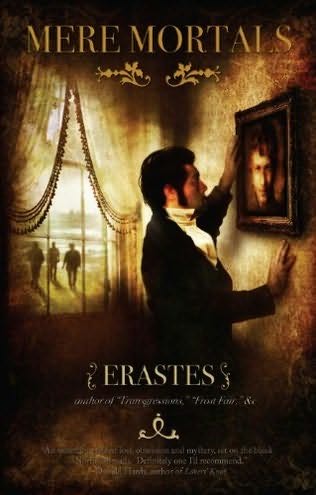
This week, we're welcoming historical novelist, Erastes, as she celebrates the release of her latest novel, MERE MORTALS, available now in print and ebook from Lethe Press, Amazon and just about everywhere. Here's the blurb:
Author Erastes' historical romance novel, Mere Mortals, is a beautifully written, haunting story about three young men who are taken in by a mysterious benefactor to live in the lap of luxury at his English countryside estate, Bittern’s Reach.

Orphaned Crispin Thorne has been taken as ward by Philip Smallwood, a man he's never met, and is transplanted from his private school to Smallwood s house on an island on the beautiful but coldly remote, Horsey Mere in Norfolk. Upon his arrival, he finds that he's not the only young man given a fresh start. Myles Graham and Jude Middleton are there before him, and as their benefactor is away, they soon form alliances and friendships, as they speculate on why they’ve been given this new life. Who is Philip Smallwood? Why has he given them such a fabulous new life? What secrets does the house hold and what is it that the Doctor seems to know? Trust acclaimed author Erastes to tell a moving story in the field of gay historical romance.

What makes your recent release, MERE MORTALS, an unusual historical?

Thanks for having me!  Well, for starters it’s set on The Norfolk Broads in England, and that’s an area that isn’t much covered by historical fiction. And it’s a gay historical which automatically gives it an “unusual” label, as despite there being hundreds more than there were five years ago, it’s a drop in the ocean when it comes to historical fiction in general.

Can you tell us a little about it?

It’s set in 1847, from November onwards. It’s told from the point of view of CrispinThorne, a rather disingenuous orphan who has been suddenly taken ward by a rich man who lives deep in the Norfolk countryside. Crispin has no idea what prompted this guardianship, as he’s never met or heard from the man before—and when he arrives at Bittern’s Reach, Philip Smallwood’s home, he finds two other young men who are also orphans, and who have more in common with Crispin than first meets the eye. The story is one of discovery, as they gradually learn more about their surroundings and their guardians character and motivation.

What inspired it?

Well, I was driving home one day and there was an interview on the radio on the BBC’s “Open Book” programme about a well-known writer (and for the life of me I can’t remember her name) who wrote a book about cloning, way back in the sixties, when cloning was still science fiction.  She said that she wasn’t really being original in the idea as the recreation of the perfect woman thing had been riffed on since the Greek Tragedies.  I’m always thinking of plots, and I suddenly thought how I could also use the idea but from a homosexual perspective.

I also wanted to shine a light on the fact that life was so cheap in Victorian (and obviously many other) times. The fact that Philip could literally take these young men out of schools because they had become an embarrassment, and take them away, and that no-one was going to check up on their welfare, made my hair stand on end.

How important are class distinctions to you when writing about your characters? For instance, the boys in Mere Mortals come across as being lower on the social scale than their benefactor. Likewise Rafe and Ambrose in Standish are from different social levels. Do you find that adds a dimension to their relationships?

When you are writing about historical periods, especially in England, it’s absolutely impossible to ignore class. Every interaction is coloured by it. If a landowner speaks to his gatekeeper you have to write it in keeping, if a vicar speaks to a peasant, then again. The young men in Mere Mortals are (probably, because it’s not explained, but they’ve all been sent to middling schools) nicely bred and they’ve had the company of their peers to teach them how to behave, but they all would feel like women did of the time, that they had no stability and their lives belonged to others. It’s not that I deliberately write unequal partnerships, but unless it’s Lord and Lord, you can’t avoid it. (and even in that case, one Lord would consider himself superior to the other.) It’s so ingrained in my English consciousness that I can’t help but be aware of it.

With your writing, which came first, the M/M or the historical?
The m/m I suppose, I started in Harry Potter fandom, but once I’d decided to write original fiction (about 2 months after starting writing in fandom) I knew that I had little interest in writing contemporary (not knowing the “scene” these days, or fantasy or sci-fi (everyone doing it far far better than I could!)

Are there any periods of history that you find so distasteful that you would never write about them?

No! LOL. Or subjects. I don’t understand writers who feel that some subjects shouldn’t be written about, such as slavery or incest or cannibalism—obviously these things should not be glorified or written for titillation (and it annoys me hugely to see slave rape done to arouse) but to ignore the problems we as humans have created in the past, and just shoving them under the mat is a grave error. If one doesn’t wish to read unpleasant subjects, that’s fine, but one should never say that a writers shouldn’t have the right write them.

I must admit, though, that I am now having a real problem with hygiene. Having watched the tremendous “Filthy Cities” recently with Dan Snow I will find it difficult to write any city/town based story prior to the 1900’s without seeing the massive amount of poo and rubbish that used to lie inches deep on the streets!

Thank you, Erastes. Please leave a comment to win a copy of MERE MORTALS!

02 June 2011

Excerpt Thursday: Erastes

This week on Excerpt Thursday, we're welcoming historical novelist, Erastes, as she celebrates the release of her latest novel, MERE MORTALS, available now in print and ebook from Lethe Press, Amazon and just about everywhere. Join us Sunday, when Erastes will be here to talk about the novel and give away a copy! Here's the blurb:
Author Erastes' historical romance novel, Mere Mortals, is a beautifully written, haunting story about three young men who are taken in by a mysterious benefactor to live in the lap of luxury at his English countryside estate, Bittern’s Reach.

Orphaned Crispin Thorne has been taken as ward by Philip Smallwood, a man he's never met, and is transplanted from his private school to Smallwood s house on an island on the beautiful but coldly remote, Horsey Mere in Norfolk. Upon his arrival, he finds that he's not the only young man given a fresh start. Myles Graham and Jude Middleton are there before him, and as their benefactor is away, they soon form alliances and friendships, as they speculate on why they’ve been given this new life. Who is Philip Smallwood? Why has he given them such a fabulous new life? What secrets does the house hold and what is it that the Doctor seems to know? Trust acclaimed author Erastes to tell a moving story in the field of gay historical romance.

***
“How long have you been Smallwood’s ward?”  
I’d expected something more personal, something impossible to answer, and the question took me by surprise. I answered him, relieved that I did not have to start my acquaintance with this man with a lie.

“I was told about it a year ago, sir.” Not for worlds would I explain the cir-cumstances of that discussion with a stranger. Just the memory—and shame—of my interview with the headmaster was enough to freeze the tongue in my mouth.

The headmaster had had his back to me, as if he couldn’t bear to look at me, and from what he’d just called me, and the expression on his face as he’d listened to my side of the story; it was clear he was revolted.

“Normally you would be sent home…in…cases like this. Archeson has al-ready been packed off and it will be up to his parents to deal with his…aberration.”

I paled. I’d met George Archeson’s father, as tall and broad and commanding as Archeson himself was slender and blond and shy—they couldn’t have been more different. I held my thumbs tightly, hoping against hope that Archeson wasn’t suffering. Wondering if we’d ever meet again, and doubting it.

“Truly, sir, you shouldn’t blame Arch.”

The headmaster rounded on me. “I do not.” The inference was clear, and I flinched under the fury of my headmaster’s gaze. “As you don’t have a home to go to, and your education is paid in full until you leave I have no alternative but to keep you, as much as I regret it.” The man returned to his desk, pulling open a drawer and removing a sheet of paper. He handled with much distaste-- as if I had written a de-scription of what Archeson and I had been doing when caught, although in truth it was little enough. “I have a letter here from Mr Smallwood, who has asked for, and has been awarded your guardianship. He wishes you to remain here for the remainder of the year.”

I felt as confused now as I had that day in the headmaster’s study. Smallwood? Who was this man? Why had he decided to become my guardian? Was it he who had paid for my education? If so, why? I had asked the headmaster these questions but the man had nothing more to tell me, or had decided not to tell me any-thing, either for reasons of his own or from sheer bloody malice.

Baynes dug a sharp elbow in my ribs. “There, lad. On your right. There’s your first sight of the Reach.” I struggled to my feet as the boat slipped quietly to-wards a wooden jetty in the distance, and gradually a house emerged from the screen of bare willows. In the year since I’d been told about a guardian I’d never met, I had imagined many houses that the man might live in: everything from a smart, four-storey townhouse in Mayfair, to a sprawling moorland farm, isolated in some bleak rolling landscape. I had not expected a huge elegant red-brick mansion with curved ornamentation to the gables. As the boat neared the jetty it became clear that behind the house the river widened considerably into a large lake, or a broad, I realised I should call them.

“Do you sail, Mr Thorne?” Baynes asked

“No, sir. That is, nothing much more than rowing. A little punting once or twice.”

“Well, you’d best learn,” Baynes said, “You can’t see it from here, but the Reach is on its own island. Boats are the horse, the carriages and carts here. You’ll find that out soon enough.” Baynes held out his hand and I shook it, gladly. “Good luck, boy.” He settled back down in his seat, leaving me no recourse but to say my farewells and to clamber ashore as gracefully as I could manage to watch the strange black boat slide away into the broad. No one waved to me from the boat, so I turned my attention to the present. My luggage was already on the jetty, such as it was, and I was about to drag it along with me when a shout sounded from the direction of the house.

“I say, leave that there, I’ll have Witheridge send someone for it later.” I turned to see a young man of a similar age to myself walking along the short path from the archway of the house. “Thorne?” The newcomer had a wide, friendly smile and as he neared the jetty he held out a hand, bare in spite of the cold, to be shaken. I did so, feeling some pleasure in at last seeing someone who seemed to be happy to see me. “Come in, you must be frozen.”

24 May 2009

Guest Author: Alex Beecroft

This week we welcome Alex Beecroft as she celebrates the release of her debut, FALSE COLORS, a m/m romance set on the high seas of the 18th century. Here's the blurb:

For his first command, John Cavendish is given the elderly bomb vessel HMS Meteor, and a crew as ugly as the ship. He's determined to make a success of their first mission, and hopes the well-liked lieutenant Alfie Donwell can pull the crew together before he has to lead them into battle: stopping the slave trade off the coast of Algiers.

Alfie knows that with a single ship, however well manned, their mission is futile, and their superiors back in England are hoping to use their demise as an excuse for war with the Ottoman Empire. But the darker secret he keeps is his growing attraction for his commanding officer--a secret punishable by death.

With the arrival of his former captain--and lover--on the scene, Alfie is torn between the security of his past and the uncertain promise of a future with the straight-laced John. Against a backdrop of war, intrigue, piracy and personal betrayal, the high seas will carry these men through dangerous waters from England to Africa, from the Arctic to the West Indies, in search of a safe harbor.
***

Welcome to Unusual Historicals, Alex. Let's start by asking "what makes your historical so unusual?"

Imagine a cross between Master and Commander and Brokeback Mountain--all the seafaring adventure and excitement of the former, together with the bittersweet, forbidden love story at the core of the latter. That was what I aimed to achieve in FALSE COLORS, a novel set in the Georgian Age of Sail that follows the romance between Lt. Alfie Donwell and his Captain, John Cavendish.

Together with TRANSGRESSIONS by Erastes, FALSE COLORS is one of two groundbreaking novels released by Running Press which aim to bring the underground phenomenon of m/m romance out into the mainstream. Running Press's aim was to see these two books, and the next two in the series, take their place in the romance section of bookshops next to traditional romances.

But surely gay romance belongs in the gay section rather than the romance section?

I would argue it belongs in both. One surprise m/m romance has for the romance industry is its great popularity with gay men. Men have previously not been much of a target audience for romance, but that isn't the case with these books.

Perhaps the larger surprise is that m/m romance appeals hugely to women as well. The success of Brokeback Mountain as a film can be set down largely to its appeal to women, rather than to gay men. There are numerous reasons why women who try m/m romance find that they adore it--two sexy heroes for the price of one, for example, or the element of real equality and mutual respect such a relationship allows. That's a subject too long for me to go into here. If you're interested, there is a debate on the subject here:

Why do women write m/m fiction?

Brokeback Mountain was an amazing love story, but I wouldn't exactly call it a romance. How do you get around the fact that in the 18th Century your characters could have been hanged for having a relationship?

Well, partly I don't try to get around that fact. What could be more romantic than a love strong enough to bloom even under the threat of the gallows? The difficulty comes in allowing the characters to have a happy ending. But I look at it this way--most of the relationships which we know of, that ended badly, we know of because they ended badly. They were recorded because they were discovered and ended up in court. But I'm writing about the other couples; the ones who were careful and clever enough not to be discovered, and who managed--not without risk, of course--to live happily every after under the radar of society.

One final question: why did you choose this setting?

Oh, that's easy! I adore the Age of Sail. There's something so beautiful and romantic in the tall ships themselves. They symbolise the sense of freedom and excitement--the feeling of new horizons opening, fascinating discoveries being made, and the optimism of the age of Enlightenment. There's a wonderful confidence and energy, and a mixture of refinement and ferocity in the men of the time that I find magnificent. I've gone into more detail here:

What the Georgians did for us: Five reasons to love the 18th century.

Please visit me on my website if you'd like to know more. It has an attached blog that I try to update every day with news about my books, works in progress, writing tips and cover art secrets, as well as the occasional aside about my adventures in re-enactment and morris dancing.

Reviews For FALSE COLORS

From Dear Author:
Rarely, oh so rarely, I'll read a book that is so sublime, so transcendent, I actually come away from it a little melancholy, because it's over and I can never read it for the first time ever again, because I know I'll never be able to do justice to it in my review or analysis, and because I know I won't meet its equal for many a year. But the process of devouring the book, of eking out its layered, textured meaning, of savoring its descriptions, and the emotions–oh, the emotions!–leaves me flying for days and the melancholy only makes it all the sweeter.

This is one of those books. It ravished me. It scoured my insides. I feel like I'm stuck in it and I don't ever want to get out.
Read the whole review here.

More reviews here.

I'd like to offer a copy of FALSE COLORS to one of your readers, chosen at random from anyone who comments on this post. And thank you again for having me! It's been an honour to be here.

***

Thanks for stopping by, Alex! We were very happy to have you. If you would like to enter for a chance to win a copy of FALSE COLORS, made a question or comment for Alex. I will draw a winner at random in one week. Good luck!

21 May 2009

Thursday Excerpt: Alex Beecroft

Thursdays on Unusual Historicals mean excerpts! This week we're featuring an excerpt from Alex Beecroft's debut, FALSE COLORS, a m/m romance set in the 18th century. Join us on Sunday when Alex will be stopping to talk about FALSE COLORS and give away a copy!

For his first command, John Cavendish is given the elderly bomb vessel HMS Meteor, and a crew as ugly as the ship. He's determined to make a success of their first mission, and hopes the well-liked lieutenant Alfie Donwell can pull the crew together before he has to lead them into battle: stopping the slave trade off the coast of Algiers.

Alfie knows that with a single ship, however well manned, their mission is futile, and their superiors back in England are hoping to use their demise as an excuse for war with the Ottoman Empire. But the darker secret he keeps is his growing attraction for his commanding officer--a secret punishable by death.

With the arrival of his former captain-and lover-on the scene, Alfie is torn between the security of his past and the uncertain promise of a future with the straight-laced John.
***

On the cluttered front of an empty warehouse, its great doors gaping wide, white flashes of lightning lighting up dangling chains, the last group of men parted before them and ran. They stood shoulder to shoulder in the rain, suddenly alone.

John turned, saw Alfie watching him; pale hair eerie in the night, wide eyes gold. Rain trickled down Alfie's face, streaking through the blood and dirt. He licked his lips, panting, his mouth open slightly, gleaming with water. "John, I...."

The look of shock, vulnerability, was just the same as he had worn that day John walked in on him when he was playing the flute. Off balance, taken unawares, and he was so…oh so beautiful. Why not? After all, why the hell shouldn't I?

Seizing Alfie by the wrist, John hauled him into the warehouse's private darkness, shoved him up against the wall and kissed him--desperate, demanding, furious. The storm crested and broke in him as he forced his way into Alfie's mouth. Warmth, and rain trickling off their hair onto his lips, and Alfie's solid body trembling against him, and for a lightning flash he had no thought at all; abandoned to sensation like an animal. Only slowly did he recognize the shaking of Alfie's pinned arms, the shudder of his chest, and the low, irregular gasp of his breath for what it was. Head back against the wall, eyes closed, he was sobbing very quietly, stripped of his authority and broken at John's touch.

The spirit stove in John's rooms sighed and guttered, damnably slow. All the time it struggled to heat the water Alfie sat at the table with his head in his hands, rain, blood, and mud dripping off him onto the clean floor. He took the teacup with numb fingers and did not drink, instead cradling it, bent over the steam.

There was so much John wanted to say. Principally "I've been an ass. I'm so sorry. I don't dare ask for your forgiveness but tell me what I can do now, to mend you. Please. Please don't carry on like this. I can't bear it." But he couldn't force it out. "You'll catch your death," he said instead. "Come, let me lend you some dry clothes."

Alfie looked up, his gaze as bleak and bedraggled as his clothing. He made to speak, but as he did so, there came a sudden, shocking hammering noise. They both flinched. Then John put down the linen towel he had been using to dry his hair and opened the door. Light shone out across a self-important, down at heel, middle-class man and the two bruisers with cudgels who lurked behind him.

"Certain accusations have been made concerning the late Captain Lord Lisburn," the man said, unconsciously patting his own belly. Indeed, he looked almost pregnant with satisfaction.

"What is that to me?" said John coldly, trying inconspicuously to stand in the man's line of sight. It did no good, he merely stepped to one side and looked past John, straight at Alfie.

"Some very serious matters have come to light about the captain's...ahem...relations with one Lieutenant Alfstan Donwell. I have been directed to take the gentleman in, for questioning. Enquiries about the harbor indicated he was last seen with you. So I came here. I presume this is him?"

John froze. So it had come to this after all; the death they had both been courting had found them here in his own rooms. He considered lying, considered drawing his sword and taking all three men down, hiding them somewhere. But as his soul revolted at the thought, Alfie slowly dragged himself to his feet. "Yes. Lieutenant Donwell at your service. What can I do for you?"

"Hand your sword to me and come with us."

"Alfie," John whispered, aghast. Alfie reached out and squeezed his wrist--he thought reassuringly, though it was hard to tell through the explosion of pain. His thin, new skin parted beneath the touch.

Alfie frowned at the blood on his fingertips as if he couldn't work out what it was. "Goodbye then, John. Pray for me."

12 April 2009

Book Party: Erastes

It's Sunday on Unusual Historicals, which means it's time to meet another author and win a book! This week our author is Erastes and her new release is TRANSGRESSIONS, an M/M romance set in the English Civil War. She's giddy about the release of the book which, together with Alex Beecroft's FALSE COLORS, are the first gay romances to be released in the mainstream. Both novels can be found in the romance section of bookshops across the US.

***

David Caverly's strict father has brought home the quiet, puritanical Jonathan Graie to help his dreamer of a son work the family forge. With war brewing in Parliament, the demand for metal work increases as armies are raised.

The indolent and deceitful David Caverly is bored by his father's farm and longs to escape, maybe to join the King's Army, mustering at Nottingham. David finds himself drawn to Jonathan, and after a passing cavalry trooper seduces the beautiful David and reveals his true nature, he determines to teach Jonathan what he's learned.

When David is forced to leave the farm, and the boys are separated by mistrust and war, they learn the meaning of love and truth as they fight their way across a war-torn country, never thinking they'll ever see each other again.
***

Tell us a bit about TRANSGRESSIONS.

It's the story of two very ordinary young men who just happen to live in Kineton, Warwickshire, England.

The story begins in the summer of 1642, David Caverly is bored of living in a place where nothing exciting happens. War seems inevitable and--as there hasn't been a major war in Britain since the Wars of the Roses 200 years previous--people were MUCH interested in it. Unbelievably, people actually went along as sightseers to watch the battle of Kineton, treating it as a day out. I deal with this in the book, although it's not quite the jolly day out that my characters expect, but rather carnage.

The story deals with David and his new friend Jonathan, who has been brought to the forge has an apprentice, their burgeoning friendship (which turns to love) and the consequences of that. Needless to say it doesn't all take place on a farm in Warwickshire, but spreads out across England, as does the war.

How do you deal with the fact that homosexual love was illegal at this time?

Obviously in 17th century England, a homosexual love affair was never going to be tolerated. Buggery was made a felony by the Buggery Act in 1533, during the reign of Henry VIII. The punishment for those convicted was the death penalty right up until 1861. Not only was it prohibited by law but by the church too--an abomination. The title "Transgressions" applies to this, and everything else that is going on in this fascinating, bloody time.

What is the main theme of the book?

It started out as David's story, as David was the character who came to me first--but after a while it really warped into Jonathan's story, as I think he has the longest journey to take. He's such an innocent in many ways, and while David finds his father's ways and the church's restrictions easy to side-step, Jonathan battles against every misdemeanour and truly suffers for it. When he finds himself falling in love with another man, it almost breaks him--and his journey becomes harder for it. What he seeks is the truth, and after a while he thinks he's found it in Matthew Hopkins' Witchfinders, but he eventually finds out that he's been looking in the wrong places.

Where do you look for inspiration?

I don't really look for inspiration. Writing is generally on my mind all the time, like an undermining sickness. And it can strike at any time--seeing a lighthouse on the horizon, hearing an author talk about her own book on the radio and where she got her inspiration from, or in conversations with people, or overheard from people. A painting, a song...I'll suddenly think--Oh, that's an idea...

The inspiration for TRANSGRESSIONS was simply the title and the concept. My mother, having read and loved STANDISH, said, "For your next one, how about the English Civil War?" That sort of set sparks off in my head, I could immediately see a summer, blissful, warm and safe, all about to be turn to pieces by a war that would tear families to pieces. The idea of two young men ending up on different sides of the war isn't an original one, of course, but it hasn't been done in gay romance before. I do highly recommend Maria McCann's "As Meat Loves Salt" though, if anyone wants to know more about the era. It's a wonderful book about this era, and again, another gay love story. I can't say that it's a "romance" though, but a stunning read.

Why do you like to write gay historical?

I don't think I'd be interested in general historical. The reasons why I am fascinated with gay historical is that it's generally wide open. When you look at the list on Speak Its Name, there's a tiny amount of books available in the genre. I'd like to see anyone try and list all the heterosexual historical fiction there is out there! Every period is ripe for writing about. There might be a top-heaviness of Regency for example, but there's so many stories yet to be told. It's an exciting time to be in the genre--a genre that no-one even acknowledged as existing a few years ago. Now it's going mainstream.

Unusual Historicals...right up your street. Do you think you could ever write a usual historical?

No, definitely no. Although I hope that gay historical will soon become non-unusual!


What's been the single most difficult thing to research?

Gah. Not the war itself in fact, because there are hundreds and hundreds of sites and books about the war. You can find out who all the main players were, what everyone was wearing, flags, munitions, how to load a musket, how to fight with a pike, how to do wheeling and counterwheeling in formation, but there's very, very little about the everyday life of a man keeping his family fed. In the end I had to approach living history groups who were hugely helpful. They helped with food and clothing and all the little things needed for this kind of book.


What was the closest you came to committing a 'great historical clanger'?

I've yet to hear what I've done wrong in TRANSGRESSIONS, but I'm sure I've made historical errors. The worst one I know of is in STANDISH. Ambrose is reading a book that wasn't published at the time. The annoying thing is that I researched it when I was writing, realised it was anachronistic and took it out--or at least I thought I'd removed all mention of it, because if you read on later in Standish, he refers to Polidori's Vampyre, which was published at the time. but I missed one reference to Dracula...Oh, the shame! The readers soon let me know! I hope to goodness that I haven't done something similar in TRANSGRESSIONS, but I'm sure that if I have, the re-enactors will let me know!

How do you research the fighting?

That was pretty easy, actually. There are so many resources about that. There must have been battle geeks even back in the 17th century because there are painstainking illustrations of the battles and descriptions of what happened during each battle.


Something inevitably seemed to go wrong, though, which struck me as very human. In the battle of Edgehill, for example, which was the first official pitched battle of the ECW, the entire cavalry charged after a retreating brigade and to loot the Parliament's baggage train. This blunder left the infantry unprotected and could have caused an inconclusive result, which in turn caused the war not to be decided on that one day.

Here's a previous post I did on the subject, which shows some of the munitions and fighting research I had to do.

How do you deal with endings? It's not like your characters can get married.

No, and that's the quandary that the gay romance author faces. I hope that this is a more satisfying ending for the reader than STANDISH, which was open ended in the same way Gone with the Wind is. But I haven't "cheated." There's the obligatory HEA, but I think that the ending will still make the reader think and that's the point. One has to worry about how any gay romance will work, especially in this bloody century.

There are further snippets on her website, together with free bookmarks and lots more. Here's the book trailer:


***

Thanks so much, Erastes, for joining us today, and good luck launching this new subgenre of historical romance!

Readers, if you'd like to win a copy, simply leave a comment or question. Have you read any M/M romances? Are you curious? I'll draw a name at random next Sunday. (Some patience may be required as Erastes has not received her author copies yet!) Good luck!

09 April 2009

Thursday Excerpt: Erastes

Today on Excerpt Thursday we have the opening to chapter one of Erastes' TRANSGRESSIONS, which will be released next week. We'll be doing a Q&A with Erastes on Sunday when you'll have the chance to win a copy. Here's the skinny:

In 1642 England, David Caverly's strict father has brought home the quiet, puritanical Jonathan Graie to help his dreamer of a son work the family forge. With war brewing in Parliament, the demand for metal work increases as armies are raised.

The indolent and deceitful David Caverly is bored by his father's farm and longs to escape, maybe to join the King's Army, mustering at Nottingham. David finds himself drawn to Jonathan, and after a passing cavalry trooper seduces the beautiful David and reveals his true nature, he determines to teach Jonathan what he's learned. When David is forced to leave the farm, and the boys are separated by mistrust and war, they learn the meaning of love and truth as they fight their way across a war-torn country, never thinking they'll ever see each other again.
***

David was not where he should be. He rarely was. He was supposed to be in the shed, milking the four cows and then cleaning the barn, but he had not even started. The beasts were at the gate lowing insistently, but David was sprawled in the tall grass on the side of the river, ignoring them and the work to be done.

He was comfortable. He had all day, and the warmth of the sun on his naked body gave him no inclination to move. The day was perfect; the grass gently grazed his flanks and his skin tingled deliciously as the water dried upon it.

Jacob, his father, had left early that morning and had given David tasks enough to keep him busy for the remainder of the day. Dutifully, David had completed the morning milking, but after he let the gentle beasts back out into the water meadow, he had sauntered down to the river and had done nothing since. It was too hot for chopping wood, and he felt his father was being somewhat overzealous by demanding such a stockpile made ready in this heat when September had not yet arrived. He planned to do it later, before his father returned.

His father had informed him that he was going to be away from the forge all day, although he not told his son where he was going, and David had not particularly cared. He liked being alone.

David chafed against hard work. He hated the forge and he loathed the smallholding. His natural state of being was one of cheerful indolence, and he would find any way of avoiding work he could, unabashed by his father's speeches on the merits of toil. Therefore in keeping, he did not spend more time than he could avoid worrying about the inevitable, such as the threat of his father's censure on his return when he found David's work undone.

The sun was scorching his flesh and getting too hot at last, David rose; a berry-brown perfection of immature muscles and rounded boyish pertness. He was not particularly tall for his sixteen years, but he was still growing; his hands and feet seeming larger than they should be as his body caught up. His body was sun-dried after his bathe, but his hair, startlingly white blond and so long it reached halfway down his back, clung damply to his skin like a white-gold horse's tail. It was David's private glory and his father's public shame. David was careful to keep it tied back and appearing to be shorter than it was when his father was about, for if his father knew that David was prideful over his hair, he would surely insist on having it cut as short as his own chin length bob.

Resentfully, David dressed and let the cows in from the fields for milking. He slapped their silken rumps a little too hard in unjust punishment for the work they were making him do, tugging at their teats and growling in annoyance when he paid the price for it, losing a whole bucket of milk to an angry kick. He knew his father would react more strongly to the loss of the milk than the chores he had not accomplished, for the milk was money. It was not that they were poor, but it was waste, and waste was sin.

David frowned; everything was sin with his father, who reproved David daily for failing to defeat the demons of the seven sins and being unable to master any of the cardinal virtues.

A joy of food was sinful, getting angry with the cows for stepping on him was sinful, wasting money was sinful, even taking a pride in his own handsomeness was somehow wrong in the eyes of the Lord. David knew he was beautiful; he did not own a looking glass, (another sin) but he had a river in which, Narcissus-like, he would gaze at his reflection. He knew that his face was changing as he matured, becoming more lean, accentuating his cheekbones and his straight dark brows. He knew too, that his eyes were unusual, for his friends had remarked on them. Not quite brown and yet not hazel; in some lights like amber honey, and in others lit with a greenish fire. He never let his father see him looking at his reflection because that, of course, was a sin.

Singing--frowned upon, dancing--forbidden. This did not prevent David doing any of these things, but it did mean that most of everything that he enjoyed he was forced to do in secret in his attempts to keep his father from being disappointed.

Such subterfuge meant that when his father did find out, he was even more disappointed by the deception more than the act. Trammelled in this way, David felt caged and trapped; his joy of life and of living spoiled, and everything he took pleasure in was tinged with guilt.

He'd become used to the guilt; his constant rebelliousness inured him to it, and the more he broke his father's rules the less he worried about it. He could not help but resent it, however, even though his father never beat him for his transgressions, never got angry with him. He simply sermonised or prayed to God to ask him to intercede, and David had long ago learned to look penitent, beg forgiveness, and promise to pray for strength to change his ways; his father accepted it, every time.

He was chopping his fifth log when he heard the return of Jacob's wagon, and he pretended to ignore it, applying himself to the task before him, not looking forward to the speech he was likely to receive for the endeavours left undone. As the horse rounded the barn he straightened up as he noticed that his father was not alone. Sitting beside him was a young man clad in sombre clothes, overshadowed by a large black hat. David's eyes narrowed; he glared openly at the stranger as he jumped down from the wagon and took the reins of the horse whilst Jacob descended.

David didn't much like what he saw. The newcomer was a tall youth about his own age or possibly a little older. Brown straight hair, pale suspicious and unhappy eyes, plain of face with flat cheekbones and a defiant scowl under his wide-brimmed hat. A plain black coat, black breeches and a high collar confirmed David's worst suspicions. A Puritan.

Read the rest of the chapter here!

20 July 2008

Book Party: Erastes

This week we welcome one of our regular contributors, Erastes, to celebrate the release of SPEAK ITS NAME, an historical anthology of homosexual love stories featuring Erastes' story "Hard and Fast."

***

Speak its Name
Major Geoffrey Chaloner has returned, relatively unscathed, from the Napoleonic War, and England is at peace for the first time in years. Unable to set up his own establishment, he is forced to live with his irascible father who has very clear views on just about everything--including exactly whom Geoffrey will marry and why. The trouble is that Geoffrey isn't particularly keen on the idea, and even less so when he meets Adam Heyward, the enigmatic cousin of the lady his father has picked out for him... As Geoffrey says himself: "I have never been taught what I should do if I fell in love with someone of a sex that was not, as I expected it would be, opposite to my own."
***

"Hard and Fast," your story in the anthology, is a Regency. STANDISH was a Regency too. Would it be fair to say that this your specialist era?

In a way--not really the Regency, but the 19th century I suppose. I've spent so many years reading books from that era, I've only just started to read modern fiction and am only now discovering new genres. But as I say, I spent so long reading "classics" that I feel most comfortable writing in a previous time. I would say that "Hard and Fast" is probably the most traditional Regency I've done so far, a drawing room match of manners and wit with a trip to Bath thrown in, but I don't want to be known only for writing Regencies. Not even gay ones. I don't want to be typecast and I like to stretch myself and try different eras. My second novel, Transgressions, is to be published by Running Press next Spring--and that's English Civil War. Oh, and I've just finished one which is based in the 1960s. And believe me, researching the 1960s was every bit as hard as the English Civil War!

How did SPEAK ITS NAME come to be?

Lee Rowan has been writing for the publisher (Linden Bay Romance) for a while now, and one day she suggested to me that her and I (and a writer called Charlie Cochrane who I hadn't met before) could do a novella each for one of LBR's "Trilogy" series. I had "Hard and Fast" started, but it had ground to a bit of a halt and this gave me the impetus to get it finished. We submitted the three stories to Linden Bay and they accepted them--we were lucky and I like to be lucky!

Was there any rationale regarding the differing eras?

We wanted to present a sweep in time--not to all write in the same era, so Charlie went for 1920s Oxford ("Aftermath"), Lee wrote a great Victorian spy story ("Gentleman's Gentleman"), and mine was Regency. I wouldn't mind doing the same kind of thing again one day, with perhaps stories from before the 19th century. There are so many eras unexplored in the realms of gay historical fiction, one only really needs to stick a pin in a calendar.

What's "Hard and Fast" about?

It's told from the point of view of Geoffrey Chaloner who is (considering he has difficulty expressing himself in speech) remarkably verbose in his own head! He's a major, and he's experiencing the first spring of peace in England. Unable to afford set himself on his own on his major's half pay, he's forced to live with his father who, naturally enough, wants his youngest and only single son to be married as soon as possible, now that Bonaparte has been defeated. Geoffrey is a little reluctant, but he's very much governed by his father and courts the lady his father chooses. The trouble is, the lady has a cousin, Adam Heyward, club-footed, rakishly handsome and with a vitriolic tongue. Geoffrey finds himself drawn to Adam in a way that he never expected, and he has to decide whether he'll follow his heart or his duty.

I tried to make it funny in parts. Geoffrey was so easy to use as a foil to spoof the ideals of the military. One instance is when Geoffrey describes how he was raised by his irascible father to know that he was destined for the battlefield; his nursery is swathed in bloodstained flags and pictures of glorious death, he has a rocking horse which is more like a charger, and had wooden swords and guns to play with. He reflects that if he were more sensitive, he would have been put off from war and only embarked upon it to save his comrades, but he admits he's not that sensitive, which is a sly dig at The Four Feathers and was great fun to write.

I can't see me changing in the near future. Perhaps I might start writing less "romance" and more just gay historical fiction, because the Happy Ever After that's required for "romance" is something I'm a little uncomfortable with, but gay historical fiction is so unexplored.

What's next for Erastes?

I'm finishing off another novella for Linden Bay at the moment--it's (yet!) another Regency, but this time it's nothing to do with ballrooms and drawing rooms. It's about an impoverished printer who has trouble making ends meet--and a large portion of the book is based around the 1814 Frost Fair which was fascinating to research.

Standish by ErastesOnce that's done, I need to get on with novel four. I'm planning a sort of sequel to STANDISH, where one of the minor characters flees to America. It's not a romance, more like gay Flashman meets the New World--each chapter a separate adventure, or that's the plan. I'm looking forward to it and dreading it by turns. Whilst my comfort zone is Regency London and Bath, researching early 19th century America is hugely daunting, and I'll be relying on my online friends a lot! After that, I'm not sure. I have several ideas percolating away: gladiators, Shakespearean actors, Victorian solicitors... *laughs* Too many ideas and I have only ten fingers.

***

Thank you for joining us, Erastes! If you'd like to try SPEAK ITS NAME for yourself, leave a comment or a question. You name will be entered in a drawing for a free copy, to be drawn next Sunday. Best of luck!

27 February 2008

Thursday Thirteen: Gay Love Poems

By Erastes

Continuing our month of love, and because love is love and is for everyone.

Thirteen Things about Gay Love Poetry


1. The Song of Songs, Now widely acknowledged to be a homoerotic poem:

Let him kiss me with the kisses of his mouth: for thy love is better than wine.

2. Shakespeare, notably the infamous (and very witty) Sonnet 20:

A man in hue all hues in his controlling,
Which steals men's eyes, and women's souls amazeth.
And for a woman were thou first created;
Till Nature, as she wrought thee, fell a-doting,
And by addition me of thee defeated,
By adding one thing to my purpose nothing.

3. Abu Nuwas (756-815):

I die of love for him, perfect in every way,
Lost in the strains of wafting music.

My eyes are fixed upon his delightful body

And I do not wonder at his beauty.
His waist is a sapling, his face a moon,

And loveliness rolls off his rosy cheek

I die of love for you, but keep this secret:

The tie that binds us is an unbreakable rope.
How much time did your creation take, O angel?
So what! All I want is to sing your praises.


4. Michelangelo: In the 1530s, Michelangelo was sustaining a relationship with his much younger model Febo di Poggio. He calls Febo "that little blackmailer," because Febo adopted Michelangelo as "my honorary father" and steadily demanded money, clothes, and love-gifts from him. On a page containing financial calculations, Michelangelo wrote:

Here with his beautiful eyes he promised me solace,
And with those very eyes he tried to take it away from me.


Their passion raged through 1533-34, but ended when Michelangelo discovered that the mignon had "betrayed" him, perhaps by actually stealing money or drawings from his sugar-daddy. The artist felt humiliated by his subservience to the model.

Several poems pun upon the boy's name. "Febo" equals Phoebus, and poggio is the Italian word for "hill"--and suggest physical consummation:

Blithe bird, excelling us by fortune’s sway,
Of Phoebus' thine the prize of lucent notion,
Sweeter yet the boon of winged promotion
To the hill whence I topple and decay!


But such a topple was sweet:

Easily could I soar, with such a happy fate,
When Phoebus brightened up the heights.
His feathers were wings and the hill the stair.
Phoebus was a lantern to my feet.


5. Walt Whitman: Perhaps less love for a single man, but love for the rough-trade he would immerse himself in. Whitman's notebooks of this period are filled with descriptions of buss drivers, ferry-boat men, and other "rude, illiterate" men that he met

I share the midnight orgies of young men . . .
I pick out some low person for my dearest friend,
He shal be lawless, rude, illiterate, he shall be condemned by others for deeds done,
I will play a part no longer, why should I exile myself from my companions?


And more romantically. . .

When I Heard at the Close of the Day (No. 11, from 'Calamus')

And when I thought how my friend, my lover, was on
his way coming, then O I was happy,
Each breath tasted sweeter – and all that day my food
nourished me more – and the beautiful day passed well,
And the next came with equal joy – and with the next,
at evening, came my friend.

6. Lord Alfred (Bosie) Douglas: Famous for being linked to Oscar Wilde and his poem "Two Loves" gives us one of the most famous lines in gay poetry.

I am true Love, I fill
The hearts of boy and girl with mutual flame.
Then sighing, said the other, 'Have thy will,
I am the love that dare not speak its name.


7. W H Auden's "Funeral Blues," famously famous in Four Weddings & a Funeral:

He was my North, my South, my East and West,
My working week and my Sunday rest,
My noon, my midnight, my talk, my song;
I thought that love would last forever: I was wrong.


8. Christopher Marlowe's Edward II. In Gaveston's first speech he reads Edward's letter to him, and he remarks upon it:

'My father is deceased. Come Gaveston,
And share the kingdom with thy dearest friend.'
Ah, words that make me surfeit with delight!
What greater bliss can hap to Gaveston

Than live and be the favourite of a King!

Sweet prince, I come! These, these thy amorous lines
Might have enforced me to have swum from France,

And, like Leander, gasped upon the sand,
So thou wouldst smile, and take me in thine arms.


9. Sir Philip Sidney's "My True-Love Hath My Heart" from Arcadia:

My true-love hath my heart, and I have his,
By just exchange one for the other given..

10. Hafiz, circa 1320-1389:

With looks disheveled, flushed in a sweat of drunkenness His shirt torn open, a song on his lips and wine cup in his hand With eyes looking for trouble, lips softly complaining So at midnight last night he came and sat at my pillow. . . ."

11. Byron's Don Leon (attributed):

How oft, beneath the arbour's mystic shade,
My boyish vows of constancy were made!
There on the grass as we recumbent lay,
Not coy wast thou, nor I averse to play;
And in that hour thy virtue's sole defence
Was not thy coldness, but my innocence.

12. Muhammad al-Nawaji bin Hasan bin Ali bin Othman (1383?-1455) wrote For a Beautiful Black Boy:

Aroused, he exhales
The intense perfume of his musk.
The sight of his face, lit by a ray of light
Imprints itself.

13. Byron's The Cornelian. Byron became obsessed with a choirboy, John Edleston (spelled "Eddleston" by Byron), whom Byron met as a student at Cambridge and with whom he was deeply in love (see The Columbia Anthology of Gay Literature, ed. Byrne R. S. Fone, p. 219) and the poem is about a stone that Edleston once gave the poet.

He offer'd it with downcast look,
As fearful that I might refuse it;
I told him, when the gift I took,
My only fear should be, to lose it.

This pledge attentively I view'd,
And sparkling as I held it near,
Methought one drop the stone bedew'd,
And, ever since, I've lov'd a tear.