Showing posts with label Charles II. Show all posts

27 January 2012

History's Mysteries: The Mystery of the 'Black Box'

By Anita Davison


Lucy Walter, a dark-haired, blue-eyed Celtic beauty referred to as 'a browne, beautiful, bold, but insipid creature,' by John Evelyn, was one of the earliest loves of King Charles II while the eighteen-year-old Prince of Wales lived in exile on the Continent after his father King Charles I was beheaded in 1649.

Already the mistress of Colonel Robert Sidney at The Hague, she met Charles in September 1648, they soon became lovers and bore Charles a son  in April 1649. Despite being short on funds, Charles provided money which enabled Lucy to live in “great splendor.”  The child was named James "Crofts" (after his guardian Lord Crofts).

In June 1649, Lucy accompanied Charles to Paris where he resided for three months, leaving Lucy behind when he returned to The Hague. During the summer of 1650, Lucy is said to have become the mistress of either Colonel Bennet, or Theobald, second Viscount Taafe and in May of 1651, Lucy’s daughter, Mary was born, though speculation was rife as to which man was the child’s father. Both men were living at the Louvre, much to Queen Henrietta Marie’s indignation but she could not afford to pay Lucy to leave when Taafe was keeping her and her children. Charles’ behavior was characteristic, in that he had done with Lucy, but was willing for her and Taafe to remain under the same roof as himself, as long as he didn’t have to support her and could keep in touch with his son.

In the summer of 1651, Lucy went to London with her brother, Justus, to recover an inheritance from their mother. Taken for a Royalist spy, she was arrested on Cromwell’s orders and sent to the Tower of London, where she called herself the wife of King Charles II. She was deported to Flanders, from where she proceeded to Paris to find that she had “lost all favor with Charles II.” While publicly denouncing her, he still sent her messages promising her money and support, ostensibly to prevent her from publishing “certain papers which Charles was anxious to obtain, possibly the contents of the mysterious ‘black box’.”

By 1655, Lucy came under the protection of the married Colonel Thomas Howard, brother of Earl of Suffolk and master of the house to Mary of Orange. Lucy neglected James’ education, and threatened Charles with creating public scandals while he was still dependent upon the goodwill of foreign royalty. Lucy lived with Henrietta Maria, the queen mother, and Princess Mary, Charles's sister, on and off for five years. These Royal ladies’ affectionate letters to Lucy Walter show a close relationship and deep family feeling which many believe would have not existed toward a mistress.


However by this time, Charles’ sister Mary regarded Lucy as an obstacle to the hoped-for restoration of the monarchy, which looked increasingly possible. Oliver Cromwell was dead and the Commonwealth became increasingly unpopular.

Unfortunately for Charles, Lucy had in her hands both his beloved son and a number of letters and papers apparently of critical importance to him, papers she threatened to make public.  When Lucy went to live in Brussels, the King, arranged for her to be lodged with his agent and Lord Bristol’s secretary, Sir Arthur Slingsby.

Slingby tried to have Lucy arrested, at which she ran into the street weeping and crying, clutching her son, James. When passersby came to her aid, Slingsby made matters worse by declaring that he was acting on behalf of the English King. This provoked such an uproar, the Governor of Brussels was forced to intervene. Charles could do nothing but find Lucy alternative housing, and explain to the Governor that Lucy’s “wild and disgraceful course” had exasperated all those concerned.


Charles sent his agent Edward Prodgers to Brussels to remove young James from his mother’s care, during which Lucy made another public scene. However, this proved too much for her and, exhausted and ill, she  surrendered James to his father.

In December 1657, James was delivered to the Queen Mother, Henrietta Maria, who put him in school at Port-Royal near Paris. Lucy’s objections were finally subdued by the threat that Charles would disown the boy if she tried to get him back and she was then driven from Brussels and moved to Paris, presumably to be close to her son in his nearby school.

Lucy died in late1658 in abject poverty according to John Evelyn, while others claim she became a penitent of Dean Cosin, later Bishop of Durham, who, while pretending to be converted from her loose manner in life, Lucy continued her vicious ways. James II unkindly said that she died of a “disease incident to her profession.”

Charles II brought the young James Crofts to London, and at fourteen, married him to Anna Scott, Duchess of Buccleuch one of the richest heiresses in the country. James took her name, and was made the Duke of Monmouth.

By the late 1670s, it was clear that Charles’ Portuguese queen, Catherine of Braganza, was unable to provide a legitimate heir, and with the prospect of the Catholic James, Duke of York as the next king, panic set in among certain Whig courtiers, such as Anthony Ashley Cooper, 1st Earl Shaftesbury.

The Parliamentarians were pushing hard to legitimize Monmouth by supporting Lucy's claim that she and Charles had been married, the Duke of Monmouth declared legitimate, and the Duke of York excluded from the line of succession due to his Catholic proclivities. James, Duke of York and his supporters were equally eager to prove Monmouth’s illegitimacy, so the long-dead Lucy’s name had to be blackened, and she was labelled unjustly a ‘whore’.

During the ‘Black Box Inquiry’ in 1680, where witnesses claimed Lucy kept her marriage records. She was reputed to have given the box to the late Anglican Bishop John Cosin, who was by then unable to testify that a contract of marriage existed and was signed at a ceremony performed by Dr. Fuller, Bishop of Lincoln. 

Sir Gilbert Gerard, Bishop Cosin’s son-in-law, denied any knowledge of the Black Box despite his earlier allegations that his father-in-law had left the object to him and that he had found the marriage contract inside.
Bishop Paterson allegedly knew the names of the witnesses at the marriage ceremony, and that Oliver Cromwell’s officers had confiscated the certificate from Lucy while she was under arrest. Coincidence or not, but all records of births and weddings filed in Lucy’s home county of Pembrokeshire in the year of Monmouth’s birth had been destroyed at the Restoration. 

During this inquiry, Charles was reportedly ill at ease, possibly due to a guilty conscience? In January 1678, he published a declaration made the previous year that he and Lucy Walter were not married. A reply was published in the form of a pamphlet entitled, “A Letter to a Person of Honour Concerning the King’s Disavowing Having been Married to the Duke of Monmouth’s mother.” Attributed to Robert Ferguson (“the plotter” who took part in the Monmouth Rebellion) he inferred that Charles had married Lucy Walter with his mother’s permission when his life was despaired of through the combination of an attack of smallpox and his frustration at being denied marriage to Lucy.

Charles allegedly told Bishop Burnet, that he would rather see Monmouth hanged than legitimize him.

In the early 1680’s, encouraged by Shaftesbury, Monmouth travelled on a quasi-royal progress throughout the West Country, drumming up popularity for the Protestant son of Charles II. The king, in retaliation, deprived Monmouth of his general's commission and forbade him to appear at court.

When Charles II died in February 1685, Monmouth was living in exile in Holland, banished for his part in The Popish Plot. In May, Monmouth arrived in England with a small army, but his ill-fated rebellion ended in his execution by his Uncle, James II in July 1685. Prior to his execution, Monmouth signed a paper stating that the late King told him he never married Lucy Walter. However, this was probably written to spare his descendants persecution following his death.

Monmouth’s ten-year-old daughter died of illness in the Tower soon after her father’s execution. His two sons became Scottish earls, and one grandson and a great-great grandson became Dukes of Buccleugh. The title passed to him from his mother, Anna  [The title Duke of Monmouth became extant after his death and has never been revived]

The conspiracy of the ‘black box’ might have ended there, however a descendant of Monmouth’s, the third Duke of Buccleuch, Henry Scott, reportedly found a marriage certificate between Charles II and Lucy Walter in the muniment room at Dalkeith. Having announced that ‘No loyal Englishman should keep such a bombshell in his possession,’ and, in front of the Duke of Abercorn, burned the document. One other story, was the Duke took the document to Queen Victoria, who, after one horrified glance set it on fire herself.

The 400 year old question remains - did Prince Charles fall in love and, feeling he had no hope of regaining his destiny, marry a young girl in a secret ceremony? Did the ‘Black Box’ ever exist, and if so, did it contain the marriage certificate of Charles Prince of Wales and Lucy Walter?

Resources:

Leigh family Website

The Personal Rule of Charles II, 1681-1685 by Grant Tapsell


Anita Davison is an historical fiction author with a love of 17th century England. DUKING DAYS: REBELLION was released in 2007 and the sequel, DUKING DAYS: REVOLUTION in 2008. TRENCARROW SECRET, a Victorian Gothic romance, is available from MuseItUp Publishing.

16 January 2011

Guest Author: Gillian Bagwell

This week on Unusual Historicals we're welcoming Berkley author Gillian Bagwell as she celebrates the release of her historical fiction debut, THE DARLING STRUMPET, set in Restoration Era England. Based on the life of Nell Gwynn, THE DARLING STRUMPET tells the story of her rise from the streets to become one of London's most beloved actresses and the life-long mistress of King Charles II. Check out below how you can win a copy!

From London's slums to its bawdy playhouses, THE DARLING STRUMPET transports the reader to the tumultuous world of seventeenth-century England, charting the meteoric rise of the dazzling Nell Gwynn, who captivates the heart of King Charles II-and becomes one of the century's most famous courtesans.

Witty and beautiful, Nell was born into poverty but is drawn into the enthralling world of the theater, where her saucy humor and sensuous charm earn her a place in the King's Company. As one of the first actresses in the newly-opened playhouses, she catapults to fame, winning the affection of legions of fans--and the heart of the most powerful man in all of England, the King himself. Surrendering herself to Charles, Nell will be forced to maneuver the ruthless and shifting allegiances of the royal court--and discover a world of decadence and passion she never imagined possible.
***

"Richly engaging portrait of the life and times of one of history's most appealing characters!" ~ Diana Gabaldon, author of the best-selling Outlander series

"Hard to resist this sort of seduction--a Nell Gwynn who pleasures the crowds upon the stages of London and the noblest men of England in their bedrooms. A vivid portrait of an age that makes our own seem prudish, told with verve, humour, pathos...and not a little eroticism." ~ C.C. Humphreys, actor and author of Jack Absolute

***

Are any of the houses where Nell lived or the theatres where she performed still there?

Sadly, none of her haunts in London are still standing, but the layout of the streets hasn't changed significantly in much of central London, and it is possible to figure out more or less where some of the old places were. No one knows exactly where she was born, but it was likely in what was then the maze of slums around Covent Garden, and her early life didn't take her far from there.

Lewkenor's Lane, the site of Madam Ross's brothel, is now Macklin Street (above), just off the north end of Drury Lane. The Cat & Fiddle and Cock & Pie taverns and inns were near the south end of Drury Lane. The Maypole in the Strand stood just about in front of the church of St. Mary Le Strand (left), which is still there, and Maypole Alley, which led to Drury Lane, would have passed through approximately the location of Bush House, which used to house the BBC and still houses some parts of it, I believe. Of course the present Theatre Royal in Drury Lane is in the same spot as the theatre Nell acted in but it's about the third building on the site.

Before Nell began acting, the King's Company and Duke's Company were both performing in converted tennis courts just off Lincoln's Inn Fields. The location of the Duke's Company theatre is at the back of what is now the Royal College of Surgeons, in a space that, at least as of the summer of 2008, was let to the London School of Economics. In fact, oddly, the LSE was occupying several places that were the sites of old theatres. Nell had a house in Newman's Row, in the northeast corner of Lincoln's Inn Fields. The passage is still there, and the square not too much changed from her days, though the house is gone.

There is a blue plaque historical market on the house at 79 Pall Mall, which is where Nell lived from about 1671 to the end of her life, but that, too, is a different building. The Banqueting House is all that remains of Whitehall Palace, but Nell certainly knew that building. By comparing old maps with contemporary maps and the layout of the ground, I've come to the conclusion that Charles II's bedroom, the site of so much intrigue, was probably right about at the location of the statue that stands behind the Ministry of Defense, just off the river.

There's a building in Windsor that is allegedly where Nell stayed sometimes, and, very incongruously, it now houses a Chinese restaurant. Burford House, which Charles gave her, is still on the grounds of Windsor Castle, but has been much altered from her time.

How many of the characters in your book are real and how many are imaginary?

Most of the major characters and quite a lot of the minor ones are real people that Nell would have known. All the actors that she watches, learns from, and plays with are based on real actors, and the stage roles they play in the book are mostly the roles those actors actually performed. Orange Moll, who had the concession to sell oranges and sweetmeats in the theatre, is real, as is the rope dancer Jacob Hall, who really did become the lover of the Duchess of Castlemaine for a while. The old sailor Dicky One-Shank, who works as a stagehand, is fictitious, but there were sailors who worked in theatres--both jobs required some of the same knowledge of rigging, hauling canvas, and so on--and Nell surely knew some of them.

How did you recreate Nell's performances, or even know what plays she acted in?

Thanks to Samuel Pepys's diary, we have some glimpses into events at the playhouse, and Nell's performances. She didn't like serious roles, and she wasn't very good in them. More than once Pepys complains about her ruining a show with her performance. But he couldn't get enough of her when she was in a comic role, and the playwrights took advantage of that and wrote great parts for her, including many that had her playing opposite her lover Charles Hart. They became the Myrna Loy and William Powell of the 1660s, playing witty bantering couples who spar and jab and have a lot of humor and sexual chemistry.

Your second book, THE SEPTEMBER QUEEN, coming next November, also involves Charles II, but at a much earlier period of his life. How did that come about?

In the course of researching THE DARLING STRUMPET, I learned about Charles's escape after the disastrous Battle of Worcester in 1651, and how a girl named Jane Lane risked her life to help him by disguising him as her servant and riding behind him on horseback so he could get to the coast where he could find a boat that would take him to safety in France. It was an enormously important and formative period for Charles, and he told the story to anyone who would listen for the rest of his life.

I couldn't get into much depth about these events without slowing the story down, and with regret, I just had Charles say, "That's a story for another time." When my agent asked what I was going to write next, and I was casting around for ideas, I remembered Jane Lane. My agent loved the idea too, and we were both astonished and delighted to discover that apparently no one had ever written a novel about the really unbelievable story of her journey with Charles.

***

Thanks so much for stopping by today, Gillian, and best of luck with your debut! Readers, if you'd like the chance to win a copy of THE DARLING STRUMPET, answer this: What is it about the Cinderella/commoner-to-royalty idea that remains so timeless in history, legend and romance? Is it a trope you enjoy? I'll draw a winner at random next Sunday. Void where prohibited. Best of luck!

13 January 2011

Excerpt Thursday: Gillian Bagwell

This week on Excerpt Thursday we're welcoming Berkley author Gillian Bagwell as she celebrates the release of her historical fiction debut, THE DARLING STRUMPET, set in Restoration Era England. Based on the life of Nell Gwynn, THE DARLING STRUMPET tells the story of her rise from the streets to become one of London's most beloved actresses and the life-long mistress of King Charles II. Join us Sunday when Gillian will be here to answer questions and give away a copy!

From London's slums to its bawdy playhouses, THE DARLING STRUMPET transports the reader to the tumultuous world of seventeenth-century England, charting the meteoric rise of the dazzling Nell Gwynn, who captivates the heart of King Charles II-and becomes one of the century's most famous courtesans.

Witty and beautiful, Nell was born into poverty but is drawn into the enthralling world of the theater, where her saucy humor and sensuous charm earn her a place in the King's Company. As one of the first actresses in the newly-opened playhouses, she catapults to fame, winning the affection of legions of fans--and the heart of the most powerful man in all of England, the King himself. Surrendering herself to Charles, Nell will be forced to maneuver the ruthless and shifting allegiances of the royal court--and discover a world of decadence and passion she never imagined possible.
***

Nell's first impression of the King's privy chamber was that it was like a chessboard filled with clocks. The floor was in squares of black and white marble, and a row of timepieces stood along the shining black mantle atop the enormous fireplace. Others dotted tables and shelves, and a tall case clock emitted a steady tock. The vast bed was surmounted by a canopy with great eagles above it, its curtains supported by cherubs that appeared to be in flight toward the elaborately painted ceiling high above. Paintings in heavy gold frames were mounted on the walls. The life-sized portraits of ladies and gentlemen in stiff finery seemed to Nell to look down on her as she passed.

It took Nell a moment to spot the King. He was seated at a writing desk, his back to the door, evidently engrossed in whatever he was studying. Three spaniels lay curled near his feet, and they lifted their heads to regard the visitors.

"Your Majesty," Buckingham began, but as he spoke, the tall clock began to tell the hour with a series of deep bongs. Another clock sounded, and then, as if they had been caught napping and were guiltily snapping to their work, the others chimed in one by one on their own notes and rhythms, creating a cacophonous jangle.

"George." The King stood and came smiling toward them, embraced Buckingham, and turned to Nell as the last of the bells faded to silence, pulling her up from her curtsy.

"Mistress Nelly. May I call you Nelly? I always think of you like that, you know, and calling you anything else would seem amiss."

"Of course, Your Majesty," Nell dimpled at him, pleased beyond measure that he "always" thought of her in any way at all.

"I've just been looking at Wren's plans for some of the new churches – come see." The King led them toward the desk, where a large drawing was unfurled.

"St. Paul's," he said. "Is it not splendid?"

"Magnificent," Buckingham agreed. "But what about some wine?"

Charles laughed. "Of course. Forgive me, Nelly, for being such a poor host. Faith, you grow more beautiful each time I see you."

"If it be so, Your Majesty, then I hope that you shall see me frequently, so that both of us may benefit," Nell laughed.

"And witty as well," Charles said over Nell's head to Buckingham. "Pretty, witty Nell."

Save for the servant who brought in the food and poured the wine, and the dogs, the three of them were alone. Charles and Buckingham were in jovial spirits, and chaffed with each other like the brothers they almost were.

They lingered over wine and sweetmeats, but as the clocks set up their clamor on the hour of ten, Buckingham declared that it was time for him to be gone.

"And you, Nelly?" asked Charles. "Must you run away? Or will you stay to keep me company a little while yet?"

"Gladly, sir," Nell said, "If it will give you pleasure."

Buckingham's footsteps faded, and Nell felt momentarily awkward – what should she do or say? But Charles poured more wine, silently raised his glass to her with a smile, and she felt at ease.

He pulled a morsel of meat from the pullet carcass on the table and held it out to one of his spaniels, who wolfed it down. Nell laughed as the dog licked its chops and cocked its head expectantly, clearly hoping for more. Charles gently pulled one of the dog's ears and scratched it under the chin.

"I had one of these beasts with me in France," he said. "Sometimes I thought he was my only true friend in the world."

"I have never had a dog, Your Majesty, but have often wondered if I had a true friend. He must have been a comfort to you."

Charles leaned forward and brushed a tendril of hair from Nell's cheek, letting his hand trail down her face, her throat, her breast. Nell felt a twinge in her belly – the involuntary contraction of arousal. She had fully expected the king to bed her. She had not expected to desire him as intensely as she suddenly found she did.

27 October 2010

Money Matters: The Country Without a Currency

By Blythe Gifford

If there's one thing we've learned during this month's focus on money matters, it's that the farther back you go in history, the more likely you'll find that "money" itself--coins, bills, and the like--has not always been the medium of exchange. Even after a country becomes accustomed to coins, they have not been the everyday necessity we would think. For example, for 13 years in the middle of the 17th century, Scotland minted no coins at all.

After 1603, Scotland and England were ruled by one King, but they remained two different countries with separate legal systems, Parliaments, government administrations, and currency.

When King Charles I assumed the throne in 1625, he authorized minting of a wide variety of Scottish and English coins. (Banknotes were not issued as legal tender until later.) Shown here is a silver, Scottish 20 pence piece, featuring the King on one side and the crowned thistle, symbol of Scotland, on the other. It was minted somewhere between 1337 and 1642.

As his reign wore on, Charles had more pressing concerns than Scottish coins, including a civil war which ended with his execution. Some of the British coins minted at this time were authorized in various cities where he found himself campaigning against enemies.

Charles' execution did not stop the protracted, bloody, complicated civil war. Scotland, which fought both against and for the Stuart kings over the course of the war, was occupied by Oliver Cromwell's army between 1651 and 1660.

Cromwell issued "Cromwell Crowns," and other money, in England, but didn't get around to authorizing any new Scottish coins. Some suggest that he planned to consolidate the two currencies.

It was not until after Charles II formally returned to the throne in 1660, that there was once again new Scottish coinage. The first new money was dated 1663.

So how did people live without money? In many ways.

First, of course, existing coins continued to circulate, though after 13 years, there was definitely a shortage. People might shave gold or silver off an existing coin, debasing the currency and, in essence, creating the 17th century version of inflation.

Second, English coins found their way across the border, though the conversion rate was NOT one to one. (The value of Scots currency was fixed at 12/1 with English.)

Third, some businesses may have issued "tokens," sort of a local currency, good for local trade only. Such tokens were wide-spread in England, but exceedingly rare in Scotland.

Fourth, there was counterfeiting, despite severe legal penalties. Unlike today, when counterfeiters produce the biggest bills, it was the smaller pieces, in amounts ordinary people would actually use, that were most counterfeited in the 17th century.

But most important, Scotland at this time was still not a "money economy." While it had moved beyond a strictly feudal model, the average person in the country, where 90% of the people still lived, did not have much need for coins.

The family would work land held by a major landowner. They grew much of their own food, made many of their own clothes, and could trade or barter for most of the other goods and services. The only goods they needed to purchase were things like salt, iron tools, and cooking pots.

Most paid their rents and were paid for services in kind and even millers and blacksmiths did not work full time at their trades. So a shortage of circulating currency was not the hardship it would be for us.

It was, however, a challenge for an author, trying to put a coin in the hand of her 17th century heroine.

For more detail on all of this, see this excellent site. Images courtesy of CNG Coins, used under GNU Free Documentation License.

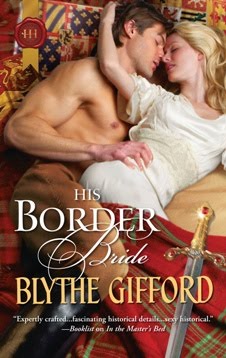
Blythe Gifford has written five 14th century medieval romances for Harlequin Historicals, featuring characters born on the wrong side of the royal blanket, most recently HIS BORDER BRIDE in May 2010. The Chicago Tribune called her work "the perfect balance between history and romance." Her 2011 release will be set in the 17th century Scottish Borders.

18 October 2010

Money Matters: The Tally Stick System

By Lisa Marie Wilkinson

Throughout the centuries people have paid their debts and bought and sold goods using forms of exchange ranging from feathers to salt to pigs and including almost everything in between. The American Indians using Wampum and the denizens of Fiji using whales' teeth as currency would both probably agree upon one thing: it's important to have a medium of exchange when you need what someone is selling but the seller doesn't have any need for what you have to offer in trade. Anything can be perceived to be money if people agree it has value.

It is generally believed that the tally record originated as a recording or counting device for tasks such as tracking menstrual cycles via a lunar phase calendar. One of the oldest examples of a tally record dating back to 30,000 BC was found in a cave in the Lebombo mountains of South Africa. The artifact consists of 29 distinct notches on the leg bone of a baboon.

As commerce developed through medieval Europe, another use for the tally record was found. With coins in short supply and the population largely illiterate, a bookkeeping method was needed to record mutual exchanges and outstanding debt. King Henry the First, son of William the Conqueror, is credited with inventing the tally stick system when he ascended the throne of England in 1100 AD.

In England, tallies took on the characteristics of today's credit card system as lenders carved out the details of the loan using a system of notches to signify denominations on the surface of a small squared willow, pine, r hazel-wood stick. At the top of the tally, a cut the thickness of the palm of a man's hand was made, representing one thousand pounds, then subsequent cuts were made to designate other values. The breadth of a thumb meant one hundred pounds, the width of a little finger represented twenty pounds, the width of a barleycorn translated to one pound, and so on. The stick was then split in half lengthwise through the center of the carving, creating a "split tally," which prevented either user from adding notches to his half of the tally stick.

Each party to the transaction was given one half of the marked tally as proof. Because the type of wood used to create the tally was selected for its clear grain, the grain of the wood was similar to the watermark on today's paper money. The two halves would be perfectly matched, fraud was difficult to perpetrate, and refinements were added over time to make the documentation of the transaction virtually tamper-proof. The two halves of the stick were made different lengths, with the lender given the longer part of the stick, referred to as the stock, which formed the basis for the modern term "stockholder" while the shorter portion, called the foil, was given to the party who had received the goods or funds. Literally, the debtor received "the short end of the stick."

When the borrower returned to the lender with the goods or money owed, the two halves of the record would be "tallied," and any attempts at fraud would become immediately apparent when the two halves of the split tally were combined.

King Henry expanded the use of tally sticks to include the collection of taxes by local sheriffs, creating a demand for them, and the sticks began to circulate as a form of money as a result. Revenues owed to the Crown were collected in this manner, and the tally stick system formed the basis of the British Empire until the formation of the Bank of England at the end of the 17th century. Tally sticks found their way into medieval courts as evidence, and into the works of William Shakespeare, who referred to them in Sonnet 122.2 from Henry VI: "nor need I tallies thy dear love to score."

When King Charles II adopted the idea of selling royal debt at a discount, he nearly plunged the country into bankruptcy by selling tallies at a discount for the purpose of financing war.

A century later, the sticks were still in use, but the tally stick system was eventually abolished in 1826, when the sticks were removed from circulation and stored in the Houses of Parliament. In 1834, Parliament ordered all sticks destroyed, and two cartloads of the tallies were scheduled to be burned. Rather than give the sticks away to be used as firewood, or burning them in an outdoor fire, a decision was made to burn them in two furnaces in the House of Lords. The resulting conflagration set fire to the wood paneling and both Houses of Parliament were destroyed.

Lisa Marie Wilkinson is an IPPY Gold Medal winning author of historical adventure-romance. Her latest novel, STOLEN PROMISE, featuring vibrant Gypsy characters and breath-taking romance, is available now.