Showing posts with label Alfonso X. Show all posts

20 July 2016

Beyond Our Stars: The Thirteenth-Century Astronomy Patronized by Alfonso X

Gemini. Spain, thirteenth century. 

It’s something of a tradition to begin or end biographies of Alfonso X, el Sabio, with one historian’s sanctimonious judgment of him: “While he contemplated the heavens and gazed at the stars, he fell on the earth.” I quote it here not to perpetuate misconceptions, but because the wording shows the importance of the astronomy carried out in Alfonso X’s court. In spite of the other fields of inquiry enhanced under the wise king’s patronage, it was the astronomy that fascinated the most people first and longest.

Alfonso’s interest in the movement of the heavens was based, as most of his passions, in pragmatism. In Alfonso’s time, astrology hadn’t been separated from astronomy as a scientific discipline and was even farther from being as discredited as it is today, as many fourteenth- and fifteenth-century medical treatises (some of which refer to Alfonsine works) attest. The king likely believed knowledge of the stars could be an important tool in gaining the upper hand on Earth because of their obvious, albeit mysterious, influence on human character and behavior.

That said, many of the Alfonsine astronomy books are based on what is still considered solid science.
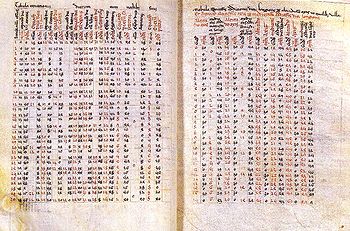
Alfonsine Tables. Spain, thirteenth century. 
The Alfonsine Tables are a set of measurements from about 1272 composed by Isaac ben Sid and Judah ben Moses ha-Cohen that track the positions of the sun, moon, and planets relative to Earth using Ptolemaic calculations. One of the astronomers who worked on the Alfonsine Tables took a copy with him in 1280 to Paris, where scholars adjusted the readings for the Paris meridian, enabling astronomers all over northern Europe to make use of the information for three hundred years. Copies survive today that were used by Copernicus and Galileo. The practical applications of the Tables are what made them popular. They well represented Alfonso X’s yearning for useful knowledge in the wider world.

The Alphonsus moon crater. Wikimedia Commons. 
Composed in the late 1270s, the most extensive book, the Book of Knowledge of Astronomy, also had the largest team behind it. The authors and translators named within the book include Jewish physicians, Muslim lawmen, and Italian and Castilian churchmen. The Book of the Eighth Sphere, which makes up the first part, describes the constellations with their celestial coordinates. The second part describes how to make and use nine different kinds of astronomical instruments, such as the astrolabe and the quadrant. Again, even in this most extensive and encyclopedic work, useful is paramount.

The Book of the Fixed Stars was translated from an Arabic book by Abd al-Rahman al Sufi composed around the year 964. In this book, the Alfonsine collaborators created a powerful combination of Ptolemy’s astronomy, Arabic traditions, and Castilian curiosity. The Andromeda Galaxy and the Large Magellanic Cloud, among other landmark bodies, were introduced to the European scientific community in this translation.

Ursa Major from a 1490 English copy of the Alfonsine Tables
The astronomy works are exemplars of the admirable Alfonsine traits of practicality and encyclopedism. The collaborators translated and compiled information from the best and most reliable sources. The majority draws from documents found in Arabic, with some information coming into Castilian from far-flung languages such as Chaldean. Without the bridge formed by these works, European astronomy might have had to start from scratch.

It’s much harder to see into the heavens if you’re not standing on the shoulders of giants.


Jessica Knauss earned her PhD in medieval Spanish with a dissertation on the portrayal of Alfonso X’s laws in the Cantigas de Santa Maria, which has been published as the five-star-rated Law and Order in Medieval Spain. Look for her book of stories based on the Cantigas, coming 2021. A driven fiction writer, Jessica Knauss has edited many fine historical novels and is a bilingual freelance editor. Her historical epic, Seven Noble Knights, is available from Encircle Publications in ebook, paperback, and hardcover. Her contemporary paranormal Awash in Talent is now available from Kindle Press. Find out more about her writing and bookish activities here. Follow her on Facebook and Twitter, too!


20 April 2016

The Intellectuals: Alfonso X’s Contribution to World Science and Culture


Juan Diego portrays
Alfonso X on the
series Toledo
He has a portrait hanging in the US House of Representatives in the Great Lawgivers series. A moon crater bears his name. His name is on the largest unified collection of annotated medieval music. Why do so many fields of inquiry praise the intellectual efforts of Alfonso X, el Sabio? What mark did he leave on the world to make us think he was so learned?

The short answer: his books.

In the General Estoria, we read: “The King makes a book, not because he writes it with his hands, but because he outlines the facts in it, and edits it and makes it right, and shows the way in which it is to be made… Just as we say that the King makes a palace, we don’t say it because he constructs it with his hands, but because he ordered it to be made…” The Book of the Sphere discusses at length the way King Alfonso worked as general editor. He came up with the idea for the book and what it should contain, and then went through it to take out extraneous parts and correct infelicities.

Alfonso X oversaw these projects to give himself access to the best knowledge in order to learn how rule his country more wisely, and a great additional benefit was that the books were created in Castilian and in Latin. They could then be consumed by Alfonso’s Castilian-reading subjects and Europeans farther afield. A wise populace is the beginning of a wise kingdom, and wise foreign friends make for smooth dealings and further the cause of that wise kingdom.

The collaborators made use of the finest sources available. They accurately cite Aristotle, the early Christian saints including Augustine, and eleventh-century philosophers such as Pedro Alfonso and Aelred of Rievaulx, to give the most basic examples. The scope of the intellectual activity has led to many scholarly volumes. Here’s a list of highlights.

The Alphonsus Crater on the Moon. Wikimedia Commons
Astronomy
• Alfonsine Tables
• Picatrix
Book of Knowledge of Astronomy
Book of the Forms and Images
Book of the Fixed Stars
Book of the Sphere, etc.

Other Science
Lapidario—A book of erudition about types of stones.

Alfonso X in the US House of Representatives
Law
• The Fuero Real—A pragmatic town charter that was granted to new towns in order to begin regularizing the rule of law throughout Alfonso’s kingdoms.
• Espéculo—Elegant and comprehensive legal theory with practical applications as an afterthought.
• Siete Partidas—A great book of medieval thought that also served as the basis of Spanish law for centuries.
• Specialized books of law—The Book of Gambling Houses, the Book of Frontier Commanders, various ordinances, etc.

History/Wisdom
• Book of Calila and Digna—This charming book is the first work of Castilian prose narrative. Based on ancient Indian texts via Arabic sources, two jackals (or lynxes) tell each other fables to illustrate complex and sometimes conflicting points of wisdom.
• Setenario—Often classed with the legal works, this book obsessed with the number seven is an unfinished compendium of the most secret kinds of knowledge and how to apply them.
• History of Spain—Tells the story of the Iberian Peninsula from the end of the Roman Empire to the beginning of the thirteenth century.
• General History—An astoundingly wide-reaching world history from Biblical times.

Music/Religion
• The Cantigas de Santa Maria—The largest collection of written medieval music in the world. More than 400 praise and miracle songs in Galician Portuguese for the Blessed Virgin with fun melodies and gorgeous illustrations. I attempted to describe how wonderful this collection is in this post. I investigate one exciting cantiga in this post.

Alfonso's sculpture at the National Library in
Madrid emphasizes intellect with books and a scroll.
Pastimes because leisure is important for refreshing the intellect.
• Various cantigas de escarnio e mal dizer—Profane, sometimes grotesque, mostly humorous, and at least one moving account of the weariness of a king in failing health (“Non me posso pagar tanto”).
• Libro de ajedrez, dados e tablas—A comprehensive illustrated compendium of chess strategy for the troubled intellectual. Ways to play dice, backgammon, and other games of chance are not as highly regarded.

Much of this body of work had far-reaching impacts in medieval Europe and modern world. The astronomy inspired and informed Copernicus, and the law works influence decisions even today in the American Southwest.

In order to begin my studies of Alfonso X, I had to vastly broaden my fields of expertise in addition to the strictly literary training I’d had up to that time. Perhaps Alfonso X’s greatest wisdom lay in the voracity with which he pursued all intellectual subjects. It seems there was nothing the Wise King wouldn’t want to investigate and read about further.


Simon R. Doubledays’ biography (The Wise King, New York: Basic Books, 2015) seamlessly weaves the trials and tribulations of Alfonso X’s life and times into the writing of the body of work he left behind. He makes a good case that Alfonso X based his intellectuality on the model of polymath Muslim princes. Indeed, the translators and compilers frequently relied on rescued ancient documents in Arabic. Doubleday’s book is an excellent overview of a fascinating king—I learned a few things I didn’t know before. 


My tribute to Alfonso's contribution to world culture, Our Lady's Troubadour, lets you experience the Cantigas de Santa Maria in a fun new way! 

Jessica Knauss earned her PhD in Medieval Spanish with a dissertation on the portrayal of Alfonso X’s laws in the Cantigas de Santa Maria, which has been published as the five-star-rated Law and Order in Medieval Spain. A driven fiction writer, Jessica Knauss has edited many fine historical novels and is a bilingual freelance editor. Her historical novel, Seven Noble Knights, is available from Encircle Publications in ebook, paperback, and hardcover. Find out more her writing and bookish activities here or here. Follow her on Facebook and Twitter, too!

16 March 2016

First Ladies: Ava de Ribagorza, a Traitor Countess?

By Jessica Knauss 


Mid-eleventh-century illumination from the
St. Sever Beatus

In the tenth century, so much definitive action took place in northern Spain that every historical person played a fascinating role. One of these historical persons was Ava de Ribagorza, Countess of Castile and wife of Count García Fernández. Although an epic poem about García’s wife circulated all over Iberia—The Traitor Countess—its storyline bears little relation to fact. I’m writing a novel with Count García and Countess Ava as central characters, and to write about her convincingly, I need to make crucial decisions based on little evidence. How to separate legend from history?

García Fernández was the second Count of Castile from his father’s death in 970 until his own passing in 995. At the time Castile was a territory on the fringes of the Kingdom of León and politically dependent on it. The Castilians’ location on the frontier with the Caliphate of Córdoba meant that by necessity, the political leaders were principally warlords. They had to be ready at any moment to defend their hard-won territory from brutal raids that terrified everyone from the haughtiest king to the lowliest laborer.

This is the era of Almanzor, a political opportunist and great military strategist whom everyone in the north of the peninsula assumed was the caliph because of his seemingly limitless power. The map shows Almanzor’s principal forays into León, Castile, Navarra, Ribagorza, and Barcelona (the “Christian kingdoms”) and the generous swath of territory he took back for his prosperous empire. The constant ebb and flow of conflict was only aggravated because the Christian kingdoms often had bloody spats amongst themselves.

The militarization of Castilian society was so extreme that it’s said that the men didn’t have time to take care of their own horses. That job, and other important ones, belonged to their tough-as-nails wives.

Count García in the Plaza Mayor
of Salamanca
Ava was born circa 945, the daughter of Count Ramón II of Ribagorza. The family name refers to the county between the France-dependent County of Barcelona and the independent Kingdom of Navarra. The Queen of Navarra may have helped arrange Ava’s marriage to Count García in 960 or 965. Ava’s prime age and noble birth made it a good match that became a fruitful union. Somehow, between battles and governance, the count and countess raised six children to adulthood. Four of the five daughters made advantageous marriages, one became a nun, and the son, Sancho, inherited the title and responsibilities of Count of Castile.

Not many other facts have survived about this woman, whom circumstance must have made extraordinary. It’s my job as a historical novelist to breathe life into Ava on the page, but I don’t have a lot to go on. Her death may even be more mysterious than her life.

I haven’t been able to find a record of when Ava died. There is no mention of her in the histories after García Fernández’s passing. This doesn’t necessarily mean she died around the same time. Because her husband’s death meant the end of her time as Countess of Castile, she might have taken on a lesser role at court, perhaps supporting the new count, her son, in ways no one valued enough to write down.

As I’ve written at Unusual Historicals before, the minstrels and then the historians who wrote down The Traitor Countess took Ava’s absence from the historical record and ran with it. They claimed that she wanted to elope to Córdoba with her Moorish lover, and they set Count García’s death squarely on her shoulders. She takes advantage of her role as horse husband by giving García’s steed food that makes it look bulky, but actually weakens it. As Ava has planned, the horse fails the count in battle, leading to his death on the frontier. She then attempts to poison her son so she can leave Castile, but Sancho turns the poison back on his mother in a scene reminiscent of Hamlet.

Presentation miniature from thirteenth-century Estoria de Espanna
It’s hard to imagine why Ava became the target of so much scorn. Perhaps something similar to this happened and became lost to history. Or, more likely, confronted with a vacuum in the record and well removed from the time period, the thirteenth-century historians preferred to write down scandalous material instead of nothing at all. A traitorous countess could explain two things that might have puzzled them: the death of the great warrior, Count García; and the curious fact that his youngest daughter, Oneca, was married to Almanzor soon after García’s death.

Yes, that Almanzor. In the tenth century, political strategy could easily have led to such a match. In the thirteenth century, however, historians were more concerned with presenting a coherent story of Castilian power and religious righteousness than with the complexity of history. If they read about Oneca’s marriage to Almanzor, terror of the north, they would have thought something had gone terribly wrong. What better way to explain a now unsavory alliance than by blaming a woman? The poor girl must have had a terrible mother, since her father was a proven example of knightly virtue.


Of course, this is impossible to prove, but I imagine a lot of drama in the scriptorium while the historians were coming up with their narratives. It looks as if I’ll have to use some of that imagination in the service of redeeming Ava—or further condemning her. I haven’t decided yet.


Jessica Knauss earned her PhD in Medieval Spanish with a dissertation on the portrayal of Alfonso X’s laws in the Cantigas de Santa Maria, which has been published as the five-star-rated Law and Order in Medieval Spain. A driven fiction writer, Jessica Knauss has edited many fine historical novels and is a bilingual freelance editor. Her historical novel, Seven Noble Knights, will be published December 11, 2020, by Encircle Publications. Find out more about her writing and bookish activities here or here. Follow her on Facebook and Twitter, too!

11 March 2015

A Miracle Close to Home: Chincoya, 1264

The restored castle at Almodóvar del Río looks the way Chincoya might have in 1264.
Photo by Jessica Knauss 2009 
Spain’s thirteenth-century Cantigas de Santa Maria are a treasure of medieval culture. Many of their stories recount events that had just happened in familiar places. This is especially the case for the songs that take place in Andalucía.

Cantiga 185 begins, “I heard a miracle that took place a while ago, over in Chincoya.” This may be the first time the event was written about. Such immediacy gives the song a partiality and emotional weightiness the miracles about far-off lands lack. Any thirteenth-century Spanish listener would have understood the implications inherent in the reference to Chincoya, in modern Jaén, at the border of what was at the time the Muslim kingdom of Granada.

Both Chincoya and its corresponding castle on the Muslim side, Belmez, would have been responsible for maintaining security in a sensitive border region. The story focuses on the castles’ two alcaides, castellans appointed personally by their respective kings for upkeep, defense, and general administration. The Christian alcaide of Chincoya has been identified in real life as a man named Sancho Martínez de Jódar.

Sancho’s fictional double has a character flaw in spite of his best intentions: “the alcaide there protected it well, but he lacked the good sense to protect it completely” (lines 11-12). The concept of good sense recurs in the Cantigas time and again as the most important virtue. Sancho’s sin would seem innocent enough: “He had a great friendship with a Moor who was the alcaide of Belmez” (15-16a). Making friends with other castellans in the region could even be a good strategy, but this alcaide’s location across the enemy border makes it a bad idea.

From Cantiga 187 (185) of the Códice rico 
The alcaide of Belmez conspires with the King of Granada, Ibn al-Ahmar, founder of the Nasrid dynasty, and a vassal of Castile since the time of Fernando III in 1246. The Moor explains to his king that he can deliver Chincoya Castle to Granada by using the alcaide’s trust to lure him out and capture him. Sancho, unsuspecting, goes out to meet his friend, bringing two squires with him. The stage has now been set to show the gap between proper conduct and the irresponsible behavior of the alcaide of Chincoya.

The squires say they are afraid of the alcaide of Belmez and offer reasonable arguments against going to meet him: Unarmed and not dressed for self-defense, Sancho has failed to take even the minimal precautions. Because we have seen the alcaide of Belmez plotting to betray Sancho’s friendship, we are obliged to believe the squires in this instance. When the squires turn back to their castle, they not only do what is right, but also show themselves to be more sensible than their alcaide, who displays his stubborn intentions by proceeding to contravene a law in which anyone who has charge of a castle specifically on the border may not leave it without the king’s mandate. In line 51, Sancho crosses a river, which is presumably the border into Granada.

The alcaide of Belmez wastes no more time duping his supposed friend, and captures the Christian alcaide. Under threat of beheading, Sancho informs his captors that only fifteen Christians defend his castle, and that they have nothing to eat. Sancho then returns to Chincoya to ask the Christians to hand it over to the Muslims. This is the last time we hear anything about the alcaide of Chincoya. Because the second stanza indicates that he almost lost the castle, and the laws only indicate punishments for such behavior when the castle is lost to the enemy, we may guess that he assumes guardianship again after this incident. However, ignoring the man who is supposed to be in charge of the castle, especially during its victorious moments, is a serious criticism of his actions, not unlike the kind of insults so frequent in the cantigas de escarnno y de maldizer. His conduct throughout the cantiga is in direct opposition to the fearlessness recommended in the law books of the time.

A more appropriate response comes from those inside the castle. In spite of what would appear to be the hopelessness of their situation, they heroically refuse to give up on their duty to keep King Alfonso’s castle safe from invasion. They comply with the heroism legally suggested for the people who might find themselves inside a besieged castle.

When the alcaide is threatened by the King of Granada, he folds immediately and betrays Chincoya. Similarly defenseless against the King of Granada, the men inside the castle show what separates them from their incompetent leader by thinking of the Virgin Mary as protector rather than giving in to fear. They place a statue of Our Lady, which in the miniatures appears as a majestic enthroned Virgin and Child, on the outside walls and bargain with her, remind her that she, too, is under threat, and reiterate their devotion (“somos teus,” line 76).

Instantly, they see results. The host turns back, and the three Moors who get through are thrown over the castle walls, merely to make the King of Granada see that he should retreat because he knows that those protected by St. Mary cannot be defeated.

Defending Chincoya in the Códice rico 
Such a swift turn of events in such hopeless circumstances, directly after the people inside the castle enlist Mary’s help, clearly indicates the intervention of the Blessed Virgin in their favor. If the castellan of Chincoya had asked for her help, he might well have received it, but he lacked the good sense. Throughout the song, the unthinking alcaide, who trusts an enemy and abandons the castle to its fate, contrasts sharply with those of good sense, who stay to defend their king’s castle and who place their faith in St. Mary, the only being who is truly worthy of it.

Although it would be impossible to legislate faithfulness in the hearts of his soldiers, King Alfonso praises it as a common trait of the people of his kingdom and offers it as the best example of his soldiers’ potential. All of the laws concerning his citizens’ duties toward their king’s fortifications amount to suggestions for achieving this state of ultimate loyalty. A dependable armed force is the only one of real use to a king. The alcaide of Chincoya in 185 is an anti-example.

Chincoya Castle today. Photo from applicajaen.com 
The ending functions as a moral to the story, poising itself purposefully as the concept anyone listening should take away: It is right to praise Mary; she takes care of her own (and it is only too clear who they are in Cantiga 185); and her enemies will always be defeated. These are useful lessons for anyone, and perhaps especially for military men who find themselves in similar situations.

It is spectacular that only fifteen men without provisions successfully defend themselves against an army, but not completely incredible, because well-staffed castles turned back armies on a regular basis. By never straying far from everyday, almost prosaic, events that really occurred, such miracles invite the devotion of even the most skeptical. Here, the audience is absorbed in the story because its location is readily identifiable by the listeners and features situations someone they know will probably encounter in their lives. It is easy to look up to the defenders of Chincoya, close in space and time to the potential audience, and to identify their behavior as an ideal model.

Listen to a great recording of Cantiga 185. 
Learn more about the Cantigas de Santa Maria
I’ve written about the legal implications of the alcaide’s actions in Law and Order in Medieval SpainI’m also working on a short story based on the incident in Cantiga 185—stay tuned for more Cantigas stories!

J. K. Knauss earned her PhD in Medieval Spanish with a dissertation on the portrayal of Alfonso X’s laws in the Cantigas de Santa Maria, which has been published as the five-star-rated Law and Order in Medieval Spain. A driven fiction writer, Jessica Knauss has edited many fine historical novels and is currently a bilingual copyeditor. Find out more about her historical novel, Seven Noble Knights, and her other writing and bookish activities here. Follow her on Facebook and Twitter, too!


Selected Resources
Alfonso X, el Sabio. Cantigas de Santa María. 3 vols. Walter Mettmann, ed. Madrid: Clásicos Castalia, 1986-1989.
—. Cantigas de Santa María: Edición facsímil del códice T.I.1 de la Biblioteca de San Lorenzo el Real de El Escorial, siglo XIII. Madrid: Edilán, 1979.
—. Las Siete Partidas del Rey don Alfonso el Sabio cotejadas con varios códices antiguos por la Real Academia de la Historia y glosadas por el lic. Gregorio López. Nueva edición. 3 volumes. París: Librería de Rosa y Bouret, 1861.
Montoya Martínez, Jesús. Historia y anécdotas de Andalucía en las Cantigas de Santa María de Alfonso X. Granada: Universidad de Granada, 1988.
O’Callaghan, Joseph F. Alfonso X and the Cantigas de Santa Maria: A Poetic Biography. Leiden: Brill, 1998.

Paredes Núñez, Juan. La guerra de Granada en las Cantigas de Alfonso X el Sabio. Granada: Universidad de Granada, 1991.

03 September 2014

Wonders and Marvels: The Cantigas de Santa Maria

By Jessica Knauss


King Alfonso directs his subjects to worship Jesus through the Virgin Mary
and the angel Gabriel in the F manuscript of the Cantigas de Santa Maria
A poor woman takes her baby with her to the wheat fields — she has no alternative. While his mother works, the boy swallows a head of wheat and his belly swells to alarming proportions. His mother, believing he’s been poisoned or bitten by a spider, frets over him for several days. When she despairs for his life, there’s only one person — or supernatural being — she can turn to. She lays him before the altar of Our Lady of Atocha. The boy’s clothes are removed, and no one can find a spider bite, but they do find an intact head of wheat coming out the boy’s side. The boy recovers immediately. Everyone gives praise to the Virgin Mary for such a beautiful miracle.


The Cantigas de Santa Maria tell of the wonders of the Virgin Mary in a way that still makes people marvel.

Alfonso X of Castile and León is called el Sabio because he loved learning. He made it possible for a team of scholars to record the latest scientific advances for future generations. He carried this compulsion for compilation through to the Cantigas, which are a collection of nearly 400 songs with words, music, and illustrations.

Many of the miracles involve a dramatic recovery, as in Cantiga 315 above, or theatrical leaps of faith, as in the story about the good wife whose husband was so jealous of her that he mistreated her terribly. She asks him if he would believe she’s faithful to him if she underwent a trial by fire. He responds that he doesn’t think that’s necessary, but she can jump off a cliff! If she comes out alive, that will be proof of her fidelity. The woman comes to the edge of the highest, scariest cliff for miles around.


She commends herself to the Virgin Mary and throws herself over. With the entire town as witness, she lands feet first on ground that seems soft and smooth to her, although for non-believers, it would have been rocky — and deadly.

In the style of a rosary, the Cantigas punctuate the miracle stories with songs in praise of the Virgin Mary’s own wondrous nature at every tenth cantiga.


Even these most spiritual of the Cantigas display a down-to-earth quality. One of Alfonso’s main objectives with these songs was to show how wonder could reach absolutely everyone in his realm through Mary, from the poor lady in the wheat field, through nobles, sheriffs, monks, nuns, and warriors, to the king himself. Because they so accurately portray real life, the Cantigas don’t limit Alfonso’s realm to people, but also include the animals that cohabited with his subjects, such as horses, cattle, sheep, dogs, ermines, and silk worms!

A woman who makes her living with silk has trouble: her silk worms are dying. She goes to the Virgin Mary’s altar and promises that if Mary revives her silk worms, she will make an altar cloth to honor the Queen of Heaven. Soon enough, the silk worms are hard at work again, but the woman forgets her promise — until, one day, she comes home to find that the worms have taken her promise upon themselves. They make not one, but two altar cloths, and in the illustrations we see the added miracle that they already have a beautiful lacy design. The fame of the miracle spreads, and since there are two of them, King Alfonso takes one for his own altar to the Virgin Mary.


Most of the lower-numbered cantigas take stories from all over Europe’s Marian repertoire, but as the king’s demand for more and more miracles increased (the goal may have been 500), the poets searched closer to home and in more recent history. As Cantiga 18 shows, some feature Alfonso himself, and 22 take place during the reconstruction of El Puerto de Santa María in the south, one of the king’s pet projects.

Cantiga 371 tells how a large ship headed for El Puerto was laden with flour and people. Some of them were coming for the land grants, some to work as masons, some to form part of the new religious community. El Puerto’s fame was already widespread, as the refrain reports: “Holy Mary performs so many miracles in her Port that we poets can’t describe the least part of them.”


Unfortunately, the ship in this cantiga hits a rock and sinks, killing everyone on board except one woman. She cries out to the Virgin, “I’m coming to you, so save my life with your great power.” In that instant, one of the sacks of flour emerges from the ship, and even though it’s heavy, it floats as if it were very light. The woman floats along atop it, calling, “Holy Mary, Mother of God, Emmanuel,” until she arrives at El Puerto to be welcomed by the residents.

Not all the miracles are so outwardly spectacular. In one of my favorites, the miracle consists of a violent, lustful knight deciding to change his ways.


As you can see in the illustrations, he’s already got an angel on one shoulder and a devil on the other. The Virgin Mary appears to him with a beautiful silver platter filled with rotten food — a metaphor for the knight’s outward loveliness and evil interior. He gets the message loud and clear. Even though the knight’s life is never threatened in this cantiga, his soul is in danger of eternal damnation, which, to medieval thinking, is the most dramatic story of all.

It’s said that the Cantigas were the king’s favorite project, as they incurred the most labor, expense, and time. The compilation may have begun before Alfonso ascended to the throne in 1252 and ended only upon his death in 1284. In his will, Alfonso instructed that the Cantigas manuscripts should be kept in the chapel where he was buried (in the cathedral in Sevilla) and sung on high feast days. None of the four extant manuscripts reside there now: an early draft without illustrations known as To is in the Biblioteca Nacional in Madrid; King Felipe II had three deluxe manuscripts (including E and T) removed to the Escorial in the sixteenth century; and somehow one of those deluxe manuscripts (F) came to be at the Italian National Library in Florence today.

The Cantigas de Santa Maria deal with people’s interior lives as well as the most unexpected details of their exterior lives, and include everyone from every social class, from Spain to Europe to Northern Africa and the Middle East. Some of these songs are masterpieces of lyricism, others are solid narratives from a time before short stories existed, and still others take humor to new heights. Each of the thousands of illustrations offers delights to appreciate from any point of view. They constitute the largest collection of medieval music ever amassed and contain every imaginable Western musical style.

In their time, the Cantigas celebrated marvels and wonders, and today they have become a marvel in themselves because of the sense of wonder they convey in greater measure as time goes on


You can now experience ten of the Cantigas de Santa Maria in a fun new way in J. K. Knauss's Our Lady's Troubadour

Jessica Knauss earned her PhD in Medieval Spanish with a dissertation on the portrayal of Alfonso X’s laws in the Cantigas de Santa Maria, which has been published as the five-star-rated Law and Order in Medieval Spain. A driven fiction writer, Jessica Knauss has edited many fine historical novels and is currently a bilingual copyeditor at an educational publisher. Find out more about her historical novel, Seven Noble Knights, and her other writing and bookish activities here. Follow her on Facebook and Twitter, too!


29 January 2014

June 1, 1252: Retracing a Day in the Life of Alfonso X el Sabio

Alfonso X in the monument in Plaza Nueva, Sevilla
Today Sevilla, Spain, is the capital of Andalusia. It exudes Baroque splendor at the same time that it shows off the latest technology. In this post, however, let me take you on a tour through the small nucleus of the city and imagine what it was like on one specific day during the reign of King Alfonso X. Alfonso's father, Fernando III, took Sevilla from the Moorish taifa king in 1248, only four years before our day. It quickly became Alfonso's favorite city and he spent nearly half his reign here, in spite of frequent, extensive travels for matters of court and politics.

The remains of the Moorish baths that were extant in Alfonso's time now house
an Italian restaurant. www.sanmarco.es
Just beyond the cathedral, nestled up close to the royal palace for protection and a short commute to the king's side, Sevilla's Jewish quarter keeps its secrets in a maze of narrow streets. Today's judería is largely a nineteenth-century reconstruction, but it preserves the idea of what it must have been like to walk around Sevilla in the thirteenth century as well as at least one authentic bit of history: the archways of a Moorish bath. While these baths served the community at large in the thirteenth century, Alfonso X and his household probably used a bath within the royal palace walls on a daily basis. On June 1, 1252, Alfonso probably took great care in his morning grooming routine, calling on all the available attendants and slaves.

Only the lower three quarters of the Giralda
bell tower existed in 1252.
Behind him, the best lineage and upbringing as well as training in politics and war. Ahead, spectacular achievements in the arts and sciences, the disappointing pursuit of his candidacy for Holy Roman Emperor, strife, and much more war. But on June 1, 1252, Alfonso X, whom history calls "el Sabio" (the Learned), was crowned King of Castile at thirty years old. Reasonably experienced at that age, but also not too old, the new king might have been a little nervous, but also secure in his destiny and obligation when the decree rang out at the cathedral in Sevilla.

The current cathedral in Sevilla is an enormous gothic masterpiece, started some 200 years after Alfonso's coronation. The cathedral in Alfonso's time would have been architecturally a mosque, hastily reconsecrated to the Christian faith. The minaret would subsequently be redesigned as a bell tower, but even today it preserves the wide ramps visitors can climb to stand under the bells and look out over the city. Originally, these interior ramps were intended to accommodate a muezzin, who would ascend to the highest point in Andalusia on horseback to perform the call to prayer.

Fernando III as depicted in a 17th-century sculpture
in the Sevilla cathedral treasury
Fernando III's conquests and his ability to unite the kingdoms of Castile and León made him so well loved that he became a serious candidate for sainthood just after his death on May 30, 1252. Alfonso, the heir to that legacy of consolidating the Iberian peninsula under Christian power, had a lot to live up to.

With the city mourning the beloved king, and with the pragmatism that usually dominates Castilian politics, the coronation was probably not an elaborate affair. No descriptions have come down to us, but it likely took place in the morning hours and involved Alfonso's oath, a bishop placing the ceremonial crown upon Alfonso's head, and oaths of fealty from the many noble vassals present. Alfonso's biographer Ballesteros Beretta imagines that the spectators then lifted Alfonso on their shoulders and paraded him around the cathedral square. Did he look down and see the faces of the nobles who would revolt against him, or the brother who would conspire against the crown? Perhaps he looked into the bright sky of Sevilla and glimpsed the Virgin Mary smiling on him. The cult of Mary would be Alfonso's lifelong devotion.

After a bit of a welcome to his new role, it's likely King Alfonso had to head straight back to the royal palace to work on matters of state. Like the cathedral, the royal palace in Sevilla was adapted from a beautiful complex constructed by the previous Muslim rulers. Only one salon and one garden area survive from the original building. Although splendid, they are now dwarfed by the labyrinthine layout and opulence of the mudéjar-style palace constructed for Pedro the Cruel in the fourteenth century.

The gothic sections of the palace were constructed beginning in 1254. New crossed archways hold the ceilings up elegantly in this small chapel and two other state rooms. In 1535, Holy Roman Emperor Carlos V had the gothic rooms covered with painted tiles and tapestries commemorating the conquest of Tunis. Alfonso would have slept and toiled in the original buildings while the gothic salons were constructed and moved his business to the area that would most impress a specific visitor once all was complete.

At the end of a terribly busy and emotional June 1, 1252, Alfonso would have climbed into a bed supported on ropes and furnished with the softest ticking, the finest sheets, and the most luxurious pillows. Although most historians have tried to paint an unhappy picture of his marriage, the person most likely sleeping next to Alfonso was his consort, now Queen Violante. She would bear ten children who survived into adulthood. She would also become embroiled in the battles of royal succession that took place upon the death of her firstborn son. But on June 1, 1252, Violante assumed her new role with quiet dignity and stood by her husband in the cathedral, the square, and the palace.


A driven fiction writer, Jessica Knauss is also a freelance editor, a translator, and a founding partner and editor at Loose Leaves Publishing. Find out more about her writing and bookish activities here. Follow her on Facebook and Twitter, too! She took five of the photos in this post in 2009 and can't wait to go back to Spain. 

Her tribute to Alfonso X's contribution to world culture, Our Lady's Troubadour, lets you experience the Cantigas de Santa Maria in a fun new way!