Showing posts with label Scandalous Affairs. Show all posts

27 February 2013

Clara Bow’s Scandalous Affair with the University of Southern California Football Team


Clara Bow was the It Girl of the 1920s, a silent film starlet with big expressive brown eyes who served as the inspiration for the cartoon heroine Betty Boop. She had a penchant for playing plucky heroines in the top-grossing movies of the decade. It was the dawn of Hollywood’s Golden Age, and the sassy Brooklyn girl was a big star. 


Clara was rarely played a femme fatale like Claudette Colbert; she was more likely to play the spunky flapper with accidental sex appeal. Nevertheless, she was one of the country’s first sex symbols and off-screen  her love life was never conventional. She dated actors like Gary Cooper and even a married man. But none of her actual affairs were the source of the scandal that ultimately ended her career. 


During her lifetime, she was the subject of all sorts of rumor and speculation about her sex life, but it wasn't until a tabloid printed a libelous series of stories accusing her of everything from bestiality to threesomes in public with prostitutes that her career suffered for it. The stories in the paper were so outrageous that the publisher was eventually arrested and jailed for attempting to blackmail Clara with them. But even after the scurrilous rumormonger was punished, one rumor persisted...

And that is that Clara Bow engaged in orgies with the whole USC Football team. As it happens, Clara was a football fan and often invited team members to her rooms for dancing and morning swims. The team members themselves, however, all vow that they were all too damned innocent to have done anything other than enjoy her less-than-sexual-hospitality.

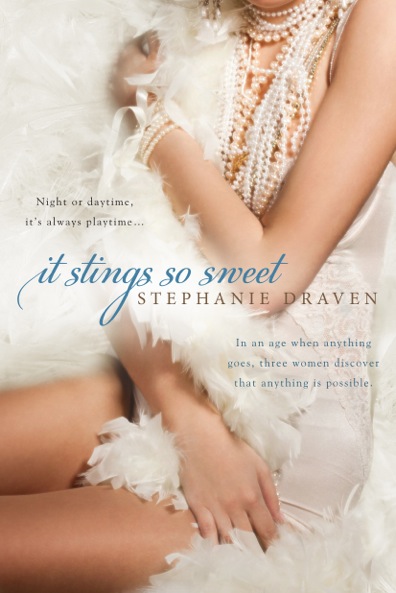
Because I’m always a sucker for an underdog whose brilliant career goes down in flames due to the malice of others, I couldn’t help but be inspired by the life story of Clara Bow in writing my latest historical erotic romance set in the 1920s, It Stings So Sweet


My Clara isn’t having any orgies with the football team, but if she were, she wouldn’t apologize for it. And we wouldn’t want her to!

Bio

STEPHANIE DRAVEN is a bestselling, award-winning and RITA-nominated author of historical, paranormal, and contemporary romance. Her newest project, IT STINGS SO SWEET is a collection of 1920s historical erotic romances that celebrate sex, women, and the Jazz Age. Her most recent novel with Entangled Publishing, IN BED WITH THE OPPOSITION, is a mix of humor and sex-appeal set against the backdrop of a zany political campaign inspired by the career of Baltimore legend William Donald Schaefer. Both novels are fun departures from her more serious Greek mythology-inspired series for Harlequin's Nocturne line, the debut novel of which was nominated by Romantic Times for Best First Series. The series has earned critical praise for its originality and awareness of social issues and garnered the 2012 SWIRL award for excellence in multi-cultural romance literature as well as the CataRomance's Reviewers Choice Award. Writing historical fiction about Cleopatra’s daughter as Stephanie Dray, she won the Golden Leaf Award for SONG OF THE NILE. Stephanie is currently a denizen of Baltimore, that city of ravens and purple night skies. She lives there with her favorite nocturnal creatures–three scheming cats and a deliciously wicked husband. And when she is not busy with dark domestic rituals, she writes her books. StephanieDraven.com

26 February 2013

Scandalous Affairs: Margaret Tudor, sister of Henry VIII, created her own scandals


We’re all familiar with King Henry VIII and his six wives, but few know that his sister, Margaret, was way ahead of him in the scandalous divorce and remarriage department. 

Queen Margaret, wife of King James IV of Scotland, was Margaret Tudor, one of two sisters of Henry VIII.  Margaret traveled to Scotland when she was only 14 to wed James IV, 30.  Before their marriage, James had seven, or maybe eight, illegitimate children by four different women.  But once they were wed, he and Margaret reportedly had a loving relationship.  During their ten year marriage, she bore him six children.


But when her husband died in a battle (fighting his brother in law Henry’s forces) only one child was living: seventeen month old, James V.  Margaret was named regent in the royal will, for as long as she remained a widow.

It was a singular honor from her husband, for she was not a popular choice.  Not only was she a woman, but she was also the sister of the king who had just killed her husband.  Yet all began well, and for the first year or so, she balanced the competing forces of those who sought an alliance with England and those who wanted Scotland to cleave to the Auld Alliance with France. 

At this point, however, after what had seemed a staid and balanced life, her tale develops striking similarities to that of her brother.  At 25, she apparently developed appetites of her own and her subsequent marriages, alliances, and divorce, changed the course of history and destroyed her position and influence. 

Archibald Douglas, 6th Earl of Angus
Less than a year after her husband’s death , she married Archibald Douglas, the 6th Earl of Angus, suddenly and secretly, without asking so much as a by-your-leave, simultaneously losing the regency, the trust of the French-leaning barons, and possession of her young son.  In addition, the marriage did not sit well with the other Scots barons, who resented her for preferring Angus, a staunch ally of the English king. 

This left an opening for the French faction to resurge and bring the Duke of Albany over from France to serve as regent.

Things went downhill from there.  

Margaret soon learned that her new husband, the Earl of Angus was living openly with a former lover – and using Margaret’s money to do so.  For the next fourteen years, Margaret, and Scotland, went through a dizzying array of shifting alliances.  The regency, along with the possession of the boy king, shifted between Angus and the regent named by the French faction.  Margaret attempted to get along with all of them, but finally, allied with one of Angus’ enemies, she seized physical control of her eight year old son and fired on her husband when he came to take the boy back.
Queen Margaret defies Parliament - painting by John Faed

She was not allowed to keep control, however, and eventually, Margaret went to England for a year, and bore the daughter that Angus had fathered.  Yet she returned to Scotland to do her duty as a queen and a mother. 

An attempt to reconcile with her husband was unsuccessful.  Weary and despairing, she wrote to her brother Henry that she was considering divorce.  Ironically, Henry sent her a pious and crabby note saying that marriage was “divinely ordained.”  (He, of course, changed his mind on that not too many years later.)  In addition, Angus was an ally, who helped to keep Scotland from swinging too far to the French side, so Henry preferred to keep him close.

To no avail.  Margaret petitioned the Pope for a divorce.  Meanwhile, she swung her support more to the French faction, thinking, perhaps, that they could help her persuade the pope to grant the divorce.  Meanwhile, Angus kidnapped the young king, virtually holding him hostage for two years.  Finally, young James V, now 16, escaped and started to rule in his own right. 

By this time, Margaret, still married to Angus, had formed a new romantic alliance, this time with Henry Stewart, whom she married within months after she learned her divorce from Angus was official.  (The grounds upon which the Pope granted her divorce seem flimsy, even for the time.  It was that Angus was pre-contracted to another woman and Margaret was ignorant of it at the time of their marriage.)

Again, her union with Henry Steward was unpopular, but her son, now finally ruling in his own right, seemed fond of the man and gave him the title 1st Lord of Methven.  For a time, he and Margaret were close advisors to James V.

Alas, Methven was no more reliable than Angus and she discovered he was keeping a mistress in one of Margaret’s own castles.  She sought another divorce, but her son would not support it and her last husband outlived her.  Late in life, her daughter in law, King James’ second wife, helped restore Margaret to a level of dignity and respect. 

And by then?  She had expressed a yearning to be reunited with Angus…

A husband, a divorce, another husband, the desire for another divorce…Queen Margaret created scandals that, in their own way, rivaled her brother Henry’s. 

 
Blythe Gifford has been known for medieval romances featuring characters born on the wrong side of the royal blanket. Now, she’s written a Harlequin Historical trilogy set on the turbulent Scottish Borders of the early Tudor era.  The books are RETURN OF THE BORDER WARRIOR, November 2012, CAPTIVE OF THE BORDER LORD, January 2013, and TAKEN BY THE BORDER REBEL in March 2013.  The Chicago Tribune has called her work "the perfect balance between history and romance."  Visit her at www.blythegifford.com, www.facebook.com/BlytheGifford, www.pinterest.com/BlytheGifford or on Twitter @BlytheGifford.  
Author photo by Jennifer Girard.

20 February 2013

Scandalous Affairs: It’s Complicated or The Scandalous Love Life of Joan of Kent


Joan_of_KentBy Ginger Myrick

In my second book, The Welsh Healer: A Novel of 15th Century England, I make passing reference to Edward, the Black Prince, and his involvement with Joan, the Fair Maid of Kent. What is well-known by enthusiasts of the era is that the pair eventually settled down into a respectable marriage, producing the future King Richard II of England. But in their youth, their relationship was much more complex as were the circumstances surrounding it. When Joan was only two years old, her father, Edmund of Woodstock, 1st Earl of Kent, was executed for treason, and her mother was placed under house arrest with her four newly fatherless children. Good King Edward III, being a chivalrous young man, took pity on the widow and brought his cousins to court where they enjoyed a privileged and comfortable childhood alongside his own children, who were only slightly younger than the Kentish brood and included the future Black Prince. With her vivacious personality, Joan quickly made herself a favorite of the new king and queen, but as with many spoiled young women with such an impetuous and passionate nature, when she hit puberty, all hell broke loose.

jkJoan was reputed to have been the most beautiful woman of her time in all of England, and it seemed she used her assets to their full advantage. At only twelve years of age, she flouted the rules of court requiring royal consent for marriage between couples of high rank and secretly eloped with Thomas Holland, a young man from another noble family. As with many unions that start out under such dubious origins, everything may very well have turned out satisfactorily had Thomas not been sent overseas for military duty. During his absence, Joan was compelled to marry an unsuspecting William Montacute, heir to the Earldom of Salisbury, and failed to mention the fact that she was previously engaged. This was an extremely dangerous position for the young woman and especially perilous for her soul. Not only would she be looked upon as a bigamist and traitoress by the whole of England, she would also be seen as an adulteress by the church and by God himself. There are some theories suggesting the Fair Maid had convinced herself that her marriage to Holland was invalid, but perhaps it simply slipped her mind … for nine years. Needless to say that when Thomas Holland returned from abroad, he did not receive the loving welcome he anticipated. Instead he was faced with William’s—by then Earl of Salisbury—wrath and reluctance to part with his significant other, demonstrated by his imprisonment of said lady in her own home. But the jilted husband would not be turned away so easily and appealed to the heads of both church and state to have his wayward wife returned. In 1349, Pope Clement VI granted the annulment, and Joan was sent back to her original spouse; no harm, no foul. The Hollands lived in a state of serene domesticity for the next eleven years and were blessed with several progeny, a sign of God’s ultimate forgiveness.

bp-face  But alas, Joan’s early indiscretions could not be erased so easily. When her patient and forgiving husband, Thomas, died in 1360, her penchant for secret pacts, which had so unfortunately resulted in the previous scandal, reared its controversial head again. This time around, the victim of her charm was her cousin Edward, the Black Prince. There are several documented instances of Edward’s affection for his fair cousin, and after her return to a marriageable status, the hope to make her his was rekindled. Because of Joan’s earlier entanglements, the king and queen would not approve their union, so the pair were clandestinely contracted to wed. Joan and young Edward were first cousins once removed, which means that Joan’s paternal grandfather was also Edward’s paternal great-grandfather, King Edward I of England, a.k.a. Longshanks and Hammer of the Scots. To our modern-day sensitivities, this may seem a valid argument against their union, and it must have also appeared so to Edward’s parents. The regents initially used the excuse of consanguinity to withhold their consent and nullify the betrothal, but seeing that there was true love between the two, the king eventually conceded and requested a dispensation from the pope. The lovebirds were officially married in October of 1361, and the Fair Maid settled down to become a dutiful wife and mother, at one point even raising an army to protect her husband’s principality of Aquitaine while he was 
177px-Edward_III_of_England_(Order_of_the_Garter)otherwise occupied in Castile. 

Now, if you will excuse a quick digression, I would also like to address the popular claim that Joan’s beauty was so legendary that she inspired an entire order of chivalry during a dance with her eventual father-in-law, King Edward III. The account states that while engaged in a rondelet, or other such energetic frolic, her garter slipped from her leg, evoking many derisive snickers by onlookers and other signs of their contempt for her questionable respectability. The king, who at the time took much pride in his own reputation of fidelity to his beloved Queen Philippa, is said to have returned the piece of frippery to the Fair Maid and declared, "Honi soit qui mal y pense,”—Shamed be the person who thinks evil of it. The phrase became the motto for The Most Noble Order of the Garter, the highest of the honors system in the United Kingdom today. The Fair Maid’s troubles may look to have been easily avoidable and rather ridiculous to the casual observer, but there are some people in the world who are suckers for love and love to be in love. Joan of Kent appeared to be one of these.

Eleanor_HibbertHer very public foibles can be summed up with a quote from one of my favorite authors, the incomparable Jean Plaidy. “How stupid lovers can be! But if they were not, there would be no story.” It is from her novel, The Courts of Love, and sounds tailor-made for Joan’s situation. Ridiculous? Maybe. Stupid? Perhaps. Scandalous? Absolutely, but far be it from me to pass judgement … and, ‘Shamed be the person who thinks evil of it!’

Ginger Myrick was born and raised in Southern California. She is a self-described wife, mother, animal lover, and avid reader and knitter. Along with the promotion for THE WELSH HEALER, and EL REY, she is currently crafting her third novel, which takes place during the U.S. Civil War. She is a Christian who writes meticulously researched historical fiction with a ‘clean’ love story at the core. She hopes to persevere with her newfound talent and show the reading community that a romance need not include graphic details to convey deep love and passion.

13 February 2013

Scandalous Affairs: Hadrian and Antinous

by  Heather Domin

You could fill a book with all the amorous shenanigans that went down in Ancient Rome (and plenty of people have); from Antony and Cleopatra to Messalina and [insert census of Rome here], scandalous stories and Roman aristocracy go together like lampreys and garum, and some of them are even true. The affair between the Emperor Hadrian and his Greek courtier Antinous is one of the most famous, a tragic romance that has inspired artists for almost 2000 years. But this affair was not scandalous for the reason some might think — the scandal was not that Hadrian had a male lover, but that Hadrian actually loved him.

Emperor Hadrian, building walls
and rocking facial hair like a boss
Not much is known about Antinous beyond the fact that 1) he was an exceptionally beautiful Greek boy and 2) Hadrian fell head over heels in love with him. Now, the Emperor getting busy with a dude was not the problem — it was perfectly acceptable for a Roman man to have lovers of any gender, as long as he always gave the impression of being... designated pitcher, if you know what I mean. For eight years Hadrian lavished so much affection on Antinous that some considered it unmanly, or at least inappropriate; the real scandal, though, was that he didn't bother to keep up appearances with his wife, and he never had any children. Now that was a big deal. Having a boyfriend was one thing; neglecting your Roman duty of procreation was another, especially when you need a royal heir. Hadrian's attitude was basically osores odierint, and since he was doing a good job running the Empire, a lot of people pretended to overlook his devotion to his paramour (in public anyway). What they could not overlook was how Hadrian reacted to Antinous' untimely death.

Antinous, the face that launched a thousand chisels
In 130 AD, while traveling down the Nile with Hadrian, Antinous fell overboard and drowned. (Whether it was an accident, murder, or ritual suicide is a mystery, but that's a different post). Hadrian was devastated. His grief soon became more of a scandal than the affair itself — he was said to have "wept like a woman", and Dio wrote that he was "ridiculed" for his excessive mourning. He founded a city at the place where Antinous died, had countless sculptures made of him, wrote poems in his honor, and took the unprecedented step of having him deified, something reserved for wives and relatives. The cult of Antinous became popular throughout the Empire, the last great cult of Roman antiquity. Thus he became a target for some early Christian writers as the embodiment of Pagan debauchery, "the shameless instrument of his master's lust" — but even St. Jerome referred to Antinous as "the love of Hadrian's heart".

Hadrian never recovered from Antinous' death. He retreated to one of his villas, surrounded by statues of his lost love, and died eight years later. He is remembered by history as a successful Emperor with one scandalous affair, while over the centuries Antinous has become a symbol of forbidden love and tragic sacrifice. He has inspired stories, songs, art, and even has his own online society. Google his name and you'll find archives of fiction about him, perfumes and candles named after him, and instructions on how to add him to your personal pantheon. How many other royal scandals ended up creating a religion?


Heather Domin is the author of The Soldier of Raetia, set in Augustan Rome, and Allegiance, set in 1922 Dublin. Her next two novels are due in 2013. She's been a reviewing member of the Historical Novel Society since 2007 and a contributor at Unusual Historicals since 2011.

05 February 2013

Scandalous Affairs: The "Abduction" of Isabel de Vermandois

By Lisa J. Yarde

On June 5, 1118, the Countess of Leicester Isabel de Vermandois became a widow upon the death of her husband, Robert de Beaumont. Within a year, Isabel remarried and bore a son for William de Warenne, the second Earl of Surrey. At the outset, this union would seem perfectly respectable, a second chance at happiness for a woman still of childbearing age and blessed with a royal pedigree. Instead Isabel's second marriage concealed a long-standing affair with William, which involved her "abduction", resulted in an illegitimate child and contributed to the unhappy passing of her first husband. According to the historian Henry of Huntingdon, these unfortunate circumstances hastened the death of Robert de Beaumont, brokenhearted "after his wife ran off with his fellow earl."

Isabel de Vermandois descended from Count Hugh de Vermandois, brother to Philip I of France, one of the Capetian line of kings. In 1096, while Isabel was still a teenager, she married Robert de Beaumont, who would have been 50 years old. A hero of the battle of Hastings in 1066 and companion of the Conqueror, Robert served three successive Anglo-Norman kings. In his youth, William de Warenne did not enjoy such a companionable relationship with the same rulers. Like many among the newly-landed nobility of England whose fathers claimed victory at Hastings, William held property in the country of his birth and Normandy, resulting in divided loyalties.   

Remains of the motte at Robert's castle
of Leicester - Creative Commons 
The divisions faded for a time under the reign of King Henry I (1100-1135), who claimed England and Normandy. Isabel, Robert and William became part of the Anglo-Norman aristocracy at Henry's court, already rife with scandals of the sovereign's own making. Henry enjoyed the notoriety of love affairs with women of varying classes, resulting in 21 acknowledged illegitimate children. Before Henry took the throne, William sought and lost the hand of Edith, of royal blood derived from England's former rulers. Instead, she became Henry's queen just after his ascension. Henry tried diffusing any resentment by arranging a marriage between one of his illegitimate daughters and William, but the Church would later forbid the union. During the same time, Isabel and Robert's family grew to include 3 sons and 5 girls, starting with their daughter Emma in 1102 and twin boys in 1104. Robert's wealth and prestige increased in 1107, as the first Earl of Leicester.  

No one knows when the affair between Isabel and William began, but his purported abduction of her would have occurred sometime between February 1116 (when William and Robert last cooperated on a mission for the king) and Robert's death in 1118. Gossip even suggested William had not stolen Isabel away; rather, she agreed to run away with him, favoring a much younger man over her aged first husband. While the chronicles don't agree on the date, the birth of Gundred de Warenne likely resulted during the affair. It's also uncertain where the couple might have escaped Robert's wrath, since William held castles throughout Yorkshire, Sussex and Norfolk.
Ruins of Castle Acre, Norfolk: did William
take Isabel here after abducting her? - Creative Commons 
After her second marriage, the new Countess of Surrey went on to have another daughter and two more sons for William. At King Henry's command, William even served as part of a council of four charged with overseeing the estates of Robert's twin heirs. Interestingly, Isabel's children by both sets of partners seem to have coexisted happily. Robert's heirs and William's eldest son attended the deathbed of King Henry in 1135, and Gundred married Robert's nephew, Roger de Beaumont. 

Despite Isabel's scandalous affair with William, public disgrace did not taint her future or that of her children. Through their marital alliances, Isabel became the ancestress of famous medieval figures, including Simon de Montfort, Malcolm IV and his brother William I of Scotland, and Robert the Bruce.              

You can learn more about the love triangle of Isabel, Robert and William in my latest title, The Burning Candle


Lisa J. Yarde writes fiction inspired by the medieval period. She is the author of historical novels set in medieval England and Normandy, The Burning Candle, based on the life of Isabel de Vermandois, and On Falcon's Wings, chronicling the star-crossed romance between Norman and Saxon lovers. Lisa has also written Sultana and Sultana’s Legacy, novels set during a turbulent period of thirteenth century Spain,where rivalries and ambitions threaten the fragile bonds between members of a powerful family.        

01 February 2013

The Scandalous Affairs of Vannozza dei Cattanei


Vannozza dei Cattanei

Born into the lowest levels of the Italian aristocracy, the beautiful and spirited Vannozza dei Cattanei was charismatic and clever enough to run not one, but two inns, or ‘osterias’ as they are called in Rome. It is likely there that her charms caught the attention of Cardinal Giuliano della Rovere, whom she scandalously entered into an affair with, despite his vows of celibacy. He later became Pope Julius II.


Giuliano della Rovere
Pope Julius II
In his elder years

In her inns, she lavishly entertained rich, ambitious cardinals. Soon, the affair with Giuliano petered out and she turned her attentions to Cardinal Rodrigo Borgia, from a very wealthy Spanish family. She soon became his favorite mistress – not bad for a guy at the highest levels of the church who is supposed to abstain from the sin of lust.


Rodrigo Borgia
Pope Alexander VI

When it came to Rodrigo, she was obliging and compliant, never making demands, and always offering helpful suggestions. He showed his appreciation by letting her use several of his properties which she eventually managed to convince him to put solely in her name. Oh, but that’s not all he gave her. In addition to properties, she had full financial support and bought a vineyard, a country-house, and more inns in highly desirable areas of Rome. As the years passed, she bore Rodrigo four children: Juan, Cesare, Lucrezia, and Jofre.

But all good things must soon come to an end and it was no different for this adoring couple. The Vatican soon took note of their wayward son and his flagrant violation of the celibacy vows that he had taken upon entering the Church. If he wanted to be in the running to become the next pope, then poor Vanozza had to go. But how could he get rid of his social climbing, materialistic, wealth-grabbing lover? The answer was simple – marry her off to someone else, of course.

So Rodrigo presided over her wedding to Domenico d'Arignano, a wealthy man who died a few short years later. With Rodrigo’s help Vanozza married a man named Antonio da Brescia. When he died, in order to continue to keep the mother of his children at arms’ length, and a safe distance from Vatican eyes, Rodrigo chose another compliant husband for his ex-mistress - Giorgio di Croce. In exchange for marrying Vanozza, Rodrigo made him apostolic secretary. A good job, steady money, why not? So Vanozza married Giorgio and moved into the same neighborhood as Cardinal Borgia's Palace on the Piazza Sforza-Ceasarini.

Over the years, Vanozza continued to be Rodrigo’s friend and confidante to many of his darkest secrets. When her second husband died a wealthy man, Rodrigo set out yet again to find her another suitable husband. This time, he chose a Mantuan named Carlo Canale, who had many lucrative and useful connections. To seal the deal, Rodrigo provide a dowry of 1000 florins and another high level job.

As Vanozza grew older, she became a little wiser too. Establishing herself as a reformed sinner, she began donating to charities and supporting convents. She remained in touch with her children.

When she died, she was given a lavish funeral almost equally attended by Vatican officials as well as citizens.
Written by Mirella Patzer
History and Women