Showing posts with label Beyond Our Stars. Show all posts

29 July 2016

Beyond Our Stars: Hanno the Navigator & the Phoenician Reliance on Astronomy


Goddess Tanit, Carthage
Modern day Senegal is said to be inhabited by a sizable Lebanese community, the majority, like my father and myself, being born there. These “African Lebanese” or “Senegalese Lebanese”, as they like to call themselves, are primarily entrepreneurs. They are deeply entrenched in Senegalese commerce and constitute a strong monopoly. 

The Lebanese have been established in Senegal for decades. Their presence dates from even before the Lebanese civil war of the mid-70s with some, like my grandfather, having arrived in the early 1930s, while others erred there on migrant boats under the misguided belief that they would be brought to America.

Regardless of their arrival date and of the deep anchor into a country they call their own, it would come as a surprise to most “Senegalese Lebanese”, to learn that thousands of years ago, their Phoenician ancestors had, long before they did, endeavoured to establish trade in Senegal.

Between 500 and 480 BC, the naval commander and King of Carthage, Hanno, sailed through the Pillars of Hercules (the Strait of Gibraltar), contouring the African coast anti-clockwise, and is said to have reached the Senegal River. Hanno recorded his journey on a tablet which he placed in a temple. His record, later translated into Greek, depicted an expedition consisting of 30000 colonists and 60 ships.

Phoenician ship detail from 2nd-c.
sarcophagus - Sidon, Lebanon
Carthage-based Phoenicians like Hanno originated from the land of Canaan which today encompasses most of Lebanon, parts of Israel and Syria. What a remarkable coincidence that like their modern day Lebanese counterparts, the Phoenicians would have had an interest in exploring trade opportunities in Western Africa, with Hanno navigating past Cape Verde, round the Gulf of Guinea and potentially as far as Cameroon.

The Phoenicians were merchants and ship builders who dominated the Mediterranean Sea three thousand years ago. Their empire stretched from the city of Tyre in modern day Lebanon, to Carthage in modern day Tunisia, and their colonies included Cadiz in Spain, Cyprus, Sicily, Corsica and Sardinia.  In their times, they were the uncontested masters of the sea, trading as far as Cornwall in England. Their desire for trade provided an incentive for exploration and this went hand in hand with navigation.

Phoenician trade routes
It is acknowledged that the Phoenicians were the first Western civilization to have developed the art of navigation at sea. Their navigation skills were aided by a knowledge of astronomy - they are considered to be the first navigators to use the Pole star. The Phoenicians had learned to sail on a cloudless night, using the star, Polaris, as a reference for North. Polaris is a star in Ursa Minor, the constellation of the Little Bear. In those days, other cultures began to call this constellation “Phoenike” after the first mariners who employed it, the Phoenicians.

Use of Polaris allowed the Phoenicians to venture away from traditional routes that generally hugged the coastline, without fearing they might become lost.  They kept the North Star to their right (starboard), when they wanted to sail West and to their left (port side), when they wanted to sail East. Interestingly, the Phoenician word for East was Asu (sunrise) while for West, it was Ereb (sunset) - terms which have given us Asia and Europe, respectively.

Along with Polaris, the Phoenicians observed other stars, together with the sun and moon. To aid in their observation of the sky, most of their Mediterranean navigation took place between March and October, when weather conditions were more favorable.

The Phoenicians could calculate how far south they were by looking at the height of the midday sun or through the emergence of new stars and the disappearance of others in the sky. They knew that the sun was lowest in the sky at the winter solstice. They also knew that during equinoxes, the sun rose in the east and set in the west more precisely than at other times.

The Phoenicians of Carthage were highly dependent on sky observation for sea travel and ultimately for their monopoly over Mediterranean commerce. This reliance is best illustrated through their increasing worship of the Goddess Tanit.

Tanit stele, Carthage
Tanit was Carthaginian Sky Goddess who ruled over the Sun, Stars and Moon, while her consort Ba’al-Hammon was the God of the Sky. Her origin may have been either local, or harked from Ashtart (Astarte), the fertility Goddess of the Tyrian Phoenicians.  Starting in the 5th century however, Tanit became the chief deity of the city of Carthage - a patron goddess and oracle.  It is this oracle quality in particular, an allusion to consulting the sky for making decisions, which further underlines the Phoenicians’ reliance on astronomy for their successful endeavours.

Today the Lebanese merchants living in Senegal are no seafarers. In their daily business, they need not gaze upon the stars nor do they worship astral deities like their Phoenician ancestors once did. Still I can’t help but smile when I consider that their inherent love of commercial exchange and their presence in Africa remain strong.  

References
  1. The Amazing Astronomers of Antiquity, Houston Museum of Natural Science
  2. The Science of Navigation from Dead Reckoning to GPS, Mark Denny, Johns Hopkins University Press, 2012.

27 July 2016

Beyond Our Stars: What Does the Sky Tell Us about God?


In Charlemagne’s day (748-814), astronomy was a blend of natural philosophy and religion, a study of the creation — and the creator.

Medieval people saw God’s hand in everything, from providing a good harvest to feed them through winter to healing the sick to deciding the victor of the war. So they would do what they could to gain God’s favor. Three days of litanies were part of the military strategy. In the medieval mind, searching the night sky for clues to God’s will made sense.

The universe had to be orderly, and Carolingians relied on Roman books to explain it: Pliny’s Natural History, Macrobius’s Commentary on the Dream of Scipio, Martianus Capella’s Marriage of Philology and Mercury, and Calcidius’s Commentary on Plato’s Timaeus. Early medieval intellectuals placed Earth at the center of the universe and the sun, moon, and seven planets revolving around it in eccentric patterns — that is, circles within each other but not sharing the same center — and at different angles to the Earth’s plane. Planets, the keepers of God’s time, could also move in epicycles, loops along a circle.

King Charles himself took a keen interest in astronomy and corresponded with scholars about phenomena such as eclipses and the size of the moon. His biographer Einhard elaborates, “He learned how to calculate and with great diligence and curiosity investigated the course of the stars.”  Charles passed on his interest in astronomy, along with the six other liberal arts, to his children, both sons and daughters. In a poem, the scholar Alcuin mentions a daughter gazing at the night sky and praising God, who created it.

The pursuit of knowledge fit into Charles’s imperial ambitions. In 780, he recruited foreign intellectuals, and in the decade that followed, workers were converting the royal villa at Aachen to a palace, one of many construction projects Charles would undertake.

Astronomical events were important enough to record in the annals. The year 810 saw two eclipses of the sun and the moon, and 812 had a midday eclipse of the sun. To Einhard, those eclipses, spots on the sun lasting seven days, and a ball of brilliant fire that fell from the sky during a war were among the signs that Charles was near the end of his life.

Einhard says Charles ignored the omens. Perhaps the emperor decided not to make a big deal of them publicly. But a year after that last eclipse, the 65-year-old monarch in declining health appeared to be putting his affairs in order. He invited his son Louis, the king of Aquitaine, to the assembly in Aachen, placed a crown on Louis’s head, and named him co-emperor. Charles also ordered that his grandson Bernard be called king of Italy, succeeding Louis’s late brother.

A few months after the assembly, a high fever and pleurisy sent Charles to his bed. He died a week later on January 28, 814. The annals say nothing about the sky that night.

Sources

  • Einhard's The Life of Charlemagne translated by Evelyn Scherabon Firchow and Edwin H. Zeydel
  • Carolingian Chronicles, which includes the Royal Frankish Annals and Nithard's Histories, translated by Bernard Walter Scholz with Barbara Rogers
  • P.D. King's Charlemagne: Translated Sources
  • Daily Life in the World of Charlemagne, by Pierre Riché, translated by Jo Ann McNamara
  • Planetary Diagrams for Roman Astronomy in Medieval Europe, Ca. 800-1500, Volume 94, Part 3, by Bruce Eastwood and Gerd Grasshoff
  • A History of Western Astrology Volume II: The Medieval and Modern Worlds by Nicholas Campion
  • Astronomies and Cultures in Early Medieval Europe by Stephen C. McCluskey
  • Ordering the Heavens: Roman Astronomy and Cosmology in the Carolingian Renaissance by Bruce Eastwood


Kim Rendfeld’s debut novel, The Cross and the Dragon, is set in the early years of Charlemagne’s reign. The story about a young woman contending with a jilted suitor and the anxiety her husband will be killed in battle will be re-released August 3, 2016, in print and ebook formats and is available for pre-order. Connect with Kim on her website, her blog, Facebook, and Twitter.

20 July 2016

Beyond Our Stars: The Thirteenth-Century Astronomy Patronized by Alfonso X

Gemini. Spain, thirteenth century. 

It’s something of a tradition to begin or end biographies of Alfonso X, el Sabio, with one historian’s sanctimonious judgment of him: “While he contemplated the heavens and gazed at the stars, he fell on the earth.” I quote it here not to perpetuate misconceptions, but because the wording shows the importance of the astronomy carried out in Alfonso X’s court. In spite of the other fields of inquiry enhanced under the wise king’s patronage, it was the astronomy that fascinated the most people first and longest.

Alfonso’s interest in the movement of the heavens was based, as most of his passions, in pragmatism. In Alfonso’s time, astrology hadn’t been separated from astronomy as a scientific discipline and was even farther from being as discredited as it is today, as many fourteenth- and fifteenth-century medical treatises (some of which refer to Alfonsine works) attest. The king likely believed knowledge of the stars could be an important tool in gaining the upper hand on Earth because of their obvious, albeit mysterious, influence on human character and behavior.

That said, many of the Alfonsine astronomy books are based on what is still considered solid science.

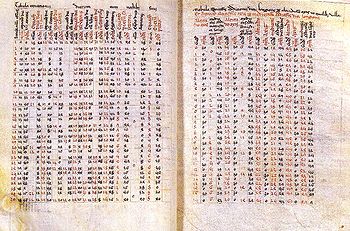
Alfonsine Tables. Spain, thirteenth century. 
The Alfonsine Tables are a set of measurements from about 1272 composed by Isaac ben Sid and Judah ben Moses ha-Cohen that track the positions of the sun, moon, and planets relative to Earth using Ptolemaic calculations. One of the astronomers who worked on the Alfonsine Tables took a copy with him in 1280 to Paris, where scholars adjusted the readings for the Paris meridian, enabling astronomers all over northern Europe to make use of the information for three hundred years. Copies survive today that were used by Copernicus and Galileo. The practical applications of the Tables are what made them popular. They well represented Alfonso X’s yearning for useful knowledge in the wider world.

The Alphonsus moon crater. Wikimedia Commons. 
Composed in the late 1270s, the most extensive book, the Book of Knowledge of Astronomy, also had the largest team behind it. The authors and translators named within the book include Jewish physicians, Muslim lawmen, and Italian and Castilian churchmen. The Book of the Eighth Sphere, which makes up the first part, describes the constellations with their celestial coordinates. The second part describes how to make and use nine different kinds of astronomical instruments, such as the astrolabe and the quadrant. Again, even in this most extensive and encyclopedic work, useful is paramount.

The Book of the Fixed Stars was translated from an Arabic book by Abd al-Rahman al Sufi composed around the year 964. In this book, the Alfonsine collaborators created a powerful combination of Ptolemy’s astronomy, Arabic traditions, and Castilian curiosity. The Andromeda Galaxy and the Large Magellanic Cloud, among other landmark bodies, were introduced to the European scientific community in this translation.

Ursa Major from a 1490 English copy of the Alfonsine Tables. 
The astronomy works are exemplars of the admirable Alfonsine traits of practicality and encyclopedism. The collaborators translated and compiled information from the best and most reliable sources. The majority draws from documents found in Arabic, with some information coming into Castilian from far-flung languages such as Chaldean. Without the bridge formed by these works, European astronomy might have had to start from scratch.

It’s much harder to see into the heavens if you’re not standing on the shoulders of giants.


Jessica Knauss earned her PhD in medieval Spanish with a dissertation on the portrayal of Alfonso X’s laws in the Cantigas de Santa Maria, which has been published as the five-star-rated Law and Order in Medieval Spain. Look for her book of stories based on the Cantigas, coming 2021. A driven fiction writer, Jessica Knauss has edited many fine historical novels and is a bilingual freelance editor. Her historical epic, Seven Noble Knights, is available from Encircle Publications in ebook, paperback, and hardcover. Her contemporary paranormal Awash in Talent is now available from Kindle Press. Find out more about her writing and bookish activities here. Follow her on Facebook and Twitter, too!