By Jeannie Lin
I went to watch the US release of John Woo's Red Cliff in the theatres with my little sister. During one breathtaking battle, the film goes to ultra-dramatic slow motion as a spear flies through the air. The general leaps, his hand closes around around spear. He lands and proceeds to knock out an entire battalion single-handedly.
"Right." I hear my sister mutter beside me.
I look at her. We giggle.
 Having grown up with Asian cinema, we're accustomed to the melodrama and the over-the-top heroism in "historical" movies, but even this seemed a bit much. I later remarked about the outlandish portrayal of these supermen to someone who had read the entirety of The Romance of the Three Kingdoms. She actually set me straight. These generals and soldiers were portrayed as superhuman in the written version as well. This wasn't just movie-making, Matrix-loving action.
The Romance of the Three Kingdoms is considered one of the four classical novels of Chinese literature. The historical novel was written in the 14th century by Luo Guanzhong and revolves around the historical events at the end of the Han Dynasty (206 B.C. – 220 A.D.) which ushered in the Three Kingdoms period. During this period, three rival states: Wei, Wu, and Shu--represented by a cast of generals and warlords--fought for control of the Han empire.
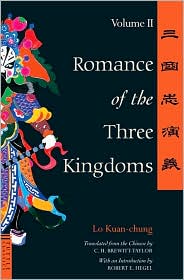 The novel is considered a work of fiction, however it relied on historical events depicted in the Records of the Three Kingdoms, which is considered the official account as documented by historian Chen Shou in the 3rd century. Chen Shou's history is considered to be the more authentic one as it was chronicled within the same century. However, Chen Shou was assigned to document the events by the Kingdom of Wei after the kingdoms of Wu and Shu had fallen. Thus within this early chronicle, the Wei rulers were held up as emperors, while the leaders of Wu and Shu were undermined and referred to as lords or simply by name. By the time the story was retold in the 14th century, the generals and strategists of the Wu and Shu kingdoms emerge as heroes. From the beginning, the retelling of these events were a mix of fact, legend, and propaganda.
With over a thousand years of documented history, something that Chinese historians knew very well was that history was malleable; it could be changed and repackaged with each subsequent era. It was quite common for Chinese emperors to commission new historical records of previous eras and essentially rewrite history. The character of the warlord Cao Cao is depicted as a villain who is blind-sided by ambition in the movie version of Red Cliff. Throughout history, Cao Cao is either depicted as a cruel tyrant or military genius, depending on the historian.
 The addition of popular culture adds another angle. Several critics of the John Woo movie have pointed out that in previous versions, including the historical records, the strategist Zhuge Liang of Wei (played by Takeshi Kaneshiro) emerges as the greater figure. Zhuge Liang is depicted in the picture the the right with his signature fan. However in the movie, military general Zhou Yu of the Wu kingdom (played by Tony Leung--depicted in foreground in poster) seems to come out on top. Perhaps this was due to Tony Leung's greater "star power"?
So it seems that in ancient Chinese historical re-tellings as well as modern ones, the figures are turned into legends, alternatively talked up or undermined, and ultimately modified for the benefit of the story. The movie adaptation of Red Cliff in this context becomes the next step in this common and ancient tradition of historical storytelling.
 Jeannie Lin writes sweeping historical romances set in Tang Dynasty China, featuring sword play, politics, and, above all, honor. Her Golden Heart award winning debut, BUTTERFLY SWORDS, and the linked short story "THE TAMING OF MEI LIN" are currently available from Harlequin Historical.