Showing posts with label English Civil War. Show all posts

26 January 2014

Author Interview: Alison Stuart

This week, we're pleased to welcome author Alison Stuart again with her latest novel, CLAIMING OF THE REBEL'S HEART. The author will offer a free copy of Claiming of the Rebel's Heart to a lucky blog visitor.  Be sure to leave your email address in the comments of today's  author interview for a chance to win. Here's the blurb.
War divides families…love unites hearts…

Herefordshire, England 1643

As the English Civil War divides England and tears families apart, Kinton Lacey castle is one of the brave few loyal to the roundhead cause.

With her father away, Deliverance Felton will do whatever it takes to defend her family home against the royalist forces ranged against it. She can shoot and wield a sword as well as any man and anything she needs to know about siege warfare she has learned from a book...but no book can prepare her for what is to come.

Captain Luke Collyer, soldier of fortune and a man with his own reasons for loyalty to the parliamentary cause, is sent to relieve the castle. Everything he knows about siege warfare in general and women in particular he has learned from experience, but when it comes to Deliverance Felton has he met his match?

Deliverance will not give up her command lightly and Luke will have to face a challenge to his authority as fierce as the cavalier foe outside the walls. He will do whatever it takes to win Deliverance’s trust but will he run the risk of losing his own, well guarded, heart?


**Author Interview with Alison Stuart**


What inspired you to write this book?

Hi Lisa… it is great to be here and I particularly appreciate that this is blog is for “unusual historicals”. My historical passion is the period of the English Civil War 1642-1660 - cavaliers and roundheads. Like the American Civil War, this was a dark period that pitted brother against brother, father against son and ... feisty women who were often left alone to protect their family home and assets.  One such woman is the heroine of Claiming the Rebel’s Heart, Deliverance Felton. She is a composite character of two real life heroines who stoutly defended their husband’s castles – one against the royalists and one against the parliamentarians. I was particularly taken with the story of Brilliana Harley and her stout defence of Brampton Bryan Castle which, if you are interested, you can read about on one of my Hoydens and Firebrands blogs…click HERE

When did you first become interested in the English Civil War?

My father had a deep and abiding love of English history and he used to read to me every Sunday afternoon. One of the books he chose was The King’s General by Daphne duMaurier which is about the royalist cause in the west country during the English Civil War. I’m not sure what it was about that book (which was based on real events and characters) but I just fell into the period and devoured any information I could lay my hands on. I still have a scrap book somewhere in the loft with articles I cut from magazines. There was a family legend (long since disproved) that our family was descended from one of the men who signed the death warrant of Charles I. True or not, it probably spurred me on!

What kind of research did you have to do for this book?
Having lived and breathed the English Civil War since I was young, the historical research is now just part of my cellular structure. Antonia Fraser’s wonderful book on women’s lives in the seventeenth century… “The Weaker Vessel”… first introduced me to the story of Brilliana and the other women, such as Charlotte, the Countess of Derby who stoutly resisted Fairfax’s attempts to take her home, Lathom House. This story took me little more work in tracking down information about siege tactics and weaponry of that period, but that’s half the fun! And if you want to know the origin of the phrase “hoist on his own petard” you will have to read the book.

When did you first consider yourself a writer?

I dislocated a shoulder in a skiing accident and found myself stuck in a ski chalet with nothing but a notebook computer for company. With a view of snow gums and crystal white snow, I started writing the book that is BY THE SWORD. As the desire to finish it gripped me, I knew then that this was what I wanted to do.  Of course it took me over ten years to become published. My first two books (which are part of the uncompleted  “King’s Men” series – Book 3 coming soon!), were set in the English Civil War, of course, but in the days before epublishing, mainstream publishers were just not prepared to take a risk on an ‘unusual’ period of history, however much they like the story. I had editors who loved the stories, only to have the book rejected by the marketing department. Thank heavens for the digital world that has opened up opportunities for books set in different periods of history to find readers and for readers, like me, who are actively looking for books set in specific periods to find the books!

Do you write full-time?

A few years ago I was deep into the corporate world, at the expense of my writing. I am a lawyer by trade and I had achieved the level of senior executive. A particularly nasty corporate restructure saw me hurled sideways off the “treadmill” and I took advantage of the opportunity it gave me to write full time for about 15 months.

However I am probably better with a little discipline in my life and I have returned to a quieter, gentler and much more rewarding job for 2 days a week working for a charity as their company secretary.

I travel quite a bit and I do find the “business” of writing and life in general very distracting so finding time to actually write is a problematical (and one of my New Year’s resolutions)! However last time I travelled I put “writer” on my immigration form and found it provokes interesting discussions (of the positive kind) with customs officials.

What’s next?

Currently on the desk top I am venturing into the world of the “series” and Claiming the Rebel’s Heart is intended as the first of three books about the Harcourt family. The second (currently untitled and in its infancy) will focus on Luke’s brother, Nicholas and the third, their sister, Elizabeth. I am looking forward to extending this story across three critical years of the English Civil War.

Just for something completely different, in May I have a Regency romantic suspense, LORD SOMERTON’S HEIR, coming out with Escape Publishing.

Learn more about author Alison Stuart at:

Twitter: @AlisonStuart14

23 January 2014

Excerpt Thursday: Claiming the Rebel's Heart by Alison Stuart

This week, we're pleased to welcome author Alison Stuart again with her latest novel, CLAIMING OF THE REBEL'S HEART. Join us again on Sunday for an author interview, with more details about the story behind the story. The author will offer a free copy of Claiming of the Rebel's Heart to a lucky blog visitor.  Be sure to leave your email address in the comments of today's post or Sunday's author interview for a chance to win. Here's the blurb.

War divides families…love unites hearts…

Herefordshire, England 1643

As the English Civil War divides England and tears families apart, Kinton Lacey castle is one of the brave few loyal to the roundhead cause.

With her father away, Deliverance Felton will do whatever it takes to defend her family home against the royalist forces ranged against it. She can shoot and wield a sword as well as any man and anything she needs to know about siege warfare she has learned from a book...but no book can prepare her for what is to come.

Captain Luke Collyer, soldier of fortune and a man with his own reasons for loyalty to the parliamentary cause, is sent to relieve the castle. Everything he knows about siege warfare in general and women in particular he has learned from experience, but when it comes to Deliverance Felton has he met his match?

Deliverance will not give up her command lightly and Luke will have to face a challenge to his authority as fierce as the cavalier foe outside the walls. He will do whatever it takes to win Deliverance’s trust but will he run the risk of losing his own, well guarded, heart?

**An Excerpt from Claiming the Rebel's Heart**

Deliverance looked up at him, the tears rolling down her cheeks and regret for his harsh tone plucked at his conscience.
“Will it be all right, Luke?”
He knew what she meant. She had remembered the terrible gun and the ruthless efficiency of Farrington’s well-trained troops. Luke resisted a sudden, inexplicable urge to draw her in his arms, kiss away the tears and tell her, yes of course it would all be all right.
He would be lying.
When he didn’t respond, she lowered her head, tears dropping on to her skirts. She wiped her face with her left arm. “Poor Kinton Lacey,” she said in a voice muffled by her sleeve. “It was never built to withstand a weapon like that.”
Luke had no comfort to give her. Kinton Lacey had been built to withstand bows and arrows or at the worse, slingshots, not a siege gun the size of the Thunderer.
He knelt down beside her. “Deliverance,” he said, using her given name for the first time. “Deliverance,” he repeated softly and laid a hand on her dark head. “What do you want to do?”
She shook her head. “I don’t know. I just can't give it up, Luke.”
He raised his right hand, and touched her hair. She made no protest, leaning her head against his chest. He stroked the dark, tangled locks and she sighed, closing her eyes. This time he surrendered to his impulse and folded her in his arms. She had shown incredible bravery and kneeling on the ground with this strange, defiant little woman in his arms, he made a silent vow to do whatever it took to protect her, save her castle, and make it right for her.
Sir John Felton’s daughter. What was he doing?
He disengaged her and rose to his feet.
“We have to keep moving, Mistress Felton,” he said. “Farrington’s men will be looking for us. On your feet.”
Learn more about author Alison Stuart at:

Twitter: @AlisonStuart14

10 August 2010

Tragic Tales: The Lost Children of Charles I

By Anita Davison

Born in 1635, Princess Elizabeth was called "Temperance" due to her kind nature. When she was seven, her father, Charles I marched into the House of Commons with troops to demand the arrest of five MPs. London was soon in open revolt and the royal family forced to flee for their safety.

Princess Elizabeth's Tomb Sculpted by Carlo Marochetti

The King and two elder sons, Charles and James, established a new royalist government at Oxford, but the Commons refused permission for Elizabeth and two-year-old Henry, Duke of Gloucester to join their parents, keeping them virtual prisoners at St. James's Palace. Their mother and baby sister, Henriette Anne, born in 1644, eventually fled to the continent, but Elizabeth never saw her mother again.

A sickly child, Elizabeth broke her leg in 1643 and was moved to Chelsea with her brother and tutored by the female scholar, Bathsua Makin. At eight, she could read and write Hebrew, Greek, Latin, Italian and French and the scriptures in their original tongues.

When Elizabeth was ten, her hostess, the Countess of Dorset, died and she and Henry were placed in the care of the Duke of Newcastle in a house on the Thames. James, Duke of York, was allowed to visit, but Elizabeth was concerned about him being around the king's enemies for any length of time and provided the clothes and perhaps the plan for his escape to the continent.

In 1647 Elizabeth and Henry were living at the country home of the Countess of Leicester. The French ambassador described her as a "budding young beauty" characterised by grace, dignity, sensibility and intelligence. Unlike her father she could judge different characters and understand different points of view. But she was powerless, distraught and saddened as the tragedy of the English revolution unfolded. As parliamentary prejudice hardened the Countess of Leicester was ordered to treat her royal charges without special privileges.

In January 1649, when Charles was tried, found guilty of treason and condemned to death, Elizabeth wrote a long letter to parliament requesting permission to join her sister, Princess Mary in Holland. This request was refused until after the execution had taken place.

On the day after Elizabeth's 13th birthday, King Charles was allowed one last meeting with Elizabeth and Henry. The prematurely aged king told her not to grieve as he would die a martyr and he gave her a Bible, which she kept close at hand for the rest of her short life.

The royal children were stripped of their titles and no one was allowed to kiss their hands or treat them as royal. Prince Henry, Duke of Gloucester, was now merely "Mr. Harry". Parliament continued to treat then with consideration, but the myth that they planned to marry Elizabeth to a commoner and apprentice Henry to a trade was royalist propaganda.

In July 1650, the ruling Council of State decided to move Elizabeth and Henry to their father's former prison, Carisbrooke Castle. Elizabeth complained that her health was not equal to moving, but it went ahead anyway. They were taken there by the king's former servant Anthony Mildmay, described as, "at heart a knave".

Elizabeth had always suffered ill health, possibly including rickets. On the Monday after her arrival she caught a chill, that developed into a fever which turned into headaches and fitting. On the morning of Sunday the 11th September 1650, Elizabeth was found dead, her head resting on the open Bible that had been her father's parting gift. Ironically three days later, unaware of the tragedy, the Council of State decided on her release so that she could join her elder sister Mary in the Netherlands. (Henry was released to Mary in early 1653.)

Elizabeth's coffin was laid in a vault under the floor of St Thomas Church in Newport, Isle of Wight, with a stone marked "E.S." for Elizabeth Stuart as her only memorial. She was fourteen years old.

In the 1850s Victoria and Albert, whose holiday home, Osborne House, is on the Isle of Wight, hired Carlo Marochetti, an Italian sculptor to complete a new tomb for Elizabeth in Carrara marble. Completed in 1856, Queen Victoria was so impressed with the result, she hired the same sculptor to carve the mausoleum statue for herself and Albert.

Henry, Duke of Gloucester joined his two brothers in exile and in May 1660 returned to England with the new King Charles II. In September, he died of smallpox at age 20.

Henry Duke of Gloucester 1653 aged 10

12 April 2009

Book Party: Erastes

It's Sunday on Unusual Historicals, which means it's time to meet another author and win a book! This week our author is Erastes and her new release is TRANSGRESSIONS, an M/M romance set in the English Civil War. She's giddy about the release of the book which, together with Alex Beecroft's FALSE COLORS, are the first gay romances to be released in the mainstream. Both novels can be found in the romance section of bookshops across the US.

***

David Caverly's strict father has brought home the quiet, puritanical Jonathan Graie to help his dreamer of a son work the family forge. With war brewing in Parliament, the demand for metal work increases as armies are raised.

The indolent and deceitful David Caverly is bored by his father's farm and longs to escape, maybe to join the King's Army, mustering at Nottingham. David finds himself drawn to Jonathan, and after a passing cavalry trooper seduces the beautiful David and reveals his true nature, he determines to teach Jonathan what he's learned.

When David is forced to leave the farm, and the boys are separated by mistrust and war, they learn the meaning of love and truth as they fight their way across a war-torn country, never thinking they'll ever see each other again.
***

Tell us a bit about TRANSGRESSIONS.

It's the story of two very ordinary young men who just happen to live in Kineton, Warwickshire, England.

The story begins in the summer of 1642, David Caverly is bored of living in a place where nothing exciting happens. War seems inevitable and--as there hasn't been a major war in Britain since the Wars of the Roses 200 years previous--people were MUCH interested in it. Unbelievably, people actually went along as sightseers to watch the battle of Kineton, treating it as a day out. I deal with this in the book, although it's not quite the jolly day out that my characters expect, but rather carnage.

The story deals with David and his new friend Jonathan, who has been brought to the forge has an apprentice, their burgeoning friendship (which turns to love) and the consequences of that. Needless to say it doesn't all take place on a farm in Warwickshire, but spreads out across England, as does the war.

How do you deal with the fact that homosexual love was illegal at this time?

Obviously in 17th century England, a homosexual love affair was never going to be tolerated. Buggery was made a felony by the Buggery Act in 1533, during the reign of Henry VIII. The punishment for those convicted was the death penalty right up until 1861. Not only was it prohibited by law but by the church too--an abomination. The title "Transgressions" applies to this, and everything else that is going on in this fascinating, bloody time.

What is the main theme of the book?

It started out as David's story, as David was the character who came to me first--but after a while it really warped into Jonathan's story, as I think he has the longest journey to take. He's such an innocent in many ways, and while David finds his father's ways and the church's restrictions easy to side-step, Jonathan battles against every misdemeanour and truly suffers for it. When he finds himself falling in love with another man, it almost breaks him--and his journey becomes harder for it. What he seeks is the truth, and after a while he thinks he's found it in Matthew Hopkins' Witchfinders, but he eventually finds out that he's been looking in the wrong places.

Where do you look for inspiration?

I don't really look for inspiration. Writing is generally on my mind all the time, like an undermining sickness. And it can strike at any time--seeing a lighthouse on the horizon, hearing an author talk about her own book on the radio and where she got her inspiration from, or in conversations with people, or overheard from people. A painting, a song...I'll suddenly think--Oh, that's an idea...

The inspiration for TRANSGRESSIONS was simply the title and the concept. My mother, having read and loved STANDISH, said, "For your next one, how about the English Civil War?" That sort of set sparks off in my head, I could immediately see a summer, blissful, warm and safe, all about to be turn to pieces by a war that would tear families to pieces. The idea of two young men ending up on different sides of the war isn't an original one, of course, but it hasn't been done in gay romance before. I do highly recommend Maria McCann's "As Meat Loves Salt" though, if anyone wants to know more about the era. It's a wonderful book about this era, and again, another gay love story. I can't say that it's a "romance" though, but a stunning read.

Why do you like to write gay historical?

I don't think I'd be interested in general historical. The reasons why I am fascinated with gay historical is that it's generally wide open. When you look at the list on Speak Its Name, there's a tiny amount of books available in the genre. I'd like to see anyone try and list all the heterosexual historical fiction there is out there! Every period is ripe for writing about. There might be a top-heaviness of Regency for example, but there's so many stories yet to be told. It's an exciting time to be in the genre--a genre that no-one even acknowledged as existing a few years ago. Now it's going mainstream.

Unusual Historicals...right up your street. Do you think you could ever write a usual historical?

No, definitely no. Although I hope that gay historical will soon become non-unusual!


What's been the single most difficult thing to research?

Gah. Not the war itself in fact, because there are hundreds and hundreds of sites and books about the war. You can find out who all the main players were, what everyone was wearing, flags, munitions, how to load a musket, how to fight with a pike, how to do wheeling and counterwheeling in formation, but there's very, very little about the everyday life of a man keeping his family fed. In the end I had to approach living history groups who were hugely helpful. They helped with food and clothing and all the little things needed for this kind of book.


What was the closest you came to committing a 'great historical clanger'?

I've yet to hear what I've done wrong in TRANSGRESSIONS, but I'm sure I've made historical errors. The worst one I know of is in STANDISH. Ambrose is reading a book that wasn't published at the time. The annoying thing is that I researched it when I was writing, realised it was anachronistic and took it out--or at least I thought I'd removed all mention of it, because if you read on later in Standish, he refers to Polidori's Vampyre, which was published at the time. but I missed one reference to Dracula...Oh, the shame! The readers soon let me know! I hope to goodness that I haven't done something similar in TRANSGRESSIONS, but I'm sure that if I have, the re-enactors will let me know!

How do you research the fighting?

That was pretty easy, actually. There are so many resources about that. There must have been battle geeks even back in the 17th century because there are painstainking illustrations of the battles and descriptions of what happened during each battle.


Something inevitably seemed to go wrong, though, which struck me as very human. In the battle of Edgehill, for example, which was the first official pitched battle of the ECW, the entire cavalry charged after a retreating brigade and to loot the Parliament's baggage train. This blunder left the infantry unprotected and could have caused an inconclusive result, which in turn caused the war not to be decided on that one day.

Here's a previous post I did on the subject, which shows some of the munitions and fighting research I had to do.

How do you deal with endings? It's not like your characters can get married.

No, and that's the quandary that the gay romance author faces. I hope that this is a more satisfying ending for the reader than STANDISH, which was open ended in the same way Gone with the Wind is. But I haven't "cheated." There's the obligatory HEA, but I think that the ending will still make the reader think and that's the point. One has to worry about how any gay romance will work, especially in this bloody century.

There are further snippets on her website, together with free bookmarks and lots more. Here's the book trailer:


***

Thanks so much, Erastes, for joining us today, and good luck launching this new subgenre of historical romance!

Readers, if you'd like to win a copy, simply leave a comment or question. Have you read any M/M romances? Are you curious? I'll draw a name at random next Sunday. (Some patience may be required as Erastes has not received her author copies yet!) Good luck!

15 March 2009

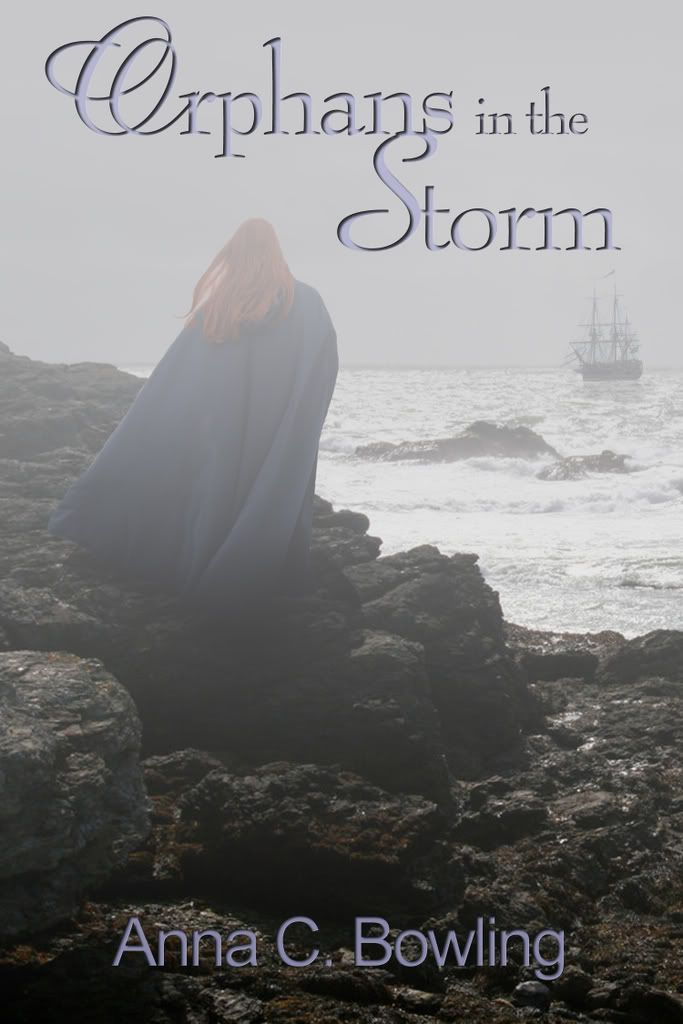
Book Party: Anna C. Bowling

This week we're talking with long-time contributor Anna C. Bowling about her latest release from Awe-Struck Press, ORPHANS IN THE STORM. Welcome!

The Hidden Countess:
A black robe brought Jonnet Killey to the Isle of Man and a black robe would take her away to the noble English family she has never known.

The King's Man:
All Simon Burke wants is to carry out his mission to return Jonnet to her birth mother and secure the funds to help finance Charles Stuart's return to British soil.

An Adventure in Exile:
A new life awaits Jonnet, with a mother on the brink of madness and a treacherous uncle who will stop at nothing to keep Jonnet's inheritance to himself. While the end of exile nears, danger mounts. Can Simon and Jonnet depend on their new found love to sustain them while the storm of treachery rages around them?
***

So, how did you get started with this latest project?

Every novel has a story of how it came to be, and ORPHANS IN THE STORM does owe a tip of the hat to a roleplaying game that didn't work. A friend had been wanting me to play for a while, and gave me some parameters for the game. My character had to be a native of the British Isles, but not English, Scots or Irish. Hmm, that would mostly leave Welsh or Manx. I'd never done much research on the Isle of Man, but what the heck, it was for a game...only it wasn't.

Due to various vicissitudes of life, the game, which had a fantasy element, didn't pan out, but my character, who introduced herself right off as Jonnet, wasn't quite done with me. She was, however, done with the fantasy element, and by this time, the Isle of Man had begun to pull me in like the yellow fog known as Mananan's Cloak. Which is how Jonnet first sets eyes on Simon Burke, a hero who definitely made an impression on me. Though I borrowed his family name from a favorite character in a classic old school romance, Simon is very much his own man, driven by an unflagging sense of right and wrong, and weighed down by regret. When these two met, I knew I'd found my next couple and they would lead me somewhere special.

What is different about the research for this book?

British Isles historicals have always been my first love, but another project with a collaborator fanned the flame of my interest in Dutch history, and as things would have it, British and Dutch history met in a very convenient time and place for Jonnet and Simon to begin their journey. I've always loved English Civil War historicals by authors such as Bertrice Small and Valerie Sherwood, so the chance to write one of my own was too good to pass up. I wanted to do something different, though, and so Jonnet and Simon's view of the conflict is from a special seat on the fringes.

The impoverished Charles II took refuge during his exile in the Low Countries, where his sister was queen, sometimes in her good graces, sometimes not. Loyal British subjects like my Simon Burke marshaled all the resources they could to fund Charles' return to British soil, and that sparked the perfect way for Simon and Jonnet to meet.

You have a special connection to your heroine in this story, yes? What is it?

Yes, Jonnet has a rather personal connection to me, because we are both adopted. While I have met a birth relative (Hi, Sally!)I know it's likely I may not meet others, and I wanted to explore something we don't often see in fictional depictions of reunions of birth parent and child; when things don't go well. Jonnet has always longed to meet her birth family, but her mother, Jacoba, trapped by grief and madness in a world of her own, can't see Jonnet for the fantasy she's woven of her ideal child. Not to mention an uncle who will stop at nothing to get what he believes is his.

Many of my stories deal with themes of identity, and of course a story dealing with the English Restoration is a natural for themes of, well, restoration. Here, Jonnet grapples with the question of what makes her, her. Is it nature or nurture or a bit of both, and how will she deal with receiving a birthright she didn't know she had? Simon must learn to let crippling guilt go if he is to accomplish anything of value, and the rest of their families in Dutch exile face the prospect of returning to an England vastly different from the one they left. I hope you will consider joining Jonnet, Simon and company on their adventure.

***

Thanks, Anna! ORPHANS IN THE STORM is available now through Awe-Struck Press, but leave a comment or question for Anna and you'll be entered in a drawing for a free copy. We'll pick a winner next Sunday. Good luck!

12 March 2009

Thursday Excerpt: Anna C. Bowling

This Sunday, we'll be helping Anna C. Bowling celebrate the release of her newest romance from Awe-Struck, ORPHANS IN THE STORM. Until Sunday, enjoy this excerpt!

The Hidden Countess:
A black robe brought Jonnet Killey to the Isle of Man and a black robe would take her away to the noble English family she has never known.

The King's Man:
All Simon Burke wants is to carry out his mission to return Jonnet to her birth mother and secure the funds to help finance Charles Stuart's return to British soil.

An Adventure in Exile:
A new life awaits Jonnet, with a mother on the brink of madness and a treacherous uncle who will stop at nothing to keep Jonnet's inheritance to himself. While the end of exile nears, danger mounts. Can Simon and Jonnet depend on their new found love to sustain them while the storm of treachery rages around them?
***

At sea, en route to the Netherlands
1659

Simon advanced on the plaid-swathed bundle of woman that stood at the rail, still and stalwart. "We have a cloak for you below." He bit back the rest. Jacoba Albyn had sent a fine cloak, a lady's cloak, but Jonnet never wore it. Dark brown woolen with enough fur trim that it might belong to a respectable merchant's wife. There were dozens, hundreds of such cloaks in Breda, or England, or all the world. It was a world in which a blanket of bright yellows and blues was a good as a bonfire. Yet no seamstress or furrier could dress Jonnet in something as fine as that blanket looked now.

"I know." The wind tugged stray wisps of reddish gold about her face. Her knuckles grew white where she clutched the edges of her wrap together. "I wanted to be Jonnet one more time."

"You will always be Jonnet."

The eyes she turned on him were wide and mournful as a scolded dog. "No. It is Easter Hastings who must step off this ship. Easter Hastings who will be welcomed with open arms. Easter Hastings who will fetch a fine purse from Englishmen loyal and true. God bless Easter Hastings, for I do not know who she is."

Simon folded her into his arms and felt her tremble. Her whole body shook as she fit her head into the space between his shoulder and chin. "You will always be Jonnet to me." In that moment, he knew it to be true. "As generous as your," he could no longer say mother, "Lady Albyn has been, no matter how good a teacher Eben may be, nobody can change the way God made you." Nor would I wish it. The shaking lessened as he spoke, so he continued. "My wild Manx Jonnet, tart-tongued and stubborn and strong." And beautiful. So very beautiful.

Jonnet braced both hands on the front of his coat before she pulled back. "But that is not what she will pay for. If I could talk to her the way I talk to you, I could bear that. I fear we will have nothing in common. Mother Mawd and I knew," small white teeth bit down into her lower lip. "Know each other. We have a history. With Lady Albyn," she sounded out the name as she often did, as though making sure she had it right. "All I have is this." She drew the small leather volume from the folds of her blanket.

"You've read more." The ribbon marker was nearly at the end now. She held it like an offering he was loathe to take, and yet he did. His hand brushed against hers, fingertips on knuckle for a heartbeat longer than needed. Her hand was as chilled as the air, but the pulse beneath the skin was steady. "Worry solves nothing."

"Action. I know. What action do I take next? What if she turns me away because I am not what she wanted? My feet are hard and my skin is brown and I would not know her if I passed her on the street. I would go home if I could, now, today." Jonnet shut her eyes, lashes wet against her cheeks.

Simon swallowed. She could, if she wanted. What man could refuse a request from those eyes, that lilt of her voice? As for coin, she had a name to barter now, and enough of noble ways to give at least an illusion of means. "Will you?" Father God, make her say no.

She took in a ragged breath and met his gaze. "I cannot. Something in me has changed. I have to do this. She is in here. The woman who bore me is in here, and whatever else she may be, she is a mother. If I had a chance," she broke off, took in a sharp breath. "A chance to bring one of Mother Mawd's babes back to her for one day, for her to hold them one more time, I could not deny her that."

"And so you will give that to Lady Albyn?"

Her nod was his only answer.

He looked over her head at the line of tall, slender houses coming into view. "We have a few days before that. You'll meet my sisters first, and my mother." And father, but she would not be there for that. Nor would he be there for what followed. A month ago, even a week, the thought would not have troubled him, and now would it not be the same as leaving one of his own hands? He shut off the thought. Any more down that road, and he would not sleep a minute until well into summer.

The mission was still the same, deliver the woman, collect the money, bring it to Charles Stuart. Only the man to carry it out had changed. I will be back as soon as I can, he wanted to tell her, but he could not give a word that might be broken before it even left his tongue. This was for England, and none of their lives were their own to give. "You will be all anyone could ask for," he managed instead.

Jonnet rewarded him with a tremulous smile. She dashed the back of her hand across her eyes that were now rimmed with red. "Will you promise to remind me who I am if I start to forget? If Easter Hastings must live, will you help me make sure Jonnet Killey doesn't fade away?"

The answer sprang so readily that it was a mere breath before Simon covered Jonnet's mouth with his own. "Always."

19 August 2008

Weapons and Armies: The English Civil War

By Erastes

The causes of the English Civil War were complicated and diverse. Poverty, Puritanism, unrest and the growing dissatisfaction of the general populace against the Monarchy to name just a few.

However, when it did start, how many everyday soldiers knew anything about these causes, or the machinations behind the scenes? For them it would have been a daily misery of mud, dirt, lice, bad food, long marches and the fear of whether they would be ambushed--or what the outcome of the next battle would be.

In fact, even many of the ordinary folk didn't even know that there was a war on at all, contrary to the belief that the entire country was split into two. There's a famous story that a farmer was asked permission to use his field for a battle and he asked "Who's fighting who, then?"

When I was researching this for my novel TRANSGRESSIONS, I found it a particularly difficult time to research satisfactorily. Not because there weren't any details on the war, there were, The internet is stuffed full of information. There are hundreds of books on the war.

However, the main problem I came up against was that it was difficult to find any details on the ordinary person's life of the period. I could find details of battles, names of generals, every minute detail of the uniforms throughout the entire war but there was little nitty gritty when it came down to what people ate, what houses they lived in, how much they earned--that sort of thing.

So I angled the book from a poor man's point of view. A young boy who wants to join up to escape his father's boring farm, and to get a bit of excitement. However--when he does--he soon finds out how little glamour there is. He finds it just as boring as being at home. To load a matchlock musket for example took around 40 separate operations to load it, and there picture manuals demonstrating each move.


A rather gruesome video. Note that the wooden powder charges he wears on the bandolier around his body were called Apostles, because there were 12 of them. They were made of wood, too, and were really unsafe things to be wearing in battle. Many a man was blown to pieces if his match touched the wrong place, or he was hit by a bullet in the wrong place. Cromwell addressed this problem when he created his New Model Army, and changed the carrying of powder to being wrapped in pieces of waxed paper, a tradition that continued for hundreds of years after.

Here's a little snippet from TRANSGRESSIONS about the training.

On the third week the drills moved on to wheeling and counter-marching. Apart from being massively boring, it was also complicated and difficult for the Sergeant to explain a move that enabled the swift relocation of some three hundred men, when he only had between twenty to thirty to demonstrate with. The Sergeant was not a patient man, and he did not explain manoeuvres well, and the more the recruits got it wrong the more incoherent he became.

For wheeling on an angle, the line had to close up close to the men either side, look to the direction of the wheel, (either right or left) and shuffle around in that direction until the line was pointing in the appropriate direction. This did not take long with the small number of soldiers David practised with, but David could only imagine how long a full line would take, all the time having their muskets out of action and vulnerable to the enemy as they shuffled helplessly in a semicircle, with nothing but pikemen to keep the enemy at bay.

At first they were hopeless at it, and Sergeant's Winter's screams of "Watch your dressings" were all that could be heard as the line buckled and bent, lost shape and direction, or forgot to look the opposite way to which they were pressing, but after days of dizzying and tiny steps they accomplished it well enough to stop their Sergeant from dishing out punishments.

Then they had to master centre-wheeling, which was worse, as the pivotal point became the soldier in the very middle of the line, and the column spun around him. The significant difference was that whilst one half of the unit was marching forwards, the other half was moving backwards and the first time they tried it, it was utter chaos. It was after a day of constant angle wheeling, which they just about mastered and Winter had explained the new manoeuvre so badly no-one understood it and no-one dared to ask him to repeat himself. Consequently everyone went in opposite directions; half the troop tripped over the other half and most ended up on the ground, helpless with laughter. Needless to say, most men were on punishment detail that night, including David, which surprised no one.
It is ironic to note that, other than to show how well trained your brigade is, the act of countermarching is considered to be completely useless on the battlefield.

For further reading, I highly recommend The Knowledge Base of the Sealed Knot without whose inestimable help, the book would not have been written.