Showing posts with label silver. Show all posts

10 October 2016

Treasure: The Staffordshire Hoard and the Anglo Saxons by Michelle Styles

Sometimes something comes along that totally changes how people consider think about an era. Think King Tut’s tomb or even Pompeii. One of the big discoveries of recent years has been the Staffordshire Hoard..
Mis-spelled Biblical inscription from Staffordshire hoard
This was discovered by two metal dectorists in 2009 and is the largest collection  of Anglo Saxon gold ever uncovered — over 3,500 individual pieces.  It was uncovered in a field near Hammerwich in south Staffordshire.  No one is sure who put it there. Given its location, it is probably from the Mercian court as it is. Most of the objects are broken, leading some to speculate that it might have belonged to a metal worker connected to the court. Because some such as a cross were folded, it may be that they were destined for a melting pot.
 The proximity of the field to two major royal centres (Tamworth and Lichfield) seems to indicate this. However because there was a distinct lack of other identifying material (such as coins) , no one can know for certain what happened except that sometime, probably in the 8th century, the horde was buried in woodland scrub near Watling Street (one of the great Roman roads which remains in use today). One would assume whoever buried it had the intention of retrieving it but never did.

Gold and garnet sword pyramid
The pieces are intricate and do give another glimpse of this forgotten world. Some of the techniques used to make the pieces. The quality of the pieces and the artwork is astonishing. They are intricate and vibrant. They are very similar in style to the Sutton Hoo treasure. Leading some to speculate that those pieces might have come from the same goldsmith  who worked on the Sutton Hoo treasure.  This could indicate that goldsmiths were highly mobile  during that time. Or it could indicate that there were close links with East Anglia. It also could be that this was part of the treasure Penda and Mercia seized when they defeated Oswald  and Northumbria. Or it could go back even further to when Oswald’s uncle
Stylised sea horse from Staffordshire Hoard
Edwin lost his crown to Cadwallon and Penda of Mercia in 632. Edwin was a great ally of Redwald. In fact Redwald had defeated Oswald’s father Aethelfirth at the River Idle and set in motion the events that led to Edwin becoming king of Northumbria and the eventual Bretwalda of all Britain.  In this scenario, it would make sense  for treasure seized from Edwin to have some links back to Sutton Hoo.  It could also explain why the silver gilt cross which was folded had mis-spelt words.
Given the different motif iconography  in the horde – mainly birds of prey, snakes, boars and fish — it is impossible to say if it comes one area or represents a jumbling together of booty from different lands. The horde may also represent when Anglo Saxon Britain was changing from a pagan society to Christian one. Some of the iconography is pagan, some is Christian. However we know from Bede that certain parts of the British Isles were Christian before St Augustine reached Kent so the treasure could be related to these shadowy kingdoms as well.

Currently researchers are still in the piecing together phase and it may be many years before these questions can be answered.  But the Staffordshire hoard allows an important new light to be shone on the Dark Ages.

Michelle Styles writes warm, witty and intimate historical romance for Harlequin Historical. Her next book, Sold to the Viking Warrior will be published in February 2017. You can learn more about Michelle on her website at www.michellestyles.co.uk 

23 June 2009

Places You've Never Heard Of: Silver City

By Jacquie Rogers

It was 1863 in the Owyhee Mountains located in the southwest corner of Idaho Territory. The War Between the States raged in the east, but out west, men had dollar signs in their eyes, looking for that next bonanza. They could get rich raising cattle, or logging, but fastest of all, gold. And silver.

The mining boom town of Ruby City was formed--a hotel, several business and residents, and the county seat. A few years later, Silver City sprang up as well. Ruby City hung on for a while but after a series of floods and a few other things that went haywire, the Idaho Hotel and the county seat were moved to Silver City.

Silver City was born on mining. Silver mine tunnels numbered in the hundreds, and dotted the countryside as well as the city. Here's a pan view of Silver City I found on YouTube. There's even a mine under the church! 60 million dollars worth of silver was taken in the 1900s, and if converted to today's currency, that would be a whole lot more for this little area. The silver lodes were the richest in Idaho Territory.

Historic Silver City writes:
During its "heydays", Silver City had about a dozen streets, seventy-five businesses, three hundred homes, a population of around 2,500, twelve ore-processing mills, and was the Owyhee County seat from 1866 to 1934. Some of the largest stage lines in the West operated in the area, and Silver City had the first telegraph and the first daily newspaper in the territory in 1874. Telephones were in use here at least by 1880, and the town was "electrified" in the 1890's.

Picture to the left: the bar at the Idaho Hotel

Never heard of it? Most people haven't, but it was truly the wild west in all manner of ways. It's located in Owhyee County, which is a large county in southwest Idaho. The newspaper they refer to is The Owyhee Avalanche, the longest operating newspaper in Idaho and one of the oldest in the West. I subscribe to it--it's a very high quality publication. There was never a shortage of news from the tough men who risked their lives in the mines every day for the promise of a life of luxury.

From The Owyhee Avalanche, October 17, 1868:
SHOOTING SCRAPE
Between seven and eight o'clock last Monday evening a shameful shooting affar occurred at Sommercamp's saloon, between two of our citizens. On account of the hitherto respectability of the parties and for the sake of their friends we suppress names. On the evening in question, we, together with the twenty-five or thirty others were in the saloon, when the two valiant shootists commenced banging away at each other with revolvers...
Silver City and the surrounding ore-rich area drew men from all over the world to mine the silver lodes. Many Chinese came to make their fortunes, and several did. Of course, as with the Anglo immigrants, most didn't. Still, the Chinese established a strong presence and the economy couldn't have survived without them. Not that there weren't a few problems along the way:

From The Owyhee Avalanche, October 17, 1868:
MORE SHOOTING
Last Tuesday night a Chinaman was shot and severely wounded in a Chinese gambling house on Jordan Street. It appears a Chinaman who was bucking at a game wanted to bet five dollars on jaw-bone, the dealer objected, the other fell back on his dignity and shot the almond-eyed gamboiler through the right shoulder. The next day we noticed Deputy Sheriff John Springer and a posse of mounted Chinamen hunting for the shootist. We learn from Dr. White, who is attending the wounded Chinaman, that he will get well.
And yes, there were Cyprians--the ladies of the evening. Men out-numbered women at one point by 200 to 1 so every woman, no matter what her status, was highly regarded. The women, however were not so impressed with one another.

From The Owyhee Avalanche, February 26, 1870:
FEMALE PUGLISTS
One evening this week be observed two frail females in the vicinity of Catalow's stable, engaged in commintting assault and battery upon each other. For some time the fur flew in all directions. They finally sank down in the snow through sheer exhaustion. Jealousy was the cause of the muss.
And, yes, confrontations with the Indians were frequent. Be warned, this next quote is even worse than the one about the Chinese and the women. "Politically Correct" was not yet invented. But we must also avoid revisionist history--Anglos were, for the most part, of the opinion that Native Americans were sub-human. This is why I avoid the entire issue in my westerns. I write humor and there isn't anything the least bit humorous about the treatment of the Indians.

From The Owyhee Avalanche, September 12, 1868:
LO THEY COME!
Tho's H. Smith Esq. just in from Camp Three Forks, informs us that last week the military of that place gobbled up and brought into Camp six-teen Indians as prisoners. Under promise of bringing in four-teen more, three bucks, whose squaws were retained as hostages, were allowed to go out into the mountains. The miserable wretches profess a desire to give themselves up and stop robbing and scalping the whites--at least till they recruit and obtain a fresh supply of arms and ammunition.
Silver City was difficult to get to and from (travel can get a bit dicey even today), so the subject of roads was always prominent in the news. Keep in mind "highways" is a subjective term here. The road into Silver City from the east isn't two-lane all the way even now. It's a dirt road and depending on the season, you drive on the high side of the ruts in order not to high center your vehicle. In those days, horses, stagecoaches, and wagons traveled the very same road.

From The Owyhee Avalanche, May 16, 1868:
THE ROADS
We are pleased to know that Mr. Abbott, Supervisor for the Road District No. 2, has commenced repairing the roads. As a consequence of the ground's thawing out and the melting of the snow, our highways in many places were in bad condition, but now the ground is becoming dry and the money now on hand in the road fund, with the taxes yet to be collected for that purpose will serve to put the roads in good order.
But most of all, people need entertainment, and the residents of Silver City weren't any different. There was a theater, several saloons, and lots of parties and receptions at the I.O.O.F Hall. In the dark of winter, entertainment was even more sought after.

From The Owyhee Avalanche, January 4, 1868:
ON WITH THE DANCE!
seems to be the motto just now--just what we expected, as soon as it became known on the outside that times were lively and money plenty in Owyhee, in comes a batch of hurdies to gobble up their share. It is an easy matter to find out where they hold forth --watch the crowds of suffering manhood as they emerge from cabins along the creek in the dusky twilight, or silently wend their way, in Indian file, down the mountainside; their steps are directed to Gabriel's large building, corner of Jordan and Second Sts., where, seated on a bench at one side of the spacious hall, are four coy and blushing damsels...
Sources
The Owyhee Avalanche
Historic Silver City Idaho
GhostTowns.com: Silver City
Wikipedia
Edna Purviance
Associated Content
IdahoHistory.net: Chinese Pioneers

Silver City is one of my favorite places to go, although it wouldn't be half so fun if Ed Jagels hadn't worked so hard for the last 30 years of his life to keep the Idaho Hotel from crumbling into ruin. He passed on several years ago, but his friends continue his good work, restoring and operating the hotel, and I'm grateful.

Jacquie

Princess Keely, Star of Faery Special RomancesDown Home Ever Lovin' Mule Blues

Myspace *** Bebo *** Faery World

Faery Special Romances *** See the book video
Royalties go to Children's Tumor Foundation, ending Neurofibromatosis through Research

Available Now: Down Home Ever Lovin' Mule Blues

10 December 2007

Holidays & Celebrations:
Winter Festivities in the Old West

By Jacquie Rogers

Yule Brings Celebration For All

The snow blows nearly sideways as it blankets the range. Ranch hands hunker down in their saddles, scarves over their ears and their Stetsons protecting them from the fierce wind. They dream of a warm fire and hot buttered rum. But they have livestock to save from freezing and starvation, so they ride on.

It's Christmas on the open range. Miserable for man and beast. But it isn't just another day at the office, so to speak. They whittle gifts for one another, sing a few carols as they sit around the campfire warming their hands and feet. Cook gives them a hot meal--the finest beans with maybe some meat thrown in. And with a little luck, Cook would bake an apple pie. Life couldn't be better and they thank their lucky stars for a sound horse and solid tack.

(Yes, I know these cattle are a modern breed and very fat, but it's the only picture I could find.)

Chanukkah in the mines

It's the 1860's in Silver City, Idaho. The Festival of Lights has been celebrated in the West since the beginning of frontier settlement, but not like their counterparts back East who have a warm and dry place to worship with their families. A menorah can be lit anywhere, and the Jewish silver miners do just that. They pray, play a little dreidel, and think a lot of home.

The picture to the left is the oldest continuously used synagogue west of the Mississippi. It's located in Boise, Idaho, and was built in 1896 by the Beth Israel congregation, now called the Ahavath Beth Israel congregation. Very beautiful.

Christmas on the farm

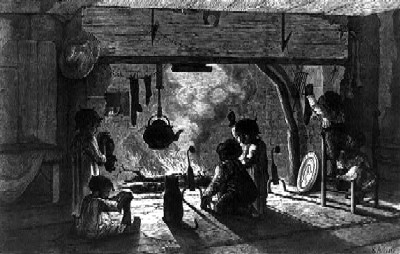
Everyone has chores to do every day. Cows needs milked, livestock needs watered and fed, eggs need gathered, and the barnyard needs to be tidied (to use a gentile term). So after the chores are done, the family can gather together and celebrate Christmas with what meager resources they have. If they don't have evergreen trees to spare, they might decorate a sagebrush with popcorn and berries. They make ornaments with precious bits of paper and scraps of cloth. Peach tins make nice ornaments, too, and they shine in the firelight.

1876 Christmas, Harper's Weekly

Their celebration might be more humble than those in the eastern cities, but they have a grand time, nevertheless. The women cook for days. They're resourceful and whatever they have available will do for a fine pie or stew. The Christmas feast could consist of chicken, venison, or maybe a ham, along with homemade rolls, freshly churned butter, potatoes and gravy, and pies--maybe one made with dried apples and a vinegar pie. Each family member has made modest gifts for the others and even the smallest child has labored over precious gifts--maybe a drawing or a doll made of sticks. They sing carols, maybe read the Bible, and if they're close enough to town, maybe even go to church.

For most Christian families, Christmas is a day for family togetherness and to show their love and appreciation for one another, as well as celebrating the religious aspect of the holy day.

Christmas for Outlaws, Gunslingers, and Cyprians

The saloon owner brings small gifts for the working ladies, the bartender, the resident gambler, and a few of the regulars. A few cowpunchers bring gifts for their favorite girl. They might have a nice meal together before they open for business, and even then, the customers are few. It's one night they can relax.

Happy Holidays to Everyone!

***
Enter the Name that Christmas Carol contest. It's fun!

Princess Keely, Star of Faery Special Romances

Jacquie Rogers *** Myspace *** Bebo *** Faery World
Faery Special Romances (Available now)
Take a look at the book video
Royalties go to Children's Tumor Foundation,
ending Neurofibromatosis through Research