Showing posts with label carnival. Show all posts

21 February 2007

Helau! Carnival in Germany (2)

Here are a few more pics of this year's Rose Monday parade in Mainz. Enjoy!


Ranzengarde with horsies


Ranzengarde from above

state theatre with VIP audience

even more of the Ranzengarde: the musicians


the provisions of the Ranzengarde


Mainzer "Schwellköpp" (swollen heads)

the wagon of the cooks of Mainz


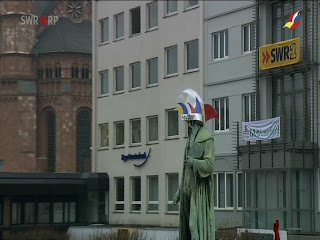
Mr. Gutenberg, too, likes to celebrate carnvial :)

Helau! Carnival in Germany (1)

Last night the German carnival came to an end as today, Ash Wednesday, marks the start of lent in the Catholic calendar. Since the Middle Ages the weeks before have been used for celebrations and fool's days on which the traditional social order was turned upside down. The instutions and rituals of the Church were parodied in "ass masses" and the choosing of a "pseudo-pope". Thus, in reference to Augustine's teachings of the two states, the Church interpreted carnival as civitas diaboli, the State of the Devil, in contrast to Lent, which was seen as civitas dei, the State of God.

In many German areas these carnival customs were lost after the reformation since the Protestant church got rid of the days of lent before Easter. In Catholic areas, however, carnival continued to be celebrated. In the towns the festivities were organized by the guilds, while the nobility held balls and masquerades in their palaces and estates. Carnival masks and costumes became more and more intricate and elaborated and were influenced by the Italian commedia dell' arte. The modern forms of carnival can be traced back to the 19th century during the years of political restoration in Germany. Modern carnival emerged as a middle-class effort with strong elements of parody of politics and the military.

Today you can find two very different forms of carnival in Germany: on the one hand you have the (political) Rhinelandish carnival (Karneval, Fasnacht, Fassenacht) with show events which combine song, dance, and speeches, and carnival parades. The strongholds of the Rhinelandish carnival are Cologne, Düsseldorf and Mainz, where the parades are held on Rose Monday, the Monday before Ash Wednesday. On the other hand, you have the Allemanic Fasnacht in southern Germany, where at the beginning of the 20th century the old forms of carnival with wooden masks were renewed. By now, each village, town and city has its own figures and masks. Here's a pic of the witches of Waldkirch (a small town in the Black Forest, which I used as a model for my fictional town of Kirchwalden in CASTLE OF THE WOLF) during the witches' sabbath on the market square:
Since those masks are rather heavy, they're usually worn only by men.


In the following you can see some pictures of the Rose Monday parade in Mainz:

the parade curves around Christ Church

the big tower of the old cathedral with the parade down below

The Ranzengarde is the oldest of the carnival guards in Mainz.
Obviously, the guards are military parodies and many of the uniforms
are modelled on the uniforms of real historical regiments.

This year about half a million people saw the parade in Mainz, and more than 9000 people took part in it and marched 7 kilometers through the city, shouting "Helau!" all the way and throwing sweets into the audience (this is why many people bring umbrellas to these parades: held upside down an umbrella is perfect for catching sweets!)

17 December 2006

Setting the scene

For the writer of unusual historicals, setting the scene is the most important task you must accomplish. Long-time readers of settings such as the Regency or the Medieval come to books set during those times with preconcieved notions and knowledge of what was and what wasn't done, what existed, real-life people of that era, etcetera. But with an unusual setting, an author can go two ways: the wallpaper historical, wherein details of manners, dress and other various things are vaguely sketched in, or you can go the detailed route, in which the setting is vital to the movements and reactions of the characters and the specified setting is unique to their story.

There are pros and cons to both. With the former, the anxious reader's fears are calmed when they open the book and realize that 1670 Venice or 1838 Russia really no different from 1803 London--but on the flip side, you may as well have set the plot and characters in 1803 London. On the occasion of the latter, the reader may be sucked into a completely different world and perhaps learn something they never may have known, but the downside may be that they found the vivid sketch of the setting overpowering the actual plot and characters (which, IMO may not be so terrible if your objective is for the setting to take on a character of its own).

Both of the aforementioned tactics can be correct, if either one is more comfortable for you, but for all of us history buffs who write unusual historicals, it is important that the romance and the characters much remain within the forefront of the novel. In a way, historical details are like backstory. You don't want to info-dump the beginning of each scene because it slows the pace of the story. Instead, study the way in which you reveal your characters by dropping little hints of their personalities and manner, follow the crumbs of idiosyncracies and dialogue dispersed within the text, and sprinkle your details throughout the novel.

So tell me, what are your own techniques for sketching the historical details of your period?

Any frustrations you run into when attempting to write about something most people are ignorant of?

Do you disagree with my pros and cons of wallpaper vs vivid details?