Showing posts with label For Love's Sake. Show all posts

26 February 2014

For Love's Sake: The Tragedy of Abelard & Heloise

By Lisa J. Yarde

Sometimes a sacrifice is the greatest display of love, specifically the act of giving up a chance at happiness for the well-being or safety of another person. The relationship between the philosopher and theologian Peter Abelard, and the abbess Heloise d'Argenteuil in the 12th century illustrates this idea. An illicit love affair brought them together, and cruelty forced them apart. In the end, Abelard chose to dedicate himself to God and begged Heloise to do the same. Still, the former lovers never forgot about each other. Their subsequent exchange of letters remains as a testament to their deep love and respect for each other.

Peter Abelard hailed from the village of Le Pallet, born in 1079 of a noble family in northwestern Brittany, part of modern-day France. As the eldest son of the lord of Le Pallet, his father Berengar and Berengar's wife Lucia, Abelard had the prospect of a bright future ahead of him. He could have aspired to a knighthood, a common choice among noble sons, but instead he devoted himself to philosophy. He left his father's castle and spent most of the next years in Paris, learning from the philosopher and theologian William of Champeaux. A rivalry developed between the men. When William retired in 1108 to the abbey of St. Victor, Abelard sought but failed to gain William's former position as chair at the Cathedral School of Paris. Five years later, Abelard accomplished this goal, but he had also established his own schools of study at Melun and Corbeil. In addition, he became a canon of Paris and enjoyed a preeminent position teaching theology. 

In 1115, he met Heloise, whose uncle Fulbert was also a canon of Paris at the church of Notre-Dame. Heloise has been presumed by some to have been a teenager born around 1100, perhaps the age of 17. Given the subjects she studied under Abelard's instruction, including medicine and her reputation as an outstanding scholar when they met, it's likely she was older, born possibly as early as 1090. With the possible intention of getting closer to Heloise, Abelard convinced his fellow canon Fulbert that Abelard should move into Fulbert’s house where he might tutor Heloise. As he relates, “All men, I believe, are under a necessity of paying tribute at some time or other to Love, and it is vain to strive to avoid it. I was a philosopher, yet this tyrant of the mind triumphed over all my wisdom; his darts were of greater force than all my reasonings, and with a sweet constraint he led me wherever he pleased.”

The affair began and change overcame Abelard. He explains, “Love is incapable of being concealed; a word, a look, nay, silence, speaks it. My scholars discovered it first; they saw I had no longer that vivacity of thought to which all things are easy; I could now do nothing but write verses to soothe my passion. I quitted Aristotle and his dry maxims to practise the precepts of the more ingenious Ovid. No day passed in which I did not compose amorous verses; love was my inspiring Apollo.”

Fulbert discovered the affair a time when Heloise conceived Abelard's son born in 1118, who would be named Astrolabus. To save Heloise from her uncle Fulbert's wrath, Abelard sent his lover to his sister Lucilla in Brittany. Abelard resolved to marry Heloise with Fulbert's permission, on the condition that the union remained a secret. There might have been some impact on his career if the scandal became widely known. Heloise surprisingly objected to the marriage at first. As she would write to Abelard, “The name of mistress would be dearer and more honorable for me, only love given freely, rather than the constriction of the marriage tie, is of significance to an ideal relationship,” but she eventually agreed to marry him in Paris after the birth of their son. Abelard's sister raised her nephew in Le Pallet.

In her youth, Heloise had lived among the nuns at Argenteuil. She went to visit them for an extended stay at the insistence of Abelard, keen to hide his marriage. Fulbert became incensed, thinking Abelard had abandoned his niece. One night, he had two servants break into Abelard's house. They castrated him. Fulbert's men were blinded, and Fulbert lost his property and power for a year. Abelard found comfort in his profession. Heloise resigned herself to life as a nun, in a Benedictine abbey Abelard founded at the Oratory of the Paraclete. The letters began around that time.   

The words are passionate, speaking of lost but not forgotten love, at first. Heloise's frustration, bitterness and sorrow at their separation is clear. “Alas! my memory is perpetually filled with bitter remembrances of passed evils; and are there more to be feared still? Shall my Abelard never be mentioned without tears? Shall the dear name never be spoken but with sighs? Observe, I beseech you, to what a wretched condition you have reduced me; sad, afflicted, without any possible comfort unless it proceed from you. Be not then unkind, nor deny me, I beg of you, that little relief which you only can give..” 

Abelard’s initial answer reflected the struggle he faced and some self-blame for the calamities that had befallen them both. “Piety and duty are not always the fruits of retirement; even in deserts, when the dew of heaven falls not on us, we love what we ought no longer to love. The passions, stirred up by solitude, fill these regions of death and silence; it is very seldom that what ought to be is truly followed here and that God only is loved and served. Had I known this before I had instructed you better. You call me your master; it is true you were entrusted to my care. I saw you, I was earnest to teach you vain sciences; it cost you your innocence and me my liberty. ”

Whether for the advancement of his career or some genuine regret at his behavior with the younger Heloise, Abelard advised his wife to accept her life as a nun, which she did. If Abelard judged their love to have been wrong, Heloise’s beliefs indicate no regrets about the time they were together. “But I am no longer ashamed that my passion had no bounds for you, for I have done more than all this. I have hated myself that I might love you; I came hither to ruin myself in a perpetual imprisonment that I might make you live quietly and at ease. Nothing but virtue, joined to a love perfectly disengaged from the senses, could have produced such effects. Vice never inspires anything like this, it is too much enslaved to the body.  When we love pleasures we love the living and not the dead. We leave off burning with desire for those who can no longer burn for us. This was my cruel Uncle's notion; he measured my virtue by the frailty of my sex, and thought it was the man and not the person I loved. But he has been guilty to no purpose. I love you more than ever; and so revenge myself on him. I will still love you with all the tenderness of my soul till the last moment of my life.”

Even after the tragedy of their separation, Abelard could not avoid controversy, as he faced continual charges of heresy. When he died in 1142, his body came to rest at the Paraclete, where Heloise finally joined him in 1163.

Source: The Letters of Abelard and Heloise and Letters of Abelard and Heloise, Kindle Edition

Images: Edmund Blair Leighton's 1882 painting of Abelard and Heloise, and the plaque on the wall at Le Pallet's donjon, dedicated to Abelard with a mention of his wife Heloise, both public domain.

Lisa J. Yarde writes fiction inspired by the medieval period. She is the author of historical novels set in medieval England and Normandy, The Burning Candle, based on the life of Isabel de Vermandois, and On Falcon's Wings, chronicling the star-crossed romance between Norman and Saxon lovers. Lisa has also written four novels in a six-part series set in Moorish Spain, Sultana,  Sultana’s Legacy, Sultana: Two Sisters, and Sultana: The Bride Price where rivalries and ambitions threaten the fragile bonds between members of a powerful family.

24 February 2014

For Love’s Sake: Axel Fersen’s Abetting of Louis XVI and Marie Antoinette’s escape from Paris

By Ginger Myrick

Anyone who knows anything about Marie Antoinette knows about her favorite, Axel Fersen. Although even experts in the field cannot definitively say whether they were physical lovers or not, there is no doubting that there was a strong bond between them. They shared a lifelong relationship that can at least be classified as a very deep and lasting friendship that began in their late teens and endured until Marie Antoinette’s death in 1793. The first recorded evidence of their association pertains to an opera ball, a masked event on January 30, 1774, when Marie Antoinette was only eighteen years old and not yet Queen of France. Fersen, who was only a few months older, notated the event in his journal as follows:

"The Dauphine talked to me for a long time without me knowing who she was; at last when she was recognized, everybody pressed round her and she retired into a box at three o’clock: I left the ball." 

Marie Antoinette’s husband Louis Auguste, then Dauphin, was in attendance along with his brothers and their wives, and the small circle of young royals seemed to approve of Fersen. A couple of weeks later the Swedish count was invited to a few of the famous bals à la Dauphine, little informal dances given by Marie Antoinette in her personal apartments. Although this may seem like coquetry associated with the beginnings of a love affair, there was actually little opportunity for misbehavior, nor was Marie Antoinette inclined to it. Despite the salacious rumors that were commonly attached to her later in her husband’s reign, Marie Antoinette was by all accounts chaste and a bit of a prude. Although known to be flirtatious, she had a reputation among those who knew her for putting a swift end to men’s advances if they crossed the line of propriety.

Fersen left Versailles to continue his Grand Tour of Europe. He would not return to France for over four years. Marie Antoinette, by then Queen of France, immediately recognized Fersen when he stopped in to pay court, even if the rest of the royals did not. His journal entry from August 26, 1778 states:

"Last Tuesday I went to Versailles to be presented to the royal family. The queen, who is charming, said when she saw me, 'Ah! Here is an old acquaintance.' The rest of the family did not say a word to me." 

Fersen became part of Marie Antoinette’s intimate circle, in fact, one of her favorites. Whenever he was in France, he spent much time at Le Petit Trianon playing cards, lounging about, and engaging in meaningful discussions with the rest of the privileged few, whatever the queen’s whim demanded in the moment.

For the rest of their association Marie Antoinette’s contact with Fersen was sporadic, a series of absences and reunions depending on his schedule of ambassadorial duties, which kept him perpetually traveling. But there was one event fully documented by historians during which Fersen risked his physical well-being, indeed his life, to aid her. This was the royal family’s ill-fated flight from Paris and subsequent capture in Varennes.

In October of 1789, Versailles was stormed by a volatile mob. The royal family was taken and held at the Tuileries Palace under strict guard. Until then, Louis XVI had regarded himself as a benevolent father to the people of France, and the reality—which contrasted starkly with this delusion—caused him to fall into a deep depression, rendering him incapable of any action toward self preservation. It was at this point that Marie Antoinette took charge, understanding that the longer they hesitated, the more they risked losing their lives. She had chosen to stand by her husband and share his fate, but she was not about to simply give up. In addition, she still believed in preserving the monarchy for their son, Dauphin Louis-Charles. She began writing copious letters in a secret cipher to her most steadfast friend, Axel Fersen, and they began planning an escape. By June of 1791, the groundwork was laid.

With his military background and firsthand experience of covert operations, Fersen was ultimately qualified to plot the escape. He arranged the whole thing down to the smallest detail. At this point, he could have just played it safe and sent someone less recognizable to enact the plan, which might have been the wiser decision on his part. But due to his deep affection for Marie Antoinette, and in lesser part her husband, he refused to rely upon anyone else. A letter dated a few months before, gives us an insight into his personal investment:

“I am attached to the King and the Queen and I owe it to them for the kindness they showed me when they were able, and I should be vile and ungrateful if I deserted them now that they can do nothing for me …” 

Fersen showed up at the indicated hour, but due to a series of errors the venture was delayed. Finally, getting off to a late start, they set off on the road to freedom. After the first leg of the journey, Fersen unwillingly ceded control of the coach at Louis XVI’s insistence. Even after his maltreatment, the king did not want his people to believe he was attempting to leave France, especially aided by a foreign personage. With its new driver the coach continued on in lumbering fashion. The king was recognized when the party sought to change horses in Varennes, a mere forty miles from their destination, the royalist stronghold at Montmédy. The royal family was taken back to Paris, the escapade accomplishing nothing beyond adding to the case for treason against the king and queen, the one thing Louis had fervently hoped to avoid. In February 1792, Fersen made his final visit to Louis XVI and Marie-Antoinette at the Tuileries palace. He again urged them to escape, which Louis absolutely refused to do.

Fersen was haunted by the bungled escape for the rest of his life. Some speculate that this was because of his love for Marie Antoinette, others that he missed out on the acclaim of his success. Regardless, his actions went far beyond the call of duty, especially since he was not French but Swedish and was beholden to the king and queen for no other reason than his personal obligation. It is apparent that there was some extraordinary force at work behind the scenes that any way one looks at it can be accurately termed love. Risking his life to get Marie Antoinette to safety is the true testament to the devotion her bore her.

Because the verity of their relationship will never be proven, it will always hold the allure of the unsolved mystery. In my current work in progress—Insatiable: A Macabre History of France Volume II~L’Amour: Marie Antoinette—due April 2014, I exploit the premise that Marie Antoinette and Axel Fersen were indeed lovers. I even take their relationship one step further by adopting the assertions of the gossip of the time attributing the paternity of her second son, Louis-Charles—who eventually became Dauphin of France—to Fersen. As my upcoming novel is a work of alternate history, the love affair between Marie Antoinette and Fersen is the least of the liberties I take with the story. But in my defense, I am not the first to do so nor will I be the last.

Ginger Myrick was born and raised in Southern California. She is a self-described wife, mother, animal lover, and avid reader. Along with the promotion for BUT FOR THE GRACE OF GOD, WORK OF ART, THE WELSH HEALER, and EL REY, she is currently crafting novel #5. She is a Christian who writes meticulously researched historical fiction with a ‘clean’ love story at the core. She hopes to persevere and show the reading community that a romance need not include graphic details to convey deep love and passion.

21 February 2014

For Love's Sake: The Prince Who Married For Love

By Blythe Gifford


Cinderella aside, until the twentieth century, most royals married for duty, not love.  Particularly in the medieval time period, marriage meant a political alliance, joining countries as well as individuals.

One of the notable exceptions was the oldest son of Edward III of England, also
Edward, Prince of Wales This image is in
 the public domain because its copyright has expired
Edward, and remembered by history as the Black Prince.  (That moniker came after his death.  He was called Edward of Woodstock during his lifetime.)  And his choice of bride came with more complications than most.
It was not for lack of trying that the prince was still unmarried at 31.  From his birth, his father had sought advantageous matches with dynasties from France, Brabant (now part of Belgium), Castile (Spain), and Portugal.  Meanwhile, the heir to the throne, first to bear the title of Prince of Wales, distinguished himself as a warrior talented as his father during the war with France. 
He also fathered an illegitimate son or two along the way.
The only known image
of Joan of Kent.  This image is
in  the public domain because
 its copyright has expired

But when the time came to marry, he chose an English woman older than he, already twice married, with a bit of a scandalous past.  Worse, he did not wait for permission from his father or the church, but joined with her in a secret ceremony, the medieval version of elopement.
The lady in question, Joan, Countess of Kent, was considered one of the most beautiful women in England.  They were no strangers, but had played together as children.  They were both descended from King Edward I, so “cousins” in the church’s eyes, prohibited from marrying without dispensation.  In addition, the prince was godfather to some of her children, so there were two strikes against their marriage, a fact they conveniently flouted by marrying without permission in a clandestine ceremony.


Joan was beautiful and of noble lineage, but she had a marital past that might have made Elizabeth Taylor blink.  She was married at thirteen (not unusual at the time) to the Earl of Salisbury, younger than she.  But it seemed that when she married Salisbury, she was already married to Thomas Holland, a reputable knight, but no earl.
Exactly when this previous marriage came to light and how she was pressured into a second one is a matter for debate, but it seemed that in the eyes of the church, the lady had, not to put too fine a point on it, two husbands.  After a lengthy wrestling match with the church, all the way up to the Pope, the marriage to Holland was upheld and the marriage to Salisbury set aside.  Joan and Holland lived as man and wife, and had a brood of children.


Upon Holland's death, Joan was an eligible, beautiful, titled widow in need of a husband.  But there were lingering whispers about how “amorous” she was.  History may have called her the Fair Maid of Kent, but the chroniclers of the time used a more satiric nickname:  The Virgin of Kent.
Tomb of The Black Prince (c) Klotz CC-A.A. 3.0
The fairy tale version of her marriage to the prince is that he was sent by a friend to plead the friend’s case for her hand.  Alas, Joan said, she was in love with another and would never marry.  “I have given my heart to the most gallant gentleman under the firmament…it is impossible that I should marry him.  So, for love of him, I wish to shun the company of men.”
Pressured by the prince, who vowed to try to make it possible for her to marry the one she loved, she finally confessed she loved him.  His response?  “As long as I live, no other woman shall be my wife.”
An unlikely story, but regardless, they finally received blessings of church and family, and Joan became the first Princess of Wales.  She and the prince lived happily together until his death.  He died before his father and so never sat on the throne, but their son, Richard, succeeded his grandfather as Richard II.

SECRETS AT COURT, my current release from Harlequin Historical, is set amidst the intrigue surrounding the marriage of Edward and Joan.  My hero, Nicholas, is charged with clearing the path for an official church wedding, but that is bringing him too close to secrets about Joan’s past – secrets my heroine, Anne, is bound to protect.


After many years in public relations, advertising and marketing, Blythe Gifford started writing seriously after a corporate layoff. Ten years and one layoff later, she became an overnight success when she sold her first book to the Harlequin Historical line.  Since then, she has published eight romances set in England and on the Scottish Borders.  SECRETS AT COURT, a Royal Wedding story, is a March release from the Harlequin Historical line.  For more information, visit www.blythegifford.com


Author photo Jennifer Girard


17 February 2014

For Love's Sake: Edward I and the Eleanor Crosses


King Edward I and Queen Eleanor
of Castile (Lincoln Cathedral)
Edward I of England has a bit of a bad rap, historically speaking: the ruthless Leopard Prince, the dreaded Longshanks, Hammer of the Scots, responsible for the brutal subjugation of Wales as well as the mass expulsion and murder of England's Jews. It's a fair cop, but for all his brutality King Edward did have one notable soft spot, one famous chink in his stony exterior: his wife, Eleanor of Castile. Not only did Edward love his queen deeply, which was rare in arranged royal marriages, but by all accounts he was faithful to Eleanor and kept no mistresses, which was almost unheard of. 

They married when both were quite young — Edward was 14, Eleanor a mere 13 — and so in a way they grew up together, which may have been part of the reason for their unusually close bond. Eleanor loved her husband as much as he loved her, and they were soul mates for over three decades. She had little political power and appears not to have influenced the King's rule (which may be another reason he loved her so much), but she made a devoted queen and helpmeet, following Edward on Crusade to the Holy Land despite being heavily pregnant and regularly accompanying him on his progresses through the kingdom. Together they had over a dozen children (possibly as many as 17!), which was quite a few even by the standards of the day. With Eleanor, Edward's famously fierce demeanor was softened; by all accounts he treated her kindly and gently, and could at times even be playfully romantic.

the Northampton Cross, one of the 3
surviving original Eleanor Crosses 
After 35 years of marriage, Edward was at Eleanor's bedside when she died of fever in 1290. Her death left the tough-as-nails king devastated and emotionally distraught. The court had been on progress when Eleanor took ill, and she died near the city of Lincoln; as her funeral cortege made its way back to London, Edward marked the places they stopped each night along the journey. At each location he ordered the creation of monuments that came to be known as the Eleanor Crosses, twelve stone pillars carved like miniature cathedrals to commemorate each place his queen lay in state on her final journey: Lincoln, Grantham, Stamford, Geddington, Northampton, Stratford, Woburn, Dunstable, St. Albans, Waltham, Cheapside, and finally Charing. They were meant as shrines, both to honor Eleanor's memory and for passersby to stop and pray for her soul. Never had an English queen been honored in such a way, and the fact that King Edward, who bled his nation for taxes to fund his wars and conquests, would use those funds for such an emotional purpose made it even more remarkable. The Eleanor Crosses are a monument to love and devotion in the reign of a king remembered mostly for his ruthlessness and cruelty.

Of the twelve Eleanor Crosses, only three survive, though the foundations of several others are still visible. Some locations replaced their lost original with a replica, and copies have been built in various towns across England; the most famous of these is Charing Cross in London, which was built during the Victorian era. Most of the cities where the original crosses stood have some type of monument or commemorative plaque either near the site or in a museum, telling the story of the Eleanor Crosses and honoring the memory of a queen who was so dearly beloved by her king, and the notoriously warlike king who went to such great lengths for love's sake. 


Heather Domin is the author of Allegiance, set in 1922 Dublin, and The Soldier of Raetia, set in Augustan Rome. She is currently working on Heirs of Fortune, the sequel to SoR, and a paranormal story set in modern-day Glasgow.

10 February 2014

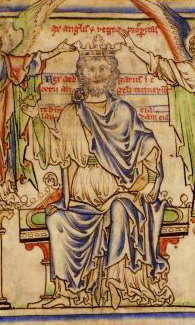
Tales of Love: King Edgar the Peaceable and Queen Elfrida


By Michelle Styles

One tends to assume the politics of Royal marriage is not very interesting during the Anglo Saxon period. After all the queens are slightly shadowy figures. However, if you start digging, Anglo Saxon royal marriage is a lot more scandalous and a lot more like Game of Thrones.

King Edgar the Peaceable and Queen Elfrida (or Aelfthyrth) is a great love story which deserves to be more widely known. Or rather it is interesting and full of scandal and gossip. But it goes to show that people behaving badly and strong women who mould events to suit them have existed for a long time.
King Edgar (source Wikipedia)

King Edgar was married at least twice before Elfrida (it depends on the source). When he tired of his wife, he tended to have her retire to a nunnery, leaving him to free to marry again. His first wife Ethelflaed the Fair was a Anglo Saxon noblewoman who was put aside so that he could marry the very political Wulfthryth who was royally descended and very devout. They had two children  -- both of whom became saints –Edward the Martyr and St Edith of Wilton.

Elfrida was a beautiful  and clever daughter of a minor nobleman. Edgar sent his best friend Aethelwald to see if she was as truly beautiful as they said. Aethelwald struck by her beauty reported back – no she wasn’t -- and then duly married her. She was supposedly playing chess with her father and beating him handily when they first met. She apparently learnt to play chess from the Vikings.

Once Edgar learnt of the trick, he decided to visit to see the woman for himself. Aethelwald implored his wife to make herself ugly but she did just the opposite. For the king, it was love at first sight. They may have begun an affair there and then but the sources grow hazy.

Aethelwald is supposed to have died in a hunting accident. Post conquest sources claim the accident was arranged by Edgar (or perhaps Elfrida who was ambitious after all?) The spot is supposedly commemorated by the Dead Man’s Plack in Harewood Forest, Hampshire.  After Aethelwald’sdeath, Wulfthryth is forcibly retired to a nunnery and becomes an abbess, leaving Elfrida and Edgar free to marry. However, all was not smooth sailing as the archbishop of Canterbury, Dunstan burst in their bedroom and accused the pair of adultery. The king and his queen weathered the storm.

Edgar was so besotted with his wife that he had crowned queen of England. Neither of his other two wives enjoyed the status of queen. In his second coronation in 973, Edgar had Elfrida jointly crowned. It is this coronation, presided over by Dunstan that forms the basis of the present day coronation.  Shortly afterward, at Chester, the other six kings of Britain, including the king of Scots and the king of Strathclyde paid homage to Edgar and his queen.

There was a huge emphasis on Elfrida’s role as protector of religion. She also served an important function in the legal system, serving as  forespeca or advocate in at least seven cases.

When Edgar died in 973, he left two sons. Edward by Wulfthryth and Aethelred by Elfrida. It is said that Elfrida arranged for Edward’s murder.  When visiting Elfrida at Corfe Castle, her servants set upon him and killed him.  This cleared her path to act as regent for Aethelred the Unready. She did so until he came of age in 984 at which point she retired (was retired?) and concentrated on bringing up the next generation. Her grandson Aethelstan Aetheling mentions her in his will as the woman who brought him up. Atheling is the Anglo Saxon term for someone who might be heir to the throne as the succession was never straight forward and there might be multiple claimants.

If you are interested in reading more about Elfrida, Elizabeth Norton recently published a biography entitled Elfrida and it is well worth a read. The first crowned queen of England deserves to be better known, particularly as she was such a strong and interesting woman!

Michelle Styles writes warm, witty and intimate historical romance in a wide range of time periods including Viking. Her next book The Return of the Viking Warrior will be published in May 2014 by Harlequin. You can learn more about Michelle’s  books on www.michellestyles.co.uk